Some aging signals show up in your skin, balance, memory, and walking pace long before a doctor runs a test. Several are surprisingly easy to spot.
The two women in the photographs shared the same DNA, the same genetic blueprint for aging, the same inherited risk for every disease on record. What they didn’t share was how long they would live.
Danish geneticist Kaare Christensen and colleagues photographed 187 pairs of identical twins in their 70s and had a team of nurses rate which twin in each pair looked older. Over the following twelve years, the older-looking twin died first more often than chance would predict, a pattern that held across the cohort. Their 2009 study in the BMJ established a formal finding: perceived facial age predicts survival, even when both people in the photograph carry identical genes.
That is what accelerated aging actually means, a measurable gap between how old your cells are and what the calendar says. Researchers call the cellular measure biological age. It is possible to carry a biological age five or ten years older than your chronological age, and several signals that this gap exists are detectable well before any blood test reveals them.
Some show up in the mirror. Others are hidden in how your hands perform, how your body moves, and how well your brain retrieves what it already knows. Fifteen of those signals are worth looking at closely.
Physical Strength and Mobility
Physical aging doesn’t announce itself. It arrives in increments, most of them easy to dismiss as a bad day or a skipped workout.
1. Your Grip Strength Has Declined
You notice it reaching for a heavy bag or working a tight lid. Grip strength, which most people don’t think of as a health metric, turns out to be one of the more telling ones researchers have access to.
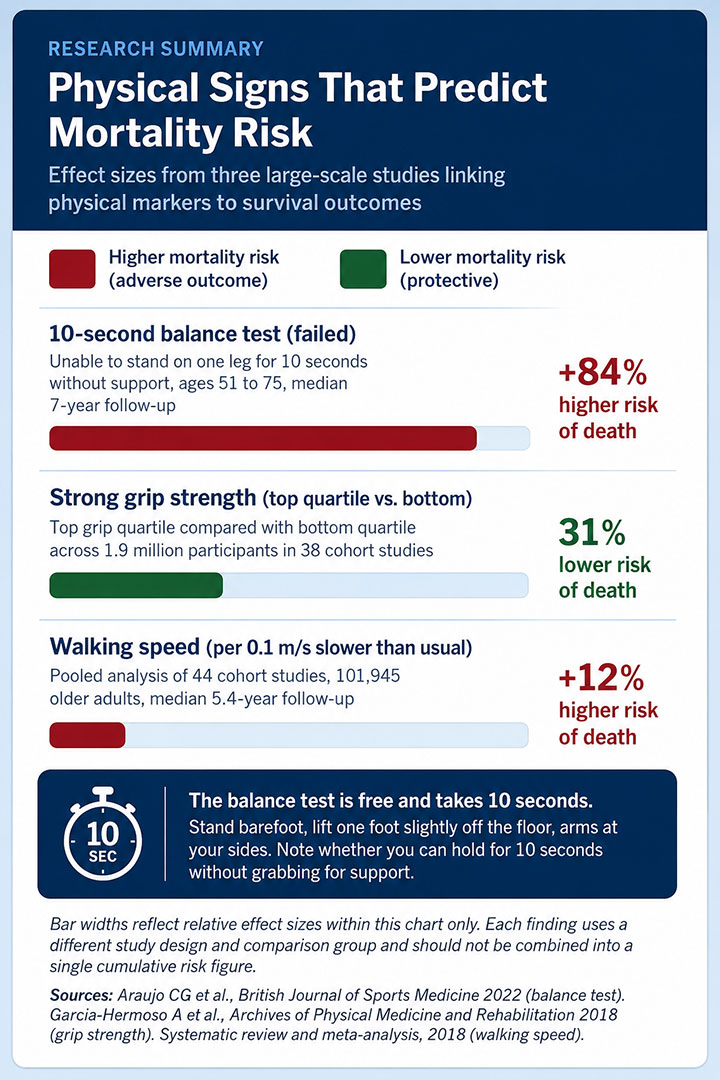
Researcher Antonio García-Hermoso and colleagues pooled data from 38 cohort studies covering roughly 1.9 million participants and found that adults in the top quartile of grip strength had a 31% lower risk of dying from any cause than those in the bottom quartile, published in the Archives of Physical Medicine and Rehabilitation in 2018. Grip functions as a proxy for overall muscle quality, and muscle quality declines with biological age faster than chronological age would predict.
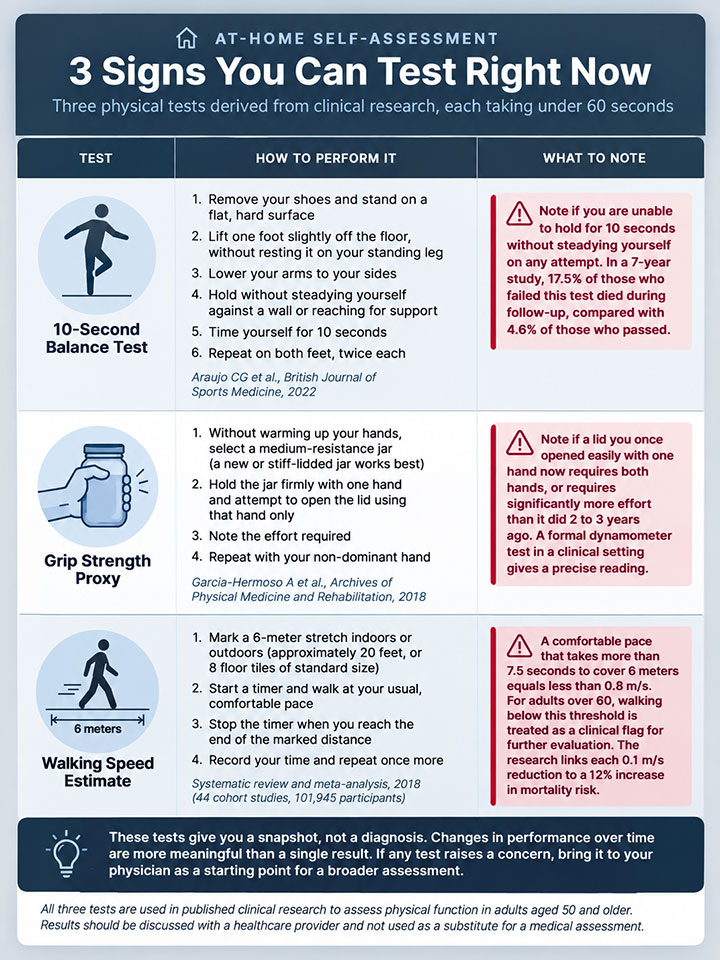
An informal self-test: if a jar you once opened easily with one hand now requires both, or significant effort, that change is worth tracking.
2. Climbing Stairs Leaves You More Winded Than Before
Aerobic capacity, the technical name for how efficiently the heart and lungs deliver oxygen to working muscle, declines at approximately 1% per year after age 30 in people who don’t actively work to preserve it. The stairs make this visible in a way flat ground doesn’t.
If a single flight leaves your legs burning or your breathing labored in a way it didn’t three or four years ago, that’s not an incidental bad day. Cardiovascular aging tends to outpace other visible markers, particularly in people who spend most of their waking hours sedentary.
3. Your Walking Pace Has Slowed Noticeably
Most people don’t time themselves walking. That’s exactly why gait speed works as a health marker: it changes before the person notices the shift.
A 2018 systematic review and meta-analysis covering 44 cohort studies and more than 100,000 participants found that each reduction of 0.1 meters per second in usual walking pace was associated with a 12% increase in mortality risk.
Walking pace reflects how well the nervous system, muscles, and cardiovascular system are working in coordination. When any one of those systems degrades, stride tends to slow first.
A benchmark used in clinical settings: a preferred walking pace slower than 0.8 meters per second in adults over 60 is treated as a flag for further evaluation.
4. You Reach for Handrails on Surfaces You Didn’t Use To
Proprioception, the body’s internal map of where it is in space, begins declining from the mid-30s onward. The handrail is the physical tell.
If you find yourself gripping the handrail on staircases or steadying yourself on uneven curbs that you once navigated without a second thought, balance and proprioception are no longer working as efficiently as they were.
The decline is gradual enough that most people attribute each instance to something specific, a moment of distraction or a slippery surface. The pattern goes unrecognized.
5. You Can’t Hold a One-Legged Stance for Ten Seconds
This is the test most worth trying today, shoes off, arms at your sides.
Researcher Claudio Gil Araujo and a team at the CLINIMEX exercise medicine clinic in Rio de Janeiro tracked 1,702 adults aged 51 to 75 over seven years. Among those who could not hold a one-legged stance for ten seconds without grabbing for support, 17.5% died during the follow-up period. Among those who passed, 4.6% died.
Published in the British Journal of Sports Medicine, the 2022 study concluded that failing the ten-second balance test was associated with an 84% higher risk of death from any cause within the following decade, after adjusting for age, sex, body mass index, and existing health conditions.
The numbers are worth sitting with for a moment.
Araujo’s team notes the finding’s limits: the cohort was Brazilian, 68% male, and generalizability to other populations is still being established. The directional signal is consistent with what the broader balance and aging literature shows.
Skin and Appearance
The visible signs are the ones most people notice first. They’re also the ones most often attributed entirely to sun damage or stress, when the underlying mechanism is broader than either.
6. Your Skin Is Drier and Duller Than It Used To Be
Sebaceous gland output decreases steadily from the 20s onward, and the rate of decline accelerates after 50. The result is skin that loses its natural oil more quickly. It appears flakier and less luminous than it did a decade ago.
Dehydration and low dietary fat intake worsen the effect, but neither explains why the change persists even after you address them. A moisturizer handles the surface. It doesn’t address why the skin started losing moisture faster.
7. Sun Spots Are Appearing Earlier Than You’d Expect
Ultraviolet light doesn’t cause skin aging in a continuous, linear way. It accumulates damage in skin cells over decades, and that damage eventually crosses a threshold where the cells can no longer repair themselves before producing pigment irregularly.
Age spots, clinically called lentigines, are an accounting of the past, not the present. They represent UV damage the skin couldn’t fully repair before it crossed a threshold, accumulated during years when sunscreen was an afterthought. If they’re showing up in your 30s, your current SPF routine isn’t what produced them. The protection you didn’t use between 15 and 25 is more relevant.
8. Minor Bumps Leave Bruises That Take Longer to Clear
The capillaries closest to the skin surface become more fragile with age, partly because collagen production declines at a steady rate from the mid-20s onward. Less structural collagen means less cushion around superficial blood vessels, and minor contact that once left no mark now produces bruising that can take ten days or more to resolve.
If bruising is severe, unexplained, or accompanied by other symptoms, it warrants a conversation with a physician. For most adults in their 40s and 50s with no other symptoms, easy bruising reflects collagen loss rather than any underlying condition.
9. Fine Lines Around Your Eyes Have Arrived Ahead of Schedule
Skin loses collagen content at a steady rate after age 20, and the cumulative effect compounds. By the mid-30s, many people are seeing lines around the eyes that they associate with their parents’ faces rather than their own.
UV exposure, smoking, and high sugar intake each accelerate collagen degradation independently of biological age. When fine lines arrive earlier than family history would suggest, lifestyle factors are usually contributing alongside the normal structural decline.
10. Your Hair Is Thinning or Falling Out More Than It Used To
Hair follicles shrink with age and produce progressively finer strands over time. The process is gradual enough that most people register the cumulative effect in the shower drain before they see it in the mirror.
Thyroid function, iron levels, and androgenic hormones each affect hair density independently of age. Rapid or patchy thinning is worth investigating through blood work. Though in most cases the results come back normal, and the answer is still aging.
Energy and Internal Health
The internal signs are the ones that compound. Each one carries a plausible one-off explanation. Several of them appearing together are harder to rationalize.
11. You’re Tired in a Way That Sleep Doesn’t Fix
Persistent fatigue, the kind that follows a person through adequate sleep and doesn’t correlate with obvious exertion, is one of the most frequently reported markers of biological aging. It differs from ordinary tiredness in one specific way: it doesn’t resolve with rest.
Mitochondrial efficiency declines with age, and the effect is specific: the same amount of effort produces less output. The organelles responsible for cellular energy generation produce less ATP per cycle, which means the body runs at a lower functional ceiling than it did ten years ago.
The frustrating part is that this happens gradually enough that most people adapt to it rather than notice it. They stop doing the things that now take more effort, and call it preference.
12. You Wake Up Repeatedly Through the Night
Sleep architecture shifts with age. The proportion of time spent in deep slow-wave sleep decreases steadily from the 30s onward, and sleep becomes more fragmented as a result. Many adults in their 40s and 50s wake two or three times per night and attribute it to stress or temperature without recognizing it as a biological pattern.
That fragmentation carries a measurable cellular cost. A 2022 analysis of 2,783 participants in the Health and Retirement Study found that short sleep and insomnia were each independently associated with accelerated epigenetic aging, with short sleepers showing approximately 1.45 additional years of biological age acceleration as measured by the GrimAge clock, which is calibrated to predict mortality risk. Insomnia alone accounted for approximately 0.70 additional years of biological age acceleration.
The implication is stranger than it sounds: poor sleep doesn’t only make you feel older. It registers in the biology.
13. Your Body Composition Has Shifted Without Much Changing
Muscle mass declines at 3 to 5% per decade after age 30, a process researchers call sarcopenia. Fat tends to redistribute toward the abdomen over the same period, even in people whose total weight hasn’t changed.
The result is clothes that fit differently and a waist that’s broader at the same scale number. The anabolic hormone decline is real, and protein synthesis efficiency in aging muscle tissue decreases with it. Adjusting diet harder isn’t usually the variable that matters most here.
Interactive Self-Assessment
Biological Age Signs Self-Check
Check each sign that currently applies to you, then see your weighted results based on the strength of evidence behind each marker.
14. Names and Recent Appointments Slip More Than They Used To
Episodic memory, the retrieval of specific recent events, relies on hippocampal function. The hippocampus is among the brain regions most sensitive to the hormonal and inflammatory changes that accompany biological aging.
The forgetting that concerns researchers is specific: not struggling to recall something that barely registered at the time, but failing to retrieve something that was clearly noted and stored. Blanking on a familiar name mid-conversation, arriving somewhere and losing the reason, losing a word that was already forming. These lapses are worth noting when they’re frequent, new, or noticeably different from your previous baseline.
15. Recovery Takes Longer Than It Used To
The body’s inflammatory response is normally temporary. After a hard workout or a respiratory virus, the acute inflammatory phase resolves and repair begins. With biological aging, that resolution slows. The inflammatory phase persists longer, and repair processes take more time to initiate.
In practical terms: more days of muscle soreness from the same session that once left you sore for just one, and a mild cold that now clears in five or six days instead of two or three. Researchers don’t yet have a clean answer for how much of this is cellular aging alone versus the cumulative effect of sleep quality, nutritional adequacy, and activity levels. Both are contributing. The proportions differ by individual.
What the Signs Are Actually Telling You
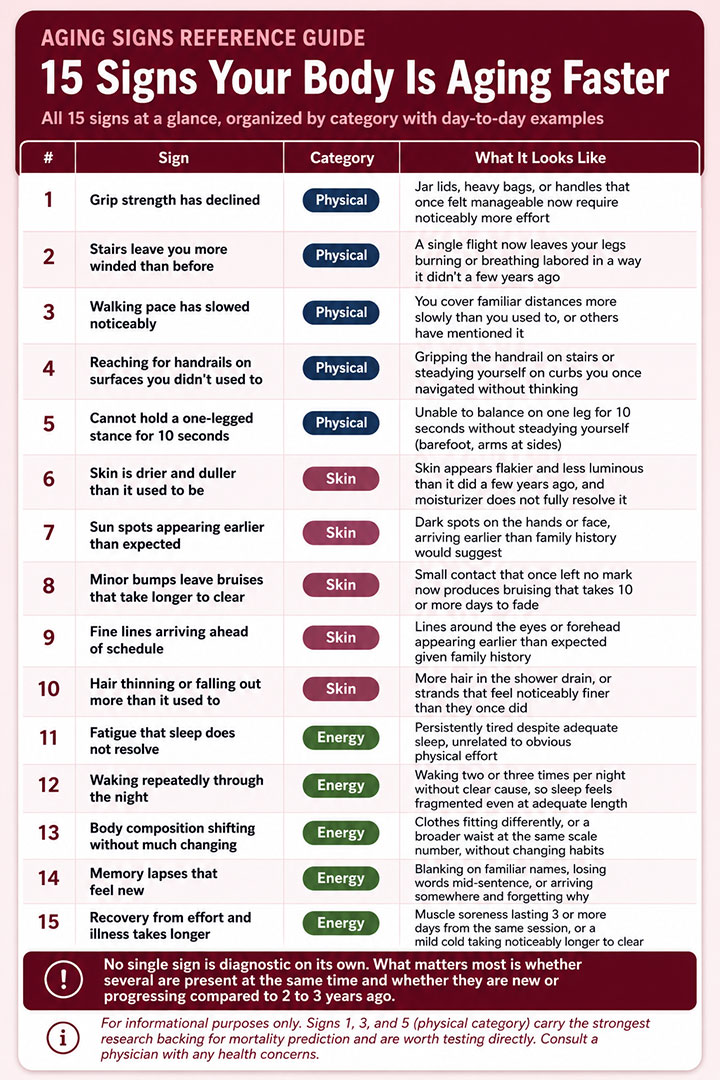
No single sign on this list identifies accelerated aging on its own. What matters is whether several are present at the same time, whether they’re new relative to two or three years ago, and whether they appear to be progressing.
The physical signs carry the strongest predictive data. Grip strength, walking pace, and the ten-second balance test are used by researchers precisely because they are objective, quick, and calibrated against large mortality datasets. If you are uncertain where you stand on any of them, the balance test takes ten seconds and requires no equipment.
Sudden-onset fatigue, rapid cognitive change, or unexpected weight shift can also signal medical conditions unrelated to aging. Those warrant clinical evaluation rather than lifestyle adjustment alone.
The strongest modifiable drivers of biological age acceleration at midlife, based on available evidence, are poor sleep quality, low physical activity (particularly resistance exercise), and accumulated UV exposure. The twin photographs are a useful reminder of how much room there is to influence the outcome. Two people with identical genomes can arrive at 70 looking years apart, and the data consistently shows which one tends to outlive the other.
The nurses who looked at those photographs in Denmark weren’t looking for illness. They were reading faces and picking up on what the body had already put on display, before any doctor had run a test or asked a single symptom question.
That is what the research keeps saying about biological aging: the body signals it before it becomes a problem. A declining grip, a slower stride, skin that doesn’t quite reflect the same person it used to. None of these are conclusions on their own. They are communications, and the evidence suggests that taking them seriously at 45 or 50, when the pace of aging is still genuinely adjustable, is more useful than noticing them at 70.