The study tracked more than 131,000 people and found a notable difference in dementia risk. But one detail about the type of coffee mattered more than expected.
For most of the twentieth century, coffee was treated as a vice that conventional medicine tolerated. Doctors warned about the heart. Nutritionists worried about the jitters. And somewhere between the anxiety studies and the blood pressure charts, the beverage that billions of people relied on every morning got filed under “probably fine in moderation, but don’t push it.”
The research that followed didn’t exactly exonerate coffee. It did something stranger: it suggested coffee might be one of the most protective dietary habits a middle-aged person can build. Not protective in the way that kale is protective, or flaxseed, or any of the things that require effort and taste like effort.
Protective in the way that, across dozens of large, long-running studies, people who drank two to three cups a day showed meaningfully lower rates of dementia and Alzheimer’s disease than people who didn’t.
The most striking number in this literature is 65%, the reduction in dementia risk observed in a Finnish cohort study that tracked coffee drinkers from midlife into their seventies. The second most striking thing about that number is how old it already was by the time a 43-year study of 131,821 Americans confirmed, in early 2026, that the pattern is real and consistent. The third most striking thing is that decaffeinated coffee didn’t show any benefit at all.
Why Two to Three Cups Is the Sweet Spot
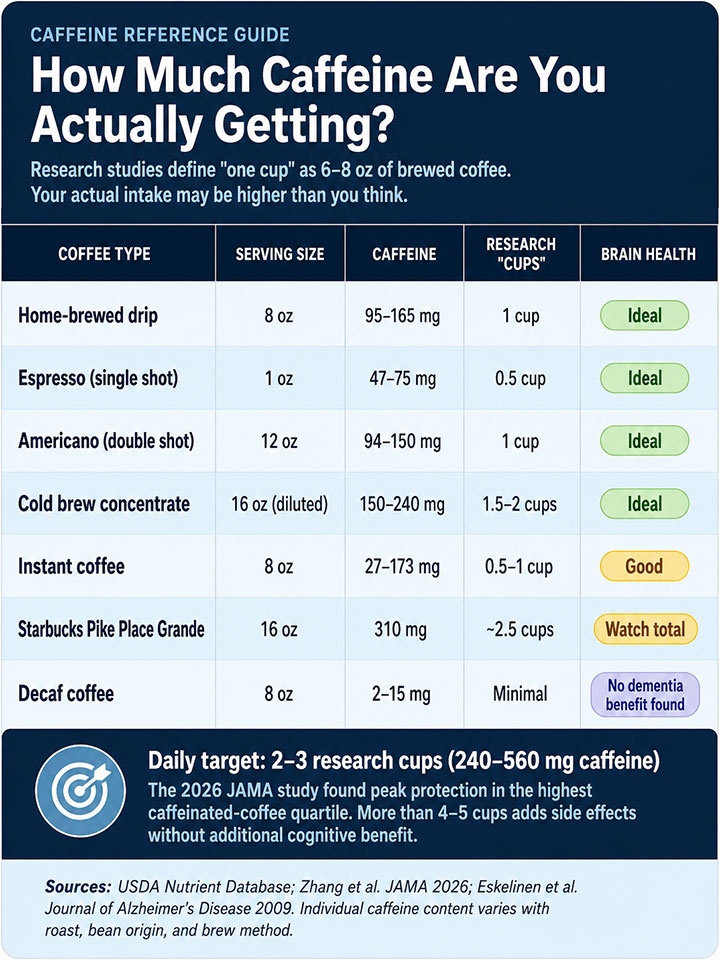
More coffee isn’t better. The relationship between consumption and brain protection follows what researchers call a U-shaped curve, with the peak benefit sitting squarely at two to three cups a day. Below that, protection is weaker. Above four or five cups, the benefits plateau and side effects accumulate.
The clearest evidence for this dose-response pattern comes from the largest study yet conducted on caffeine and cognitive aging. Published in JAMA in February 2026, the Zhang et al. study followed 131,821 participants from the Nurses’ Health Study and the Health Professionals Follow-Up Study for up to 43 years, a span of follow-up that most nutrition research can’t come close to matching.
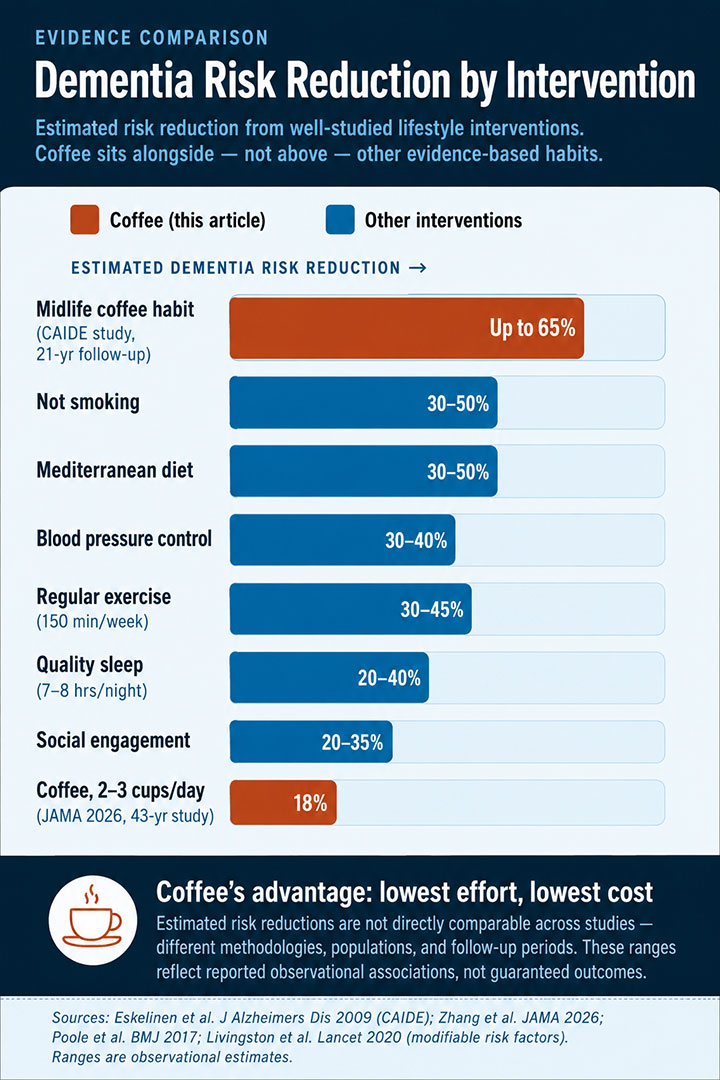
People in the highest quartile of caffeinated coffee consumption had an 18% lower risk of developing dementia compared with those who reported drinking little or no caffeinated coffee. Crucially, higher intake of caffeinated coffee was also associated with lower rates of subjective cognitive decline and modestly better performance on objective cognitive tests.
Decaffeinated coffee showed none of this. The researchers found no association between decaf consumption and lower dementia risk or better cognitive performance, which puts the caffeine itself (not just coffee’s antioxidants) at the center of the story.
The decaf finding is the interesting one. Not because it’s surprising exactly, but because it suggests the ritual isn’t the medicine. The warming of the hands, the morning pause, the smell: none of that registers in the data. The caffeine does.
Standard research defines one cup as six to eight ounces of brewed coffee. Your actual mug may hold two cups by that measure. A 16-ounce cold brew concentrate can count as one and a half. Track your ounces, not your containers.
The CAIDE Finding: What You Drink at 50 Shapes Your Brain at 70
The Finnish CAIDE study remains the longest-running and most cited piece of evidence in this space. Researchers wanted to know whether coffee habits formed in midlife had any connection to dementia risk decades later, a question most studies at the time were structurally unable to answer because they started tracking people who were already old.
The Eskelinen, Ngandu, Tuomilehto, Soininen, and Kivipelto study, published in the Journal of Alzheimer’s Disease in 2009, tracked 1,409 adults from their midlife checkups in the 1970s and 1980s through a follow-up examination 21 years later.
Of those who returned for the late-life assessment, researchers identified 61 cases of dementia. Coffee drinkers at midlife had a significantly lower risk. People who drank three to five cups daily showed a 65% reduction in dementia and Alzheimer’s disease rates compared with those drinking little to no coffee.
That number deserves consideration. A 65% lower rate of dementia. Sustained over two decades. From a daily habit most people already have.
The mechanism being proposed is cognitive reserve, the idea that regular exposure to coffee’s protective compounds builds a kind of buffer in brain tissue over years. The pathological changes associated with Alzheimer’s begin decades before symptoms appear. Coffee’s compounds may slow or reduce those early changes when consumed consistently across midlife.
The implication that follows from this is less positive: starting at 70 will not deliver the same benefit. The protective effects need time to accumulate.
Women Over 65 See the Strongest Protection
The gender finding is one of the more unexpected threads in this research. Several large studies have found that the cognitive benefits of coffee appear more pronounced in women, particularly after menopause, and the effect shows up in specific cognitive domains rather than globally.
The Women’s Health Initiative Memory Study pursued this directly. In the Driscoll et al. study, published in The Journals of Gerontology in 2016, 6,467 postmenopausal women aged 65 and older were followed for up to ten years, with annual cognitive assessments.
Women consuming above the median caffeine intake for the group (an average of 261 mg daily, equivalent to two to three 8-ounce cups) had a 36% lower rate of probable dementia or global cognitive impairment than those drinking minimal amounts.
A French cohort study, the Three City Study, examined the same question in a different population. Ritchie et al.’s 2007 paper in Neurology followed more than 4,000 women and nearly 3,000 men aged 65 and older from three French cities.
Women drinking three or more cups of caffeinated coffee daily maintained significantly better verbal retrieval and visuospatial memory over the four-year follow-up. Men in the same study showed no clear protective pattern.
Scientists point to possible interactions between caffeine and estrogen as a partial explanation. After menopause, when estrogen levels drop, coffee’s active compounds may provide compensatory support to brain systems that estrogen previously protected.
The effects appeared most clearly in verbal fluency and spatial memory, two domains that often decline with age and that most people would notice in their daily lives long before any clinical threshold is crossed.
For postmenopausal women already on hormone replacement therapy, the interaction between HRT and caffeine is worth discussing with a doctor, not because the combination is necessarily harmful, but because individual responses vary and both affect overlapping biological systems.
Ground Coffee vs. Instant: The Difference Is Real
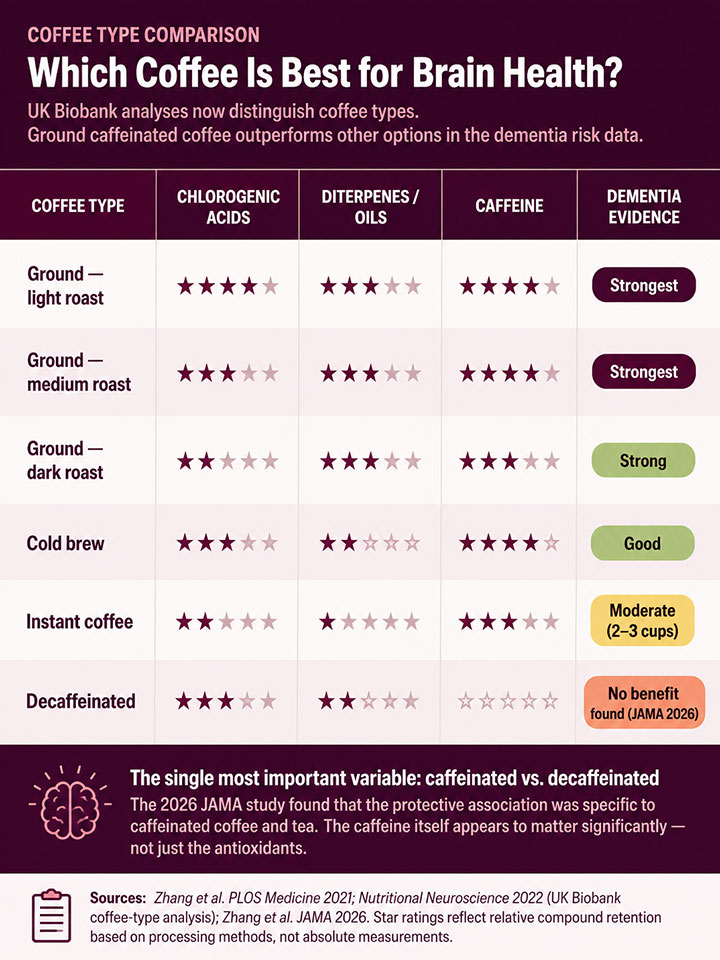
Not all coffee delivers the same protection. How beans are processed and how coffee is brewed affects which beneficial compounds reach your cup, and two large UK Biobank analyses have now measured those differences.
The Zhang, Yang, Li, and Wang study, published in PLOS Medicine in 2021, analyzed 365,682 UK Biobank participants aged 50 to 74 over a median follow-up of 11.4 years. Coffee and tea consumption separately and in combination were associated with lower rates of stroke and dementia. The lowest risk appeared at two to three cups of coffee daily.
A second UK Biobank analysis, published the same year in Nutritional Neuroscience, looked specifically at coffee type. Moderate ground coffee consumption (one to three cups daily) was associated with a 22% lower risk of dementia and a 42% lower risk of vascular dementia specifically.
Heavy instant coffee consumption (more than six cups daily) and moderate decaffeinated coffee consumption were both associated with higher, not lower, dementia risk. Moderate ground coffee outperformed both.
The reason likely lies in processing. Lighter roasts retain more chlorogenic acids. Ground coffee preserves oils and compounds that additional processing removes. The roasting and extraction process determines what survives into your cup.
Instant coffee is still better than no coffee (protection doesn’t disappear entirely), but fresh-ground coffee appears to preserve more of the compounds that matter.
Storage and freshness matter too, though not because of dementia research specifically. Whole beans stored in an airtight container, ground just before brewing, retain more antioxidant content than pre-ground coffee exposed to air. It’s a small thing. Over twenty years of daily consumption, small things compound.
Coffee Type Comparison — Brain Health
Compare two coffee options to see how they stack up for long-term cognitive protection.
How Coffee Protects the Brain: Three Mechanisms That Hold Up
Coffee contains over a thousand distinct compounds. The protection it appears to offer against cognitive decline likely involves several of them working in parallel, not a single active ingredient. Three have the strongest evidence behind them, and they don’t all carry the same weight.
Vascular protection is where the human evidence is clearest. Coffee’s polyphenols support blood vessel function throughout the body, including the small capillaries that supply brain tissue. Better circulation means better delivery of oxygen and nutrients to neurons.
The UK Biobank data found coffee’s association with lower dementia risk was particularly strong for vascular dementia, the type most directly caused by impaired blood flow, which is a meaningful signal: if the mechanism were purely neurological, you’d expect all dementia subtypes to show similar reductions. The vascular subtype showing a 42% lower risk is consistent with a circulation story.
Anti-inflammatory activity runs alongside this. Chlorogenic acids, the primary non-caffeine antioxidants in coffee, appear to reduce chronic low-grade inflammation, which is increasingly recognized as a driver of neurodegeneration that damages neurons gradually and worsens over decades.
The Poole et al. umbrella review, published in the BMJ in 2017, synthesized 201 meta-analyses across 67 health outcomes. Coffee consumption, particularly three to four cups daily, showed consistent associations with reduced neurological and cardiovascular risk, with chlorogenic acid activity among the proposed explanations.
A third pathway is biologically compelling but less settled. Autophagy (the brain’s cellular cleaning process, essentially a recycling program that breaks down and removes damaged proteins) may be activated by coffee compounds, potentially helping clear the misfolded proteins that accumulate in Alzheimer’s disease.
The problem is that most of this evidence comes from cell studies and animal models. Whether it holds at the same scale in humans drinking two cups daily for twenty years remains genuinely open. The mechanism is plausible, and researchers consider it worth watching. It doesn’t warrant the same confidence as the vascular data.
None of these mechanisms produces a measurable result in a week, or a month, or even a year. They accumulate. The dramatic statistics in the CAIDE and JAMA studies are the product of decades of daily exposure, not a course of treatment.
What the 2026 JAMA Study Changed
The Zhang et al. JAMA study matters more than the others not because it found something new, but because it resolved something old.
Previous research on coffee and dementia had been genuinely inconsistent. Some studies found a protective effect, others didn’t. The inconsistency often came down to methodology: studies with short follow-up windows, studies that didn’t distinguish between caffeinated and decaffeinated coffee, studies that measured diet once at baseline and assumed it stayed constant. The JAMA study addressed all three problems directly.
Dietary intake was assessed every two to four years using validated questionnaires, not once. Follow-up ran up to 43 years. Caffeinated and decaffeinated coffee were tracked separately throughout.
The result was a coherent picture: higher caffeinated coffee intake was associated with an 18% lower risk of dementia across 11,033 cases. Decaffeinated coffee was not. Tea showed a similar pattern to caffeinated coffee. The protective effect was most pronounced at moderate intake levels, consistent with the U-shaped curve the earlier literature suggested.
Dr. Susan Kohlhaas, executive director of research at Alzheimer’s Research UK, offered an important caveat when the study was published: “This research doesn’t prove that coffee or tea protect the brain. This study shows an association, not a cause-and-effect relationship.”
That’s correct. Randomized controlled trials of long-term coffee consumption are logistically impossible. What the JAMA study provides is the most extensive observational data yet available, and the consistency of the association across populations, study designs, and decades of follow-up is, as the authors note, meaningful.
Building the Habit for Long-Term Protection
Most people, reading this far, want to know the same thing: does any of this change what I should actually do tomorrow morning? The answer is almost certainly no, you probably already have the habit. The question is whether you’re doing it in the way the research describes.
Two to three cups daily, before 2 PM, with minimal additions. That’s the pattern most studies are describing when they report their protective findings. The 2 PM cutoff matters: caffeine has a half-life of approximately five hours, so an afternoon cup may still be affecting sleep quality by bedtime.
Deep sleep is when the brain clears metabolic waste products, including proteins associated with Alzheimer’s disease. Disrupting that process undermines the same protection coffee is supposed to support.
The “minimal additions” rule is less absolute than it sounds. A splash of milk doesn’t meaningfully affect coffee’s active compounds. A teaspoon of sugar is unlikely to cancel the benefit. What creates a genuine trade-off is chronic high sugar intake, not because of any specific coffee interaction, but because persistent insulin resistance is an independent risk factor for cognitive decline, and sweetened coffee drinks consumed multiple times a day can contribute to that pattern over years.
Consistency matters more than perfection. The CAIDE study tracked people who maintained their coffee habit across midlife, not sporadic drinkers who occasionally had three cups. The protective effects in the JAMA study appeared in the highest regular consumption quartile, not in people who sometimes drank coffee. A daily habit is what the research is actually describing.
Pairing coffee with other evidence-based habits amplifies rather than duplicates its protection. The Mediterranean diet, regular exercise, adequate sleep, and sustained social connection each show independent associations with lower dementia risk. Coffee fits naturally alongside those, easy, inexpensive, already part of most people’s morning.
When Coffee Doesn’t Work For You
Strong evidence is not the same as universal advice. The population-level findings that make coffee compelling for most people are also the reason they don’t apply cleanly to everyone.
Some people carry genetic variations in the CYP1A2 enzyme that slow caffeine metabolism significantly. For slow metabolizers, caffeine lingers in the system longer, intensifying side effects (jitteriness, anxiety, disrupted sleep) without adding proportional benefit.
If two cups before noon leave you wired at midnight, that’s a signal worth taking seriously. Decaffeinated coffee retains most of coffee’s antioxidants and roughly 60–70% of the observed health associations (with the notable exception of the dementia protection, which the JAMA study found was specific to caffeinated coffee).
Anxiety disorders deserve specific mention. Caffeine is pharmacologically active and can worsen anxiety symptoms, sometimes significantly. Quality sleep is a more powerful neuroprotectant than coffee.
If coffee is disrupting sleep, the net cognitive effect may be negative, even before considering anxiety. Prioritizing sleep over coffee consumption is not a close call for anyone who has to choose between them.
Uncontrolled high blood pressure, acid reflux, and pregnancy are situations where standard coffee recommendations require modification or medical guidance. The long-term cognitive benefits don’t change the calculus on these; other health priorities take precedence.
For people who love the ritual of coffee but can’t tolerate caffeine, low-acid varieties and cold brew (which is 60–70% less acidic than hot-brewed coffee) address many of the digestive concerns. The 2026 JAMA finding on decaf is disappointing, but decaffeinated coffee is not without value. It simply doesn’t appear to carry the same dementia-specific protection as the caffeinated version.
Coffee and Brain Health — Symptom Checker
Answer six questions to find out whether your current coffee habit is working for your brain — or working against it.
The Research Tells a Consistent Story
What’s unusual about coffee and dementia research isn’t the size of the effect. It’s how reliably the same finding has turned up across different countries, different study designs, different populations, and now four decades of follow-up data in two large American cohorts.
Nutrition research has a poor track record for consistency. The conventional wisdom on eggs, fat, red wine, and salt has reversed or moderated so many times that a reasonable person has largely stopped updating their behavior based on individual studies.
Coffee is different. The protective association between moderate caffeinated coffee consumption and cognitive aging has shown up in Finland, France, the United States, and the United Kingdom. It has appeared in men and in women.
It has appeared in studies focused on Alzheimer’s disease specifically and in studies that tracked all-cause dementia. It has appeared across a range of intake levels, with the most consistent protection in the two-to-three-cup range.
Dr. Yu Zhang, the lead author of the 2026 JAMA study, described it plainly: “Coffee and tea are widely consumed globally, so even modest associations could have meaningful population-level implications.”
That framing undersells the magnitude of what the studies are reporting. A 65% reduction in midlife coffee drinkers, an 18% risk reduction across 131,000 Americans, a 36% reduction in postmenopausal women: these are not modest associations. They are among the largest diet-disease associations in the dementia literature.
Two cups of coffee tomorrow morning won’t protect your brain. Two cups every morning for the next twenty years might. That’s the honest shape of the evidence, and it’s worth understanding.
Frequently Asked Questions
Coffee makes me jittery. Can I still get brain benefits?
Jitteriness typically signals either high sensitivity to caffeine (often genetic) or consuming too much too quickly on an empty stomach. Try starting with one cup and drinking it with food, as slowing caffeine absorption reduces the intensity of side effects noticeably for most people.
Half-and-half blends of regular and decaf also give you some protective compounds with less caffeine. The evidence suggests protection builds from consistent moderate intake, not from pushing through discomfort at higher doses.
I’m caffeine-sensitive. What are my options?
Decaffeinated coffee retains most of coffee’s antioxidants and polyphenols. The 2026 JAMA study found it didn’t share the dementia-specific protection, but it isn’t without health value. Green tea provides a different blend of neuroprotective compounds with roughly 25–50 mg of caffeine per cup compared with 95–165 mg in brewed coffee, and the JAMA study found caffeinated tea showed similar associations to caffeinated coffee. Timing also matters: limiting consumption to morning hours may allow even sensitive individuals to tolerate a cup without sleep disruption.
Will adding milk reduce the benefits?
One to two tablespoons of milk or cream won’t meaningfully affect coffee’s brain-protective properties. Some research suggests milk proteins may bind to certain antioxidants and reduce their absorption slightly, but the effect is modest. Plant-based milks don’t interfere with the relevant compounds.
What does matter is avoiding heavy sweeteners, flavored syrups, and artificially flavored creamers, not because of any specific coffee interaction, but because chronic high sugar intake has independent effects on insulin sensitivity and metabolic health that work against the same cognitive outcomes coffee appears to support.
I only drink instant coffee. Should I switch?
The UK Biobank data suggests ground coffee outperforms instant, but heavy instant coffee consumption (more than six cups daily) was the specific pattern associated with higher dementia risk, not moderate instant coffee consumption.
Drinking two cups of instant daily is still likely to provide some benefit. If switching to ground coffee is convenient and affordable, it appears to offer a meaningful advantage. If instant is what you’ll actually drink consistently, consistency probably matters more than coffee type.
Does the water temperature matter when brewing?
Water between 195–205°F (90–96°C) extracts coffee’s beneficial compounds most effectively. Water significantly hotter than this can degrade some antioxidants; water too cool under-extracts. Most automatic drip machines reach appropriate temperatures.
If brewing manually, bringing water to a boil and letting it sit for 30 seconds before pouring over grounds is close enough. Cold brew uses room temperature water over 12–24 hours and produces coffee with a different compound profile and significantly lower acidity. It’s a legitimate alternative for people with digestive sensitivity.
Can I drink coffee if I already have memory problems?
The research on coffee and dementia focuses on prevention and slowing of decline, not reversal of existing impairment. Coffee is unlikely to restore function that has already been lost. For people with a diagnosis of mild cognitive impairment or early dementia, medication interactions become more important to check, as caffeine interacts with several drugs. This is genuinely a conversation to have with your doctor, who can evaluate your specific medications and health profile.
Is coffee good for brain fog?
Short-term, yes: caffeine blocks adenosine receptors and increases dopamine activity, which produces measurable improvements in alertness, reaction time, and mood for most people within 30–45 minutes of consumption.
Whether that relief is sustainable depends on the cause of the brain fog. Sleep deprivation, dehydration, and elevated stress all cause brain fog that caffeine can temporarily mask but doesn’t address. Using coffee to push through chronically inadequate sleep may actually worsen long-term cognitive outcomes, given sleep’s role in clearing neurological waste products.
What is the 2-hour coffee rule?
The “2-hour rule” refers to delaying your first cup of coffee until roughly 90–120 minutes after waking. The rationale is that cortisol levels are naturally elevated immediately after waking and drive alertness on their own.
Drinking caffeine at peak cortisol may build tolerance faster without adding much benefit. Waiting until cortisol begins to drop allows caffeine to be most effective as a supplement to the body’s own alertness chemistry rather than competing with it.
The research base for this specific timing recommendation is limited; it’s derived from circadian cortisol patterns rather than direct clinical trials on cognitive outcomes.
Medical Disclaimer: This article is for informational purposes only and does not constitute medical advice. Coffee consumption recommendations may not be appropriate for everyone, particularly those with certain health conditions, during pregnancy, or taking specific medications. Consult with your healthcare provider before making significant changes to your diet.