Pain at the front of your hip can have very different causes. Knowing which one you’re dealing with changes what you should do next and what to avoid.
The instinct, when a hip flexor hurts, is to stretch it. Reach for the front of the thigh, hold it for a minute, repeat. That reflex is deeply ingrained, and for the kind of soreness most people are experiencing, almost entirely unsupported by the evidence.
A 2011 Cochrane review covering multiple randomized studies found that stretching, whether performed before, after, or both before and after exercise, produces no clinically meaningful reduction in delayed-onset muscle soreness. The average reduction across all included studies was roughly one point on a hundred-point scale.
The more important issue is this: not everyone arriving at “hip flexor pain” is dealing with the same thing. Normal post-exercise soreness, overuse injury, an acute muscle strain, and something that warrants clinical attention all produce similar discomfort at the front of the hip, and the appropriate response is genuinely different for each. Applying the stretch-first reflex without distinguishing between them can, in certain circumstances, slow recovery rather than support it.
Four Things That Can Make Your Hip Flexors Hurt
The front of the hip houses several distinct structures. The iliopsoas, made up of the psoas major and iliacus muscles, does the primary flexion work, while the rectus femoris and sartorius contribute, and a bursa cushions the tendon where it passes over bone. Any of these can produce pain at the front of the hip that feels broadly similar from the outside.
Knowing which structure is involved, and what caused the irritation, is what determines whether to stretch, rest, progressively load, or call a clinician.
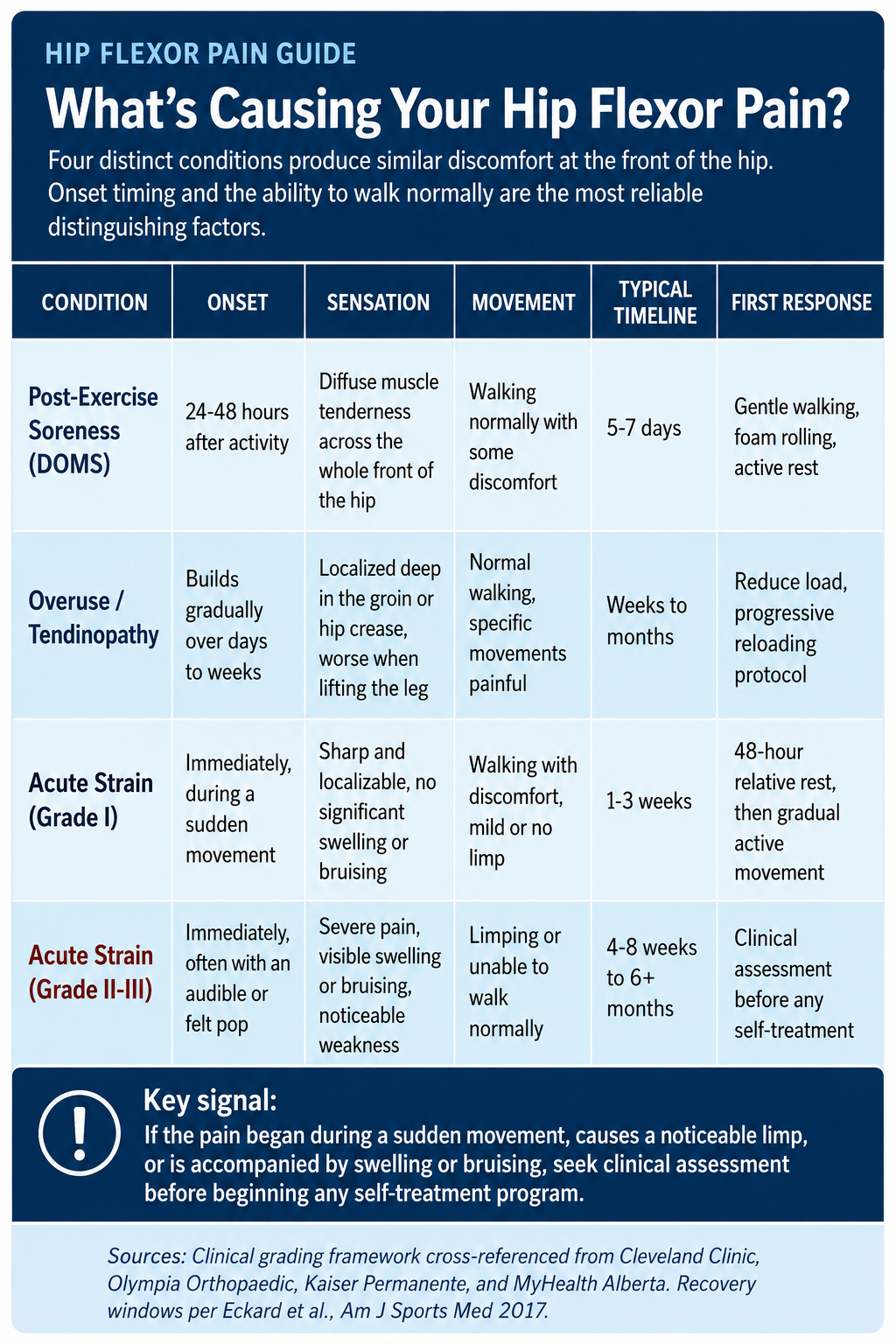
Post-Exercise Soreness (DOMS)
Delayed-onset muscle soreness typically appears 24 to 48 hours after unaccustomed exercise, particularly activities involving eccentric contraction, when the muscle lengthens under load rather than shortens. Running downhill, aggressive reverse lunges, or a new class involving deep hip flexor positions all load the muscle eccentrically. The soreness is the result of micro-damage to muscle fibers and an associated inflammatory response, not lactic acid accumulation, a misconception the clinical literature corrected decades ago.
If you tried something new on Saturday (a longer hike, a cycle class, a set of lunges you haven’t done in months) and woke up Monday wondering what happened to your hip, this is almost certainly it. The characteristic signs are diffuse tenderness across the muscle belly, onset the day after activity rather than during it, and resolution without intervention within five to seven days. You can typically bear weight normally, walk without a limp, and produce force on demand, even if the muscle is sore to the touch.
Overuse and Tendinopathy
Iliopsoas tendinopathy develops gradually when repetitive hip flexion accumulates load faster than the tissue can recover. Runners increasing mileage too quickly, cyclists logging long hours in a compact position, and desk workers whose hip flexors spend eight or more hours a day in a shortened state are all at risk. The pain tends to build over days or weeks rather than appearing suddenly, and is often more localized to the groin or hip crease than across the broad muscle belly.
Overuse injuries respond poorly to rest alone and to aggressive stretching in the early phase. The current evidence base, drawn largely from tendinopathy research on better-studied structures like the Achilles tendon, supports progressive loading beginning with isometric holds before advancing to eccentric and then concentric work.
Acute Strain
An acute hip flexor strain has a moment. You were sprinting, kicking, or changing direction fast, and something gave way or seized. The pain is immediate, often sharp and localizable to a specific area, and in more significant strains, swelling and bruising develop over the following hours while the muscle feels genuinely weak on active hip flexion rather than just sore.
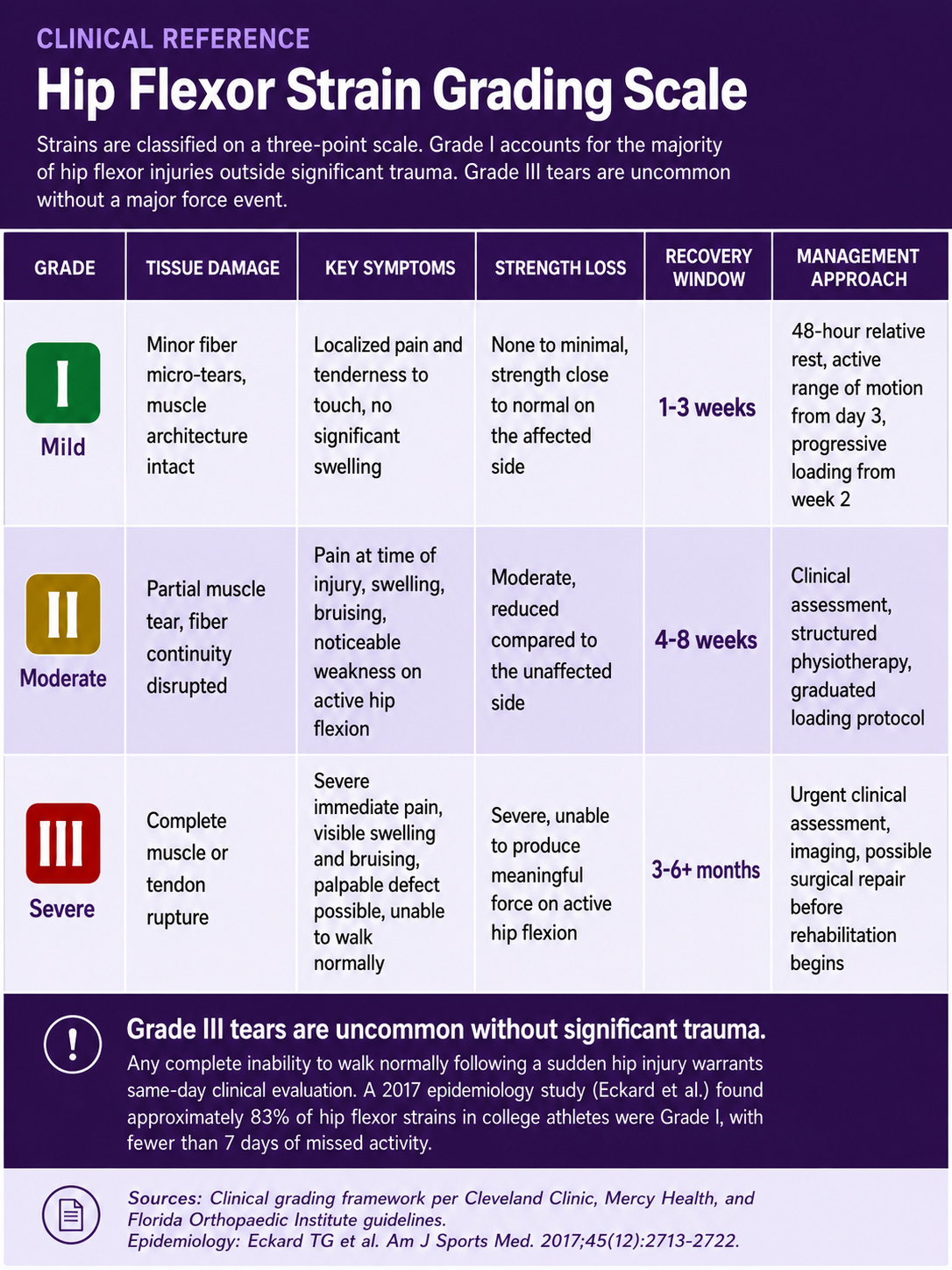
Strains are graded on a three-point clinical scale. Grade I involves minor fiber damage with no meaningful strength loss and a recovery window of one to three weeks. Grade II involves a partial tear with noticeable weakness and instability. Recovery typically requires four to eight weeks of structured rehabilitation.
Grade III is a complete rupture. It typically makes normal walking painful and requires immediate clinical assessment, often including imaging to determine whether surgical repair is indicated before rehabilitation can begin.
The complication is that the instinct to stretch the muscle in the first 48 to 72 hours following an acute strain can work against recovery by adding tensile load to tissue in the acute inflammatory phase, before basic structural repair has occurred.

Red-Flag Patterns
Some presentations at the front of the hip are not the hip flexor at all. Lumbar nerve root compression can refer pain into the groin and hip flexor region, and hip labral pathology produces a deep ache that may be indistinguishable from iliopsoas tenderness on initial assessment. Femoral neck stress fractures, less common but serious, produce anterior hip pain that worsens with loading rather than easing.
Pain radiating down the leg past the knee, numbness or tingling in the thigh or groin, pain that is severe at rest without a clear precipitating activity, or a complete inability to bear weight all warrant clinical evaluation rather than self-treatment of any kind.
What Type of Hip Flexor Pain Do You Have?
Answer 3 to 5 short questions. This tool routes you to the pattern that best fits your symptoms and gives you evidence-matched guidance.
What to do next
Stretching and Soreness: What the Evidence Actually Shows
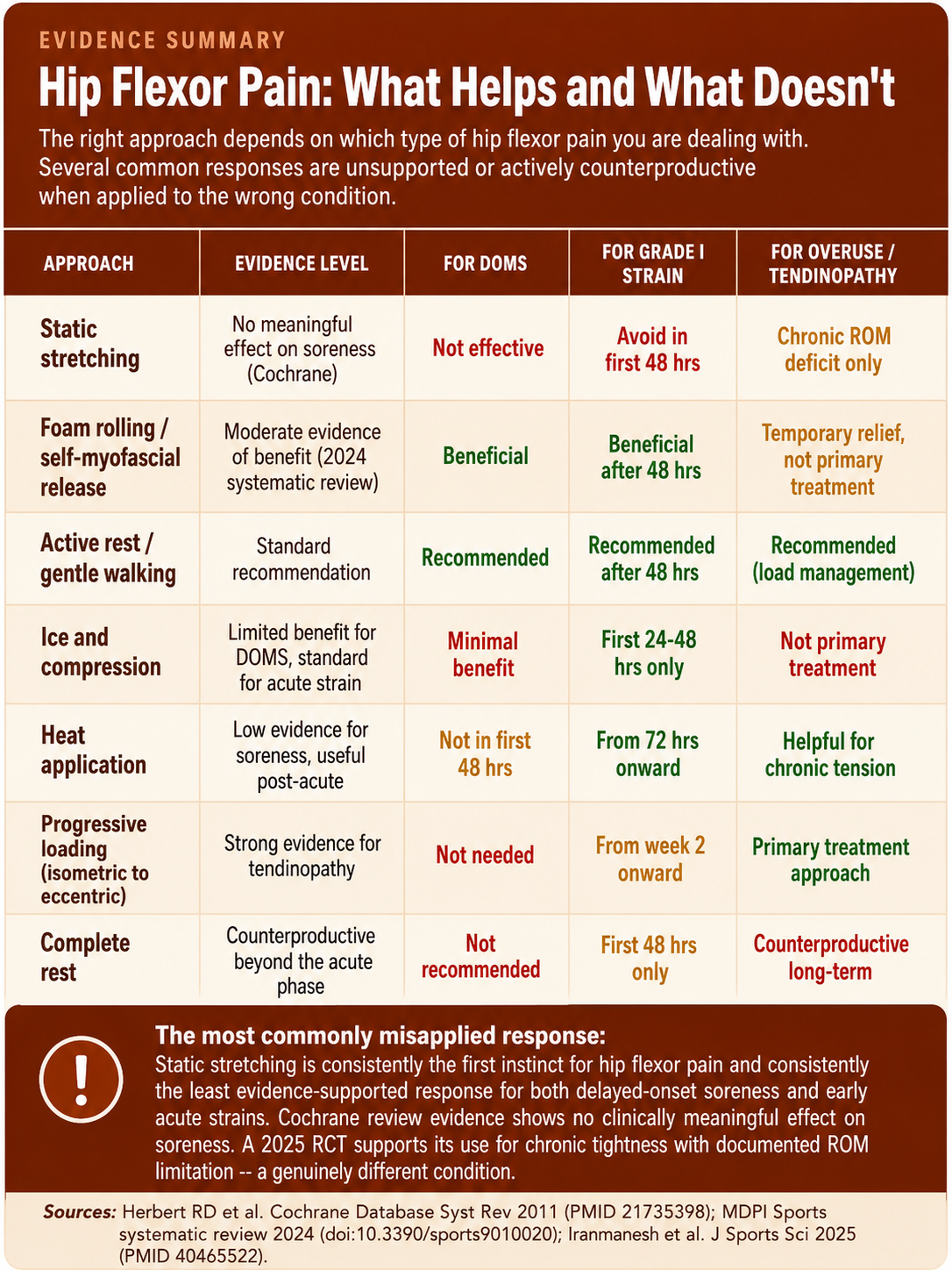
Richard Herbert and colleagues at the University of Sydney analyzed data from multiple randomized controlled trials, each testing whether stretching before or after exercise reduces delayed-onset muscle soreness. Their Cochrane review, updated in 2011 and subsequently replicated by independent teams, concluded that stretching produces no clinically important reduction in soreness, whether performed before, after, or both.
That finding took a while to settle into the standard guidance. A 2021 systematic review and meta-analysis reached the same conclusion by a different path, examining post-exercise stretching specifically against passive recovery, and found no statistically robust effect at 24, 48, or 72 hours post-exercise.
That conclusion argues against stretching as the automatic first response to hip flexor soreness, where the evidence does not support it, rather than against stretching as a practice across all contexts.
What the Evidence Favors Instead
Foam rolling has accumulated a more favorable record than stretching on this particular question. A 2024 systematic review in Sports, published by MDPI, found that self-myofascial release produced positive effects on range of motion and delayed-onset muscle soreness compared to passive recovery, with evidence quality graded as moderate across the included trials. The proposed mechanism involves changes in fascia compliance and pressure-mediated modulation of pain signals rather than structural change to the muscle itself.
Moderate quality means foam rolling is not a cure, but the evidence base is meaningfully stronger than the case for post-exercise stretching on this specific problem.
Active rest, in the form of gentle walking at a pace that does not reproduce the pain, maintains blood flow and hip extension range of motion without adding eccentric load. For DOMS and Grade I strains alike, complete inactivity is generally counterproductive after the first 48 hours. For Grade II strains, load management is more deliberate and usually benefits from physiotherapy guidance, but extended rest remains the wrong answer even there.
In the acute phase of a strain, the first 24 to 48 hours, compression and ice address the inflammatory response more effectively than heat. Heat becomes useful later, roughly from 72 hours onward, particularly for reducing residual muscle tension as the acute phase resolves.
When Stretching Is the Right Tool
Researchers in Kerman, Iran wanted to know whether a structured dynamic stretching protocol could help athletes who had chronic low back pain and documented hip flexor restriction, not acute soreness but long-standing tightness built up over months. The eight-week randomized controlled trial by Mojtaba Iranmanesh and colleagues, published in the Journal of Sports Sciences in 2025, enrolled forty professional footballers and assigned half to five stretching sessions per week. By the trial’s end, hip flexor range of motion had improved and pain scores had decreased meaningfully compared to the control group.
That is the condition stretching is well-suited for: chronic restriction accumulated gradually, not acute soreness from activity two days ago. The distinction between tightness that has developed over months and soreness that appeared after Saturday’s hike is exactly what the stretch-first reflex erases. One of those conditions responds to consistent, progressive mobility work over weeks, while the other resolves on its own within a week regardless of whether you stretch it.
Recovery Timelines: What to Expect
One of the most useful pieces of information about hip flexor pain is how long each type is expected to last. That timeline does more to answer the “should I be worried?” question than almost any other single factor.
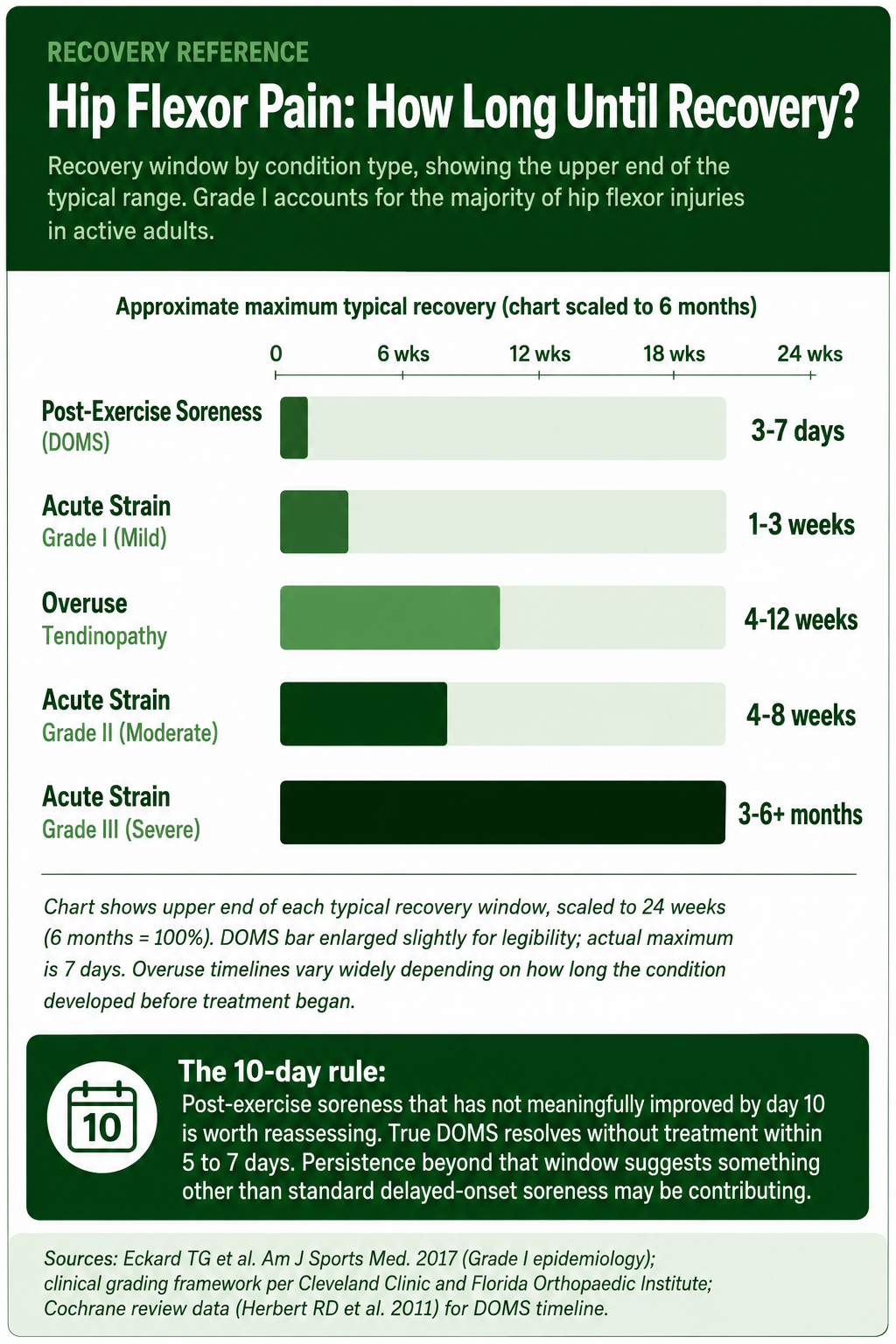
DOMS is self-limiting. It peaks between 24 and 72 hours after the triggering activity and resolves without treatment within five to seven days in most cases. If soreness extends past ten days without a plausible reinjury event in between, the original assessment deserves a second look.
Grade I strains, which account for the majority of hip flexor injuries across sports and activity populations, typically resolve within one to three weeks with relative rest and progressive reintroduction of load. A 2017 NCAA epidemiology study by Timothy Eckard and colleagues found that approximately 83% of hip flexor strains in college athletes were mild Grade I injuries, with fewer than seven days of missed activity in each case.
Grade II injuries require four to eight weeks of structured rehabilitation. Grade III tears, which are uncommon outside significant trauma or direct athletic contact, involve timelines of three to six months or longer.
The Hip Flexor and Lower Back Pain Connection
A 2026 study of ice hockey players found that athletes with hip flexor tightness developed low back pain at three times the rate of those with normal hip flexibility: 15.7% incidence compared to 5.1%, with a relative risk of 3.17. The study was observational and sport-specific, which limits generalization, but the signal is consistent with what the mechanical picture would predict.
What the hockey numbers don’t show directly is the mechanical reason they exist. When the hip flexors are chronically shortened or irritated, they draw the pelvis into anterior tilt, increasing compressive load on the lumbar vertebrae, and the gluteal muscles, which counter that forward pull under normal circumstances, cannot fire at full capacity when the hip flexors dominate the movement. Low back pain often develops downstream from that imbalance, sometimes appearing weeks or months after the original hip issue, which makes the connection easy to miss.
Persistent hip flexor problems that do not respond to the approaches above are worth taking seriously for this reason. The hip and the lower back share a mechanical relationship, and chronic restriction in one reliably affects the other over time.
Signs It’s Time to See Someone
Most hip flexor pain resolves without clinical intervention. The following presentations fall outside that pattern and warrant assessment before any self-treatment program continues:
- Pain radiating into the thigh, knee, or lower leg, particularly with numbness or tingling alongside it.
- Severe pain at rest that was not preceded by any recognizable activity or injury event.
- Visible swelling, bruising, or a palpable gap in the muscle belly following a sudden injury.
- An audible pop at the moment of injury followed by immediate weakness or inability to walk normally.
- Hip flexor symptoms that began shortly after hip or abdominal surgery.
- No measurable improvement after three full weeks of appropriate rest and progressive care.
Snapping or clicking at the front of the hip during flexion, known clinically as snapping hip syndrome, is not inherently dangerous. Persistent pain accompanying the click is worth imaging to rule out labral involvement or bursitis. The snap alone, without pain, is usually a benign mechanical finding and does not require intervention.
Frequently Asked Questions
Is walking good for sore hip flexors?
For DOMS and Grade I strains, walking at a comfortable pace is generally beneficial rather than harmful. It maintains range of motion, supports blood flow, and avoids the deconditioning that accompanies complete rest. Both pace and distance should remain below the level that reproduces or significantly worsens the pain, and if walking normally causes sharp rather than mild discomfort, reduce both and reassess at 24 hours.
What can be mistaken for tight hip flexors?
Several conditions produce symptoms that closely resemble tight or sore hip flexors. Lumbar disc irritation and nerve root compression can refer pain to the front of the hip and groin without any local hip flexor pathology. Hip labral tears produce a deep ache and often a catching sensation during flexion, while femoral nerve entrapment generates anterior thigh pain that may be indistinguishable from hip flexor soreness without targeted nerve testing.
Sports hernia produces groin pain that worsens with exertion and may have no obvious mechanical trigger. Any presentation that fails to respond to reasonable self-care after three to four weeks is worth investigating beyond the hip flexors themselves.
How do you release hip flexor pain?
The answer depends on which type of pain is present. For DOMS, foam rolling and gentle active movement are more evidence-supported than static stretching. For an acute Grade I strain, relative rest in the first 48 hours followed by pain-free active range of motion is the standard clinical approach, while overuse or tendinopathy responds better to a progressive loading protocol starting with isometric holds than to soft tissue release alone.
For any presentation involving nerve referral or suspected structural damage, manual work is not the right first step. Clinical assessment should come before any self-treatment in those cases.
How do you unpinch a hip flexor?
The phrase most often describes hip flexor impingement, a sensation produced when the tendon is compressed against bone during flexion, causing sharp or catching pain rather than a dull ache. The most evidence-informed approach is to reduce the specific movement provoking the symptoms temporarily, work on hip extension mobility to decompress the anterior hip, and strengthen the surrounding muscles to offload the tendon. If the catching sensation persists alongside pain, imaging can confirm whether there is bursitis or structural impingement that requires more specific management.
How long does hip flexor pain last?
DOMS resolves within five to seven days in most cases. Grade I strains typically clear within one to three weeks with appropriate management, and Grade II injuries require four to eight weeks of structured care. Overuse and tendinopathy timelines vary more widely, from several weeks to a few months. The range depends on how long the condition had been developing before treatment began.
Pain persisting beyond three weeks without a clear explanation warrants evaluation rather than continued self-management.
Most hip flexor pain resolves on its own within a predictable window. Stretching into DOMS does not meaningfully accelerate that timeline, but stretching into an acute strain in the first 48 hours can slow recovery rather than support it. The question of which situation you are actually in is almost always answerable from symptoms alone, and the answer determines the right response.