Steep a black tea for four minutes, and it tastes rich. Steep the same leaves for six, and it can taste awful.
Nothing about the leaves changed in those two minutes. What changed was which molecules had time to dissolve.
Most steeping advice treats time like a single dial: longer for strong, shorter for weak. That’s roughly true, but it skips the more useful fact. Different flavor and health compounds enter the water on their own separate schedules, and at least one widely repeated steeping shortcut, the one about slashing caffeine in thirty seconds, does not hold up against the chemistry.
What Steeping Time Actually Changes in the Cup
Steeping is a diffusion problem before it’s a flavor problem. Hot water pulls dissolved compounds out of the leaf, and different compounds move at different rates.
Amino acids and caffeine are small, so they dissolve fast. Catechins, the antioxidants tea is best known for, take a little longer to follow. Tannins, the compounds behind astringency and bitterness, keep accumulating the longest, which is why a tea that tasted fine at four minutes turns sharp at seven.
A 2007 study in the Journal of Chromatography A, led by researcher Deng-Jye Yang, measured this directly. Yang’s team steeped black, green, oolong, and pu-erh tea bags for durations ranging from thirty seconds up to four minutes and tracked caffeine, catechins, and gallic acid at each interval.
All three compounds rose steadily across that range. There was no early spike and no plateau.
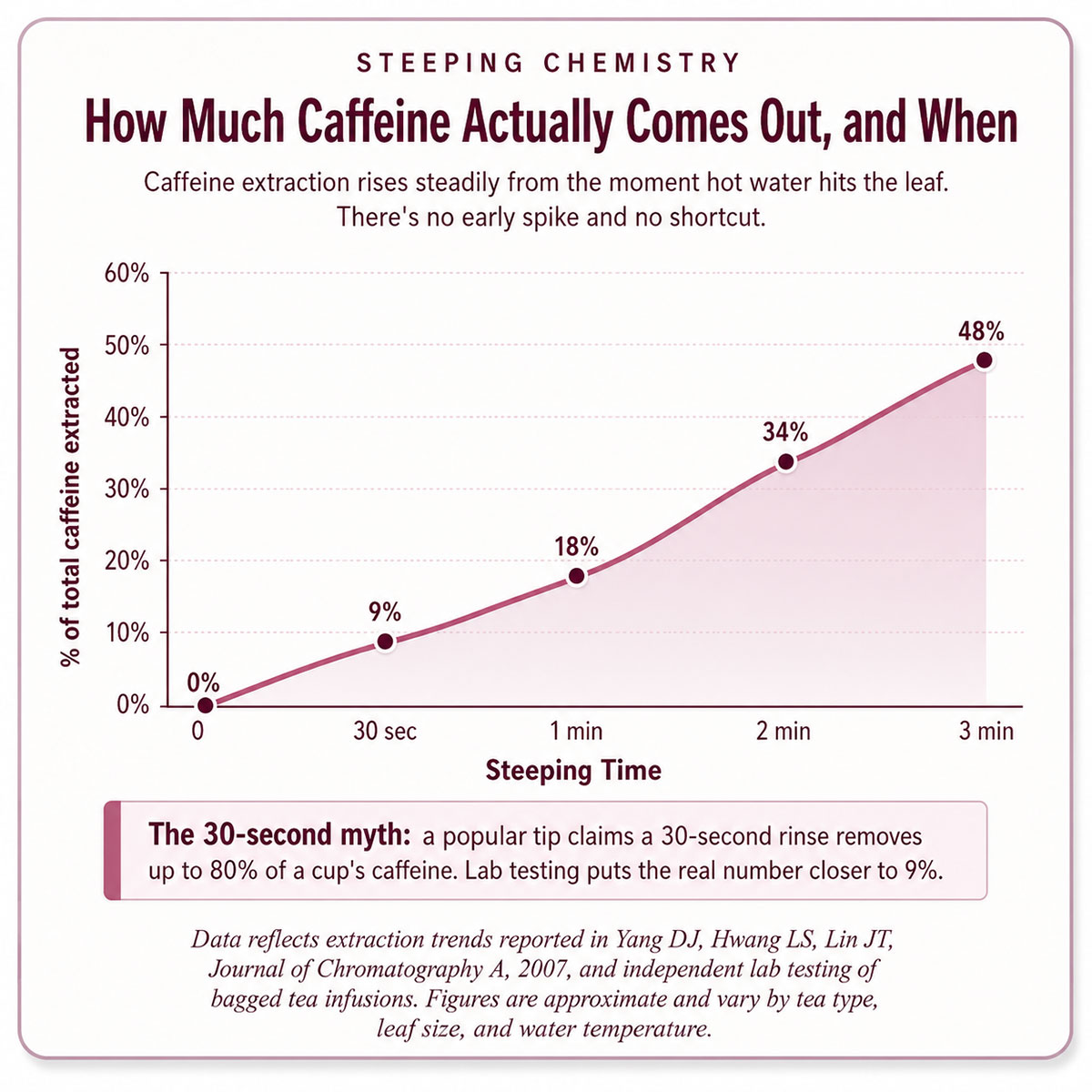
That steady curve quietly undercuts a decades-old tea-industry tip: the claim that a thirty-second rinse, poured off and discarded, removes up to 80 percent of a cup’s caffeine. Independent lab testing puts that figure closer to 9 percent. Cutting caffeine meaningfully this way takes three to four minutes of discarded steeping, and by that point, most of the tea’s flavor is gone too.
The myth persisted for decades because it sounded plausible, not because anyone checked.
How Long to Steep Every Type of Tea
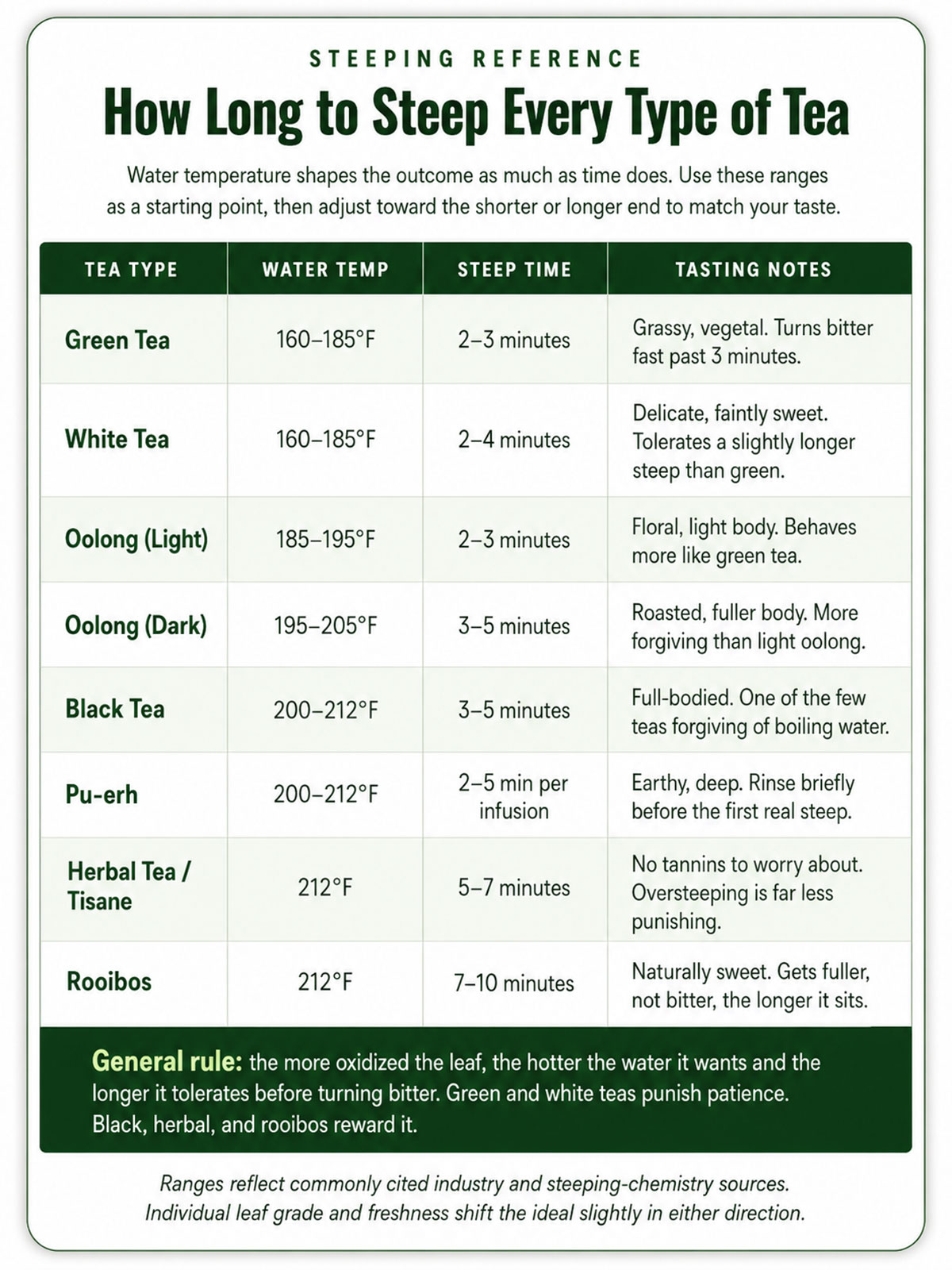
Every tea type has a different oxidation level, leaf size, and chemical makeup, so the numbers below are starting points rather than absolutes. Water temperature matters as much as time. Water that’s too hot for a delicate leaf pulls tannins out early, regardless of how carefully the steeping is timed.
Green Tea
Green tea is the least forgiving type to oversteep because the leaves are unoxidized and the tannins sit close to the surface. Two to three minutes at 160 to 185°F is the standard range.
Water straight off a rolling boil “cooks” the leaf and pushes out bitter compounds almost immediately. Let boiled water sit for two to three minutes before pouring if you don’t own a variable-temperature kettle. Properly steeped green tea should look pale yellow, not deep green or brown.
Black Tea
Black tea is fully oxidized, which makes it more forgiving than green tea and one of the few types where boiling water off the kettle is correct. Three to five minutes at 200 to 212°F produces a full-bodied cup without excessive astringency. Earl Grey is the exception worth knowing: the bergamot oil coating the leaves means Earl Grey turns bitter faster than a plain black tea, so pulling it at the three-minute mark rather than five preserves the citrus notes instead of drowning them.

White and Oolong Tea
White tea is the least processed of the true teas, and despite its delicate reputation, it often needs slightly longer than green tea to develop flavor: two to four minutes at 160 to 185°F. Oolong sits between green and black on the oxidation spectrum, and its steeping time depends on where it falls on that scale. Lightly oxidized oolongs behave more like green tea (two to three minutes), while darker, more roasted oolongs need three to five minutes at closer to 205°F.
Herbal Tea (Tisanes)
Herbal teas aren’t technically tea at all. They come from the Camellia sinensis plant, and anything else (chamomile, peppermint, rooibos, hibiscus) is a tisane.
Tisanes carry far less tannin than true tea, so oversteeping is much less punishing. Most benefit from a longer steep than any true tea gets: five to seven minutes in water at a full 212°F.
Rooibos tolerates the long end of that range especially well. It develops a fuller, slightly sweeter flavor the longer it sits.
Water Temperature Without a Thermometer
Most kitchens don’t have a variable-temperature kettle, but the timing of a standard boil gives a reasonable substitute.
- Green tea (160-185°F): let boiling water sit for two to three minutes until the surface stops bubbling.
- White tea (160-185°F): let boiling water sit for one to two minutes until the visible steam thins out.
- Oolong tea (185-205°F): let boiling water sit for thirty seconds to one minute.
- Black and herbal tea (200-212°F): use water straight off the boil.
Tea Steeping Timer
Pick your tea and your preferred strength, then let the timer do the counting.
Tea Bags vs. Loose Leaf: Does the Method Change the Time?
Tea bags are usually filled with smaller, broken leaf particles, which have more surface area exposed to water. That means bagged tea extracts faster than an equivalent amount of whole loose leaf, sometimes by a full minute. If a recipe or box gives a steeping time without specifying which format it assumes, treat it as a loose-leaf estimate and check a bagged cup a minute early.
Squeezing a tea bag after steeping is one of the most common ways people accidentally oversteep without realizing it. The gesture feels efficient.
It forces out concentrated tannins that were still trapped in the leaf fragments, and that’s what pushes a perfectly timed cup into bitter territory in the last five seconds. Lift the bag out and let it drip on its own instead.
Getting the Ratio, Water, and Technique Right
Steeping time is only one variable in a system that includes leaf-to-water ratio, water quality, and vessel choice, and changing any of them shifts what “correct” timing looks like.
The standard ratio is one teaspoon, or about two grams, of loose leaf per eight ounces of water. If a cup tastes weak, the instinct is to steep longer, but that mostly adds bitterness, not strength. Adding more leaf solves the problem that’s actually causing the weakness, since strength and steeping time answer two different questions.
Water quality shapes the outcome too. Filtered water removes chlorine and mineral buildup that can mute tea’s flavor compounds, while distilled water is almost too clean and lacks the trace minerals some teas rely on for depth. Hard water with high mineral content can leave a filmy residue on the surface.
Avoid reboiling water that’s already been heated once. It loses dissolved oxygen in the process, and the resulting cup tends to taste noticeably flat regardless of steeping time.
A few smaller habits round out a consistent cup. Pre-warming the teapot or mug with hot water before adding the leaves keeps the water at temperature longer during steeping.
Covering the vessel while it steeps traps aromatic compounds that would otherwise escape as steam, which matters more for herbal teas and oolongs than for black tea. One gentle stir partway through helps distribute flavor evenly instead of concentrating it near the leaves.
None of these habits show up on a steeping chart, but they’re usually the real difference when the same tea comes out better one day than the next.
Adjusting Steeping Time to Match Your Taste
The ranges above are starting points, not rules, and tea is one of the few categories where personal adjustment is expected rather than a sign you’re doing it wrong.
Steeping at the upper end of a tea’s range produces a bolder, more full-bodied cup. Black tea at the five-minute mark reads as robust rather than harsh, as long as the water temperature was right to begin with.
Steeping at the lower end produces something lighter and more delicate instead. This is a good first move if bitterness has been a recurring problem. A two-minute green tea steep tastes noticeably fresher than a three-minute one, without needing to change anything else.
Steeping time changes what a tea reveals as much as how strong it tastes. Oolong is the clearest example.
The same leaves steeped for four minutes tend to show floral, lighter notes. Pushing to seven minutes on a second or third infusion of the same leaves reveals a deeper, roasted character that the shorter steep never reaches.
Multiple Infusions of the Same Leaves
High-quality loose-leaf tea, especially oolong and pu-erh, is built to be steeped more than once. Each subsequent infusion needs slightly hotter water and a slightly longer steep than the one before it, since there’s less compound left in the leaf to extract quickly.
Premium oolongs can offer three to seven distinct infusions from a single serving of leaves. The flavor profile shifts noticeably from one steep to the next instead of simply fading.
What Steeping Time Does (and Doesn’t) for Health Benefits
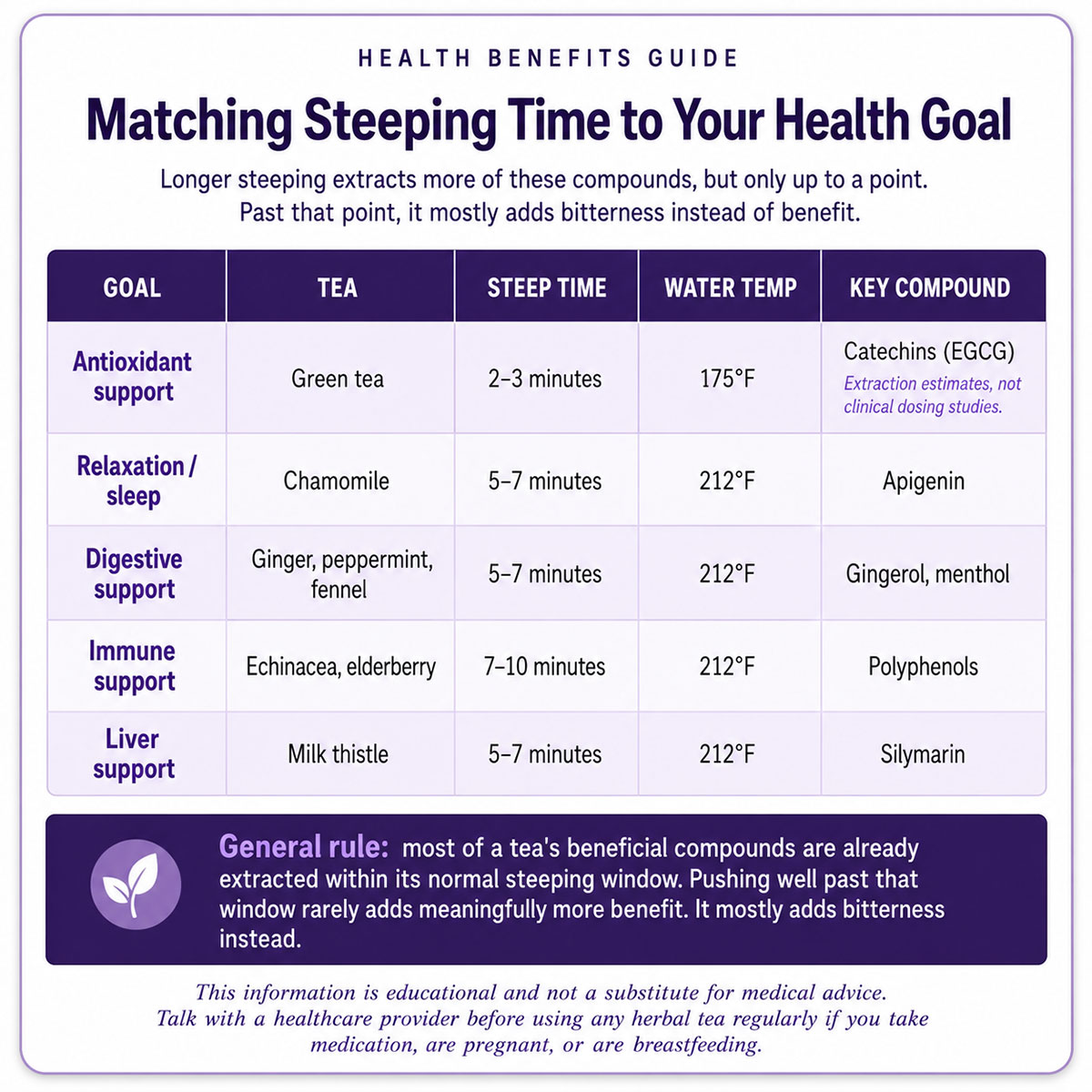
Longer steeping does pull more antioxidants like catechins out of the leaf, but that relationship has a ceiling that most people overshoot without realizing it.
The research behind specific antioxidant numbers is messier than most steeping charts suggest. Catechin studies typically measure isolated extracts under lab conditions, not a mug steeped on a kitchen counter, so a figure like “two to three minutes for maximum antioxidants” is closer to a reasonable estimate than a settled number.
What the evidence does support clearly is the tradeoff: past a certain point, additional steeping time adds tannins and bitterness far faster than it adds anything beneficial.
A few special-diet questions come up often enough to answer directly. Plain tea, without milk or sweetener, does not break an intermittent fast.
Black tea with MCT oil or grass-fed butter, the so-called bulletproof approach, works with any steeping time that suits your taste, since the fat doesn’t interact with the steeping chemistry. Peppermint and ginger tea are generally well tolerated on a low-FODMAP diet.
The Most Common Steeping Mistakes and How to Fix Them
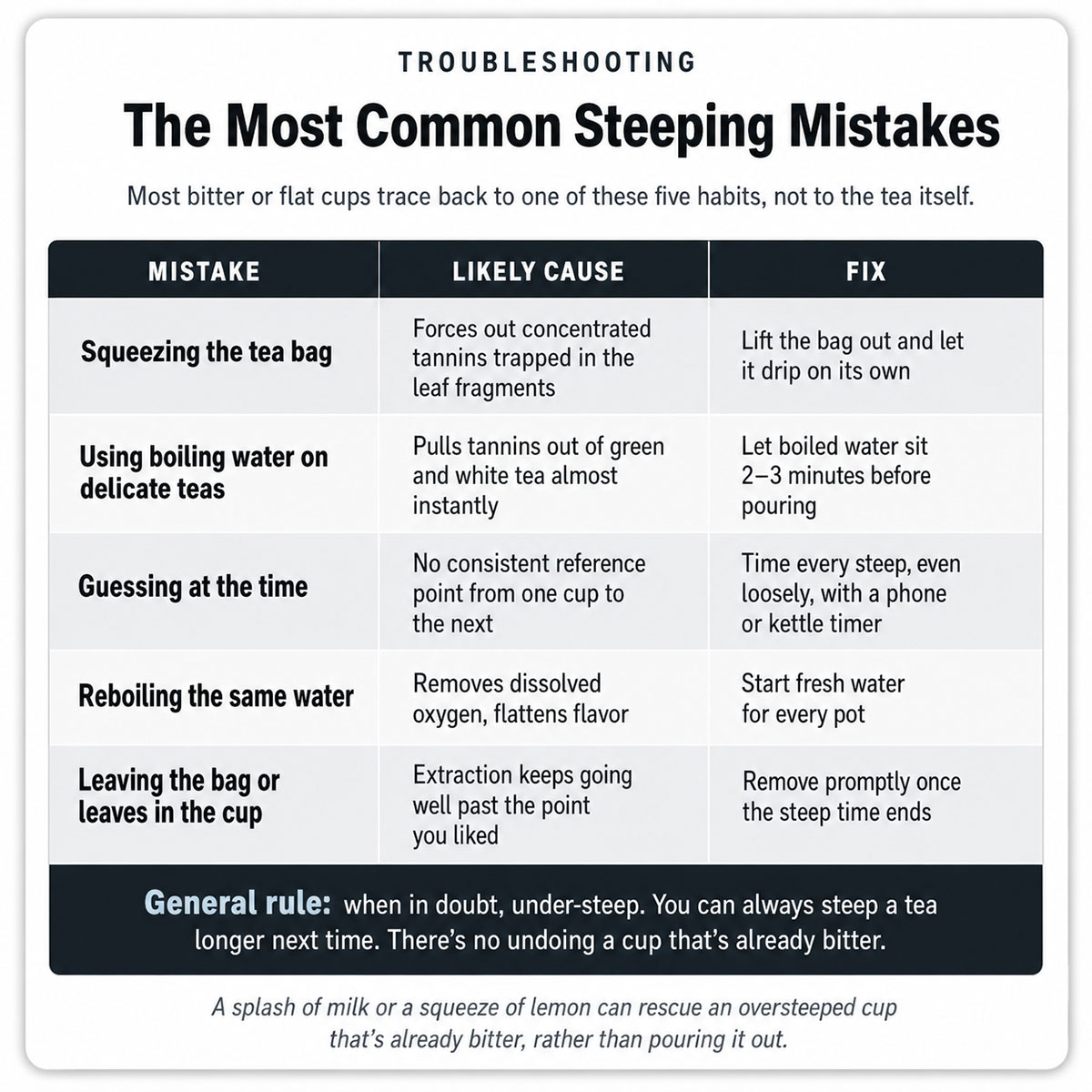
Nearly every steeping complaint traces back to one of a handful of fixable habits, and most of them share the same root cause: guessing at time instead of measuring it.
If a cup does come out too bitter despite following the timing, a splash of milk or a squeeze of lemon usually smooths it out enough to drink rather than pouring it down the drain.
How Culture Shapes the Way Tea Is Steeped
Steeping conventions vary enough across regions that “correct” is really a matter of which tradition you’re asking about.
Chinese gongfu brewing flips the entire logic of steeping. Instead of one long infusion, a small Yixing clay teapot holds a high ratio of leaf to water, and each steep lasts only fifteen to thirty seconds before being poured off.
The same leaves go through ten or more rounds in a single sitting. The flavor evolves noticeably from one steep to the next. It’s a method built around watching a tea change over an afternoon, not around getting one cup out the door quickly.
Gongfu is used almost exclusively for oolong and pu-erh, the two categories with enough complexity to reward the repeated infusions.
Japanese tea ceremony asks for a different kind of precision, one measured less in a stopwatch and more in exact water temperature and ritual timing, particularly for matcha and gyokuro. A bamboo whisk and careful attention to water that’s been cooled well below boiling matter more here than any specific minute count.
British tea tradition, by comparison, is the least fussy of the three: three to five minutes for black tea in a teapot, milk added after steeping rather than before, served alongside an afternoon snack. It barely counts as a distinct steeping method so much as a straightforward, well-worn habit.
Iced Tea, Cold Brew, and Seasonal Adjustments
Cold water extracts more slowly than hot, which is exactly the point of cold brewing. Refrigerated cold brew uses about 1.5 times as much leaf as a hot brew and needs six to eight hours for green and white tea, eight to twelve hours for black and oolong, and twelve or more for herbal blends. The payoff is a smoother, less astringent cup, since the slow extraction favors flavor compounds over tannins.
Flash-chilling skips the wait entirely: steep tea at double strength using the standard hot method, then pour it directly over a full glass of ice. Sun tea, the traditional method of steeping in ambient sunlight for three to four hours, is a slower middle ground between hot brewing and true cold brew, though food safety guidance generally favors the refrigerator method for anything left steeping longer than an hour or two.
Seasonal adjustment is more about habit than chemistry, and it’s the one part of this guide where the “correct” answer is really just whatever feels right. Warmer months are a natural cue to favor cold brew and shorter hot steeps. Cooler months pull the other way, toward longer steeps on black and herbal teas and a longer pre-warm on the teapot itself.
Building a Tea Ritual Around the Time of Day
Caffeine content and flavor intensity both point toward a natural rhythm across the day, even if nothing requires following it strictly.
Morning
Black tea at four to five minutes and 212°F delivers the strongest caffeine and fullest body of any steeping window in this guide, which probably explains why breakfast tea culture settled on black tea rather than something gentler. Standard breakfast blends hold up well at four minutes at the same temperature, robust enough to take milk without disappearing into it.
Yerba mate deserves a slight detour here, even though it isn’t tea in the technical sense. Steeped for five to seven minutes at a cooler 170°F, it offers a more sustained, less jittery lift than either black tea or coffee. That reputation is mostly anecdotal, but it’s consistent enough across cultures to be hard to dismiss.
Afternoon
Oolong at four to five minutes and 190°F offers a balanced lift without the intensity of a morning black tea. Green tea (two to three minutes, 175°F) and Darjeeling (three minutes, 200°F) both work here too, each trading some of that intensity for a lighter, more complex cup that suits an afternoon slowdown.
Evening
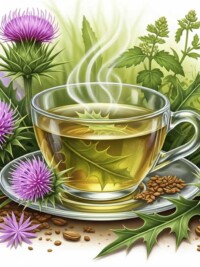
Milk thistle tea, steeped five to seven minutes in water just off the boil, is a less common evening choice than chamomile but works on the same caffeine-free logic, and it’s one of the few herbal teas where longer steeping is worth pursuing specifically for the plant’s active compound, silymarin, rather than for flavor alone.
Chamomile itself, at the same five-to-seven-minute range, remains the more familiar option for winding down, and rooibos or lavender both make reasonable substitutes if chamomile’s floral profile isn’t for you.
None of them will out-relax a genuinely tired body, though. The steeping time matters less here than whether you actually stop for the ten minutes it takes to drink it.
Conclusion
The instinct to treat steeping as a single dial, more time for more flavor, isn’t wrong so much as incomplete. Caffeine, catechins, and tannins are all racing into the water on their own schedules, and the timing that flatters one of them is often the timing that ruins another. Once that’s visible, the thirty-second caffeine myth stops looking like a shortcut and starts looking like what it actually is: a rounding error that got repeated until it sounded like fact.
FAQs
Can I steep tea for too long?
Yes. Oversteeping releases more tannins into the water, which is what produces the bitter, astringent taste most people associate with a “stewed” cup. Green tea punishes oversteeping the fastest, and herbal tisanes tolerate it best.
Does steeping tea longer increase health benefits?
Only up to a point. Most of the beneficial compounds a given tea has to offer are extracted within its recommended steeping window, and pushing past that mainly adds bitterness rather than additional antioxidants.
How long should you steep tea before drinking?
It depends on the type. Black tea: three to five minutes. Green tea: two to three minutes. White tea: two to four minutes. Oolong: two to five minutes, depending on oxidation level. Herbal tea: five to seven minutes. The full breakdown with water temperatures is above.
How do you properly steep tea?
- Heat water to the temperature appropriate for your tea type.
- Place the tea in a teapot or infuser.
- Pour hot water over the leaves.
- Cover the vessel and steep for the recommended time.
- Remove the leaves or bag promptly.
- Drink while the flavor is at its peak.
Does steeping tea make it stronger?
Yes, in both flavor and caffeine content, but only within limits. Past a certain point, additional time adds bitterness far faster than it adds strength worth having.
How many times can you steep the same tea bag?
Most bags hold up for one to two steeps before the flavor drops off noticeably. High-quality loose-leaf tea is a different story: premium oolongs and pu-erh can offer three to seven distinct infusions from the same leaves.
Should you remove the tea bag or leaves after steeping?
Yes. Leaving the bag or leaves in the cup continues the extraction well past the point you tasted and liked, which is the single most common cause of a drink that started well and finished bitter.
Why shouldn’t you squeeze a tea bag?
Squeezing forces out concentrated tannins that were still trapped in the leaf fragments, and that pushes a well-timed cup into bitter territory in the final seconds. Lifting the bag out and letting it drip avoids this entirely.
Should you pour out the first steep of tea?
For everyday drinking, no. In some traditional ceremonies, particularly with oolong or pu-erh, the first brief infusion is discarded as a rinse meant to wash and “wake up” the leaves ahead of the steeps that follow.
Is it okay to drink oversteeped tea?
Yes, it’s safe, just more bitter than intended. Diluting with hot water or adding milk usually salvages the cup rather than requiring you to start over.
Can steeping tea too long release toxins like fluoride?
Tea leaves do accumulate fluoride from the soil, and a 2025 systematic review in the journal Applied Sciences, which pooled 30 studies under PRISMA guidelines, confirmed that fluoride concentration in an infusion rises the longer tea steeps. That said, the increase plateaus well within the range considered safe for typical daily tea consumption, and it isn’t a reason to avoid a longer steep on herbal or black tea. The bigger practical concern with oversteeping remains taste, not safety.
What’s the best brewing tool for loose-leaf tea?
Options include teapots with built-in infusers, stainless steel mesh infusers, paper or cloth filters, a gaiwan, a French press, and tea balls or eggs. The right choice depends mostly on how much leaf-expansion room a specific tea needs and how much control you want over the brewing process.