The interesting question isn’t simply whether muscle can grow during a deficit. It’s why the outcome can be so different depending on where you start.
The standard advice for getting stronger was always built around one assumption: eat more than you burn. If you want to build muscle, you run a surplus. If you want to lose fat, you run a deficit. The two goals sit in separate seasons of your life, and you never try to pursue both at the same time.
That model was built largely on research conducted on experienced male athletes. For that population, the rules are genuinely rigid. But most people are not experienced male athletes, and for the rest of the population, the picture is considerably more useful.
For beginners, people returning after a break, and anyone carrying higher body fat levels, simultaneously losing fat and adding lean mass is not only possible. In some ways, it is the most efficient use of time in the gym. Here is what the evidence actually says, and exactly how to make it work.
Why a Calorie Deficit Doesn’t Always Mean Muscle Loss
When you eat less than your body needs, something has to supply the missing energy. The conventional fear is that the body will cannibalize muscle tissue to make up the shortfall. That does happen, but only when the conditions for protecting muscle are absent.
The mechanism behind body recomposition is not mysterious. Resistance training sends a strong signal to preserve and build muscle tissue. Dietary protein provides the building material. Stored body fat provides the fuel. The three elements work simultaneously through different pathways, which is why the idea that “you can’t do both” was always an oversimplification rather than a law of physiology.
The reason this works better for some people than others comes down to energy availability. Someone with higher body fat levels has substantially more stored fuel to draw on than someone who is already lean. That stored energy creates the margin that experienced athletes at low body fat simply don’t have.

Who Can Build Muscle in a Calorie Deficit
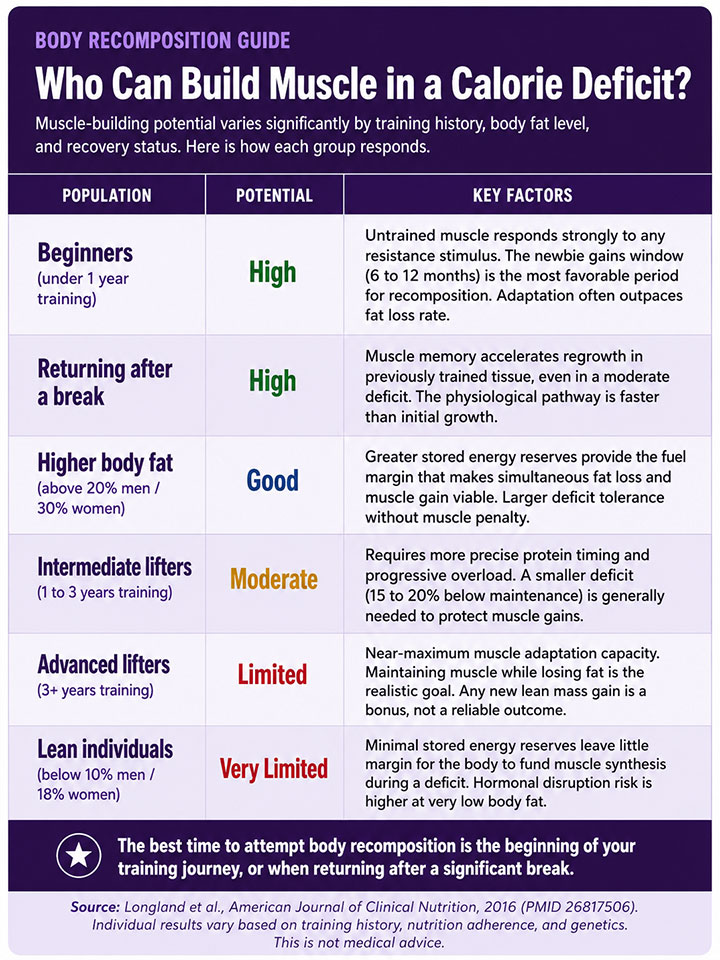
Your results will depend heavily on where you’re starting from. The research is clear that some populations are far better positioned for body recomposition than others.
Beginners have the greatest potential. A muscle that has never been trained responds strongly to the initial stimulus of resistance exercise (the so-called newbie gains window typically runs 6 to 12 months depending on consistency and genetics). During this period, muscle growth during a deficit is most achievable, and the adaptation is often faster than the rate at which the body is losing fat.
People returning after a break occupy a similar position. Muscle memory is a real physiological phenomenon: previously trained muscle tissue rebuilds faster than untrained muscle grows for the first time, and this holds true even in a moderate calorie deficit.
Higher body fat levels matter too. Research published in the American Journal of Clinical Nutrition in 2016, from a randomized trial by Thomas Longland and colleagues at McMaster University, found that participants in a significant energy deficit who ate high protein while following a structured exercise program were able to gain lean mass and lose fat at the same time. The mechanism was exactly what the physiology predicts: stored body fat served as the energy substrate while protein drove muscle protein synthesis.
The Four Things That Determine Whether This Works
Body recomposition is not automatic. The same conditions that make it possible also have to be actively managed. Miss any of the four, and the results drop sharply.
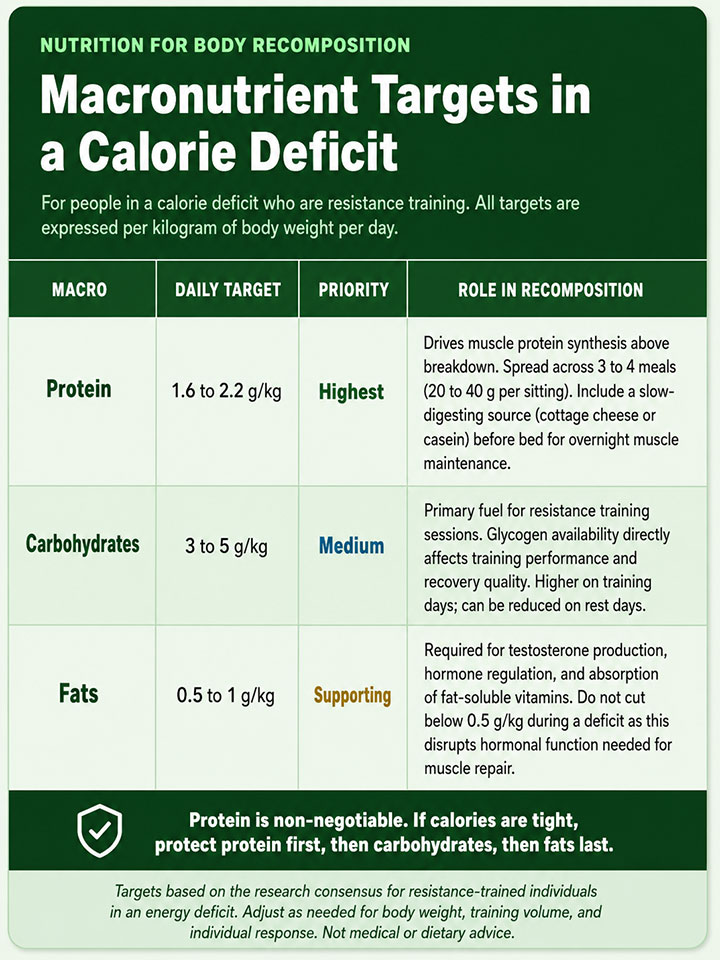
Protein: Non-Negotiable and Often Underestimated
Protein is the single most important variable. Muscle protein synthesis requires a steady supply of amino acids: enough to maintain net positive balance even under caloric restriction, not merely enough to meet basic needs.
The research consensus puts the target at 1.6 to 2.2 grams of protein per kilogram of body weight per day for people in a calorie deficit who are resistance training. Spread it across meals (roughly 20 to 40 grams per sitting, every three to four hours) so that muscle protein synthesis stays elevated throughout the day rather than spiking and fading. A slow-digesting protein source before bed, such as cottage cheese or casein, has shown particular benefit for overnight muscle maintenance.
At those intake levels, the kidney question comes up. It shouldn’t. A crossover trial published in the Journal of the International Society of Sports Nutrition, in which resistance-trained men consumed 2.6 to 3.3 grams of protein per kilogram daily for four months, found no effect on kidney function or blood lipid markers. A follow-up study running a full year at similar intakes reached the same conclusion.
The Deficit Itself: Moderate Beats Aggressive
The size of your calorie deficit is not a minor detail. A 500-calorie daily deficit is enough to drive meaningful fat loss without stripping the body of the energy it needs to support muscle repair after training. For most people, that sits at 15 to 25 percent below maintenance calories. To estimate it: multiply your body weight in pounds by 14 to 16, then subtract the deficit percentage from that number.
Deficits beyond 500 calories per day start to impair muscle protein synthesis, reduce training performance, and push the body toward using muscle tissue for energy. Beginners and those with higher body fat can manage slightly larger deficits without the same penalty, but moderate remains the right starting point for almost everyone.
Resistance Training: The Muscle-Preservation Signal
Without the signal from resistance training, the body has no reason to protect muscle tissue during a calorie deficit. The training sends that signal. Three to five sessions per week, targeting each major muscle group two to three times, with working sets in the range of 70 to 85 percent of one-rep maximum. That is the stimulus that drives muscle protein synthesis high enough to matter even when calories are restricted. It is also the reason the “surplus to build, deficit to shrink” model broke down when researchers tested it on people who weren’t experienced athletes. The training signal was strong enough to override the caloric shortfall.
Progressive overload matters throughout. Gradually increasing the weight lifted or the number of reps performed keeps the adaptation signal strong as the body adjusts.
What happens when it stalls is instructive. Someone lifting at the same weight for months (same reps, same sets, no progression) has given the body no reason to protect the muscle they already have, let alone add to it. The signal that says “this tissue is needed” depends on the body being regularly asked to do something it couldn’t quite do the week before. In a deficit, where the margin for error is smaller, this matters more than in a surplus, not less.
Recovery: More Important in a Deficit Than Out of One
Sleep is not optional for muscle growth. The majority of muscle protein synthesis happens overnight, driven by growth hormone release during deep sleep. Seven to nine hours is the research-supported target. Falling below six consistently impairs recovery and blunts the hormonal response to training in ways that a protein shake cannot fix.
Stress management matters for the same hormonal reasons. Elevated cortisol, the body’s primary stress hormone, directly promotes muscle protein breakdown and fat retention. It is a particular concern during a calorie deficit, when cortisol levels already run slightly higher than normal. Active recovery days (walking, light stretching, deliberate rest) are not a sign of under-training. They’re part of the work.
Body Recomposition Potential Calculator
Answer 3 questions to see your realistic muscle-gain range and recommended deficit size.
These estimates are based on research consensus ranges, not individual testing. Results depend on nutrition adherence, sleep quality, training consistency, and genetics. This tool does not provide medical or dietary advice.
How Much Deficit Is Too Much?
People who search for specific calorie numbers (1,200, 1,500, 1,700) are usually looking for a threshold. A number that’s safe. The honest answer is that the threshold isn’t universal: it depends on your starting point.
At 1,200 to 1,300 calories per day, most adults are operating at or near their basal metabolic rate: the calories the body needs just to keep running at rest, before any activity. Training hard on this intake is asking the body to do significant repair work with very little available fuel. Muscle preservation becomes extremely difficult, and performance in the gym will decline. This level is appropriate only under medical supervision for specific weight-management situations.
At 1,500 calories, the picture is somewhat better, but still constraining for anyone training with volume. Protein targets become harder to hit alongside adequate carbohydrate for training energy and fat for hormonal function.
At 1,700 to 2,000 calories (which for many moderately active adults represents a 250 to 500 calorie deficit), body recomposition becomes genuinely achievable. The margins exist to hit protein targets, fuel training, and still create the caloric shortfall that drives fat loss.
The cleanest rule: if your daily deficit is under 500 calories and protein is meeting the 1.6 to 2.2 g/kg target, the conditions for body recomposition are in place. Larger deficits require more vigilance, and anything that pushes performance down in the gym is a sign the deficit is working against you.
Differences Between Men and Women
The physiology of body recomposition is the same in men and women, but the hormonal context is different, and that context matters for how the approach is calibrated.
Lower testosterone levels in women mean a slower rate of absolute muscle gain. That much is well-established. What is less discussed is the other side of that hormonal picture: women tend to show better lean-mass preservation during energy-restricted periods. A twelve-month randomized trial published in Nutrition and Metabolism, examining 130 overweight adults on a 500-calorie daily deficit, found that a higher-protein diet preserved lean mass more effectively in women than in men, with men losing proportionally more trunk lean mass at similar protein intakes.
Women also tend to use fat as a fuel substrate more efficiently during moderate-intensity exercise. The net result is that moderate deficits (rather than aggressive ones) work particularly well for women pursuing body recomposition. The outcome most women worry about (muscle loss during a cut) is one the female physiology is, in some respects, better equipped to resist than male physiology.

Supplements That Are Worth Considering
Whole foods should do most of the work. But for people in a calorie deficit who are training hard, a handful of supplements have enough evidence behind them to be worth including.
Whey protein is the most practical. Getting 1.6 to 2.2 grams of protein per kilogram from food alone is entirely possible, but adding a protein shake makes it considerably easier to hit targets without excess calories.
Creatine monohydrate is the most extensively studied performance supplement in sports nutrition research. Three to five grams daily has been shown repeatedly to improve strength output and enhance recovery, and both matter more, not less, when training in a deficit. It does not cause fat gain despite the water retention associated with loading phases.
Vitamin D and fish oil (for the combined EPA and DHA) address gaps that a calorie-restricted diet can create. Vitamin D supports testosterone production and immune function. EPA and DHA reduce training-related inflammation and support recovery. Neither is dramatic, but both cover legitimate nutritional ground that tends to get squeezed during a cut.
For a full breakdown of which supplements have real evidence behind them (and which are marketed well ahead of what the research shows) see our guide to muscle-building supplements.
Realistic Timelines
Expectations calibrated to the research make the process more sustainable than chasing short-term results.
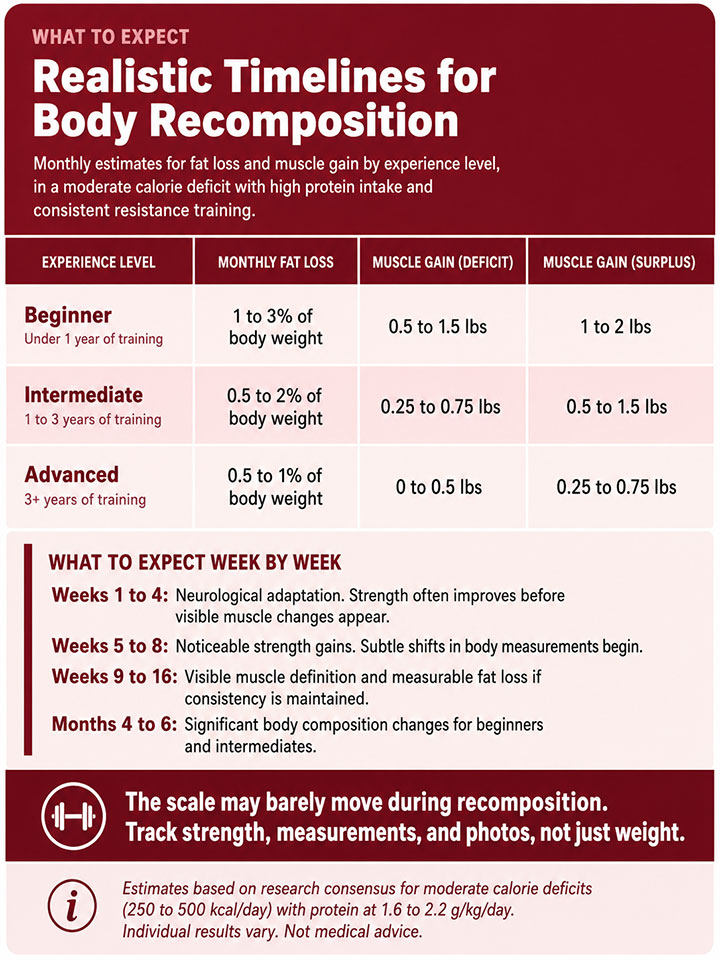
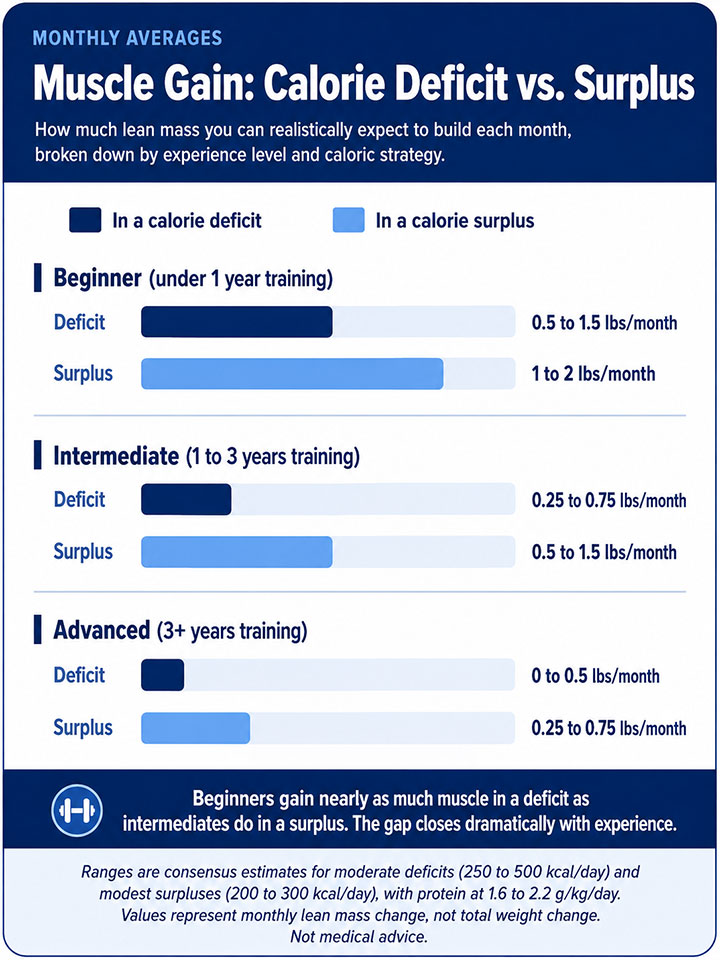
Beginners can typically expect to lose one to three percent of body weight per month in fat while gaining half a pound to a pound and a half of lean mass per month during the first six to twelve months. That is a genuinely significant body composition change in a twelve-month window, more than most people would predict from a calorie deficit alone.
Intermediate trainees see slower muscle gains (roughly a quarter to three-quarters of a pound per month) while fat loss follows a similar curve to beginners at the same deficit. Advanced lifters should primarily expect to maintain muscle while losing fat, with any lean mass gain a bonus rather than a goal.
The first four weeks of a new program will show minimal visible changes. The body is adapting neurologically before it adapts structurally. Strength often improves noticeably in weeks two to four before the muscle itself grows. Staying consistent through this period, when the scale isn’t moving and the mirror hasn’t changed, is where most programs succeed or fail.
How to Track Whether It’s Working
Scale weight is the least useful metric for body recomposition. If you’re losing fat while gaining muscle, the scale might barely move, or might move in the wrong direction from water retention during a new training program. Trusting it as your primary feedback will send you off course.
Better signals: strength performance, body measurements, and progress photographs. If your squat and deadlift numbers are holding or climbing while the scale stays flat, and your waist measurement is dropping while your clothing fits differently across the shoulders, body recomposition is working. A body composition scan every eight to twelve weeks provides the clearest data, but is not essential if the other indicators are tracking in the right direction.
When to adjust: if scale weight drops faster than one percent of body weight per week for more than two consecutive weeks, increase calories slightly. If strength drops consistently across two or more weeks, the deficit is likely too large or recovery is insufficient. Add 100 to 200 calories and reassess sleep before changing anything else.
Common Misconceptions Worth Clearing Up
A few persistent beliefs about calorie deficits and muscle building continue to send people in the wrong direction.
The idea that lifting heavy makes you bulky is not supported by the evidence. Building significant muscle mass requires years of consistent training, a caloric surplus, and in many cases favorable genetics. Lifting challenging weights during a deficit does the opposite of what people fear: it signals the body to preserve and build muscle rather than breaking it down.
Eating every two to three hours is not required. Total daily protein and calorie intake matter far more than meal timing for most people. Three or four protein-rich meals timed to suit your life will serve body recomposition as well as six smaller meals (possibly better), since the larger individual servings more reliably hit the 20 to 40 gram threshold for a maximal muscle protein synthesis response.
Training fasted in the morning is neither essential nor harmful. It works well for some people. It makes others feel weak and produces worse training sessions. The only rule worth following is the one that gets you into the gym consistently and training with adequate intensity.
The Simpler Version
The “eat a surplus to grow, eat a deficit to shrink” model was never wrong, exactly. It was just built for a population where the margins are tight and every calorie decision has a visible consequence. For everyone else, the body is considerably more flexible than that model suggests, especially at the beginning, and especially when body fat reserves give it something to work with.
The most common mistake is not understanding this possibility. The second most common is understanding it but chasing too aggressive a deficit, then wondering why strength is dropping and the mirror isn’t cooperating. Moderate deficit, high protein, consistent training, adequate sleep. Those four things, held together over several months, produce results that the rigid bulking-and-cutting model often doesn’t.
Frequently Asked Questions
Can you build muscle on a 500-calorie deficit?
Yes, particularly if you’re a beginner, have higher body fat, or are returning after a training break. A 500-calorie daily deficit is considered moderate for most people and leaves enough energy available to support training and muscle protein synthesis while promoting fat loss.
Is a 500-calorie deficit too much to build muscle?
At the moderate end, a 500-calorie deficit is workable with high protein intake and consistent resistance training. If performance in the gym declines or strength drops for two or more consecutive weeks, the deficit may be too large for your current starting point. Reduce it by 100 to 200 calories and reassess.
Can you build muscle on 1,500 calories a day?
For smaller individuals and women, 1,500 calories may represent only a moderate deficit and can support body recomposition with sufficient protein. For larger or more active adults, 1,500 calories creates a steep deficit that makes hitting protein targets difficult and reduces training performance. Use it as a starting check: if 1.6 to 2.2 g/kg of protein fits within 1,500 calories without removing the carbohydrate needed to train effectively, the conditions are there.
Can you build muscle on 1,200 or 1,300 calories a day?
At these levels, most adults are approaching their basal metabolic rate. Training performance will be impaired, protein targets are harder to meet alongside adequate training fuel, and muscle preservation becomes very difficult. These calorie levels are generally not appropriate for anyone trying to build or maintain muscle alongside fat loss unless under specific medical supervision.
How big a deficit is too big for muscle building?
As a guideline, deficits beyond 25 percent of maintenance calories start to work against muscle preservation for most people. A declining trend in strength performance over two or more weeks is the clearest practical signal that the deficit is too aggressive.
Am I losing fat or muscle?
The clearest indicators of fat loss are decreasing body measurements (particularly waist) while strength performance is maintained, and clothing that fits differently without significant scale weight change. Muscle loss tends to show as a consistent decline in strength, a “deflated” rather than leaner appearance, and reduced training capacity over time.
What happens if I lift weights but don’t eat enough calories?
Insufficient calories while training can lead to declining strength and performance, poor recovery between sessions, increased injury risk, and eventual muscle loss as the body uses tissue for energy. Hormonal disruptions, particularly reduced testosterone and elevated cortisol, are common with severe or prolonged deficits and compound the problem.
Should I lose fat first or build muscle?
If body fat exceeds roughly 20 percent for men or 30 percent for women, body recomposition is often the most efficient first approach. The fat reserves support the energy demands of muscle building while the deficit drives fat loss. If you’re already relatively lean, alternating between dedicated muscle-building phases (slight surplus) and focused cut phases is typically more efficient for experienced lifters than trying to pursue both simultaneously.
Is lifting on a calorie deficit pointless?
The opposite. Resistance training in a deficit is the primary signal that tells the body to preserve muscle tissue rather than breaking it down for energy. Without it, a calorie deficit primarily produces a smaller version of the same body composition. With it, the deficit reshapes body composition instead of simply reducing it.
Should I eat back my exercise calories?
If your daily calorie target already accounts for your activity level, eating back exercise calories on top of that creates a surplus, not a deficit. If you set your target based on a sedentary calculation and are training hard, eating back some calories (prioritizing protein and carbohydrate) can support training quality and muscle preservation without eliminating the fat-loss effect.