Your muscles aren’t disappearing because you’re getting older. They’re disappearing because your body thinks you don’t need them anymore, but that decision isn’t permanent.
The muscle you have right now is more expensive than you think. Your body runs a constant cost-benefit calculation on every tissue it maintains. Muscle is metabolically demanding: it burns calories at rest, demands upkeep, and requires protein and repair cycles. And when your brain decides you no longer need a particular physical capacity, it stops paying for it.
That is the actual mechanism behind age-related muscle loss. Not time, and not fate. Disuse. The body concludes that a muscle group is no longer needed and withdraws its investment. What most people call “getting weak with age” is largely the body doing exactly what it was designed to do: cutting unnecessary expenditure.
The good news is that this logic runs in both directions. Demand the capacity again, and the body begins rebuilding. Research on adults aged 85 to 97 (people who had never strength-trained before) found strength gains of 37 to 47 percent after twelve weeks of resistance training. The body does not check your age before responding to demand.
The Biology of Reversal: Why This Works
Your muscles follow a clear use-it-or-lose-it logic, but the details of what goes first matter more than most people realize. The first fibers to disappear are not the endurance fibers (the slow-twitch ones that carry you through a long walk). Those are relatively durable. What vanishes first are the Type II fast-twitch fibers, the ones that fire in a fraction of a second.
These are the fibers that catch you when you stumble. They are what let you spring out of a chair, react to a curb you didn’t see, or steady yourself on an uneven surface. When people describe feeling like they “move differently” after 60, this is usually what they are feeling: not a general loss of strength so much as the disappearance of reactive speed. The implication is stranger than it sounds.
The exercises in this article were chosen specifically to address this deficit. Chair squats, split squats, explosive push-up phases: each of them demands a fast force production component that slow-twitch training doesn’t reach.
What You’re Really Fighting: The Numbers Behind Muscle Loss
Sarcopenia progresses at different rates depending on activity level. For people who do nothing, the progression looks roughly like this: a loss of 3 to 5 percent of muscle mass per decade between ages 30 and 50, accelerating to 5 to 8 percent per decade through the 50s, and reaching 8 to 15 percent per decade after 60. By age 75, total muscle loss can approach 30 to 50 percent of peak muscle mass for sedentary adults.
These figures describe inactivity, not aging itself. Active adults maintain substantially more muscle at every age group than these averages suggest. The rate is not fixed.
How to Tell If You’re Losing Muscle
Muscle loss symptoms are often subtle before they become obvious. Watch for noticeable shrinking or softening of the arms or legs, persistent weakness during tasks that used to feel routine, slower recovery after physical activity, and balance problems that weren’t there before. A simple self-test: time yourself standing from a chair without using your arms five consecutive times. Under 11 seconds is normal. Over 15 seconds warrants attention.
Can You Get Back Muscle You Have Lost?
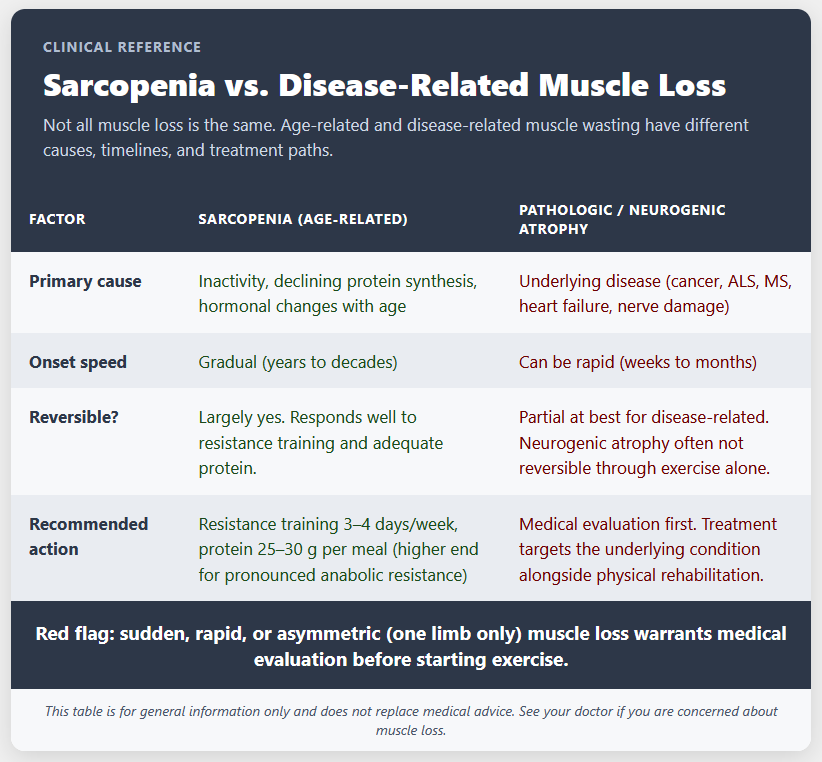
For most people, yes. Disuse atrophy (the muscle loss caused by inactivity or reduced demand) is largely reversible with consistent resistance training. Neurogenic atrophy, caused by nerve damage or disease, is a different situation and generally not reversible through exercise alone. If muscle loss is sudden, asymmetric (one limb noticeably smaller than the other), or accompanied by pain or neurological symptoms, that warrants a medical evaluation before starting a training program.
What Illness Makes You Lose Muscle?
Sarcopenia is a normal aging process. But several medical conditions accelerate or mimic muscle loss independently of age. Cancer cachexia causes rapid whole-body muscle wasting driven by inflammation and altered metabolism. Multiple sclerosis, ALS, and other neuromuscular diseases cause neurogenic atrophy by disrupting the nerve signals that maintain muscle tone.
Chronic conditions including heart failure, COPD, and type 2 diabetes are also associated with accelerated muscle loss. If weight loss and muscle wasting are happening simultaneously and you are not dieting, see a doctor. That pattern is a red flag that goes beyond normal sarcopenia.
The Bodyweight Advantage
Gym equipment has a useful illusion: it makes resistance feel measurable and serious. But when you lower yourself slowly into a chair, you are lifting your entire body weight against gravity. That is real load. Your muscle fibers cannot distinguish between a barbell and your own mass.
Bodyweight training offers something gym machines do not: it trains your muscles for the actual demands of your environment. A leg press machine locks you onto a fixed plane. A split squat forces you to stabilize through your hips, ankles, and core in three dimensions, the same demand your body faces on a staircase.

The 5-Move “Anti-Aging” Circuit
Perform each exercise for one minute: 45 seconds of work, 15 seconds of transition. Complete the circuit twice. That is your ten-minute routine. Start where you are. Progress when the last few reps stop feeling difficult.
1. The Chair Squat (Sit-to-Stand)
What it targets: Legs, glutes, core
Here is a useful diagnostic before you begin. Can you get out of a chair without using your hands? Can you rise from a car seat? Can you use a low toilet without gripping the wall? These are not small tests. They are the difference between living independently and needing daily assistance from another person.
The chair squat is the most functionally predictive exercise in this list. A 2025 systematic review and meta-analysis in Aging Clinical and Experimental Research, covering 24 randomized controlled trials and 951 participants, found that resistance training significantly improved the five-times sit-to-stand test performance in older adults with sarcopenia, a direct measure of this exact movement pattern.
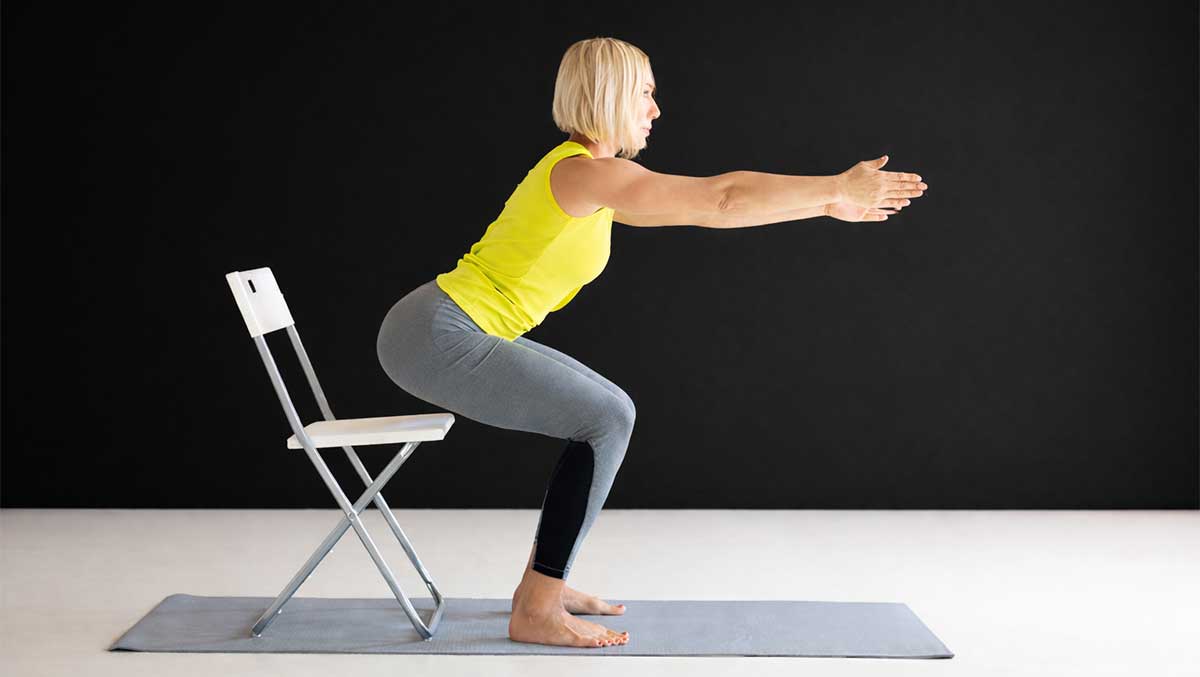
How to do it:
- Stand in front of a sturdy chair with feet hip-width apart.
- Lower yourself slowly, counting three seconds on the way down.
- Tap your bottom to the seat. Do not sit. Keep weight through your heels.
- Stand back up with a quick, strong push. The upward phase should feel explosive.
- Keep your chest up and your knees tracking over your toes throughout.
The downward count matters. Slower lowering increases time under tension, which is the actual driver of muscle adaptation, not the number of reps.
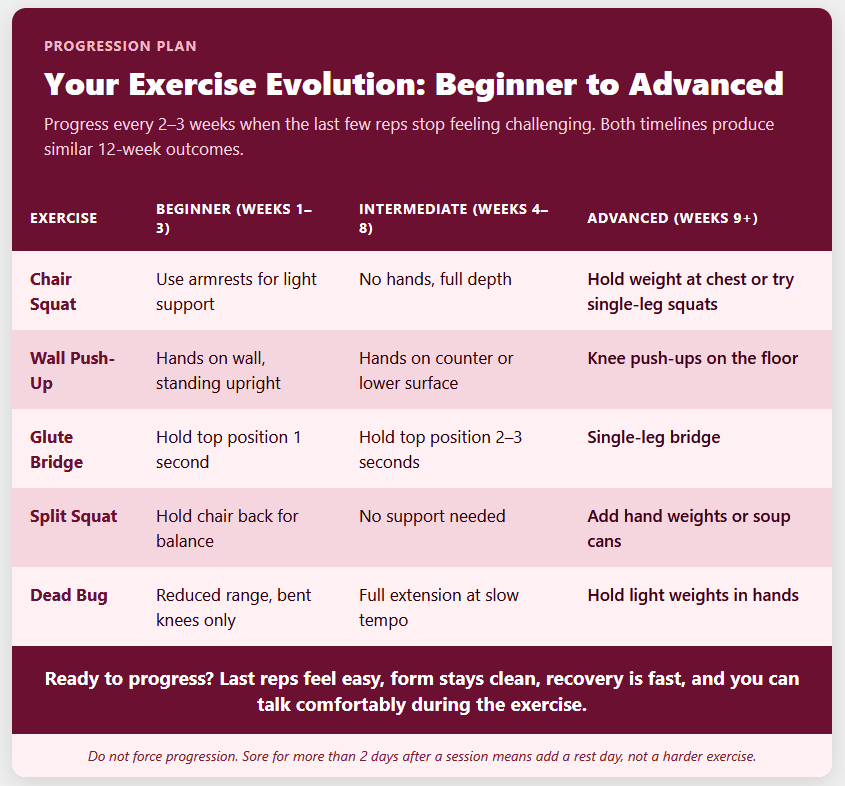
Make it easier: Use the armrests for light support. Touch them, do not lean on them.
Make it harder: Remove the chair. Squat to where the chair would be, or hold a water jug at your chest.
2. The Wall “Power” Push-Up
What it targets: Chest, shoulders, arms, wrists
Upper body strength barely gets mentioned in fall-prevention discussions, which is odd, because when you trip forward, your arms are what stand between you and the floor. The standard response to a forward fall (extending both hands, absorbing impact, redirecting momentum) requires a decent amount of pressing strength. That is exactly what the wall push-up builds.
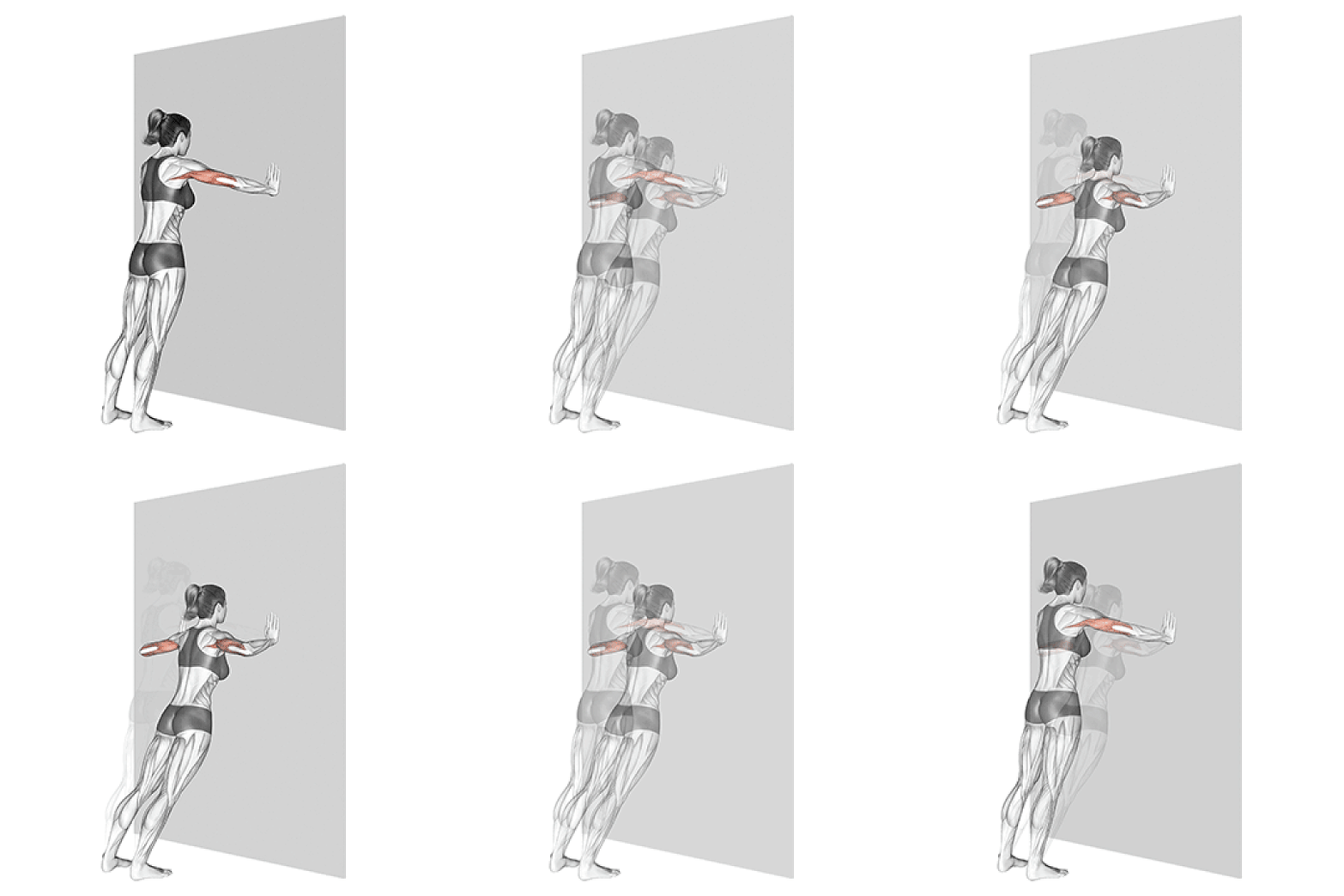
How to do it:
- Stand an arm’s length from a wall, hands flat at shoulder height.
- Step your feet slightly back so your body forms a straight line from head to heels.
- Bend your elbows and lower your chest toward the wall. Your nose should almost touch.
- Push back explosively. Feel your chest muscles contract at the top.
- Keep your core tight and hips in line throughout. Do not let them sag.
Make it easier: Stand closer to the wall. A more upright angle reduces the load considerably.
Make it harder: Move to a kitchen counter or a sturdy table. The lower the surface, the greater the demand.
3. The Glute Bridge Hold
What it targets: Glutes, hamstrings, lower back
Sitting switches off the glutes. Hours of inactivity per day train your nervous system to stop recruiting these muscles automatically, and the glutes are the largest, most powerful muscle group in the lower body. Weak glutes create a chain of consequences: altered pelvis position, compressed lumbar discs, reduced power on stairs, and a characteristic forward lean that most people associate with “walking like an old person.”
Strong glutes stabilize the pelvis, offload the spine, and power uphill movement. The exercise to rebuild them is simpler than most people expect.
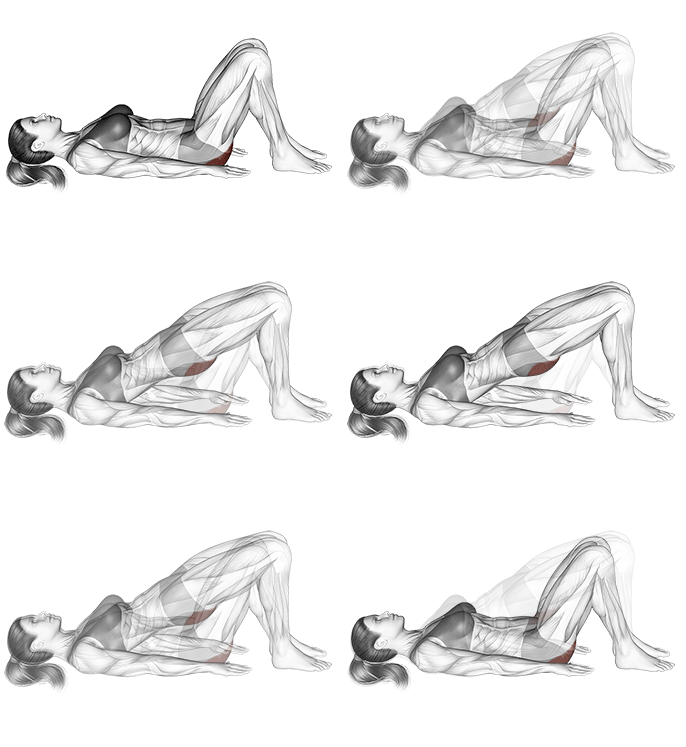
How to do it:
- Lie on your back with knees bent, feet flat on the floor hip-width apart, heels close to your bottom.
- Squeeze your glutes before you lift. This is a glute exercise, not a hip flexor exercise. Initiate from the glutes.
- Lift your hips until your body forms a straight line from shoulders to knees.
- Hold for two seconds at the top. Feel the contraction in your glutes, not your lower back.
- Lower slowly. Do not let your hips drop. Control the descent.
Make it easier: Hold the top position for only one second. Focus on the squeeze rather than the height.
Make it harder: Single-leg bridge. Keep one foot on the floor and extend the other leg straight. Lift using one leg only. This version doubles the demand and challenges lateral stability.
4. The “Grocery Carry” Lunge (Stationary Split Squat)
What it targets: Legs, hips, balance
Life runs on one leg. Stepping up a curb, climbing stairs, walking across uneven ground: all of it requires single-leg stability that bilateral exercises (like regular squats) simply do not train. Most people also have meaningful strength differences between their left and right legs that they are not aware of until a balance test exposes them.
The split squat closes this gap. It also mimics the exact demand of carrying bags from a car, hence the name. Heavy bilateral loading makes you feel strong in a gym. Loaded single-leg work makes you functional in a parking lot.
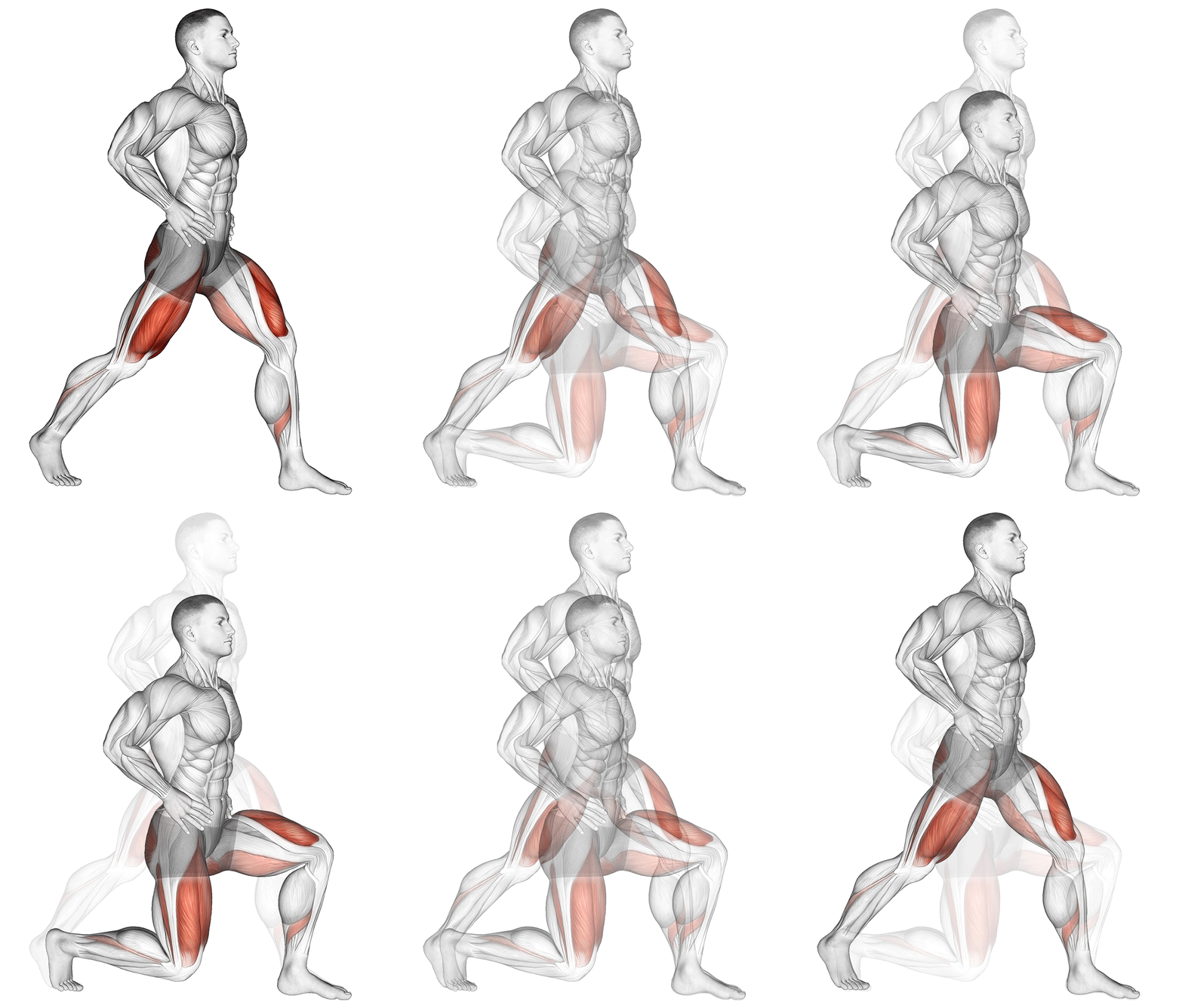
How to do it:
- Stand tall. Step one foot forward, the other back. This is your starting position.
- Drop your back knee straight down toward the floor. Keep your front shin vertical.
- Do not let your front knee travel past your toes.
- Push back up through your front heel.
- Work 30 seconds on one leg, then switch immediately for the remaining 30 seconds.
Make it easier: Hold the back of a chair for balance. Touch it only for stability, not to offload weight.
Make it harder: Hold soup cans or water bottles at your sides. The added resistance simulates carrying groceries and raises the demand on your legs and grip.
5. The Dead Bug (Core Stability)
What it targets: Deep abdominals, spinal stabilizers
This is the most technically demanding exercise in the circuit, and the one most people get wrong initially. The dead bug is not a crunch. It does not load the spine into flexion. It trains the deep muscles that hold your spine in a stable, neutral position while your limbs are moving, which is exactly the demand your body faces during every activity you do standing up.
Most people discover two things the first time they attempt it: their lower back lifts off the floor (which means the core is not doing its job), and the coordination between opposite arm and leg is harder than it looks. Both are normal. The correction for both is the same: slow down and reduce the range of motion until you can maintain contact between your lower back and the floor.
Researchers still don’t agree on exactly which deep core muscles are primary drivers here, but the pattern of spinal stability produced by this movement has been consistently associated with reduced back pain in older adults.
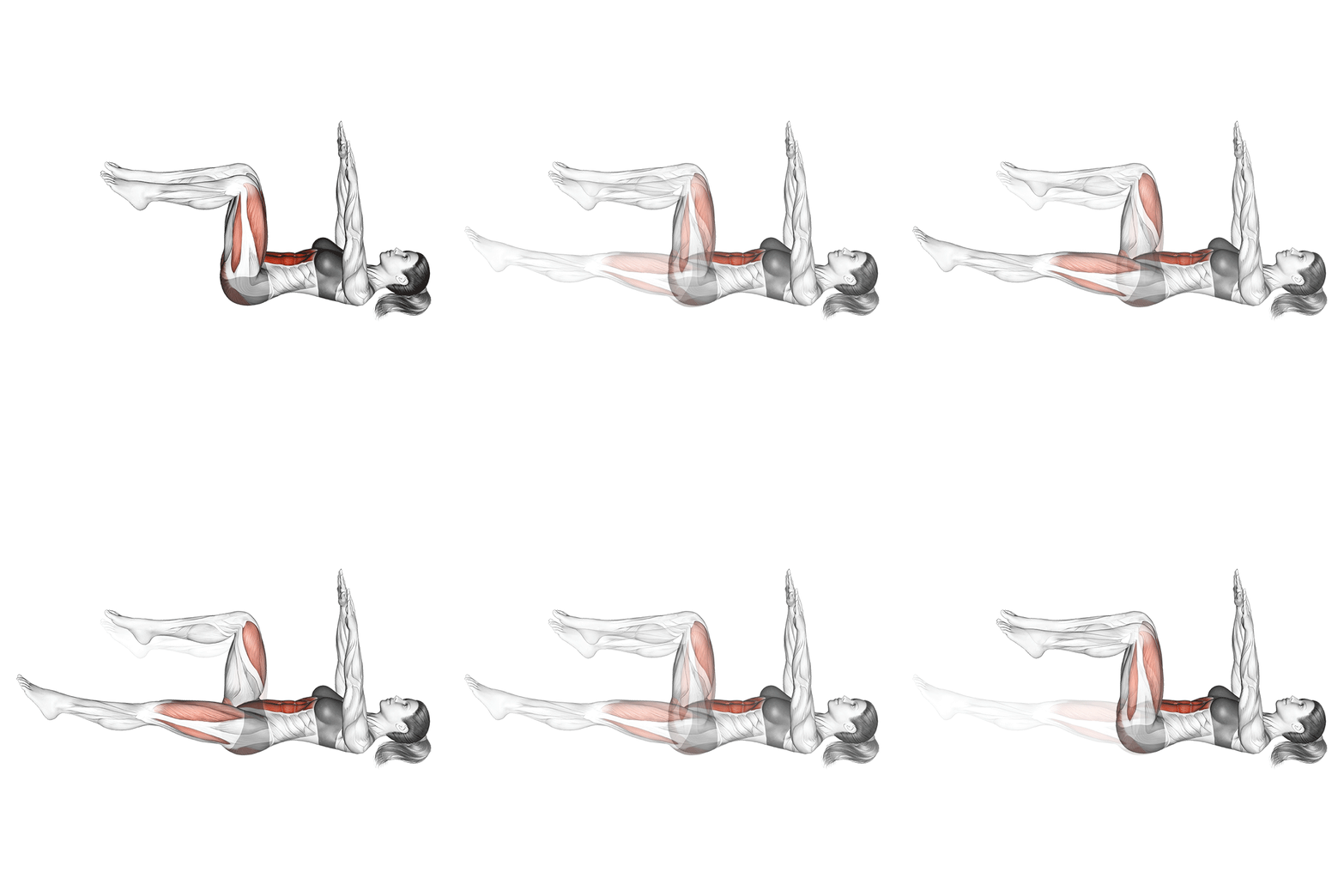
How to do it:
- Lie on your back. Extend both arms straight toward the ceiling. Lift your legs, bending knees to 90 degrees. Your shins should be parallel to the floor.
- Press your lower back firmly into the floor. Maintain this contact throughout.
- Slowly extend your right arm overhead while straightening your left leg toward the floor. Lower both until they are just above the floor.
- Return to the starting position. Switch sides.
- Move slowly. Control is the entire point.
If your lower back lifts off the floor, stop there. Shorten the range of motion. You do not need to reach full extension to get the training effect. Half extension with a flat back is worth far more than full extension with an arched one.
Three Rules That Determine Whether This Works
The exercises above are the easy part. Most people who start a home routine and abandon it within a month don’t quit because the movements were too hard. They quit because they misunderstood what was actually producing results, and when the visible changes didn’t arrive on the timeline they expected, they assumed they were doing something wrong.
Rule 1: The Last Few Reps Must Be Hard
If you finish a set feeling completely fresh, nothing productive happened. Muscle adaptation requires the fibers to be pushed beyond what they can comfortably handle. That is the signal that triggers growth.
A 2017 meta-analysis in the Journal of Strength and Conditioning Research examined 21 studies comparing low-load and high-load training and arrived at a finding that cuts against what most gym-goers assume: the weight on the bar did not determine muscle growth outcomes. Effort at the end of the set did. When participants trained to failure, light loads and heavy loads produced comparable hypertrophy.
This is good news for anyone training with body weight. The key is reaching the point where the last two or three reps genuinely challenge you. When the exercise stops feeling difficult, the adaptation has already happened. Progress to a harder version.
Rule 2: Protein Does More Work Than the Exercise Does
Exercise breaks down muscle tissue. Protein rebuilds it. Without sufficient protein, the training signal produces no structural change because your body has no raw material to work with.
After 50, this relationship gets more complicated. Aging is associated with a reduced muscle protein synthetic response to protein intake, a well-documented phenomenon called anabolic resistance, in which the threshold for triggering muscle protein synthesis rises.
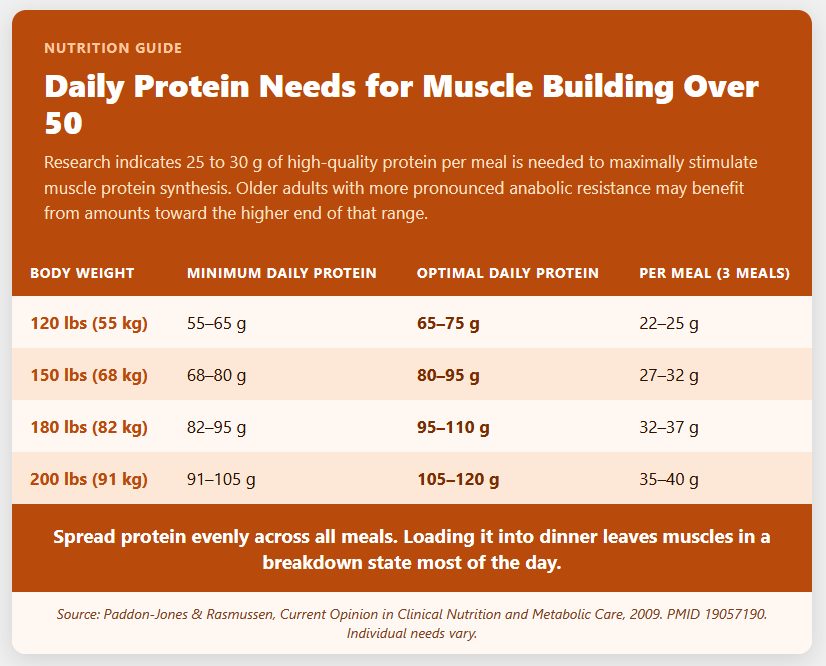
Research in this area indicates that approximately 25 to 30 grams of high-quality protein per meal is needed to maximally stimulate muscle protein synthesis in both younger and older adults, with subsequent work suggesting that older adults with more pronounced anabolic resistance may benefit from amounts toward 30 to 40 grams per meal.
Distribute that intake across meals rather than loading it into one. The body can only process so much protein for muscle-building purposes at one sitting.
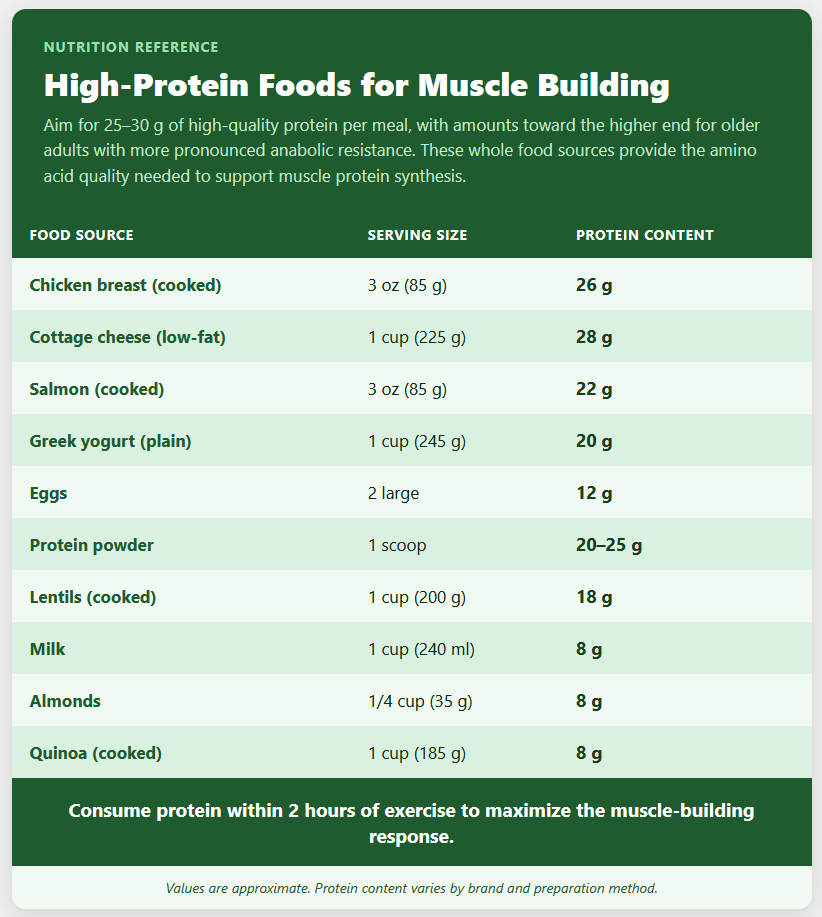
Personalized Protein Calculator
Calculate your daily protein needs for muscle building after 50
Your Personalized Protein Plan
A post-workout snack within two hours of exercising increases the muscle protein synthesis window. Greek yogurt with berries, a couple of eggs on whole grain toast, or a serving of cottage cheese with fruit all work. Protein powder is a convenient option when whole food sources are impractical, but it is not required.
Rule 3: Muscles Grow While You Sleep
The training session is the stimulus. Sleep is when the adaptation happens. Growth hormone, the primary repair signal for muscle tissue, is released during slow-wave sleep, and its secretion declines with age, which is part of why recovery takes longer as you get older.
Seven to eight hours per night is the minimum for meaningful recovery. If you are consistently sore for more than 48 hours after a session, that is not a training problem. It is a recovery problem. Add a rest day before adding a harder exercise.

What to Expect: A Realistic Timeline
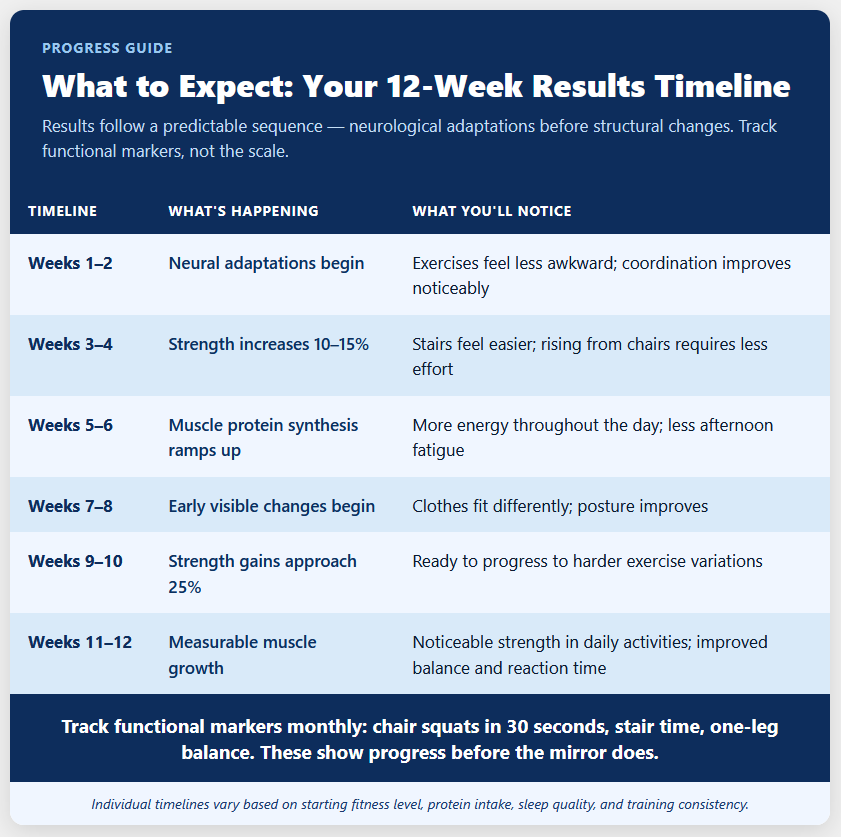
The first month will not look like progress. It will feel like it. The initial gains from resistance training are almost entirely neurological: your brain learns to recruit muscle fibers more efficiently before the fibers themselves change.
That includes the fast-twitch Type II fibers introduced earlier. Your nervous system is essentially relearning to access them. You will get stronger without getting bigger. Stairs will feel easier. Rising from chairs will require less effort. These are real adaptations. They just don’t photograph well.
Visible muscle changes begin appearing around weeks seven to eight for most people. By week twelve, measurable strength improvements of 25 percent or more are well within range for adults who start at low baseline fitness levels.
The timeline varies. People who have maintained any level of physical activity throughout their life tend to respond faster than complete beginners, because the neuromuscular pathways are still partly intact.
Track the right things. The scale is not useful here, since muscle is denser than fat. Track functional markers instead: how many chair squats you can complete in 30 seconds, whether you can manage a flight of stairs without gripping the railing, how long you can stand on one leg. These measurements show progress when the mirror doesn’t yet.
Common Mistakes (And How to Avoid Them)
Most of these mistakes share a common logic: they substitute the feeling of effort for the mechanics of it. Speed feels like work. Soreness feels like progress. Daily training feels like commitment. None of these sensations map reliably to the adaptations you are actually after.
Moving too fast is the most widespread error. In resistance training, speed actively works against you. The lowering phase (called the eccentric phase) is where much of the muscle damage and subsequent growth signal comes from. Rushing through it eliminates most of the benefit. Count three seconds down on every squat and bridge. Let the movement take up space.
Staying comfortable is the second mistake. An exercise that no longer challenges you is an exercise that no longer produces results. Once the last few reps feel easy, progress to a harder version. This should happen every two to three weeks in the early months. If it is not happening, you are not working hard enough at the end of the set.
The third common error is daily training without rest days. Muscle is not built during exercise. It is built during rest. Training the same muscle groups every day without a recovery gap between sessions slows progress and increases injury risk. Three to four days per week with 48 hours between sessions is the research-backed schedule for most adults.
Breath-holding during effort spikes blood pressure and causes dizziness. The pattern is simple: breathe out during the hard phase (standing up, pushing away), breathe in during the easy phase (lowering down). Make it rhythmic and it becomes automatic within a few sessions.
One distinction that matters: muscle burn is appropriate feedback. Joint pain is not. Sharp or stabbing pain in a knee, shoulder, or wrist during a movement is a signal to stop, not a signal to push through. Modify the exercise (a narrower stance on the squat, a closer wall position on the push-up) and if the pain persists, ask a physiotherapist before continuing.
When to Progress: Your Exercise Evolution
The signs that you are ready to progress are fairly consistent across exercises: you complete all reps with good form, the last few reps do not challenge you, you can hold a conversation during the exercise, and you recover within 30 seconds of finishing. When all four are true, move to the next level.
The signs that you should stay at your current level are equally clear: your form breaks down in the final reps, you are excessively sore for more than two days afterward, or you cannot complete the full working interval. Both progressions are valid. Some people advance in two weeks. Others spend six weeks at each level. The outcome at week twelve is similar either way.
Lifestyle Factors That Accelerate Results
Several factors outside the gym change how efficiently the body responds to training, and one of them is more consequential than most people realize.
Vitamin D functions more like a hormone than a vitamin in the context of muscle health. Low levels are associated with reduced muscle strength and increased fall risk, and deficiency is common in adults over 50, particularly in the northern hemisphere during winter.
Getting levels checked (and supplementing to reach 30 to 50 ng/mL if deficient) is worth considering. This is not about megadosing. It is about correcting a gap that directly affects muscle function. The evidence here is not conclusive but is consistent enough to warrant attention.
Chronic inflammation slows muscle protein synthesis. A diet with consistent vegetables, fatty fish twice a week, and limited processed foods addresses the most common dietary inflammation drivers.
Stress management matters here too, because sustained cortisol elevation is catabolic, meaning it breaks down muscle tissue. This is not a call for perfection. It is a reason why the lifestyle context around training matters alongside the training itself.
Hydration affects strength output more than most people appreciate. Even mild dehydration reduces force production during resistance exercise. Pale yellow urine throughout the day is a reliable enough field test. Dark yellow means drink before the next session.
Sample Weekly Schedule: Three Options
If you are not sure where to start, Option 2 is the most sustainable starting point for most adults. A consistent three-day week builds the habit without creating enough soreness to discourage the next session.
Option 1: Every other day. Monday, Wednesday, Friday, Sunday. Four sessions per week, consistent recovery time between each. Good for people who prefer routine and want maximum frequency.
Option 2: Three-day week. Monday, Wednesday, Friday. Three sessions with a full weekend off. The recommended starting point for most people, especially those returning to exercise after a long break.
Option 3: Extended sessions. Monday, Wednesday, Friday with three rounds (15 minutes) instead of two. This option produces faster results for people who have more time and want to push the early progress curve.
Pick one and hold it for four weeks before evaluating whether to change anything. The first four weeks are about building the habit more than optimizing the protocol.
Conclusion
The fast-twitch fibers that disappeared were not lost to time. They were lost to disuse, which means the demand that triggers their return is available to anyone who applies it consistently. You do not need to restore your peak athletic capacity.
You need enough Type II fiber activity to catch yourself when you stumble, enough leg strength to get off a chair without thinking about it, enough upper body reserve to push through a stuck door. That is a surprisingly achievable target, and ten minutes three times a week is a reasonable starting point for getting there.
FAQs
Can I really build muscle in just 10 minutes a day?
Ten minutes daily helps maintain muscle and slow age-related loss, and it is a solid starting point for building the habit. For optimal muscle growth, most people benefit from 60 to 90 minutes of resistance training spread across two to three sessions per week. Start with ten minutes. Progress the duration when the habit is established.
How soon will I see results?
Strength improvements typically begin within two to three weeks as your nervous system adapts. Visible muscle changes take eight to twelve weeks. Functional improvements (easier stairs, less effort from chairs) often appear before either of those.
What if I have arthritis or joint pain?
Modify the exercises before abandoning them. A higher chair for squats, a closer wall position for push-ups, a reduced range of motion on any movement: these adjustments make a meaningful difference. Gentle movement often reduces arthritis-related stiffness. Check with your doctor or physiotherapist before starting if you have an existing joint condition, and ask them to watch your form on the modifications.
Should I do this every day?
No. Muscles require 48 hours of recovery between resistance training sessions. Three to four days per week is the research-backed target for older adults. Monday, Wednesday, Friday works well. Adding Sunday gives you four sessions without violating the recovery window.
I can barely do 5 reps of some exercises. Is that okay?
Yes. Five reps with good form are substantially more valuable than fifteen reps with poor form. Add one rep each week. In a month you will double your starting number. The rate of early progress in beginners is consistently faster than people expect, precisely because the nervous system improvements happen quickly.
Can women do these exercises, or are they just for men?
These exercises work for every adult. Women experience sarcopenia on the same timeline as men, driven by the same mechanisms. Bodyweight resistance training does not produce the bulk associated with heavy weight training. It produces functional strength and improved muscle tone.
What if I miss a few days?
Get back to it on the next available day. Muscle loss from detraining is slower than muscle gain from training, so a week off does not erase meaningful progress. Consistency over months matters far more than any individual missed session.
Do I need supplements or protein powder?
Supplements are not required. Eggs, chicken, fish, Greek yogurt, beans, and cottage cheese all provide the protein quality needed to support muscle growth. Protein powder is convenient when hitting your daily target from whole food sources is difficult. It is a practical tool, not a necessary one.
I’m 75 years old. Am I too old to start?
The same study cited at the top of this article (Kryger and Andersen, Scandinavian Journal of Medicine and Science in Sports, 2007) examined adults aged 85 to 97 who had never trained before.
After twelve weeks of resistance training, they showed strength gains of 37 to 47 percent and measurable muscle size increases. The body’s adaptive capacity does not disappear. It slows. Start with the easiest versions of each exercise and progress based on how you respond.