Think optimism is the secret to resilience? The research suggests otherwise. One trait showed the strongest link to resilience across the factors studied.
The standard advice for building psychological toughness is to stay positive. Think optimistically. Look on the bright side. The problem with that advice is that when researchers actually rank the traits most strongly linked to resilience, optimism comes in fourth. What comes in first may not be what you’d guess.
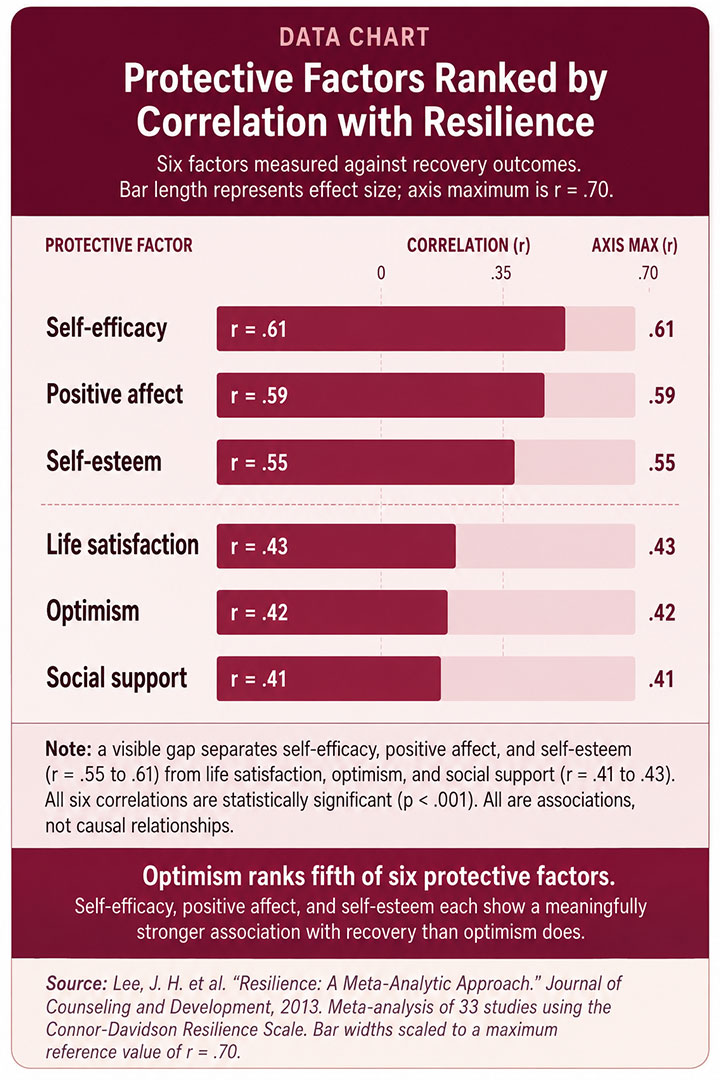
A meta-analysis published in the Journal of Counseling and Development identified six key protective factors and measured their individual effect on psychological resilience. Self-efficacy, the belief that your actions actually change outcomes, ranked highest of all of them. Optimism followed it, but not before positive affect and self-esteem.
People who have faced real difficulty tend to recognize something like this, even if they never had a name for it. You keep functioning, so everyone around you assumes you’re fine. What the popular articles tend to skip is what’s actually doing the work underneath.
The nine characteristics below are drawn from systematic reviews and large-scale research on what predicts recovery, adaptation, and growth after hardship. They’re not fixed personality types. They are patterns that appear consistently in people who get through hard seasons intact, and most of them can be built.
The research points to nine recurring characteristics. In no particular order of importance:
- A high sense of self-efficacy
- Cognitive flexibility
- Emotional regulation
- Strong social connections
- A problem-solving orientation
- Acceptance of difficult realities
- Cautious optimism
- Physical self-care
- The ability to find meaning
What the Research Actually Measures
When psychologists measure resilience, they’re looking for one specific outcome: does a person maintain or regain good psychological functioning in the face of meaningful stress? Not whether they avoid pain, and not whether they look fine from the outside.
One of the largest analyses to date, a 2025 systematic review published in Nature Mental Health that covered 193 longitudinal studies and more than 805,000 participants across three decades, found that the factors predicting this outcome divide into two categories.
Internal resources, things like problem-solving ability, self-efficacy, and a sense of hope, work alongside external supports such as close relationships, stable environments, and perceived social connection. Both matter. Neither operates well alone.
The nine traits below fall on both sides of that divide.
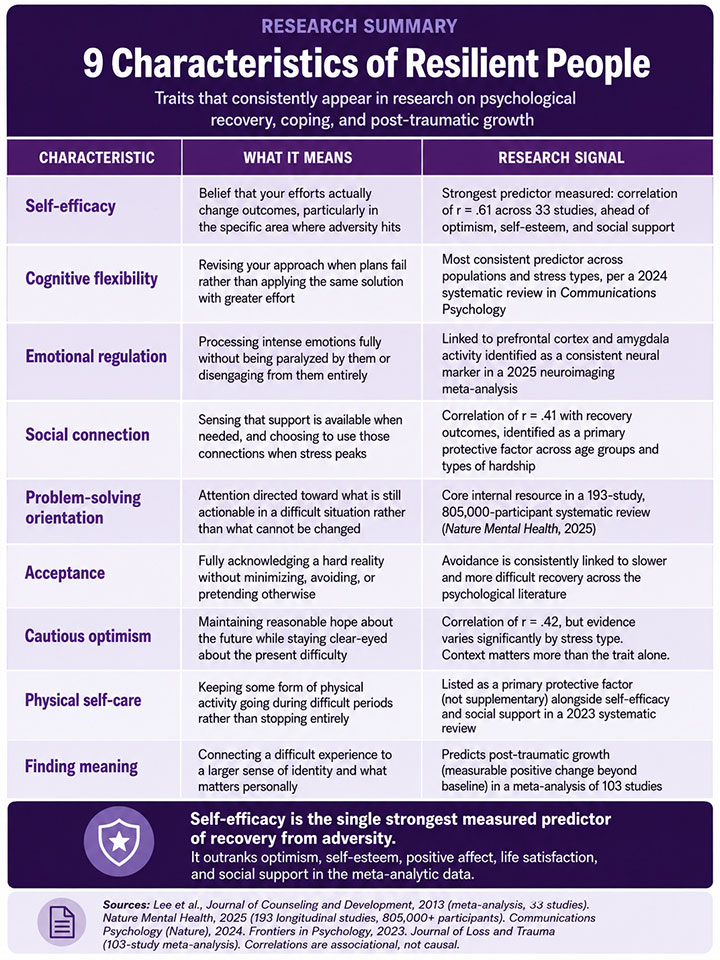
1. A High Sense of Self-Efficacy
Self-efficacy is the belief that your efforts actually produce results. It is distinct from confidence, and it is not the same as self-esteem. A person can think well of themselves and still doubt that their actions change anything in the world around them.
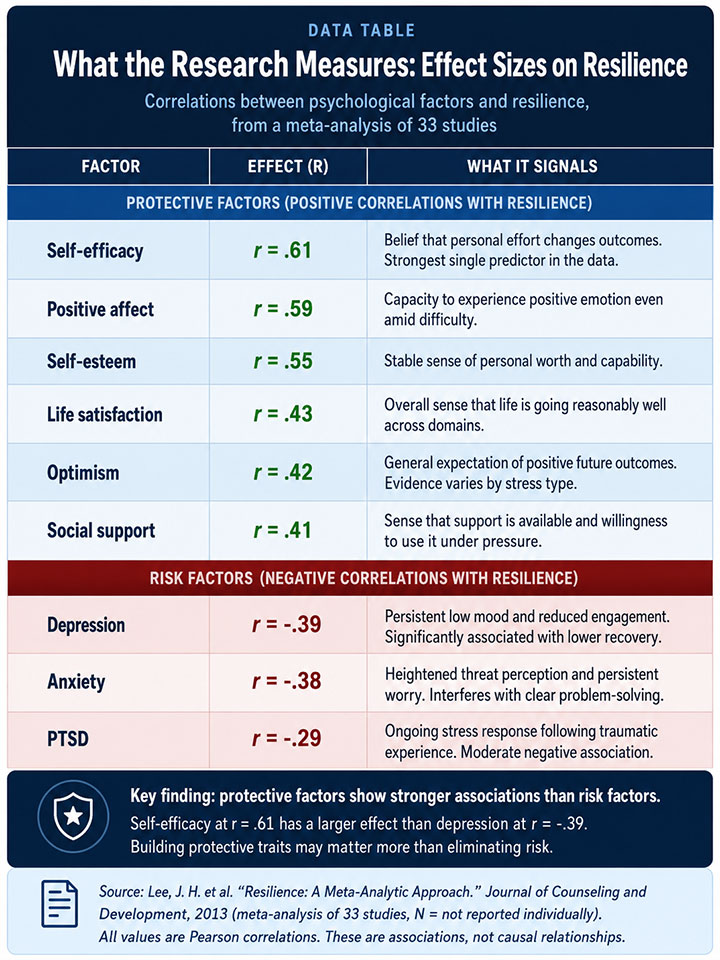
The Journal of Counseling and Development meta-analysis calculated the correlation between self-efficacy and resilience at r = .61, the highest of any factor tested. Positive affect followed at r = .59, self-esteem at r = .55, life satisfaction at r = .43, optimism at r = .42, and social support at r = .41.
The gap between self-efficacy and everything else is small in absolute terms but consistent across the 33 studies in the sample. People who believe their actions matter tend to show stronger recovery from adversity than those who don’t, regardless of how positive their mood happens to be.
The practical implication is narrower than it sounds. Self-efficacy doesn’t need to be global to have an effect. High self-efficacy in the specific domain where adversity hits, whether that’s professional setbacks, health challenges, or relationship strain, appears to be what actually predicts outcomes. It’s less “I can handle anything” and more “I can handle this.”
2. Cognitive Flexibility
Rigid thinking, locking onto one explanation for why something happened or one strategy for fixing it, is one of the clearest signals of poor recovery. People who manage adversity well tend to hold their interpretations loosely. They revise plans when circumstances shift rather than forcing the same approach onto a changed situation.
A 2024 systematic review published in Communications Psychology found that cognitive emotion regulation and cognitive flexibility produced the most consistently favorable outcomes across different populations, different types of adversity, and different measurement approaches.
Effect sizes were described as small in many cases, but the consistency across studies was higher than for factors like optimism or active coping, which both showed weaker or more mixed patterns. The finding took researchers some time to move away from the conventional positivity narrative. Flexible thinking, it turns out, matters more than positive thinking.
3. Emotional Regulation
Managing intense emotion does not mean suppressing it. Research draws a clear distinction between people who are emotionally regulated and people who appear emotionally flat. The former feel the full weight of difficult situations and still maintain enough control to think and act. The latter may appear calm because they are disengaged, which is a different outcome and not a healthy one.
Emotional regulation shows up in the literature as both a trait and a skill that responds to practice. People with stronger regulation capacity can sit with fear or grief without being paralyzed, and they return to clearer thinking faster after an emotional peak. The mechanism runs through the prefrontal cortex’s ability to modulate activity in the amygdala, a pathway that is measurable on brain imaging and that a 2025 neuroimaging systematic review and meta-analysis identified as one of the three consistent neural markers of psychological resilience across psychiatric conditions. Worth knowing it exists.
4. Strong Social Connections
Perceived social support, the sense that the people around you would actually show up if things got bad, correlates with resilience at r = .41 in the meta-analysis data. That number separates “having relationships” from “believing those relationships are available when you need them.” The belief matters independently of how many contacts are in your phone.
People who come through adversity intact tend not to handle it alone. A 2023 systematic review published in Frontiers in Psychology identified social and family support as among the most consistent protective factors across age groups and types of hardship, alongside physical activity and self-efficacy. The review covered school-based interventions in adolescents, which limits direct generalizability to adult populations, but the pattern aligns with the larger body of evidence on adult resilience. What shows up again and again is social willingness, not breadth of network: the choice to use available connections rather than withdraw from them when stress peaks.

5. A Problem-Solving Orientation
People with strong coping capacity tend to look for what is actionable in a bad situation rather than cataloguing what went wrong. That’s a consistent behavioral pattern, not blind optimism: when conditions are difficult, where does attention go? Toward what can no longer be changed, or toward what still can?
Problem-solving as a protective quality appears across the research in different forms. In the Nature Mental Health 2025 review, it appears under the broader category of internal resources, alongside self-efficacy and optimism. What the 2024 Communications Psychology review adds is a nuance worth preserving: active coping alone, without the flexibility to change strategies when the first approach fails, does not consistently predict good outcomes. The combination matters. Trying the same solution harder when it isn’t working is rigidity wearing the clothing of effort, not problem-solving.
6. Acceptance of Difficult Realities
Avoidance (refusing to acknowledge a difficult situation) tends to make most adversity harder and longer. People who process difficult news quickly and accept their new situation without minimizing or pretending tend to move through difficulty faster than those who resist the reality for weeks or months after it becomes clear.
Acceptance here does not mean approval, and most people understand that intellectually. What the research doesn’t fix is the emotional logic that makes the two feel the same in the middle of something genuinely bad. A person can know, consciously, that accepting a situation is not the same as deciding it was okay, and still resist it for months because it feels like betrayal. That gap between knowing and doing shows up in this literature more than almost any other. It is not a character flaw.
7. Cautious Optimism
Optimism appears in almost every popular list of traits associated with strong recovery, and the data supports its inclusion. The meta-analytic correlation is r = .42. The caveat is that the 2024 Communications Psychology systematic review found the evidence for optimism as a predictor of favorable recovery outcomes to be inconsistent across studies. In some cases the association was favorable. In others it pointed to null or even unfavorable effects, depending on the type of stress and the demands it placed on the person’s thinking.
The honest picture is that optimism helps under many circumstances and doesn’t help under all of them. People who maintain reasonable hope about the future while staying clear-eyed about the present difficulty tend to fare better than committed pessimists, and also better than people who use positive thinking to avoid confronting what is actually happening. The distinction matters. Researchers still don’t fully agree on why optimism has such a context-dependent effect, which is itself worth knowing before treating optimism as a reliable trait to rely on.
8. Physical Self-Care
Physical activity is one of the most consistently overlooked factors in the research. The 2023 Frontiers in Psychology systematic review listed it alongside social support and self-efficacy as a primary protective factor in the resilience process, not a supplementary one.
The mechanism runs through multiple pathways: activity reduces physiological stress reactivity, supports emotional regulation through neurobiological channels, and tends to protect sleep quality. Sleep is one of the most consistent predictors of how well a person copes with difficulty in the following day, week, and month. People who maintain some form of physical activity during hard periods tend to preserve more coping capacity than those who stop entirely. What the research doesn’t explain cleanly is why people who have historically exercised regularly are the ones most likely to stop when things get hard, precisely the moment when maintaining the habit would matter most. That pattern is in the data. Nobody’s fully satisfied with the explanations for it yet.
9. The Ability to Find Meaning
People who come through adversity intact often do more than return to their previous state. A meta-analytic review of 103 studies published in the Journal of Loss and Trauma found that optimism, social support, and coping strategies each independently predicted post-traumatic growth: measurable positive change in how people understood themselves and their situation following hardship, not merely a return to baseline.
Finding meaning in a difficult experience doesn’t require deciding the experience was good or that the pain was worth it. It means being able to place the experience inside a larger story about who you are and what matters to you. People who manage to do this tend to carry their hard experiences differently than those for whom an event remains unintegrated, a wound that never became part of anything. Whether that integration is driven by deliberate reflection, religious framework, therapy, or conversation with people who know them, the outcome in the research is the same.
What Low Resilience Looks Like
The same research that identified protective factors also measured risk factors. Anxiety correlated with lower resilience at r = -.38, depression at r = -.39, and PTSD at r = -.29 in the meta-analytic data. These are not surprising associations, but they clarify something worth saying plainly: lower coping capacity tends to appear alongside specific psychological states, most of which are responsive to the right kind of support. It is not a fixed trait or a character flaw.
Behavioral signs include withdrawing from relationships when stress peaks, locking onto a single explanation for why something went wrong and refusing to revise it, avoiding difficult feelings rather than processing them, and a persistent sense that your actions don’t change what happens to you. None of these is a verdict about a person, and all of them show up in the research as patterns that shift with the right conditions.
Can These Traits Be Learned?
The research consistently treats these characteristics as learnable rather than fixed. A 2024 meta-analysis published in npj Digital Medicine reviewed 101 randomized trials and found that digital interventions targeting resilience factors, including self-efficacy, cognitive flexibility, and emotional regulation, produced small to moderate improvements in those areas. The effects were real, if modest.
None of these traits develops quickly. They tend to build in the presence of appropriate challenge and they build unevenly, which means most people who have been through genuine difficulty have some of them in reasonable shape and others that need attention. Knowing which is which tends to be more useful than a general instruction to work on your resilience. That’s a direction. These nine are a map.
Resilience Trait Self-Assessment
9 questions. 5 minutes. A clearer picture of where your coping capacity is strong and where it is still developing.
This assessment covers the nine traits most consistently linked to recovery from adversity in the research literature. For each question, choose the option that best reflects your typical pattern over the past several months.
There are no right or wrong answers. The goal is a practical snapshot of which traits are already working for you and which are worth developing.
The nine traits covered:
- Self-efficacy
- Cognitive flexibility
- Emotional regulation
- Social connection
- Problem-solving focus
- Acceptance
- Cautious optimism
- Physical self-care
- Finding meaning
The Bottom Line
The label gets handed around casually, usually by people who don’t fully appreciate what they’re recognizing. It is sometimes a genuine recognition and sometimes a reason someone gives themselves for offering you less support than the situation actually warrants. The research uses the term to describe a capacity that has identifiable components, all of which can be measured and most of which can be changed. It is not a form of praise. That seems like the version of the conversation worth having.