The people who recover fastest from setbacks aren’t always the toughest. Research suggests they practice a different set of habits long before life gets difficult.
For years, the standard advice for a hard season of life was to grit your teeth and get through it. That advice is incomplete. Gritting your teeth is what you do when the goal is simply lasting it out. Resilience is a different goal entirely: how fast you recover.
Picture a rubber band. One that snaps under pressure never had this quality to begin with. One that stretches and springs back to shape has done something a stiff, unbending object never could. That’s the version of strength this article is actually about.
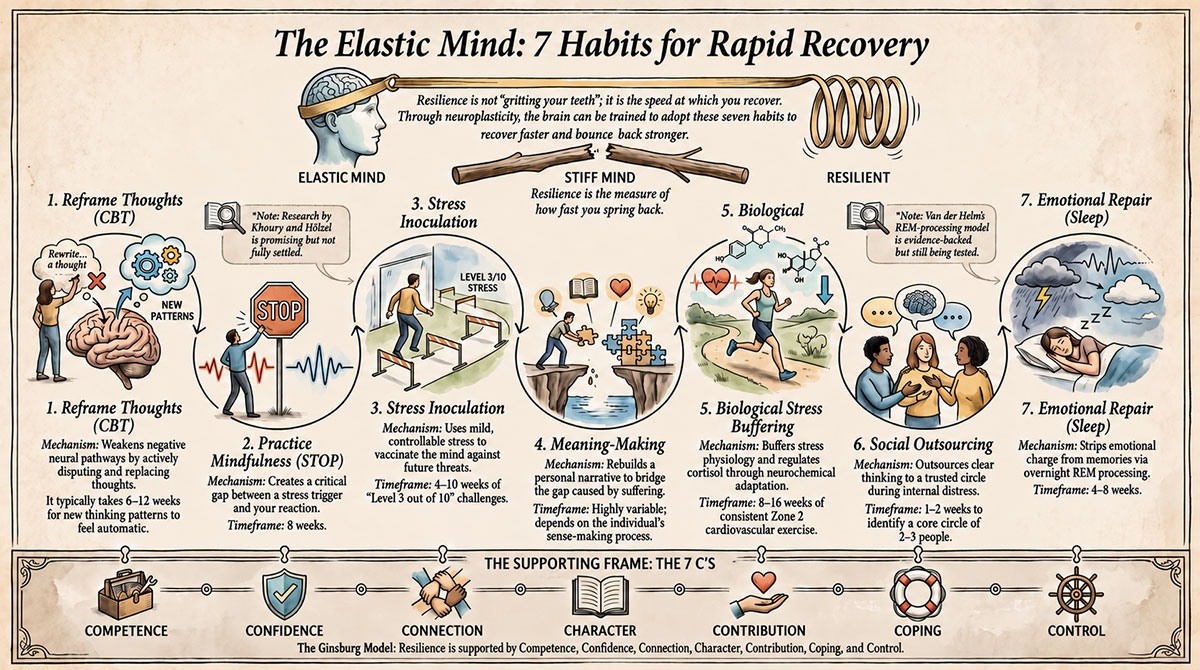
Your brain can be trained toward that second kind of strength. Not through willpower. Through seven specific, testable habits, each with its own evidence base, each with its own catch.
Five Signs Your Recovery Time Has Slowed
Most people don’t notice a resilience problem until it’s acute. The early signs are quieter than that. A few worth watching for:
- Small setbacks (a curt email, a missed train) leave you rattled for hours instead of minutes.
- You’ve stopped attempting things you might fail at, even small things.
- Sleep has become the first casualty of a bad day, and the last thing to recover.
- You notice you’re rehearsing an argument or mistake long after it’s over, with no new information coming in.
- Asking someone for help feels harder than it used to, even from people who have said yes before.
None of these is a diagnosis. They’re a pattern worth naming, because the habits below are built to interrupt exactly this pattern.
What Resilience Actually Is
Resilience is not a trait you’re issued at birth. It behaves more like a skill, which means it can be trained the way a muscle can.
The mechanism is neuroplasticity: the brain’s capacity to reroute itself based on repeated practice. Practice a stress response enough times, in a specific way, and the neural pathway underneath it changes. That’s not a metaphor. It’s what functional imaging studies of these interventions actually show.
None of what follows is vague “think positive” advice. Each of the seven habits below has a specific mechanism, a specific evidence base, and its own honest limitations. Some are stronger than others. That’s worth knowing up front rather than discovering later.
Resilience Assessment
Fourteen statements. Answer honestly, not aspirationally.
1. Reframe Your Thoughts Using the CBT Method
Catching a negative thought before it spirals is a specific, learnable skill, not a personality trait some people happen to have.
Stefan Hofmann, a clinical psychologist at Boston University, has spent decades studying whether cognitive behavioral therapy actually delivers on its reputation. His 2012 review in Cognitive Therapy and Research pooled 106 separate meta-analyses covering conditions from anxiety disorders to chronic pain to general stress.
The strongest, most consistent evidence turned up for anxiety disorders specifically. Effects on general stress and mood were real but more modest, which is a more honest summary than treating CBT as a uniform fix for anything stressful.
Here’s the part that matters day to day: actively disputing a negative thought weakens the neural pathway underneath it, while the replacement thought builds a new one. Do this enough times and the new pathway becomes the default. Six to twelve weeks is the window most of the underlying trials used before measuring a real shift.
A thought that spirals, incidentally, is worth naming for what it is. That pattern has a name, overthinking, and it runs on the exact same loop that cognitive reframing is designed to interrupt.
Sarah’s boss criticized a report she’d spent a week on. Her first thought: I’m terrible at my job. She caught it, checked it against the evidence (three other reports had been praised that same month), and swapped it for something closer to true: this one needs revision, and I’m still capable. Thirty seconds of mental work. It stopped what would have been a full day of spiraling.
The method has a name almost as memorable as the technique itself: Catch, Check, Change.
- Catch the thought the moment your mind goes negative. “I always mess things up” is a common one.
- Check the evidence for what’s actually true here. What supports the thought, and what contradicts it?
- Change the thought to something neutral and accurate, such as “I made a mistake this time. I can learn from it.”
Three daily phone reminders solve the most common obstacle, which is simply forgetting to catch the thought in the first place. If evidence-gathering feels impossible in the moment, text the thought to a friend and ask what they see. Outside perspective helps more than it should.
Progress here doesn’t arrive on a clean schedule. Most people notice they’re catching thoughts faster within the first couple of weeks. The evidence-checking step usually starts running on autopilot around weeks six to eight. The full twelve weeks is what it typically takes before the new thinking pattern stops feeling like an effort and starts feeling like simply how your mind works now.

2. Practice Mindfulness to Lower Your Stress Response
Marcus felt his heart rate spike halfway through a tense meeting. Instead of panicking about the panic, he ran a technique that takes about ten seconds. The anxiety didn’t disappear. It also didn’t run the room.
That’s mindfulness in its most practical form: paying attention to what’s happening right now without immediately trying to fix it or judge it.
Bassam Khoury and colleagues put this to the test in 2015, pooling 29 separate studies on mindfulness-based stress reduction in the Journal of Psychosomatic Research, specifically in people without a diagnosed clinical condition.
Using self-report measures and standard clinical instruments, they found a meaningful drop in stress reactivity along with better quality of life and lower depression and anxiety scores. That’s the accurate scope of the finding. The 29 studies measured what people reported feeling and how they scored on validated questionnaires, not brain scans.
The brain-imaging evidence for mindfulness comes from a separate line of research. Britta Hölzel’s team found in 2010 that eight weeks of mindfulness-based stress reduction correlated with reduced gray matter density in the amygdala, the structure most involved in fear and threat detection. It’s a genuinely striking finding.
It’s also a finding that a later attempt to replicate, across two separate controlled trials, failed to confirm, which is worth knowing before treating “shrinks your amygdala” as a settled fact rather than a promising but unresolved lead.
Practicing mindfulness reliably does one thing: it creates a gap between the trigger and the reaction. The amygdala’s threat response becomes less reactive over repeated practice, while the prefrontal cortex, the part handling reasoned thought, stays more consistently online.
You respond instead of reacting. That gap is what Marcus was running on in that meeting, ten seconds of practice standing between a spike in heart rate and a derailed presentation.
The technique itself has a name: STOP. S is for stop whatever you’re doing. T is for one deliberate breath, in through the nose, out through the mouth. O is for observing what’s happening in your body and your thoughts, without editing it. P is for proceeding, now that you’ve actually noticed what you’re working with.
Full mindfulness programs typically run eight weeks. You can start with two minutes a day, which is shorter than most people spend scrolling before getting out of bed.
A racing mind at the start of practice isn’t a sign you’re doing it wrong. Mindfulness was never about silencing thoughts, only about noticing them without getting swept into them. If sitting still triggers sleep instead of awareness, try it upright with eyes open, or right after a short walk.
The two minutes tend to produce a noticeably calmer moment almost immediately. The harder-to-measure shift, an actual pause before reacting instead of after, tends to show up by week three or four. By the full eight-week mark, most people report that the baseline itself has moved, not only their response to individual triggers.
3. Build Stress Tolerance Through Small Challenges
Deliberately taking on manageable discomfort, on purpose, on a schedule, is one of the stranger-sounding habits on this list. It’s also one of the better-supported ones, provided the doses stay small.
Donald Meichenbaum began developing what he called Stress Inoculation Training in the early 1970s, building the concept out of work with phobia patients at the University of Waterloo. The logic borrowed from immunology: a vaccine exposes the body to a weakened version of a threat so it can build defenses before the real thing arrives. Meichenbaum applied the same logic to the mind.
The biological version of this idea, known as hormesis, has genuine laboratory support. A 2016 review in Neural Plasticity by Ashokan and colleagues traced how mild, controllable stress exposure in animal models built measurable resilience to later, larger stressors.
That’s an important caveat rather than a footnote: most of the hormesis evidence comes from animal studies, and it’s a related but distinct research tradition from Meichenbaum’s clinical work with humans. The two lines of evidence point in the same direction. They aren’t the same study.
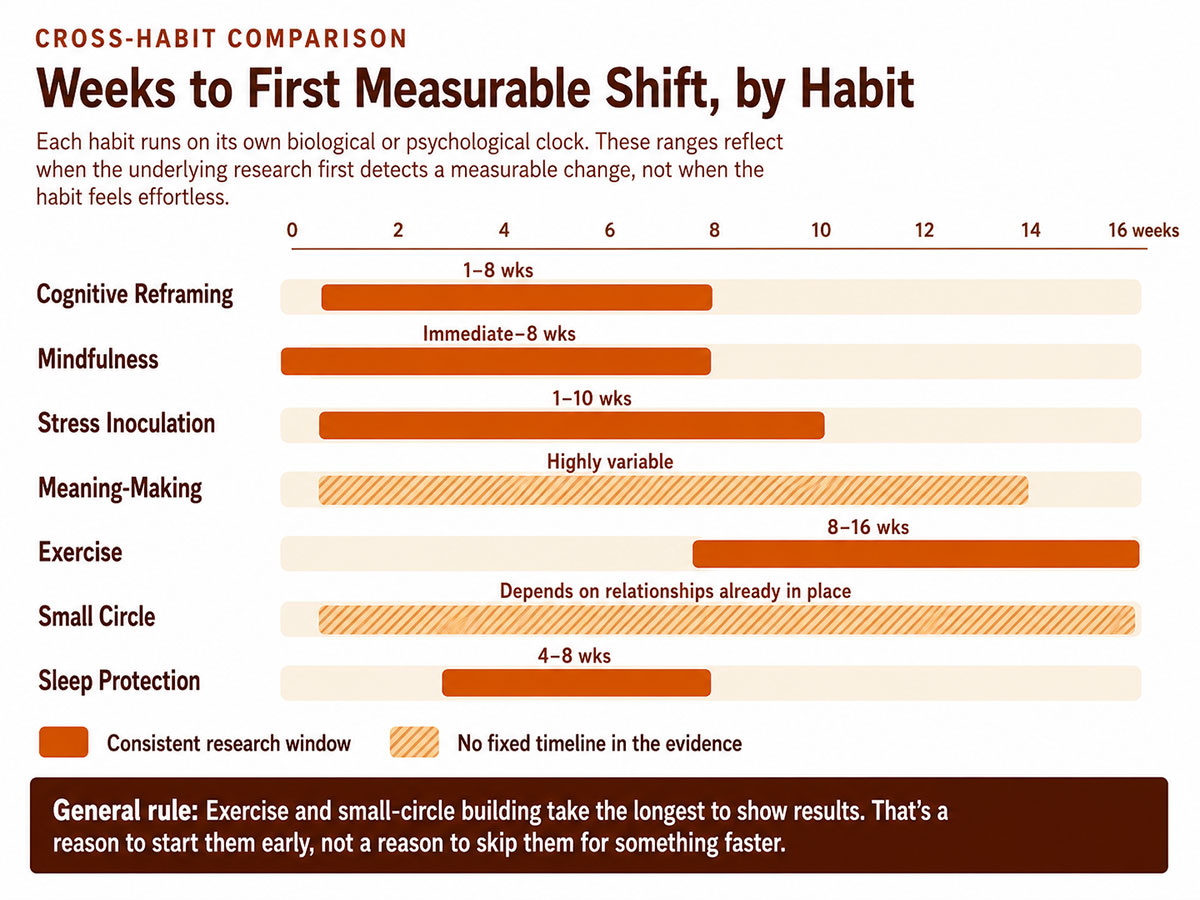
Clinical applications of stress inoculation in humans, particularly for performance anxiety in athletes and people in high-pressure jobs, tend to show benefits within four to ten weeks of practice. People become less avoidant. They tolerate discomfort better and recover from setbacks faster.
Jake was terrified of public speaking, so terrified he’d turned down two promotions to avoid it. He didn’t force himself into a keynote. Week one, he spoke up once in a team meeting. Week two, a short update.
By week four, he was leading a ten-minute presentation. Week eight, he stood in front of fifty people for half an hour. He didn’t get less afraid all at once. He got progressively less afraid of the next size up.
Pick one thing per week that pushes you slightly past comfortable. A sixty-second cold shower. Speaking up in a meeting you’d normally sit through quietly. A conversation you’ve been avoiding. Asking for help instead of white-knuckling it alone.
The word doing the real work in that list is “slightly.” Ten out of ten is trauma. Three out of ten is the target.
Not having anything to try this week is the most common obstacle here, and the fix is lowering the bar until something clears it. A challenge that goes badly isn’t failure. It’s data about where the edge actually is. What almost never works is rushing straight to the hardest version, which tends to reinforce the avoidance it was supposed to break.
This one doesn’t lend itself to a tidy four-stage calendar. Most people manage their first micro-challenge within a week or two. Somewhere between weeks three and six, the dread beforehand starts to shrink, sometimes gradually, sometimes in a single noticeable jump. By eight to ten weeks, several people report actively seeking out the next challenge rather than waiting to be pushed into it.

4. Find Meaning in Your Struggles
Actively looking for purpose inside a hard stretch of life, rather than simply waiting it out, turns out to be one of the stronger predictors of how well people eventually recover.
Crystal Park, a psychologist who has spent years studying adjustment to trauma and illness, published an influential integrative review in 2010 in Psychological Bulletin.
Her model distinguishes two related but separate processes: making sense of what happened, and identifying a genuine benefit that came from it. Both help. Which one matters more, and for whom, is still actively debated among researchers who study meaning-making, and nobody has fully settled it.
The mechanism Park describes is essentially a gap-closing process. A bad event clashes with your assumptions about how the world is supposed to work. That mismatch is what produces the suffering, more than the event itself in many cases. Meaning-making closes the gap by helping you rebuild a story that makes sense again.
Elena lost her job and felt, for a while, like a straightforward failure. She started journaling about it. What emerged wasn’t comfort. It was the recognition that the job had been quietly draining her creativity for two years before it ended. The loss forced a reevaluation she’d been avoiding. Within months, she’d started the side business she’d been too frightened to try while employed.
Ten minutes, once a week, answering one question honestly: how has this difficulty forced growth that comfort never would have? No manufactured silver linings required. Maybe the honest answer is that you’re tougher than you assumed. Maybe it’s that you found out who your real friends are.
A few more prompts worth sitting with if the first one doesn’t land: What strengths did this reveal? What matters most to you now that didn’t seem urgent before? Who would you tell if they were facing the same thing?
Finding nothing is a legitimate outcome some weeks, not a personal failure. Anger and meaning-making aren’t opposites either. You can be furious at what happened and still be doing the work of making sense of it.
Some people report a small insight within the first couple of weeks. Others get nothing for a month, then arrive at something substantial all at once. Nobody has fully explained why the timeline is so uneven from person to person, which is one of the more honest things to say about this particular habit.
5. Use Exercise as a Biological Stress Buffer
Moderate, consistent cardio does something to stress physiology that a self-help book alone cannot.
Peter Salmon’s 2001 review in Clinical Psychology Review laid out the case that exercise influences mood through neurochemical pathways, with real overlap with how antidepressant medications work, alongside endorphin release and improved regulation of the body’s cortisol response.
A 2017 review by Mikkelsen and colleagues in Maturitas synthesized the mechanisms further: exercise appears to improve regulation of the hypothalamic-pituitary-adrenal axis, the system that governs the body’s cortisol response to stress, alongside reduced inflammation and increases in brain-derived neurotrophic factor, a protein that supports new neural connections.
Eight to sixteen weeks of consistent movement is the window where these stress-buffering effects tend to become measurable. That’s a longer runway than the CBT habit above, and there’s no strong reason to expect otherwise. Biological adaptation and cognitive habit formation aren’t running on the same clock.
Twenty minutes of walking, jogging, or cycling at a pace where you could talk but not sing, three to five times a week. That’s Zone 2 cardio, and it doesn’t need to be complicated to work.
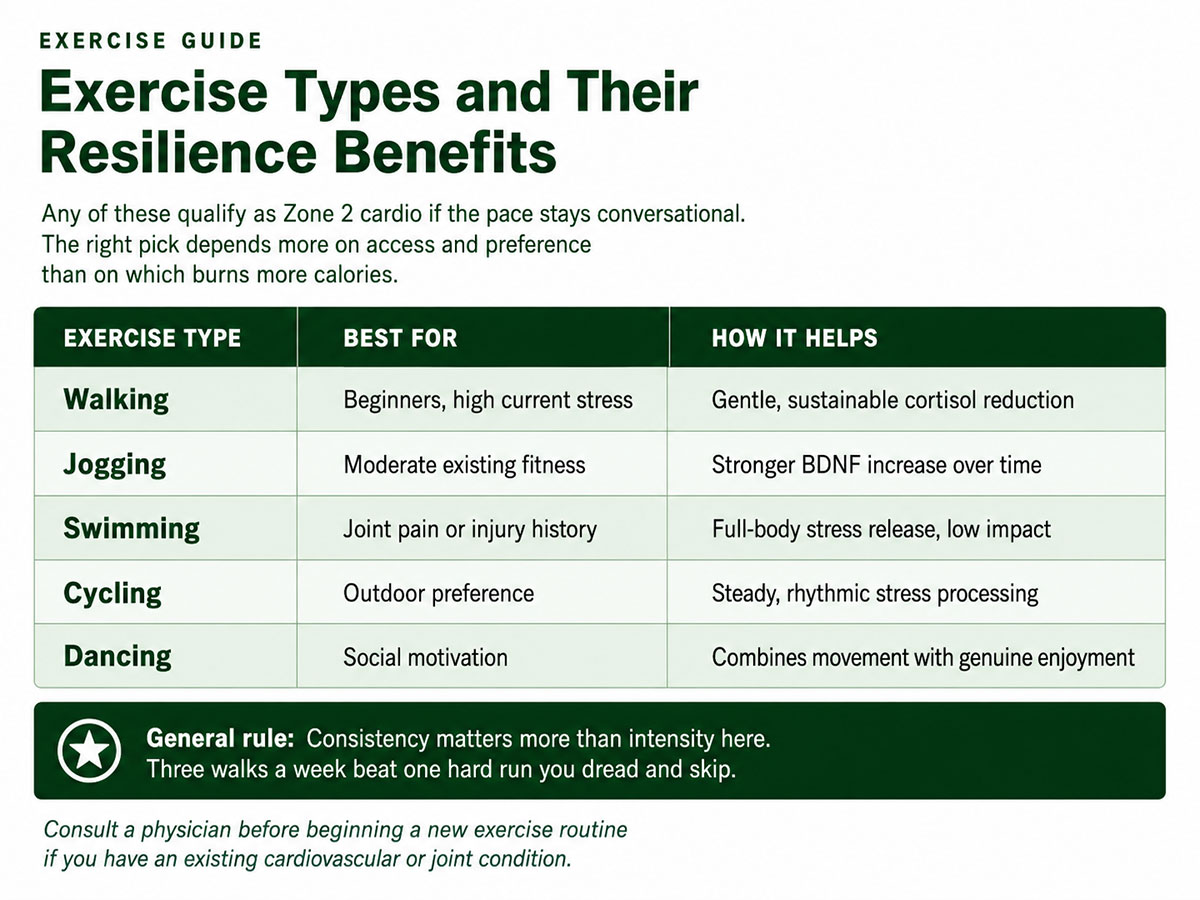
David used to snap at his kids the moment he walked through the door after work. He started jogging twenty minutes before the commute home instead of after. Three weeks in, the same traffic that used to wreck his evening had become merely irritating. His body had time to process the day’s cortisol before he was back in the house. The habit didn’t touch the traffic. It touched what the traffic could still do to him by the time he got home.
6. Build a Small Circle You Can Actually Turn To
Lisa’s business was failing, and she felt too paralyzed to think clearly about next steps. She called three people: her mentor, her sister, and her closest friend from college. That’s the entire habit, more or less. Her mentor helped her see the numbers objectively.
Her sister reminded her of a previous crisis she’d already survived. Her friend mostly listened. Between the three of them, she found her way to an actual plan.
Two or three specific people, not a broad social network, tend to matter more for recovery than most people expect.
Steven Southwick, a psychiatrist who has spent much of his career studying people who weathered severe hardship well, from combat veterans to trauma survivors, helped convene a wide-ranging panel of resilience researchers in a 2014 European Journal of Psychotraumatology paper.
One idea recurred across very different research traditions: resilience is frequently, in Southwick’s phrase, socially outsourced. In the middle of a crisis, clear thinking is hard to access from the inside. Someone who cares about you and isn’t drowning in the same crisis can supply it.
A separate empirical study by Pietrzak and colleagues, published in Depression and Anxiety in 2009, followed soldiers returning from deployment and found that postdeployment social support predicted lower rates of PTSD and depressive symptoms.
Quality outperformed quantity across that research, which is exactly what Lisa’s three calls illustrate. One relationship with real depth beats five that stayed shallow.
Look for the people who ask good questions instead of simply agreeing, who tell you something true even when it’s difficult to hear, who stay calm while you’re not. Tell two or three of them directly: when I’m struggling, you’re someone I trust to help me see clearly. Reach out for a reality check, not a venting session. The two aren’t the same thing, and only one of them tends to move you forward.
Not having anyone like this yet isn’t a dead end. It means building toward it starts now, through shared-interest groups or simply being the kind of support you’re hoping to find. Worrying about becoming a burden misreads how most real friendships actually work. And getting a perspective you disagree with doesn’t obligate you to follow it. You’re still the one making the decision.
The timeline on this one depends entirely on whether the relationships already exist or need to be built first, which makes it the least predictable habit on this list. Identifying who belongs in this circle usually takes no more than a week or two of honest thought.
Reaching out to test it takes courage more than time. What comes after that, whether the relationship deepens into something you’d actually call on during a crisis, isn’t something any study has managed to put a clean number on.
7. Protect Your Sleep for Emotional Recovery
Protecting REM sleep specifically, the stage where the brain does most of its emotional processing, may matter more for resilience than total hours logged.
Cara Palmer and Candice Alfano’s 2017 integrative review in Sleep Medicine Reviews laid out the broader case: disrupted sleep is a consistent risk factor across a wide range of psychiatric conditions, and emotion regulation is the mechanism most likely connecting the two.
Even partial sleep restriction, their review found, made people more reactive to neutral situations and worse at regulating their emotional response once it started.
The more specific mechanism, why REM sleep in particular seems to matter, comes from Matthew Walker’s sleep laboratory at UC Berkeley. A 2011 study by van der Helm, Walker, and colleagues found that REM sleep is accompanied by a sharp drop in noradrenaline, the same brain chemical involved in stress and arousal.
Their proposed explanation: the brain reprocesses emotional memories during REM while that stress chemical is suppressed, which strips some of the emotional charge from the memory without erasing the memory itself. It’s a persuasive model, backed by real data. It also remains a proposed mechanism rather than a fully settled one, and the researchers themselves note it’s one of at least two plausible explanations still being tested.
Rachel used to cry over minor irritations by the end of a short-sleep week. She started protecting her sleep with a simple structure. Within two weeks, the same stressors that used to break her stopped landing quite as hard. Her brain had gotten the overnight processing time it had been missing.
Ten hours before bed, cut caffeine. Three hours before, stop eating large meals. Two hours before, close the laptop. One hour before, put the phone down. That’s the 10-3-2-1 structure, and it exists to protect the REM sleep that does the actual emotional repair work.
A cool bedroom, ideally 65 to 68 degrees, blackout curtains, and a bed reserved only for sleep all support the same goal. So do a consistent bedtime and wake time, weekends included, and a wind-down period with the lights dimmed ninety minutes before sleep.
Four to eight weeks of consistently improved sleep quality is the window most research points to before better emotional regulation becomes reliably measurable. Falling asleep despite exhaustion often responds to a body scan, tensing and releasing each muscle group from feet to head.
Waking in the middle of the night goes better without checking the clock, which mostly increases anxiety about the hour. Blue-light blocking glasses and dimmed screens help when cutting screens out entirely isn’t realistic.
A Resilience Framework Worth Knowing
Pediatrician Kenneth Ginsburg, working out of Children’s Hospital of Philadelphia, built a widely used framework for the American Academy of Pediatrics, identifying seven interlocking components of resilience, adapted from the earlier Positive Youth Development model. It was designed for adolescents. The seven components map onto adult resilience-building just as cleanly, including everything covered above.
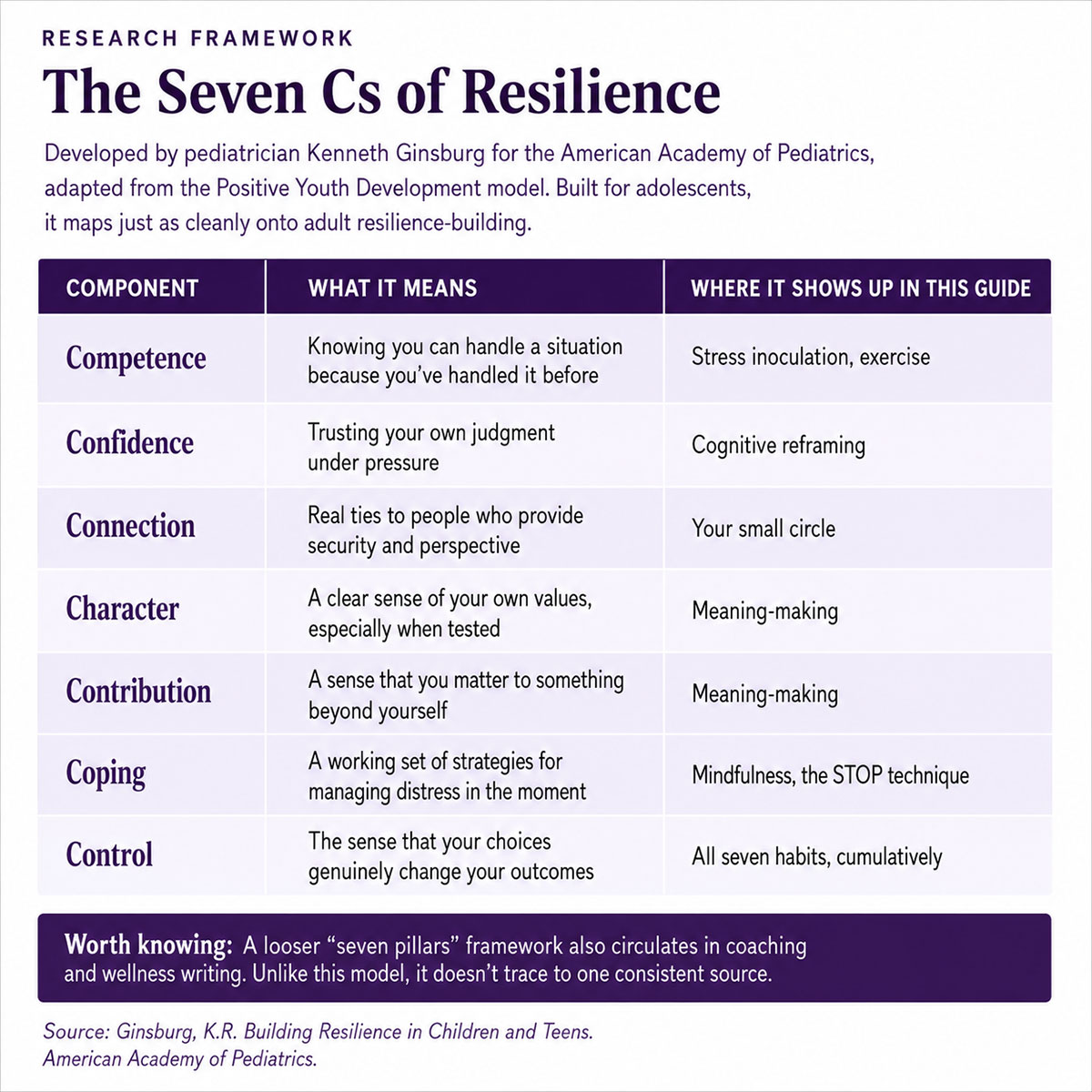
A looser “seven pillars” framework circulates widely in coaching and wellness writing, usually listing qualities like optimism, self-efficacy, and acceptance. It’s worth knowing it exists if the phrase turns up elsewhere. Unlike Ginsburg’s model, it doesn’t trace to one consistent source, and different writers list slightly different sevens depending on where they encountered it.
Building This at Work
Everything above was written for an individual reader working through a personal hard stretch. The same mechanisms apply, with light adjustments, to a team trying to recover well from a bad quarter or a difficult stretch of change.
Cognitive reframing works the same way in a debrief meeting as it does in a journal: catch the story the team is telling itself about a failure, check it against what actually happened, and change it before it hardens into a narrative nobody questions. The resilience-council habit scales up directly, too. A team’s version of a trusted small circle is usually two or three people whose read on a bad situation the rest of the group actually trusts, not the person with the loudest opinion in the room.
Where it differs: team recovery depends heavily on whether people feel safe admitting a mistake without it becoming a mark against them. That single factor tends to predict whether a team’s setbacks turn into learning or into blame.
What Actually Gets in the Way
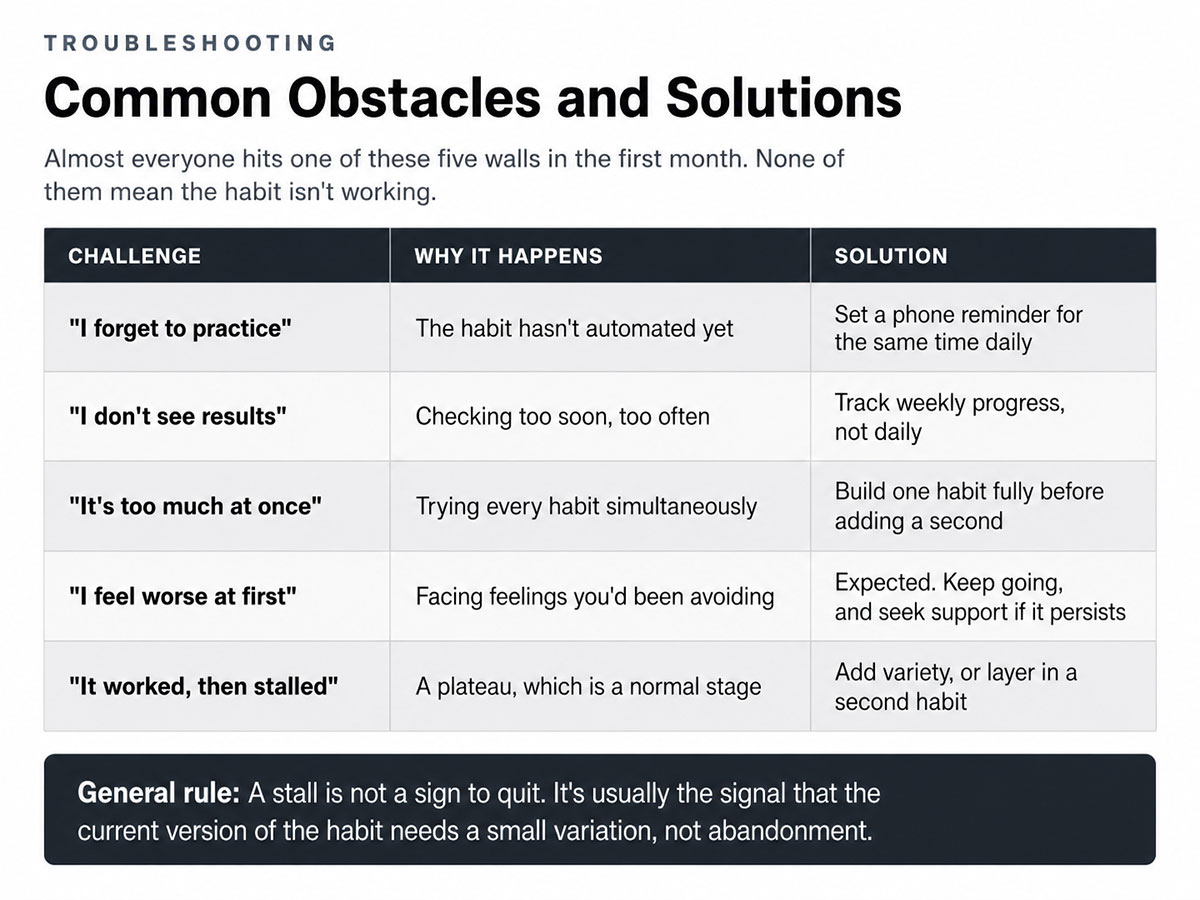
Your 30-Day Starter Plan
Week 1: Choose and Begin
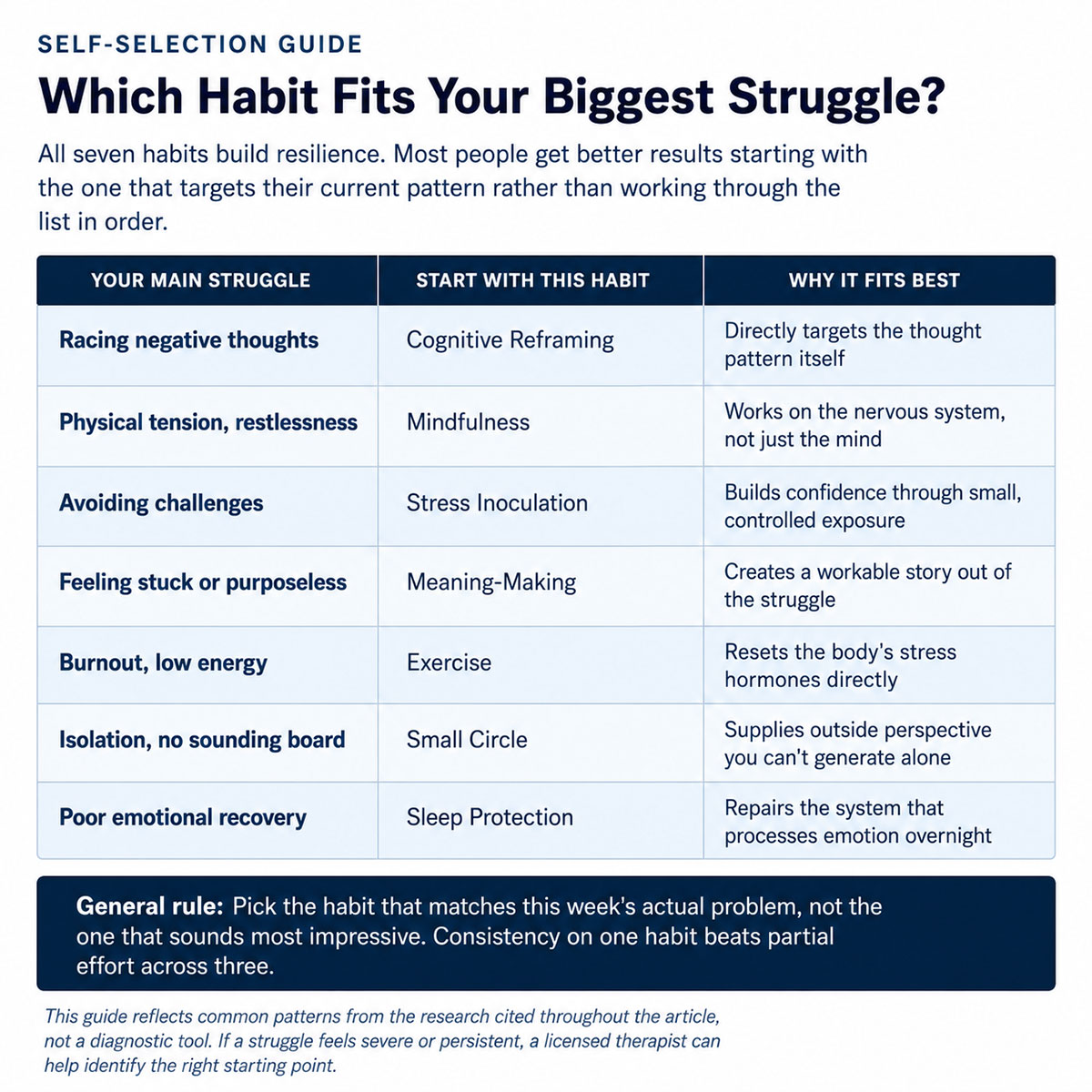
Review the seven habits and pick the one that addresses your most pressing struggle. Practice it five to ten minutes daily, tracked with nothing more than a simple check mark. The only goal this week is showing up, not doing it well.
Not ready to commit to a single habit yet? Two short routines work as a lower-commitment way to start instead. A ten-minute morning version: three minutes of mindful breathing, noticing five breaths without trying to change them, four minutes journaling one thing you’re grateful for and one challenge worth reframing, three minutes planning a single micro-challenge for the day ahead, best done before the phone comes out. A five-minute emergency version: one minute running the STOP technique, two minutes catching and changing the loudest negative thought in your head, two minutes of movement, a short walk or twenty jumping jacks, whatever’s available.
Week 2: Build Consistency
Extend practice to ten to fifteen minutes. Notice which time of day actually works for you. Add one micro-challenge or one journaling session on top. Hitting five out of seven days counts as a win here.
Week 3: Expand Slightly
Keep the primary habit running and add one complementary habit (the pairings below are a place to start). Try using both under real stress, not just during scheduled practice time.
Week 4: Integrate and Assess
Both habits should feel like part of your routine by now. Rate the same struggle you started with. What’s actually different? Commit to one more month with your two strongest habits before adding a third.
A few pairings that tend to reinforce each other: cognitive reframing with mindfulness (catch the thought, then calm the body that’s reacting to it). Exercise with sleep protection (movement tires the body, sleep does the repair). Stress inoculation with cognitive reframing (face the challenge, then manage the story you tell yourself about how it went).
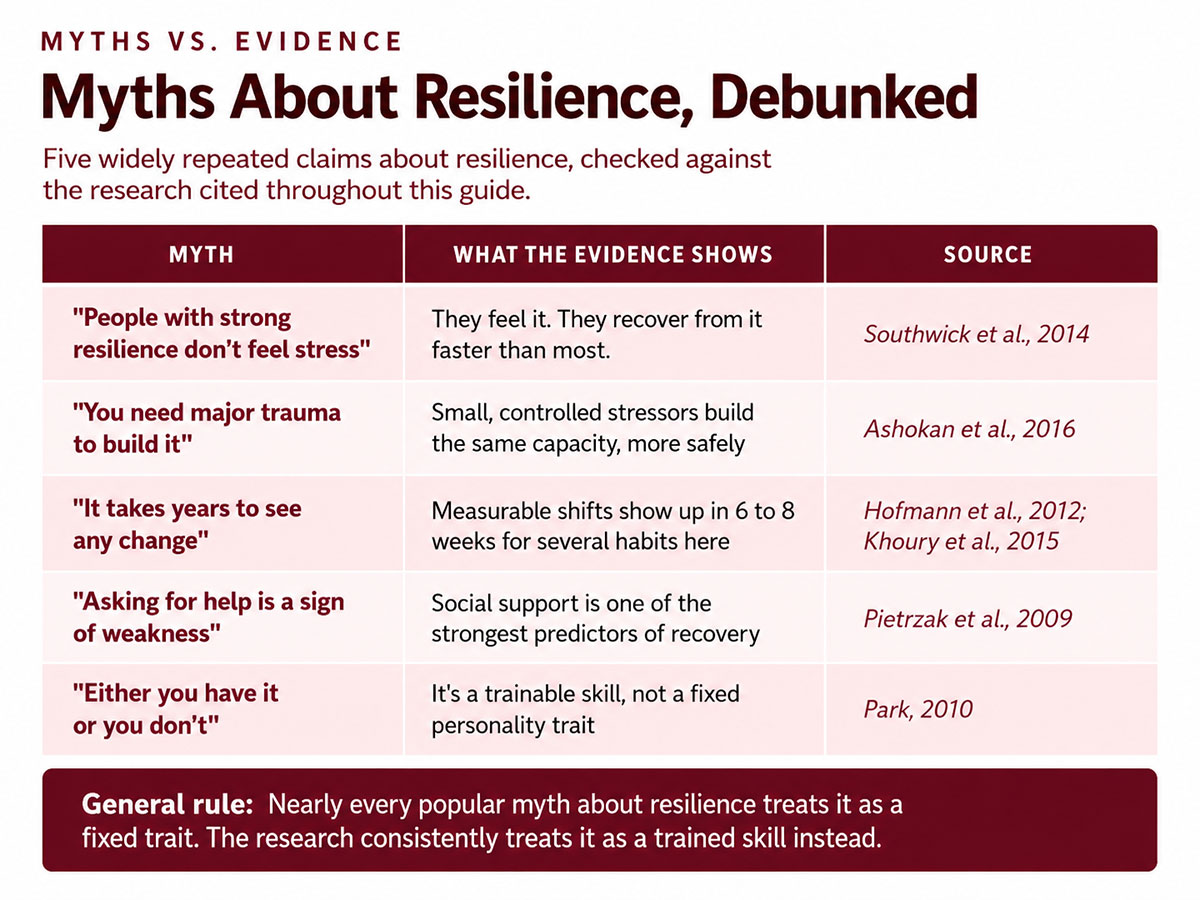
When These Habits Aren’t Enough
These seven habits are genuinely useful. They are not a substitute for professional support when the situation calls for it. Consider talking to a therapist if you feel stuck despite consistent practice, if trauma symptoms are interfering with daily functioning, if you’re having thoughts of self-harm, or if depression or anxiety have become too heavy to manage alone.
Look specifically for a therapist trained in CBT or trauma-focused therapy. Many offer sliding-scale fees, and telehealth has made access considerably easier than it used to be. Reaching out for that kind of support is not a failure of the habits above. If anything, it’s a continuation of the same instinct that built your resilience-council habit in the first place.
The Real Work
Resilience was never a fixed quantity you either got at birth or didn’t. It’s closer to a set of trained reflexes, built one repetition at a time.
Pick one habit. Practice it for fourteen days before judging whether it’s working. Don’t try to install all seven at once. That’s the fastest route to abandoning all of them.
The rubber band from the beginning of this piece doesn’t spring back to shape because it was engineered never to feel pressure. It springs back because something in its structure was built for exactly that. Your nervous system can be built the same way. Not instantly. Repetition by repetition.
Frequently Asked Questions
How long does it take to build resilience?
Small shifts tend to show up within two to three weeks. More noticeable change usually lands at six to eight weeks. Full integration, where the habit stops feeling like effort, typically takes three to six months of consistent practice.
Can anyone learn resilience?
Yes. Some people start with a head start from temperament or upbringing, but the underlying skill responds to practice regardless of where someone starts.
What’s the fastest single habit to start with?
Cognitive reframing, mainly because it applies to the widest range of situations and requires no equipment, schedule, or other person to begin.
Is resilience the same as mental toughness?
No, and the distinction matters. Mental toughness is about gritting it out. Resilience is about recovering. It’s entirely possible to build strong resilience without being stoic about it.
What if the hard thing was major trauma, not everyday stress?
These habits can still help, but major trauma usually calls for professional support alongside them, ideally from a therapist trained specifically in trauma treatment.
Do all seven habits need to happen at once?
No. Start with one, get it running on its own, then add from there. Quality of practice beats the number of habits running simultaneously, every time.