The most striking result appeared in one group of participants. But what researchers saw on the MRI scans wasn’t simply about memory or thinking.
The lab result said one number was too high. There were no warning signs: no brain fog, no tingling, nothing to connect it to anything a person could actually feel. But the research behind that number, particularly a 2010 clinical trial from Oxford, contains a finding most people with a high homocysteine result never encounter.
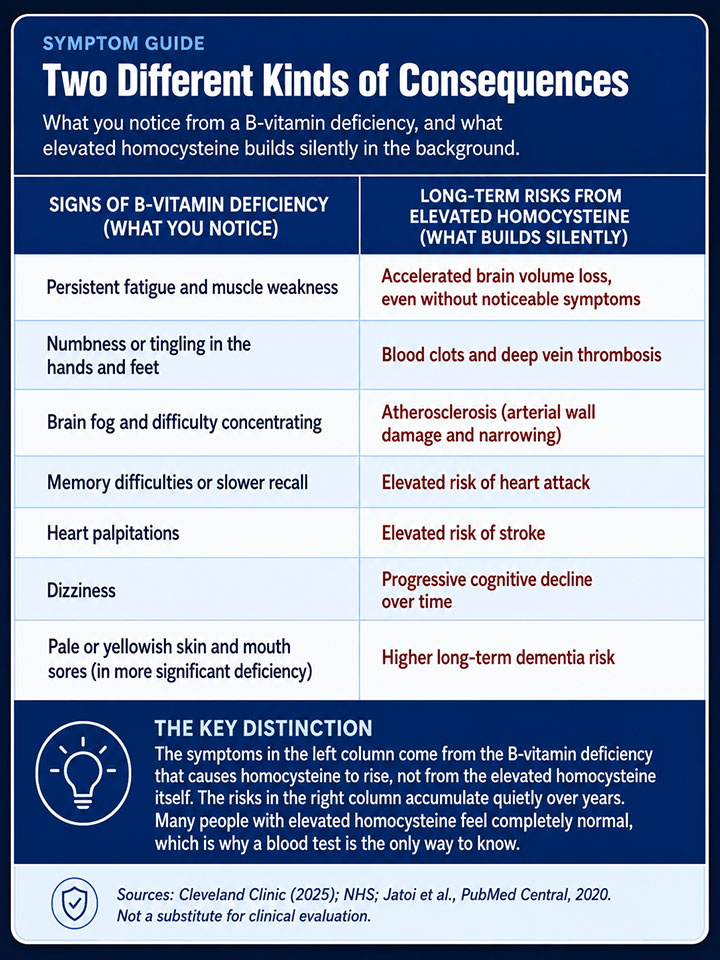
The brain fog, fatigue, and tingling in the hands and feet that people search for when they find a high homocysteine result aren’t usually caused by elevated homocysteine itself. They come from the B-vitamin deficiency that allowed it to accumulate, and understanding that difference changes both what you should look for and what’s worth doing about a high reading.
A randomized controlled trial tracked what happened when a combination of three inexpensive B vitamins was given to older adults with mild cognitive impairment and elevated homocysteine. Two years in, the researchers measured brain volume using MRI scans. The difference between the treated group and the placebo group was evident on imaging.
What do high homocysteine symptoms actually feel like?
Usually nothing. Elevated homocysteine itself does not produce direct, noticeable symptoms in most adults. What people do notice, and what sometimes prompts medical attention, are the signs of the underlying B-vitamin deficiency.
Those deficiency-related symptoms include persistent fatigue and muscle weakness, numbness or tingling in the hands and feet, dizziness, heart palpitations, and difficulty concentrating or recalling information. Mouth sores and pale or yellowish skin can also appear, particularly when B12 has been low for an extended period.
Brain fog sits in a distinct category. A 2020 review by Shabbir Jatoi and colleagues, published on Cureus and cited 129 times, found that low B12 is specifically linked to impaired cognition and memory alongside the physical nerve symptoms. In more severe or prolonged deficiencies, the cognitive effects can closely resemble dementia, according to the NHS, which is one reason early identification of B12 deficiency matters.

What counts as a high homocysteine level?
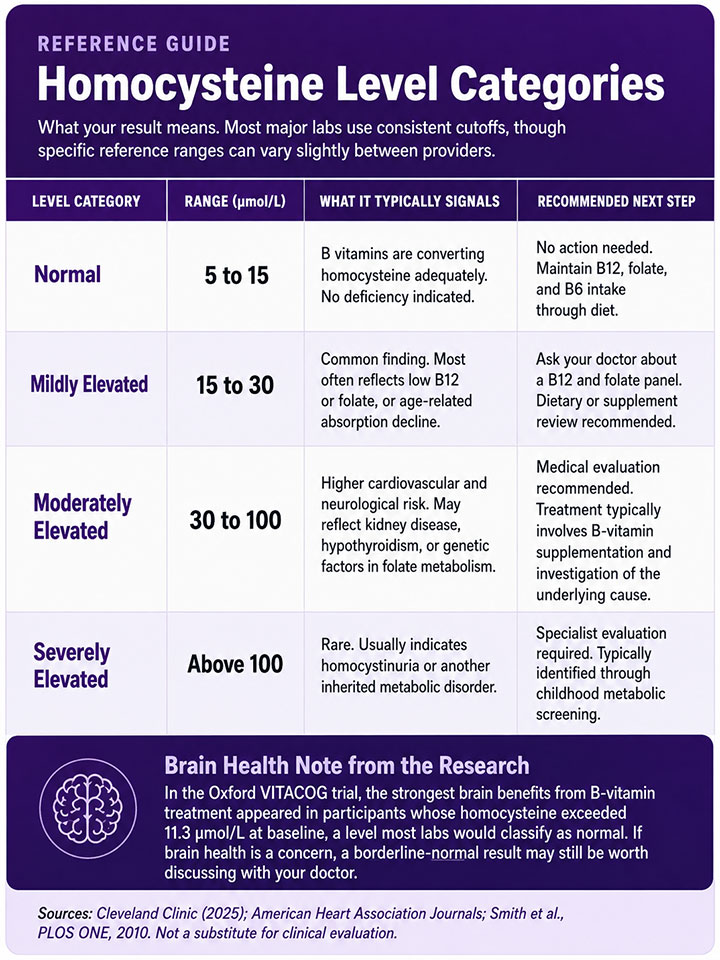
Healthcare providers use a relatively consistent set of cutoffs when interpreting results, though reference ranges can vary slightly between labs.
The strongest benefits in the Oxford trial appeared in participants whose homocysteine exceeded 11.3 µmol/L at baseline, a level most labs would classify as normal. The conventional reference range appears inadequate for assessing brain-health risk.
What raises homocysteine in the first place?
The most common driver, by a significant margin, is a shortage of the B vitamins required to metabolize it. Vitamins B12, B6, and folate are all part of the conversion process. When any of them falls short, homocysteine accumulates.
The American Heart Association Journals identify B-vitamin deficiency as the primary cause of most mildly elevated readings. The deficiency typically traces back to poor dietary intake, impaired absorption, or both.
Age plays a role independent of diet. Stomach acid production decreases with age, which reduces the body’s ability to absorb B12 from food. Adults over 50 can develop subclinical B12 shortfalls for this reason, even with adequate dietary intake.
Homocysteine tends to rise with age as a result. Other contributors include chronic kidney disease, hypothyroidism, certain medications (metformin, proton pump inhibitors, and some antiepileptic drugs can all affect B-vitamin metabolism), and a variant in the MTHFR gene that reduces folate processing efficiency.
The MTHFR connection has attracted more alarm than the evidence quite supports, but it does mean that some people process dietary folate better than the synthetic folic acid found in most supplements.
What high homocysteine does to the brain
The association between elevated homocysteine and accelerated brain aging was documented in observational research for years before anyone ran a trial to test whether changing the number would change the outcome. A team at the University of Oxford decided to find out.
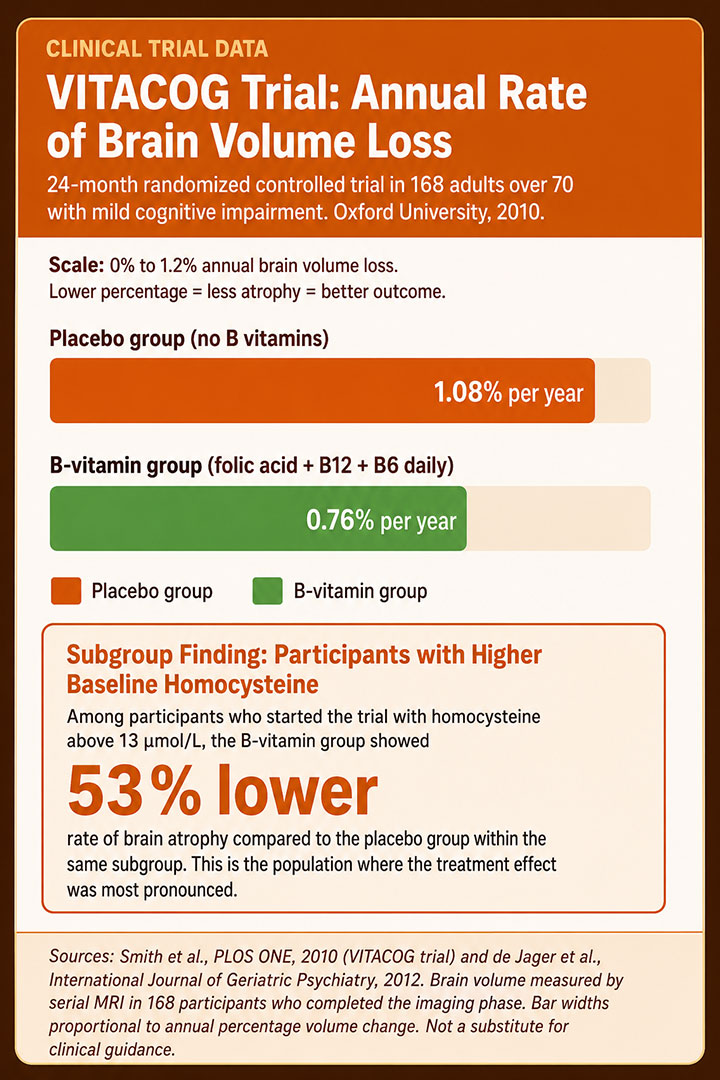
Professor A. David Smith led the VITACOG trial, which recruited 271 adults over the age of 70 with mild cognitive impairment and randomly assigned them to receive either a daily B-vitamin combination or a matching placebo for 24 months. The B-vitamin group received folic acid (0.8 mg), vitamin B12 (0.5 mg), and vitamin B6 (20 mg) per day.
In the placebo group, brain volume shrank at a rate of 1.08% per year, consistent with the accelerated atrophy typical of mild cognitive impairment. In the B-vitamin group, that rate fell to 0.76% per year.
Among participants who started the trial with homocysteine above 13 µmol/L, the rate of atrophy was 53% lower in the treatment group, according to the 2010 VITACOG paper in PLOS ONE.
The trial’s cognitive test results told a parallel story. A 2012 analysis by Celeste de Jager and colleagues, published in the International Journal of Geriatric Psychiatry, found that among participants with baseline homocysteine above the trial median of 11.3 µmol/L, B-vitamin treatment produced significantly better outcomes on measures of global cognition, episodic memory, and semantic memory than placebo.
Whether elevated homocysteine actively drives neurodegeneration or reflects a broader pattern of metabolic disruption remains an open question. A July 2025 metabolomics reanalysis of VITACOG blood samples, published in Alzheimer’s & Dementia, identified detectable biochemical differences between the two groups but could not confirm which explanation is correct.
Does B-vitamin supplementation actually help?
The VITACOG result is well-documented and applies clearly to its specific population: adults over 70 with mild cognitive impairment and elevated homocysteine. What it doesn’t settle is whether B-vitamin supplementation protects the brain more broadly, across different ages and baseline homocysteine levels.
A December 2025 systematic review and meta-analysis, drawing on data from multiple randomized controlled trials, concluded that supplementation with B6, B9, or B12 provides what the researchers characterized as high-certainty evidence of a benefit on global cognitive function in older adults. The effect size, however, was explicitly described as very small.
An earlier 2021 meta-analysis in Nutrition Reviews, covering more than 12,000 participants in its homocysteine analysis, found that B-vitamin supplementation slowed cognitive decline in people without established dementia but showed no detectable benefit in people who already had dementia. Folate intake specifically was associated with a 39% reduced risk of incident dementia in that analysis, while B12 and B6 intake alone did not show the same association.
The same pattern surfaces consistently: the clearest evidence points to benefit in people with elevated homocysteine who haven’t yet developed dementia. Researchers still don’t fully agree on whether a meaningful treatment window closes at some point in the disease progression, or whether the benefit in later stages is simply too small to detect with current methods.

How to lower homocysteine naturally
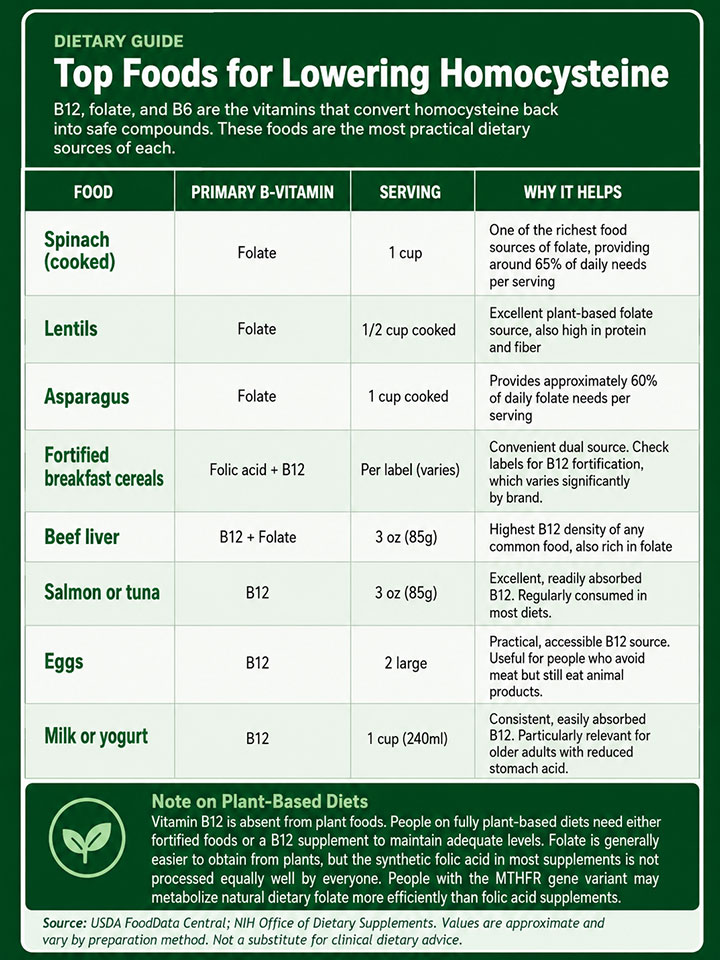
For most people with mildly elevated readings, diet is the first practical lever. Folate-rich foods, including dark leafy greens, legumes, asparagus, and fortified grains, address the most common nutritional driver.
Vitamin B12, found in meat, fish, eggs, and dairy but absent from plant foods, warrants particular attention for people on plant-based diets and for adults over 50 whose absorption capacity may have declined.
The Cleveland Clinic notes that healthcare providers commonly recommend supplementation with B12, B6, and folic acid when readings are elevated. The dosing requires care.
The VITACOG trial used 20 mg of B6 per day, a dose that exceeds the European Food Safety Authority’s 2023 tolerable upper intake level of 12 mg per day for adults. That upper limit was established because of peripheral neuropathy risk at higher doses.
Standard pharmacy-shelf B-complex products typically fall below that limit, but combining multiple supplements or fortified products that each contain B6 can push total daily intake above it without a person realizing it. Check labels, and talk to a healthcare provider before choosing a dose.
Lifestyle factors play a supporting role. Regular physical activity, avoiding smoking, and managing underlying conditions like kidney disease and hypothyroidism when present all contribute. They’re additions to the B-vitamin intervention, not substitutes for it.
Should you get a homocysteine test?
Routine testing isn’t universally recommended for people without symptoms or specific risk factors. A homocysteine test is most commonly ordered when a doctor is investigating B-vitamin deficiency, evaluating cardiovascular risk, assessing unexplained blood clots, or monitoring someone with a condition known to raise levels.
The practical details: most labs require 8 to 12 hours of fasting before the blood draw for accurate results, though some direct-access testing services don’t require it. Medications including metformin and proton pump inhibitors can affect the reading, so tell your provider what you take before the test.
An elevated result isn’t a reason for alarm. The next step after a high homocysteine reading is usually a follow-up panel that includes B12, B6, and folate levels, which will typically clarify whether a nutritional shortfall is responsible. Treatment decisions can then be made with a doctor based on your results, history, and relevant risk factors.
What a high reading actually signals
The most productive frame for a high homocysteine result is investigative rather than alarmed: a signal that B-vitamin status deserves closer attention, and a prompt to understand the difference between the long-term risks the number carries and the day-to-day symptoms it does or doesn’t produce.
The VITACOG finding matters not as a universal prescription, but as evidence that a measurable process in the brain responds to intervention when the relevant pathway is clearly disrupted. That’s a more grounded reading than the worst-case framing some people encounter after seeing a flagged lab result, and a more specific one than the reassurance that it’s just a vitamin deficiency.
A number that sits quietly in a blood panel, producing nothing you’d notice from one day to the next, can still be worth understanding. The research behind homocysteine is more substantial than most lab result explanations suggest.