Forgetting names, misplacing keys, and walking into rooms without remembering why may not mean what you think. Researchers explain why.
If a search for short-term memory loss is what brought you here, the most likely answer is also the least dramatic one. Most people under 65 who notice these moments piling up aren’t dealing with dementia. They’re dealing with a brain running on poor sleep, chronic stress, and a handful of fixable habits gone missing.
Short-term memory loss means trouble holding onto or recalling something you encountered only moments, hours, or days ago: a name, a misplaced phone, a sentence you just read. For most adults without other warning signs, it usually comes down to lifestyle factors far more often than disease.
Working memory is the system actually involved here. Think of it as a mental notepad that holds a few items active while you use them: a phone number on the way to dialing it, the first half of a sentence while you finish the second, where you set your keys thirty seconds ago. Overwork that notepad long enough, and ordinary life gets more challenging in small, constant ways.
The good news, and the actual subject of this page, is that the brain rebuilds this capacity at almost any age. Twelve specific habits have research behind them strong enough to act on. A few of the popular fixes you’ve probably already tried do not hold up nearly as well, and one of the most respected diets in this space just had its biggest test come back far more complicated than the headlines suggest.
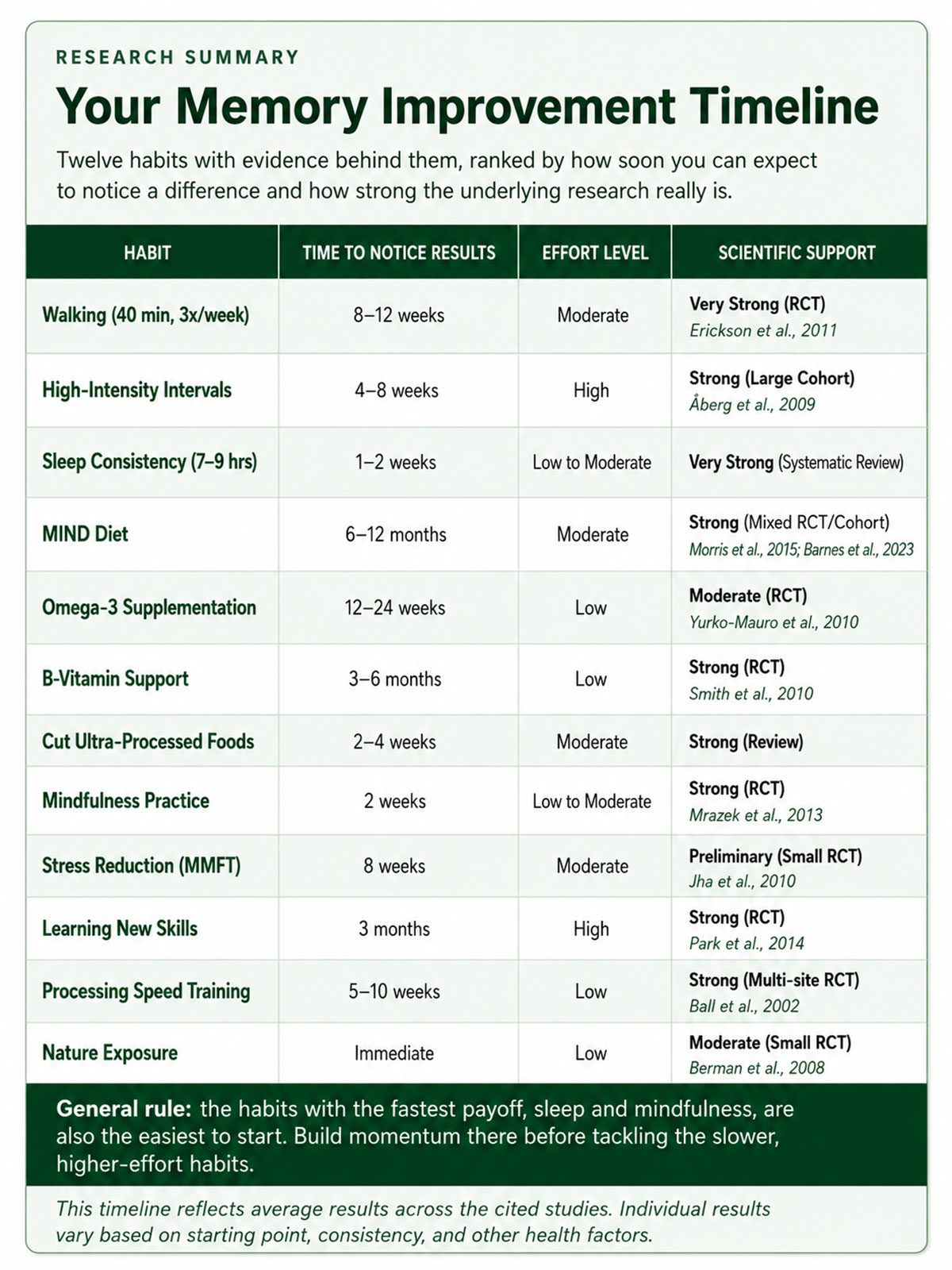
Not sure where to start? For a fast overview, here’s how all twelve habits compare on effort, timeline, and evidence strength.
When Lifestyle Habits Aren’t the Right First Step
Everything below this point assumes ordinary, lifestyle-driven forgetfulness. That’s not always what’s going on, and it’s worth ruling out before investing weeks into new habits.
Talk to a doctor rather than working through this list alone if you notice any of the following:
- Getting lost in places you know well
- Forgetting the names of close family members
- Struggling to follow a recipe you’ve made dozens of times
- Difficulty managing money or paying bills you used to handle easily
- Asking the same question repeatedly within minutes
- Noticeable personality changes or mood swings
- Trouble with basic tasks like getting dressed
- Memory problems that are starting to affect your job or daily life
None of these are things to self-diagnose from an article. They’re a sign to consult with a professional, not a sign to try harder on your own.
The Physical Foundation: Building a Better Brain
1. The Walk That Grows Your Hippocampus
Your hippocampus is the brain’s memory center, and it typically shrinks by one to two percent a year once you pass 50. Walking appears to reverse that.
Kirk Erickson, an exercise neuroscientist then at the University of Pittsburgh, tracked 120 adults between 55 and 80 for a full year in a study published in the Proceedings of the National Academy of Sciences. Half walked briskly for 40 minutes three times a week. The other half stretched.
After twelve months, the walking group had gained about 2 percent more hippocampal volume than the stretching group, roughly the equivalent of turning back the clock on brain aging by a year or two. Intensity drove the difference. Movement alone wasn’t enough.
What’s striking is how unremarkable the winning routine actually was. No equipment, no app, only a brisk walk three times a week outperforms a year of ordinary brain aging.
Aim for a pace that makes talking a little difficult, sometimes called the talk test, or a perceived effort of six or seven out of ten. If walking isn’t an option, swimming, cycling, or seated exercise that raises your heart rate seems to work through the same mechanism.
Start at 20 minutes three times a week and build toward 40 over a month. The jump matters less than the consistency.
2. Short Bursts, Real Payoff
Forty minutes isn’t always realistic. Shorter, harder bursts of movement appear to deliver a related benefit through a different route.
Cardiorespiratory fitness tracked closely with performance on general intelligence tests, including logical reasoning and verbal comprehension, in a 2009 study in the Proceedings of the National Academy of Sciences that followed over a million young Swedish men through the Sahlgrenska Academy. The objective wasn’t about being an athlete. It was about how efficiently the heart delivers oxygen to the brain.
Interval training delivers results on that same mechanism in less time.
Beginners can start with thirty seconds of brisk walking against a slower pace, repeated five times with ninety-second rests in between, and build from there as fitness improves. Two sessions a week on non-walking days are enough to start.
3. What Your Brain Does While You Sleep
During the day, your brain holds new information in temporary storage. At night, it sorts through that storage, keeping what matters and discarding what doesn’t.
Sleep does something else too, closer to a maintenance shift than a filing system. In a 2013 study published in Science, Lulu Xie and colleagues at the University of Rochester found that cerebrospinal fluid flows through the brain during deep sleep and clears out metabolic waste, including amyloid beta, a protein associated with Alzheimer’s disease.
That finding came from mice. The human evidence for the same mechanism is real but still developing, which is worth knowing before anyone tells you sleep “detoxes” your brain like it’s a settled fact.
People who sleep seven to nine hours consistently tend to perform better on memory tasks, and the consistency seems to matter as much as the total hours. A fixed wake time, even on weekends, appears to help set the timing of the brain’s internal clock for this nightly maintenance.
Keep the bedroom cool, somewhere between 65 and 68 degrees Fahrenheit, dark, and free of screens for the hour before bed. Cut caffeine after 2 p.m. and get morning sunlight within half an hour of waking.
If you need an alarm every morning, feel groggy on waking, or fall asleep in under five minutes most nights, your sleep debt is probably larger than it feels. If you picked one habit to fix this week, a fixed wake time is usually the most effective place to start, since it tends to pull the rest of the schedule into line behind it.
Mental Inputs: Feeding Your Brain Right
4. The MIND Diet, and a Trial That Complicates It
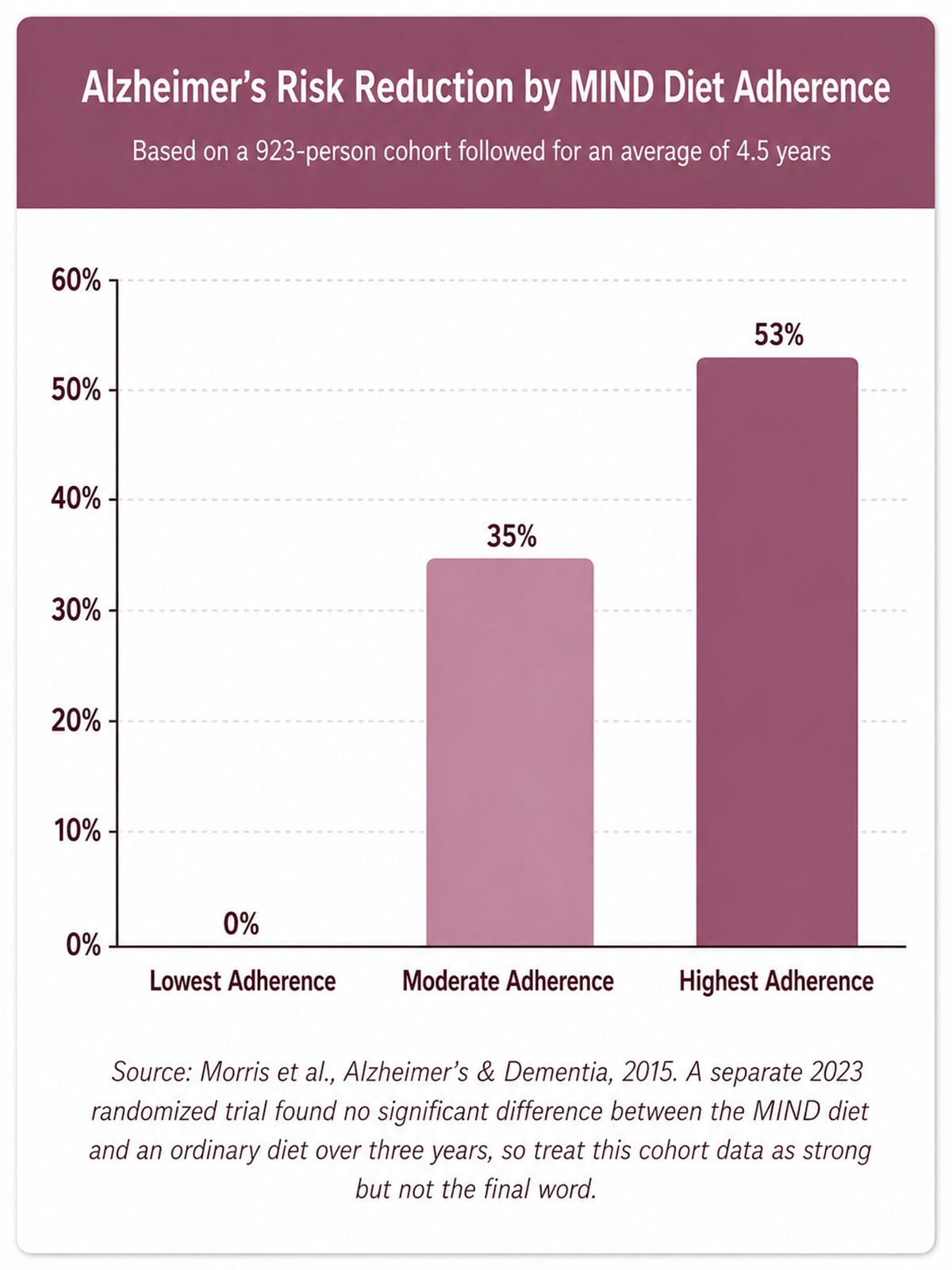
The MIND diet combines elements of the Mediterranean and DASH diets, built specifically around foods tied to brain health. Martha Clare Morris, a nutritional epidemiologist at Rush University who helped develop the diet, led a study following 923 older adults for an average of 4.5 years, published in Alzheimer’s & Dementia. Participants who followed the diet most closely had a 53 percent lower risk of Alzheimer’s disease, and even moderate adherence was tied to a 35 percent reduction.
A separate companion study from the same Rush research group followed nearly a thousand older adults and found that high MIND diet adherence was associated with a rate of cognitive decline similar to that of someone roughly 7.5 years younger.
A larger 2024 study in Neurology followed more than 14,000 people for a decade and found a 4 percent reduction in cognitive decline risk among those closest to the diet, with the benefit appearing stronger for women.
Here’s the study that conflicts with the results of the research above. A 2023 randomized controlled trial in the New England Journal of Medicine, the most rigorous head-to-head test the diet has faced, put 604 older adults on either the MIND diet or an ordinary diet, both paired with mild caloric restriction, and followed them for three years.
The two groups showed no significant difference in cognitive performance or brain MRI outcomes. That doesn’t erase the cohort evidence above, but it does mean the science is less definitive than most habit guides imply, and that a diet built on strong correlational data hasn’t yet been proven in a tightly controlled trial.
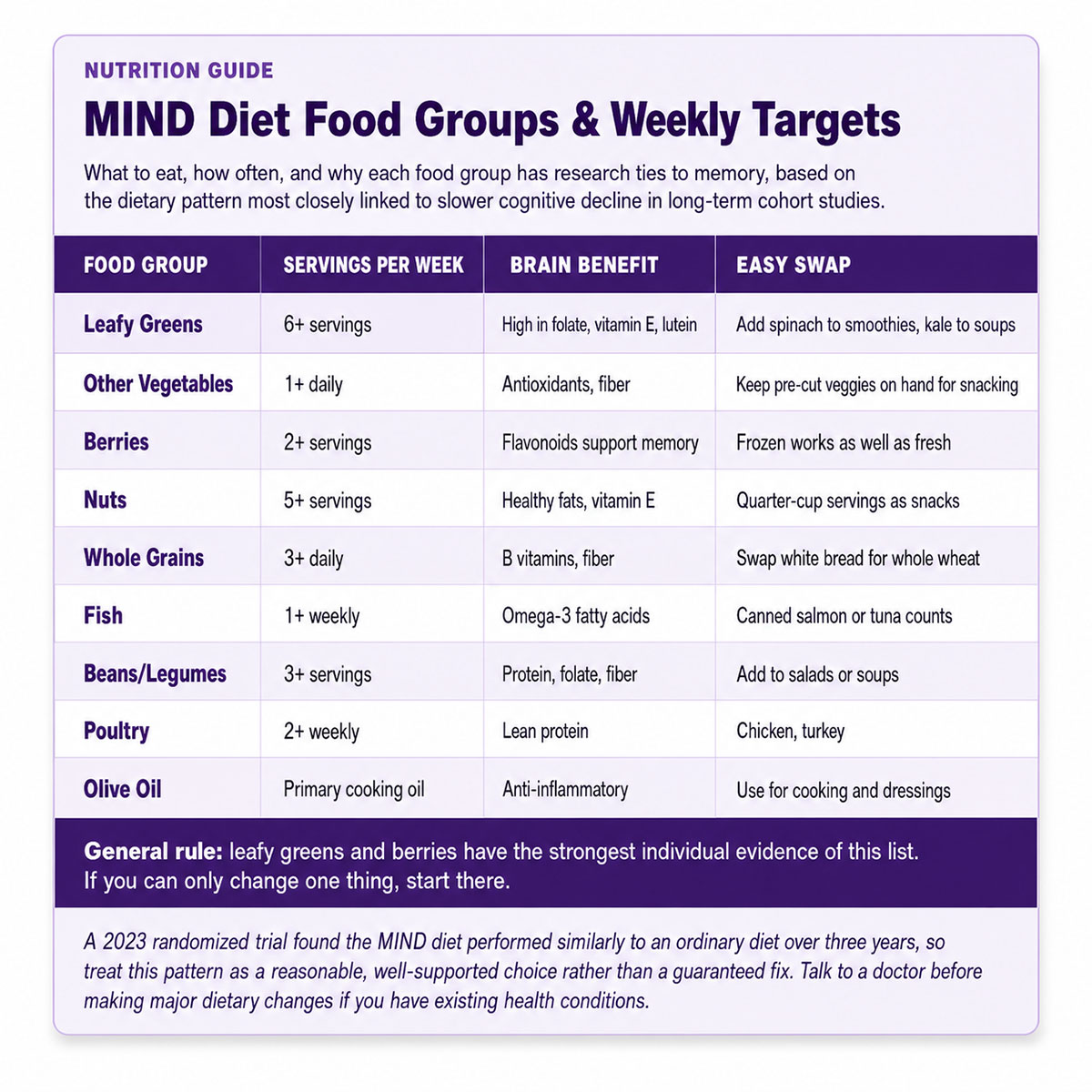
A 2018 study in Neurology tied a single daily serving of leafy greens to slower cognitive decline, on the order of 11 years of brain aging. The exact mechanism is still being worked out, though folate, vitamin E, lutein, and vitamin K are the leading candidates.
5. Omega-3s: A Building Block, Not a Cure-All
Roughly 60 percent of your brain is fat, and DHA, an omega-3, makes up a meaningful share of the structure of brain cell membranes.
Karin Yurko-Mauro and colleagues gave 485 adults with memory complaints either an omega-3 supplement or a placebo for 24 weeks in a study published in Alzheimer’s & Dementia. The supplement group showed improved working memory performance, with the largest gains appearing in people who started with the lowest omega-3 levels.
Researchers haven’t fully explained why early deficits predict bigger gains, though it fits a general pattern in nutrition research where correcting a real shortfall tends to matter more than adding extra on top of an adequate baseline.
Fatty fish twice a week covers most people’s needs. Walnuts, ground flaxseed, and chia seeds are reasonable plant-based additions. If you supplement, look for a combined DHA and EPA dose of at least 500 milligrams daily, in triglyceride form, third-party tested.
6. B Vitamins and the Homocysteine Connection
Your body produces a compound called homocysteine, and high levels of it are associated with brain shrinkage in memory-related regions. B6, B12, and folate work together to keep it in check.
Could a vitamin sold at any pharmacy actually slow brain shrinkage? A two-year trial of 271 older adults with mild cognitive impairment and high homocysteine, published in PLOS ONE in 2010, found that B-vitamin supplementation slowed brain shrinkage by up to 53 percent in that high-risk subgroup. The effect was smaller, though still present, in people who started with more typical homocysteine levels.
That’s a meaningful effect for something this unglamorous, a blood test and a basic supplement, not a specialized intervention.
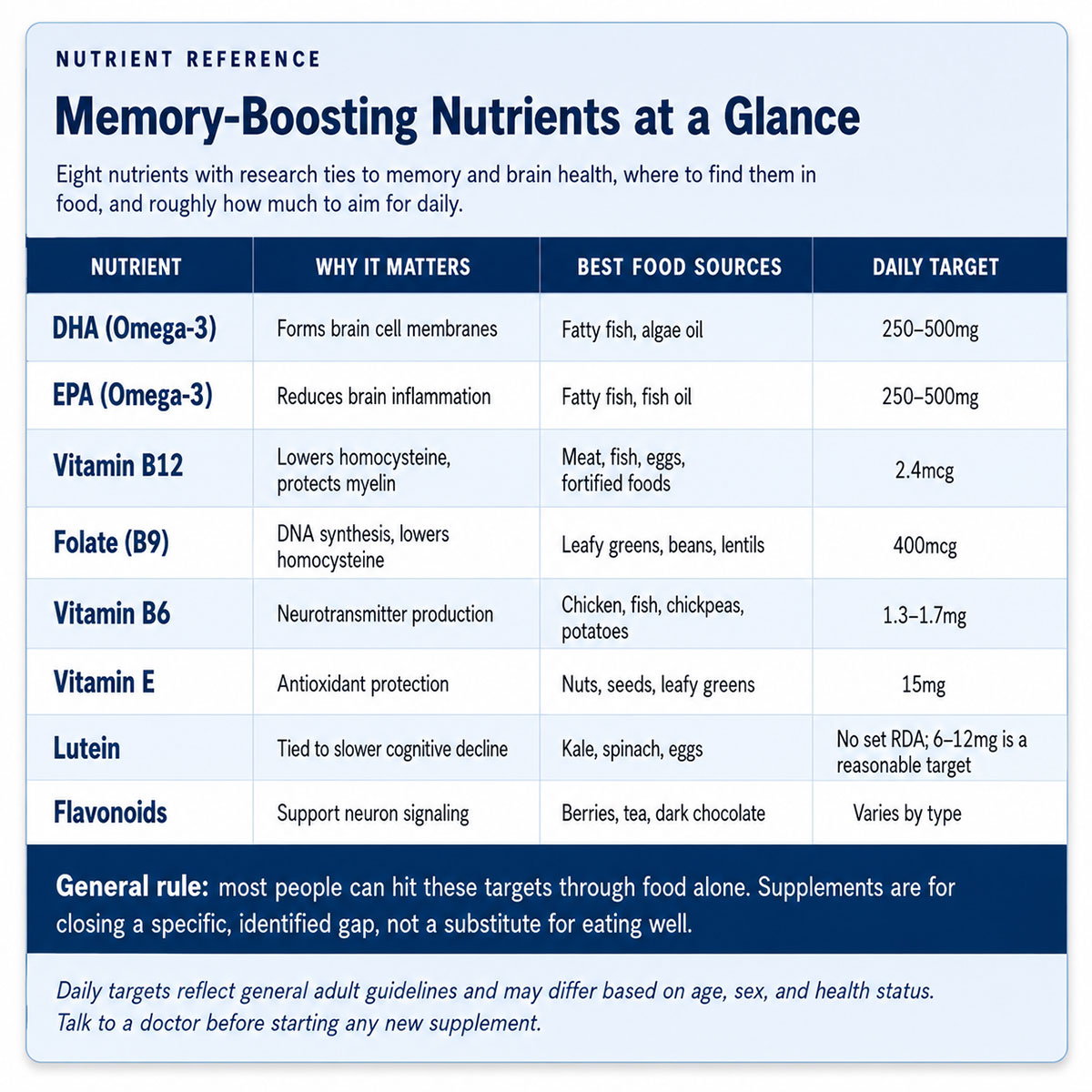
Adults over 50, vegetarians and vegans, and anyone on long-term acid-reducing medication face a higher risk of B12 deficiency, since stomach acid plays a role in absorbing it from food. Get B12 levels checked at your next physical. A result above 400 pg/mL is generally considered better for brain health than the lower end of the standard reference range.
7. The Foods Working Against You
Sugar and heavily processed food drive inflammation, and the hippocampus, the same region responsible for forming new memories, is particularly sensitive to it.
A 2011 review in Physiology & Behavior found that high-sugar, high-fat eating patterns impaired memory formation within weeks in both animal and human studies. Blood sugar swings compound the problem in the moment: a spike makes information harder to process, and a crash makes it hard to focus on anything at all.
Weeks, not years, is the detail worth noticing. This isn’t a slow-building risk so far off that it’s easy to ignore.
A practical rule holds up reasonably well here: if the ingredient list runs longer than five items and you can’t picture most of them in their original form, it’s probably working against you. Sugary drinks, packaged pastries, white bread and pasta, and processed meats with added nitrates are the most common culprits.
Swap one snack at a time rather than overhauling your diet at once. Apple slices with almond butter, a handful of mixed nuts, or Greek yogurt with berries are easy substitutes for whatever the vending machine is offering.
Cognitive Training: Sharpening Your Mental Tools
8. Training a Wandering Mind
The mind wanders for close to half of waking hours, by some estimates. You can’t remember what you never fully noticed in the first place.
Michael Mrazek and colleagues at UC Santa Barbara taught a group of college students mindfulness for two weeks, using 45-minute sessions four times a week, in a study published in Psychological Science. Working memory capacity and reading comprehension scores both improved, and the improvement tracked closely with how much mind-wandering had decreased.
Three approaches work for most people. Try whichever feels least unbearable rather than the one that sounds most legitimate.
- Sit comfortably and close your eyes.
- Focus on the sensation of breathing in and out.
- Count each exhale from one to ten, then start over.
- When your attention drifts, notice it and return to counting without judgment.
A body scan trains the same skill through a different route: lie down, start at your toes, and move attention slowly upward through each part of the body, noticing sensation without trying to change it. Mindful walking does the same thing in motion, paying attention to each footfall rather than the destination.
Five minutes of breath focus each morning is enough to start. The goal isn’t a clear mind. It’s noticing the drift and coming back, over and over.
9. Protecting Memory Under Pressure
Cortisol, the body’s main stress hormone, damages memory cells in the hippocampus over time. Chronic stress shrinks the same region that walking and sleep are working to protect.
Amishi Jha and colleagues studied U.S. Marines preparing for deployment in a 2010 study published in Emotion, teaching one group an eight-week program called Mindfulness-based Mind Fitness Training, distinct from the more widely known Mindfulness-Based Stress Reduction program. During the high-stress weeks before deployment, the trained group maintained their working memory capacity while an untrained comparison group’s memory declined.
The trial was small, 31 trained Marines against 17 untrained, so it’s best read as a promising early signal rather than a definitive finding. You don’t need to be deploying overseas for the underlying mechanism to apply.
Daily stress accumulates the same way, only more slowly. It rarely announces itself as stress, either. It shows up as forgetting why you walked into a room, three times in one afternoon.
A two-minute body scan during a stressful moment, scanning from your toes upward and noticing where tension has gathered, can lower cortisol almost immediately. The same is true of 4-7-8 breathing:
- Breathe in through your nose for four counts.
- Hold for seven counts.
- Exhale through your mouth for eight counts.
- Repeat the cycle four times.
Use it before stress builds rather than after it peaks. Prevention works better than damage control here.
10. Why Easy Doesn’t Count
Crossword puzzles and sudoku feel productive, and they aren’t nothing, but they rely on patterns your brain already knows. New connections require something that genuinely frustrates you at first.
Denise Park and colleagues at the University of Texas at Dallas split 221 older adults into groups for a 2014 study in Psychological Science: some learned digital photography, others learned quilting, and a control group socialized or did undemanding activities like listening to music. After three months, only the groups learning a genuinely difficult new skill showed measurable improvements in memory and reasoning. The control group, despite staying just as socially active, did not.
That result is awkward for a lot of generic search advice, including the kind this exact search usually surfaces. Type a question about improving memory into a search engine today, and there’s a good chance you’ll be told to do crossword puzzles or download a brain-training app. Park’s finding, and the deeper research literature on cognitive training, points the other way: skills that stay easy stop teaching your brain anything new.
That’s a separate topic from what this page covers. Techniques like chunking information into smaller groups or quizzing yourself right after learning something work on how you encode and retrieve specific material, not on the brain’s underlying capacity the way a genuinely hard new skill does.
Pick something you’ve been curious about: a language, an instrument, drawing, code, or a complex game like chess. Commit to 30 minutes three times a week for three months, and expect to feel incompetent for the first few weeks. That discomfort is the part that’s working.
11. Speed Is Part of Memory Too
Processing speed affects how much your working memory can hold at once. A faster processor can juggle more before something is lost.
Researchers running the ACTIVE trial wanted to know something specific: if you make the brain’s basic processor faster, does that actually show up in memory years later? It did, and it held up far longer than most cognitive-training research on healthy older adults usually shows.
The trial followed 2,832 older adults and reported its initial results in JAMA in 2002: two years of training on processing speed and reasoning tasks produced measurable, lasting gains. A separate ten-year follow-up published later in the Journal of the American Geriatrics Society found that those benefits persisted far longer than the original two-year window suggested, a result that’s often misattributed to the 2002 paper itself.
The training didn’t teach memory tricks. It made the underlying processor faster, through tasks like identifying briefly flashed objects or finding patterns quickly, with difficulty increasing as performance improved.
Look for tools that adapt to your performance and get harder as you improve. Static brain games that don’t escalate in difficulty, however popular, don’t appear to transfer to real-world memory.
12. The Nature Reset
Constant digital stimulation exhausts the brain’s attention system in ways that are easy to underestimate. Time outdoors appears to work against that in a specific, measurable way.
Marc Berman and colleagues at the University of Michigan had participants walk either through a park or through a busy urban area for 50 minutes, then tested their working memory in a 2008 study published in Psychological Science. The nature-walk group improved by roughly 20 percent. Walkers in the urban setting showed no benefit at all.
That sample was small, just 38 undergraduates, so the effect size is best read as suggestive rather than definitive. Still, the direction of the finding has held up in later, larger work on what researchers call attention restoration.
Researchers describe the proposed mechanism as fairly straightforward: directed attention, the kind traffic and crowds demand constantly, gets to rest in a natural setting while gentle, involuntary stimuli like birdsong or rustling leaves keep the mind lightly occupied. That rest appears to restore working memory capacity, not unlike closing background programs that have been quietly draining a computer’s processing power.
Even a window view of greenery or twenty minutes in a city park seems to provide some benefit, though the effect is strongest with sustained, real exposure. Leave the phone in your pocket and walk at a comfortable pace rather than an intense one.
The Science of What Doesn’t Work
Knowing what doesn’t hold up matters as much as knowing what does, since it’s the fastest way to stop spending time and money on the wrong things.
Multiple large trials have tested ginkgo biloba in healthy adults and found little to no benefits. Steven DeKosky and colleagues followed 3,069 older adults for a median of six years in the GEM trial, published in JAMA in 2008, and found no benefit for preventing dementia or slowing memory decline.
The bigger one, and the one worth consideration, is brain games. Search for ways to improve short-term memory today, and the advice you’ll most likely see, including from automated search summaries, leans on Sudoku, crossword puzzles, and games like Tetris.
The research on generic, non-adaptive brain games doesn’t support that advice. Without progressive difficulty that tracks your actual performance, the training stays specific to the game itself and doesn’t transfer to memory in daily life. That’s the same conclusion Habit 10’s research points to, and it’s worth knowing before spending money on an app that promises otherwise.
Coconut oil doesn’t have research support for brain health either, and its high saturated fat content may increase inflammation rather than reduce it. Extremely low-carb diets can impair cognitive function in some people, since the brain runs primarily on glucose, part of why the MIND diet includes whole grains rather than cutting them.
And doing what you’re already good at, however enjoyable, doesn’t build new capacity. Thirty years of the same crossword format trains familiarity, not growth.
How to Actually Start
Don’t try all twelve habits in the same week. That’s the fastest way to abandon all of them by week three.
Start with sleep. It’s the foundation the other habits build on, since a rested brain finds it easier to stick with exercise and food changes in the first place. A fixed wake time alone, held for a week, tends to pull bedtime into line behind it without much extra effort.
Add walking next, even for twenty minutes, three times a week. Layer in one diet change, like leafy greens at lunch or a swap for one processed snack. By the end of the first month, most people are running three or four habits at once, not all twelve, and that’s enough to notice a difference.
From there, expansion looks less like a calendar and more like addition by subtraction: once a habit runs on autopilot, add the next one.
The honest description of what this looks like after a few months isn’t a transformation. It’s quietly fewer bad days: fewer afternoons when focus disappears after lunch, fewer moments standing in a doorway with no idea why.
That’s a realistic outcome to aim for. Not a different brain. A slightly more reliable one.
Conclusion
The honest conclusion of this story isn’t that everything works. It’s that the things with real evidence behind them, walking, sleep, a handful of specific nutrients, a genuinely hard new skill, keep holding up even when a trendier claim doesn’t.
The MIND diet’s best-designed trial found it tied with an ordinary diet. That’s not a reason to abandon it, since the cohort evidence behind it is still substantial, but it’s a useful reminder that habit advice usually oversells certainty it hasn’t earned.
Your brain built this capacity once already, over years of ordinary living. It hasn’t stopped being able to rebuild it just because you forgot, again, why you walked into the kitchen.
FAQs
How long until I see memory improvements?
It depends on which habit you start with. Sleep changes tend to show up within one to two weeks, while walking takes eight to twelve weeks to produce measurable structural brain changes, though many people feel sharper within a month.
Diet changes typically show results over six to twelve weeks. Most people notice some improvement within the first month if they commit to three or four habits consistently.
Can I reverse memory loss with these habits?
If lifestyle factors like poor sleep, chronic stress, or a poor diet are driving the problem, yes, these habits can meaningfully improve recall, and the research above shows actual brain change beyond improved test scores. If an underlying condition like Alzheimer’s disease is involved, these same habits can slow progression but won’t reverse it, which is exactly why ruling out a medical cause first matters.
Which habit should I start with?
Sleep. It’s the foundation everything else depends on, and fixing it tends to make every other habit easier to stick with.
Are supplements necessary, or can I get everything from food?
Most people can meet these targets through food alone. The exceptions are omega-3s if you don’t eat fish twice a week, B12 if you’re vegetarian or vegan, and vitamin D if you live somewhere with limited winter sunlight. For everything else, whole foods should come first, with supplements filling specific, identified gaps rather than replacing a decent diet.
What if I can only manage two or three habits?
Sleep consistency, walking three times a week, and cutting back on ultra-processed food deliver the most noticeable change for the least effort. Add others once those three feel automatic.
Do these habits work for young adults, or only older people?
Short-term memory loss in young adults usually has the same lifestyle roots as it does at any age, with different triggers, often poor sleep, high stress, or heavy multitasking, rather than age-related decline. Mrazek’s mindfulness study used college students, and Åberg’s fitness study tracked men in their late teens and twenties. The mechanisms that build brain health at 60 build it at 25 too.
How much does genetics matter?
Genetics play a real role in Alzheimer’s risk, including the APOE4 gene variant, but lifestyle factors appear to matter more than most people assume. Research suggests that following the MIND diet and exercising regularly can meaningfully reduce risk even in people carrying that variant.
Can I drink coffee, or will it hurt my memory?
Moderate coffee, two to three cups daily, is fine for most people and may even help, since coffee contains antioxidants that appear to support brain cells. Among the various drinks marketed for brain health, coffee has one of the better evidence bases, mostly because it’s been studied so extensively.
The main risk is timing rather than the coffee itself: drinking it too late in the day disrupts the sleep this entire list depends on, so cutting off around 2 p.m. protects more than it costs.
What’s the 2-7-30 rule for memory?
It’s an informal study technique, not a medical concept: review new material after two days, then seven days, then thirty days, spacing out repetition rather than cramming it all at once. It’s a real and useful idea, rooted in what researchers call the spacing effect, but it belongs to a study technique rather than the everyday biological habits covered here.
What about the “8-second memory trick” or the “4 C’s of memory”?
Both are catchy repackagings of real underlying techniques, attention, chunking information into smaller groups, and creating vivid mental images, rather than new scientific discoveries. They’re not harmful to try, but treat them as memory tricks for specific moments, like a name or a number, not as a substitute for the habits in this list that change the brain’s underlying capacity.
Will one habit done intensely work better than several done moderately?
The habits reinforce each other. Walking amplifies the benefit of good nutrition, and good sleep makes everything else easier to maintain. Most people see better results running three or four habits moderately than perfecting one in isolation, though something consistent is always better than nothing at all.
How do I know if my memory problems need medical attention?
See a doctor if memory loss is interfering with daily life, if you’re repeatedly forgetting important appointments or getting lost in familiar places, if family members have raised concerns, or if symptoms are worsening quickly. The habits in this guide address ordinary, lifestyle-driven forgetfulness, not an underlying medical condition.
What if I have ADHD? Will these habits still help?
Often, yes, particularly exercise, interval training in particular, mindfulness practice, and omega-3 intake, all of which have research ties to improved working memory and attention in people with ADHD. They complement medication rather than replace it, so work with your doctor on combining lifestyle changes with whatever treatment plan already fits your situation.
Can I skip the nature walks and just exercise indoors?
You’ll still get the cardiovascular benefits from an indoor workout, but the attention-restoration effect specifically comes from natural environments, not exercise itself. If getting outside genuinely isn’t possible, a window view of greenery or nature sounds during an indoor walk can provide a smaller version of the same benefit.