If your first instinct is another cup of coffee, there’s a surprisingly simple alternative. Researchers found it can improve mental performance in minutes.
You read the same paragraph four times. You walked into the kitchen and stood there, blank. You know the word you want, and it’s simply gone. At some point, you probably reached for more coffee, not because you believed it would fix anything, but because there was nothing else obvious to try.
There is something else. Researchers have spent years testing it, and a team at Penn State just identified a mechanism that explains, at a biological level, why it works. The answer is not a supplement, not a breathing technique, and not caffeine. It takes about ten minutes, and you can do it from wherever you are right now.
Why Your Brain Feels Foggy (The Short Version)
Brain fog has many triggers, but the most common day-to-day version has a straightforward cause: prolonged stillness. When you sit at a desk for hours, blood flow to the brain slows, your body stops generating the movement signals your nervous system uses to stay alert, and metabolic waste products that accumulate in brain tissue during sustained mental effort are not being cleared efficiently.
The caffeine problem compounds this. Caffeine works by blocking adenosine receptors, the brain’s signal for fatigue. It doesn’t remove tiredness. It muffles the signal. When the caffeine clears your system, adenosine rushes back in and hits an upregulated set of receptors (more receptors than you started with), which is why the crash after a few cups often feels worse than the fog you were trying to escape.
StatPearls, the clinical reference published by the National Institutes of Health, describes this rebound as a documented withdrawal mechanism involving reduced dopamine release in the prefrontal cortex, the region most directly responsible for focus and working memory.

What Neuroscientists Found Out About Movement and the Brain
A study published in the spring of 2026 by researchers at Penn State offers the most mechanistically specific explanation yet for why physical movement clears mental fog in ways that sitting quietly does not.
Patrick Drew, a professor of engineering science, mechanics, and neurosurgery, led a team that found something unexpected: the brain may have a built-in cleaning system that depends on bodily movement to activate.
Each time your abdominal muscles contract during walking, they compress blood vessels connected to the spinal cord in a way that acts, as Drew described it in the Penn State press release, “just like a hydraulic system.”
That pressure causes the brain to shift gently within the skull. The shift is tiny (barely perceptible), but it appears to drive cerebrospinal fluid, the liquid that surrounds and bathes the brain, across the brain’s surface. And when cerebrospinal fluid moves, it carries metabolic waste products with it. The kind of cellular debris that builds up during long stretches of cognitive work.
The primary work was done in mice, and the human simulations are still being validated. Drew framed the implications as promising rather than settled. But the mechanism itself is physiologically plausible, it aligns with what other researchers have observed about the brain’s waste-clearance network during sleep, and it gives researchers a new reason to think that the problem with sitting for hours is not just circulation. It may be the literal accumulation of metabolic byproducts in brain tissue.

The 10-Minute Protocol (and What the Research Actually Says About It)
Across more than a hundred studies involving nearly 4,400 participants, a 2024 systematic review and Bayesian meta-analysis found that a single bout of acute exercise produces a small but statistically real improvement in cognitive function, specifically in working memory and the ability to inhibit distracting information. That’s the category that covers most of what feels like brain fog: the inability to hold a thought, focus on a task, or filter out noise.
The effect is modest. Effect sizes in this class of research hover around g=0.13, which is the honest number. Movement does not transform your cognitive capacity. What it does is move the needle measurably in the right direction, and it does so in a single session, not after weeks of training.
The protocol researchers have used in acute exercise cognition studies is also very achievable:
- Walk at a brisk pace: purposeful, slightly elevated breathing, not leisurely.
- Keep going for 10 minutes without stopping.
- Stay off your phone. The evidence for movement’s effect on cognitive function is based on movement, not multitasked movement.
- Return to your task within a few minutes of finishing. The cognitive benefit appears in the period immediately following the walk, not hours later.
The direction matters as much as the distance. Walking outside appears to have an advantage over walking on a treadmill for certain mood and attention outcomes, but the core cognitive effect has been observed in both settings. If a ten-minute outdoor loop is available to you, take it. If the only option is walking the corridor of your office building, that counts.
If You Only Have Two or Three Minutes
Google’s AI overview for “how to clear brain fog instantly” now recommends a brisk two-minute walk as a first-line intervention. That reflects a separate body of literature showing short movement bouts (even five minutes) produce detectable increases in blood flow to the prefrontal cortex.
The ten-minute threshold is where cognitive task performance improvements become consistent in the research. Below that, the evidence is thinner but directionally sound. If two minutes is all you have, two minutes is worth doing. Walk fast, arms moving, away from your screen.
The Honest Comparison: What Walking Beats and What It Doesn’t
One of the murkier claims you’ll encounter in content about movement and brain fog is that walking outperforms meditation for mental clarity. The research does not support that claim, and one study directly contradicts it.
A 2021 randomized trial published in Frontiers in Psychology compared 10 minutes of exercise, 10 minutes of mindfulness meditation, and 10 minutes of reading as a control in a population with attention deficits. Meditation improved performance on every executive functioning task. Exercise improved mood and self-efficacy, but not executive function.
This does not mean meditation is universally superior. Population, context, and what cognitive domain you’re measuring all change the picture significantly. What it means is that exercise and meditation appear to work through different pathways: exercise activates the cardiovascular and mechanical systems described above, while meditation appears to target attention regulation and working memory through sustained focus practice.
They are not rivals. If you have a meditation practice, keep it. If a ten-minute walk is more realistic in the middle of a workday, the evidence supports that too.
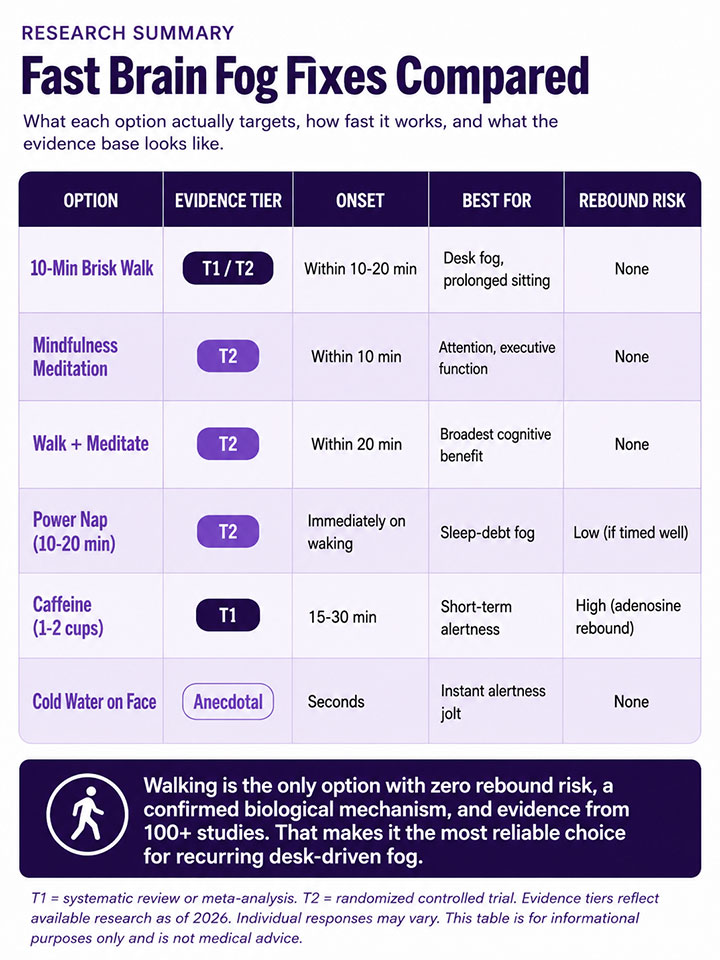
The table below compares the major fast-acting options across the dimensions most relevant to someone with brain fog right now.
The Caffeine Comparison Nobody Talks About Honestly
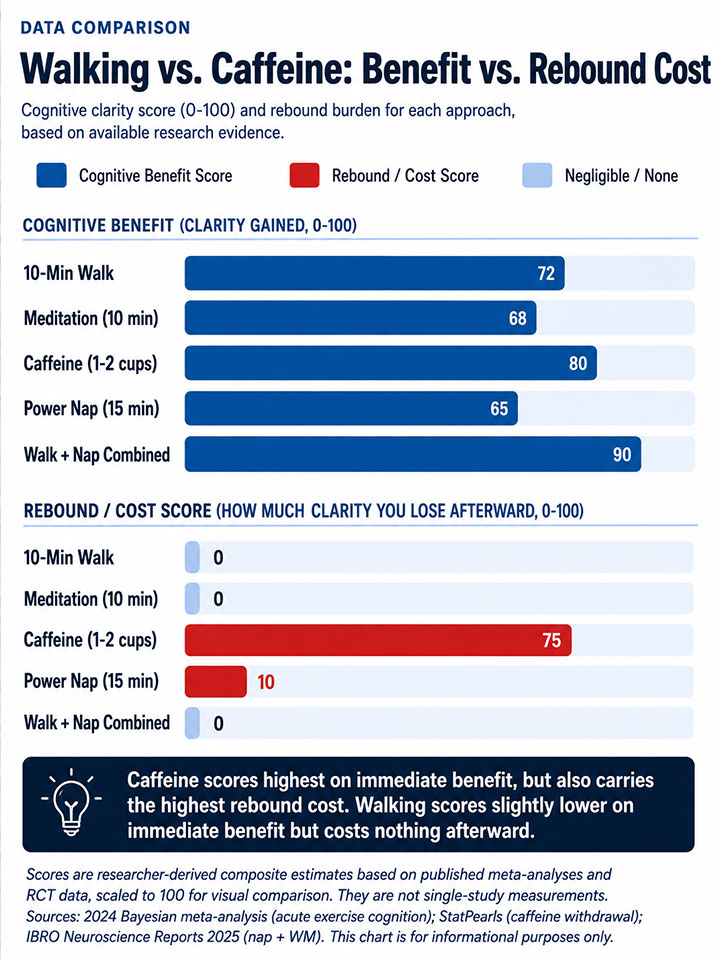
The question most people are really asking when they search “how to clear brain fog fast” is whether movement beats the option they’re already using: another cup of coffee.
For short-term alertness in a sleep-deprived state, caffeine has a legitimate edge. It is fast (effects begin within 15 minutes), it works on adenosine receptors with reasonable reliability, and it requires no physical effort. A well-established body of research confirms moderate caffeine use improves attention and reaction time.
The problem is cumulative. Chronic use upregulates adenosine receptors. Each cup of coffee needed to reach the same level of alertness means more adenosine signaling when that cup wears off, which means a more pronounced fog on the other side.
The neurobiology is documented: regular caffeine dependence is associated with reduced dopamine release in the prefrontal cortex during withdrawal, the same region responsible for the focus and clarity you were trying to restore.
A ten-minute walk carries no rebound. The movement-triggered mechanisms (blood flow, cerebrospinal fluid circulation, BDNF release) do not generate a withdrawal state. For mid-afternoon fog specifically, research on circadian rhythms consistently shows the early afternoon dip in alertness responds better to movement and brief rest than to additional stimulants. The caffeine just delays the dip. It rarely eliminates it.
How Long Does It Take to Clear Brain Fog?
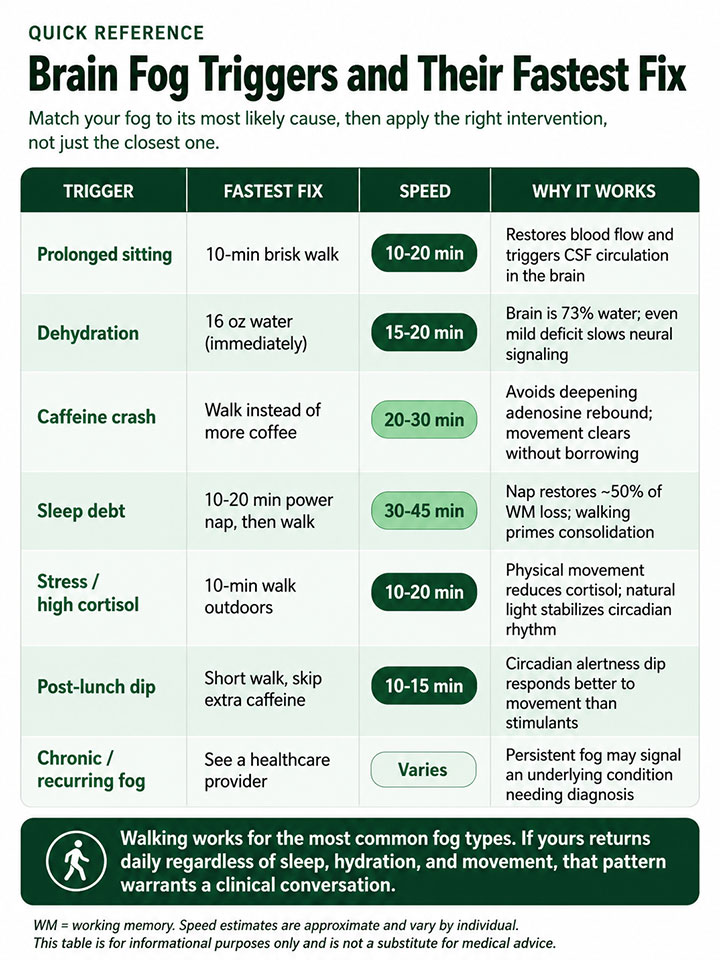
For fog driven by prolonged sitting, the research on acute exercise cognition suggests the cognitive benefit appears in the minutes immediately following the activity. You are not waiting hours for a delayed effect. The studies that observe Stroop task improvements and working memory gains measure participants within 10–20 minutes of finishing the exercise session.
For fog driven by caffeine withdrawal, the timeframe is longer and more variable. The adenosine rebound that follows the wearing-off of caffeine typically peaks 4–6 hours after your last dose, and the full receptor recalibration described in clinical literature takes 7–14 days of reduced or eliminated caffeine intake before baseline sensitivity is restored. A walk helps in that window, but it is not a fix for caffeine dependence. It is symptom management at best.
Sleep-driven fog is the hard case. A 10-minute walk will move the needle, but it cannot substitute for what the brain does during sleep: consolidating memories, rebalancing neural networks, clearing the kind of accumulated fatigue that two good nights would fix and no amount of walking will.
A 2025 study published in IBRO Neuroscience Reports found that a 30-minute nap restored roughly half the working memory capacity lost to sleep deprivation. If both a walk and a nap are available, the evidence suggests combining them is better than either alone, based on a 2020 study in the journal Sleep. The sequence appears to matter: move first, then rest. The walking seems to prime the consolidation that follows.
Who Benefits Most (And When Walking Isn’t Enough)
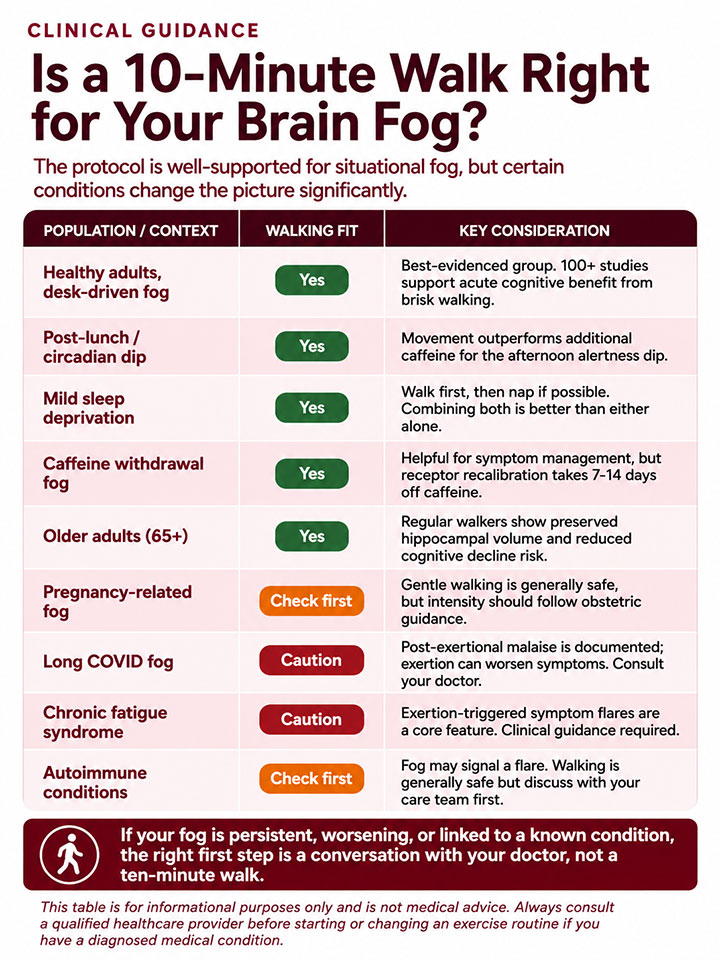
The evidence base for movement-triggered cognitive improvement is strongest in healthy adults dealing with situational fog, the kind that builds over a long stretch of desk-bound work. If your fog fits that pattern, ten minutes of walking is a well-supported first intervention.
For people managing fog associated with long COVID, chronic fatigue syndrome, or autoimmune conditions, this article’s advice does not apply accordingly, and pushing through anyway can make things worse.
Post-exertional malaise is a documented feature of these conditions, meaning physical effort sometimes increases symptoms rather than relieving them. The mechanisms are still being studied, but the clinical experience is consistent enough that the standard guidance from healthcare providers in those contexts is caution, not brisk walking.
If you suspect your fog falls into this category, the right first step is a conversation with your doctor, not a ten-minute loop around the block.
Which Brain Fog Fix Fits Right Now?
Answer 3 quick questions to get a personalised, evidence-tagged recommendation for your situation.
Putting It All Together
You reached for coffee because it was there, it was fast, and there wasn’t anything else obvious. That part was reasonable. The problem is what the second and third cups set up for later, and the way the eventual crash tends to feel worse than the fog you started with.
The ten-minute walk is not a dramatic intervention. The effect size is modest, the mechanism was only described in detail this year, and it will not fix fog that stems from months of bad sleep. What it does is stop the borrowing. Every cup of coffee is a loan against clarity you’ll have to repay at adenosine gunpoint. Every walk is a deposit. Over a workday, that distinction compounds.