The standard advice for a struggling relationship is to talk more, listen better, and communicate your feelings. Researchers at Northwestern University tried something different.
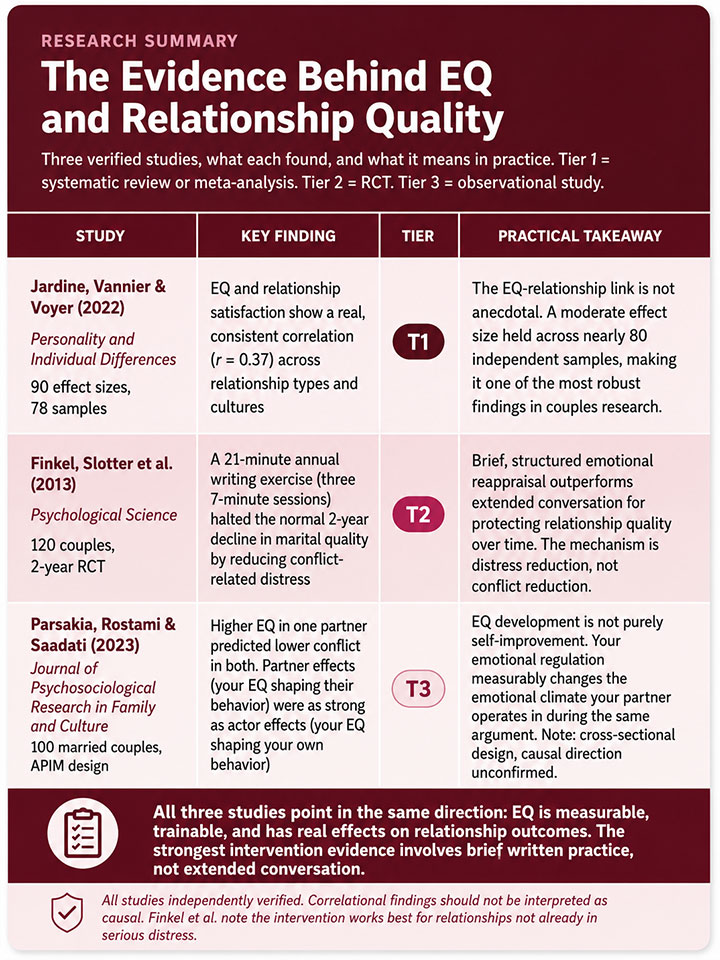
Instead of asking 120 couples to talk their conflicts through, they gave them a writing exercise. Three short sessions, a few minutes each, with no conversation between partners required.
After two years, the couples who did the exercise had held onto their relationship quality. The couples who did nothing had slid, the way most relationships do after the first year. The Finkel et al. study published in Psychological Science in 2013 found this without the couples resolving anything, or even raising it between them.
That finding matters because it changes the question. The problem probably isn’t that you and your partner don’t talk. The real gap may be what’s happening emotionally before either of you opens your mouth.
Why Your EQ Affects Your Partner’s Behavior, Too
Most conversations about emotional intelligence frame it as personal growth: work on yourself, and your relationship benefits. The research tells a more interesting story.
Psychologists Kamdin Parsakia, Mehdi Rostami, and Seyed Milad Saadati studied 100 married couples in Canada, asking both partners to independently report their EQ and the frequency of marital conflicts.
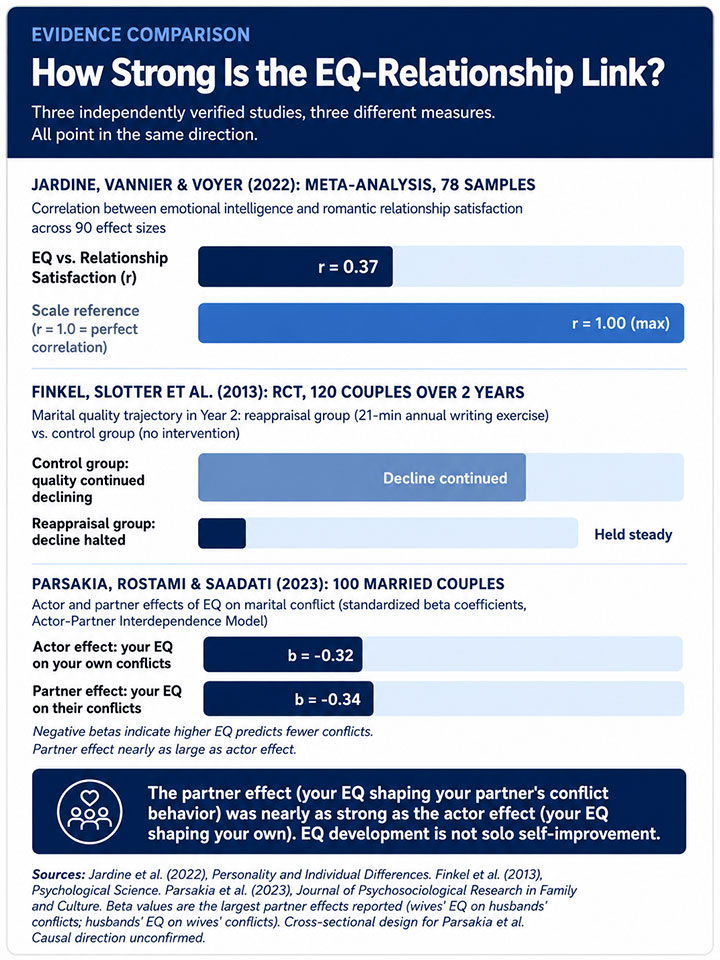
What they found, published in the Journal of Psychosociological Research in Family and Culture in 2023, was that a partner’s EQ didn’t just predict their own conflict behavior. It predicted their spouse’s conflict behavior too.
Wives with higher EQ had husbands who reported fewer conflicts. Husbands with higher EQ had wives who reported fewer conflicts. The effect ran in both directions, across both partners.
What that means, practically, is that EQ work is not something you do purely for yourself. It is, in a measurable way, changing the emotional climate your partner operates in during the same argument.

What the 5 Components Actually Look Like in a Relationship
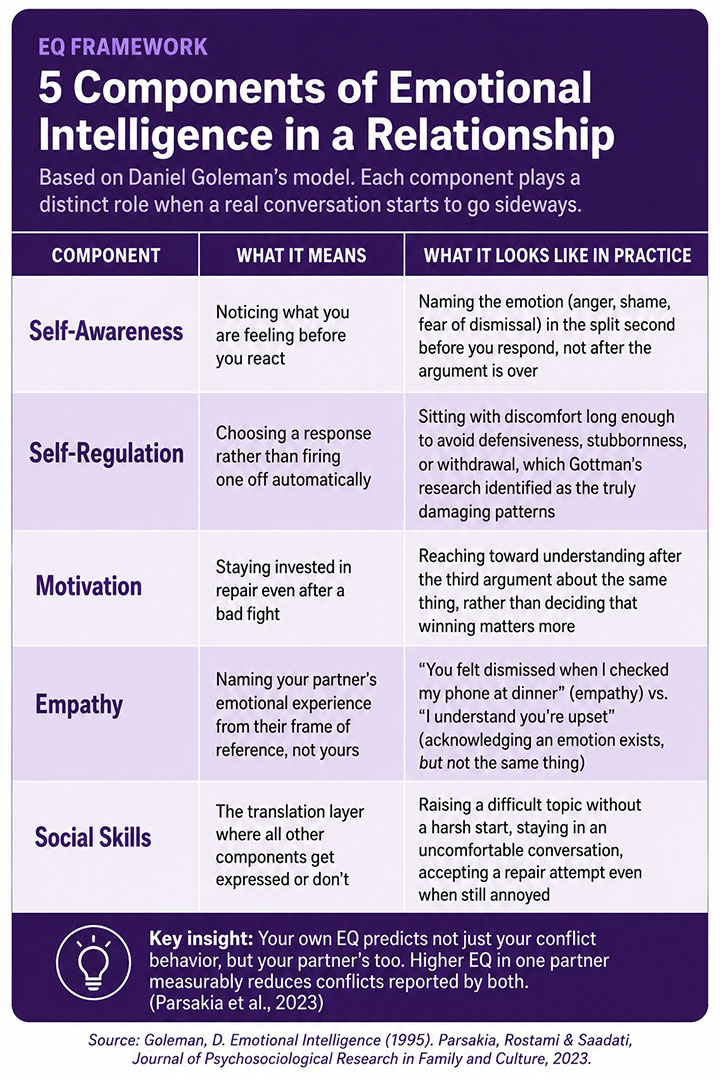
Goleman’s five components are defined in abstract terms in most descriptions. Here is what they look like in practice, when a real conversation starts to go sideways.
Self-awareness is the ability to notice what you are feeling before you react. In a conflict, this is the split second between something your partner says and your response. People with high self-awareness can name the emotion (anger, shame, fear of being dismissed) before it becomes behavior. People with low self-awareness often discover what they were feeling only after the argument is over.
Self-regulation is what you do with the emotion once you name it. Not suppression. Not venting. The capacity to sit with the discomfort long enough to choose a response rather than fire one off. What Gottman found in his 1989 longitudinal work in the Journal of Consulting and Clinical Psychology is essentially a portrait of what happens when self-regulation fails under stress: the damaging patterns weren’t anger, but defensiveness, stubbornness, and withdrawal.
Motivation is the least-discussed component and possibly the most important in a long-term relationship. It’s what keeps you reaching toward repair after the third argument about the same thing. Without it, the other four components sit unused. You can have perfect self-awareness and still decide that winning this argument matters more than understanding it.
Empathy is the component most people are most wrong about. Not because they lack it: most people in relationships genuinely want to understand their partner. But wanting to understand and actually understanding are different things.
Accurate empathy means naming your partner’s emotional experience from their frame of reference, not yours. “You felt dismissed when I checked my phone during dinner” is empathy. “I understand you’re upset” is reporting back that an emotion exists.
Most people, when they feel they’ve been empathetic, have actually described what they would have felt in the same situation. It’s a starting point. But it’s not the same thing.
Social skills (the ability to raise a difficult topic without a harsh start, to stay in a conversation when it gets uncomfortable, to accept a repair attempt even when you’re still annoyed) is where the other four components either get expressed or don’t. You can have all the internal emotional intelligence in the world. Social skills is the translation layer.
The Research That Changed How This Should Be Taught
The Finkel study is worth describing in some detail, because the mechanism matters as much as the result does.
Eli J. Finkel and his colleagues recruited 120 couples enrolled in an intensive two-year study. In year two, half were randomly assigned to a reappraisal exercise.
The other half received no intervention. Both groups had already shown the same pattern in year one: the natural, gradual decline in marital quality that characterizes most long-term relationships.
The reappraisal exercise was not a conversation with their partner. Each person wrote alone, three times over the course of a year, in response to a simple prompt: describe a recent conflict from the perspective of a neutral third party who wants the best for everyone involved. The sessions took approximately seven minutes each. The total time commitment across the year was 21 minutes.
In year two, the control group continued declining. The reappraisal group held steady. The study traced this effect to one mechanism: reappraisal reduced conflict-related distress over time. What changed was how undone the couples were by the fights they were still having.
One caveat worth stating directly: the researchers noted the exercise works best in relationships not already in serious distress. It is a maintenance tool, not a rescue.
The Myth That Good Couples Don’t Fight
John Gottman spent years in his University of Washington lab watching couples argue, then tracking them for years afterward to see which relationships held. What he found in his longitudinal research published in the Journal of Consulting and Clinical Psychology in 1989 complicated what therapists had been telling couples for decades.
Anger and disagreement, by themselves, did not predict which relationships would decline. Three patterns did: defensiveness, stubbornness, and withdrawal from the conversation entirely. The couples who stayed together weren’t necessarily calmer. They were better at recovering.
Recovery, in Gottman’s framework, hinges on what he calls repair attempts. A repair attempt is any bid to de-escalate a conflict before it spirals. It can be an apology. A touch on the arm. A poorly-timed joke.
An acknowledgment that you said something you didn’t mean. The content matters less than the function. And the function, his research found, matters enormously: couples whose repair attempts were consistently rejected showed far higher rates of relationship failure than couples with similar conflict frequency whose repairs landed.
The skill isn’t avoiding conflict. The skill is getting good at repair.
What to Actually Do: A Practice-First Guide
What follows is less a list of principles than a set of moves, specific enough to try in the next argument, not just the next version of yourself.
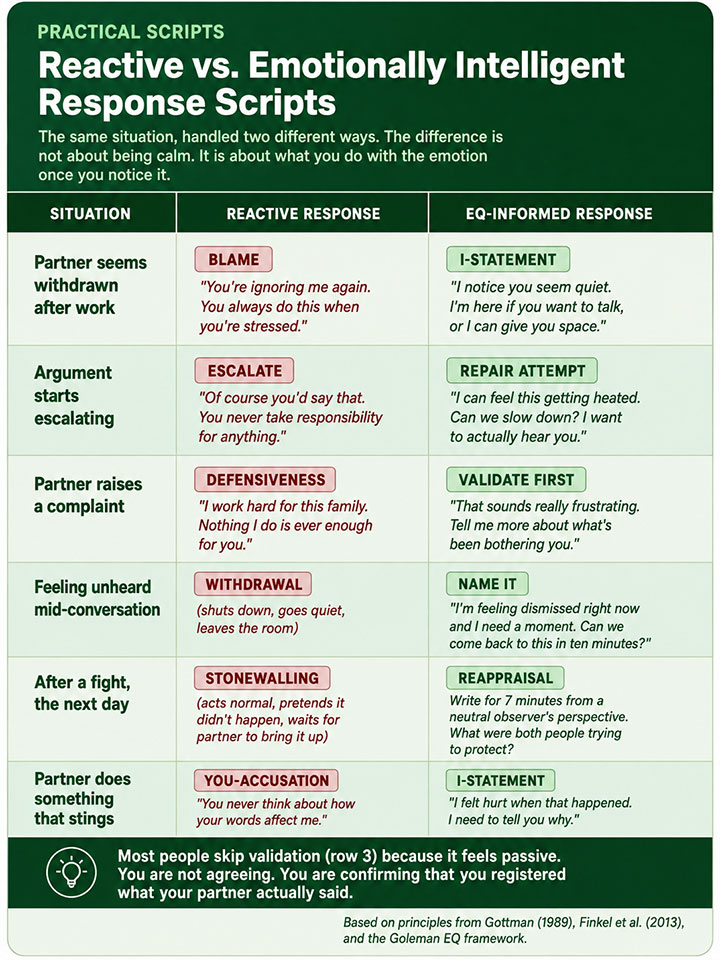
Pause and name the emotion before you speak. This is the self-awareness practice made concrete. Before responding to something that stings, take a moment to identify the feeling. Not “I’m upset.” More specific: “I feel dismissed,” “I feel scared this is going to happen again,” “I feel embarrassed.” Naming the emotion with precision does two things: it engages the prefrontal cortex, which is responsible for considered responses, and it slows the automatic defensive reaction.
Listen to understand, not to counter. In most arguments, people listen selectively, scanning for the part they disagree with so they can respond to it. Listening to understand means staying with what your partner is saying until you can reflect their experience back to them accurately. This is not the same as agreeing. You are not required to agree with your partner’s interpretation of events. You are required, if you want a functioning relationship, to understand what they experienced.
Validate the feeling before solving the problem. The sequence matters. “That sounds really hard” before “here’s what I think we should do” produces a different outcome than the reverse. Jumping to solutions before acknowledging an emotion tends to read as dismissal, even when it’s well-intentioned. This is the practice most people skip, mostly because it feels passive, like you’re agreeing rather than helping. You’re not agreeing. You’re confirming that you registered what your partner actually said.
Use “I” statements in place of “you” accusations. This is advice that gets simplified to the point of uselessness in most articles. The principle isn’t just “say I instead of you.” The principle is: express what you feel and need, rather than what your partner did wrong. “I feel unheard when conversations end before I’ve said what I needed to say” is different from “You never listen.” One describes your experience. The other assigns blame. Under stress, people default to blame. Emotional intelligence means catching that default and choosing the alternative instead.
Try the 7-minute reappraisal exercise. Based directly on the Finkel intervention, this takes about seven minutes and is best done alone after a conflict, not during one. Write about the disagreement from the perspective of a neutral observer who genuinely cares about both of you. What would they notice? What were both people trying to protect? What might they suggest? The goal isn’t resolution. The goal is reducing the distress the conflict is carrying into the next interaction.
Make repair attempts early. The instinct when a conversation starts to escalate is to push harder. The behavior that actually works is to interrupt the escalation. This can be a direct acknowledgment (“I can feel this getting heated. Can we slow down?”), a soft bid for connection (“I don’t want us to fight about this”), or something lighter. What it cannot be is nothing.
When Your Partner Is the One Who Struggles With EQ
This is the question that shows up in relationship forums far more often than it shows up in health articles: what do you do when you’re the one doing all the emotional work?
The Parsakia et al. 2023 data offers a partial answer, though not a comfortable one. Because emotional intelligence shows a partner effect, raising your own EQ does measurably influence the emotional climate your partner operates in. That is not a prescription to become your partner’s emotional caretaker, but an observation that the system is more interconnected than it appears.
What doesn’t work is demanding that your partner “work on their EQ.” That phrasing tends to land as an accusation, and accusations activate defensiveness, which is the exact state least conducive to emotional learning. What works better is modeling the behaviors consistently enough that the relationship itself becomes a practice environment.
Knowing your own limits matters too. Consistently absorbing emotional unavailability without support is not a sustainable position. If the gap is significant and neither modeling nor direct conversation is changing anything, couples therapy provides a structured environment where both partners can build these skills with professional guidance. Couples therapy is not a failure of the approach described here. It is that approach at greater depth, with a professional present.

How Long Does This Take?
The honest answer is that nobody has measured this properly yet for relationship-specific EQ practices in isolation. The Finkel intervention showed effects measured in months, across a two-year study.
General EQ research suggests that self-awareness and self-regulation show the fastest gains from structured practice. Empathy takes longer, particularly the accurate-reflection kind rather than the intent to empathize, because it requires consistent feedback from another person.
What the Jardine, Vannier, and Voyer 2022 meta-analysis in Personality and Individual Differences establishes clearly is that the correlation between emotional intelligence and relationship satisfaction is real, moderate, and consistent across 78 separate samples. That’s not a guarantee of any specific timeline, but it is evidence that the direction of travel is right.
A more useful frame than “how long” is: what would change in your next difficult conversation if you paused, named the emotion, and listened to understand rather than to respond? That is not a two-year project. That is a decision available in the next argument.
What Is Your Relationship EQ Starting Point?
8 scenario-based questions. Your result points to the one practice most likely to make a difference for you right now.
The Part Nobody Tells You
Developing emotional intelligence in a relationship is not a solo project that improves your half of the partnership. The Parsakia data suggests your emotional regulation literally changes what your partner experiences in the same argument.
The Finkel data suggests a brief, individual writing practice can slow the decline most relationships don’t notice until it’s advanced. The Gottman research suggests the couples who stay together aren’t the ones who fight less. They’re the ones who got good at reaching toward each other mid-fight, and accepting it when the other person reached back.
The goal was never to have fewer feelings. The goal was always to get better at what you do with them.