Researchers found that believing you’re emotionally intelligent and actually being emotionally intelligent are often two very different things. Here’s what the highest scorers do.
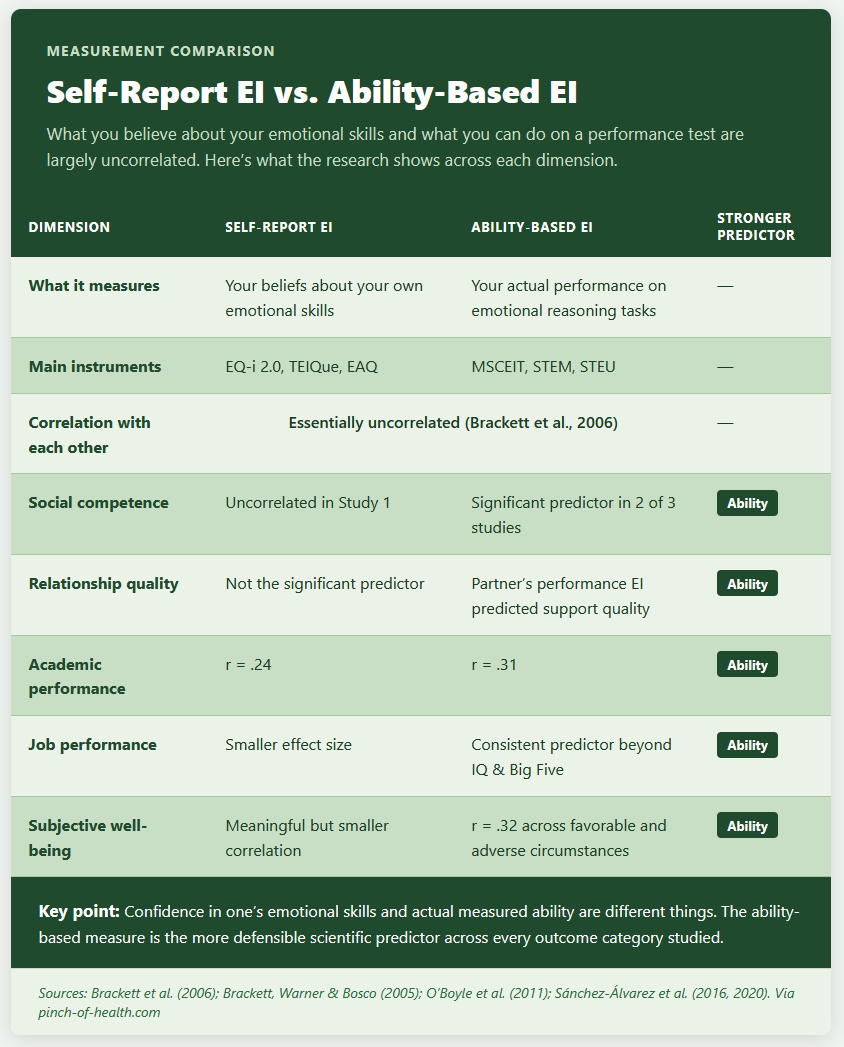
There’s a specific finding that almost never makes it into articles about emotional intelligence, and it changes everything. When researchers test people using a performance-based measure of emotional ability, their scores are essentially uncorrelated with what those same people reported about their own emotional skills. Not slightly mismatched. Functionally unrelated.
This matters more than it sounds. It means the question isn’t whether you feel emotionally intelligent. The real question is whether you actually are, when the situation demands it. Those are different questions. The research treats them as such.
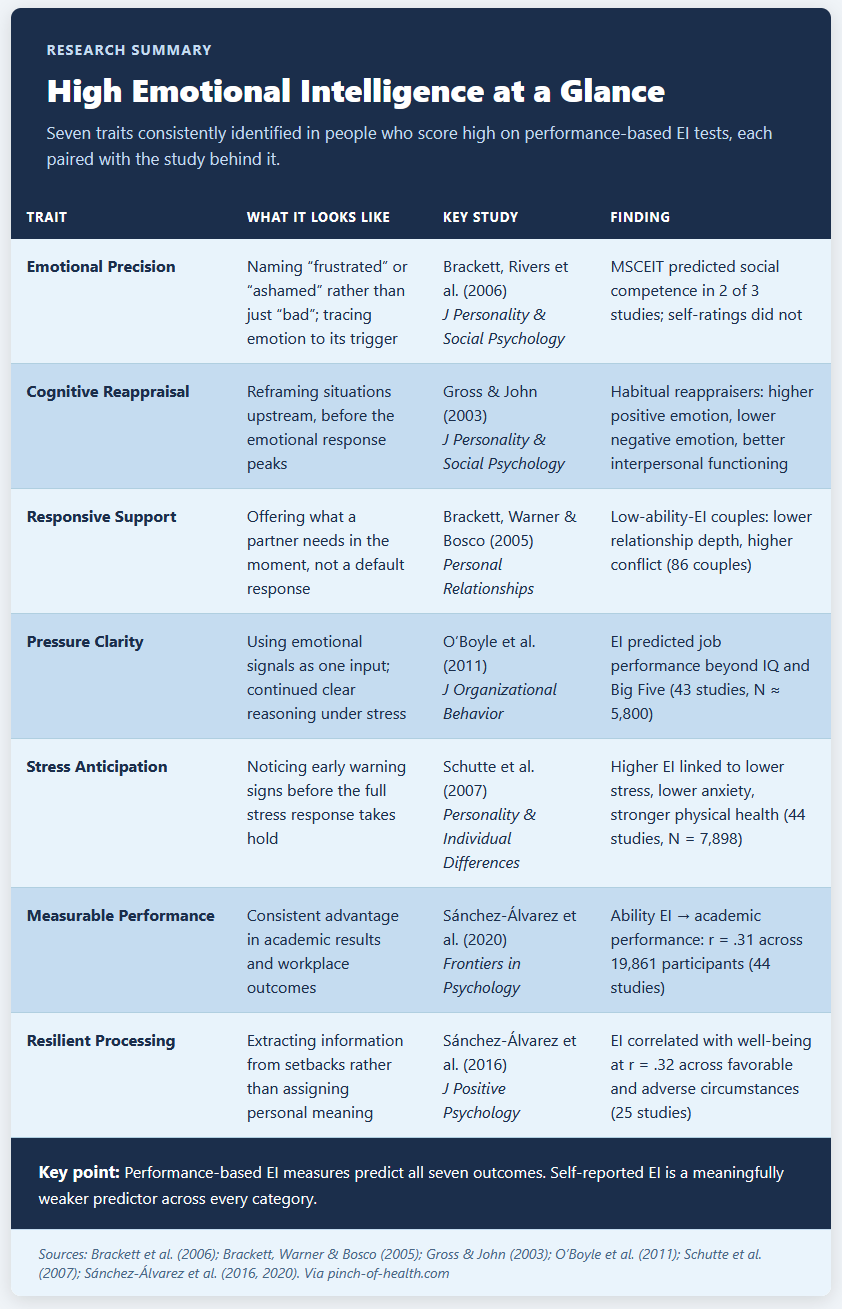
Seven specific behaviors consistently appear in people who score high on performance-based measures of emotional intelligence, across large, independent studies. These aren’t personality types. They’re measurable patterns, tied to real outcomes, in relationships, health, and work. And a 2019 meta-analysis in Human Resource Management Review by Victoria Mattingly and Kurt Kraiger found that all of them can be developed through structured training.
Trait 1: They Identify Emotions With Precision
The Brackett research has a finding that tends to get buried: people’s ratings of their own emotional abilities and their performance on an emotional reasoning test were not meaningfully related in Study 1. Not slightly off. Functionally uncorrelated.
The implication is that emotional perception is something you can be quite poor at while having no particular awareness of that fact. That makes it an unusually useful skill to develop intentionally.
Marc Brackett and colleagues at Yale ran three studies on this question, published in the Journal of Personality and Social Psychology in 2006. Using the MSCEIT, a validated performance test of emotional ability, they measured how well participants could perceive and reason about emotions, then compared those scores against self-reported emotional skills.
In two of the three studies, it was the performance scores, not self-ratings, that predicted real-time social competence. The researchers noted this effect held for men across both studies. The picture for women was more complex, and the authors flagged it as an area needing further work.
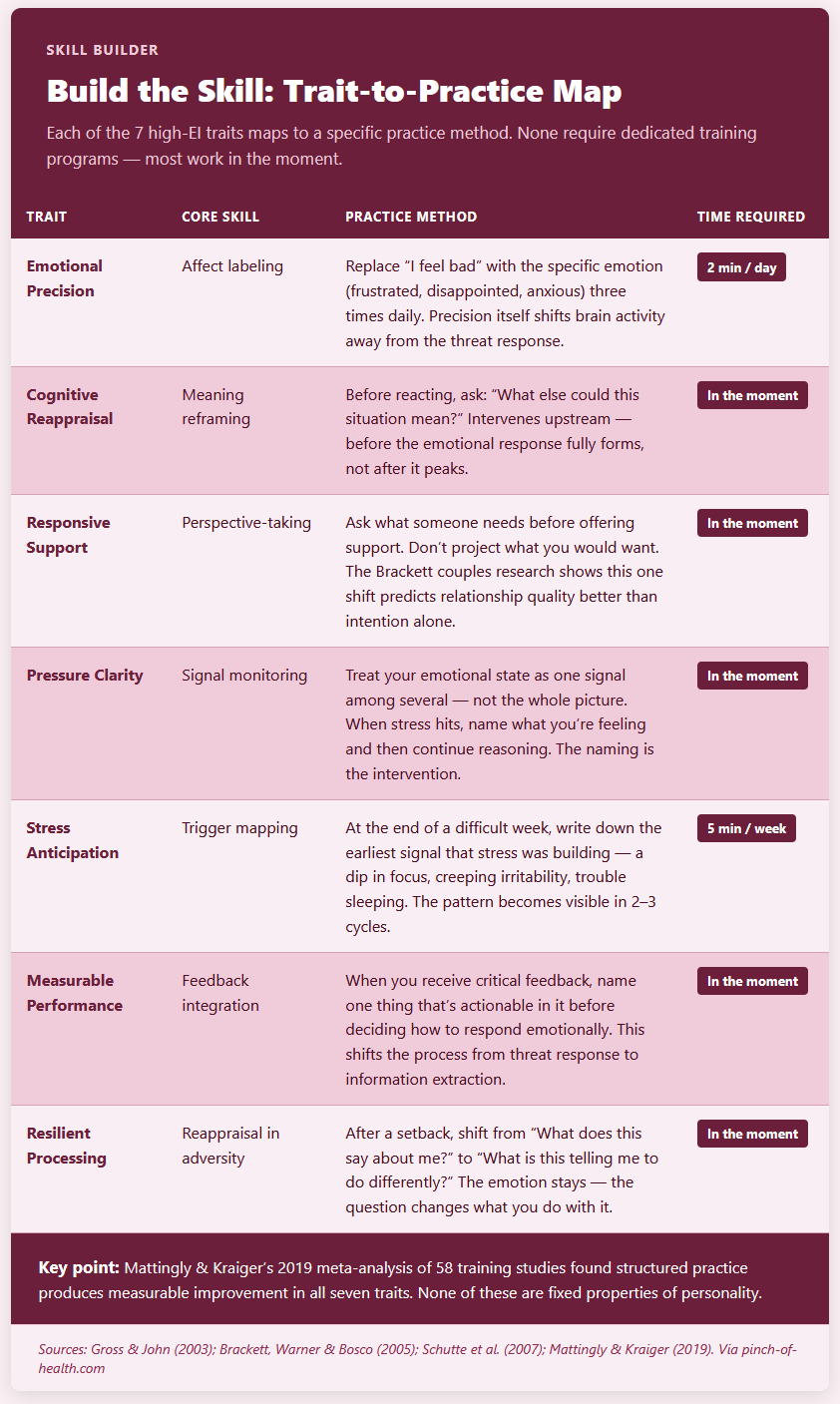
One practical method for building this skill is affect labeling: naming what you feel in specific terms rather than settling for “stressed” or “bad.” Neuroscience research has shown that precise emotional labeling reduces amygdala activation, the brain region most associated with threat response. The act of naming it accurately is itself a regulating mechanism.

Trait 2: They Reframe Instead of Suppress
The common advice for managing a difficult emotion is to stay calm, breathe through it, don’t react. That’s not what high-EI individuals are actually doing. They’re intervening earlier in the emotional process, before the feeling has fully escalated, by changing how they interpret the situation rather than suppressing the response.
This strategy, called cognitive reappraisal, was the subject of a landmark five-study investigation by James Gross and Oliver John at Stanford and UC Berkeley, published in the Journal of Personality and Social Psychology in 2003. Gross and John tracked habitual use of reappraisal versus suppression across multiple samples and found consistent well-being differences.
Habitual reappraisers reported higher positive emotion, lower negative emotion, better interpersonal functioning, and greater life satisfaction. Habitual suppressors showed the opposite pattern, including social disconnection and reduced positive affect even when they successfully dampened negative emotion.
The mechanism explains the gap. Suppression is response-focused: it works on the emotion after it has formed. It tries to hold back something already in motion. Reappraisal is antecedent-focused: it changes the emotional meaning of the event before the full response takes shape.
Suppression tries to hold back a flood that’s already flowing. Reappraisal redirects the river upstream. The difference in downstream costs is real.
Trait 3: They Give the Kind of Support That Actually Helps
High EI in relationships isn’t about being warm or easy to be around. It’s about reading what someone actually needs in a specific moment, rather than projecting what you would want. That’s a harder skill than it sounds, and it shows up clearly in the data.
Marc Brackett, Rebecca Warner, and Jennifer Bosco studied this in a sample of 86 couples, published in the journal Personal Relationships in 2005.
Using performance-based EI measurement rather than self-report, they found that couples in which both partners scored low on ability EI tended to have the lowest scores on relationship depth and support quality, and the highest scores on conflict and negative relationship quality. Higher ability EI, particularly in the partner who provided support, predicted a better quality of emotional responsiveness.
What this looks like in practice is a responsiveness researchers sometimes describe as being a “relationship architect”: noticing whether a partner needs space or connection, validation or problem-solving, honesty or comfort at a particular moment.
The original study acknowledged Brackett’s earlier colleagues Paulo Lopes and Peter Salovey in this context, and the broader body of work they contributed to confirms the pattern.
The ability versus self-report distinction applies directly here. The Brackett, Warner, and Bosco findings held for performance-based EI. What people believed about their emotional skills in relationships did not predict these outcomes in the same way. Confidence in one’s empathy and actual measured empathic ability are different things.
Trait 4: They Stay Sharp When the Pressure Is On
Ernest O’Boyle Jr. and colleagues at Virginia Commonwealth University set out to settle a longstanding debate in organizational psychology. Emotional intelligence advocates argued it was a meaningful predictor of work performance.
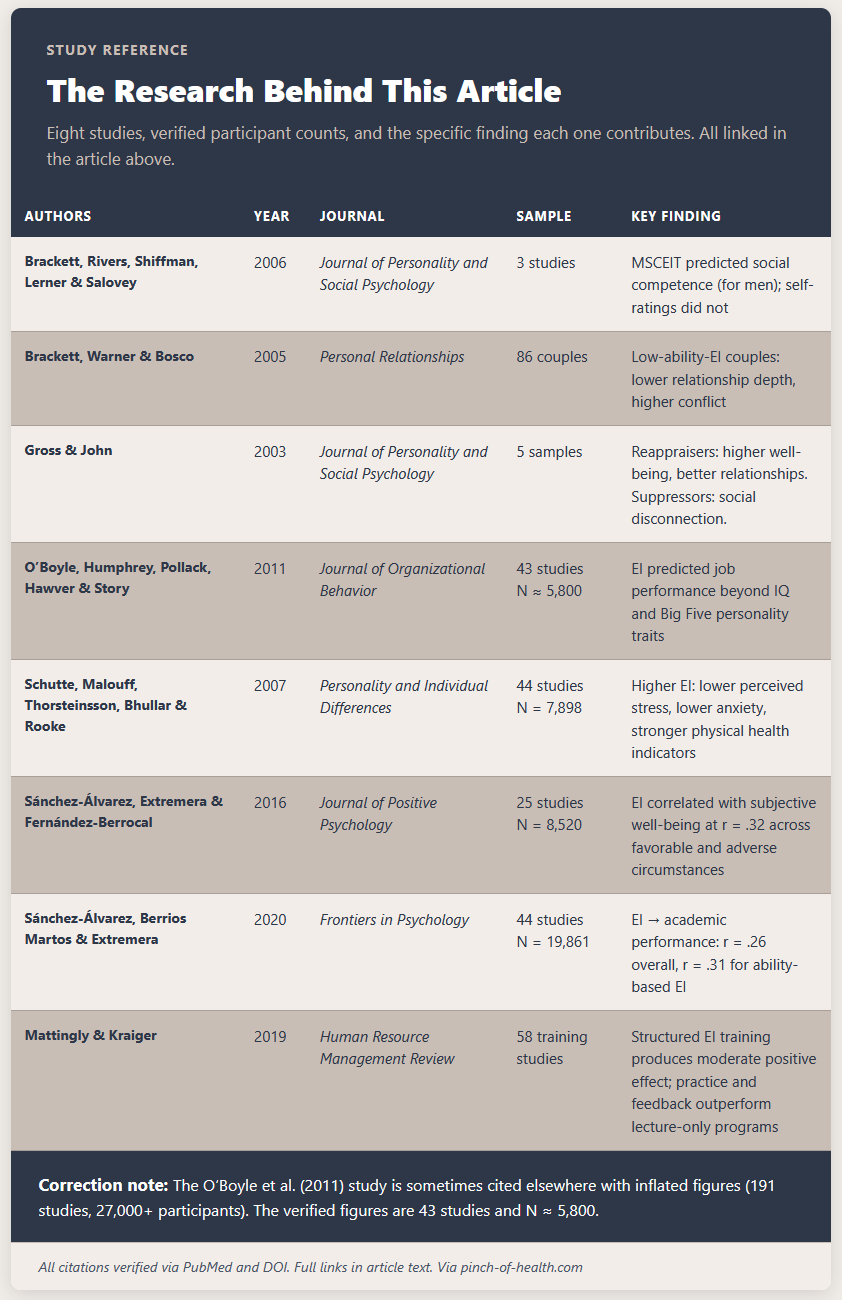
Critics said EI effects would vanish once you controlled for personality and general intelligence. The O’Boyle meta-analysis, published in the Journal of Organizational Behavior in 2011, tested this with 43 studies and a cumulative sample of around 5,800 individuals.
EI predicted job performance beyond what both IQ and the Big Five personality traits could explain. That last part is the finding worth pausing on. Researchers already have good personality and intelligence measures.
The fact that EI adds predictive power beyond those measures means it’s measuring something distinct, not repackaging conscientiousness or agreeableness with different labels.
What separates high-EI performers under pressure is that they treat emotional signals as information rather than interference. When stress hits, lower-EI individuals tend to either ignore the internal signal entirely, which means missing relevant data, or get overwhelmed by it.
High-EI individuals notice what they’re feeling, factor it in as one signal among several, and continue reasoning clearly. The emotion becomes input, not noise.
The EI field has genuine critics worth acknowledging here. Daniel Goleman’s popularized model, while influential, was criticized almost immediately by academic researchers as unfalsifiable, and the construct validity of trait-based EI measures remains contested.
The O’Boyle meta-analysis specifically used a three-stream classification to address this, separating ability-based from self-report and mixed models. The performance advantage held across all three, though the effect was stronger for some EI measure types than others.
Trait 5: They Catch Stress Before It Peaks
Managing stress and getting ahead of it are different skills. The distinction matters because cortisol, the primary stress hormone, compounds when elevated chronically. It doesn’t just reflect that something stressful happened.
At sustained levels, it suppresses immune function, disrupts sleep architecture, and contributes to cardiovascular risk over time. Getting ahead of stress means interrupting that cascade before it fully starts.
Nicola Schutte and colleagues investigated this relationship in a meta-analysis of 44 effect sizes drawn from 7,898 participants, published in Personality and Individual Differences in 2007. Higher EI was consistently linked to better health outcomes: lower perceived stress, lower rates of depression and anxiety, and stronger physical health indicators across multiple study populations.
The authors proposed the mechanism is anticipatory rather than reactive. High-EI individuals notice early emotional warning signs, a creeping irritability, difficulty concentrating, a subtle restlessness, and respond to those signals before the full stress response takes hold.
Scheduling brief emotional check-ins at two or three points in the day, not as a journaling exercise but as quick internal calibration, builds the habit of noticing before reacting. Mapping recurring stress triggers takes about five minutes at the end of a difficult week. The pattern becomes visible faster than most people expect.
Trait 6: The Performance Gap Is Real
Emotional intelligence research attracts legitimate skepticism. One common critique is that EI is just general intelligence or personality measured with nicer language, and that its effects disappear when you control for those established predictors.
A second criticism, distinct from the first, is that academic performance differences attributed to EI are small and therefore not practically meaningful. The evidence pushes back on both.
A 2020 meta-analysis by Nicolás Sánchez-Álvarez, María Pilar Berrios Martos, and Natalio Extremera in Frontiers in Psychology analyzed 44 studies covering 19,861 participants and found a significant positive association between EI and academic performance.
The overall effect size was r = .26. For ability-based EI measures specifically, the association was stronger at r = .31. That’s a modest but meaningful effect in a field where many well-funded educational interventions barely move the needle.
The distinction between ability and self-report EI matters here too. Self-reported EI (r = .24) showed a weaker association with academic performance than performance-based EI (r = .31). People’s assessments of their own emotional skills were less predictive of actual outcomes than their measured abilities. That pattern repeats across the body of research in this area.
The O’Boyle workplace meta-analysis adds a related dimension: beyond job performance, high-EI individuals were more likely to engage in what organizational psychologists call citizenship behavior. This means going beyond formal job requirements, helping colleagues, and contributing to team culture in ways that compound over a career but are difficult to detect at hiring.
Trait 7: They Treat Failure as Data, Not Verdict
The Sánchez-Álvarez et al. (2016) well-being finding has a detail that’s easy to read past: the EI-to-well-being correlation held across life circumstances, not just favorable ones. The benefit wasn’t conditional on things going well.
That surprised even researchers with a stake in the result. It points toward something structural in how high-EI individuals process adversity rather than something situational about the lives they happen to lead.
The 2016 meta-analysis by Nicolás Sánchez-Álvarez, Natalio Extremera, and Pablo Fernández-Berrocal in The Journal of Positive Psychology analyzed 25 studies covering 8,520 participants and found a moderate positive association between EI and subjective well-being at r = .32.
The reappraisal research from Gross and John explains part of it. People who habitually reframe negative experiences maintain more positive emotion over time and are less likely to enter rumination loops. In practical terms, this shift shows up as a specific reorientation: from “what does this failure say about me?” to “what is this feeling telling me?” The emotion is treated as information rather than a verdict.
Psychologists sometimes describe this orientation as treating emotional experience like a data stream rather than a report card. Every feeling carries information. High-EI individuals develop the habit of reading it rather than being evaluated by it.
High EQ Self-Check
8 questions. Your results in under 3 minutes.
Can You Actually Develop These Traits?
The short answer is yes, with meaningful caveats about what that looks like in practice.
Victoria Mattingly and Kurt Kraiger published a meta-analysis of 58 EI training studies in Human Resource Management Review in 2019. Their conclusion: structured training produces a moderate positive effect on emotional intelligence scores, consistent across both ability-based and mixed-model measures, regardless of participant gender.
Mattingly and Kraiger flagged one detail the effect size alone doesn’t capture: training that included practice and feedback outperformed lecture-based programs, though only exploratory analyses support this and the authors were careful to note the comparisons are preliminary.
It matters because most organizational EI training is lecture-based. If the early data holds, the field has been recommending the wrong delivery method.
What this means practically is that emotional perception can be practiced through affect labeling exercises. Reappraisal is a learnable technique, not a personality feature. Stress anticipation improves with self-awareness routines that sharpen over time.
Resilience builds through repeated experience of processing difficulty rather than avoiding it. The seven traits above aren’t fixed properties of emotionally talented people. They’re skills with a developmental path.

Conclusion
The EI field has accumulated genuine problems over the years: an inflated early literature, oversimplified popularizations, and ongoing debates about whether certain measures are even testing distinct abilities.
None of that weakens the research surveyed here. The studies on emotional perception, reappraisal, relationship quality, job performance, health, and well-being are real, large, and reasonably well-replicated. The seven traits they support are not a personality type anyone either has or doesn’t have.
The more defensible reading of this literature is this: there are specific emotional skills, they can be measured, they predict meaningful outcomes beyond what IQ and personality already explain, and they can be developed. That’s a narrower claim than the popular version of emotional intelligence promises. It’s also considerably more useful.
Frequently Asked Questions
What are the signs of high emotional intelligence?
The clearest signs are behavioral rather than self-reported: naming emotions with precision rather than vague labels, reframing difficult situations rather than suppressing the feeling, providing the kind of support a situation actually calls for rather than a default response, and maintaining clear reasoning under stress. Research consistently shows that what people report about their own emotional skills is a weaker predictor of these behaviors than performance-based measurement.
Do emotionally intelligent people apologize?
Yes, and the research suggests they do so in a specific way. The capacity to acknowledge that your behavior caused harm to another person requires accurate emotional perception of both your own state and the other person’s.
People scoring higher on ability-based EI are more likely to recognize the impact of their behavior and to engage in repair behaviors, including apology, as part of conflict resolution. High-EI apologies also tend to focus on the impact rather than on the apologizer’s intentions.
Can emotional intelligence be measured reliably?
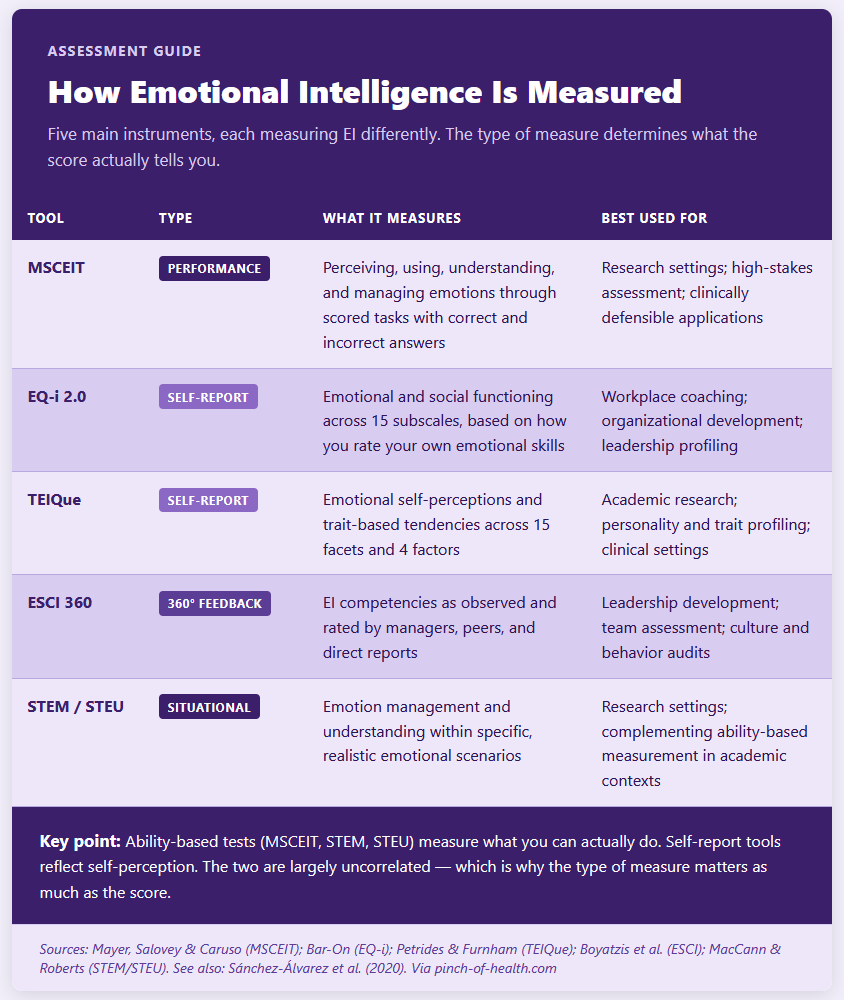
This is genuinely contested territory. The ability model, assessed through performance tests like the Mayer-Salovey-Caruso Emotional Intelligence Test (MSCEIT), has reasonable psychometric properties and predicts real outcomes.
Self-report measures, which ask people to rate their own emotional skills, are less reliable as predictors because self-assessments of emotional ability are largely uncorrelated with tested ability. Mixed-model measures, which combine ability-like items with personality traits, are widely used in organizational settings but criticized by academic researchers for conflating distinct constructs.
The short version: ability-based measures are more defensible scientifically, but fewer validated tools exist at a consumer level.
Is high emotional intelligence the same as being empathetic?
Empathy, specifically the accurate perception of others’ emotional states, is one component of EI within the ability model. But high EI also includes using emotional information to guide reasoning, understanding how emotions typically evolve and interact, and managing one’s own emotional responses.
Someone can be highly empathic, experiencing others’ emotions strongly, without being particularly skilled at managing those responses or using emotional data to inform decisions. Empathy is a component, not a synonym.