For years, the research on screens and aging seemed to point in one direction: more time on devices meant worse cognitive outcomes, and the responsible habit for anyone approaching middle age was to pull back. The problem with that conclusion, it turned out, was the population it was based on.
The screen-time literature that shaped that narrative was built largely on children and adolescents. For adults who grew up before computers became everyday objects and came to digital technology in their forties and fifties, the question of what sustained engagement was actually doing to their aging brains had barely been asked at scale.
That gap was what Jared Benge, a neurologist at the University of Texas at Austin, and Michael Scullin, a psychology and neuroscience professor at Baylor University, set out to close in 2025.
Their meta-analysis in Nature Human Behaviour pooled findings from 136 studies and 411,430 adults aged 50 and older. The question they were testing: does a lifetime of technology exposure protect the aging brain, or speed its decline?
The data fell clearly on one side. For adults who came to computers and smartphones as adults, the habit most people had been treating as a cognitive liability appears to do something quite different.
What 400,000 People’s Data Showed
Benge and Scullin organized the study around a genuine dispute the literature hadn’t settled. One hypothesis, which they call “digital dementia,” holds that offloading tasks to devices and navigating with GPS instead of memory gradually erodes the brain’s working capacity.
The other, which they call “technological reserve,” holds that adapting to new platforms and staying socially connected through digital means builds a mental buffer against decline, similar to what formal education is known to provide.
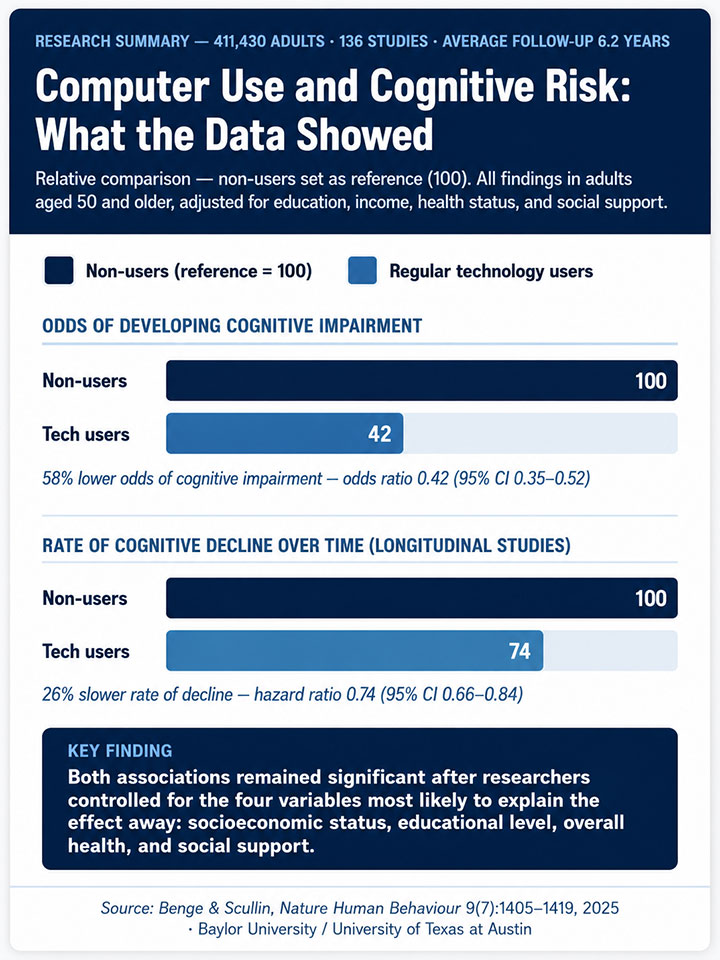
To settle the question, they searched eight academic databases, identified 136 studies meeting strict inclusion criteria, and pooled the 57 compatible with formal statistical analysis. Together, those studies tracked 411,430 adults with an average baseline age of 68.7 years, each followed for an average of 6.2 years.
Adults who used digital technology regularly had 58% lower odds of developing cognitive impairment compared to those who did not, across the pooled studies. That corresponds to an odds ratio of 0.42. The effect size is not subtle, and it held up through every statistical adjustment the researchers could apply.
A separate analysis of the longitudinal studies in the pool found that technology users showed a 26% slower rate of cognitive decline, corresponding to a hazard ratio of 0.74. Both findings remained significant after controlling for socioeconomic status, educational level, overall health, cognitive reserve proxies, and social support variables, the four categories most likely to explain away an association of this magnitude.
The breakdown by technology type produced one finding worth sitting with. Computer use, internet use, smartphone use, and mixed uses all showed significant protective associations.
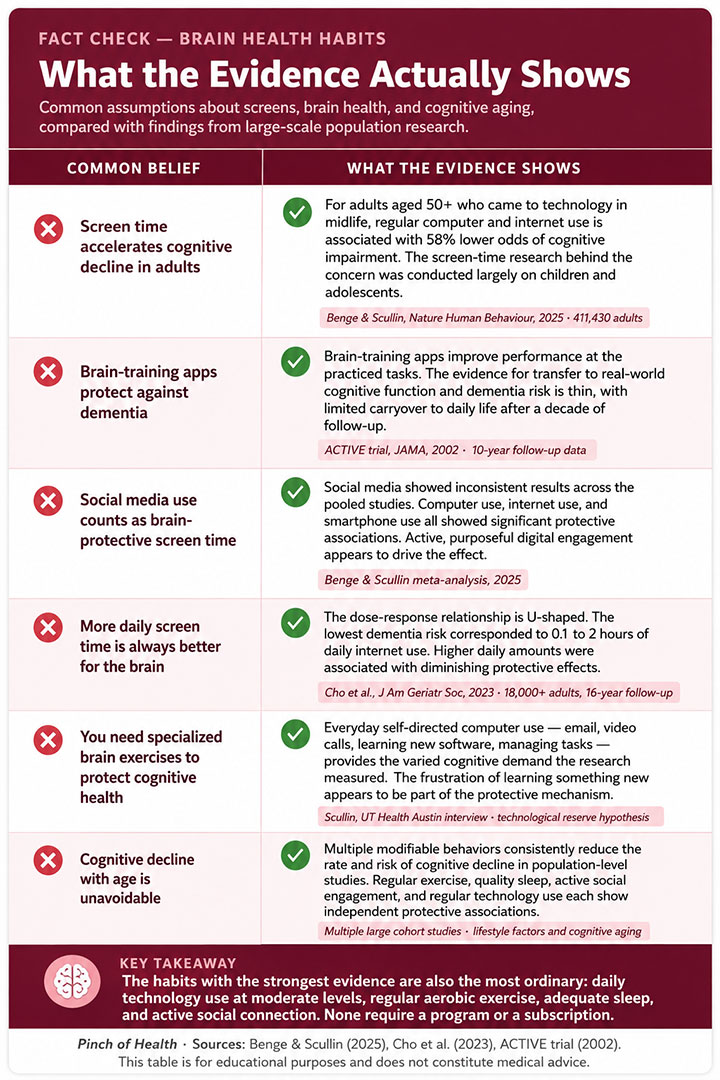
Social media didn’t: results were inconsistent across the pooled studies, and Benge and Scullin didn’t treat it as a reliable protective factor. Active, purposeful engagement with technology appears to drive the protective effect. Passive consumption does not show the same signal.
How Much Is Actually Enough?
Benge and Scullin were not the first to examine this question at scale. Researchers at New York University wanted to know what 16 years of internet use data would reveal about dementia risk.
Gawon Cho and colleagues followed more than 18,000 adults aged 50 to 65 over that period, and published their findings in a 2023 study in the Journal of the American Geriatrics Society. Regular internet users had roughly half the risk of developing dementia compared to non-users.
The dose-response relationship, however, was U-shaped. The lowest dementia risk corresponded to between 0.1 and 2 hours of daily internet use.
At higher daily amounts, the protective association diminished. That finding is worth sitting with before interpreting the meta-analysis as a green light for unlimited screen time.
Researchers have not yet identified which specific activities are driving the protective effect. Email, video calls, managing finances, learning unfamiliar software, navigating new platforms, and general browsing are all grouped under “computer use” in the underlying studies.
Whether some of these activities are doing more of the work than others is a question the current literature cannot answer.
Most people who use a computer for an hour or two each day aren’t doing any of this strategically. They’re working, staying in touch with people, and figuring things out. On the current evidence, that appears to be enough.

What Counts as Protective, and What Doesn’t
The protective pattern Benge and Scullin documented is specific to everyday, self-directed digital engagement. This is meaningfully different from what commercial brain-training applications are offering, and conflating the two would misread the evidence.
Cognitive training apps are designed to improve performance on specific practiced tasks. The evidence for transfer to real-world cognitive function, and to dementia risk in particular, is thin. The ACTIVE trial, a multicenter study published in JAMA in 2002 and followed for a decade, found that participants improved at the practiced tasks with limited carryover to daily life.
Everyday computer use operates through a different mechanism. The ongoing friction of learning new software, troubleshooting problems, adapting to platform changes, and staying connected through digital means provides varied, self-directed mental demand that a narrow training protocol does not replicate.
Scullin explained the distinction in an interview with UT Health Austin. “One of the first things that middle-aged and older adults were saying is that I’m so frustrated by this computer. This is hard to learn. That’s actually a reflection of the cognitive challenge, which may be beneficial for the brain even if it doesn’t feel great in the moment.” The frustration, on this account, is the point.
Other Habits for Brain Health Worth Keeping
Technology use showed protective effects in the meta-analysis even after Benge and Scullin adjusted for exercise levels, sleep quality, and social support. Each of those habits was statistically separated from the technology finding in the analysis. They’re doing their own work through their own mechanisms.
If computer use is the finding that surprises people, aerobic exercise is the one that shouldn’t anymore. The evidence is old enough, and consistent enough, that it would be unusual to write about brain health habits without naming it.
Kirk Erickson’s research group at the University of Pittsburgh documented the effect directly: 150 minutes of brisk walking per week over one year produced measurable hippocampal volume growth in older adults. What makes exercise different from most of what appears on brain-health lists is that the structural change is visible on a scan, not inferred from a questionnaire.
Sleep is where the brain does its maintenance work. The glymphatic system, which clears metabolic waste including amyloid-beta protein linked to Alzheimer’s pathology, operates primarily during slow-wave sleep, and age systematically reduces that window. The cognitive benefits of most other habits, including technology engagement, depend partly on what the brain is able to do during those hours.
Social engagement’s protective effect is tied to its quality, not its volume. Loneliness has been identified as an independent dementia risk factor in multiple large cohort studies.
Technology use that reduces isolation (video calls with family, messages that sustain real relationships) may contribute to the protective effect the meta-analysis documented. For adults in this age group, the social dimension of daily computer use is hard to separate from the cognitive one.
What the Research Hasn’t Settled Yet
The meta-analysis is observational. It cannot prove that technology use causes a lower risk of cognitive decline.
The causal direction is genuinely unresolved: people whose cognitive health is already stronger may use technology more actively, rather than technology use making them cognitively healthier. Benge and Scullin acknowledge this limitation directly and call for future experimental work to test the bidirectional relationship.
In response to that gap, Benge and Scullin have launched a multi-site randomized controlled trial comparing paper-based and digital organizational strategies in adults with mild cognitive impairment.
The trial tests whether training people in digital calendar use and memory tools improves daily cognitive functioning compared to traditional paper equivalents. Results from that study will add a layer of experimental evidence to what the meta-analysis could only observe.

Frequently Asked Questions
What are the best hobbies for brain health?
The evidence points most consistently to regular aerobic exercise, quality sleep in the 7-to-9-hour range, meaningful social engagement, and regular computer or internet use at moderate daily amounts.
Learning genuinely new skills, whether a language, an instrument, or unfamiliar software, adds cognitive demand that familiar activities do not. Of these, exercise has the deepest research base and the most consistently measured effects on brain structure and function.
What are the 7 habits to avoid dementia?
The modifiable behaviors most consistently associated with higher dementia risk include physical inactivity, chronic sleep deprivation, social isolation, smoking, heavy alcohol use, leaving vascular risk factors such as high blood pressure and diabetes untreated, and ignoring hearing loss.
That last one surprises most people: the cognitive effort required to process degraded auditory input appears to reduce the resources available for memory and attention, and hearing aids have shown a measurable protective effect in cohort studies.
Does regular computer use actually protect against cognitive decline?
The association is real and large. Adults 50 and older who used digital technology regularly had 58% lower odds of cognitive impairment in a 2025 meta-analysis covering 411,430 people. The effect survived adjustment for income, education, health, and social support.
Whether the relationship is causal is still being investigated, but the size and consistency of the finding across 57 pooled studies are notable. The protective dose appears to be moderate: roughly 0.1 to 2 hours of daily use, based on a separate 16-year cohort study.
How much screen time is protective for older adults?
A 2023 cohort study published in the Journal of the American Geriatrics Society found a U-shaped relationship between internet use and dementia risk. The lowest risk was observed in adults using the internet between approximately 0.1 and 2 hours per day.
Higher daily amounts were associated with diminishing protective effects. Regular, moderate use appears to be the pattern the evidence supports, not extended or passive scrolling.
The assumption that screens were silently damaging their brains was plausible. The evidence behind it was real. It measured different outcomes in a different life stage.
For the generation that adopted computers as adults and now faces the cognitive risks that come with age, the data points somewhere different. The guilt about hours at a keyboard may be the most straightforwardly unwarranted part of that picture. The mechanism isn’t fully explained, and the causal direction isn’t proven, but that’s where the best available evidence currently lands.