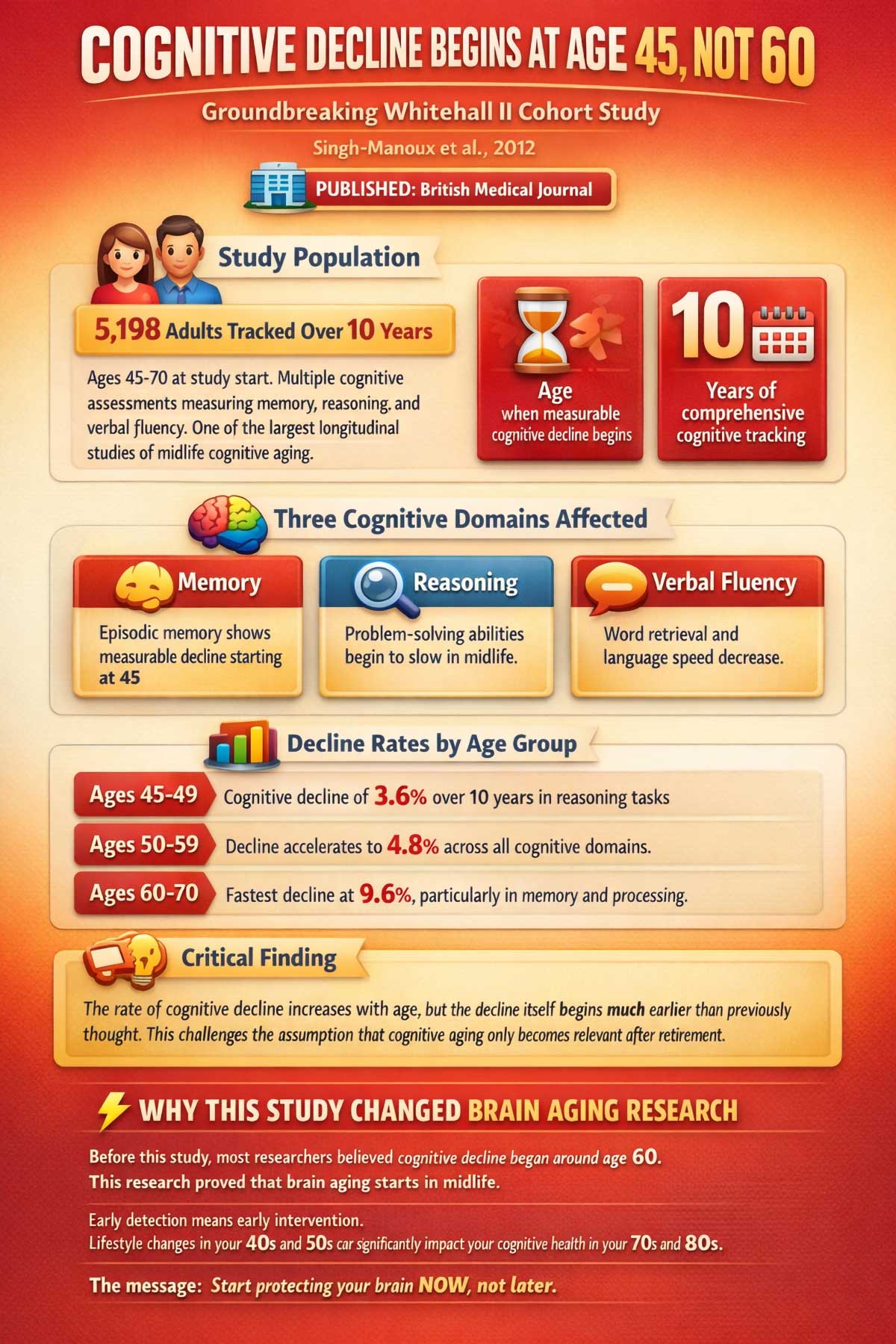
Science shows that cognitive decline can begin in your mid-40s—decades before most people expect it. A study from the Whitehall II cohort tracked 5,198 adults aged 45 to 70 and found something surprising. Memory, reasoning, and verbal fluency all begin to decline by age 45, with the rate of decline speeding up as people get older.
Here’s what most people don’t know: your brain has two ages. There’s your chronological age—the number on your driver’s license. Then there’s your biological brain age—how well your prefrontal cortex and hippocampus are actually working.
These two numbers don’t always match. You might be 52 on paper but have the mental sharpness of someone 42. Or vice versa.
The good news? Your brain is the only organ that can improve with use, no matter your age. The key is catching the warning signs early.
This article gives you a 9-point checklist based on neuroscience research. You’ll learn what each sign means, why it happens in your brain, and what you can do about it.
Sign #1: The “Lag” Factor (Slower Processing Speed)
The Symptom
You’re driving and need to react to a car that suddenly brakes. It takes you a beat longer than it used to.
Or you’re in a group chat where everyone’s talking fast. You feel like you’re always one step behind the jokes.
These moments add up. Tasks that felt automatic now require more effort.
The Neuroscience
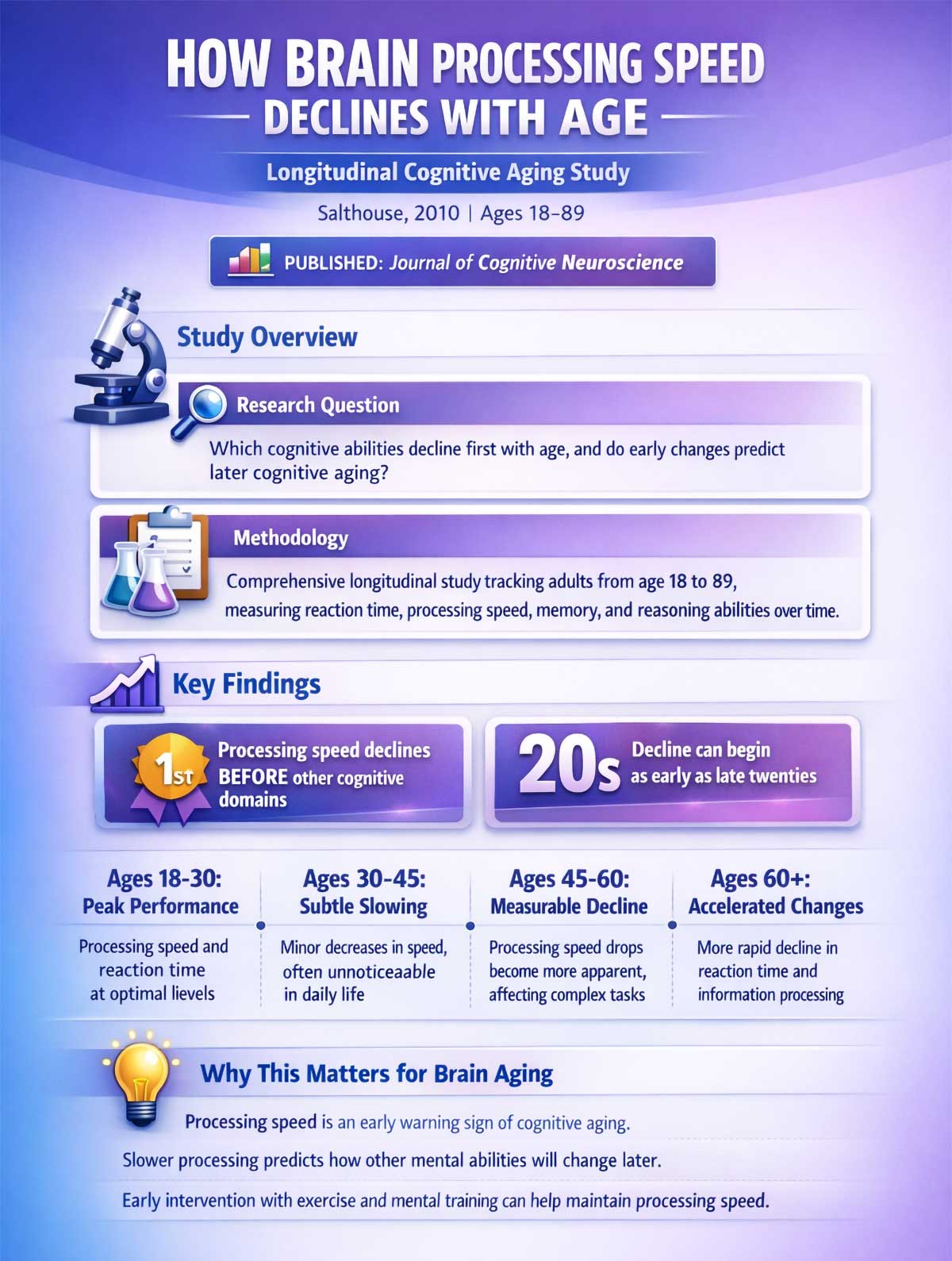
Processing speed is often the first thing to decline. A comprehensive study by Timothy Salthouse examined adults ranging from age 18 to 89 and tracked their cognitive performance over time. The research found that processing speed and reaction time begin declining earlier than other mental abilities and actually predict how other cognitive skills will age later.
The culprit? Your white matter loses integrity. Think of white matter as the brain’s wiring system. When insulation around these wires breaks down, signals travel slower. Neural transmission simply takes longer.
The Fix
Speed-of-processing drills can help. Try apps that challenge you to make quick decisions or spot differences in patterns.
High-intensity interval training (HIIT) also makes a difference. Short bursts of intense exercise boost something called BDNF—Brain-Derived Neurotrophic Factor. This protein helps your neurons communicate faster and stay healthy.
Even three 20-minute HIIT sessions per week can improve your mental speed.
Sign #2: The “Where Did I Put It?” Loop (Increased Forgetfulness)
The Symptom
Misplacing your keys is normal. Forgetting what keys are for is not.
The distinction matters. Normal aging brings episodic memory gaps—you forget where you parked or what you ate for breakfast. But you remember events from your past. You know who people are. You recall what objects do.
If you’re forgetting appointments you made an hour ago or repeating the same story multiple times in one day, that’s different.
The Neuroscience
Your hippocampus is shrinking slightly each year. This seahorse-shaped structure stores new memories. As we age, the dentate gyrus inside the hippocampus changes. It becomes less efficient at encoding new information.
A detailed review by Harada and colleagues examined memory performance across the aging process. Their analysis showed that normal aging produces measurable declines in episodic memory—your ability to remember specific events and experiences. But these declines look different from the memory loss seen in Alzheimer’s disease or other forms of dementia.
The Fix
Mnemonic strategies work. Create vivid mental images or stories to remember information. Link new details to things you already know.
Diet matters too. The MIND diet combines Mediterranean and DASH eating plans. It focuses on brain-healthy foods like leafy greens, berries, nuts, and fish. Studies show it may slow cognitive decline by protecting the hippocampus.
Sign #3: The Multitasking Meltdown (Difficulty Task-Switching)
The Symptom
You’re answering an email when your phone rings. A timer goes off in the kitchen. Suddenly you feel overwhelmed.
Switching between tasks feels harder. You lose your train of thought more easily. Getting back on track takes longer.
The Neuroscience
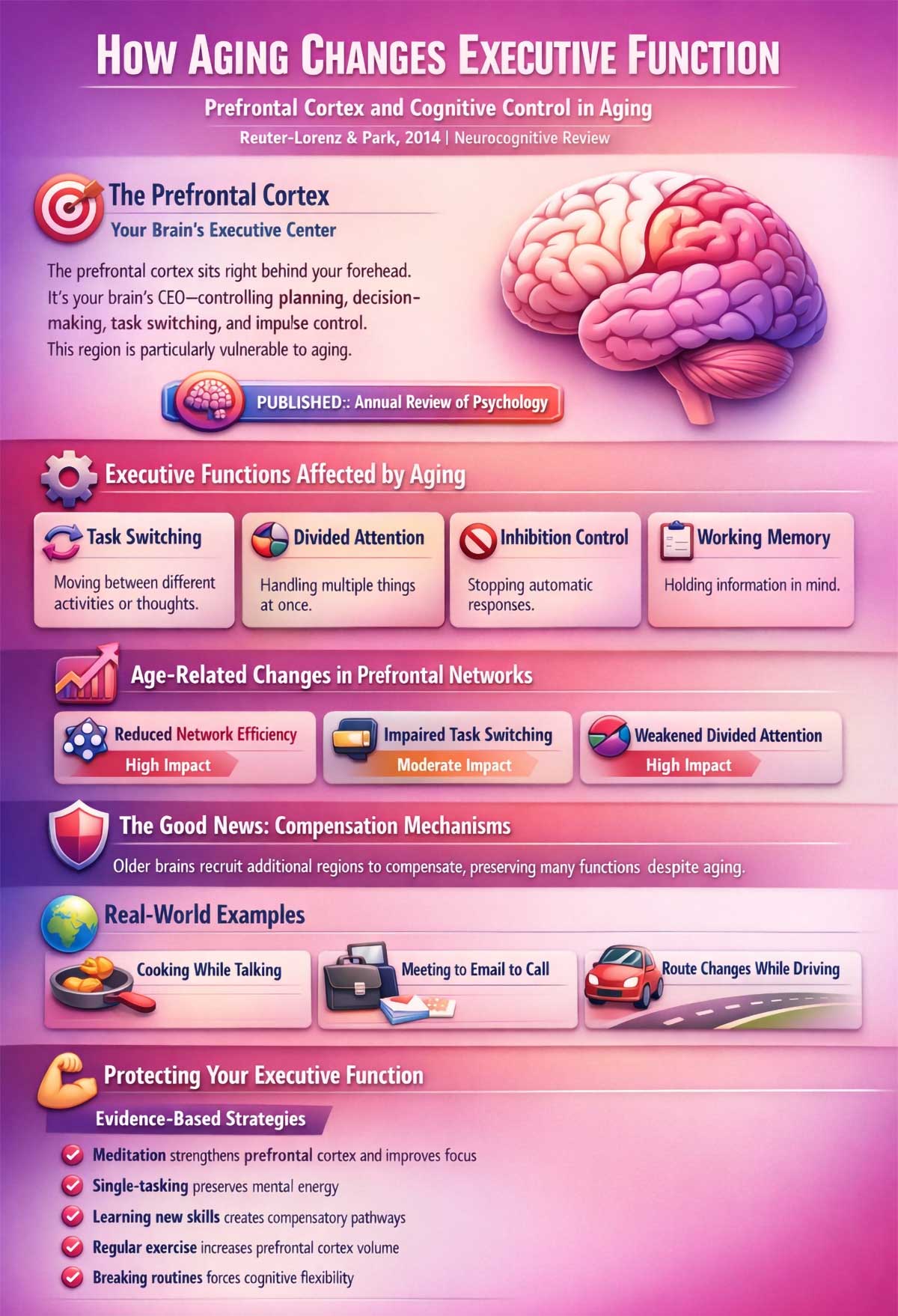
Your prefrontal cortex controls executive function—the mental skills that help you plan, focus, and juggle tasks. As this region changes with age, your brain loses efficiency in these networks.
Research by Reuter-Lorenz and Park reviewed the neurocognitive changes that happen as we age. Their findings showed that age-related changes in prefrontal brain networks specifically impair task switching and divided attention. Your brain simply can’t coordinate multiple demands as smoothly.
The Fix
Stop trying to multitask. It’s a myth that we’re good at it anyway.
Instead, practice “single-tasking.” Focus on one thing at a time. Finish it. Then move to the next.
Mindfulness meditation strengthens your prefrontal cortex. Just 10 minutes a day can improve your ability to stay focused and switch between tasks when needed.
Brain-Boosting Foods by Cognitive Function
Different nutrients target different aspects of brain health. Here’s what to eat for each warning sign:
| Warning Sign | Key Nutrients | Best Food Sources | How Much to Eat |
|---|---|---|---|
| Slower Processing Speed | Omega-3 fatty acids, Vitamin E | Salmon, mackerel, walnuts, almonds, olive oil | Fish 2-3x/week, 1 oz nuts daily |
| Memory Problems | Flavonoids, Folate, Vitamin B12 | Blueberries, strawberries, leafy greens, eggs | 1 cup berries daily, 6 servings greens/week |
| Task-Switching Issues | Choline, Antioxidants | Eggs, broccoli, brussels sprouts, dark chocolate | 1-2 eggs daily, 5 servings cruciferous veggies/week |
| Mental Fatigue | Magnesium, B-vitamins | Spinach, pumpkin seeds, legumes, whole grains | 2-3 servings daily |
| Attention Problems | Polyphenols, Omega-3s | Green tea, wild salmon, olive oil, red grapes | 2-3 cups tea, fish 3x/week |
| Learning Difficulties | Zinc, Iron, Omega-3s | Oysters, lean beef, lentils, sardines | 2-3 servings/week |
| Sleep Issues | Tryptophan, Magnesium | Turkey, chicken, pumpkin seeds, bananas | Include at dinner |
| Cognitive Rigidity | Antioxidants, Vitamin C | Berries, bell peppers, citrus, kiwi | 2-3 servings daily |
| Verbal Recall | DHA, B-vitamins | Fatty fish, nutritional yeast, fortified cereals | 3-4 servings/week |
Sign #4: The 2:00 PM Wall (Chronic Mental Fatigue)
The Symptom
Simple tasks drain you. Reading three emails feels like running a mental marathon. By mid-afternoon, your brain feels foggy and slow.
This isn’t the normal tiredness from a busy day. It’s feeling mentally exhausted after activities that didn’t used to tire you at all.
The Neuroscience
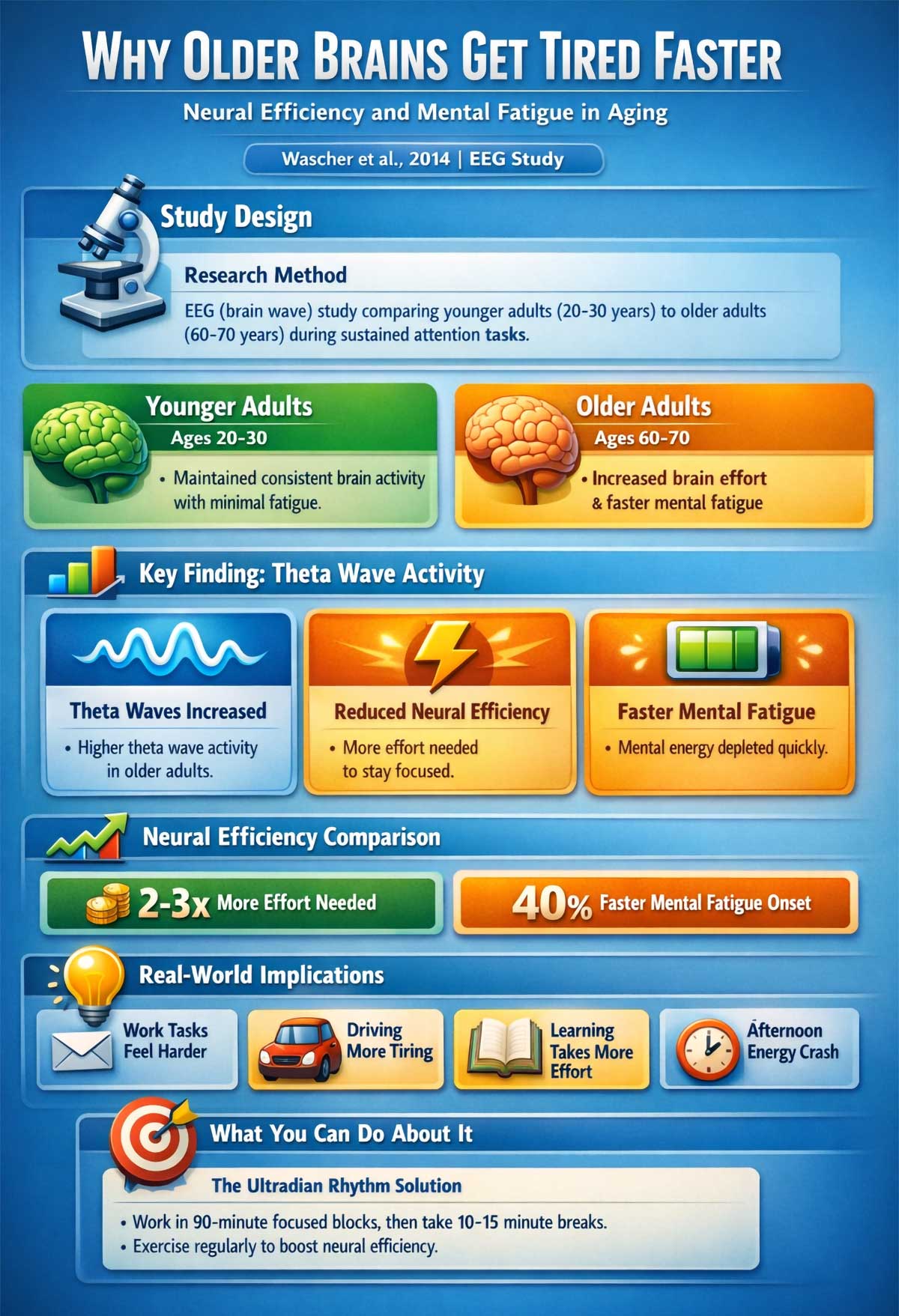
An EEG study by Wascher and colleagues compared adults in their 20s to those in their 60s during sustained attention tasks. Older adults showed increased theta wave activity during these tasks. Theta waves indicate your brain is working much harder to achieve the same result. The research revealed that older brains show reduced neural efficiency, requiring greater mental effort and experiencing more fatigue.
Your neural efficiency drops. What used to happen automatically now requires conscious effort and burns more mental energy.
The Fix
Work with your natural rhythm. Your brain operates in cycles called ultradian rhythms—roughly 90-minute periods of high focus followed by a need to rest.
Work in focused 90-minute blocks. Then take a real 10-minute break. Step outside. Move your body. Give your brain a chance to reset.
Don’t push through the fatigue. Your brain needs these recovery periods to maintain efficiency.
Sign #5: The Wandering Mind (Reduced Attention Span)
The Symptom
You can’t finish a long article without checking your phone. Movies feel too slow. Your mind drifts during conversations.
You start reading a book and realize you haven’t absorbed the last three paragraphs. You have to keep rereading the same section.
The Neuroscience
A study by McAvinue and colleagues examined sustained attention in healthy adults aged 18 to 78. They found that the ability to maintain attention on a single task for extended periods declines with age. This decline links directly to reduced frontal gray matter volume and decreased white matter integrity in the brain.
Your frontal lobes help you stay focused on one thing for extended periods. As gray matter volume decreases, holding attention becomes harder.
The Fix
Build your attention stamina gradually. Start with “deep work” sessions—just 15 minutes of focused reading or thinking with no distractions.
Add five minutes each week. Work up to 45-minute or hour-long sessions.
Cut back on dopamine-loop activities. Endless scrolling on social media trains your brain to expect constant stimulation. This makes sustained focus feel boring and difficult.
Replace some scrolling time with reading long-form content. Your attention span is like a muscle—it responds to training.
Sign #6: The “New Dog, Old Tricks” Struggle (Slower Learning)
The Symptom
Learning new software at work feels frustrating. Picking up a new language seems harder than it should. You avoid trying new things because they take too long to master.
Your brain feels less flexible. New information doesn’t stick like it used to.
The Neuroscience
The Betula Project followed adults from age 35 to 80, tracking their memory and learning abilities over time. Research from this cohort by Nyberg and colleagues showed that episodic memory and learning speed begin declining earlier than expected, with the rate of decline speeding up after age 60. The changes relate to both hippocampal shrinkage and alterations in dopamine pathways.
Dopamine helps encode new information. As these pathways change, your brain forms fewer strong connections when learning.
Synaptic plasticity—your brain’s ability to reorganize and create new neural pathways—decreases with age.
The Fix
Use the “Protege Effect.” Learn something new with the goal of teaching it to someone else right away.
This strategy forces deeper processing. You don’t just absorb information—you organize it, find examples, and explain it clearly. This creates stronger neural connections.
Pick a skill. Learn it. Then teach it to a friend, family member, or even make a video explaining it. Your brain will retain much more.
Three Brain-Healthy Recipes
Recipe 1: Memory-Boosting Berry Smoothie Bowl
Benefits: High in flavonoids and antioxidants that protect the hippocampus and improve episodic memory.
Ingredients:
- 1 cup frozen mixed berries (blueberries, strawberries, blackberries)
- 1/2 frozen banana
- 1 cup spinach
- 1/2 cup unsweetened almond milk
- 1 tablespoon ground flaxseed
- 1 tablespoon almond butter
Toppings:
- 1/4 cup fresh blueberries
- 2 tablespoons chopped walnuts
- 1 tablespoon hemp seeds
- Drizzle of honey (optional)
Instructions:
- Blend frozen berries, banana, spinach, almond milk, flaxseed, and almond butter until smooth.
- Pour into a bowl.
- Top with fresh blueberries, walnuts, and hemp seeds.
- Eat immediately for breakfast or post-workout.
Nutrition Info: 350 calories, 15g protein, 18g healthy fats, 8g fiber
Why It Works: Berries contain anthocyanins that cross the blood-brain barrier and reduce oxidative stress in memory centers. Walnuts provide omega-3 ALA. Spinach delivers folate for neurotransmitter production.
Recipe 2: Omega-3 Rich Salmon with Walnut Pesto
Benefits: Supports white matter integrity and neural transmission speed. Rich in DHA for cognitive processing.
Ingredients:
- 4 (5-oz) wild salmon fillets
- 1 cup fresh basil leaves
- 1/2 cup raw walnuts
- 3 cloves garlic
- 1/4 cup extra virgin olive oil
- 2 tablespoons lemon juice
- 1/4 cup grated Parmesan cheese
- Salt and pepper to taste
Instructions:
- Preheat oven to 400°F.
- Make pesto: Blend basil, walnuts, garlic, olive oil, lemon juice, and Parmesan until smooth. Season with salt and pepper.
- Season salmon with salt and pepper. Place on parchment-lined baking sheet.
- Spread 2 tablespoons pesto over each fillet.
- Bake 12-15 minutes until salmon flakes easily.
- Serve with roasted vegetables or quinoa.
Nutrition Info (per serving): 420 calories, 35g protein, 28g healthy fats, 3g carbs
Why It Works: Salmon provides DHA and EPA—omega-3 fatty acids that maintain myelin sheath integrity. Walnuts add extra omega-3s and vitamin E. Olive oil contains oleocanthal, which has anti-inflammatory effects in the brain.
Recipe 3: Brain Power Breakfast: Spinach & Egg Scramble
Benefits: High in choline for acetylcholine production, supporting memory and executive function.
Ingredients:
- 3 large eggs
- 2 cups fresh spinach
- 1/2 cup mushrooms, sliced
- 1/4 cup cherry tomatoes, halved
- 2 tablespoons feta cheese
- 1 tablespoon olive oil
- 1 clove garlic, minced
- Salt, pepper, turmeric
Instructions:
- Heat olive oil in a pan over medium heat.
- Add garlic and mushrooms. Cook 3 minutes.
- Add spinach and tomatoes. Cook until spinach wilts.
- Whisk eggs with a pinch of salt, pepper, and 1/4 teaspoon turmeric.
- Pour eggs into pan. Scramble gently until just set.
- Top with feta cheese.
- Serve with whole grain toast or avocado.
Nutrition Info: 320 calories, 24g protein, 22g healthy fats, 8g carbs, 3g fiber
Why It Works: Eggs are the richest food source of choline, which converts to acetylcholine—a neurotransmitter critical for memory and learning. Turmeric contains curcumin, which crosses the blood-brain barrier and has neuroprotective effects. Spinach provides lutein and folate.
Sign #7: The Midnight Fog (Sleep-Related Cognitive Decline)
The Symptom
You sleep seven or eight hours but wake up feeling unrefreshed. Your sleep feels light and broken. You wake up multiple times during the night.
The next day, your thinking feels muddy. Decision-making is harder. Your memory is worse.
The Neuroscience
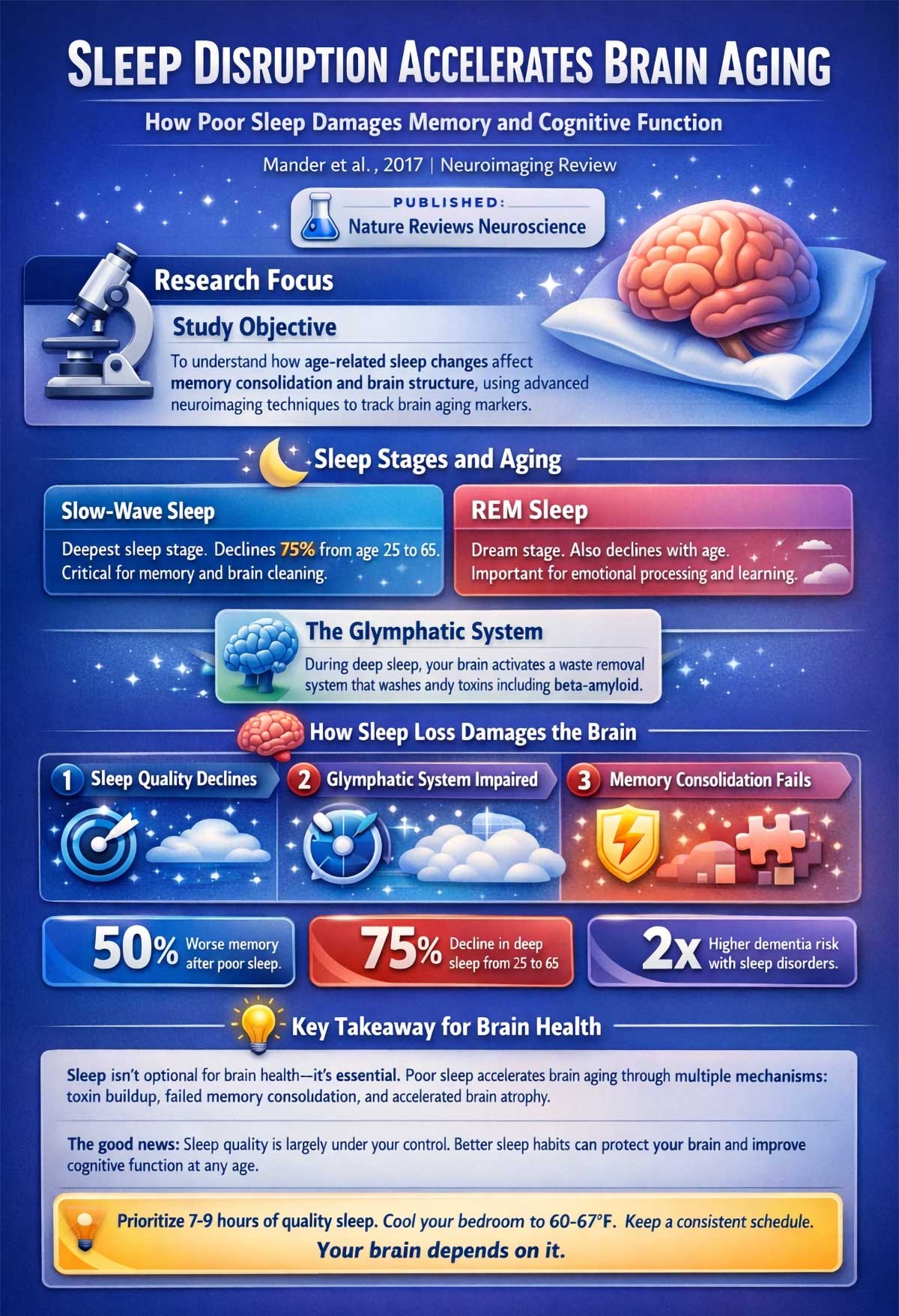
Age brings a decline in slow-wave sleep—the deepest stage of sleep. This matters more than you might think.
During slow-wave sleep, your brain activates the glymphatic system. This is your brain’s waste removal system. It washes away toxins that build up during the day, including beta-amyloid—a protein linked to Alzheimer’s disease.
A comprehensive review by Mander and colleagues examined how aging disrupts sleep architecture. Their research showed that age-related reductions in slow-wave sleep impair the brain’s ability to consolidate memories effectively. The study also found that poor sleep quality correlates with markers of brain atrophy and increased risk of cognitive decline.
Less deep sleep means more toxins, worse memory, and faster brain aging.
The Fix
Sleep hygiene isn’t optional. It’s essential for brain health.
Keep a consistent sleep schedule. Go to bed and wake up at the same time every day, even on weekends.
Cool your bedroom. Your body needs a temperature drop to reach deep sleep. Keep your room between 60 and 67 degrees Fahrenheit.
Limit screens for an hour before bed. Blue light disrupts your natural sleep signals.
If you snore loudly or gasp during sleep, get checked for sleep apnea. Untreated sleep apnea devastates cognitive function.
The 10-3-2-1-0 Sleep Formula
This simple protocol optimizes your sleep quality and increases deep sleep stages:
10 hours before bed: No more caffeine. Caffeine has a half-life of 5-6 hours. That afternoon coffee is still affecting you at bedtime.
3 hours before bed: No large meals. Digestion disrupts sleep architecture. If you’re hungry, have a small snack with tryptophan—like turkey or bananas.
2 hours before bed: No more work. Mental stimulation activates your prefrontal cortex. Your brain needs time to wind down.
1 hour before bed: No screens. Blue light suppresses melatonin production. Read a physical book instead or try gentle stretching.
0 times hitting snooze: Get up when your alarm goes off. Snoozing disrupts your circadian rhythm and makes you groggier.
Follow this formula for two weeks. Most people notice deeper sleep and better morning alertness.
Sleep Hygiene Checklist
| Sleep Factor | Optimal Range | Why It Matters |
|---|---|---|
| Room Temperature | 60-67°F (15-19°C) | Core body temp must drop for deep sleep |
| Darkness | Complete darkness or eye mask | Light suppresses melatonin by 50%+ |
| Consistency | Same bedtime ±30 min | Regulates circadian rhythm |
| Mattress Age | Replace every 7-10 years | Poor support disrupts sleep cycles |
| Pre-bed Routine | 30-60 minutes | Signals brain to prepare for sleep |
| Bedroom Use | Sleep and intimacy only | Strengthens mental sleep association |
| Alcohol Cutoff | 3+ hours before bed | Metabolization disrupts REM sleep |
| Exercise Timing | Finish 3+ hours before bed | Raises body temp and cortisol |
Sign #8: The Rigid Thinker (Reduced Cognitive Flexibility)
The Symptom
Plans change and you feel stressed or irritated. You prefer the same routines and resist new approaches. Your thinking becomes more “black and white.”
You notice a “my way or the highway” mental shift. Adapting to unexpected situations feels harder.
The Neuroscience
Your prefrontal cortex controls cognitive flexibility—the ability to adjust your thinking and behavior when situations change.
A detailed review by Hedden and Gabrieli examined cognitive control and executive function across the aging process. Their findings showed that age-related changes in the prefrontal cortex specifically reduce cognitive flexibility. The brain struggles more to inhibit established habits and switch to new strategies when circumstances change.
This doesn’t mean you’re stuck. But it does mean your brain needs more practice switching gears.
The Fix
Try “neurobics”—exercises for your brain that force new neural pathways.
Break your routines intentionally. Take a different route home. Use your non-dominant hand to brush your teeth. Rearrange your furniture. Shop at a different store.
These small changes force your brain to pay attention and adapt. They build cognitive flexibility.
Try new experiences regularly. Take a cooking class. Learn an instrument. Travel somewhere unfamiliar. Novelty creates new neural connections.
Sign #9: The Tip-of-the-Tongue Syndrome (Slower Verbal Recall)
The Symptom
You know the word you want. You can feel it right there in your mind. But you can’t quite grab it.
Names become especially tricky. You recognize people but their names escape you. Mid-conversation, you pause awkwardly, searching for a common word.
The Neuroscience
The Whitehall II study we mentioned earlier found that verbal fluency begins declining at age 45. This isn’t just about vocabulary. It’s about how quickly you can access and produce words.
The brain regions involved in language retrieval lose some efficiency. The connections between knowing a concept and finding the right word become less automatic.
The Fix
Read complex literature. Challenge your brain with dense vocabulary and intricate sentence structures. This keeps language networks active.
Join discussion groups or book clubs. Active conversation forces you to retrieve words quickly. Debating ideas strengthens verbal fluency.
Play word games. Crossword puzzles, Scrabble, and word-finding apps all exercise your verbal recall.
The more you use your language skills actively—not just passively listening or watching—the better they stay.
Exercise Types and Their Brain Benefits
Different types of exercise protect different aspects of brain health:
| Exercise Type | Cognitive Benefits | Brain Regions Affected | Recommended Frequency |
|---|---|---|---|
| Aerobic (running, cycling, swimming) | Increases BDNF, improves processing speed, boosts memory | Hippocampus, prefrontal cortex | 150 min/week moderate or 75 min/week vigorous |
| HIIT (intervals, sprints) | Rapid BDNF increase, enhanced neural plasticity | Entire brain, especially frontal regions | 3 sessions/week, 20-30 min |
| Strength Training | Improves executive function, reduces inflammation | Prefrontal cortex | 2-3 sessions/week |
| Yoga | Reduces stress hormones, improves focus and flexibility | Prefrontal cortex, amygdala | 3-5 sessions/week |
| Dance | Combines aerobic, coordination, learning—powerful combo | Hippocampus, cerebellum, motor cortex | 2-3 sessions/week |
| Tai Chi | Enhances attention, reduces cognitive decline rate | Frontal and temporal lobes | 3-5 sessions/week |
| Walking (brisk) | Accessible entry point, supports brain volume | Hippocampus | Daily, 30-60 min |
Key Insight: Combining aerobic exercise with coordination or learning (like dance or martial arts) provides greater cognitive benefits than either alone.
The Brain Health Audit: Putting It All Together
Let’s be clear about what’s normal and what’s not.
Normal aging brings some changes:
- Occasionally forgetting names or appointments
- Taking slightly longer to learn new things
- Needing to write things down more often
- Feeling mentally tired after a long, demanding day
- Sometimes losing your train of thought
Warning signs look different:
- Forgetting important events or conversations you had recently
- Getting lost in familiar places
- Struggling to follow simple instructions or recipes you’ve used before
- Difficulty handling money or paying bills
- Changes in mood or personality that others notice
- Withdrawal from social activities you used to enjoy
The nine signs in this article fall in between. They’re not normal aging, but they’re not dementia either. They’re your brain telling you it needs support.
Normal Aging vs. Warning Signs vs. Serious Concern
| Cognitive Area | Normal Aging | Warning Sign | See Doctor Immediately |
|---|---|---|---|
| Memory | Occasionally forgetting names or where you parked | Forgetting recent conversations or events from earlier today | Getting lost in familiar places; forgetting what common objects are for |
| Processing Speed | Taking slightly longer to react or make decisions | Noticeable delays in response time affecting daily activities | Unable to process simple information or follow conversations |
| Multitasking | Preferring to focus on one task at a time | Feeling overwhelmed by two simultaneous simple tasks | Cannot complete basic familiar tasks even with full attention |
| Learning | New technology takes longer to master | Avoiding all new learning due to frustration | Cannot retain new information at all |
| Attention | Mind wanders occasionally during long meetings | Cannot focus on any task for more than a few minutes | Attention span so short that daily activities are impossible |
| Language | Occasional tip-of-tongue moments | Frequent word-finding pauses in every conversation | Cannot name common objects; speech becomes nonsensical |
| Planning | Sometimes need lists for complex tasks | Difficulty following simple multi-step instructions | Cannot plan or sequence even basic familiar activities |
| Judgment | Occasional minor lapses | Repeated poor decisions out of character | Dangerous decisions showing complete lack of judgment |
| Mood | Occasional frustration with changes | Persistent anxiety or resistance to any change | Dramatic personality changes; depression; paranoia |
Risk Factors for Accelerated Brain Aging
Understanding your risk helps you take action. Some factors you can’t change. Others you have complete control over.
Risk Factors You Cannot Control
Age: Risk increases significantly after 65, but changes begin much earlier.
Genetics: The APOE-e4 gene variant increases Alzheimer’s risk. Having one copy raises risk 2-3 times. Two copies raise it 8-12 times.
Family History: Having a parent or sibling with dementia increases your risk 2-3 times.
Gender: Women have higher dementia risk, partly due to longer lifespan and hormonal changes after menopause.
Past Head Injuries: Traumatic brain injury at any age increases later dementia risk by 50-200%.
Risk Factors You CAN Control
Smoking: Increases cognitive decline risk by 30-50%. The good news? Risk drops to near-normal within 5 years of quitting.
Heavy Alcohol Use: More than 14 drinks per week for men or 7 for women accelerates brain shrinkage, especially in the hippocampus.
Physical Inactivity: Sedentary lifestyle increases dementia risk by 30-40%. Exercise is the single most effective prevention strategy.
Poor Diet: High processed food, sugar, and saturated fat intake damages blood vessels and promotes inflammation.
Social Isolation: Lonely individuals have 50% higher dementia risk. Social engagement protects cognitive function.
Chronic Stress: Elevated cortisol damages the hippocampus over time. Stress management is brain protection.
Untreated Health Conditions: High blood pressure, diabetes, high cholesterol, sleep apnea, and depression all accelerate brain aging when left untreated.
Hearing Loss: Untreated hearing loss increases cognitive decline risk by 30-40%. Get your hearing checked.
Low Mental Stimulation: Lack of cognitive challenge leads to “use it or lose it” decline.
Relative Risk Comparison
| Risk Factor | Increased Risk | Evidence Level |
|---|---|---|
| Smoking | +30-50% | Strong |
| Physical inactivity | +30-40% | Strong |
| Social isolation | +50% | Strong |
| Diabetes | +50-100% | Strong |
| Midlife hypertension | +60% | Strong |
| Obesity (midlife) | +30-40% | Moderate |
| Heavy alcohol use | +20-40% | Moderate |
| Depression | +90% | Moderate |
| Low education | +40% | Moderate |
| Sleep apnea (untreated) | +30-50% | Moderate |
| Hearing loss (untreated) | +30-40% | Moderate |
| Traumatic brain injury | +50-200% | Moderate |
Evidence-Based Supplements for Brain Health
Supplements can help, but they’re not magic pills. They work best when combined with diet, exercise, and sleep improvements.
| Supplement | Daily Dose | Evidence Level | What It Does | Who Benefits Most |
|---|---|---|---|---|
| Omega-3 (EPA/DHA) | 1,000-2,000mg | Strong | Maintains myelin, reduces inflammation | Anyone not eating fatty fish 3x/week |
| Vitamin D | 2,000-4,000 IU | Strong | Supports neuron growth, mood regulation | Those with low sun exposure or tested deficiency |
| B-Complex | B6 (50mg), B12 (500mcg), Folate (400mcg) | Moderate | Lowers homocysteine, supports neurotransmitters | Adults 50+, vegetarians/vegans |
| Magnesium | 300-400mg | Moderate | Improves sleep quality, reduces stress | Those with sleep issues or high stress |
| Curcumin | 500-1,000mg with black pepper | Moderate | Anti-inflammatory, crosses blood-brain barrier | Those with family history of dementia |
| Lion’s Mane Mushroom | 500-1,000mg | Emerging | May support nerve growth factor | Those noticing memory changes |
| Phosphatidylserine | 300mg | Moderate | Supports cell membrane health | Those with processing speed issues |
| Ginkgo Biloba | 120-240mg | Weak to Moderate | May improve blood flow | Mixed evidence, inconsistent results |
Important Notes:
- Always consult your doctor before starting supplements, especially if you take medications
- Quality matters—choose third-party tested brands (USP, NSF, ConsumerLab)
- Supplements work best as additions to healthy lifestyle, not replacements
- Save your money on “proprietary blends” with dozens of ingredients and tiny doses
What Doesn’t Work
Don’t waste money on these:
- “Brain enhancement” pills with secret formulas
- Extremely high doses of individual vitamins
- Coconut oil for Alzheimer’s (no quality evidence)
- Coral calcium
- Most nootropic stacks marketed for healthy people
Medications That May Impair Cognition
Some common medications have anticholinergic effects—they block acetylcholine, a key neurotransmitter for memory and learning.
Common Culprits:
- Sleep aids: Diphenhydramine (Benadryl, Tylenol PM), doxylamine
- Allergy medications: First-generation antihistamines
- Bladder control: Oxybutynin, tolterodine
- Anxiety: Benzodiazepines (lorazepam, diazepam, alprazolam)
- Muscle relaxants: Cyclobenzaprine
- Some antidepressants: Amitriptyline, paroxetine
- Stomach medications: Cimetidine
What to Do: Talk to your doctor about alternatives if you take these long-term. Don’t stop medications without medical guidance. Often there are newer options with fewer cognitive side effects.
When to See a Doctor
Not every memory slip requires a doctor visit. But certain red flags should never be ignored.
See your doctor if you or a loved one experiences:
- Memory loss that disrupts daily life (forgetting how to do familiar tasks)
- Challenges in planning or solving problems you used to handle easily
- Difficulty completing familiar tasks at home, work, or leisure
- Confusion with time or place (losing track of dates, seasons, or locations)
- Trouble understanding visual images and spatial relationships
- New problems with words in speaking or writing beyond normal tip-of-tongue moments
- Misplacing things and losing the ability to retrace steps
- Decreased or poor judgment, especially with money
- Withdrawal from work or social activities
- Changes in mood and personality that others notice
What to Expect During Cognitive Testing:
Your doctor will likely start with a simple screening test like the Mini-Mental State Examination (MMSE) or Montreal Cognitive Assessment (MoCA). These take 10-15 minutes.
If screening suggests concerns, you may be referred for detailed neuropsychological testing. This examines:
- Memory (immediate and delayed recall)
- Attention and concentration
- Language skills
- Visual-spatial abilities
- Executive function (planning, reasoning)
- Processing speed
Blood tests check for reversible causes like vitamin B12 deficiency, thyroid problems, or infections.
Brain imaging (MRI or CT scan) looks for structural changes, strokes, or other abnormalities.
Questions to Ask Your Doctor:
- “Based on my symptoms, what’s the most likely cause?”
- “What tests do you recommend and why?”
- “Are any of my medications affecting my cognition?”
- “What lifestyle changes would you prioritize for me?”
- “How often should I be reassessed?”
- “What resources are available if this is early cognitive decline?”
- “Should my family members be screened given our history?”
Getting assessed early matters. Many causes of cognitive problems are treatable—depression, sleep apnea, medication side effects, vitamin deficiencies, thyroid issues.
Even if testing shows early decline, starting interventions now makes a difference.
Lifestyle Modifications Ranked by Effectiveness
Not all interventions are created equal. Here’s how they stack up based on scientific evidence:
| Intervention | Difficulty | Time Commitment | Evidence Level | Expected Results |
|---|---|---|---|---|
| Regular Aerobic Exercise | Low-Moderate | 30 min/day, 5x/week | Very Strong | 30-40% risk reduction, improved processing speed, memory |
| Mediterranean/MIND Diet | Moderate | Daily meal planning | Strong | 35% risk reduction, slower cognitive decline |
| Quality Sleep (7-9 hours) | Low-Moderate | 7-9 hours nightly | Strong | Improved memory consolidation, 40% better cognitive function |
| Social Engagement | Low | 2-3x/week | Strong | 50% risk reduction for dementia |
| Cognitive Training | Low | 15-30 min/day | Moderate | Improved specific skills, may transfer to daily function |
| Blood Pressure Control | Low | Daily medication + lifestyle | Very Strong | 60% risk reduction for vascular dementia |
| Stop Smoking | High | Ongoing | Very Strong | Risk returns to normal within 5 years |
| Limit Alcohol | Moderate | Daily awareness | Strong | Preserves hippocampal volume |
| Stress Management | Moderate | 10-20 min/day | Moderate | Reduced cortisol, protected hippocampus |
| Learn New Skills | Moderate | 3-5 hours/week | Moderate | Increased cognitive reserve |
| Hearing Aids | Low | Daily use | Strong | 30-40% risk reduction |
| Treat Depression | Moderate | Therapy + possible medication | Strong | 50% better cognitive outcomes |
Start Here: If overwhelmed, begin with the top three—exercise, diet, and sleep. These give you the biggest return on investment and create momentum for other changes.
The 30-Day Brain Reset Challenge
Want a structured plan? This 30-day challenge builds brain-healthy habits progressively.
Week 1: Foundation (Sleep)
- Day 1-2: Track your current sleep patterns
- Day 3-4: Implement the 10-3-2-1-0 formula
- Day 5-6: Create complete darkness and cool temperature (60-67°F)
- Day 7: Establish consistent bed/wake times (even weekends)
Daily Check: Did you get 7+ hours? Did you wake feeling refreshed?
Week 2: Movement
- Day 8-9: Take a 30-minute walk daily
- Day 10-12: Add speed intervals (2 min fast, 2 min normal, repeat 5x)
- Day 13-14: Try a new activity (dance class, swimming, cycling)
Daily Check: Did you move for at least 30 minutes? Did you elevate your heart rate?
Week 3: Nutrition
- Day 15-16: Add berries to breakfast and lunch
- Day 17-18: Include fatty fish or plant omega-3s
- Day 19-20: Swap one processed meal for a whole-food MIND diet meal
- Day 21: Cook one brain-healthy recipe from this article
Daily Check: Did you eat 6 servings of vegetables? Did you avoid processed foods?
Week 4: Mental Training
- Day 22-23: Start 15-minute deep work sessions
- Day 24-25: Learn something new with intent to teach it
- Day 26-27: Break one routine (new route, non-dominant hand tasks)
- Day 28-30: Engage in meaningful social interaction
Daily Check: Did you challenge your brain? Did you connect with someone meaningfully?
Weekly Brain Training Schedule
Here’s a practical weekly template that addresses all nine warning signs:
Monday: Speed & Processing
- Morning: 20-minute HIIT workout
- Afternoon: Speed-of-processing app (15 minutes)
- Evening: Brain-healthy dinner (salmon recipe)
Tuesday: Memory & Learning
- Morning: Memory-boosting smoothie bowl
- Afternoon: Learn something new (30 minutes)
- Evening: Teach what you learned to someone
Wednesday: Attention & Focus
- Morning: 45-minute deep work session
- Afternoon: No social media day
- Evening: Read complex literature (30 minutes)
Thursday: Flexibility & Adaptation
- Morning: Take a new route to work
- Afternoon: Try non-dominant hand for routine tasks
- Evening: Cook a new recipe
Friday: Social & Verbal
- Morning: Brain power breakfast (egg scramble)
- Afternoon: Join discussion group or debate
- Evening: Social dinner with meaningful conversation
Saturday: Physical & Mental Challenge
- Morning: Try new physical activity (dance, martial arts)
- Afternoon: Word games and puzzles
- Evening: Early bedtime for sleep recovery
Sunday: Integration & Rest
- Morning: Gentle yoga or tai chi
- Afternoon: Weekly review and planning
- Evening: Implement 10-3-2-1-0 sleep protocol
Adjust based on your schedule. The key is consistency, not perfection.
Myth vs. Fact: Brain Aging Edition
Let’s clear up common misconceptions:
Myth: “We only use 10% of our brain.” Fact: We use virtually all parts of our brain. Brain imaging shows activity throughout the brain even during rest. This myth has been thoroughly debunked by neuroscience.
Myth: “Brain cells can’t regenerate.” Fact: Neurogenesis—the creation of new neurons—occurs throughout life, especially in the hippocampus. Exercise, learning, and proper sleep promote new brain cell growth.
Myth: “Memory loss is inevitable with age.” Fact: While some cognitive slowing is normal, significant memory loss is not inevitable. Many people maintain sharp memory into their 90s. Lifestyle choices matter more than age alone.
Myth: “Doing crossword puzzles prevents dementia.” Fact: Puzzles help with puzzle-solving skills, but don’t necessarily prevent dementia. Learning entirely new skills (languages, instruments) builds more cognitive reserve than familiar mental activities.
Myth: “Supplements can reverse Alzheimer’s.” Fact: No supplement has been proven to reverse Alzheimer’s disease. Some may support brain health when combined with lifestyle changes, but claims of reversal are false.
Myth: “Brain training apps make you smarter.” Fact: Most brain training apps improve your performance on the app itself. Transfer to real-world cognitive abilities is limited. Learning actual new skills (coding, language, instrument) works better.
Myth: “You can’t teach an old dog new tricks.” Fact: Neuroplasticity continues throughout life. Older adults can learn new skills effectively, though it may take longer. The key is consistent practice and the right approach.
Myth: “Drinking alcohol kills brain cells.” Fact: Moderate alcohol doesn’t kill neurons directly, but heavy drinking damages them and shrinks the brain. Heavy use disrupts connectivity and function. Moderation matters.
Myth: “Memory problems mean you have Alzheimer’s.” Fact: Many treatable conditions cause memory problems: depression, sleep apnea, medication side effects, vitamin deficiencies, thyroid issues. Always get properly evaluated.
Myth: “Nothing can be done about cognitive decline.” Fact: Lifestyle interventions can reduce dementia risk by 30-40%. Even people with early cognitive changes can slow progression through diet, exercise, sleep, and mental stimulation.
Your Action Plan: Where to Start
You’ve absorbed a lot of information. Here’s how to turn it into action.
Assess yourself honestly. Which signs did you recognize? One or two might be normal life stress. Four or more suggests your brain age may be ahead of your chronological age.
Start with sleep. It affects everything else. Fix your sleep first using the 10-3-2-1-0 formula.
Move your body. Exercise is the single most effective intervention for brain health. Aim for 150 minutes of moderate activity per week, plus some high-intensity intervals.
Challenge your mind. Learn new skills. Break routines. Read difficult material. Have real conversations.
Eat for your brain. Focus on the MIND diet principles. More vegetables, berries, nuts, fish, and olive oil. Less processed food and sugar.
Stay social. Isolation speeds cognitive decline. Meaningful social connection protects your brain.
Manage health conditions. High blood pressure, diabetes, and high cholesterol all damage your brain. Work with your doctor to control them.
Consider testing. If you’re concerned, ask your doctor about cognitive testing. Baseline measurements help you track changes over time.
Be patient with yourself. Brain changes don’t happen overnight—in either direction. Small consistent actions compound over months and years.
Track your progress. Use the self-assessment quiz quarterly. Notice improvements in energy, focus, and memory.
Share what you learn. Teaching others reinforces your own knowledge and helps people you care about.
The Bottom Line
The brain is plastic. It responds to how you use it. Give it the right inputs—sleep, exercise, learning, social connection, proper nutrition—and it can maintain or even improve function.
Your brain age isn’t fixed. You have more control than you think.
The nine warning signs in this article aren’t a death sentence. They’re an early warning system. Your brain is telling you what it needs.
Most people experiencing these signs can slow or reverse them with lifestyle changes. Some will discover treatable medical conditions. A smaller number will need more advanced interventions.
But doing nothing guarantees decline. Taking action gives you a fighting chance at maintaining your cognitive abilities for decades to come.
You’ve made it through this comprehensive guide. That’s already a brain-healthy activity—you challenged yourself to learn complex information about neuroscience and health.
Now pick one change from this article. Just one. Make it this week.
Next week, add another.
In a month, reassess using the quiz at the beginning.
Your future self will thank you.
Because the best time to protect your brain was 20 years ago. The second best time is today.
“`html
FAQs
At what age does brain aging start?
Cognitive changes begin earlier than most people think. Research shows that processing speed can start declining in your late 20s, though it’s barely noticeable. More significant changes in memory and reasoning typically begin around age 45. The rate of decline varies greatly between individuals based on genetics and lifestyle.
Can you reverse brain aging?
You can’t turn back the clock completely, but you can slow, stop, or even partially reverse some aspects of cognitive decline. Exercise increases brain volume in the hippocampus. Learning new skills creates new neural pathways. Treating sleep apnea improves memory. The brain retains plasticity throughout life.
What foods cause brain aging?
Processed foods high in sugar and trans fats accelerate brain aging. These include sugary drinks, fried foods, processed meats, refined grains, and foods with partially hydrogenated oils. High sugar intake is linked to hippocampal shrinkage. Trans fats damage cell membranes and promote inflammation.
How much does exercise help the aging brain?
Exercise is the single most effective intervention. Studies show regular aerobic exercise can reduce dementia risk by 30-40%. It increases BDNF, promotes neurogenesis, improves blood flow, and actually increases brain volume. Even starting exercise later in life provides benefits.
Is brain aging genetic?
Genetics plays a role but isn’t destiny. The APOE-e4 gene increases Alzheimer’s risk, but many people with this gene never develop dementia. Lifestyle factors can offset genetic risk. Studies of identical twins show that lifestyle choices matter as much or more than genetics.
Can stress cause brain aging?
Chronic stress accelerates brain aging. Elevated cortisol damages the hippocampus, impairs memory formation, and may increase dementia risk. The good news: stress management techniques like meditation, exercise, and social connection protect against these effects.
How is normal aging different from dementia?
Normal aging brings slower processing and occasional forgetfulness, but you can still function independently. Dementia involves progressive decline that interferes with daily life—forgetting how to do familiar tasks, getting lost in known places, inability to manage finances. If changes disrupt your daily function, see a doctor.
Do brain supplements really work?
Most brain supplements marketed to healthy people show little benefit. However, correcting actual deficiencies (vitamin D, B12, omega-3) does help. The evidence is strongest for omega-3 fatty acids in people who don’t eat fish. Save your money on fancy “brain boosting” formulas.
Can you improve your brain after 60?
Absolutely. Your brain remains plastic throughout life. People who start exercising after 60 still show improvements in cognitive function and brain volume. Learning new skills at any age creates new neural connections. It’s never too late to support your brain health.
How much sleep do older adults need?
Adults of all ages need 7-9 hours of sleep. The myth that older adults need less sleep is wrong. Sleep architecture changes with age—less deep sleep, more awakenings—but the total sleep need remains the same. Poor sleep accelerates cognitive decline at any age.
Does coffee help or hurt brain aging?
Moderate coffee consumption (3-5 cups daily) is actually associated with reduced dementia risk. Coffee provides antioxidants and may protect against neurodegeneration. The key is timing—no caffeine after 2 PM to protect sleep quality.
What’s the best diet for brain health?
The MIND diet (Mediterranean-DASH Intervention for Neurodegenerative Delay) has the strongest evidence. It emphasizes leafy greens, berries, nuts, fish, olive oil, and whole grains while limiting red meat, butter, cheese, and sweets. Studies show it can reduce Alzheimer’s risk by up to 53%.
Can hearing loss affect cognitive function?
Yes, significantly. Untreated hearing loss increases cognitive decline risk by 30-40%. The brain has to work harder to process sound, leaving fewer resources for memory and thinking. Hearing aids reduce this risk. If you have hearing loss, treatment is brain protection.
Is multitasking bad for your brain?
Multitasking reduces efficiency and increases errors. Your brain doesn’t actually do two things simultaneously—it switches rapidly between tasks. This switching depletes mental energy and impairs performance. Single-tasking is more efficient and less mentally draining, especially as you age.
What’s the youngest age to worry about brain health?
Brain health starts early. Habits in your 30s and 40s impact your brain in your 70s and 80s. Midlife obesity, high blood pressure, and diabetes significantly increase later dementia risk. The best time to start protecting your brain is now, regardless of age.