If you understand something today but struggle to recall it next week, your study method could be working against you. The fix isn’t more re-reading.
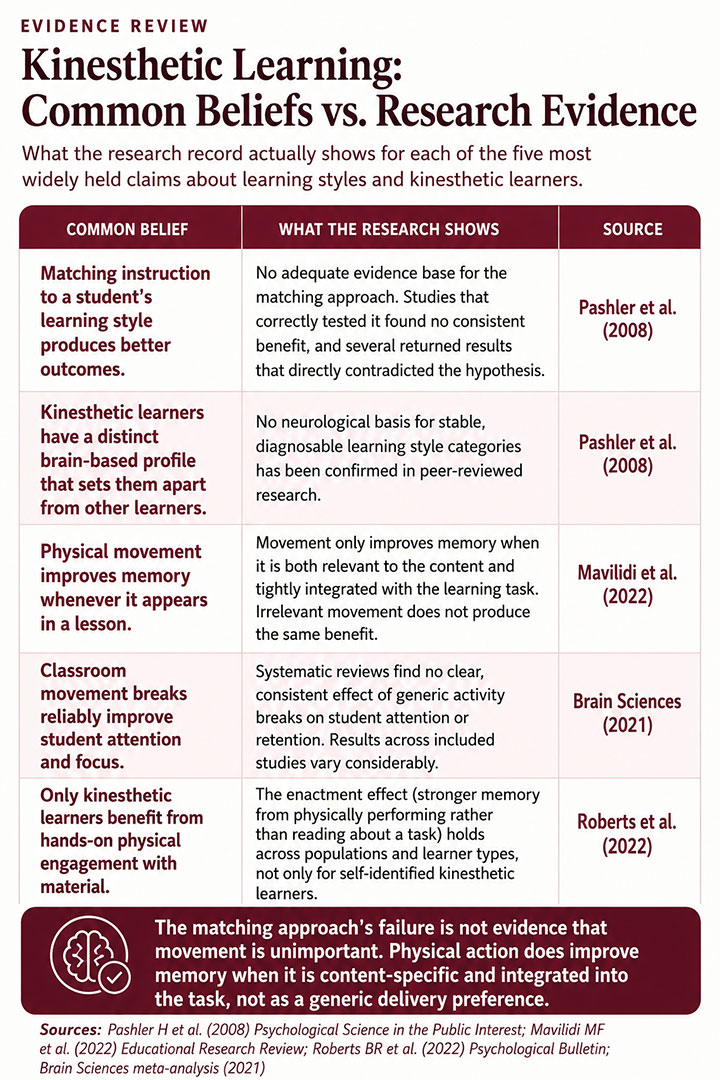
Somewhere between 88% and 97% of teachers across the UK, the Netherlands, China, Turkey, Spain, and Greece believe that instruction works best when it’s matched to a student’s preferred learning style. That consensus is enormous. And the definitive scientific review of the research behind it found no adequate evidence to justify the practice.
Kinesthetic learning, the idea that some people learn best through physical movement and hands-on engagement, is the most widely recognized of those styles. The gap between how strongly the belief is held and how thinly the matching approach is supported by research is significant, though the story doesn’t end at “learning styles are wrong.”
Movement does something measurable when it’s tied to learning. The mechanism is specific, well-documented, and almost entirely absent from the kinesthetic learning conversation most people have encountered.
What Is a Kinesthetic Learner?
A kinesthetic learner is typically described as someone who retains information better through physical experience than through sitting and listening. You sat through the lecture, understood it in the room, and three days later had almost none of it. The person who spent the lab session actually building the thing still has it.
That’s the experience the label is trying to name, and it’s real. In practice, it looks like understanding a procedure by doing it rather than reading the steps, feeling most engaged in workshops and labs, and losing focus when instruction is primarily verbal or text-based.
The experience is broadly shared. Whether it reflects a stable learner type that instruction should be tailored to match is where the research breaks sharply from the popular framing.
Kinesthetic learning is sometimes used interchangeably with tactile learning, though the two are not identical. The broader definition covers whole-body movement, physical action, and role-play scenarios. Tactile learning refers more specifically to fine-motor manipulation, such as writing by hand, assembling components, or handling materials directly.
The Learning Styles Problem
For the meshing hypothesis to hold up, a very specific pattern of evidence is required. Studies would need to show that kinesthetic learners genuinely perform better with kinesthetic instruction and worse with visual or auditory instruction, while learners in those other categories show the reverse. That crossover interaction, the statistical fingerprint that would confirm that style-matching matters, has been almost entirely absent from the studies claiming to support learning styles.
Harold Pashler at the University of California, San Diego, together with colleagues Mark McDaniel, Doug Rohrer, and Robert Bjork, set out to review the available evidence in a paper published in Psychological Science in the Public Interest in 2008. Their conclusion was direct: no adequate evidence base exists to justify incorporating learning-style assessments into educational practice. Of the studies that had tested the hypothesis correctly, several had returned results that flatly contradicted it.
The belief has not been deterred. Sander Dekker and colleagues at the University of Amsterdam tracked learning-style matching as one of the most persistently endorsed neuromyths in a 2012 teacher survey published in Frontiers in Psychology. Subsequent national surveys in China, Turkey, Spain, and Greece have found endorsement rates running at 91% to 97%.
Why Movement Actually Helps Memory
The research on whether learning styles should guide instruction is separate from the research on whether physical action improves memory. One body of evidence is weak. The other is substantial.
Brady Roberts, Colin MacLeod, and Myra Fernandes at the University of Waterloo conducted a systematic review and meta-analysis of 145 behavioral studies and published their findings in Psychological Bulletin in 2022.
The effect they measured is called the enactment effect: the memory advantage that comes from physically performing an action, compared to reading about it, watching it, or imagining it. The average effect size across those studies was g = 1.23, which is a large result by the standards of cognitive psychology.
For comparison, retrieval practice, one of the most consistently recommended study techniques in educational research, typically produces effect sizes of approximately d = 0.50 in large-scale meta-analyses. The enactment effect at g = 1.23 registers considerably higher. It does not receive proportional attention in everyday learning-strategy content.
The enactment effect is real, but it is specific. Susan Wagner Cook, Zachary Mitchell, and Susan Goldin-Meadow at the University of Chicago set out to isolate what the movement was actually doing in a 2008 study published in Cognition.
Children who physically gestured while learning a new mathematical concept retained what they had learned. Those who discussed the same material verbally, without any gesture, did not. The physical act was doing specific cognitive work, not simply providing a different delivery format.
When Movement Helps and When It Doesn’t
Not all movement produces the same effect. Walking around while passively rereading notes is not the same cognitive act as physically performing the steps of a concept you’re trying to learn. That distinction matters more than the learning-styles framing tends to acknowledge.
Myrto Mavilidi, Caterina Pesce, and colleagues analyzed data from 83 studies involving more than 25,000 children and adolescents in a 2022 meta-analysis published in Educational Research Review. They sorted movement-based learning interventions into a framework based on two variables: how relevant the movement was to the learning content, and how tightly integrated it was with the learning task itself.
The pattern of results was selective. Memory improved when movement was both relevant to the content and tightly integrated with the learning task. Movement that was neither relevant nor integrated improved behavioral control but not memory.
That finding has a direct bearing on classroom “brain breaks,” short movement intervals disconnected from what students are studying. A 2021 systematic review and meta-analysis published in Brain Sciences found no clear, consistent effect of generic in-class activity breaks on students’ attention.
High variation across the included studies makes the finding inconclusive rather than a firm null result, but the implication holds: movement for its own sake is not a reliable learning tool.
Kinesthetic Learning Examples That Actually Work
Given the evidence, the useful question shifts. Not “am I a kinesthetic learner?” but “how do I use movement in a way that actually does something?” The answer from the research is more specific than learning-styles advocates tend to suggest.
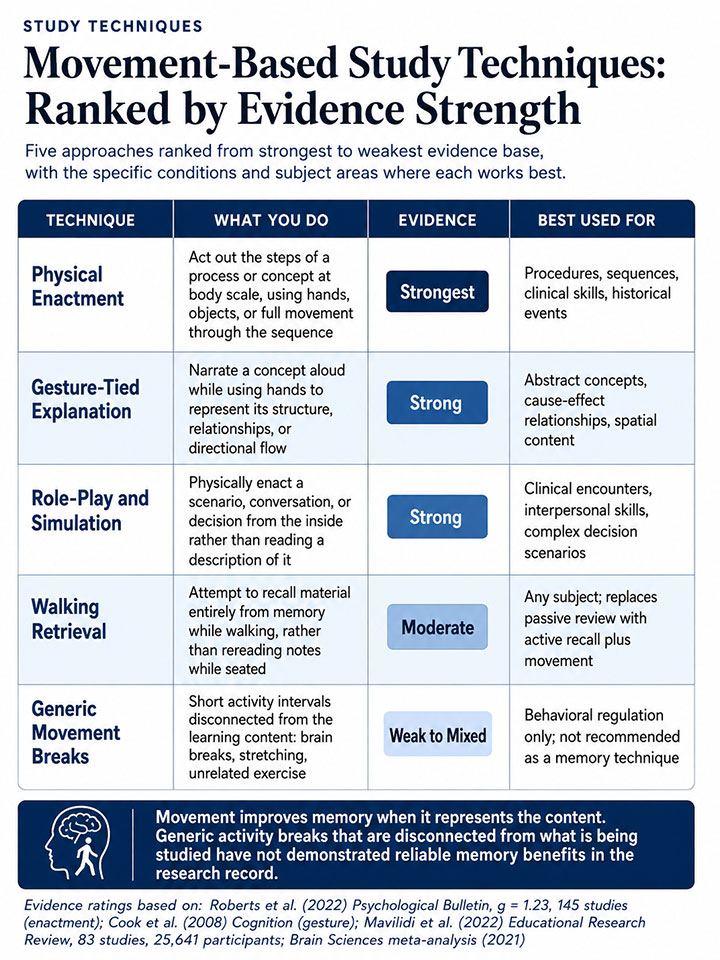
Physical enactment of a process is the most directly supported technique. Physically acting out a sequence of steps, whether that means tracing a chemical reaction with your hands, moving through a historical narrative in space, or simulating a clinical procedure, produces reliably stronger retention than reading the same description. The movement has to represent the content, not simply accompany it.
Gesture tied to explanation works through the same mechanism. Narrating a concept aloud while producing gestures that represent its structure, the shape of a relationship, the direction of a process, actively changes what gets encoded during that pass. This is what the Cook and Goldin-Meadow research shows: the specific content of the gesture, not just the physical activity of gesturing, carries the effect.
Walking and recalling at the same time is worth distinguishing from movement for movement’s sake. Attempting to retrieve what you’ve studied while walking layers a memory demand on top of mild physical activity. That’s a different cognitive act from strolling while rereading notes, and the difference is what matters.
Role-play and simulation extend the same mechanism to larger scenarios. Physically enacting a conversation, a negotiation, a clinical procedure, or any procedural sequence produces stronger retention than reading about it, because the body is performing the cognitive sequence rather than observing it.
Medical and professional training have relied on simulation for exactly this reason. The enactment research is the explanation.
Turn It Into a Movement
Enter what you are studying. Get 2 to 3 physical technique suggestions grounded in enactment and gesture research.
Please enter a topic before submitting.
What This Means If You Think You’re a Kinesthetic Learner
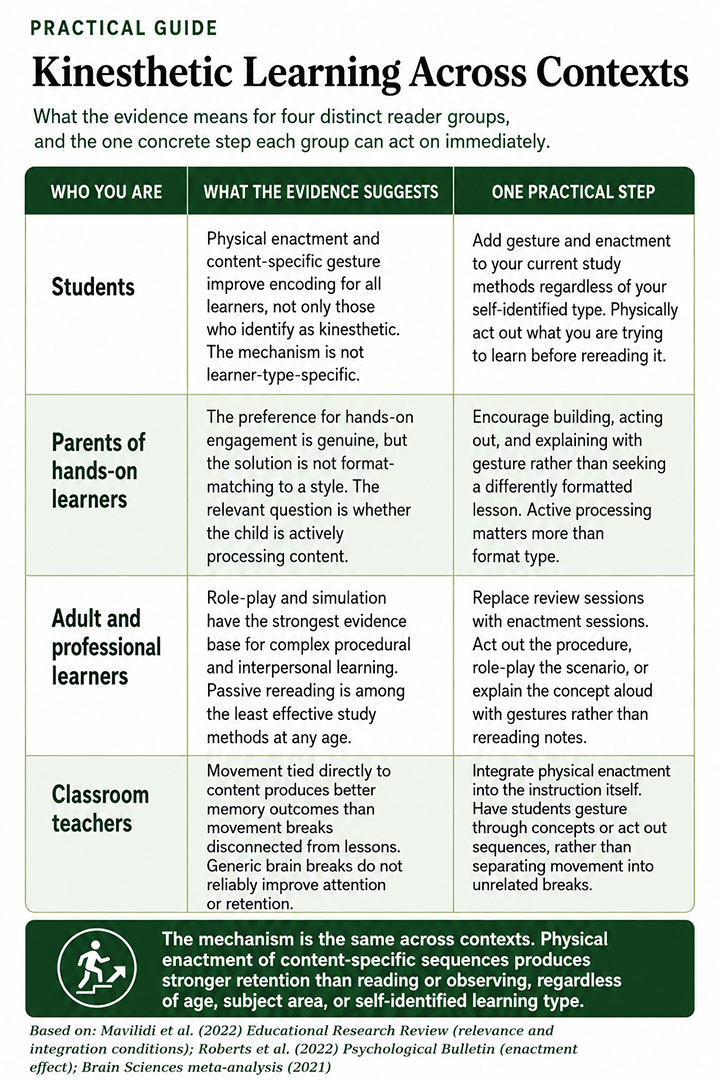
The preference for hands-on learning is genuine. What it points toward is a description of how physical action encodes memory differently from passive exposure, rather than a fixed learner category. Knowing that makes the practical question simpler: not “what type of learner am I?” but “where can I add physical engagement to what I’m trying to learn?”
Treating “kinesthetic learner” as a fixed identity tends to produce a search for environments that match the preference, and a resigned tolerance for environments that don’t. Treating the enactment effect as a tool produces something more useful: a set of techniques you can bring to any learning context, regardless of how the instruction was designed.
The label puts the responsibility on the environment. The mechanism puts it back on you.
People who apply this most effectively don’t wait for instruction to arrive in their preferred format. They add physical engagement to whatever content they’re working with, using gesture when self-explaining, acting out processes rather than reading about them, and retrieving from memory while moving rather than while rereading. These are applications of a cognitive mechanism that holds across studies, populations, and ages, not accommodations for a specific learner type.
The Label vs. the Mechanism
The kinesthetic learning label will likely outlast the evidence that questions it. It is too intuitive, too widely taught, and too embedded in school culture to be quietly revised by research most people will never read.
What the evidence does leave behind is something more useful than a personality type: a mechanism. Physical action changes how information gets stored in memory, under specific conditions that are now well-documented.
That mechanism belongs to anyone who uses it deliberately, not exclusively to kinesthetic learners.
FAQs
What are kinesthetic learning examples?
Examples grounded in the evidence include physically acting out a process rather than reading about it, gesturing while explaining a concept aloud, retrieving information from memory while walking rather than rereading notes, and using role-play or simulation to enact a scenario.
These work because the physical action is tied directly to the content being learned, not because movement is happening in the general vicinity of the study session.
What do kinesthetic learners struggle with?
People who prefer hands-on engagement often find extended lectures, dense textbooks, and primarily auditory instruction difficult to stay engaged with. The more accurate version of that experience is that passive exposure tends to be less effective for most people, regardless of learning-style identity.
The more productive question is how to introduce physical engagement into whatever format the content arrives in, rather than waiting for the format to match a preference.
What is the difference between kinesthetic and tactile learning?
Kinesthetic learning in its broad definition covers whole-body movement, physical action, and role-play. Tactile learning refers more specifically to fine-motor engagement, such as writing by hand, assembling components, or handling materials directly.
Some frameworks treat them as interchangeable, while others draw the distinction between large-scale physical action and fine-motor manipulation through the hands.