You don’t need to master all 12 techniques at once. Even replacing one common study habit with a better one can dramatically improve what you remember over time.
Schools taught most of us a quiet lie about learning. Not a malicious one. Just the working assumption of a system that hadn’t looked carefully at the evidence: that some people are born quick learners and others simply aren’t. That the gap is talent. That intelligence is fixed, and capacity is set.
It isn’t. And the evidence showing it isn’t has been sitting in peer-reviewed journals for decades.
The difference between people who learn quickly and people who struggle is rarely the brain they were born with. It’s the method they use. More specifically, most people rely on strategies that feel productive (rereading notes, highlighting, reviewing what’s already familiar) while avoiding the strategies that actually build durable memory. The uncomfortable ones. The ones that feel like they’re not working while they’re working far better than anything else.
Twelve of those strategies are below. Each is drawn from controlled research, and each addresses a different aspect of how memory forms and holds. The fastest way through this material is to start using one technique this week, not to finish reading first.
The 12 Pillars of Accelerated Learning
1. Spaced Repetition: The End of Cramming
Your brain forgets on a predictable curve. Within an hour of learning something new, you lose roughly half of it. By the next day, 70% is gone. This isn’t a failure of effort or attention. It’s how memory consolidation works, and it has a direct implication for how you should schedule study.
In 2006, Nicholas Cepeda and colleagues published a meta-analysis in Psychological Bulletin covering 839 assessments of distributed practice across 317 experiments. The conclusion held across every subject and age group: spacing study sessions over time outperforms concentrating them. The same amount of study time produces dramatically different retention depending entirely on when that time is scheduled.
What happens between sessions matters as much as what happens during them. Memory consolidation (the process of moving information from temporary to durable storage) takes place in the gaps, not at the desk. When you cram, you’re forcing everything through before consolidation can begin. When you space, you give each piece of information time to settle before you disturb it again.
Cramming is like shoving clothes into a closet. You can make everything fit, but it all falls out the next day. Spaced repetition is folding and filing. The upfront work is harder, but what you put away stays where you put it.
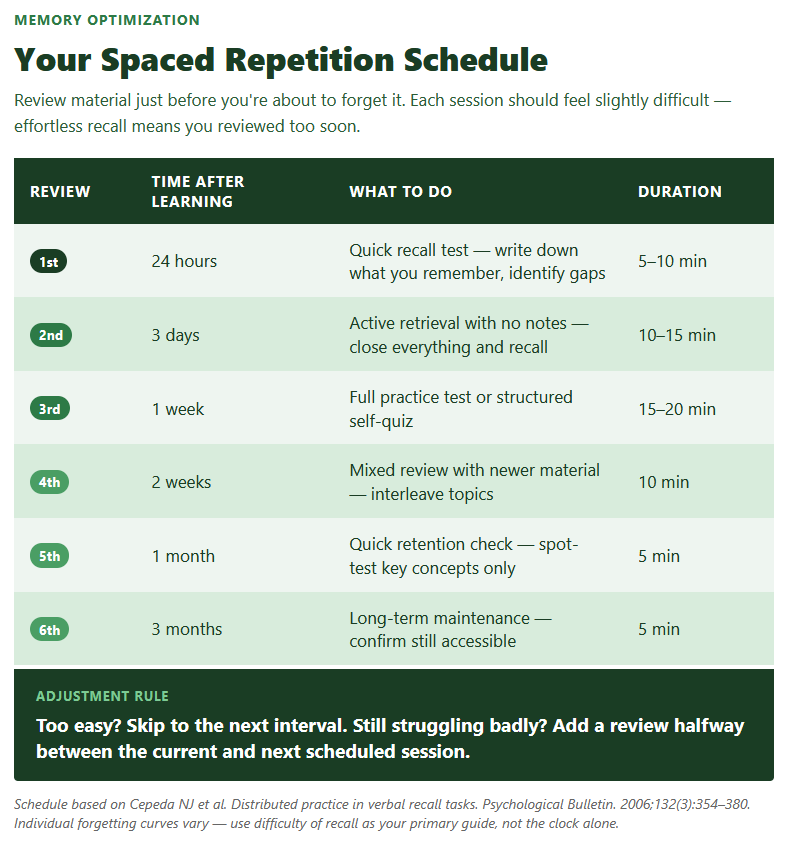
Review material just before you’re about to forget it: not so early that the review is effortless, and not so late that nothing remains. Start a first review within 24 hours, return after 3 days, then after a week, then a month. Each review should feel slightly difficult. If a concept comes back immediately and cleanly, you’ve reviewed too soon.
Apps like Anki automate the scheduling, but a calendar system works equally well. The algorithm matters less than the habit of letting time pass between reviews.
2. Retrieval Practice: The Power of the Test
Rereading notes feels productive. The information looks familiar. You recognize it and think, “Yes, I know this.” But recognition and recall are two different things, and the one you’re tested on is never recognition.
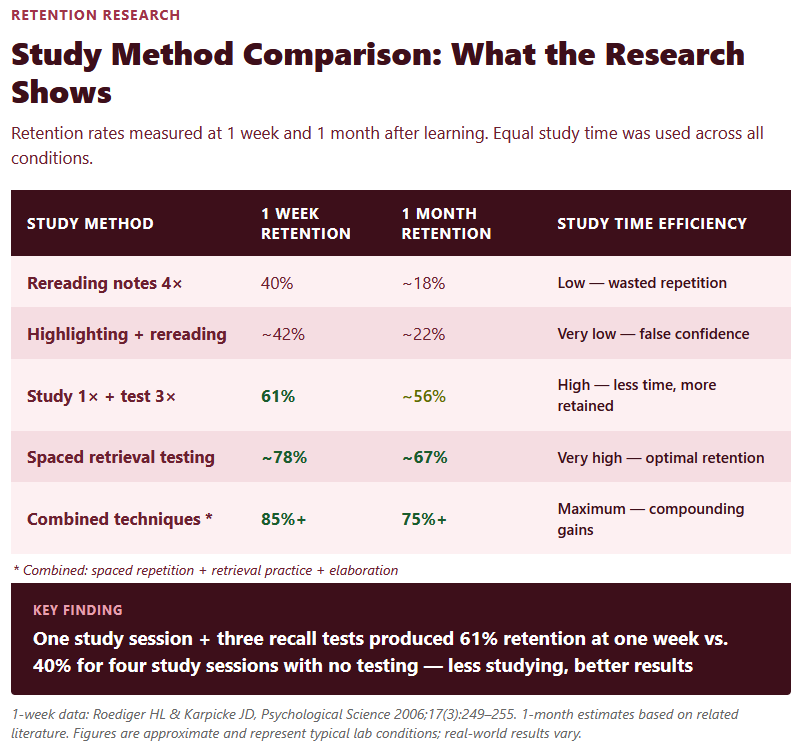
Henry Roediger and Jeffrey Karpicke wanted to know how much it mattered whether students tested themselves vs. simply restudied. In 2006, they ran an experiment that divided students into three conditions: study the passage four times (SSSS), study three times and test once (SSST), or study once and test three times (STTT).
Five minutes after the final session, the results favored reading: the SSSS group recalled 83%, the STTT group 71%. A week later, the ranking had completely inverted. The STTT group (one study session, three tests) recalled 61% vs. the SSSS group’s 40%. The most-studied group had forgotten more than half of everything they knew.
That finding took a while to sink in. Less studying, more testing, substantially better results. Not because testing is magical, but because retrieval does something categorically different from rereading. When you pull information from memory, you strengthen the neural pathway to it. Rereading is looking at a map of the path. Testing is walking the path itself.
The discomfort of trying to recall something is the actual mechanism. Your brain is reconstructing the information, and that reconstruction work is what makes the memory more resistant to forgetting. When retrieval feels easy, you’re not getting much benefit. When it’s a genuine effort, you are.
Close your notes and write down everything you remember. Don’t peek. Use flashcards where you generate the answer before seeing it. Take practice tests early in the learning process, not at the end when you feel ready. The rule of thumb: if you’re not struggling to recall, you’re not doing retrieval practice.
3. Interleaving: Mixing It Up for Mastery
Nate Kornell and Robert Bjork were testing a reasonable assumption. Their 2008 study asked whether studying one category at a time, all of one artist’s paintings and then all of another’s, would help people learn to recognize styles better than seeing them randomly shuffled. The assumption being tested: that organization aids learning.
It didn’t. Students who studied paintings in blocked groups identified artists correctly 36% of the time on the test. Students who studied the same paintings interleaved, without any organizational structure, scored 59% correct. The blocked group had felt more confident during study. They were wrong to be.
The brain settles into a rhythm when it sees the same problem type repeatedly. When you practice addition problems for twenty minutes and then switch to subtraction, you’re not just doing different problems. You’re practicing the judgment of recognizing what type of problem you’re facing. That discrimination is the actual skill. Blocked practice builds fluency within a category. Interleaving builds the ability to navigate between categories, which is what real-world application requires.
One honest caveat on this: the interleaving advantage is real and replicable, but it tends to be smaller for people at the very beginning of learning a subject. When you don’t yet know enough to notice the contrasts, the confusion can overwhelm the benefit rather than create it. Interleaving pays off most when you have some foundation to work from. If a concept is completely new, a brief period of focused, category-specific practice first is a reasonable starting point.
Stop grouping your study by topic type. If it’s algebra and geometry, mix them in the same session. If it’s vocabulary and grammar, alternate rather than finish one before starting the other. For exam preparation that covers multiple subjects, don’t work through one in full before starting the next. The discomfort of the switching is the signal that your brain is working.
4. Elaboration: The Self-Explanation Strategy
Reading is passive. Your eyes can move across a page while your mind does almost nothing with what it’s seeing. Elaboration is the practice of forcing your mind to work during study by explaining material to yourself in your own words: not what the information is, but why it’s true, how it works, and how it connects to what you already know.
Michelene Chi at Arizona State University tracked eighth-grade students working through a passage on the circulatory system and found in 1994 that the students who generated the most self-explanations, who kept asking themselves why each sentence was true and how it fit with the previous one, were far more likely to build an accurate mental model of the system than students who simply read the text, even twice. The high-explainers weren’t necessarily smarter. They were doing something different while reading that the low-explainers weren’t.
Your brain stores information in networks, not in isolation. New material needs to connect to something existing to stick. Self-explanation is the act of building those connections manually, finding the slots in your existing knowledge where the new information belongs. The more connections you build, the more retrieval routes you create, and the more durable the memory becomes.
Teaching someone else is the highest-leverage form of this. When you have to explain something aloud in plain language, you discover very quickly which parts of your understanding are solid and which are vague approximations. The gaps in your explanation are a map of the gaps in your knowledge, which is exactly what you need for efficient further study.
After reading each section of material, close the book. Ask yourself: Why is this true? What would happen if one variable changed? How does this connect to what I already know? If you can’t answer in plain language, you don’t understand it yet.

5. Desirable Difficulty: Embracing the Struggle
Consider two students reviewing for the same exam. One goes over her notes until every answer comes back quickly and cleanly. The other keeps putting aside material that already feels solid and drilling the parts that still feel uncertain. The first student leaves the session feeling more confident. The second performs better on the test, consistently, across decades of research into how memory actually works.
Robert Bjork at UCLA coined the term “desirable difficulties” for this phenomenon. The idea, developed across decades of research beginning with his 1994 work on memory and training, is that certain obstacles during learning (forgetting, confusion, having to reconstruct rather than recognize) are what drive durable encoding. Difficulty is only desirable, though, when it’s surmountable. Challenge that leaves you completely unable to progress isn’t productive. The target is the zone where you’re struggling but eventually getting there.
Fluency during review is a warning sign, not a success signal. If your notes feel completely familiar when you reread them, you’re not doing useful review work. Review material at the point where it’s slightly difficult to recall, where you have to reach for it. That reaching is what you’re after.
Test yourself on material before you’ve studied it thoroughly. Attempt problems before you’ve seen the solution method. Study without your notes, even when struggling. The discomfort you feel isn’t evidence that something is wrong. It’s the mechanism of learning, happening in real time.
6. Focused Attention: The High Cost of Context Switching
The common assumption is that multitasking is a productivity tool. The neuroscience is less generous. What we call multitasking is actually rapid task-switching, and every switch carries a cost that accumulates across a study session.
Eyal Ophir, Clifford Nass, and Anthony Wagner at Stanford tested this in 2009 by comparing heavy media multitaskers against light multitaskers across several cognitive control tasks. The published results in PNAS were counterintuitive: the heavy multitaskers performed worse on task-switching, not better. They were more susceptible to interference from irrelevant information in the environment and from their own memory. Chronic multitasking, it turned out, doesn’t train the ability to switch effectively. It trains a broader but shallower attention that struggles to filter out what doesn’t matter.
During learning specifically, divided attention means information encodes shallowly. A lecture half-listened to while checking a phone doesn’t go in well. A reading session interrupted by notifications requires re-engagement every time, and research on attention interruptions suggests that recovery to full concentration after a brief distraction can take 20 minutes or more. Not from the distraction itself. From the brief awareness that the distraction occurred.
Creating a distraction-free environment isn’t a self-discipline hack. It’s a prerequisite for the study techniques above to function. Spaced repetition and retrieval practice operate on information that was properly encoded in the first place. Put the phone in another room. Close tabs. Set a specific end time so the session has a boundary. The quality of 50 focused minutes substantially exceeds the quality of 3 hours of interrupted, half-present study.
7. Sleep-Based Consolidation: Learning While You Dream
The hours after a study session are when much of the actual learning happens. Not at the desk, but asleep. Susanne Diekelmann and Jan Born at the University of Tübingen published a comprehensive review in Nature Reviews Neuroscience in 2010 establishing what the field now treats as settled: sleep actively consolidates newly learned information, transferring it from the hippocampus (which functions as a kind of temporary staging area) to neocortical storage, where it becomes more durable and more integrated with existing knowledge.
During slow-wave sleep, the hippocampus replays the day’s learning events and gradually shifts the storage burden to the neocortex. During REM sleep, separate consolidation processes appear to support procedural skills and the integration of new material with existing memory structures. The details of how these stages interact are still an active area of research. The precise role of REM in declarative memory consolidation, in particular, remains debated. What isn’t debated is that truncating sleep truncates this process.
Studying late at night and then sleeping fewer than seven hours is a worse trade than it appears. You’re cutting the very process that turns what you studied into something you’ll still know tomorrow. The research on sleep deprivation and memory is consistent enough that many researchers who study it no longer pull all-nighters at all, even under deadline pressure.
Study before sleep when possible. Naps of 90 minutes after intensive learning sessions allow a full sleep cycle and measurably improve retention compared to the same amount of time spent continuing to study. If you have a choice between one more hour of study and sleep, choose sleep.
8. Aerobic Exercise: Growing Your Brain’s Hardware
In 2011, Kirk Erickson at the University of Pittsburgh ran a randomized controlled trial that produced one of the more striking findings in cognitive neuroscience that year. One hundred and twenty older adults were assigned either to aerobic walking (40 minutes, three times per week) or to a stretching control group. After one year, the aerobic group’s hippocampal volume had increased by 2%, effectively reversing one to two years of age-related shrinkage. Their spatial memory improved in parallel.
The mechanism is BDNF (brain-derived neurotrophic factor), a protein that promotes neuron growth and strengthens synaptic connections. Aerobic exercise reliably elevates BDNF levels in the hippocampus, the brain structure most involved in the formation of new memories. This is not a metaphorical relationship between exercise and brain health. It’s a measurable structural change, visible on an MRI scan, that follows a dose-response curve.
Exercise timing matters for this reason. BDNF levels peak roughly one to two hours after moderate-intensity aerobic exercise and remain elevated for several hours. A 20-to-30-minute run or brisk walk before a study session primes the hippocampus for encoding. Even brief movement breaks during study (10 minutes of walking between sessions) produce measurable improvements in subsequent memory performance compared to sitting through the break.
You don’t need to become a committed runner. Moderate intensity, anything that elevates your heart rate and produces light breathlessness, is sufficient to trigger the BDNF response. The research on interval training suggests slightly higher BDNF peaks than steady-state cardio, but both work. What doesn’t work is staying sedentary during a period of intensive learning.

9. Error-Driven Learning: The Mistake Advantage
The intuition most students carry is that making mistakes contaminates learning, that a wrong answer recorded in memory will persist alongside, or instead of, the right one. The research does not support this. Janet Metcalfe at Columbia University reviewed the evidence in Annual Review of Psychology in 2017 and found that errorful learning followed by corrective feedback consistently benefits retention, often substantially more than passive exposure to correct information alone.
The effect is strongest when errors are made with high confidence. When a student is certain of an answer that turns out to be wrong (what researchers call the hypercorrection effect), the correction tends to stick considerably better than it would if the student had been uncertain. The surprise of being wrong when you were sure you were right appears to trigger stronger encoding of the correction. Confident errors are the most valuable kind to make.
Attempt before studying, not after. Before you read a chapter, try to answer the questions at the end. Before watching a lecture, attempt the problem set. You won’t know the answers. That’s not the point. When you encounter the correct information after a failed attempt, you encode it against the backdrop of your specific wrong answer, which is a much stronger signal to the brain than reading a correct answer you had no prediction about.
One rule governs this: feedback must be immediate. An error made and not corrected until a week later loses most of its learning benefit. Test yourself, check the answer, and study the correction right away.
10. Chunking: Optimizing Your Mental RAM
Working memory holds roughly four to seven items at any one time. That’s not enough to work with complex information unless those items are organized into meaningful groups (what psychologists call chunks).
William Chase and Herbert Simon at Carnegie Mellon established the foundational picture of this in their 1973 study of chess expertise. When they showed chess positions briefly to players of different skill levels and asked them to reproduce the positions from memory, grandmasters far outperformed beginners, but only when the positions were from real games. On random positions with no strategic logic, the advantage disappeared almost entirely. The masters weren’t working with better raw memory. They were working with a different unit. A cluster of pieces forming a known defensive formation was one item in working memory, not six.
What counts as a single item depends on how much meaningful structure you can find in the material. A phone number memorized as three digits, then four, is two items instead of seven. Historical events grouped by cause-and-effect chain are one chunk instead of five dates. The more meaningfully you can organize material (by real relationships, not arbitrary groupings), the more you can hold and process at once.
Does that mean expertise is just pattern recognition? Mostly, yes. Which raises an interesting question about how we build pattern libraries in the first place, and whether the other techniques above give a better answer than raw repetition does.
11. Dual Coding: The Visual-Verbal Connection
Most people studying from a textbook use only one of the two available memory channels. They read. They take written notes. The visual channel sits mostly idle, which is worth knowing because the two channels don’t compete. They compound.
Allan Paivio at the University of Western Ontario developed what became known as dual coding theory across decades of research, formalizing it in a 1991 review: encoding information through both the verbal and visual channels creates two independent memory traces, each capable of cueing recall of the other. Richard Mayer’s subsequent work on multimedia learning extended this to formal instruction, establishing that people learn more deeply from words and pictures together than from words alone.
When you take notes on a process, also sketch the process, even a rough box-and-arrow diagram. When you read a verbal description of a system, draw the system. When you study a diagram, write an explanation of what it shows. Artistic skill is irrelevant. The goal is to encode the same information twice, through different processing routes, creating two ways back to the same memory.
The physical act of drawing slows you down, which has an independent benefit: it forces you to think about relationships rather than passively absorbing sequence. Sketching how parts of a system connect requires you to understand those connections first.
12. Frequent Short Breaks: The Vigilance Restoration
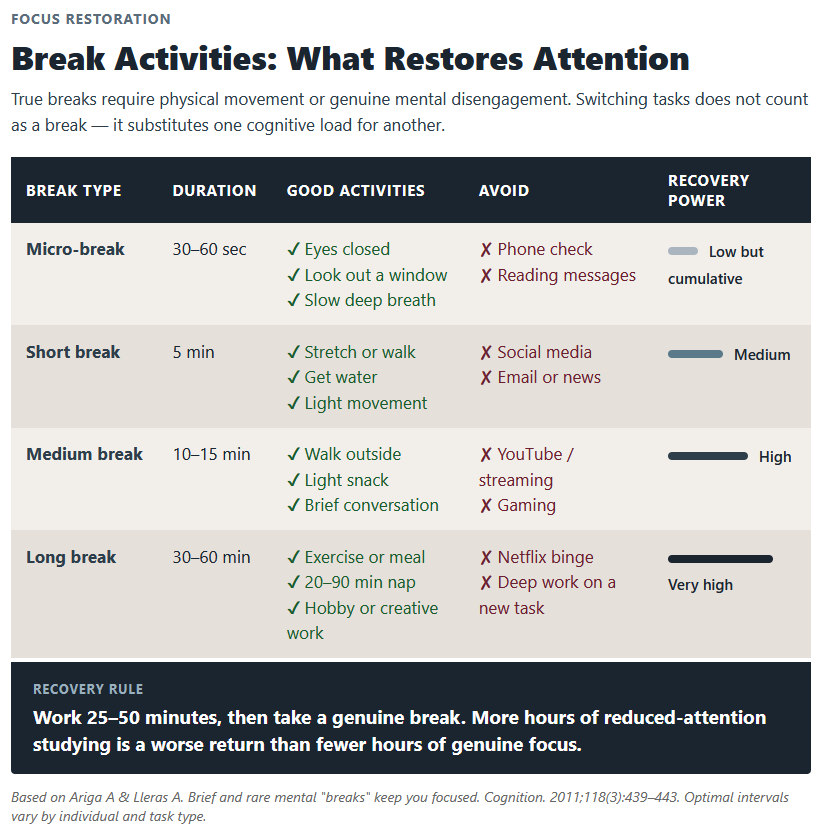
Sustained attention degrades over time. This isn’t a motivational problem. It’s a property of how the attentional system works. Atsunori Ariga and Alejandro Lleras at the University of Illinois demonstrated in a 2011 study in Cognition that brief mental disengagements during a 50-minute task completely prevented the performance declines that accumulated in the group that worked straight through. The mechanism is habituation: sustained exposure to the same mental demand causes the brain to progressively filter it out, much as you stop noticing the feel of clothing on skin after a few minutes. Brief breaks reset the goal representation and restore selective attention.
The key distinction is between true breaks and task switches. Checking email or social media during a break doesn’t restore attention. It substitutes one cognitive demand for another and often introduces residual preoccupation with whatever you saw. A true break involves either physical movement or genuine mental disengagement. A short walk, a period of looking out a window, a few minutes of deliberate physical stretching: these work. Scrolling does not.
The optimal work interval varies by person and task type, but 25-to-50 minutes of focused work followed by 5-to-10 minutes of genuine disengagement is well-supported. Longer sessions erode the quality of attention, not just its duration. More hours of diminished-attention studying is a worse return than fewer hours of genuine focus with breaks in between.
How to Stack These Techniques
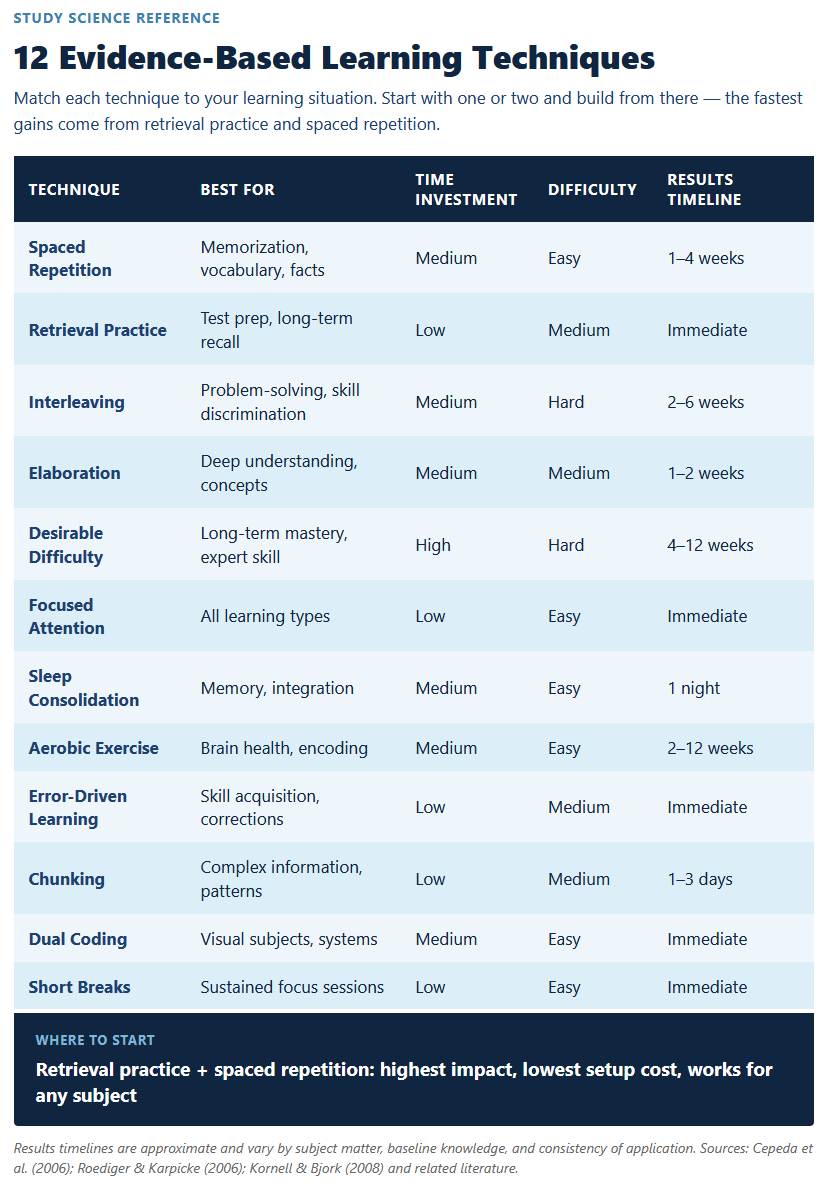
These techniques don’t compete. They compound. Spaced repetition schedules the timing. Retrieval practice determines what you do during each session. Sleep consolidates what retrieval practice encoded. Exercise prepares the brain to encode. Interleaving prevents the fluency illusion that blocked practice creates. Used together, the gains exceed what any single technique delivers in isolation.
For anyone new to evidence-based study, the most efficient starting point is a sequence rather than a complete overhaul. In the first week, focus on two changes only: eliminate distractions during study (focused attention), and replace rereading with active recall at the end of each session (retrieval practice). Add sleep protection in week two: 7 to 9 hours, treated as non-negotiable rather than variable. These three changes alone are sufficient to produce measurable improvement in retention before adding the more complex techniques.
Spaced repetition and interleaving can be layered in once the basics are consistent. The higher-order techniques (elaboration, desirable difficulty, error-driven learning) become available when you’re comfortable enough with the material to know what a confident wrong answer looks like. Chunking and dual coding work across all phases and can be integrated early without complication.
One technique applied consistently outperforms twelve techniques applied occasionally. The system compounds when you’re ready. It doesn’t require you to be ready first.
A Weekly Study Protocol
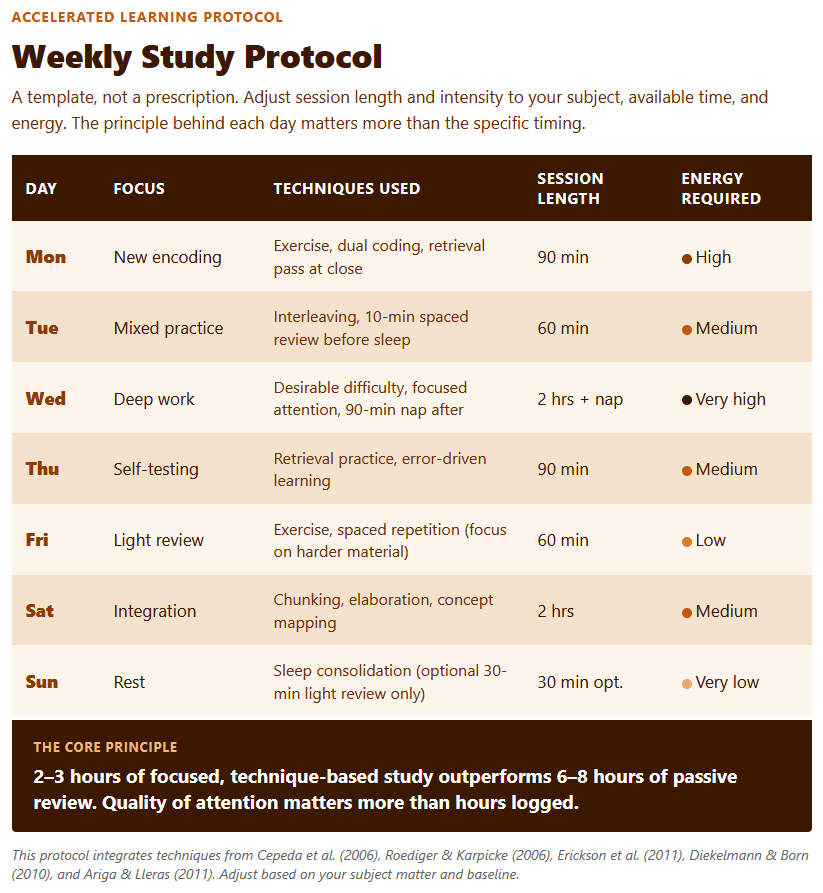
The structure below is a template, not a prescription. Adjust to your subject matter, available time, and energy cycle. What matters is the principle behind each day’s design: new encoding on high-energy days, retrieval and review on medium-energy days, integration and pattern recognition on lower-energy days.
Monday opens the week with new material on a day when cognitive resources are fresh. A brief aerobic session beforehand (20 minutes is sufficient) elevates BDNF for the encoding session that follows. Close every Monday session with a retrieval pass: close all notes and write down what you remember from the session. This is your first review, and it happens within hours, not days.
Tuesday uses the previous day’s material as a starting point for interleaved practice. Mix Tuesday’s new content with Monday’s, alternating topics rather than completing one before beginning another. Before sleep, spend 10 minutes on a light review of Monday’s material.
Wednesday is for deep work. Pick your hardest material and spend two concentrated hours on it with full environmental protection: no phone, no notifications, genuine focus. Attempt problems before checking solutions. Embrace confusion as a signal of productive difficulty, not failure. A 90-minute nap after this session is not a luxury.
Thursday is test day. No new material. Use practice tests, flashcard review, and retrieval prompts across everything covered this week. Pay extra attention to the confident mistakes: the answers you were sure about that turned out to be wrong. Note them specifically and review the corrections before moving on.
Friday closes the active week with a light aerobic session followed by spaced review of the material from earlier in the week, focusing on anything that felt difficult during Thursday’s testing. Weekend sessions work best for chunking and elaboration: taking time to see the larger structure, building concept maps, explaining topics aloud as if teaching someone who knows nothing about the subject.
Applying These Techniques by Subject
The twelve techniques above are general-purpose, but the emphasis shifts depending on what you’re learning.
For language acquisition, spaced repetition and retrieval practice are the core. Vocabulary learned on a Monday and reviewed at 24 hours, 72 hours, one week, and one month is learned once. Vocabulary learned by rereading a word list is learned and relearned repeatedly with diminishing returns. Interleaving grammar, vocabulary, and listening comprehension in single sessions builds the discrimination skills that transfer to actual conversation. Error-driven learning is especially productive in language: attempt sentences before you’ve confirmed their grammar, and let native-speaker correction do its work.
For mathematics, interleaving is the single most underused technique. Most students practice all derivative problems before moving to integrals, building blocked fluency that collapses when the exam mixes problem types. Mixing problem types from the first session builds the pattern recognition that the exam actually tests. Elaboration is the complement: being able to explain why a method works, not just how to execute it, predicts transfer to novel problems more reliably than execution speed.
For high-stakes test preparation (medical boards, bar exam, CPA), the research consistently points toward the same conclusion: practice questions done consistently from the beginning of preparation outperform content review that postpones testing until “ready.” You are never ready in a way that makes the first test feel comfortable. Start testing on week one, accumulate a large practice question bank, and use the errors as a study guide rather than a source of discouragement.
Common Learning Mistakes
Highlighting material is widespread and mostly ineffective: it produces familiarity, not recall. Replace that time with a retrieval attempt immediately after reading.
Rereading notes until they feel familiar is the fluency illusion in action. The material feels known because recognition is easy. Recall, which is what any real-world application requires, is a different cognitive operation entirely. Replace rereading with closing your notes and writing down what you remember.
Studying when tired produces shallow encoding. The physiological capacity to consolidate learning decreases meaningfully as sleep debt accumulates. Two hours of alert, rested study produces better outcomes than four hours of exhausted study, demonstrably so in the retention data.
Avoiding difficult material is perhaps the most costly mistake. Error-driven learning and desirable difficulty both depend on engaging with problems you haven’t solved yet, which feels unrewarding and discouraging compared to reviewing material you already know. The efficient strategy is precisely backward from the comfortable one: spend more time on what’s hard and less on what’s easy.
FAQs
What is the fastest way to learn something new?
Test yourself rather than rereading, and space those tests out: 24 hours after you first learn something, then 3 days, then a week, then a month. Add a full night of sleep after intensive study. That combination outperforms any single technique by a margin that shows up in your next test, not just in lab data.
Do fast learners have high IQ?
Generally, no. What looks like a natural ability to learn quickly is usually a combination of prior knowledge (which makes new information easier to connect and chunk), effective study habits developed through exposure to what works, and deliberate practice with retrieval rather than passive review. The techniques in this article are not shortcuts for people with high IQ. They’re the actual methods that explain why some people appear to learn faster than others.
Can I learn anything 10x faster?
The “10x faster” framing circulating online overstates what any single technique delivers. What the research does show is that switching from passive review to active retrieval, combined with appropriate spacing, produces roughly a 50-to-100% improvement in retention at one week compared to rereading. Stacking spaced repetition, retrieval practice, sleep consolidation, and exercise can produce compounded gains across longer periods. That’s meaningful, but “10x” is a marketing figure, not a research finding.
What is the 3-2-1 study rule?
The 3-2-1 study rule refers to a recall-based review structure: read a concept three times, then try to speak it from memory twice, then write it once from memory. It has gained popularity as a simple framework for active review. It incorporates retrieval practice and elaboration, which is why it outperforms passive rereading, though the specific ratios are a popular shorthand rather than a rigorously tested protocol in the literature.
How can I improve my memory and learning ability?
Three changes produce the most consistent improvement across the research: test yourself regularly instead of rereading, space your study sessions across days and weeks rather than concentrating them, and protect 7-to-9 hours of sleep after learning. Adding aerobic exercise to your routine increases hippocampal volume over weeks and months, which supports encoding capacity over the longer term.
Does exercise really help you learn faster?
Yes, with measurable mechanisms. Aerobic exercise increases BDNF, which promotes neuron growth in the hippocampus. Erickson’s 2011 randomized controlled trial showed that 40 minutes of walking three times per week increased hippocampal volume by 2% over one year in older adults, reversing age-related shrinkage and improving spatial memory. Exercise before a study session primes the hippocampus during the BDNF peak window for better encoding.
How long should study breaks be?
Five to ten minutes after every 25 to 50 minutes of focused work. The break should involve physical movement or genuine mental disengagement: a short walk, looking out a window, brief stretching. Checking a phone or switching to a different mentally demanding task doesn’t restore attention. It substitutes one cognitive load for another.
What is the most effective study technique?
Retrieval practice combined with spaced repetition. This pairing outperforms all other single techniques in the literature on long-term retention. Interleaving and elaboration produce strong compounding effects when added.
How many hours a day should I study?
Quality matters more than quantity here. Two to three hours of focused, technique-based study with appropriate breaks consistently outperforms six to eight hours of passive review in retention outcomes. More hours of diminished-attention studying is a worse investment than fewer hours of genuine focus.
Can you learn while sleeping?
You can’t acquire new information during sleep. The brain isn’t encoding novel input in that state. What sleep does is consolidate what was learned while awake. Studying before sleep and getting a full 7-to-9 hours afterward produces substantially better retention than studying in the morning without sleep following. The consolidation window is not optional.
What time of day is best for studying?
Scheduling is less universal than often claimed. The general principle: exercise beforehand to elevate BDNF for encoding, study new and demanding material during your peak alertness window (for most people this is mid-morning), and review material before sleep to activate the consolidation window. Match session intensity to your energy level rather than following a fixed clock schedule.
Why do I forget everything I study?
Almost certainly because you’re rereading rather than testing yourself, and because your reviews are too closely spaced. Switch to retrieval practice (close your notes and recall) and schedule reviews at 24 hours, 3 days, 1 week, and 1 month after initial learning. If you’re still forgetting at those intervals, you’re likely not spending enough time on the initial encoding, or sleep is being cut short before consolidation can occur.
How do I stay focused while studying?
Create the conditions for focus rather than trying to maintain it through willpower. Phone in another room, all tabs closed except study materials, notifications off, a specific end time set before the session starts. Work in 25-to-50 minute blocks. Even a brief awareness of a notification carries an attention cost that extends well beyond the few seconds of dismissing it.
Is highlighting and rereading effective for studying?
No. Highlighting produces familiarity without recall ability. Rereading produces the same effect: the material looks known because recognition is easy. Four rounds of rereading produce 40% retention at one week in Roediger and Karpicke’s data, compared to 61% for one reading followed by three recall tests. The time spent rereading is not wasted in the sense that it does produce some encoding. It’s wasted relative to what retrieval practice produces in the same time.
How long does it take to see results from these techniques?
Retrieval practice and focused attention produce measurable improvement in your next test or application: the effect is immediate in the sense that one study session with active recall outperforms one session of passive review. Spaced repetition effects accumulate over weeks. Exercise-driven hippocampal changes emerge over months with consistent training. Most people notice substantially better retention within two to four weeks of consistent application of spaced retrieval.
The Bottom Line
Every technique in this article rests on the same premise your school got wrong. Learning isn’t a fixed capacity distributed unevenly at birth. It’s a skill, one that responds to method with the same reliability that physical training responds to a well-designed program. The students who struggled in class weren’t less capable. They were using the wrong strategy. In most cases, they were using the strategy that felt the most natural and productive, which happens to be the one the evidence most consistently contradicts.
Start with one technique this week. Retrieval practice costs nothing and requires no new materials: close your notes after the next session and write down what you remember. That one change is enough to produce a measurable difference in what you retain. The rest follows from there.