The advice sounds reasonable enough: learn a language, it’s good for your brain. What nobody tells you is how much you actually have to do before anything measurable happens inside your skull.
Most people guess in one of two directions. Either they assume you need years of immersion, near-fluency, and daily use before the brain begins to change. Or they take the app-based shortcut and hope that a five-minute Duolingo streak counts for something.
The research sits in neither camp. It points to a number that is more specific, more achievable, and more demanding than either extreme implies.
That number has only recently become possible to state with any confidence. And the study that produced it didn’t use elite military linguists or full-time language school students. It used ordinary adults between 60 and 80 years old, learning Spanish, French, or Japanese at home, on a laptop, in their own time.
The Study Behind the Number
In 2024, a team led by Douglas Schultz and Ladan Ghazi Saidi at the University of Nebraska set out to answer a question that sounds simple but had never been properly tested: does learning a new language actually change how an older brain performs on cognitively measurable tasks?
Forty-one healthy, monolingual adults aged 60 to 80 enrolled in an online language course through Rosetta Stone, choosing whichever language they wanted to learn. Spanish was the most popular. Japanese came fifth.
The program asked for 90 minutes a day, five days a week, over four months. Participants underwent fMRI brain scans before and after, alongside the Stroop task, a well-validated test of executive function that measures how well the brain manages conflict between competing signals.
The Stroop task is worth pausing on. It works by flashing words in mismatched colors, the word “red” printed in green ink, and asking participants to name the ink color. The brain’s automatic reading response and the correct answer point in opposite directions.
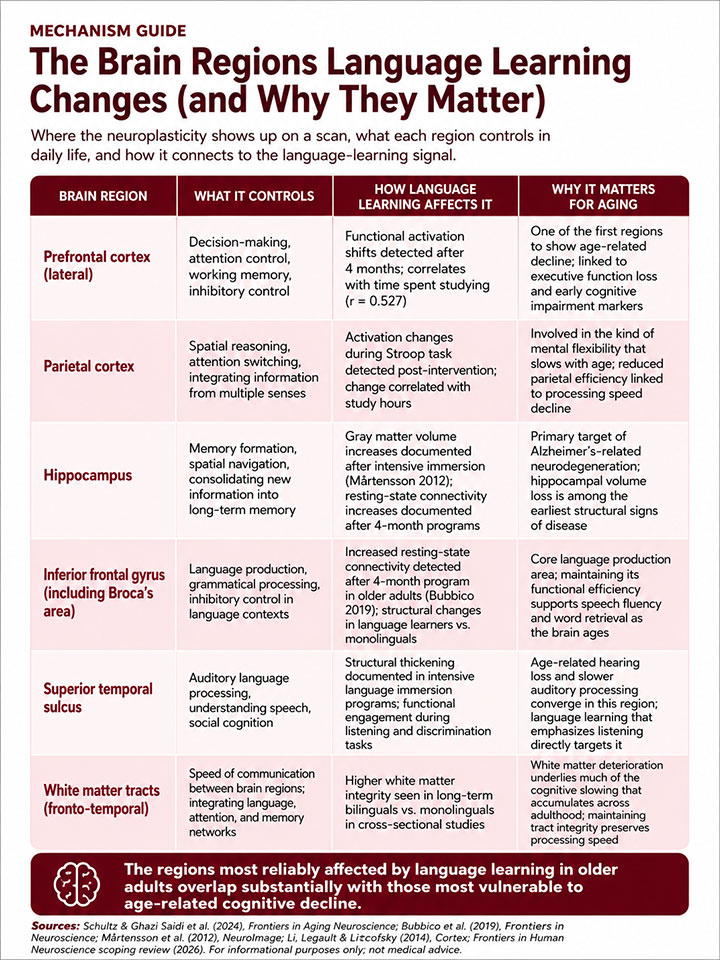
Handling that conflict calls on the prefrontal cortex, the same region involved in language switching, attention regulation, and the kind of cognitive control that tends to erode first with age.
After the intervention, accuracy on the incongruent trials, the harder ones, improved significantly. Response times on those same trials also shortened. The fMRI data showed corresponding changes in the prefrontal and parietal cortex, regions that had shown no significant difference between baseline and post-intervention scans for the group as a whole. Something was shifting in the brain.
Then the researchers looked at how much each participant had actually done.

The Threshold That Actually Matters
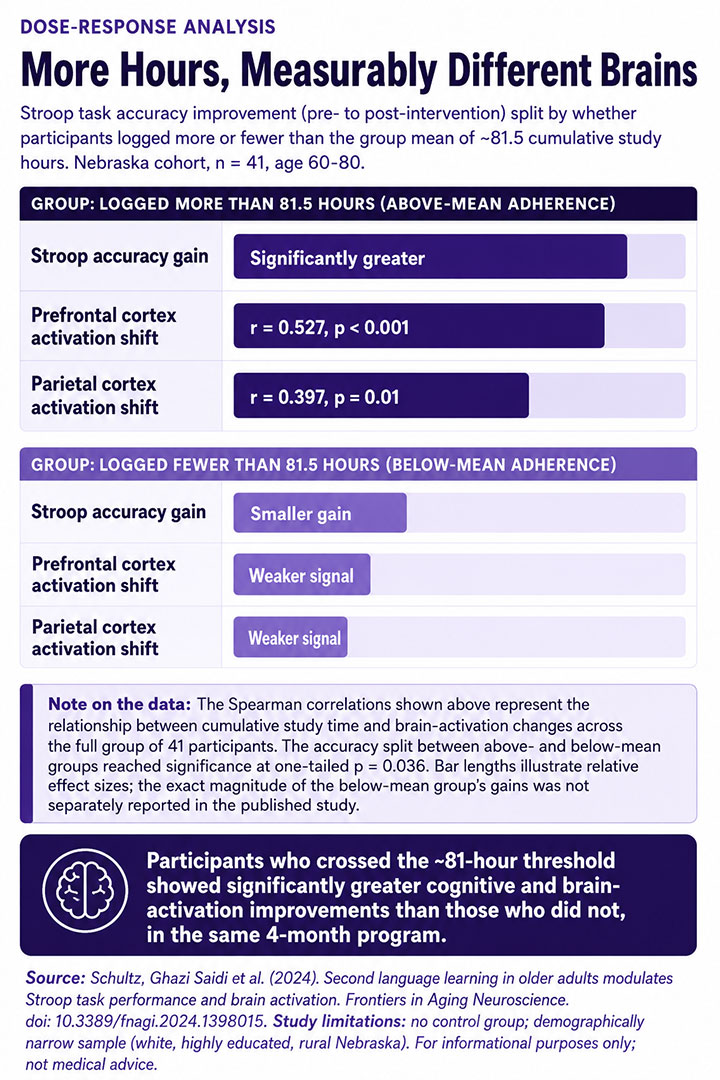
Not every participant hit the 90-minute daily target. The average was 66.5 minutes a day, which added up to roughly 81.5 hours across the four months. That average became the threshold.
Participants who logged more than the mean showed significantly greater gains in Stroop accuracy than those who logged less. In the brain-activation data, time spent on the program correlated positively with changes in the left prefrontal cortex and left parietal cortex, with a Spearman correlation of 0.527 (p < 0.001), as Schultz, Ghazi Saidi, and their team reported in Frontiers in Aging Neuroscience.
That finding, about 81 hours over four months, is as close to a minimum threshold as the current literature has produced. It is the dose at which the functional neuroplasticity signal becomes statistically detectable. Below it, effects were present but weaker. Above it, they were measurably larger.
Two caveats belong here, plainly stated. First, this study had no control group. It was a pre-post design, which means it cannot fully rule out practice effects or other explanations for the improvement. Second, the sample was demographically narrow, all white, all highly educated, all from rural Nebraska. The results are promising and not definitive, and the authors say so directly.
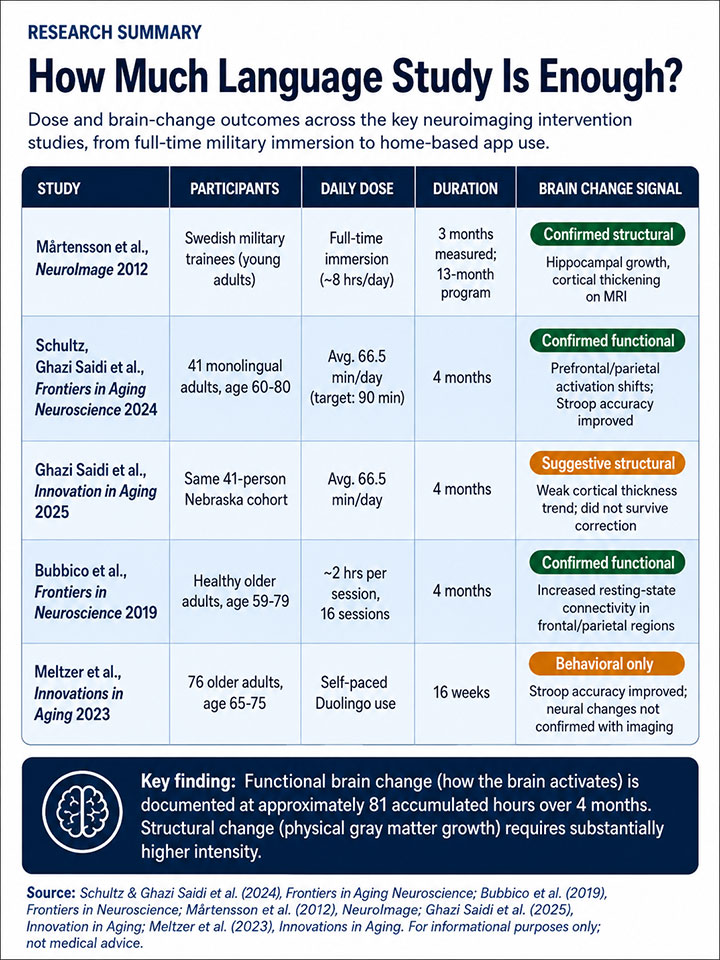
A second, independent study by Gianfranco Bubbico and colleagues, published in Frontiers in Neuroscience in 2019, ran a different four-month second-language program in healthy older adults aged 59 to 79.
They used resting-state fMRI rather than a task, and found increased functional connectivity in the right inferior frontal gyrus, right superior frontal gyrus, and left superior parietal lobule after the program ended. The overlap is not exact, but the timeframe is the same: four months of sustained effort produced detectable functional change in two independent cohorts.
What “Neuroplasticity and Language Learning” Actually Means in an Older Brain
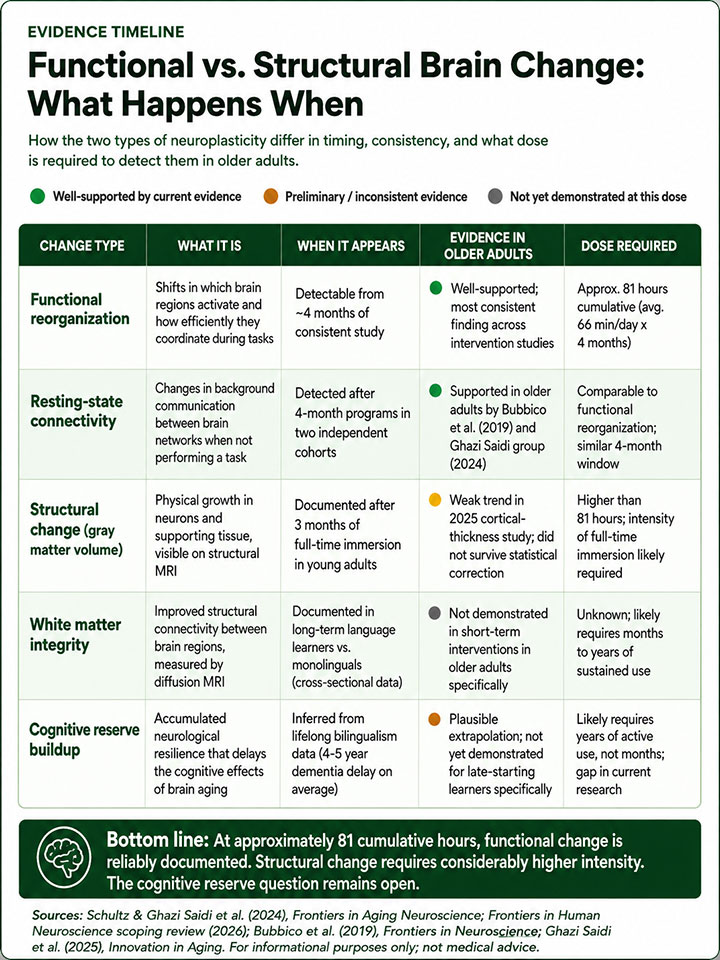
A 2026 systematic scoping review published in Frontiers in Human Neuroscience pooled the neuroimaging evidence on adult second-language learning and arrived at a finding that deserves more attention than it typically gets: in older adults, functional reorganization is more consistent than structural change.
This matters because most popular coverage of neuroplasticity and language learning focuses on gray matter growth, the physical enlargement of brain regions that shows up in structural MRI.
That evidence is real, and it has been documented most dramatically in Johan Mårtensson’s 2012 study in NeuroImage, where Swedish military interpreter trainees learning Arabic, Russian, or Dari full-time showed hippocampal volume increases and cortical thickening after just three months at that pace.
But the intensity required to produce that structural signal is considerable: full days of language study, for months, at near-military demand.
Functional change follows a different timeline. It reflects shifts in how the brain allocates activation during cognitive tasks, which networks fire, how efficiently they coordinate, and how much prefrontal effort is required to do things that used to cost more.
This kind of change appears to be accessible at lower dose levels than structural growth, and it may be what is driving the cognitive improvements researchers can actually detect in more realistic intervention studies.
The companion cortical-thickness analysis from the same Nebraska cohort, published by Ghazi Saidi and colleagues in Innovation in Aging in 2025, found a weak trend toward structural change in the left middle frontal sulcus and right superior frontal sulcus after the four-month program.
That trend did not survive correction for multiple comparisons. What the data shows, honestly, is that 81 hours produces functional change reliably. Structural change: not yet.
Researchers still don’t agree on exactly how much more is needed for structural change to cross the significance threshold. That question remains open.
Does It Matter Which Language You Choose?
The Nebraska study allowed participants to pick their own language, and the cognitive effects were not tied to any particular choice. Spanish learners and Japanese learners showed the same general pattern of improvement.
The brain’s executive control machinery doesn’t distinguish between Romance languages and logographic scripts at the level of cognitive benefit. What drives the benefit is the cognitive demand of managing a new linguistic system, not the features of that system.
This has a practical implication. The language you are most motivated to learn is probably the right one. Motivation predicts adherence, adherence determines cumulative hours, and cumulative hours, as the Nebraska data shows, are what the brain responds to.
Language Dose Estimator
How does your practice schedule compare to the threshold linked to measurable brain change?
The Fluency Myth
None of the participants in the studies above became fluent. The Nebraska cohort averaged a 96% pass rate on the Rosetta Stone proficiency tests at the end of each lesson, which sounds impressive until you understand what it means.
Rosetta Stone’s curriculum tests comprehension and recognition within the lesson material itself. Passing at 96% means the learner absorbed that unit’s content well enough to move to the next one. It says nothing about being able to sustain a conversation, read a newspaper, or follow a film without subtitles.
By most definitions of real-world language proficiency, these participants were still beginners when the scanning ended. Their brains had already started changing.
That is one of the more important things the literature makes clear: fluency is not the threshold for neuroplasticity. The threshold is sustained cognitive effort in the new language.
Vocabulary retrieval, grammar rule application, phoneme discrimination, the mental work of selecting the right word while suppressing your first-language response: all of this demands the prefrontal and parietal systems that the Stroop task improvements reflect. That demand begins at lesson one. It does not require you to order dinner in Paris or follow a news broadcast without subtitles.
What matters is that the effort is real and active. Low-stakes passive exposure, listening to a foreign radio station while doing other things, does not appear to produce the same signal. The brain needs to work, not just overhear.
The Dose Question, Practically Stated
Eighty-one hours over four months is easier to picture as a daily habit than as a running total. At 30 minutes a day, seven days a week, you reach that figure in roughly 162 days, or about five and a half months. At 45 minutes a day, five days a week, you arrive in about seven months. At an hour a day, five days a week, the threshold lands in four months, matching the Nebraska study directly.
These are approximations. The research does not say the brain changes on day 122 and not on day 121. It says that people who accumulated more than roughly 81 hours showed greater measurable change than those who accumulated less. The threshold is a signal, not a hard line.
What the data does support clearly: consistency outperforms intensity. A 15-minute session today and again tomorrow is more valuable than a 90-minute session once a week. This matches the broader neuroplasticity literature on spaced practice, and it matches what the Nebraska adherence data showed informally: daily engagement, even at reduced duration, sustained the program better than larger blocks spread further apart.
What the Evidence Still Cannot Tell You
Language learning research is younger than it sounds. The number of longitudinal intervention studies in older adults with neuroimaging outcomes, the kind that can actually track brain change, remains small.
The 2026 scoping review identified enough to synthesize patterns, but acknowledged that findings vary considerably across studies because the interventions themselves vary considerably: different languages, different durations, different intensities, different cognitive measures, different imaging modalities.
The clearest gap is a proper dose-finding study: no trial has yet randomized participants to different daily-minute targets and compared brain outcomes directly. The Nebraska study used the adherence variation within a single group as a proxy, which is useful but not the same thing. Until that trial exists, the 81-hour figure is the best approximation the literature offers, not a prescription.
The cognitive reserve question is also still being worked out. The idea that language learning might build a neurological buffer against future cognitive decline draws support from the bilingualism literature, where lifelong bilinguals show delayed dementia onset by four to five years on average, according to evidence reviewed in Frontiers in Psychiatry in 2021. Whether starting a language at 65 produces a comparable buffer, or a smaller one, or something structurally different, is not yet known.
The bilingualism literature studied lifelong use. The intervention literature studied months of effort. What happens in the gap between those two conditions, and whether four months at 65 starts something that compounds over the following decade, is a question the current evidence cannot reach.
Conclusion
The honest conclusion of “learning a language is good for your brain” is this: roughly 81 hours of active, consistent study, accumulated over four months, is associated with detectable functional changes in the brain regions that govern executive control and cognitive flexibility.
The brain does not care whether you reach fluency. It responds to the cognitive demand. What it requires is enough of that demand, sustained long enough, to register as a meaningful experience worth pursuing.
That is a more achievable target than most people assume. It is also a higher bar than five minutes on a language app. The gap between those two things is where most of the popular advice on this topic gets lost.
Frequently Asked Questions
Does learning a language increase neuroplasticity?
Yes. A 2024 study in Frontiers in Aging Neuroscience found measurable changes in prefrontal and parietal brain activation in adults aged 60 to 80 after four months of daily language learning. A 2026 systematic scoping review confirmed that functional brain reorganization is one of the most consistent findings across adult second-language neuroimaging studies.
How many hours of language study does it take to change the brain?
The best current estimate from intervention research is approximately 81 hours accumulated over four months. This figure comes from the Nebraska fMRI study, where participants who logged more than the group mean of about 81 hours showed significantly greater gains in executive function and measurably larger shifts in brain activation patterns.
Does it matter how old you are?
The Nebraska study enrolled adults aged 60 to 80, specifically. Functional brain change was detectable in that age group with this dose. Structural change, meaning physical gray matter growth, is more reliably documented in younger adults and in intensive immersion programs. Age slows neuroplasticity but does not stop it.
Do you need to reach fluency to get brain benefits?
No. None of the participants in the key studies achieved conversational fluency. The brain benefits arise from the cognitive effort of language learning, not from the level of proficiency reached. Active, consistent engagement with the material produces the signal.
Does an app like Duolingo count?
Possibly. A behavioral study by Joshua Meltzer and colleagues found that older adults who used Duolingo for 16 weeks improved on Stroop accuracy at levels comparable to a structured language program. Whether the neural changes are equivalent is not yet confirmed with imaging. What the behavioral data does suggest: doing it daily matters more than which app you use.