Most people over 50 don’t think about falling until they feel an unfamiliar wobble. Reaching for something above eye level. Stepping off a curb at a slight angle. Turning around quickly in a narrow hallway. The moment passes, but it stays with you in a way it didn’t a decade earlier.
Balance isn’t something the body maintains automatically. It’s a trainable skill, and the window for training it stays open much longer than most people expect.
When Sabrina Youkhana and colleagues at Macquarie University analyzed six randomized trials for their 2016 systematic review and meta-analysis in Age and Ageing, they found yoga produced small-to-moderate improvements in balance performance (Hedges’ g = 0.40) and medium improvements in physical mobility (Hedges’ g = 0.50) in adults aged 60 and older.
A separate 2023 review from researchers at Harvard-affiliated Brigham and Women’s Hospital took a broader look: 33 randomized controlled trials, 2,384 participants. Researchers found with moderate certainty that yoga improved walking speed and lower-extremity strength in adults over 65. Walking speed is one of the most reliable predictors of longevity and fall risk in this age group. That finding took a while to sink in.
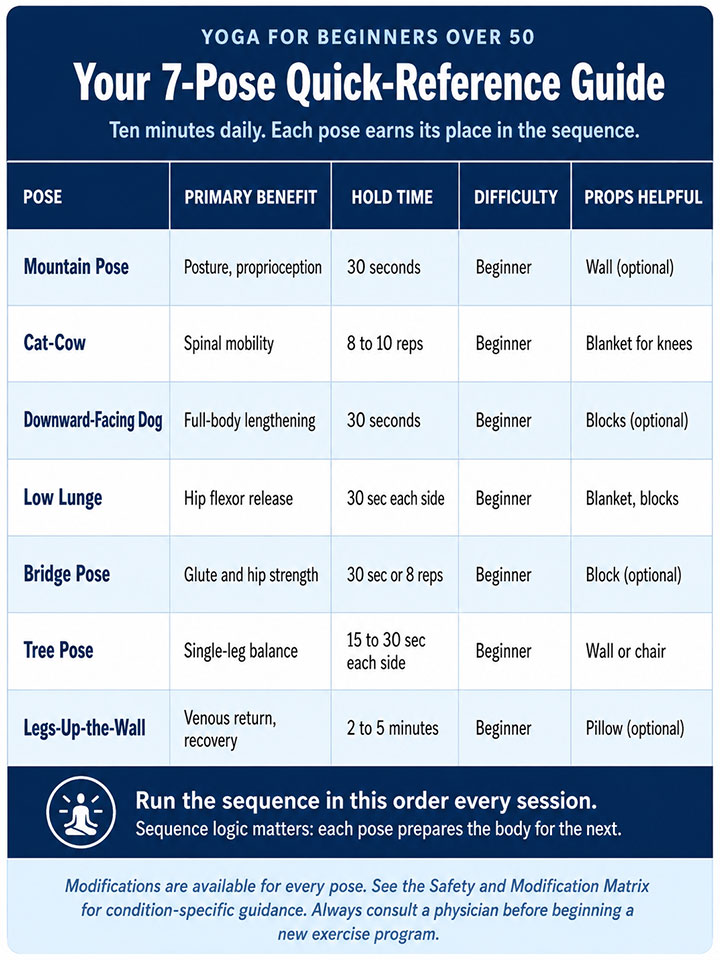
The seven poses in this routine address balance, joint mobility, and functional strength in 10 minutes, built on a 12-week progression grounded in the same research population the studies above examined.
The 7 poses:
- Mountain Pose (Tadasana)
- Cat-Cow (Marjaryasana–Bitilasana)
- Downward-Facing Dog (Adho Mukha Svanasana)
- Low Lunge (Anjaneyasana)
- Bridge Pose (Setu Bandhasana)
- Tree Pose (Vriksasana)
- Legs-Up-the-Wall (Viparita Karani)
What the Research Shows About Yoga After 50
Balance, mobility, and functional strength decline together after 50, and they respond to training together. The Youkhana et al. meta-analysis found that balance improvements tend to appear first, typically within six to eight weeks of consistent practice.
Measurable mobility gains and lower-body strength follow. Most people notice something subtler even earlier: less morning stiffness, easier transitions from floor to standing.
The 2023 Brigham and Women’s review, published in Annals of Internal Medicine by Dr. Julia Loewenthal and colleagues, identified gait speed and lower-extremity strength as the frailty markers most consistently improved by yoga.
Gait speed, specifically, has a well-established connection to survival in older adults. Slower walking is associated with higher fall risk, earlier onset of disability, and increased mortality. A yoga practice that measurably changes gait speed over 12 weeks is doing more than improving fitness.
Two smaller trials fill in the mechanism detail. Anne Tiedemann and colleagues at the University of Sydney conducted a 2013 pilot randomized controlled trial in which 54 community-dwelling adults (mean age 68) completed a 12-week Iyengar yoga program.
The yoga group showed significant improvements in standing balance, timed sit-to-stand, and a four-meter walk test compared to controls. A 2014 quasi-experimental study in the Journal of Alternative and Complementary Medicine found statistically significant improvements in postural control, normal and fast gait speed, and the Timed Up and Go test after a 12-week therapeutic yoga program. With only 13 participants, it is best read as mechanistic evidence rather than clinical proof.
The picture from all of this: 12 weeks of consistent practice is enough to produce measurable change in the physical systems that matter most for staying steady on your feet.
The 7-Pose Basic Yoga Routine for Beginners
This is a Hatha-style basic yoga routine for beginners: slow-paced, alignment-focused, and built around holding poses rather than flowing between them. Static balance challenges, where you hold a position and feel your stabilizers engage, are the same approach the Tiedemann and Youkhana research used, and the same used in the standing postures of traditional Hatha yoga. Each pose below serves a specific function in the sequence.
1. Mountain Pose (Tadasana): Foundation and Balance
Mountain Pose builds proprioceptive awareness (the body’s ability to sense its own position in space) by demanding precisely calibrated standing alignment. It looks passive. It isn’t.
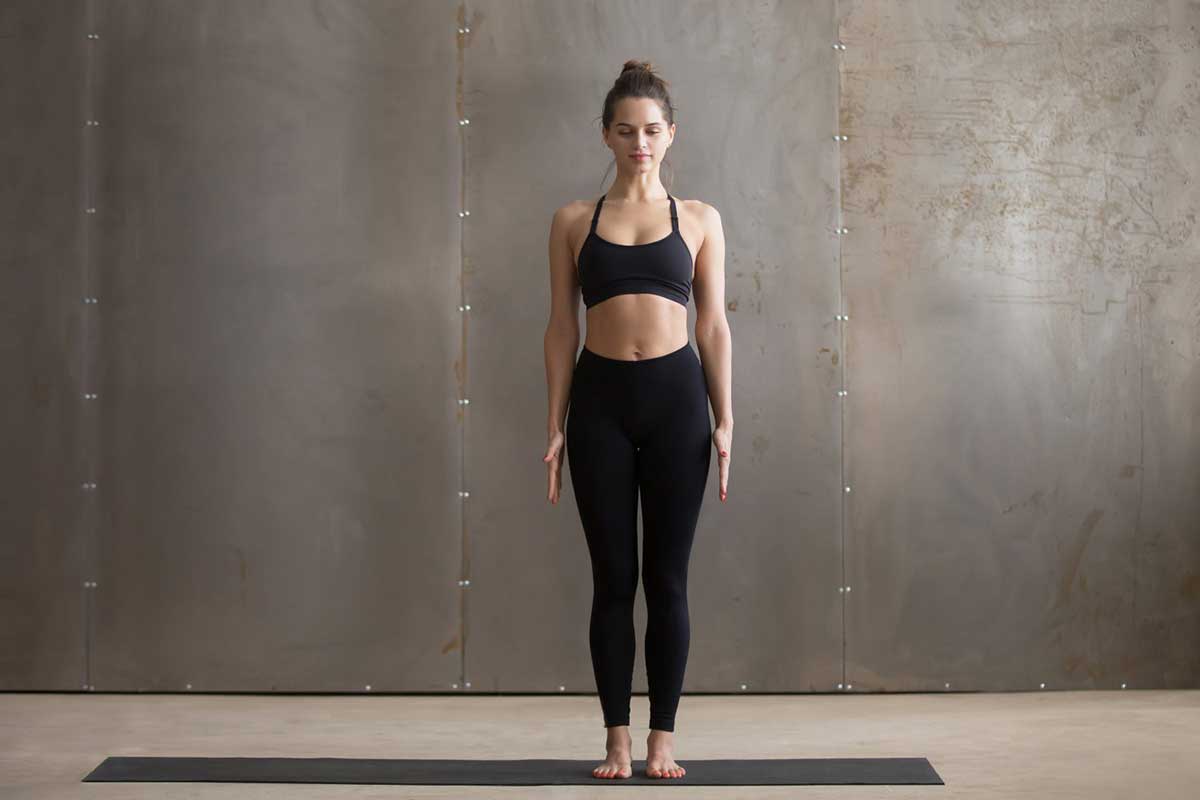
- Stand with feet slightly apart, weight distributed evenly across both feet.
- Gently engage the leg muscles without locking the knees.
- Lengthen the spine, lifting the crown of the head upward.
- Relax the shoulders away from the ears and let the arms hang naturally.
- Breathe steadily. Notice which foot you instinctively weight more.
Over 50 Pro-Tip: Practice with your back against a wall for the first few sessions. The feedback from the wall reveals postural habits (forward head position, one hip higher than the other) that are difficult to self-correct without that reference point.
Hold for 30 seconds or five deep breaths. Keep the knees soft throughout. Locking them cuts off the proprioceptive feedback the pose is designed to develop.
2. Cat-Cow (Marjaryasana–Bitilasana): Spinal Mobility
Cat-Cow mobilizes each spinal segment individually. It counteracts the compression and stiffening that accumulate from prolonged sitting. For anyone who wakes up with a stiff back, this is where the routine’s effects appear first.
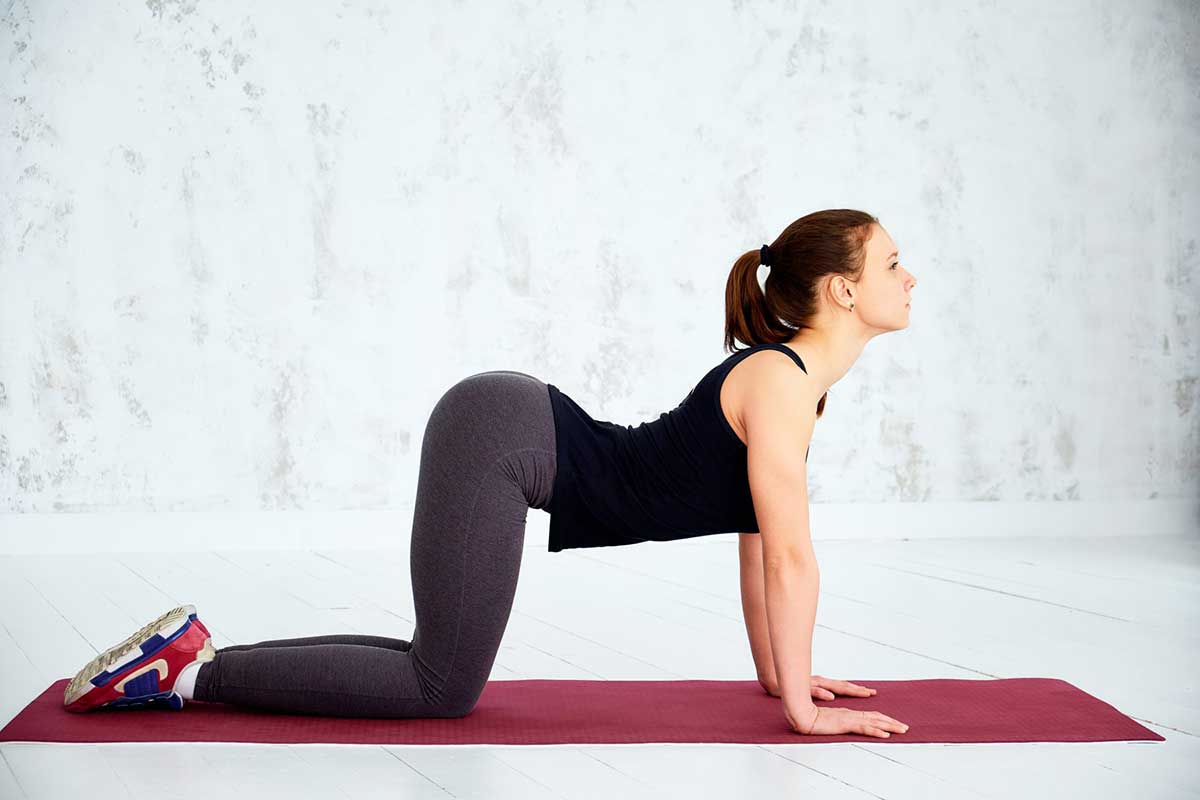
- Start on hands and knees with wrists directly under shoulders and knees under hips.
- Inhale: drop the belly toward the floor, lift the chest and tailbone (Cow).
- Exhale: round the spine toward the ceiling, tuck the chin and pelvis (Cat).
- Move slowly between the two positions, matching breath to movement.
- Let the movement originate from the pelvis and travel up through each vertebra.
Over 50 Pro-Tip: Place a folded blanket under the knees. If wrist pain arises, make fists and rest on your knuckles. This positions the wrist in a neutral rather than extended position and eliminates most of the load on the carpal tunnel.
Complete 8–10 slow cycles. The quality of the movement matters more than the range. A small, controlled arc through the full spine is more useful than a dramatic arch that compensates by collapsing at the lumbar.
3. Downward-Facing Dog (Adho Mukha Svanasana): Full-Body Lengthening
Downward Dog decompresses the spine and lengthens the posterior chain (hamstrings, calves, and the muscles along the back) while placing moderate load through the arms and shoulders. It requires the body to support itself in an unfamiliar geometry, which is part of the balance training.
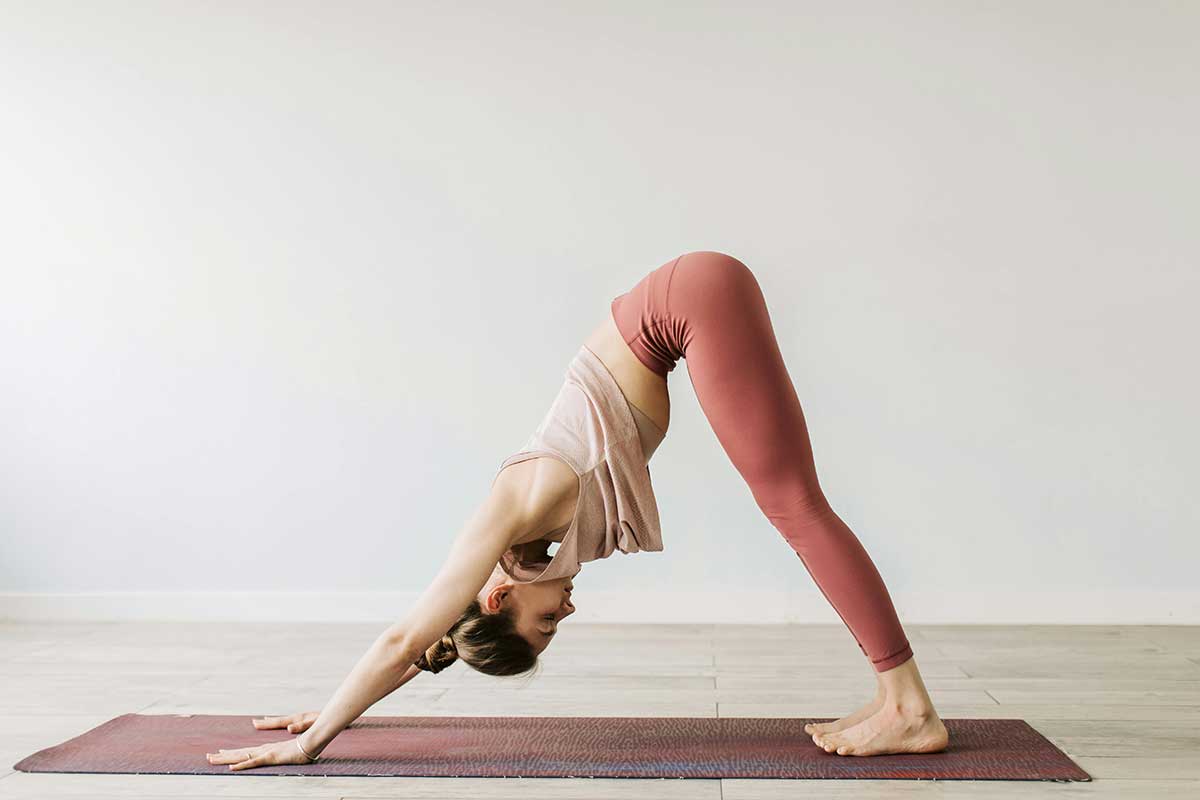
- From hands and knees, tuck the toes under and press the hips up and back.
- Keep the knees generously bent. The priority is a long, flat spine, not straight legs.
- Press the floor away through the palms, spreading the fingers wide.
- Let the heels reach toward the floor without forcing. They do not need to touch it.
- Hold and breathe steadily for 30 seconds.
Over 50 Pro-Tip: For anyone with tight hamstrings, bent knees are the correct modification in this pose, not a compromise. Straightening the legs while rounding the spine produces strain. A flat spine with bent knees produces the benefit the pose is designed to deliver.
Progression happens naturally: over the 12-week plan, the legs will gradually straighten as the hamstrings lengthen. That timeline cannot be hurried without risking the lower back.
4. Low Lunge (Anjaneyasana): Hip Flexor Lengthening
The psoas (the deep hip flexor that connects the lumbar spine to the femur) shortens in response to prolonged sitting and contributes significantly to both lower back pain and altered gait mechanics. Low Lunge targets it directly, in a position that most people rarely access during ordinary movement.
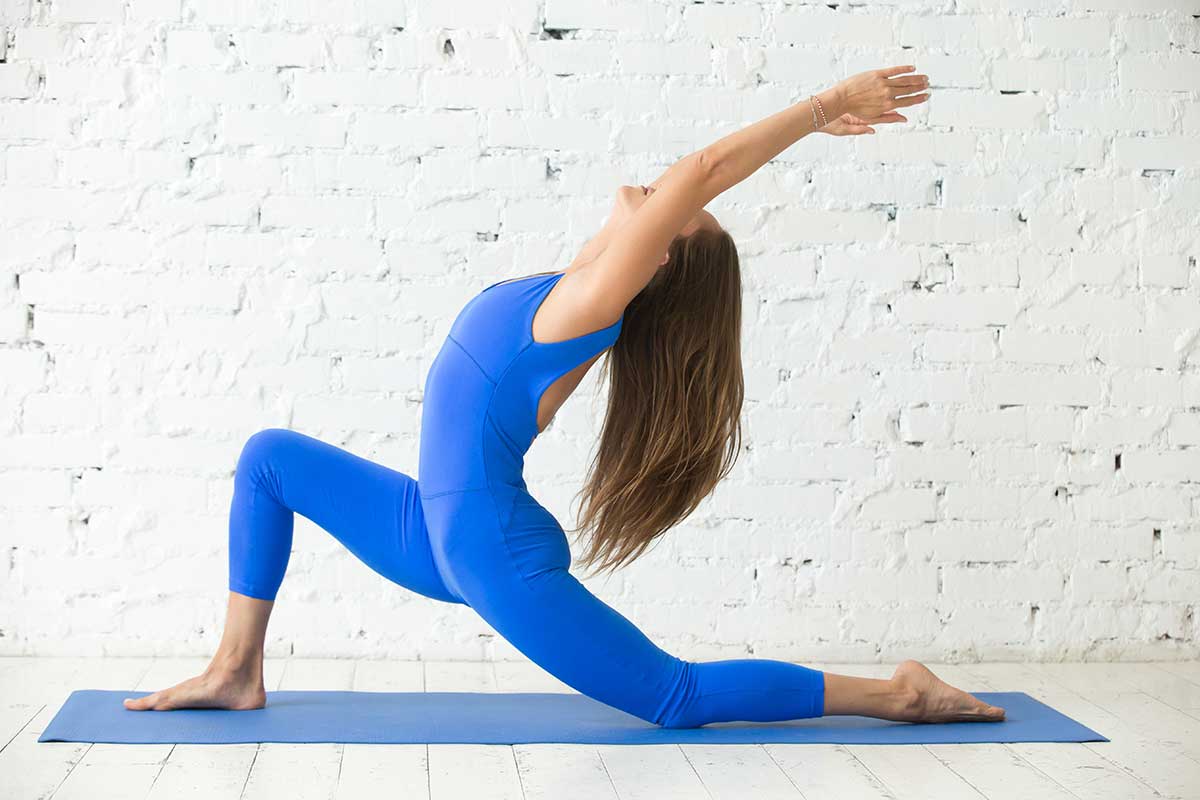
- From Downward Dog, step the right foot forward between the hands.
- Lower the left knee to the floor, positioned below the left hip.
- Keep the right knee directly over the right ankle, not forward of it.
- Place the hands on the right thigh for support. Feel the stretch in the front of the left hip.
- Hold for 30 seconds, then repeat on the other side.
Over 50 Pro-Tip: Place a folded blanket under the back knee. If the hands don’t reach the floor comfortably, place yoga blocks beside the front foot. This maintains the hip-opening angle without forcing a forward lean that rounds the back.
A tight psoas also contributes to anterior pelvic tilt, where the pelvis tips forward and the lumbar curve becomes exaggerated. In that position, the glutes are inhibited. Low Lunge addresses both problems at once, which is why it earns its place in a routine this short.
5. Bridge Pose (Setu Bandhasana): Glute and Posterior Chain Strength
Weak glutes are consistently associated with increased fall risk in older adults, as well as with poor hip stability and lower back pain. Bridge Pose activates the gluteus maximus and medius in a supported, low-load position, accessible for nearly everyone, including people with knee or hip concerns when properly modified.
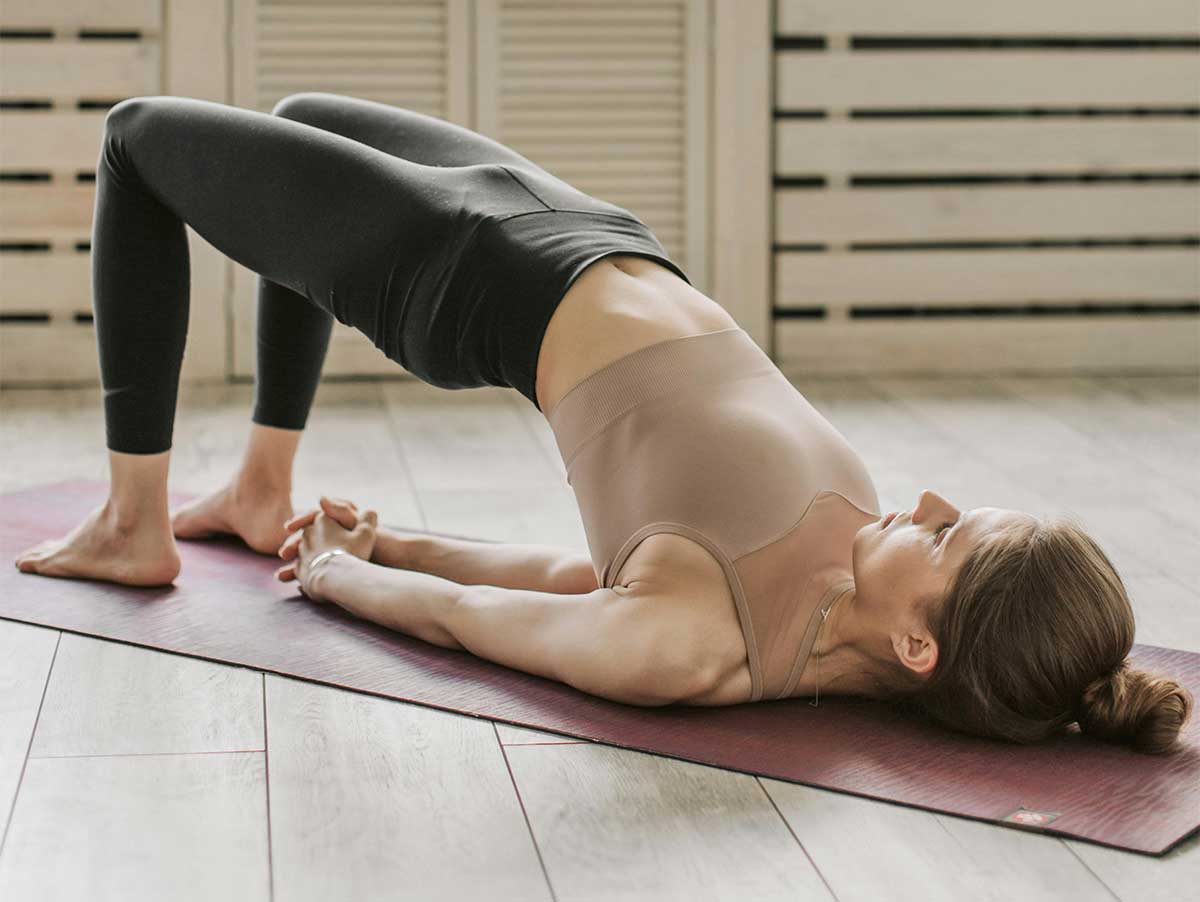
- Lie on your back with knees bent and feet flat on the floor, hip-width apart.
- Position the feet close to the glutes, close enough that fingertips can graze the heels.
- Press through both heels and lift the hips toward the ceiling.
- Squeeze the glutes firmly at the top. Keep the knees tracking over the second toe.
- Hold for 30 seconds, then lower slowly with control. Or perform 8 controlled repetitions.
Over 50 Pro-Tip: If the lower back feels strained, place a yoga block between the thighs and gently squeeze it throughout the pose. This cue activates the adductors and reinforces correct pelvic alignment, which removes the compensatory load from the lumbar spine.
Strong glutes protect the lower back, support proper walking mechanics, and are one of the primary contributors to stable single-leg stance, which is exactly what Tree Pose, the next pose, tests.
6. Tree Pose (Vriksasana): Balance Training
Tree Pose is a single-leg balance challenge. The scientific rationale for including it is straightforward. Balance is a neuromuscular skill that degrades without practice, and single-leg stance is the closest analog in yoga to the weight-shifting demands of ordinary movement: walking up stairs, stepping over a threshold, navigating uneven ground.
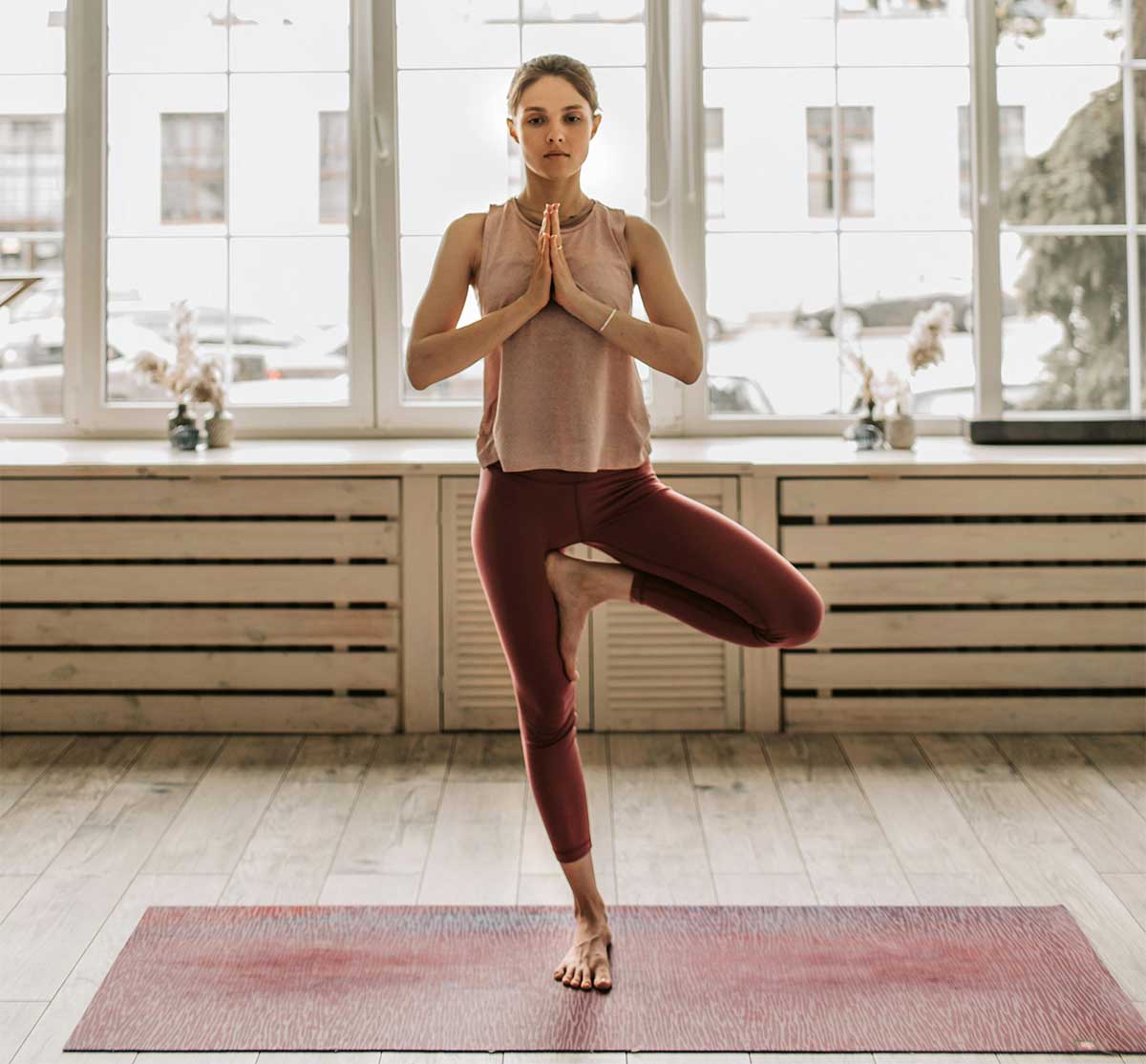
- Stand near a wall or sturdy chair. This is a tool, not a crutch.
- Shift weight onto the left foot and find a stable standing position.
- Place the right foot on the inner left calf. Never place it against the knee joint.
- Rest one hand lightly on the wall or chair back.
- Find a fixed point to focus on. This is called a drishti in yoga practice, and it measurably improves balance stability.
- Hold for 15–30 seconds, then switch sides.
Over 50 Pro-Tip: Wobbling is balance training. The micro-corrections the body makes while trying to stabilize are precisely what strengthens the proprioceptive system. Practicing recovery from instability is the actual skill that prevents falls. Holding a static pose perfectly is not.
What nobody has cleanly separated yet is how much of the balance gain comes from single-leg poses like Tree Pose versus the full practice combined. The Youkhana study data doesn’t parse it that finely. For a 10-minute routine, Tree Pose is doing substantial work. That much the evidence supports.
7. Legs-Up-the-Wall (Viparita Karani): Circulation and Recovery
This pose reverses the effects of gravity on the venous circulation in the legs, which reduces swelling and improves venous return to the core. It also activates the parasympathetic nervous system, which governs rest, digestion, and recovery. Ending the routine here is deliberate: it signals to the nervous system that the practice period is complete.
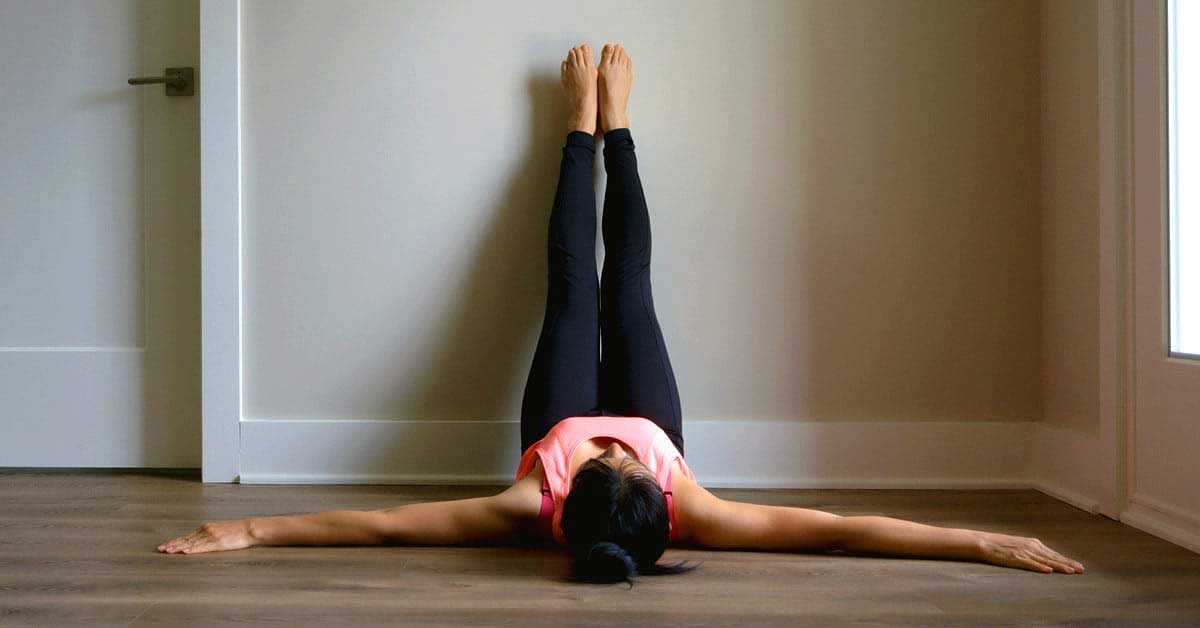
- Sit sideways with one hip against a wall.
- Swing the legs up the wall as you lower the torso to the floor.
- Scoot the glutes as close to the wall as comfortable. Tighter hamstrings require more distance.
- Rest the arms by the sides, palms facing up.
- Close the eyes and breathe steadily. Stay here for two to five minutes.
Over 50 Pro-Tip: Place a folded blanket or pillow under the lower back if the pelvis tilts awkwardly away from the wall. If you have uncontrolled high blood pressure, elevate the torso slightly on a bolster rather than lying flat. This maintains the restorative benefit while reducing the pressure change.
Two to five minutes is the effective range. Less than two minutes and the parasympathetic shift hasn’t had time to settle. More than five and most people find it uncomfortable to maintain the position.
10-Minute Beginner Yoga Flow
Daily mobility and balance routine for adults over 50
Your 12-Week Plan
The daily sequence runs in this order: Mountain Pose (30 seconds), Cat-Cow (8–10 reps), Downward-Facing Dog (30 seconds), Low Lunge right (30 seconds), Low Lunge left (30 seconds), Bridge Pose (30 seconds or 8 reps), Tree Pose right (15–30 seconds), Tree Pose left (15–30 seconds), Legs-Up-the-Wall (2–5 minutes). Total time: 8–12 minutes depending on hold lengths.
The 12-week structure below replaces session-by-session tracking with phase goals and a few concrete checkpoints. Consistency across phases matters more than hitting any single checkpoint on schedule.
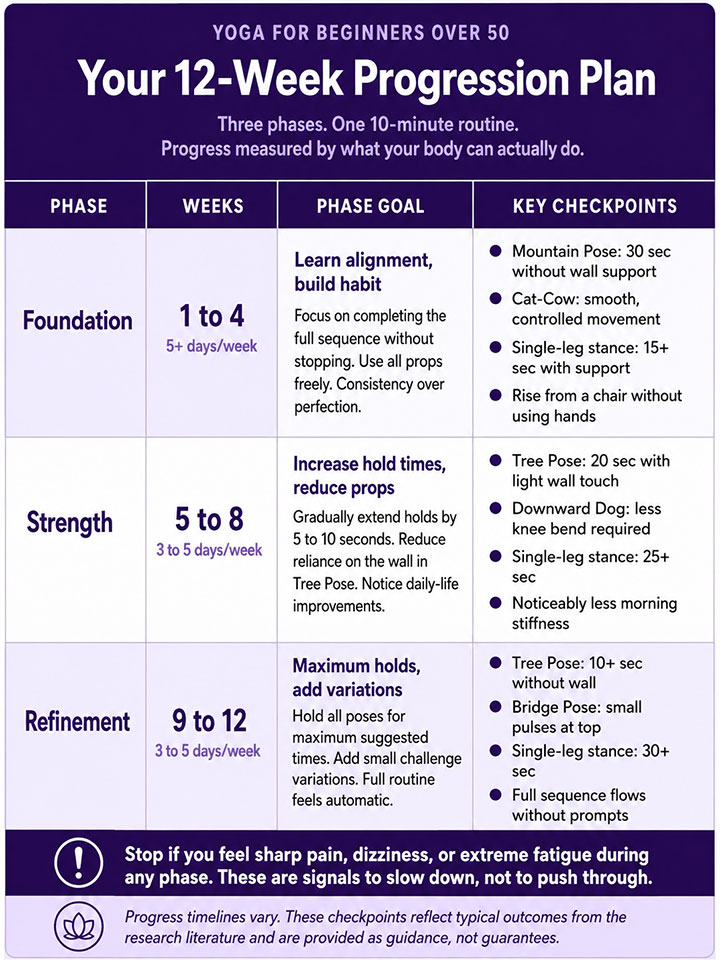
Practice five or more days per week during the Foundation phase. Three to four days per week is enough to maintain the gains built there, but daily practice produces faster results in the early weeks when the nervous system is adapting most rapidly.
Red flags during any phase: sharp pain (as distinct from the ordinary discomfort of a stretch), dizziness, or extreme fatigue. These signal a need to slow down, not to push through.
Three measurable checkpoints serve as honest progress indicators across the 12 weeks. At week 4: single-leg stance for 15 or more seconds, ability to rise from a chair without hands.
At week 8: single-leg stance for 25 or more seconds, noticeably less morning stiffness in the lower back and hips. At week 12: single-leg stance for 30 or more seconds, the full routine flowing without having to consciously recall what comes next.
After 12 weeks, the natural progressions are modest additions rather than dramatic changes. Tree Pose with eyes briefly closed. Single-leg bridge holds. Extending Legs-Up-the-Wall to eight minutes. Downward Dog with one leg lifted. The routine stays at 10 minutes. These additions replace holds rather than adding time.
Setting Up Your Home Practice
Yoga for beginners at home requires less setup than most people expect. A space roughly six feet by three feet, close to a wall, is enough for every pose in this routine. A non-slip surface or a yoga mat prevents the kind of sliding that breaks concentration and alignment. Good ventilation helps. This isn’t a hot yoga practice, but a stuffy room makes the longer holds harder.
Equipment that genuinely helps, in order of usefulness: a yoga mat or thick bath towel ($0–$30), a sturdy chair or wall for Tree Pose and Mountain Pose support, two yoga blocks or firm folded towels for Low Lunge and Downward Dog ($0–$20), and a folded blanket for knee cushioning in Cat-Cow and Low Lunge ($0 if you use what’s already in the house). Nothing else is needed to complete this routine safely and effectively.
Practicing at the same time each day (not the same calendar slot, but the same slot in the day’s rhythm, such as before the first coffee or after the evening news) builds the habit faster than scheduling it as a separate event.
The routine being short is the point. Anything that requires clearing 45 minutes from a calendar gets skipped on difficult days. Ten minutes before the kettle boils does not.
Safety, Modifications, and Specific Concerns
The Arthritis Foundation recommends yoga as a safe, joint-friendly activity for adults managing osteoarthritis and rheumatoid arthritis. The American College of Rheumatology includes exercise among its primary treatment recommendations for both conditions. For the specific poses in this routine, here are the modifications that matter most by common condition.
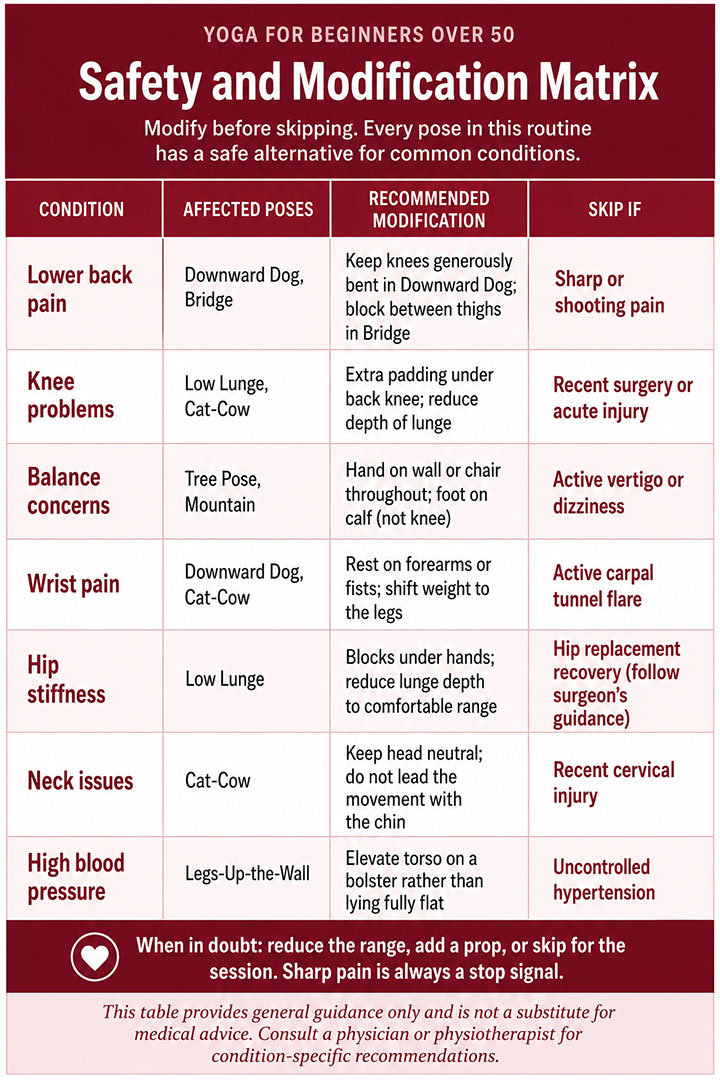
For the four most common specific concerns: lower back pain responds best to emphasis on Cat-Cow and Bridge Pose, with Legs-Up-the-Wall extended to five minutes. Hip tightness benefits from spending 45–60 seconds in Low Lunge on each side, and adding hip circles before starting the routine.
Balance as the primary goal is served by practicing Mountain Pose throughout the day (standing in a doorway for 30 seconds while waiting for something) in addition to the routine’s Tree Pose. Stress and sleep concerns are addressed most directly by extending Legs-Up-the-Wall to five minutes and pairing it with slow, deliberate exhalations.
Arthritis specifically: yoga can be excellent for joint health when the movement stays within a pain-free range. The Arthritis Foundation notes that gentle, consistent movement circulates synovial fluid through the joints. That fluid deteriorates when joints are kept still. Avoid forcing range of motion. Work at the edge of comfortable movement, not past it.
Balance is the physical capacity that most quietly determines how the next decade goes. It does not announce its decline the way strength loss or cardiovascular fitness do. It starts making ordinary movements feel less automatic.
The research on yoga’s effect on balance and functional mobility in adults over 50 is not ambiguous. The barrier to addressing it is that 10 minutes requires intention in a way that larger commitments paradoxically do not.
This routine is exactly 10 minutes, a precise enough dose to produce measurable change and a short enough duration to actually happen every day. That combination is rarer than it sounds.
Frequently Asked Questions
What type of yoga is this routine?
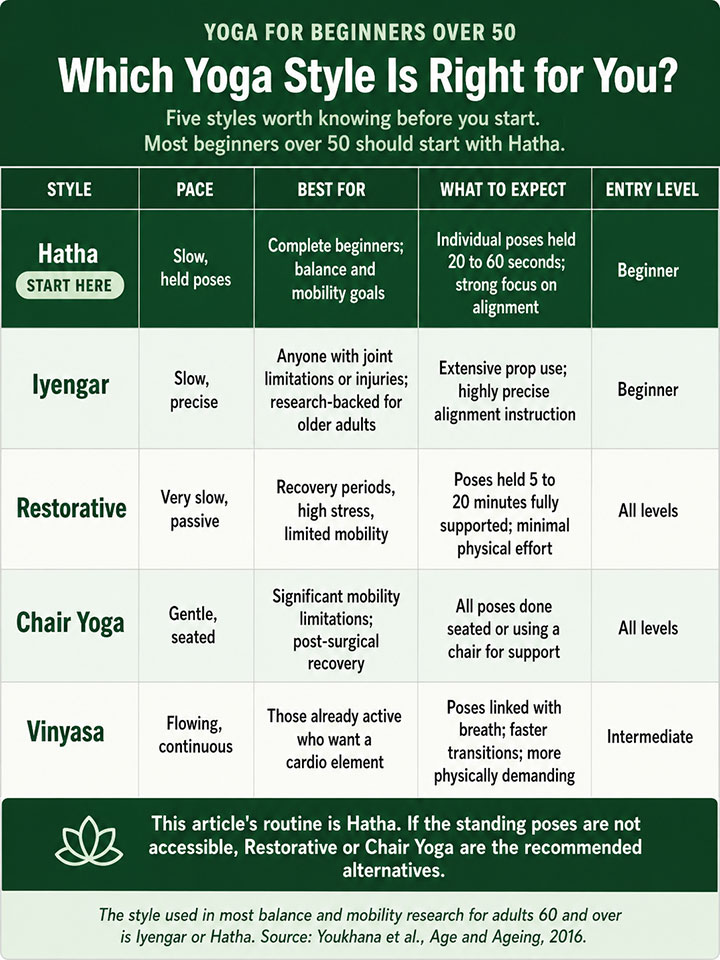
This is a Hatha yoga routine. Hatha yoga for beginners refers to slow-paced, alignment-focused practice where individual poses are held rather than linked in flowing sequences. It is the foundation from which most modern yoga styles developed, and it is the style used in most of the research on yoga and balance in older adults, including the Youkhana et al. meta-analysis.
The other styles worth knowing are Vinyasa (flowing between poses on the breath, more demanding and better suited to those already active), Restorative (entirely floor-based with props and minimal physical effort, appropriate for injury recovery or high-stress periods), Chair yoga (all poses adapted for a seated or standing position, suited to those with significant mobility limitations), and Iyengar (highly precise alignment with extensive prop use, slower than Vinyasa and well-supported by research for older adults).
For adults over 50 starting yoga for the first time, Hatha is the correct entry point. Restorative and Chair yoga are alternatives if the standing poses in this routine are not accessible.
How many days a week should a beginner practice?
Five days per week during the first four weeks. Daily practice accelerates early nervous system adaptation, which is where the first balance gains come from. After week 4, three to four sessions per week maintain the gains built during the Foundation phase.
Research on exercise training and detraining in this age group suggests flexibility and balance improvements are preserved at reduced frequencies once they are established. Missing occasional days does not erase progress. Missing entire weeks starts to.
How should a complete beginner start?
Start with the first three poses on the list (Mountain Pose, Cat-Cow, Downward-Facing Dog) for the first week. Hold each for the minimum suggested time. Add poses four and five in week two. Add Tree Pose and Legs-Up-the-Wall in week three. By week four, the full sequence should be manageable.
This approach reduces the cognitive load of learning seven new movements simultaneously, which is the most common reason beginners stop before the nervous system adaptation has time to begin.
What if I can’t touch my toes?
Flexibility of that kind is not required for any pose in this routine, and it is not what the routine develops. Downward-Facing Dog with bent knees produces the same spinal decompression and posterior chain lengthening as the version with straight legs.
Low Lunge with blocks under the hands produces the same psoas stretch as the version without them. The proprioceptive and balance training in Tree Pose and Mountain Pose are entirely independent of hamstring length. Flexibility increases gradually as a consequence of consistent practice, not a prerequisite for beginning.
Is there a downside to yoga?
There is one worth knowing. Yoga injuries are real, and the most common cause is overstretching: pushing a joint or muscle past its current functional range in the belief that further is better. For adults over 50, connective tissue (tendons and ligaments especially) responds more slowly to training stress and is more vulnerable to overuse injury than it was at 30 or 40.
The modifications in this routine exist for that reason. A pose that causes sharp or shooting pain is being done incorrectly, done too aggressively, or is inappropriate for that individual’s body at that time. The fix is to back off the range, add a prop, or skip the pose for that session.
Yoga is also not a substitute for resistance training: it improves functional strength, but it does not build or maintain muscle mass in the way that progressive resistance loading does. Both belong in a complete fitness approach after 50.
Can I do this if I have arthritis?
For most arthritis presentations, yes. The Arthritis Foundation and the American College of Rheumatology both include yoga among evidence-based movement recommendations for osteoarthritis and rheumatoid arthritis.
The key principle is to stay within a pain-free range and avoid loading an inflamed joint. On days when a specific joint is actively inflamed, either skip the poses that load it or reduce the range significantly.
The Cat-Cow and Legs-Up-the-Wall poses are almost always accessible regardless of arthritis location. Consult a physician or physiotherapist for guidance specific to joint replacement recovery or advanced disease staging.
When is the best time to practice?
Morning practice reduces overnight stiffness and improves body awareness through the day. Evening practice supports sleep quality. The parasympathetic activation from Legs-Up-the-Wall is particularly useful in the hour before bed. The honest answer is that the best time is the time that will actually happen consistently. Consistency across months matters far more than the time of day chosen.
What if I only have five minutes?
Cat-Cow (30 seconds), Downward-Facing Dog (30 seconds), Low Lunge on each side (30 seconds each), Bridge Pose (30 seconds), Tree Pose on each side (30 seconds each). Four minutes of movement maintains the habit on days when the full routine isn’t possible. The complete routine produces the research-backed results. The abbreviated version keeps the practice alive between full sessions.
How long before results are noticeable?
Most people notice reduced morning stiffness within one to two weeks. Measurable balance improvements (testable with a single-leg stance test) typically appear between weeks four and eight of consistent practice. The Tiedemann et al. pilot trial found significant improvements in balance and functional mobility over 12 weeks. The full 12-week commitment is what the evidence supports, and it is a reasonable timeframe to commit to before assessing whether the routine is working.
Can I do this if I take blood pressure medication?
Most blood pressure medications are compatible with this routine. The one exception is Legs-Up-the-Wall for those with uncontrolled hypertension. Elevating the torso on a bolster moderates the pressure change while preserving most of the restorative benefit. Consult the prescribing physician if there is any uncertainty about how a specific medication interacts with inversion positions.