Most people watch their memory as they age. But researchers found another cognitive ability changes earlier, and its decline can affect how well the brain functions.
The word was right there. You know it. You’ve said it a thousand times. But for one strange, infuriating half-second, it wasn’t available. So you paused, filled the gap with “um,” and the conversation moved on without you.
Most people assume that’s a memory problem. It isn’t, and the difference matters: it’s a processing speed problem, and it’s the first thing to change as the brain ages, years before memory does.
Researchers have spent decades trying to identify which cognitive function matters most for long-term brain health. The answer keeps pointing to the same place: not recall, not reasoning, not vocabulary. Processing speed (the pace at which your brain takes in, interprets, and responds to information) appears to be the rate-limiting factor for nearly everything else the brain does well.
Signs of Slow Processing Speed in Adults
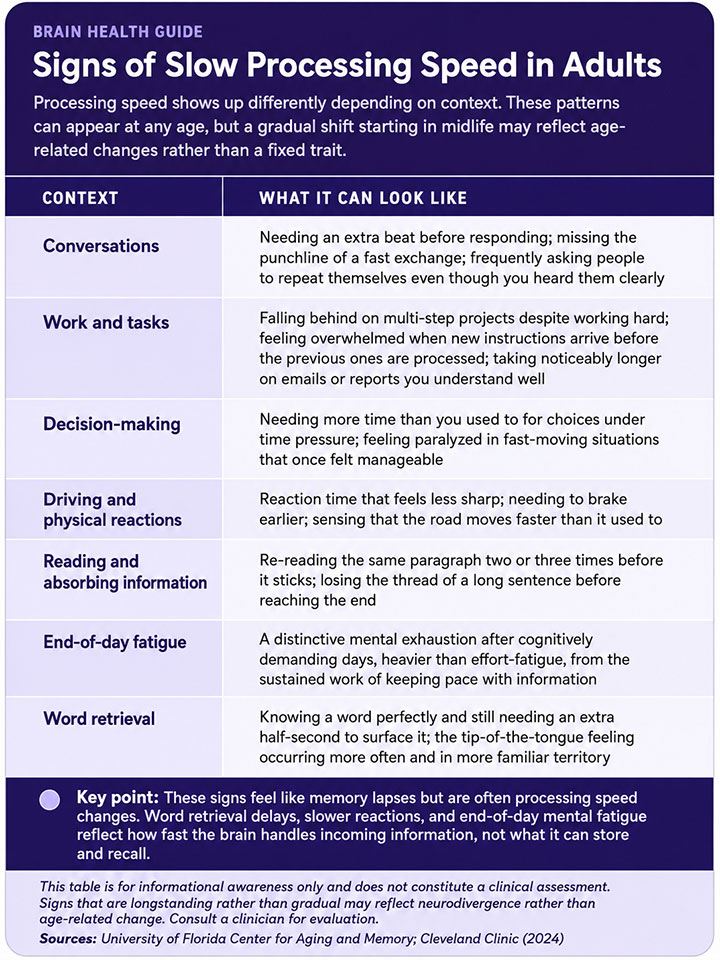
Slow processing speed shows up differently depending on the context. In conversations, it looks like needing an extra moment before responding, missing the punchline of a fast-moving exchange, or asking someone to repeat themselves (not because you didn’t hear, but because the information didn’t land quickly enough to act on).
In workplace situations, it looks like falling behind on multi-step tasks, feeling overwhelmed when new instructions arrive before the previous ones are complete, or taking longer than you used to on emails and reports you understand perfectly well.
There’s also a physical signature. Reaction time on the road slows. Decision-making under time pressure becomes noticeably harder. And at the end of a cognitively demanding day, a particular kind of exhaustion sets in: not fatigue from effort, but something heavier, from the work of keeping up.

These signs matter for reasons beyond daily inconvenience. Research from the University of Florida found that slower processing speed in older adults was associated with less independence, a higher risk of car accidents, and greater vulnerability to memory problems over time. Processing speed is one of the metrics that clinical memory programs assess as a matter of routine, and it proves to be a more sensitive early signal than memory recall tests alone.
Worth naming before moving on: some people reading this will recognize the signs immediately: not as something that changed, but as something that’s always been there. That pattern, the lifelong difficulty keeping pace in fast conversations or under time pressure, belongs to a different profile than age-related slowing.
The two can overlap, and a clinician can help separate them. What this article addresses is the gradual shift that typically begins in midlife and tracks with the structural changes described below: not a fixed trait, but a function that was sharper and has been slowing since.
Why Processing Speed Declines With Age
The decline isn’t random. It tracks a specific kind of structural change in the brain. The brain’s white matter (the dense cabling that connects different regions) degrades gradually with age, and those connections determine how fast information moves from one area to another. When Lars Penke and colleagues at the University of Edinburgh scanned the brains of 420 older adults from the Lothian Birth Cohort and measured white matter integrity across 12 major tracts, they found a consistent pattern: the strength of those global connections predicted processing speed more reliably than age itself.
A separate line of research points to the same conclusion from a different angle. Scientists studying cortical thickness in healthy older adults found that thinning in four specific brain regions (the insula, the fusiform gyrus, the parahippocampal gyrus, and the inferior parietal lobule) corresponded with measurable declines in processing speed. These aren’t obscure structures. They handle visual integration, memory encoding, spatial orientation, and error processing, which is why slowing in this domain affects other cognitive functions.
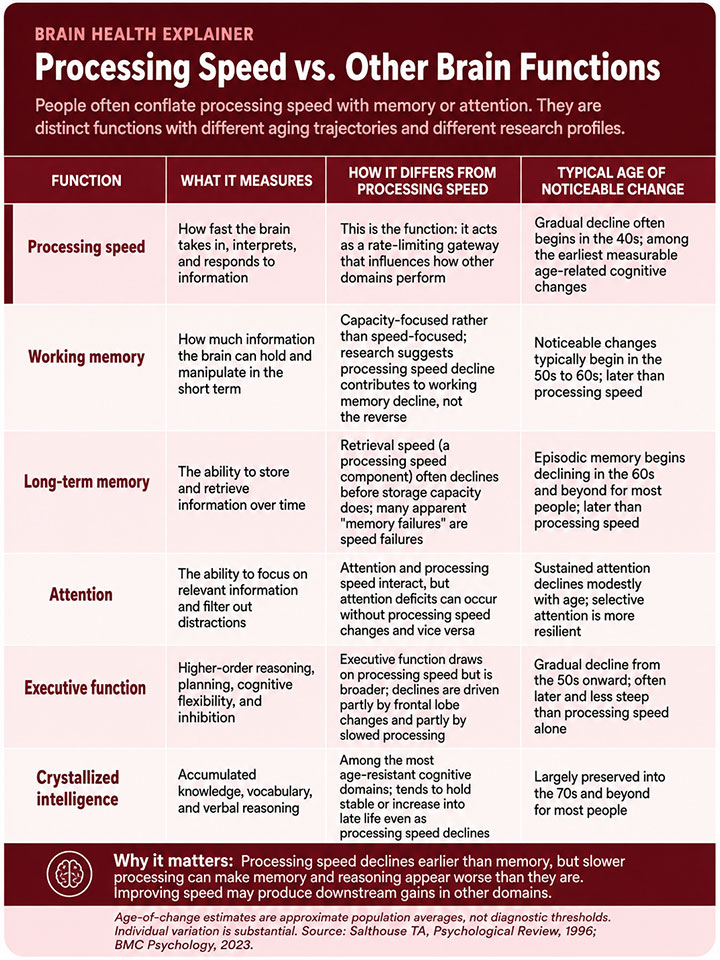
That ripple effect is the key point. Timothy Salthouse, a cognitive psychologist at the University of Virginia, proposed what’s now known as the processing speed theory of cognitive aging: the idea that because so much of what the brain does depends on rapid internal communication, when that speed drops, working memory and reasoning capacity tend to drop with it. The theory, published in Psychological Review in 1996, remains the dominant framework in cognitive aging research, cited in meta-analyses published as recently as 2026.
The practical implication is notable but worth sitting with: the function most people overlook may be the one that shapes how other functions hold up over time.
Does Processing Speed Predict Who Ages Well?
The SuperAger research gives a direct answer. SuperAgers are adults over 80 whose memory and cognitive performance matches or exceeds normative scores for people 15 to 30 years younger. Researchers spent years trying to identify what separates them from their peers.
In a 2023 study published in BMC Psychology, a team tracked 96 community-dwelling adults aged 80 to 101 over six years and built a predictive model for who would become a SuperAger. Of the cognitive variables measured at baseline, processing speed was the strongest predictor, ahead of memory scores and executive function measures.
The standard assumption is that memory performance in midlife is the thing to watch. The data says otherwise: it’s the rate at which the brain operates, not what it can store and retrieve, that most accurately forecasts cognitive resilience in old age.
A 2025 NHANES cohort study added another layer. Researchers looking at more than 3,000 older adults found that slower processing speed (measured using a standard digit symbol substitution test) was associated with increased all-cause mortality risk.
The connection wasn’t just cognitive. Processing speed proved to be a broader signal of how the body was aging, not just the brain. (The research team flagged complexity in some of the subgroup interactions, so the mortality finding should be read as directional rather than definitive, but the signal is real.)
What Accelerates the Decline
Of the controllable factors, cardiovascular health is the one researchers found most surprising. The connection isn’t subtle: the brain depends entirely on blood flow, and conditions that constrain it (high blood pressure, elevated fasting glucose, chronic low-grade inflammation) slow the neural transmission that processing speed depends on.
An observational study from the UCSF Memory and Aging Center tracking 120 cognitively normal older adults found that cardiovascular risk factors were among the strongest predictors of processing speed decline over time, more strongly linked than genetic
Alzheimer’s risk markers in that sample. That’s a more specific finding than the usual “exercise is good for your brain.” It suggests that managing blood pressure in your 50s may be doing work you won’t see on a memory test for another decade.
Sleep disruption and chronic stress each add their own drag, and the effects show up within days, not years. A single night of sleep deprivation produces detectable reaction time slowing. Chronic stress appears to accelerate white matter changes of the kind associated with processing speed decline.
The useful frame here isn’t that these factors matter (most people already know that), but that processing speed is one of the faster-responding metrics when something improves or gets worse. It is a more sensitive readout than memory scores for whether a lifestyle change is reaching the brain.

How to Improve Processing Speed in Adults: What the Evidence Actually Shows
This is where the research becomes genuinely interesting, and where popular assumptions get complicated.
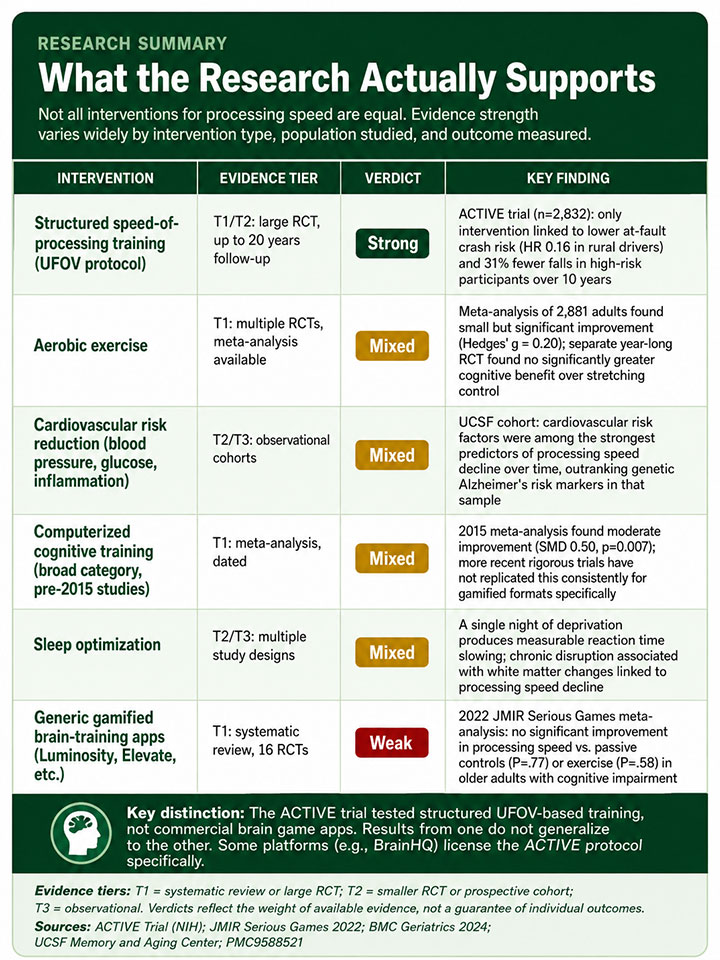
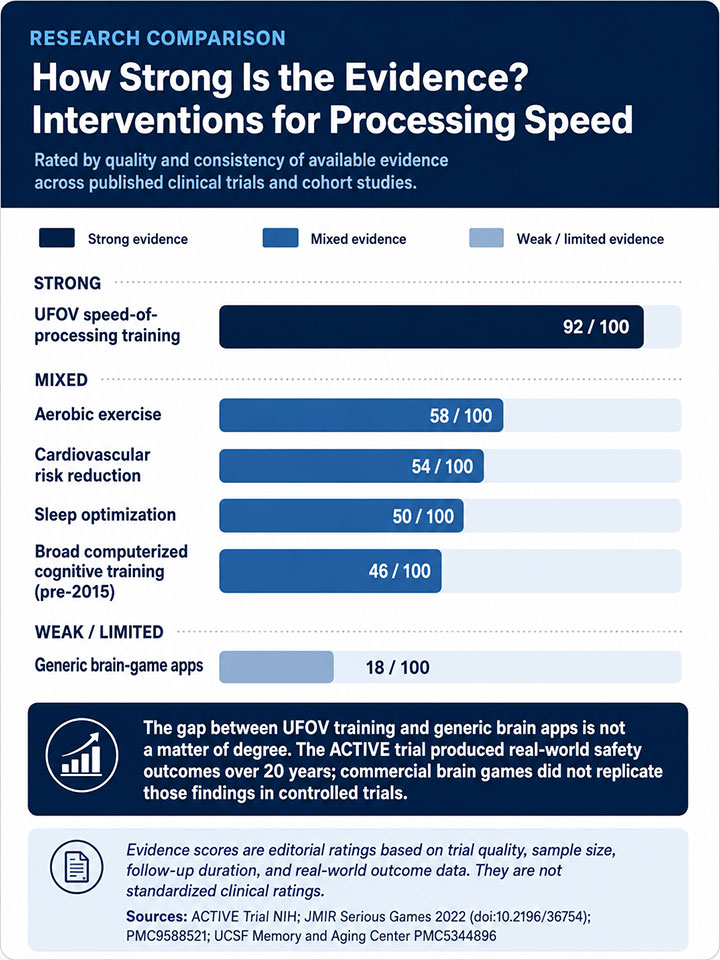
The obvious answer is brain training apps. Luminosity, BrainHQ, Elevate: there are dozens of them, all marketed as tools for keeping the mind sharp. A 2022 systematic review and meta-analysis in JMIR Serious Games, covering 16 randomized controlled trials, found no statistically significant improvement in processing speed from these gamified cognitive-training tools compared to passive controls or conventional exercise, and the gap was not close.
But that is not the end of the story.
The ACTIVE trial (the Advanced Cognitive Training for Independent and Vital Elderly study, funded by the National Institutes of Health and run across six universities including Johns Hopkins and Penn State) tested something different.
Not general brain games. A specific, structured protocol called speed-of-processing training, built around a task called the Useful Field of View (UFOV), which trains the brain to extract information from a wide visual field under time pressure. The trial enrolled 2,832 adults aged 65 to 94 and followed many of them for up to 20 years.
The 20-year crash-risk analysis found that speed-of-processing training was the only intervention (not memory training, not reasoning training) linked to a meaningful reduction in at-fault driving accidents.
Among rural drivers specifically, the hazard ratio dropped to 0.16, meaning those who received the training were roughly 84% less likely to be involved in an at-fault crash during the follow-up period. A 10-year falls analysis from the same trial found that high-risk participants who received the training were 31% less likely to experience a fall.
The implication is stranger than it sounds. A specific type of cognitive training (not memory puzzles, not word games, not the apps on your phone) produced real reductions in two of the most feared real-world outcomes for aging adults: car crashes and falls.
The same training showed no such effects for the memory or reasoning arms of the trial. Processing speed, trained directly, appears to transfer to physical safety outcomes in ways that training other domains does not produce.
The training protocol is based on the UFOV task. Some platforms, including BrainHQ, license ACTIVE-derived protocols, though it’s worth distinguishing between platforms offering evidence-based UFOV training specifically and the broader universe of brain games with weaker backing.
Aerobic exercise is the other intervention with real, if more qualified, support. A meta-analysis of randomized controlled trials covering 2,881 middle-aged and older adults found that aerobic exercise produced a small but statistically significant improvement in processing speed (Hedges’ g = 0.20), with effects that varied by exercise type, duration, and individual factors.
A separate year-long RCT found that aerobic exercise improved cardiovascular fitness substantially but did not produce significantly greater cognitive improvement than a stretching-and-toning control group. The honest read: aerobic exercise helps, probably, but not as cleanly or dramatically as the headlines about exercise and the brain typically suggest.
Sleep optimization, cardiovascular risk reduction, and stress management round out the evidence-based list. None of them is a fast fix, and none is particularly surprising. But for processing speed specifically, the combination of lifestyle management and targeted UFOV-type training represents the most evidence-backed path currently available.
Processing Speed Self-Check
A brief awareness quiz to help you reflect on how your brain's processing speed may be changing
A Note on Testing
Formal processing speed assessments (the Digit Symbol Substitution Test, the Trail Making Test, UFOV-based evaluations) are used routinely in neuropsychological evaluations, and self-administered versions exist online for a rough directional read.
What neither can do is tell you whether a change is significant enough to act on. That judgment belongs with a clinician who can see the full picture: baseline cognition, health history, sleep quality, cardiovascular risk, and a longitudinal comparison over time.
A single slow result on an informal test means little. A noticeable subjective shift (the feeling of needing an extra beat that didn’t used to be there) is more worth mentioning to a doctor than most people realize.
The Takeaway
Processing speed rarely gets named in conversations about brain health. Most people track memory and worry about memory. Memory is the more emotionally loaded word, the one that comes up in the context of the things people most fear about getting older.
But the research consistently positions processing speed as earlier-changing, more broadly predictive, and more responsive to the right interventions than memory performance alone.
The 20-year ACTIVE trial data is the clearest illustration of how much that distinction matters. Researchers spent two decades following older adults who had trained their processing speed, and the results showed up not in their test scores but in whether they were still driving and still on their feet. That’s what the function actually does when it’s preserved: it keeps people in the world.