Most people think adding an avocado is enough. The research suggests something much more important determines whether your cholesterol actually changes.
For most people with elevated LDL cholesterol, the advice comes in two versions: take a statin, or eat better. The second version is rarely specific enough to act on. Eat less saturated fat. Add more fiber. Avoid processed foods. The guidance is accurate and almost entirely useless as a daily plan.
One daily avocado changes that picture. The research on this is unusually concrete, unusually consistent, and unusually encouraging. A measurable LDL drop, confirmed in controlled trials, within five weeks.
The catch is that the mechanism matters as much as the habit. Avocado works because of three distinct biological pathways working simultaneously. Add it to your diet in the wrong way, and the benefits disappear into the calorie math. Add it correctly, and the numbers shift in ways that standard cholesterol tests may actually undercount.
Three things in avocado that change your cholesterol
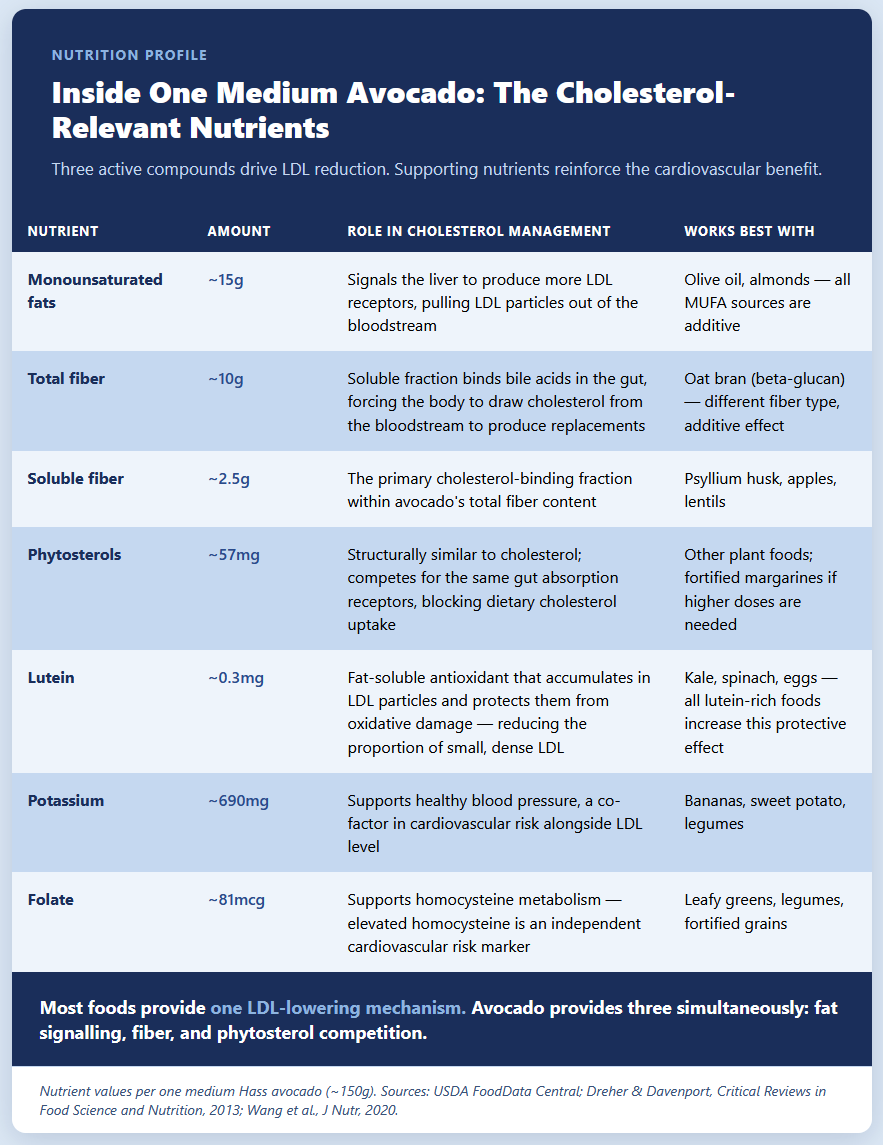
One medium avocado contains about 15 grams of monounsaturated fatty acids, the type of fat the heart-disease research has consistently associated with lower LDL. Think of these fats as the liver’s cleanup crew.
When you eat them, your liver responds by increasing the number of LDL receptors on its surface: the docking stations that pull LDL particles out of the bloodstream and break them down. More receptors, less circulating LDL. The process is efficient and well-documented.
The second mechanism is the one most people overlook. Avocados contain phytosterols (plant compounds with a molecular structure close enough to cholesterol that the gut treats them as the real thing). They compete with dietary cholesterol for absorption at the same receptor sites, and cholesterol loses.
The gut can only absorb so much at a time. Phytosterols fill the queue first, acting like bouncers at a door, and dietary cholesterol waits outside. One avocado provides about 57 milligrams of them. At that daily level, consistently, the competition adds up.
The third is fiber. One avocado contains roughly 10 grams total, with about 2.5 grams of soluble fiber. Soluble fiber dissolves in water, forms a gel in the digestive tract, and binds to bile acids. Your body uses cholesterol to make bile acids. When soluble fiber traps the acids and removes them, the body has to pull more cholesterol out of circulation to produce replacements. LDL levels fall as a result.
What five weeks of daily avocado actually does
The week-by-week picture is worth understanding, because the visible change (a lower number on a lab test) lags behind the biological change. Your body shifts before you can measure it.
Weeks 1 and 2: the metabolic shift
You probably will not feel different. Energy levels stay the same. But inside, the liver is already responding to the change in dietary fat composition. It raises LDL receptor density and begins to process fats differently. This phase is about establishing the pattern. Eat your avocado at roughly the same time each day, and replace something rather than add on top.
Weeks 3 and 4: the numbers start to move
This is where the effect becomes measurable. A randomized crossover trial published in the Journal of the American Heart Association in 2015, led by Li Wang at Penn State University, tracked 45 overweight and obese adults through three different cholesterol-lowering diets, each for five weeks.
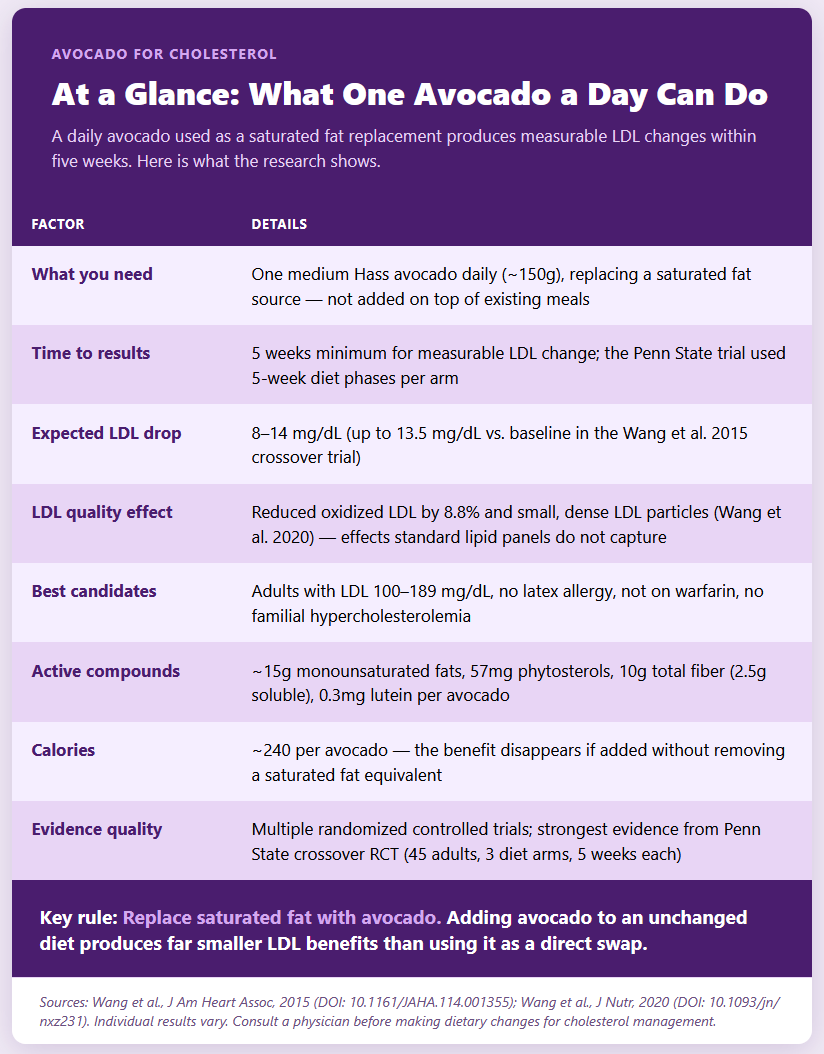
The avocado diet produced an LDL drop of 13.5 mg/dL from baseline. That was significantly larger than the 8.3 mg/dL drop on the matched moderate-fat diet without avocado and the 7.4 mg/dL drop on the lower-fat control diet.
That difference matters. The Cholesterol Treatment Trialists’ Collaboration, analyzing data from 26 statin trials involving over 169,000 participants, found a 22% reduction in major vascular events per 1 mmol/L (roughly 39 mg/dL) of LDL lowered.
That data comes from pharmaceutical trials. Dietary LDL changes have not been studied at the scale of cardiovascular outcomes. But the direction is clear, and the avocado diet’s 13.5 mg/dL drop is not trivial.
If your LDL is currently at 135 mg/dL, a reduction of that size brings you to the near-optimal range. Whether you are starting at 130 or 160, the proportional benefit is similar.
Week 5: the quality shift
Standard cholesterol tests measure LDL quantity. They miss something important: LDL comes in different sizes, and the smaller, denser particles are the ones most likely to penetrate artery walls and trigger inflammation. By week five, avocado consumption has been shown to shift the distribution toward the safer, larger particles.
The same Wang research group went back to that 45-person cohort and examined oxidative markers, specifically oxidized LDL, the form that becomes sticky and inflammatory inside blood vessels.
Their 2020 study in the Journal of Nutrition found that the avocado diet reduced circulating oxidized LDL by 7.0 U/L (8.8%), and increased plasma lutein concentrations by 68.7%. Both changes were significantly different from the control diets.
The drop in oxidized LDL correlated directly with the reduction in small, dense LDL particles. The mechanism is the lutein, a fat-soluble antioxidant concentrated in avocado that appears to protect LDL particles from oxidative damage in circulation.
That finding takes a moment to sit with. Your cholesterol is lower. So is the damage potential of what remains.
What the research shows
Researchers in Mexico were studying avocado’s lipid effects two decades before Penn State ran its landmark trial. López Ledesma and colleagues, writing in the Archives of Medical Research in 1996, compared a MUFA-enriched avocado diet to a standard diet in people with mild hypercholesterolemia.
Over seven days, the avocado diet produced a 17% reduction in total cholesterol, a 22% reduction in LDL, and an 11% increase in HDL in hypercholesterolemic subjects, alongside a 22% drop in triglycerides. The duration was short, and the fat composition was markedly high, but the direction of effect was consistent with everything that followed.
The Carranza-Madrigal group (1997, Archives of Medical Research) found that hypercholesterolemic patients on a vegetarian diet enriched with avocado saw reductions in total cholesterol and LDL alongside improvements in HDL compared to a vegetarian diet alone.
The avocado provided an advantage beyond what the already-healthy baseline diet achieved. A separate study by Lerman-Garber and colleagues, published in Diabetes Care in 1994, found that the MUFA benefits extended to 12 women with type 2 diabetes: an avocado and olive oil enriched diet improved their fasting lipid profiles compared to a high-carbohydrate control diet.
Mark Dreher and Adrienne Davenport analyzed this entire body of evidence in their 2013 paper in Critical Reviews in Food Science and Nutrition. Across multiple clinical trials, consistent LDL reductions appeared when avocados replaced saturated fats, not when they were simply added to an existing diet.
The fatty acid profile accounted for roughly 60 to 70% of the effect. The fiber and phytosterol fractions made up the rest. The whole fruit was necessary. That finding matters for one practical reason: avocado oil contains the MUFAs but leaves the fiber and phytosterols in the pulp.
One honest note. A 2020 piece from McGill University’s Office for Science and Society, summarizing some of the same trials, described avocado’s cholesterol effect as “vanishingly small” and “clinically irrelevant” when isolated from the dietary substitution effect.
That critique has a point. Avocado added to an unchanged diet, without removing saturated fat, produces far smaller benefits than avocado used as a replacement. The 13.5 mg/dL drop in the Penn State trial required a specific dietary context. Add it correctly, and the evidence is strong. Add it carelessly, and the results are much more modest.
Fitting an avocado into your diet without adding calories
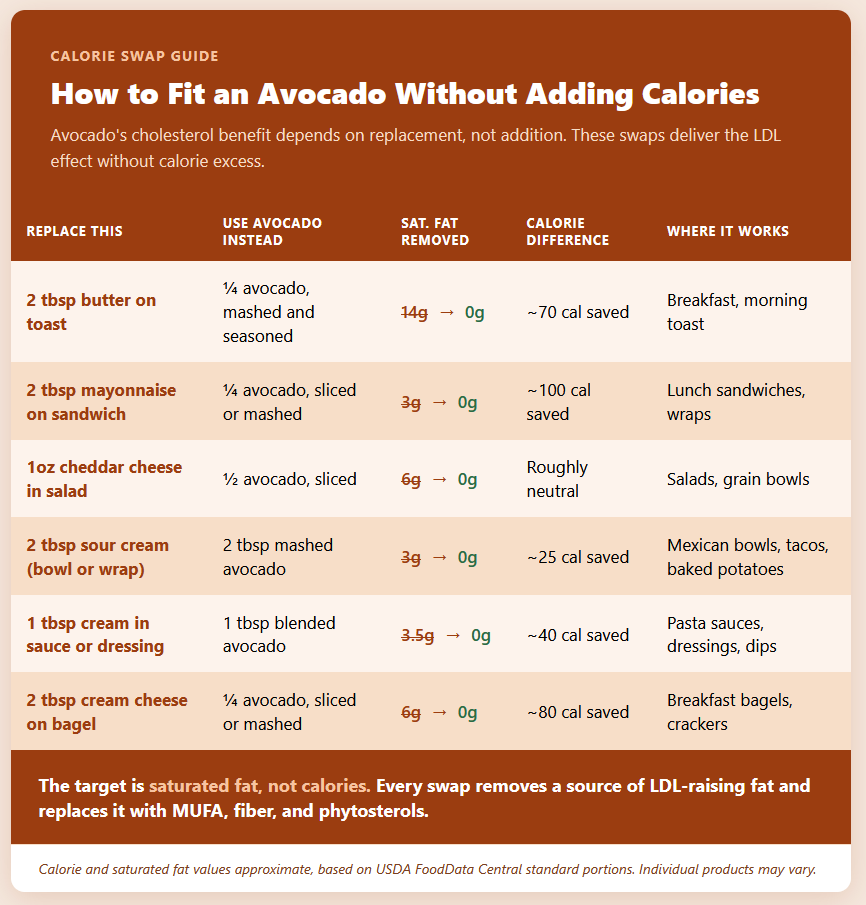
One medium avocado adds about 240 calories to your daily intake. If you are simply adding it on top of your current meals, the calorie excess undermines the benefit and can cause weight gain, which itself raises LDL. The word that matters here is replace.
The substitution that gets the most benefit per calorie swap is replacing saturated fat sources: butter on toast, mayonnaise on sandwiches, cheese in salads, cream in sauces. Avocado provides a similar creaminess and fat satisfaction while delivering MUFAs instead of saturated fats. The practical approach is to identify one daily habit involving saturated fat and swap it.
For meal variety across the week, the approach that works best is variety without complexity: mashed on toast or eggs in the morning, sliced into salads or grain bowls at lunch, as a side or topping at dinner. If the taste becomes monotonous, blend avocado into smoothies or chocolate mousse. The flavor disappears. The nutrient profile does not.
Is this approach right for you?
Avocados are appropriate for most adults with moderately elevated LDL, no established cardiovascular disease, and no allergy. Several situations require more care. People taking warfarin or other blood thinners should discuss any significant change in avocado intake with their doctor, as the vitamin K content can affect medication dosing.
Those with a confirmed latex allergy face a higher risk of avocado sensitivity (roughly 30 to 50% of people with latex allergy also react to avocado). Anyone with chronic kidney disease or a history of kidney stones should check with their physician before significantly increasing avocado intake, as the oxalate and potassium content may be relevant.
Familial hypercholesterolemia, the genetic condition causing LDL to remain high regardless of diet, typically requires medication. An avocado a day may provide a modest supplementary benefit on top of prescribed treatment, but it cannot replace pharmaceutical management in that context.
Is the 6-Week Avocado Plan Right for You?
Answer these questions to find out if this plan is a good fit
How avocado compares to other approaches
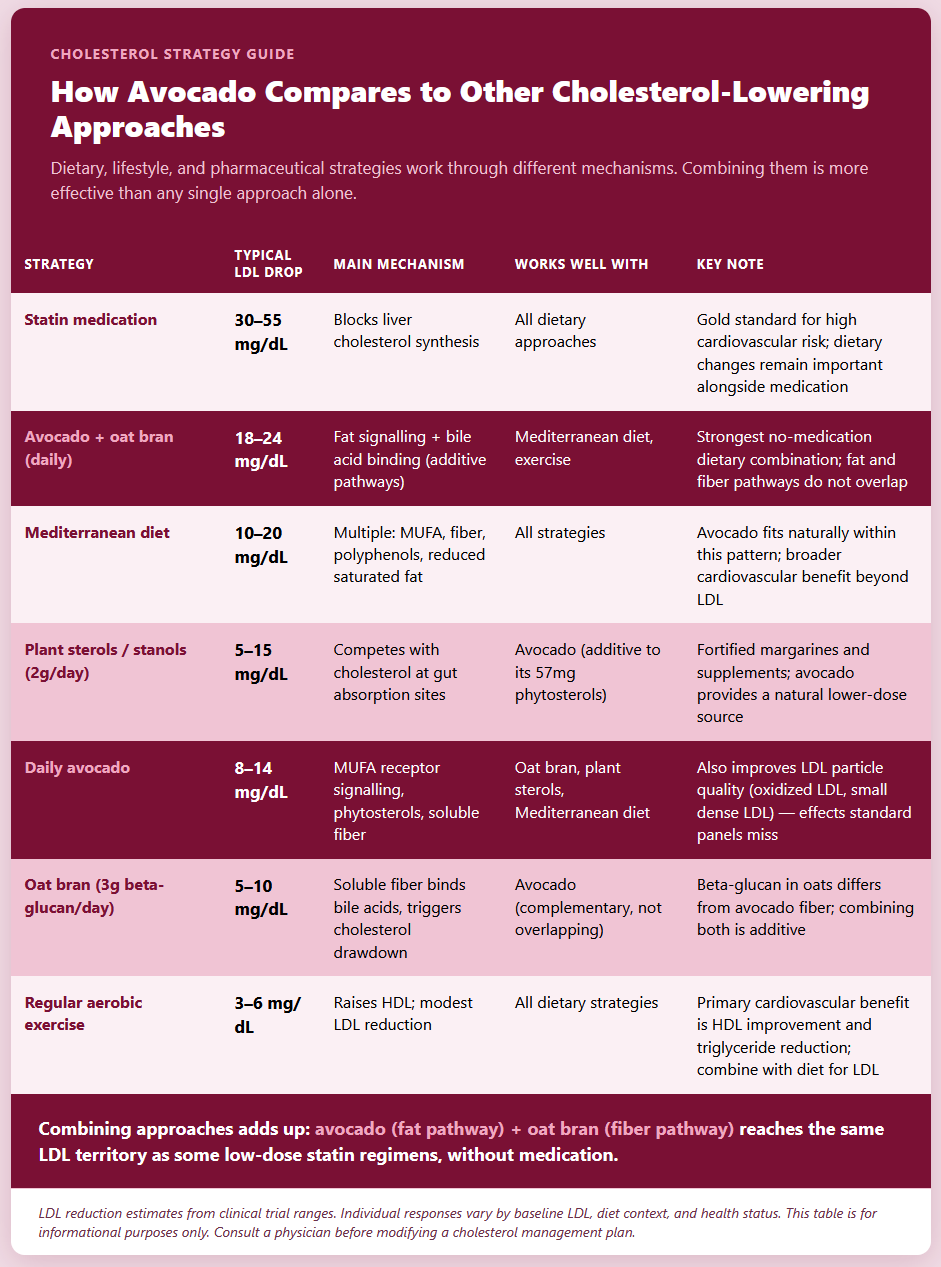
Avocado produces LDL reductions in the range of 8 to 14 mg/dL, comparable to other dietary interventions and modest compared to statins, which typically produce reductions of 30 to 50 mg/dL. The comparison table below puts the numbers in context.
Avocado doesn’t outperform statins on raw LDL numbers. What it does instead (improving LDL particle quality and working through pathways statins don’t touch) makes it a natural complement rather than a competitor. A daily avocado alongside 3 grams of oat bran (a combination that addresses both the fat and fiber sides of the cholesterol equation) produces more than either alone. The math on combining approaches adds up quickly.
A note on expectations
The standard medical threshold for “borderline high” LDL is 130 mg/dL. A 13.5 mg/dL dietary reduction brings someone at that threshold into the near-optimal range without a single prescription. That is not a minor outcome.
What avocado cannot do is change the underlying genetic machinery driving cholesterol production in people with familial hypercholesterolemia, or replace medication when LDL is high enough that cardiovascular risk is already significant. The right use of this evidence is as a component of a broader approach, not a shortcut past the harder conversations about risk and treatment. An avocado a day is, quite literally, one food. That it does this much through the pathways it uses is, on reflection, the more interesting part of the story.
Frequently Asked Questions
How long does it take for avocado to lower cholesterol?
The clinical evidence points to five weeks as the minimum for measurable LDL change. The Wang Penn State trials each ran five-week diet phases, and the LDL drop observed was the result of that full period. Shorter durations are less reliable. If you get bloodwork done at week three, do not treat a flat result as evidence the approach is not working.
Can I use avocado oil instead of eating the whole fruit?
Avocado oil contains the monounsaturated fats, but the fiber and phytosterols remain in the pulp and are not present in the extracted oil. The Dreher and Davenport review estimated that fiber and phytosterols together account for roughly 25 to 35% of avocado’s cholesterol-lowering effect. For cooking at high heat, where avocado oil’s high smoke point is genuinely useful, it is a good fat choice. But it does not replicate the full lipid benefit of eating the whole fruit.
Will this work if I am already on statins?
Possibly, and the effects may add to the statin’s action. Avocado and statins work through different mechanisms: statins reduce cholesterol synthesis in the liver, while avocado addresses both synthesis (via MUFA signaling) and absorption (via phytosterols and fiber). Discuss any dietary changes with your prescribing physician. Your statin dose may need reviewing as LDL drops further.
Can I eat half an avocado twice a day instead of one whole avocado at once?
Yes. The clinical trials used one avocado per day without specifying timing. Splitting it across two meals does not change the daily nutrient delivery.
Are frozen avocados as effective as fresh?
No clinical trial has tested frozen avocado specifically. Freezing does not significantly affect fat content, phytosterol levels, or fiber, the primary active components. The texture softens substantially, which makes frozen avocado well-suited for blending into smoothies and much less useful for slicing. For smoothies and blended preparations, frozen avocado is a practical and likely equivalent alternative.