Not all apples appear to tell the same story for cholesterol. One variety was tested in a carefully controlled trial, and what researchers found was revealing.
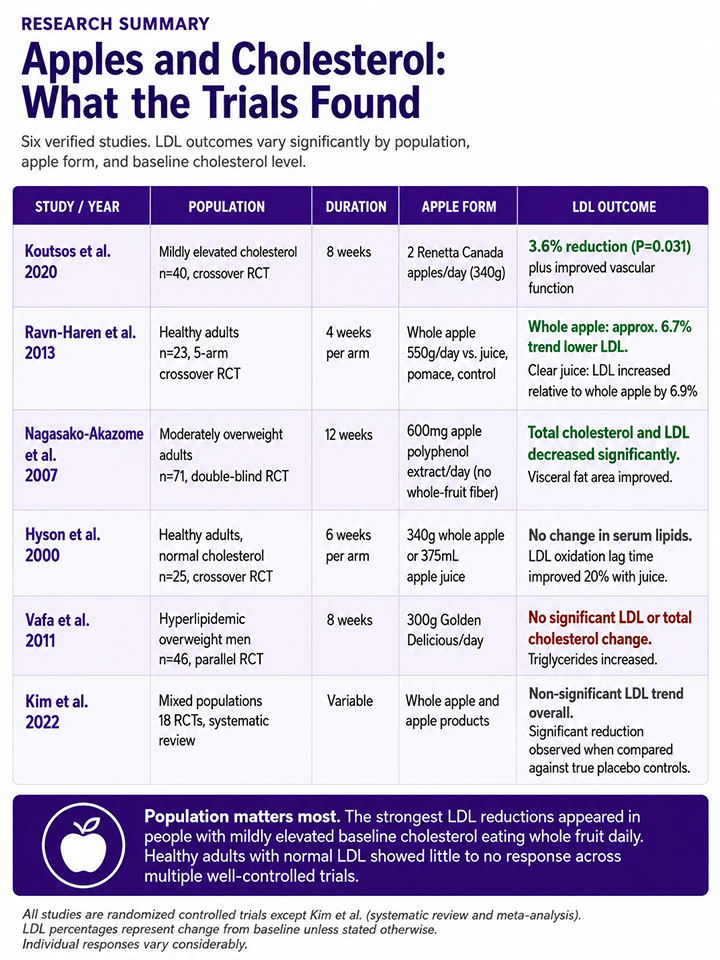
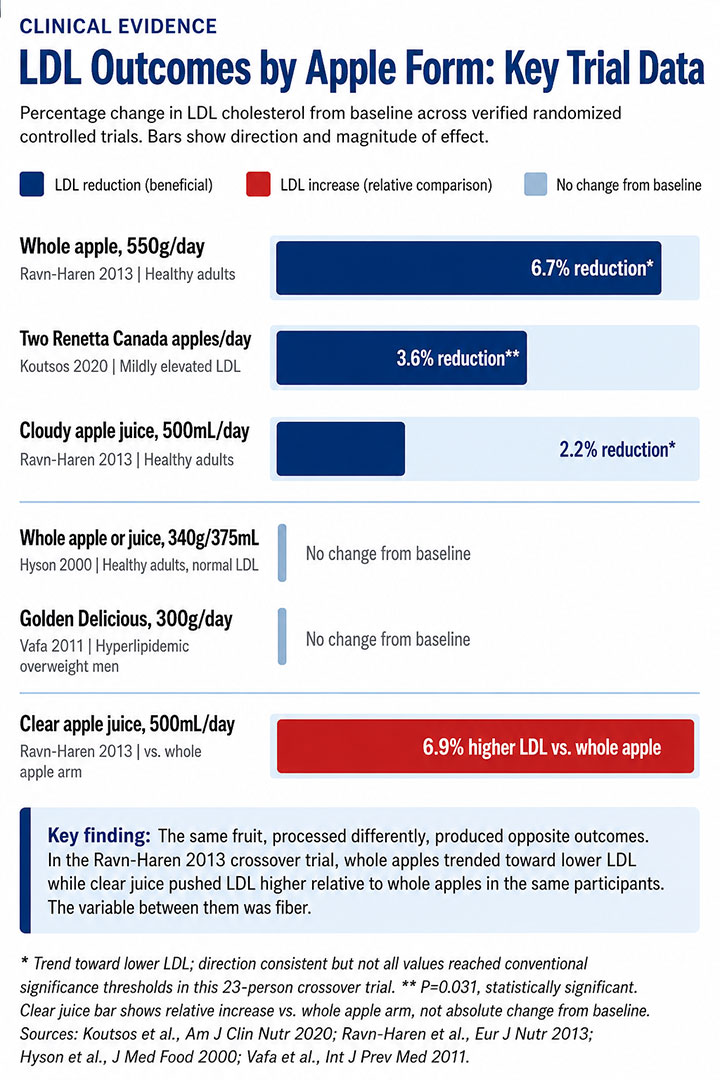
In 2000, researchers at UC Davis enrolled 25 healthy adults in a six-week apple trial. Half added 340 grams of whole apple to their daily diet. The other half drank 375 milliliters of apple juice. When the blood work came back, serum cholesterol had not moved. Body weight was unchanged. The lipid panel was flat.
That finding does not disprove the connection between apples and cholesterol. What it does is define its limits. The population matters. The apple form matters. And baseline cholesterol levels matter considerably more than most of the advice on this topic acknowledges.
Two decades later, a more targeted trial enrolled adults whose cholesterol was already elevated and tracked what happened when they ate two specific apples every day for eight weeks. The results looked very different. And the differences explain who should actually expect apples to move the needle, by how much, and under what conditions.
What a Controlled Trial Actually Found
Two whole apples a day, eaten consistently over eight weeks, lowered LDL cholesterol in adults with mildly elevated levels. That is what a 2020 randomized controlled crossover trial published in the American Journal of Clinical Nutrition established.
Athanasios Koutsos, Julie Lovegrove, and colleagues at the University of Reading gave 40 mildly hypercholesterolemic adults two Renetta Canada apples each day for eight weeks, then switched each participant to a sugar-matched control beverage for a second eight-week period, with a washout interval between.
Every participant served as their own comparison, a crossover design that controls for the individual differences that contaminate parallel-group trials.
LDL fell from 3.86 to 3.72 mmol/L, a 3.6% reduction that reached statistical significance. Total cholesterol decreased. Triglycerides declined. Blood vessel function improved, measured by endothelium-dependent microvascular vasodilation. A key inflammation marker, ICAM-1, was also reduced.
What the apples did not change: HDL cholesterol, blood pressure, or blood glucose. The intervention was specific. It improved the outcomes where the underlying mechanism had reason to produce an effect, and left the others unchanged.
Why Fiber Does the Heavy Lifting
Researchers wanted to understand why whole apples and clear apple juice produce such different effects on blood lipids. To find out, Ravn-Haren and colleagues designed a five-arm crossover study published in the European Journal of Nutrition in 2013, enrolling 23 healthy volunteers to compare whole apples at 550 grams per day, apple pomace, clear juice, cloudy juice, and no supplement, each for four weeks. The result was more striking than the setup suggested.
Whole apples produced a trend toward lower LDL of roughly 6.7%. Clear juice didn’t just fail to replicate that. It pushed LDL higher. The same fruit, the same sugars, the same person, and opposite directions on the lipid panel. The variable between them was the fiber.
The mechanism centers on bile acids. Pectin, the soluble fiber concentrated in apple flesh and skin, forms a viscous gel inside the digestive tract that traps bile acids before they can be reabsorbed. Your liver normally recycles roughly 95% of the bile acids it produces from cholesterol to aid fat digestion.
When pectin disrupts that cycle, the liver draws LDL cholesterol from the bloodstream to produce the replacement bile it needs. That drop in circulating LDL is what appears in the lipid panel.
Peeling substantially reduces the fiber available. Juicing removes it almost entirely. Neither process restores the cholesterol effect of the whole fruit.
What Polyphenols Add to the Picture
A long-standing assumption about apple polyphenols was that they protect LDL from oxidation but don’t lower LDL levels. The evidence doesn’t quite support that framing. In a 2007 study in the Journal of Oleo Science, Nagasako-Akazome and colleagues enrolled 71 moderately overweight adults and gave them 600 milligrams of apple polyphenol extract daily for 12 weeks. Both total cholesterol and LDL decreased, without any whole-fruit fiber present. Visceral fat area and adiponectin levels improved too.
What the extract study doesn’t resolve is whether a capsule and a whole apple deliver polyphenols the same way. The food matrix, the ratio of different polyphenol classes, and how the compounds interact with digestion all differ between a supplement and a piece of fruit. Koutsos and Lovegrove noted that the polyphenol and fiber fractions of a whole apple likely act through different but complementary pathways, and that the strongest cholesterol outcomes in whole-fruit trials may depend on both operating together.
Practically, the skin holds most of what matters on the polyphenol side. Roughly 70 to 80% of apple polyphenols concentrate in the peel.
Peeling eliminates the majority of that oxidation-protective fraction alongside a substantial portion of the fiber. Researchers still don’t have a settled explanation for why polyphenol response varies as widely as it does between individuals eating the same fruit in the same amounts.
What Kind of Apple Is Best to Lower Cholesterol?
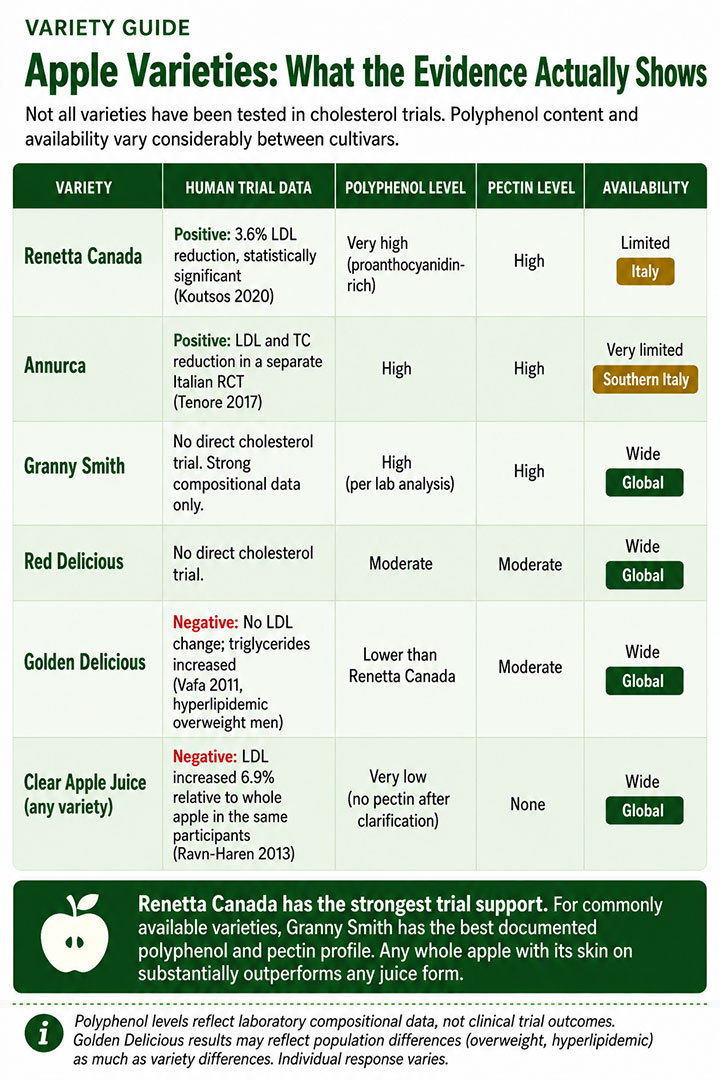
Renetta Canada has the strongest direct trial evidence. It was the variety used in the 2020 University of Reading study, and its high proanthocyanidin content appears to be a meaningful part of why those participants responded. Renetta Canada is an Italian cultivar that isn’t widely available in most supermarkets outside Europe, which is the gap between what the research supports and what the consumer advice typically recommends.
Golden Delicious has a more complicated record. A study published in the International Journal of Preventive Medicine by Vafa and colleagues gave 46 hyperlipidemic overweight men 300 grams of Golden Delicious daily for eight weeks. Cholesterol levels showed no meaningful change.
Triglycerides increased. The study population was both heavier and more metabolically compromised than the Koutsos group, which complicates the comparison, but the variety’s lower polyphenol content per gram relative to Renetta Canada is also a plausible contributor to the divergent outcome.
The honest answer for anyone outside northern Italy without access to Renetta Canada: any whole apple with its skin on delivers pectin and polyphenols. Granny Smith is frequently cited in nutrition content for its polyphenol composition, and the laboratory data on that characterization is reasonable. Direct controlled-trial data for Granny Smith’s cholesterol effect in humans is limited. Which variety sits on the shelf matters less than whether you eat it whole, unpeeled, and every day.
Who Benefits Most, and What Apples Cannot Do
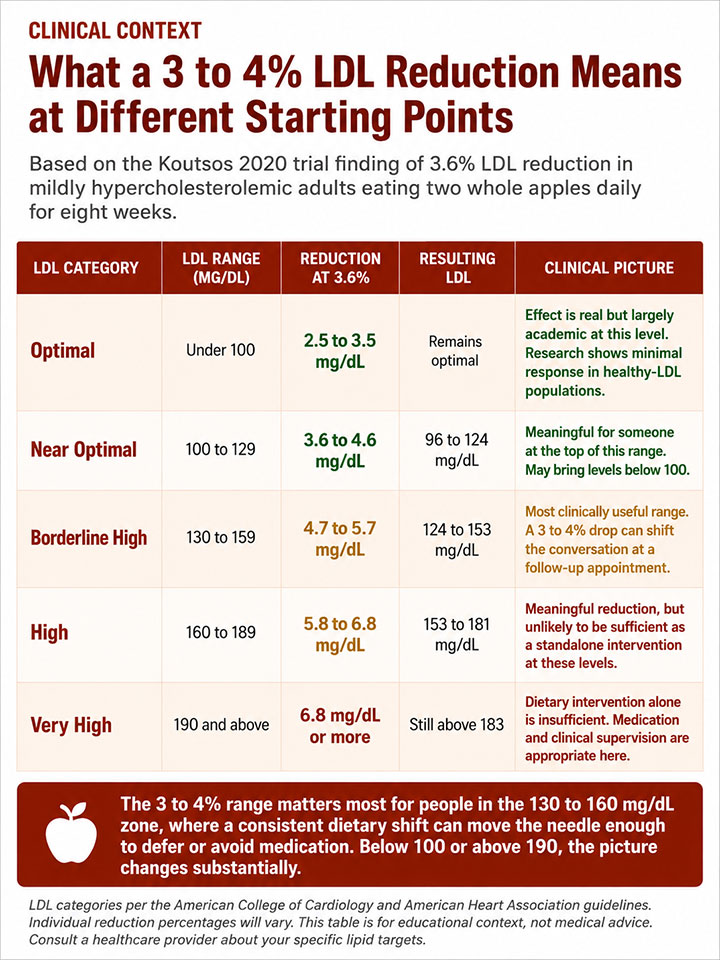
The clearest dividing line in the research runs between people with elevated baseline cholesterol and people with normal cholesterol. The 2000 Hyson trial that found no lipid changes enrolled healthy adults.
The 2020 Koutsos trial specifically recruited people with mildly elevated levels. When LDL is already within a normal range, the liver’s bile acid recycling machinery isn’t operating under the same pressure, and a fiber-based intervention has less room to produce measurable change.
For someone with total cholesterol in the borderline-high range, typically 200 to 239 mg/dL, a 3 to 4% LDL reduction is clinically meaningful. It can shift someone out of the borderline category, and that shift changes the next doctor’s conversation from “let’s keep monitoring this” to “diet is working.”
For someone already at target, the same daily apples remain worthwhile. Cholesterol isn’t the primary reason.
Two apples a day is a reasonable daily intake from a blood sugar perspective for most people. The Koutsos trial found no adverse effects on blood glucose or insulin across eight weeks. The fiber that slows bile acid recycling also slows glucose absorption, which moderates the blood sugar response to the fruit’s natural sugars.
What apples cannot do: offset a diet consistently high in saturated fat, substitute for cardiovascular medication in people with established heart disease, or correct a genetic predisposition to elevated LDL production. The evidence positions them as a meaningful component of a heart-healthy dietary pattern, not as a standalone treatment.
Making 8 Weeks Work
A 2022 meta-analysis in Frontiers in Nutrition reviewed 18 randomized controlled trials on apple consumption and found something worth knowing before acting on any of this: the cholesterol benefit was significant when the comparison group was a true placebo, but not when compared against another dietary change already in progress.
The effect is most measurable against an apple-free baseline. If apples are being added to a diet already in flux, the benefit is harder to isolate and probably harder to produce.
Whole fruit, skin on, every day, for at least eight weeks. That is the profile the trials that found results had in common. The bile acid binding that reduces LDL operates across every meal cycle where pectin is present, and the eight-week trials measured what consistent daily intake produces.
Eating one apple at breakfast and one mid-afternoon is an easier daily habit to sustain than two at once. Consistency matters more than variety selection. Missing occasional days doesn’t collapse the mechanism, but sporadic eating produces a different physiological picture than the one the trials measured.
Apples work alongside other soluble fiber sources rather than replacing them. Pectin is structurally distinct from the beta-glucan in oats or the psyllium in fiber supplements, and each type has somewhat different binding properties in the gut. A diet that draws on several soluble fiber sources produces more consistent bile acid interruption across meal contexts than any single source alone.
Apple LDL Impact Calculator
Estimate your potential 8-week LDL change based on two whole apples daily
Conclusion
The 2000 null result is the baseline: a description of what apples do in a body that doesn’t have a cholesterol problem to solve. Not much.
The positive trials measured something different: what happens when mildly elevated LDL meets consistent daily fiber and polyphenol intake over eight weeks, in a body where the bile acid pathway has room to respond. That’s a different condition, with a different outcome.
The profile the evidence actually supports is specific enough to be useful. Borderline-high LDL, whole fruit, skin on, daily, for at least eight weeks. Within that profile, the mechanism is real, the effect is modest, and the research is consistent across well-designed trials.
Outside of it, the apples are still worth eating. The cholesterol math doesn’t apply the same way.