You don’t need months of lifestyle changes to give your memory a boost. Some research-backed techniques take only minutes and fit into an ordinary day.
You just sat through an hour-long meeting. Someone walks up and asks what was covered. Your mind goes blank.
It’s not a sign of low intelligence. The forgetting curve, documented by Hermann Ebbinghaus in the 1880s, works the same way for everyone. We can lose up to 70% of new information within a single day if nothing reinforces it. The exact rate varies from person to person and from topic to topic. The direction doesn’t.
Most advice for ways to improve memory requires a long-term commitment: consistent sleep, daily exercise, a cleaner diet. That guidance is worth following, though it doesn’t help much when you have forty minutes before a presentation and need your brain working better right now.
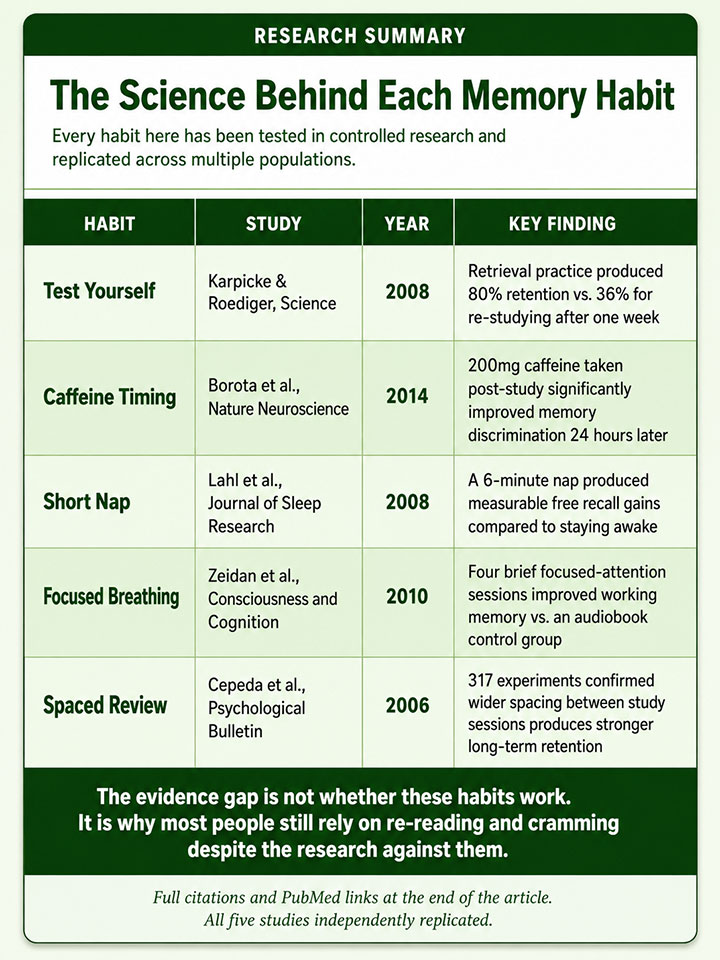
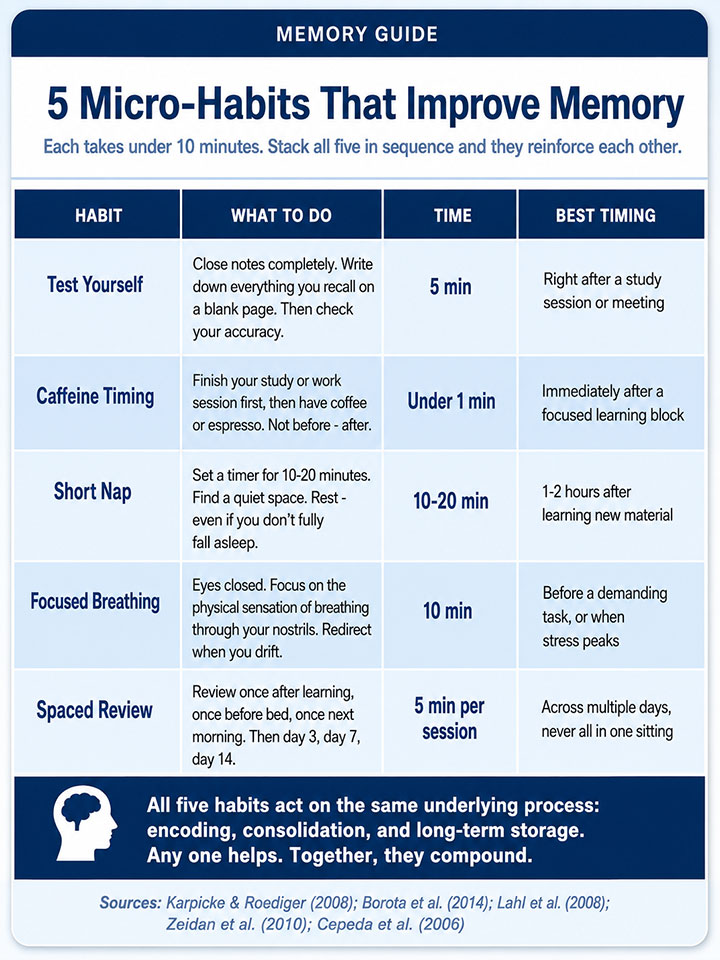
Five of them show up consistently across the research: self-testing, caffeine timing, a short nap, focused breathing, and spaced review. Each takes under ten minutes. What’s less apparent is that they work on the same underlying process, and knowing that changes how you use them.
Test Yourself Instead of Re-Reading
Re-reading your notes feels productive. Your eyes move across familiar words, the material looks recognizable, and you finish feeling like you’ve done something useful. That feeling is real, but the retention behind it usually isn’t.
The question that drove Jeffrey Karpicke and Henry Roediger’s 2008 study in Science was whether that sense of fluency holds up over time. Forty undergraduates at Washington University learned Swahili-English word pairs across alternating study and test cycles. The researchers then manipulated what came next for each item: more study, or more self-testing.
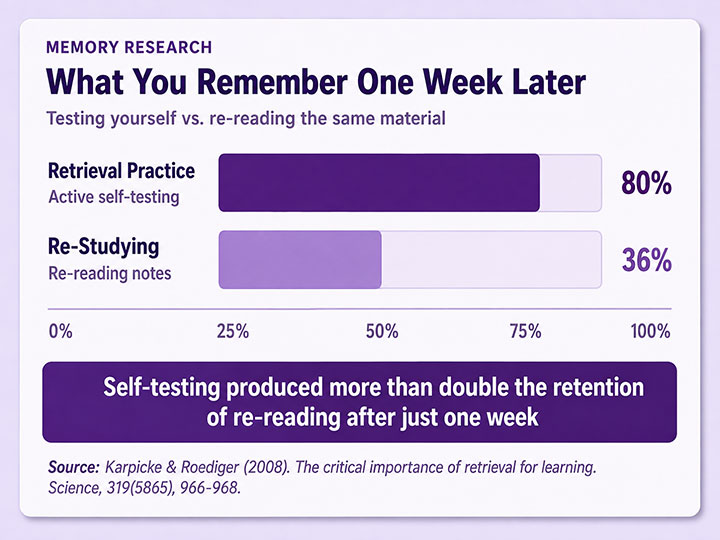
A week later, the students who kept testing themselves on already-mastered material retained around 80% of it. Those who kept re-studying the same content retained roughly 36%.
That 44-point gap held regardless of how confident students felt during study, and the findings have since been replicated across dozens of subject areas and age groups: a 2014 meta-analysis by Christopher Rowland, drawing from 159 separate experiments in Psychological Bulletin, found benefits this consistent across populations that the question has largely shifted from whether retrieval practice works to why re-reading persists as the dominant study method despite the evidence against it.
The mechanism isn’t complicated. Pulling a memory from your mind is effortful, and that effort leaves a stronger trace. Recognizing something on a page does almost nothing to consolidate it. Think of it the way a coach thinks about training: a muscle gets stronger from the work of contracting, not from being observed.
Drink Coffee After a Study Session, Not Before
Most people treat caffeine as a pre-work ritual. Wake up, brew a cup, then start absorbing information. That timing is fine for alertness. For memory consolidation, it leaves something on the table.
A 2014 double-blind study in Nature Neuroscience by Daniel Borota and colleagues at Johns Hopkins tested a specific question about caffeine: whether it affects memory consolidation rather than just attention during learning.
Participants who didn’t regularly consume caffeine studied a series of images, then received either a 200mg caffeine tablet or a placebo, administered after the study session rather than before. Tested 24 hours later, the caffeine group outperformed the placebo group on a task requiring them to distinguish between similar images they hadn’t previously seen.
That’s a measure of pattern separation, a high-resolution encoding process that reflects deep rather than surface-level memory storage.
Most coverage of caffeine and the brain treats timing as irrelevant. This finding changes the picture. The effect was specific to consolidation (the process where the brain stabilizes what it just took in), not to alertness or attention during study itself.
One caveat worth knowing: the study tested people who weren’t regular caffeine consumers. If you already drink coffee daily, you’ve built up some tolerance, and the memory benefit may be smaller. The research on habitual users is still limited.
But the sequencing principle still applies: if you’re going to have coffee anyway, having it after a focused learning block is the smarter choice. Finish the study session or meeting first, then have approximately 200mg (one to two espresso shots or a standard strong cup).
Skip it if it falls within a few hours of your intended sleep. Sleep is still the most powerful consolidation tool available, and no timing trick for caffeine is worth that trade-off.
A 6-Minute Nap Can Do More Than You’d Expect
The popular assumption is that you need a full 90-minute sleep cycle to get any real cognitive benefit from lying down. Six minutes would barely qualify as a rest. The research puts a dent in that assumption.
In a 2008 study in the Journal of Sleep Research, Olaf Lahl and colleagues at the University of Düsseldorf gave participants two minutes to memorize a 30-word list, then had them either stay awake, take a six-minute nap, or nap for an average of 35 minutes before a recall test one hour later.
Those who stayed awake recalled an average of just under seven words. The six-minute nap group recalled more than eight. The longer nap group did better still. But even the ultra-short nap produced a measurable, consistent gain in free recall.
Six minutes. That gap held.
Researchers believe the onset of sleep, rather than the depth of it, may be enough to initiate hippocampal consolidation processes that continue even after waking. That’s the proposed mechanism, and it’s still being worked out. What isn’t in question is the direction of the effect.
Ten Minutes of Focused Breathing Clears Your Mental Workspace
Stress is one of the most underrated obstacles to memory. When cortisol rises (during a tight deadline, a hard conversation, or just a packed afternoon of context-switching), working memory takes a measurable hit. Working memory is the mental workspace where you hold and actively use information in real time. When it’s overwhelmed by stress, new information has less room to register.
Fadel Zeidan and colleagues at Wake Forest University School of Medicine wanted to know how little meditation experience was needed to produce a cognitive effect. In a 2010 study in Consciousness and Cognition, adults with no prior meditation experience completed four brief sessions of focused attention training: concentrating on the breath, noticing when the mind wandered, and redirecting attention. A control group spent the same time listening to a recorded audiobook.
The meditation group showed improved working memory, visual-spatial processing, and executive function. The audiobook group showed none of those changes.
Four sessions. Most people spend longer than that avoiding a single hard conversation.
Longer programs show the same pattern at a larger scale. A 2019 randomized trial by Julia Basso and colleagues at NYU, published in Behavioural Brain Research, found that eight weeks of brief daily meditation (13 minutes per session) improved attention and working memory capacity compared to a matched podcast listening control. The effect was clear at eight weeks but not at four, which suggests that consistent practice accumulates in ways a single session won’t always show.
For a before-work or between-meeting reset, sit comfortably with your eyes closed. Focus on the physical sensation of air moving through your nostrils: not the idea of breathing, but the actual feeling of it. When your mind wanders (and it will), redirect attention back. Ten minutes of that is enough to alter working memory performance for the hour that follows.

Spread Your Reviews Out Instead of Cramming
Cramming works for a test on Friday. It doesn’t work for anything you need to remember by Monday.
The finding that distributing practice across time produces stronger long-term recall than massing it together is among the oldest and most replicated results in memory science. A 2006 meta-analysis by Nicholas Cepeda and colleagues in Psychological Bulletin analyzed 839 assessments of distributed practice across 317 separate experiments.
The result was clear: the optimal gap between study sessions should grow as the retention interval grows. For information you need to retain over weeks, wider spacing beats narrower spacing almost every time.
A separate 2006 study by David Balota and colleagues found the same spacing benefit in both younger and older adults, extending to early-stage Alzheimer’s disease. That last finding matters: this isn’t just a student’s tool and doesn’t require an intact memory system to produce results.
The reason comes down to what the brain treats as a signal worth keeping. When information reappears across multiple, distinct time points, retrieval is harder, and that difficulty deepens the trace. Cramming sends the opposite message: this was only needed once. The brain files it accordingly.
How These Habits Work Together
These five habits aren’t just additive. Put them in sequence, and the compounding becomes visible.
Study for 30 minutes using retrieval practice. Drink coffee immediately after. Two hours later, take a 10-minute rest. Before bed, do a brief breathing reset, then run through the material one more time. Three days later, review it again.
Each step reinforces the ones before it: retrieval strengthens initial encoding, caffeine supports consolidation, the nap deepens it, the breathing session creates room for everything to register, and the spacing ensures it holds over time.
You don’t need to run the full sequence every day. Knowing how the habits connect, though, changes what you reach for when you only have ten minutes.
Conclusion
Memory is a process, and specific points in that process respond to deliberate choices made in small windows of time.
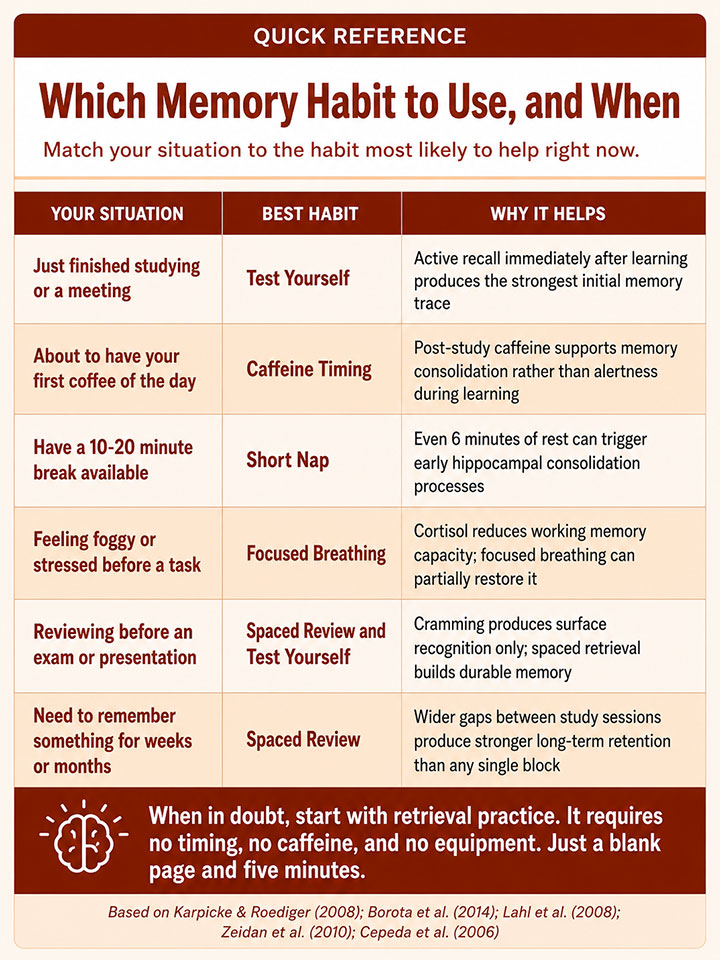
Don’t adopt all five habits at once. Pick the one that fits most naturally into what you’re already doing. If you already drink coffee, try shifting it post-study. Take a ten-minute rest at lunch if you can manage it. Before a meeting, switch from re-reading to recall. The test of any of these isn’t how it feels during the ten minutes. It’s whether the information is still there a week later.
Frequently Asked Questions
What is the best natural memory booster?
Retrieval practice (testing yourself on material rather than re-reading it) has the most consistent evidence behind it of any behavioral approach to memory improvement. The benefit holds across age groups, subject areas, and retention intervals, and it requires no equipment. Among nutritional approaches, flavonoid-rich foods, particularly berries, have the strongest human trial support of any dietary category for cognitive function.
What drink is good for brain memory?
Coffee has the most research behind it for acute memory effects, especially when consumed after learning rather than before. Green tea, which contains both caffeine and L-theanine, has a smaller body of evidence for sustained attention and working memory. Among whole food sources, blueberries have more human trials on memory and brain function than almost any other fruit, and the evidence is more specific than most people realize.

What causes poor memory?
The most common causes of everyday memory difficulty in otherwise healthy adults are sleep deprivation, chronic stress, and passive learning habits such as re-reading rather than self-testing. Sleep is particularly significant: memory consolidation happens almost entirely during sleep, and even a few nights of poor rest can impair working memory capacity and slow retrieval. Chronic stress elevates cortisol, which reduces hippocampal volume and working memory performance when sustained over time.
Persistent or worsening memory problems (difficulty with familiar tasks, disorientation in familiar places, or repeatedly asking the same questions) are distinct from normal everyday forgetting and warrant a conversation with a physician.
Can memory improve at any age?
Yes. The habits covered here have shown measurable benefits across age groups. David Balota’s 2006 work on spaced retrieval found the spacing effect held for both younger and older adults. The Rowland meta-analysis confirmed consistent retrieval practice benefits across populations.
The brain retains meaningful plasticity into older adulthood, though consolidation does slow with age. That’s exactly why spacing matters more for a 60-year-old than for a 25-year-old, not less. The gaps have to work harder to do the same job.