Most people assume working memory inevitably declines with age. The research tells a far more hopeful story, and one finding surprised even neuroscientists.
Think of working memory as your brain’s RAM. Your long-term memory is like a hard drive. It stores everything you’ve ever learned. But working memory is the active workspace where you juggle information right now.
It’s how you hold a phone number in your head while you dial it. It’s how you follow a conversation while thinking of your response. It’s how you remember what you read at the start of this sentence by the time you reach the end.
And just like RAM on an old computer, it has limits.
Your brain can only hold about four to seven pieces of information at once. That’s it. When you try to do more (checking email while on a call, scrolling social media while listening to a podcast), you’re not multitasking. You’re rapidly switching between tasks. Each switch leaks cognitive power.
Why Your Mental Workspace Keeps Crashing
Your prefrontal cortex, the brain region that manages working memory, burns through energy fast. When it’s overloaded, focus collapses. Tasks take longer. Mistakes pile up.
But here’s the good news: working memory isn’t fixed. It can be protected and potentially improved through specific daily habits. These aren’t vague wellness tips. They’re backed by measurable results from clinical trials.
How Your Smartphone is Hijacking Your Cognitive Workspace
Your phone isn’t just a distraction. It depletes working memory even when you’re not using it.
The more unsettling finding is this: you don’t even need to see a notification. In a study published in the Journal of the Association for Consumer Research, researchers led by Adrian Ward at the University of Texas at Austin assigned 520 undergraduate smartphone users to one of three conditions: phone on the desk face-down, phone in pocket or bag, or phone in another room.
Those in the other-room condition performed significantly better on working memory tasks, even when they reported no awareness of thinking about their phone. The mechanism, Ward’s team argued, is that actively suppressing the urge to check your phone consumes exactly the cognitive resources you need for everything else. The phone doesn’t have to interrupt you to drain you. Its presence is enough.
Notifications are worse still. A study by Cary Stothart and colleagues at Florida State University found that receiving a cell phone notification during a sustained-attention task, even without responding to it, produced significant impairment in task performance.
The interruption happened before conscious awareness. Participants received a text or a call, didn’t look at their phone, and still showed measurable drops in performance. What the researchers described as “task-irrelevant thoughts” had been triggered, and those thoughts competed with the task at hand.
The Email and Messaging Trap
Email and messaging apps create an expectation of constant availability. This fragments attention throughout the day.
Gloria Mark, an informatics professor at the University of California, Irvine, has tracked knowledge workers in their natural environments across multiple studies. Workers check email an average of 77 times per day. Each check is a context switch. Each switch depletes working memory resources. By the end of the day, your cognitive workspace is exhausted, not from productive work, but from constant task-switching.
The solution isn’t to ignore communication. It’s to batch it. Check email at specific times, say, 9 AM, 1 PM, and 4 PM, rather than continuously. This protects working memory for focused work.
Social Media and Cognitive Fragmentation
Social media platforms are engineered to capture and hold attention. Infinite scroll, autoplay videos, push notifications: these features are designed to keep you engaged. The problem is what this training does to the brain over time.
Research consistently links heavier media multitasking to reduced sustained attention and working memory performance.
A landmark study by Eyal Ophir, Clifford Nass, and Anthony Wagner at Stanford, published in the Proceedings of the National Academy of Sciences, found something counterintuitive: heavy media multitaskers actually performed worse on cognitive control tasks than light multitaskers. The people doing the most switching were the worst at switching. The constant exposure seemed to train the brain toward distraction rather than away from it.
The fix isn’t necessarily to quit social media entirely. It’s to use it intentionally rather than reflexively. Delete apps from your phone. Access social media only through a browser. Set specific time limits. These friction points protect your working memory from continuous depletion.
Signs Your Working Memory is Struggling
Before exploring solutions, check if these patterns sound familiar:
- You walk into a room and forget why you went there
- You lose track of conversations when someone interrupts
- You read a paragraph three times and still don’t absorb it
- You can’t follow multi-step directions without writing them down
- You forget what you were saying mid-sentence
- You struggle to do mental math that used to be easy
These aren’t signs of a bad memory. They’re signals that your working memory is overloaded or underperforming, and that’s fixable.
The Baddeley-Hitch Model of Working Memory
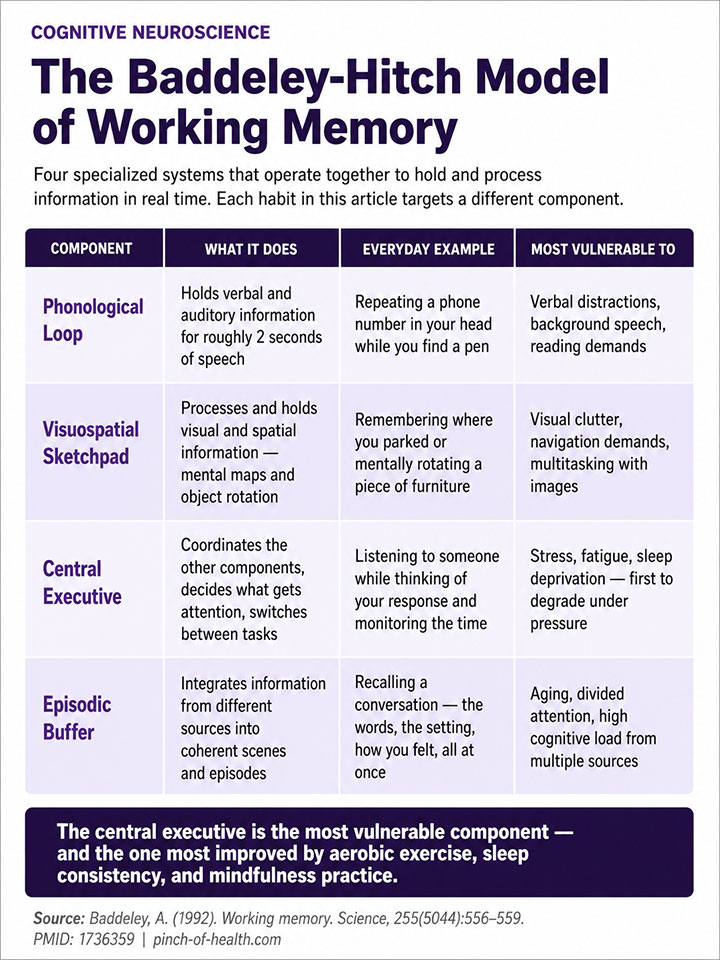
Working memory lives primarily in your prefrontal cortex, the area right behind your forehead. But it doesn’t work alone. It’s part of a network that the British psychologist Alan Baddeley, working with Graham Hitch, mapped in the 1970s and refined over decades. Their model, now foundational in cognitive neuroscience, describes four specialized components that operate together. Understanding them makes the habits below easier to apply, because each habit targets a different part of the system.
The Phonological Loop
This system handles verbal and auditory information. When you repeat a phone number in your head, this is the component at work. It can hold about two seconds of speech. Try saying the digits “2-4-7-5-9-1-3” out loud. That takes roughly two seconds, and that’s close to the phonological loop’s capacity.
The Visuospatial Sketchpad
This processes visual and spatial information. It’s what you use when you mentally rotate an object or remember where you parked your car. When someone gives you directions using landmarks, your visuospatial sketchpad creates and holds that mental map.
The Central Executive
The system’s coordinator. It decides what information gets attention, manages the other components, and switches between tasks. When you’re juggling multiple demands, listening to someone while thinking of your response while also monitoring the time, the central executive is doing the heavy lifting. It’s also the most vulnerable to fatigue and stress.
The Episodic Buffer
This component integrates information from different sources into coherent scenes or episodes. It’s your brain’s way of binding sight, sound, and meaning. When you remember a conversation, you don’t just recall the words, you remember where you were, what the person looked like, how you felt. That binding is the episodic buffer at work.
Why Working Memory Fails Under Pressure
Your prefrontal cortex is expensive to run. It uses about 20% of your body’s glucose despite being only 2% of your body weight. When you’re stressed, hungry, tired, or distracted, this region struggles first.
Cortisol (your stress hormone) directly impairs prefrontal cortex function. This is why you can’t think clearly during a crisis or why test anxiety makes your mind go blank. The very system you need most under pressure is the one most vulnerable to it.
Sleep deprivation reduces glucose metabolism in the prefrontal cortex by up to 12%. That’s like running demanding software on a dying battery. Your working memory limps along, but can’t perform at full capacity.
Age matters too. The prefrontal cortex is one of the last brain regions to mature (around age 25) and one of the first to show decline with aging. But the rate of decline is heavily influenced by lifestyle. Two 50-year-olds can have vastly different cognitive function. The difference is usually the habits they’ve maintained for the past 20 years.

The habits that follow all target different components of that system, and the sequence in which you build them matters.
Habit 1: Move Your Body for 45+ Minutes
Aerobic exercise doesn’t just strengthen your heart. It reshapes your brain’s structure.
The most direct evidence comes from a randomized controlled trial led by Kirk Erickson at the University of Pittsburgh and published in the Proceedings of the National Academy of Sciences. One hundred and twenty older adults were assigned to either a walking program or a stretching control group for 12 months.
After a year, the walking group showed a 2% increase in hippocampal volume, actual physical growth in a brain region tied to memory formation, in a group whose hippocampus would have been expected to shrink. Not slowing decline. Growing. That finding is worth sitting with.
Duration matters too. A 2018 systematic review by Joseph Northey and colleagues in the British Journal of Sports Medicine analyzed 39 studies of adults over 50 who underwent exercise interventions.
The finding was clear: sessions lasting between 45 and 60 minutes produced the strongest cognitive benefits. Shorter sessions helped, but crossing that 45-minute threshold consistently triggered more robust improvements in executive function.
You don’t need to sprint. What works is sustained, moderate aerobic movement: brisk walking, cycling at a conversational pace, swimming steady laps. This kind of exercise triggers brain-derived neurotrophic factor (BDNF), a protein that acts as fertilizer for brain cells.
It promotes new neural connections and protects existing ones. BDNF levels rise during exercise and remain high for hours afterward. This creates optimal conditions for learning and memory.
Understanding “Moderate Intensity”
You’re in the right zone when:
- You can talk in full sentences but not sing
- Heart rate is 50-70% of your maximum (roughly 220 minus your age)
- You feel slightly breathless but not gasping
- You could maintain the pace for 45+ minutes
Too easy: you can hold a detailed conversation without effort. Too hard: you can only speak in short phrases or single words.
This “Zone 2” intensity triggers BDNF production without excessive cortisol from overtraining. High-intensity exercise spikes cortisol, which can impair cognitive function when done too frequently.
Sample Week for Beginners
Monday: 45-min brisk walk (morning)
Wednesday: 50-min bike ride (lunch break)
Saturday: 60-min swim (afternoon)
Progression Plan:
- Weeks 1-2: Focus on consistency, any duration
- Weeks 3-4: Build to 30-minute sessions
- Weeks 5-8: Reach 45-minute minimum
- Weeks 9+: Maintain 45-60 minute sessions
The key is consistency. Three 45-minute sessions beat one three-hour weekend warrior session. Your brain responds to regular, repeated signals that exercise is part of your routine.
Habit 2: Guard Your Sleep Like It’s Sacred
Sleep isn’t downtime. It’s a maintenance cycle for your brain.
During sleep, your brain flushes out metabolic waste through the glymphatic system, a clean-up crew that only activates when you’re unconscious. When you skimp on sleep, that waste builds up. Cognitive function suffers.
The sleep research literature consistently documents this. Studies tracking adults under sleep restriction, typically reducing time in bed by 90 minutes to two hours per night, show progressive working memory impairment that accumulates across days.
By the end of one week, the cognitive cost rivals what you’d see in people with mild cognitive impairment. The participants in these studies consistently underestimate how impaired they’ve become. You feel like you’re managing. The tests say otherwise.
Quality matters as much as quantity. Research by Kristine Wilckens and colleagues has examined how sleep efficiency, the percentage of time in bed actually spent asleep, relates to working memory performance in older adults. Their finding: sleep consistency predicts cognitive function more reliably than total sleep hours alone. Going to bed and waking at consistent times matters more than occasional long sleep sessions.
Your brain thrives on routine. When your sleep schedule bounces around, your circadian rhythm gets disrupted. Even if you get enough total hours, irregular timing prevents your brain from reaching the deepest, most restorative sleep stages.
Sleep Consistency Template
- Choose your wake time: 6:30 AM (plus or minus 15 min)
- Count back 8 hours: 10:30 PM bedtime (plus or minus 15 min)
- Wind-down starts: 9:30 PM (no screens)
- Track for 7 days to find your natural rhythm
- Adjust by 15-min increments only
Stick to this schedule seven days a week. Weekend sleep-ins might feel good, but they disrupt your brain’s natural rhythm. Social jet lag (the misalignment between your biological clock and your social schedule) creates the same cognitive impairment as traveling across time zones.
Evening Wind-Down Protocol
- 2 hours before bed: No work, no stressful news
- 1 hour before bed: Dim lights (bright light suppresses melatonin)
- 30 minutes before bed: Physical relaxation (stretching, hot shower)
- In bed: Reading (physical books, not screens) or meditation
If you’re awake after 20 minutes, get up. Lying in bed awake trains your brain that bed is for wakefulness. Do a quiet activity until you feel sleepy, then return to bed. This is called stimulus control therapy, and clinical trials consistently show it’s one of the most effective behavioral treatments for insomnia.
Habit 3: Train Your Attention With Brief Mindfulness Practice
Mindfulness meditation isn’t just relaxation. It’s resistance training for your attention span.
When stress hits, working memory capacity typically drops. Your mental workspace gets hijacked by worry, anxiety, and distraction. Mindfulness creates a buffer against that decline.
Amishi Jha and colleagues at the University of Pennsylvania studied this directly by working with military service members during the high-stakes predeployment period, a genuinely stressful, not lab-simulated interval.
Forty-eight participants, divided between a mindfulness training group and a control group, were tracked using the Operation Span task, with findings published in Emotion. The trained group, who practiced at least 10 minutes daily, maintained working memory capacity through the predeployment stress.
The control group showed significant degradation. What’s notable is where the protection appeared: specifically during the period of maximum cognitive threat, not in spite of the stress but because of it.
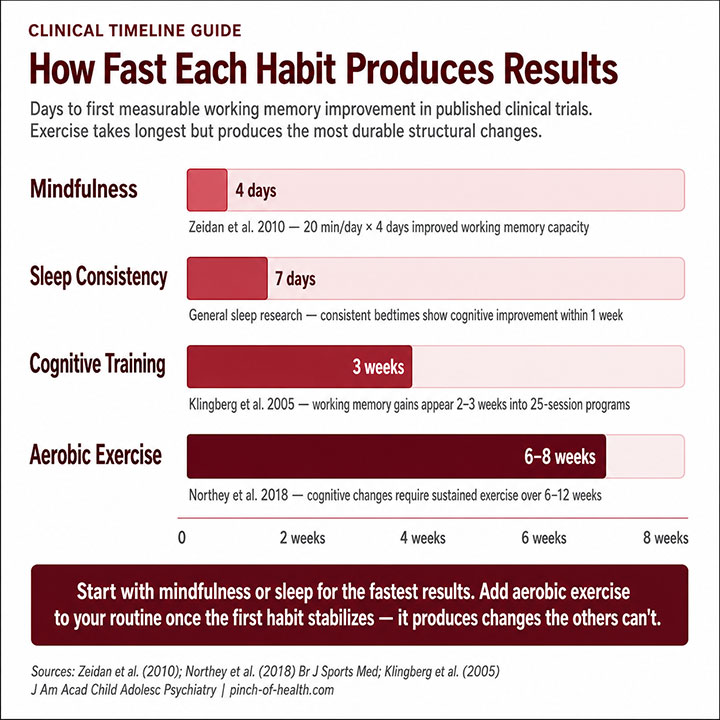
Even more striking is what researchers at the University of North Carolina Charlotte found (published in Consciousness and Cognition) when they gave meditation-naive college students four days of practice, 20 minutes per day, 80 minutes total.
Significant improvements in working memory and executive function appeared on multiple cognitive tests, including the demanding n-back task. Four days. The researchers confirmed it with multiple cognitive tests, so it’s not a fluke.
What that timeline suggests is almost more interesting than the finding itself: the gains weren’t being built from scratch. They were being uncovered. Something already there, but crowded out by noise.
The practice works by strengthening your ability to notice when your mind wanders and gently redirect it. Each time you catch yourself drifting and bring focus back, you’re building cognitive control, the exact skill that prevents working memory from being hijacked by distractions.
10-Minute Starter Routine
- Minute 1: Settle into your seat, close eyes
- Minutes 2-3: Notice body sensations (feet, hands, face)
- Minutes 4-8: Focus on breath (in/out at nose or chest)
- Minutes 9-10: Expand awareness to sounds, then open eyes
Your mind will wander. That’s not failure, that’s the point. Meditation isn’t about stopping thoughts. It’s about noticing when you’ve wandered and returning to the breath. Each time you notice and return, you’re building the exact skill that strengthens working memory. Beginners might do this 50 times in 10 minutes. That’s 50 repetitions.
When to Practice
Morning: Sets cognitive baseline for the day. Cortisol is naturally higher in the morning, and mindfulness helps regulate that stress response before it interferes with working memory.
Lunch: Resets focus for afternoon work. A brief meditation break can restore mental clarity during the afternoon slump.
Evening: Clears mental clutter before sleep. Processing the day’s stress through mindfulness prevents rumination from disrupting sleep quality.
Start with 10 minutes daily. Consistency beats duration. Ten minutes every day outperforms one hour once a week.
Habit 4: Challenge Your Brain With Adaptive Tasks
Your brain responds to challenge. If a task is too easy, you plateau. If it’s too hard, you disengage. The sweet spot is adaptive difficulty, tasks that scale with your ability.
Computerized working memory training uses this principle. Tasks start at your current level and get harder as you improve.
Torkel Klingberg and colleagues at the Karolinska Institute established early evidence for this approach in a randomized controlled trial involving 53 children ages 7 to 12 with ADHD. Over 25 sessions of computerized working memory training, children in the adaptive program showed significant improvements both on trained tasks and on other working memory measures not used during training.
Those gains persisted at a three-month follow-up. The study’s limitation was that it was conducted in a pediatric clinical population, which is worth flagging, and later research has extended the work to healthy adults with more mixed results on how broadly the gains transfer.
That’s the honest version of what the training evidence shows. A 2015 meta-analysis by Jacky Au and colleagues found that n-back working memory training produced a statistically reliable effect on fluid intelligence, with a Hedges’ g of 0.24. That’s modest.
The improvements are real, but they’re not dramatic, and they’re most consistent for the specific type of task trained. Whether that training transfers to everyday skills like remembering names or following complex conversations (what researchers call far transfer) remains genuinely unresolved. Three competing bodies of evidence exist. None of them fully holds.
Researchers still don’t agree on why some people see robust transfer effects and others see almost none. Individual differences in baseline working memory capacity, age, and training compliance all appear to matter, but the precise interaction isn’t settled science.
Try a Quick Working Memory Test
Before exploring training programs, it’s worth knowing where you’re starting. The digit span test below is a simple, validated measure of working memory capacity, the same type of test used in many clinical assessments.
Choosing Effective Brain Training Programs
The brain training industry is full of exaggerated claims. Some programs are backed by research. Others are just games with a marketing angle.
What to Look For:
- Adaptive difficulty: The program must get harder as you improve. If you can master a level and repeat it endlessly, you’re not training, you’re playing.
- Multiple domains: Effective programs target different aspects of working memory, verbal, spatial, and executive control.
- Evidence base: Look for programs tested in peer-reviewed research, not just marketing claims.
- Progress tracking: You should be able to see objective improvements over time.
Programs With Research Support
Cogmed: Developed by Klingberg and colleagues. Multiple clinical trials have found improvements in working memory capacity with 25 sessions over 5 weeks. The program uses visuospatial and verbal working memory exercises that adapt in real-time.
Dual N-Back: Free program with some transfer effects to fluid intelligence in controlled studies. Available as free apps. You’re presented with sequences of stimuli and must identify when the current stimulus matches one from N steps back.
BrainHQ: Developed by neuroscientists at Posit Science. Published trials document improvements in processing speed and attention, with some working memory benefits.
Lumosity: Mixed results. The company paid $2 million to settle FTC charges of deceptive advertising in 2016, so approach marketing claims with skepticism. Better than nothing, but not the strongest option.
Programs That Probably Don’t Work
Most mobile game apps that market themselves as “brain training” aren’t effective. Games that don’t adapt or that you can “beat” aren’t training tools. Crossword puzzles and Sudoku are enjoyable and keep your mind active, but they don’t specifically improve working memory capacity, you get better at crosswords and Sudoku, and that’s it.
How to Structure Your Training
Initial training phase (5-6 weeks):
- 5 sessions per week
- 20-30 minutes per session
- Gradually increasing difficulty
- Mix of verbal and spatial tasks
Maintenance phase (ongoing):
- 2-3 sessions per week
- 15-20 minutes per session
- Continue with challenging levels
- Periodic breaks (1 week off every 3 months)
Realistic expectations: Improvement typically appears after 2-3 weeks. Effects persist 3-6 months with maintenance. Gains are modest, 10-20% improvement on trained tasks is typical, with less reliable transfer to everyday life.
Combining Training With Other Habits
Training works better alongside the lifestyle habits described in this article. A systematic review by Loc Nguyen, Kevin Murphy, and Glenda Andrews published in the Psychological Bulletin synthesized decades of research on cognitive training in older adults and found that interventions combining exercise and cognitive training consistently outperformed either approach alone.
The mechanisms support each other: exercise increases BDNF, which helps the brain adapt to training, better sleep improves training consolidation, and mindfulness supports the sustained focus needed for challenging tasks.
Fuel Your Brain Properly
Your brain is 2% of your body weight but uses 20% of your energy. What you eat and drink directly affects working memory performance.
Hydration Matters More Than You Think
Even mild dehydration affects how you feel and function cognitively. A placebo-controlled study led by Lawrence Armstrong and colleagues at the University of Connecticut followed 25 healthy women through three experimental hydration conditions.
When participants lost about 1.4% of body mass through exercise-induced dehydration, they reported increased perception of task difficulty, worse concentration, and more headaches. Mood and perceived effort were measurably worse.
Most aspects of cognitive performance on standardized tests, however, were not significantly impaired at this level of dehydration, the subjective experience was worse before the objective performance was.
The practical takeaway: don’t wait until you feel dehydrated to drink water. By the time thirst registers, you’ve likely already passed into the range where focus and task effort feel harder.
Simple hydration protocol:
- Start your day with 16 oz of water before coffee
- Keep water visible at your workspace
- Drink 8 oz every 2 hours during the workday
- Monitor urine color as your feedback system (pale yellow is the target)
Blood Sugar Stability
Your brain runs on glucose. When blood sugar crashes, so does working memory.
A study found that non-diabetic adults with higher blood glucose levels showed lower memory performance and reduced hippocampal volume. The relationship held even within the normal range. The caveat worth noting: this was a single time-point observation, not a longitudinal follow-up, so it shows association rather than causation over time.
The issue isn’t total sugar intake, it’s stability. Large swings in blood sugar (high after a sugary snack, then crashing an hour later) disrupt cognitive function. When blood sugar drops, your brain doesn’t have the fuel it needs for demanding tasks like working memory.
Strategies for stable blood sugar:
- Pair carbs with protein or fat (apple with almond butter, not apple alone)
- Eat protein with breakfast to set metabolic baseline
- Avoid long gaps between meals (more than 4-5 hours)
- Choose complex carbs (oats, quinoa, sweet potatoes) over refined grains
Omega-3 Fatty Acids
Your brain is 60% fat by dry weight. The types of fats you eat become part of its structure.
Matthew Muldoon and colleagues at the University of Pittsburgh, published in Military Medicine, measured blood levels of omega-3 fatty acids in 280 healthy adults between ages 30 and 54, then administered a battery of cognitive tests.
Higher blood levels of DHA specifically, not total omega-3s, not EPA alone, tracked with better working memory performance and faster processing speed. The relationship was dose-dependent, and it persisted after controlling for age, sex, race, and blood pressure.
The best sources are fatty fish: salmon, mackerel, sardines, anchovies. Aim for 2-3 servings per week. If you don’t eat fish, consider an algae-based omega-3 supplement (1,000-2,000 mg daily of DHA). Algae is where fish get their omega-3s, the supplement provides the same building blocks without the fish.
Foods That Support Working Memory
Blueberries: Rich in flavonoids that improve communication between brain cells. A 2017 randomized trial by Joanna Bowtell and colleagues at the University of Exeter gave 26 healthy older adults either concentrated blueberry juice (equivalent to 230g of blueberries daily) or placebo for 12 weeks. The blueberry group showed increased task-related brain activation in multiple regions and improvements in working memory on brain scans.
The common thread across the foods below is blood flow and inflammation, not any single ingredient. The brain that gets enough of both operates differently from one that doesn’t.
Dark leafy greens: Packed with folate, vitamin K, and lutein. A five-year prospective study by Martha Clare Morris and colleagues at Rush University followed 960 older adults and found that those who ate one serving of leafy greens daily had cognitive abilities equivalent to someone 11 years younger, after controlling for other lifestyle factors. That’s a large effect for a dietary change that takes no special effort.
Nuts and seeds: Provide vitamin E, which protects brain cells from oxidative stress. Walnuts are particularly rich in omega-3s. An ounce daily delivers meaningful benefit without excess calories.
Eggs: Contain choline, a precursor to acetylcholine, a neurotransmitter vital for memory. The yolk is where the relevant nutrients are concentrated (whole eggs, not whites).
Dark chocolate (70%+ cacao): A randomized trial by Adam Brickman and colleagues at Columbia University, published in Nature Neuroscience in 2014, found that high-flavanol cocoa consumption for three months improved dentate gyrus function in healthy older adults, with measurable changes on brain scans.
The dentate gyrus is the hippocampal subregion most associated with age-related memory decline, which makes this finding more specific and more interesting than the general “chocolate is good for you” framing tends to acknowledge.
Caffeine: Friend or Foe?
Caffeine can temporarily improve working memory performance, but timing and dose matter.
A 2013 review by Suzanne Einother and Timo Giesbrecht in Psychopharmacology analyzed the existing literature on caffeine and attention. The evidence supported improvements in both simple and complex attention tasks, including executive control. The effective dose range appears to be roughly 40-300 mg, about half a cup to three cups of coffee, with effects peaking 30-60 minutes after consumption.
But caffeine after 2 PM disrupts sleep, which harms working memory more than caffeine helps it in the long run. And tolerance builds quickly. Regular users need caffeine just to reach baseline performance, without their morning coffee, they’re actually performing below their natural baseline.
Green tea offers a gentler version of this effect. The combination of caffeine and L-theanine in green tea produces more stable attention improvements than caffeine alone, with less of the spike-and-crash pattern that follows high-dose coffee.
If you’re sensitive to caffeine’s side effects, green tea is worth considering as a morning alternative. For a closer look at what green tea’s compounds do for memory specifically, this breakdown covers the research in detail.
Smart caffeine use:
- Limit to before 2 PM
- Keep doses moderate (100-200 mg max)
- Take 1-2 days off per week to prevent tolerance
- Never use caffeine to compensate for poor sleep
If you need caffeine to function, you don’t have a caffeine benefit. You have a sleep problem.
What to Avoid
Alcohol: Even moderate drinking impairs working memory for 24-48 hours afterward. A study by Anya Topiwala and colleagues at the University of Oxford, published in the BMJ in 2017, followed 550 people for 30 years with repeated brain scans and cognitive tests.
People who drank 14 or more units per week showed faster cognitive decline and greater hippocampal atrophy. Even moderate drinkers (7-14 units weekly) showed some negative structural changes.
High-sugar processed foods: Create blood sugar spikes and crashes that disrupt focus and promote inflammation, which impairs brain function.
Trans fats: Found in some fried and processed foods. Associated with worse cognitive performance and increased dementia risk. Check labels for “partially hydrogenated oils.”
Optimizing Your Work Environment for Cognitive Performance
Your workspace design directly affects working memory capacity.
The Open Office Problem
Open offices were designed to promote collaboration. But they’re difficult for working memory.
Ethan Bernstein and Stephen Turban at Harvard Business School tracked employees at two Fortune 500 companies before and after moving from private offices to open workspaces, using sociometric badges and digital tracking to measure actual interactions.
What they found was published in the Philosophical Transactions of the Royal Society B in 2018, and it ran counter to the stated purpose of the redesign. Face-to-face interactions decreased by approximately 70% in both cases. Email and instant messaging surged to fill the gap. Employees wore headphones to create artificial privacy, defeating the collaboration purpose entirely.
The constant visual and auditory distractions fragment attention. Your working memory is continuously interrupted by movement, conversations, and phone calls that aren’t relevant to your task. Each interruption costs cognitive resources even if you don’t consciously process it.
Solutions when you can’t change your workspace:
- Use noise-canceling headphones with instrumental music or white noise
- Position your desk facing a wall rather than a walkway
- Use visual signals (headphones, a “focus” sign) to reduce interruptions
- Block focus time on your calendar
- Negotiate work-from-home days for deep work
Meeting Overload
Back-to-back meetings destroy working memory capacity. You can’t process information from one meeting before the next begins. Context-switching creates cognitive overload.
Research by Leslie Perlow and Jessica Porter at Harvard Business School, published in Harvard Business Review in 2009 after four years studying Boston Consulting Group teams, found that when teams implemented “predictable time off”, protected blocks of uninterrupted time, productivity and satisfaction improved significantly. Workers reported better focus and completed more meaningful work. The protected time allowed proper processing and integration of information.
Meeting hygiene for better cognitive function:
- Schedule 50-minute meetings instead of 60 (10-min buffer)
- Block 2-hour focus periods with no interruptions
- Decline meetings without clear agendas
- Take 5-minute walks between back-to-back meetings
- Batch similar meetings on the same days
Task Management Strategies
Your working memory can only track a few active tasks. When you try to keep everything in your head, important things fall through the cracks.
E.J. Masicampo and Roy Baumeister at Florida State University demonstrated why writing tasks down works in a series of experiments published in the Journal of Personality and Social Psychology in 2011.
Unfinished goals persist in working memory as intrusive thoughts, competing with the task at hand. Making a concrete plan to complete a task, writing it down with a specific when and how, reduced cognitive interference from that task. Your brain stops rehearsing the task once it trusts you have a system.
Practical task management:
- Brain dump: Write down every task, commitment, and worry
- Process daily: Decide next actions for each item
- Use a single trusted system (app, notebook, whatever you’ll actually use)
- Review weekly: Update and reorganize
- Keep working memory for execution, not tracking
Why Breaks Are Not Optional
Here’s a finding that should matter for anyone who powers through long work blocks without stopping: your performance was declining before you noticed it. Atsunori Ariga and Alejandro Lleras at the University of Illinois, writing in Cognition, tested this with 84 participants completing a 50-minute computer task.
Those who took two brief breaks maintained consistent performance throughout. Those who worked continuously showed significant deterioration by the end, not because they were less motivated, but because sustained attention to a fixed goal habituates. The goal stops pulling. The prefrontal cortex doesn’t “get tired” in the conventional sense. It stops treating the task as novel enough to keep attending to it.
The Pomodoro Technique (25 minutes on, 5 minutes off) works on this principle. The break must involve movement, not scrolling: switching to a social media feed shifts the depletion rather than clearing it. Even a walk around the block is enough to reset the signal.
The same logic applies at home. Remote work removes commute stress and office noise, but it also eliminates the physical threshold that tells your brain work is done. Without a clear transition, work thoughts drift into evenings, rest periods fragment, and the prefrontal cortex never fully disengages.
The fix is architectural: a specific workspace used only for work, a consistent shutdown time, a small ritual (close the laptop, step outside, change out of work clothes) that the brain can learn to read as a genuine switch. Research consistently finds that remote workers who build these boundaries sustain better attention during work hours, not just better rest during personal time.
How These Habits Build on Each Other
These habits don’t just work in isolation. They create a feedback loop.
Exercise improves sleep quality. Better sleep gives you the energy and emotional regulation needed for consistent mindfulness practice. Mindfulness reduces stress, which protects the cognitive resources you need for challenging brain training. Good nutrition provides the fuel for all of it. And all of these together create an environment where your working memory can function at its best.
The 30-Day Habit Stack
Week 1: Sleep consistency only. Set a bedtime alarm for 30 minutes before your target sleep time. Track wake time daily. No other changes yet.
Focus exclusively on sleep for the first week. This builds the foundation. When you’re well-rested, every other habit becomes easier.
Week 2: Add morning movement. A 20-minute walk right after waking. Maintain the sleep schedule from Week 1.
Morning exercise reinforces your circadian rhythm, making sleep consistency even easier. The habit pair, wake up, then walk, creates a natural routine.
Week 3: Add a mindfulness anchor. Ten minutes of meditation right after your morning walk. Creates the automatic routine: wake, walk, meditate.
By week 3, waking and walking feel automatic. Adding meditation feels like a natural extension rather than a new burden.
Week 4: Introduce cognitive challenge. Fifteen minutes of a brain training app while having morning coffee. Full routine now established.
With the first three habits stable, you have the mental bandwidth for structured cognitive training. Your improved sleep, fitness, and stress management make the training more effective.
This gradual approach prevents overwhelm. Each habit supports the next. By week 4, you’re not maintaining four separate habits, you’re maintaining one integrated routine.
Troubleshooting Common Obstacles
Knowledge isn’t the barrier. Implementation is. Here’s how to handle the most common obstacles.
“I Don’t Have Time to Exercise for 45 Minutes”
This is the most common obstacle. Here’s the truth: you have time. You’re choosing to use it differently.
The average American watches four hours of television daily according to Nielsen data. You’re not looking for four hours. Just 45 minutes, three times per week. That’s 2.25 hours out of the 168 hours in your week.
Solutions:
- Exercise before work, before other demands take over
- Split sessions: 25 minutes morning + 20 minutes evening
- Walk during lunch breaks
- Exercise while watching TV (treadmill, stationary bike)
- Use “found time”, park farther away, take stairs, walking meetings
If you genuinely cannot find 45 minutes three times per week, start with 20 minutes daily. Some benefit is better than none. Research consistently shows that even shorter sessions produce measurable cognitive benefits, though not as robust as longer ones.
“I Can’t Fall Asleep at a Consistent Time”
Sleep consistency is hard when your mind races at bedtime.
Michael Scullin and colleagues at Baylor University ran a clever test of this. They brought 57 healthy adults into a sleep lab and assigned them one of two five-minute bedtime writing tasks: either a to-do list for the next few days, or a list of tasks they’d already completed.
Those who wrote the to-do list fell asleep an average of nine minutes faster. Getting the unfinished business out of your head and onto paper appears to satisfy whatever part of the brain keeps rehearsing it.
Evening wind-down protocol:
- 2 hours before bed: No work, no stressful news
- 1 hour before bed: Dim lights (bright light suppresses melatonin)
- 30 minutes before bed: Physical relaxation (stretching, hot shower)
- In bed: Reading (physical books, not screens) or meditation
“My Mind Won’t Stay Still During Meditation”
Your mind is supposed to wander. That’s not failure, that’s the point.
Meditation isn’t about stopping thoughts. It’s about noticing when you’ve wandered and returning to the breath. Each time you notice and return, you’re building the exact skill that strengthens working memory: cognitive control.
If meditation feels impossible:
- Start with 3 minutes instead of 10
- Use guided meditations (apps provide structure)
- Try walking meditation (focus on physical sensations of walking)
- Count breaths: inhale (1), exhale (2), up to 10, then restart
“Brain Training Apps Feel Boring”
This is actually a good sign. If training feels easy or entertaining, it’s probably not challenging enough. Effective working memory training should feel difficult. You should be operating at or just above your current capacity. That sensation is uncomfortable because your brain is genuinely working hard, and that work is the point.
The motivation problem is real, though. What tends to help: tracking your progress graphs (seeing the line go up matters more than you’d expect), pairing your training session with something you actually enjoy like morning coffee, and setting the bar at completion rather than performance.
On a bad day, finishing counts. Most people also find that competing against their own previous scores keeps them going longer than competing against anyone else does. No app’s leaderboard can replicate what it feels like to beat yourself.
“I Did Everything for a Week and Don’t Feel Different”
One week isn’t enough. Neuroplasticity takes time.
Realistic timelines:
- Sleep consistency: 7-14 days for noticeable improvement
- Mindfulness: 2-4 weeks for measurable benefits
- Exercise: 6-8 weeks for cognitive changes
- Brain training: 3-5 weeks for performance gains
Your brain is remodeling itself at the cellular level. Neurons are forming new connections. Brain regions are changing in size. Blood flow patterns are shifting. Keep a simple daily focus log (rate mental clarity 1-10). After four weeks, compare your first week to your fourth. The pattern will be clearer than day-to-day fluctuations.
“I’m Over 60, Is It Too Late?”
Absolutely not. Your brain maintains plasticity throughout life.
Research consistently shows that sedentary older adults who begin aerobic exercise programs can achieve meaningful cognitive improvements. This includes structural brain changes, not just better performance on tests, but measurable changes in hippocampal connectivity and volume, even in people who have been inactive for years. The effects may be smaller than starting younger, but the alternative is continued decline.
Start where you are. Modify as needed. Use walking poles for stability. Try chair exercises. Adjust meditation posture for comfort. You’re not trying to become an athlete or a meditation master. You’re supporting your brain’s natural function.
The Two-Way Street Between Working Memory and Mental Health
Working memory problems don’t exist in isolation. They’re closely linked with mental health conditions.
Anxiety and Working Memory
Anxiety hijacks working memory. When you’re anxious, your mind fills with worry loops, repetitive thoughts about potential threats. These thoughts consume working memory capacity that should be available for the task at hand.
Tim Moran at Georgia Tech synthesized data from 177 studies involving more than 22,000 participants in a 2016 meta-analysis published in Psychological Bulletin. The finding was consistent across anxiety types (state vs. trait), populations (clinical vs. non-clinical), and working memory tasks: higher anxiety reliably correlated with lower working memory capacity, with a moderate effect size (g = -0.33). The relationship works both ways. Overtaxed working memory amplifies anxiety, because the sensation of cognitive overload triggers the same stress response as a physical threat.
Breaking the cycle:
- Write down worries to externalize them (reduces cognitive load)
- Practice “worry time”, 15 minutes daily to process concerns (contains rumination)
- Use breathing techniques to reduce physiological anxiety (4-7-8 breathing)
- Break tasks into smaller steps to reduce cognitive load
The writing technique is particularly well-supported. Kitty Klein and Adriel Boals at North Carolina State University found in a series of experiments published in the Journal of Experimental Psychology: General that expressive writing about stressful experiences improved working memory capacity over a seven-week period. Not just mood. Measured cognitive capacity. Getting worries out of your head appears to free up the working memory resources that had been quietly consumed holding them.
Depression and Cognitive Function
Depression significantly impairs working memory. P.L. Rock and colleagues conducted a meta-analysis of 113 studies comparing cognitive performance in people with depression to healthy controls, published in Psychological Medicine in 2014. People with depression showed moderate to severe working memory deficits, effect sizes in the range of d = -0.34 to -0.65.
The impairment wasn’t limited to active depressive episodes and persisted into remission, suggesting that cognitive impairment is a feature of depression rather than simply a symptom of current low mood.
The good news: exercise and mindfulness, both described in this article, are evidence-based treatments for mild to moderate depression. A 2016 meta-analysis by Felipe Schuch and colleagues, published in the Journal of Psychiatric Research, found that exercise had a large and statistically significant antidepressant effect compared to control conditions.
The comparison to antidepressant medication specifically showed a small, non-significant difference, meaning exercise isn’t a clear substitute for medication, but it’s a real complement to it, particularly for mild-to-moderate presentations.
ADHD and Working Memory
Working memory deficits are a core feature of ADHD. People with ADHD typically score substantially below average on working memory tests, representing a real impairment in the ability to hold and manipulate information temporarily.
This isn’t about intelligence. Research by Michael Kofler and colleagues examining working memory components in children with ADHD suggests the impairment is specifically related to storage capacity, the mental workspace is smaller, so it fills up faster, independent of processing speed. This explains why people with ADHD benefit from breaking tasks into smaller steps and using external memory aids.
The habits in this article help but aren’t sufficient for ADHD. People with ADHD typically need additional support: medication, cognitive behavioral therapy, external organizational systems, and accommodations at work or school. But these habits provide a foundation that makes other treatments more effective.
Chronic Stress and Burnout
Prolonged stress damages the hippocampus and impairs prefrontal cortex function. High cortisol levels over extended periods literally reduce brain tissue in regions involved in memory, this has been documented in neuroimaging studies of people experiencing burnout, which consistently show reduced gray matter in prefrontal areas.
The effects can persist months after the stressful period ends. Recovery from burnout takes time because you’re not just tired, your brain structure has changed.
Prevention is easier than recovery. Regular stress management through mindfulness, exercise, adequate rest, and social support protects working memory from stress-related damage.
Working Memory Across Different Life Stages
Working memory needs and challenges vary across the lifespan. The variation between individuals grows with age, which means the habits covered in this article matter more, not less, the older you get.
Working Memory in Children and Teens
Working memory develops throughout childhood and adolescence, reaching adult capacity somewhere around ages 12 to 15. A 7-year-old has roughly half the working memory capacity of an adult. This affects everything from following classroom instructions to completing homework.
Parents often mistake working memory limitations for disobedience. When you tell a child to “go upstairs, brush your teeth, put on pajamas, and get your backpack ready,” you’re asking them to hold four separate tasks. For a young child, that’s overload. Breaking tasks into single steps works better: “Go brush your teeth.” Wait for completion. Then: “Now put on your pajamas.”
Exercise matters especially for developing brains. A nine-month randomized trial at the University of Illinois enrolled 221 children ages 7 to 9 in a structured after-school physical activity program. Published in Developmental Science by Keita Kamijo, Charles Hillman, and colleagues, the study found that children in the exercise program showed significantly improved working memory and attention compared to the wait-list control group.
Sleep is equally critical. Adolescents need 8-10 hours per night, but a 2018 CDC report by Anne Wheaton and colleagues found that only about 27% of high school students get sufficient sleep on school nights, not 38%, as is commonly cited. The cognitive cost of this deficit is substantial.
Working Memory in Young Adults
Your 20s are peak performance years for working memory. But this is also when bad habits start: irregular sleep schedules, excessive alcohol, chronic stress from early career pressure, sedentary lifestyles.
The choices you make now set your trajectory. Two people at 25 with identical working memory capacity can look very different at 45. The one who exercises, sleeps well, and manages stress maintains strong cognitive function. The one who doesn’t may struggle with focus and mental clarity.
Alcohol deserves specific attention in this age group. Research by Carbia and colleagues examining college students who engaged in regular binge drinking found impaired working memory performance even when sober, compared to non-binge-drinking peers.
The more frequent the binge episodes, the worse the cognitive function. The hippocampus, already established as central to working memory, is particularly vulnerable to alcohol-related damage during this developmental window.
Working Memory in Middle Age
Middle age is where working memory gets blamed for things that aren’t actually its fault. The 40s and 50s feel like decline, losing names, trailing off mid-sentence, suddenly dependent on lists, but a lot of that isn’t capacity loss. It’s load.
You’re managing more than you’ve ever managed at once: career at its most demanding, children, aging parents, finances, the slow accumulation of every relationship you’ve maintained for two decades. Your working memory may not have shrunk. It’s just finally full.
The good news is that this is exactly the window where the habits in this article show strong protective effects. A review by Cindy Barha and Teresa Liu-Ambrose in the FASEB Journal synthesized evidence suggesting that aerobic exercise in midlife may be particularly important for preserving cognitive health.
Women appeared to show especially significant benefits. Stress management becomes critical too, research consistently links high perceived stress in midlife to accelerated cognitive decline in later years, operating through the cortisol-hippocampus pathway described earlier.
Working Memory in Older Adults
After 65, working memory capacity naturally decreases. Processing speed slows. Distractions become more disruptive. But decline isn’t uniform. The variation between individuals grows dramatically with age, and lifestyle factors explain much of that variation.
The Whitehall II study, which followed over 10,000 British civil servants for 25 years with repeated cognitive assessments, found that people who maintained physical activity, social engagement, and cognitive challenges in midlife had significantly better working memory in older age. The effects were substantial: active lifestyles were associated with cognitive function 10-15 years “younger” than sedentary peers.
Even starting late helps. Research by Lisanne ten Brinke and colleagues at the University of British Columbia, published in the British Journal of Sports Medicine in 2015, found that previously sedentary older women with probable mild cognitive impairment showed improved executive function and changes in brain connectivity after six months of aerobic exercise.
The study population was clinical: these weren’t average healthy older adults. But the finding still demonstrates that the brain remains responsive to exercise even in the context of cognitive impairment.
Timothy Salthouse at the University of Virginia has spent decades studying cognitive aging across large samples, and his consistent finding is that individual differences in cognitive change are at least as large as average age effects, sometimes larger. Your birth date is less determinative than most people believe. Your habits are more determinative than most people act on.
Popular Myths That Don’t Help Working Memory
Not everything marketed as “brain training” actually works. Here’s what to avoid.
Brain training games without adaptive difficulty: If the game doesn’t get harder as you improve, you’re not training, you’re playing. Static difficulty produces minimal gains.
Multitasking practice: You can’t train your brain to multitask better. Ophir, Nass, and Wagner’s Stanford study showed the opposite, heavy media multitaskers performed worse on cognitive control tasks than light multitaskers. Chronic multitasking appears to train the brain toward distraction, not away from it.
Memory supplements: Most nootropics lack strong evidence for working memory improvement in healthy adults. Fish oil and ginkgo biloba, two of the most popular, show weak or inconsistent effects. The Cochrane Collaboration’s systematic review of ginkgo biloba for cognitive impairment and dementia, published in 2009, found the evidence inconsistent and unreliable. Save your money for good food.
Background music with lyrics: For most people, music with lyrics competes for working memory resources. Your phonological loop has to process both the lyrics and your work task simultaneously. Silence or instrumental music works better for focus-heavy tasks.
When Lifestyle Changes Aren’t Enough
Most working memory challenges improve with these habits. But sometimes struggles signal a deeper issue.
See a healthcare provider if you experience:
- Sudden, dramatic decline in memory or focus (not gradual)
- Memory problems that interfere with work or daily safety
- Difficulty that emerged after a head injury or illness
- Accompanying symptoms like confusion, mood changes, or headaches
- Problems that persist despite 3+ months of lifestyle changes
- Age-related decline that seems faster than peers
Conditions that affect working memory include ADHD, anxiety disorders, depression, sleep apnea, thyroid issues, and early cognitive decline. These require professional assessment and treatment. A neuropsychological evaluation can identify specific cognitive strengths and weaknesses and distinguish normal aging from pathological decline.
These habits support brain health, they don’t replace medical care when it’s needed.
Conclusion
You don’t need to overhaul your entire life tomorrow. Pick one habit to anchor for the next seven days. If you already exercise but sleep is a mess, start there. If you sleep well but never move, try three 45-minute walks this week. If stress is your biggest barrier, ten minutes of mindfulness before bed.
Once that first habit feels stable, usually after two to three weeks, layer in the next one.
The RAM analogy that opened this article holds. And then it breaks. RAM is hardware. You upgrade it by opening the machine. What the research keeps finding, across exercise trials and sleep labs and four-day meditation experiments, is that working memory doesn’t work quite like that. The limits are real. The ceiling, it turns out, is not fixed. Every study in this article points toward the same conclusion from a different angle: the brain you are working with today is not the only brain available to you.
Start with one habit. The rest follows.
FAQs
How long does it take to improve working memory?
It depends on the method. Mindfulness can show benefits in 4 days. Exercise takes 8-12 weeks for structural brain changes. Sleep consistency improves daily function within 1-2 weeks. Cognitive training shows gains after 5 weeks. The timeline varies, but all methods produce measurable improvements when done consistently.
Can working memory be permanently improved?
Working memory is plastic: it responds to training and lifestyle. Gains persist with continued practice but fade without maintenance. Think of it like fitness: you build it up and need to keep using it. Research on working memory training suggests that gains decline after several months without practice but typically remain above baseline. You don’t lose everything, but you need maintenance.
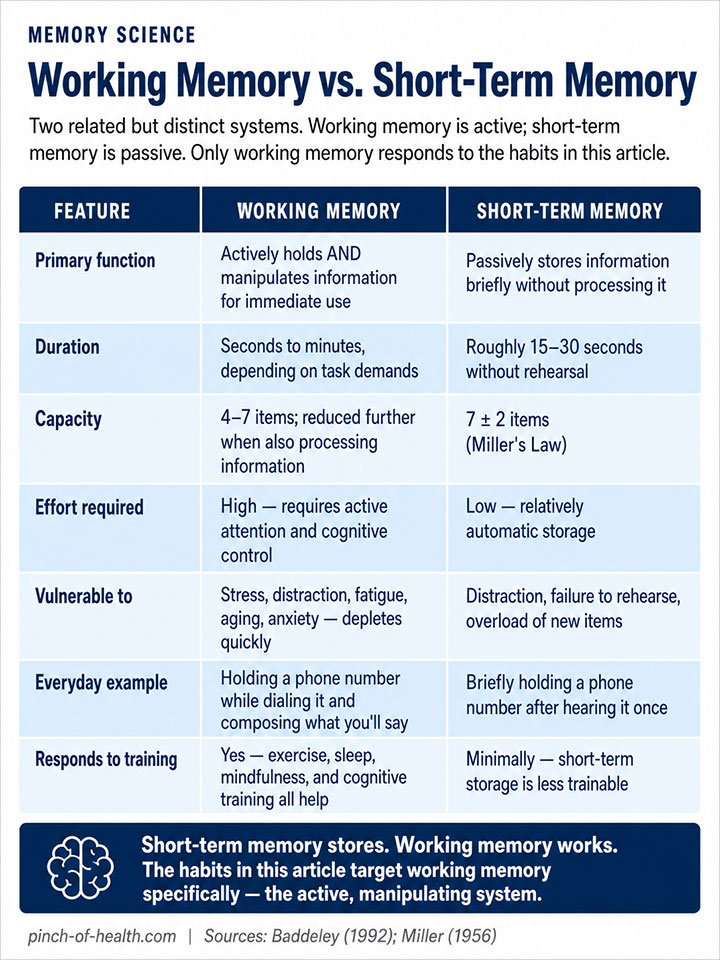
What’s the difference between working memory and short-term memory?
Short-term memory is passive storage, briefly holding a phone number, for instance. Working memory is active manipulation: holding that phone number while also dialing it, thinking about what you’ll say, and monitoring the noise around you. Working memory is more complex and more vulnerable to disruption. It requires active attention and mental effort, while short-term memory is more automatic.
At what age is working memory fully developed?
Working memory continues developing through adolescence and reaches adult capacity somewhere between ages 12 and 15 for most people. It typically peaks in the mid-20s, then gradually declines with age, though the rate of decline varies enormously based on lifestyle.
Some studies find that working memory development reaches a functional ceiling by early adolescence, while others trace continued refinement into the late teens, particularly for the central executive component. The honest answer is that the exact age depends partly on how you measure it and which component you’re looking at.
Can you have a high IQ with low working memory?
Yes. Working memory capacity and general intelligence are related but distinct. A person with high verbal or crystallized intelligence can have significant working memory difficulties. This pattern is particularly well-documented in people with ADHD, dyslexia, and certain learning differences.
Working memory limitations affect how efficiently you can apply intelligence in real time, especially under time pressure or distraction, rather than how much you know or how quickly you can reason through familiar problems. Many highly intelligent people use external memory aids precisely because they’ve recognized this gap.
Does screen time affect working memory?
Heavy screen time, particularly when it involves switching between media, is consistently associated with reduced sustained attention and working memory performance. Kevin Madore and colleagues at Stanford, publishing in Nature in 2020, found that heavier media multitaskers showed a greater tendency toward attention lapses, and that those attention lapses directly predicted memory failures, not just poorer performance in the abstract, but measurable failures to encode and retrieve specific information. The connection appears to work through attention: heavy multitasking habits predict less ability to sustain focus, and less focus means less gets stored.
At what age does working memory decline?
Working memory peaks around age 25, then gradually declines. But the rate of decline varies hugely based on lifestyle. Active, healthy 60-year-olds often outperform sedentary 35-year-olds.
Timothy Salthouse’s research at the University of Virginia, published in the Annual Review of Psychology in 2012, established that individual differences in cognitive aging are at least as large as average age effects. Your habits matter more than your birth date.