For years, the focus has been on finding the perfect time to eat yogurt. New research suggests the more important question is what you eat it with.
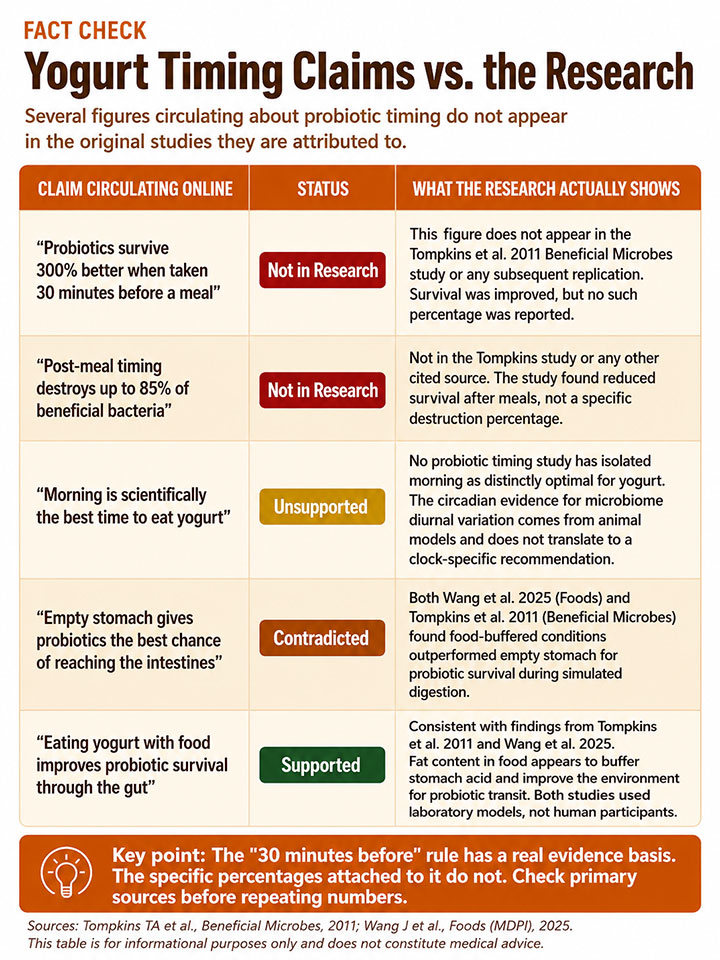
The most widely shared piece of advice on when to eat yogurt for gut health traces back to a single 2011 laboratory study. That study tested a probiotic capsule, not yogurt. Several of the sites now citing it have added percentage figures that do not appear anywhere in the original research.
The result is a confident-sounding recommendation built on a foundation that is older and narrower than the advice implies. If you have been saving your yogurt for a quiet empty-stomach window before breakfast, thinking that gives the bacteria the best shot, the more recent evidence points in the opposite direction.
Why the Advice Keeps Changing
Health sources push readers toward different timing windows because they are answering different questions. Some are focused on improving probiotic survival through the stomach acid barrier. Others are targeting protein absorption or blood sugar management.
A few are repeating whatever they found upstream.
The deeper problem is that most probiotic timing research has been done in vitro, meaning in laboratory models of digestion rather than inside actual human subjects. When those capsule-based laboratory findings get applied to yogurt-eating habits, a gap opens between what the study measured and what the recommendation claims. That gap is where most of the bad advice resides.
What “30 Minutes Before a Meal” Actually Comes From
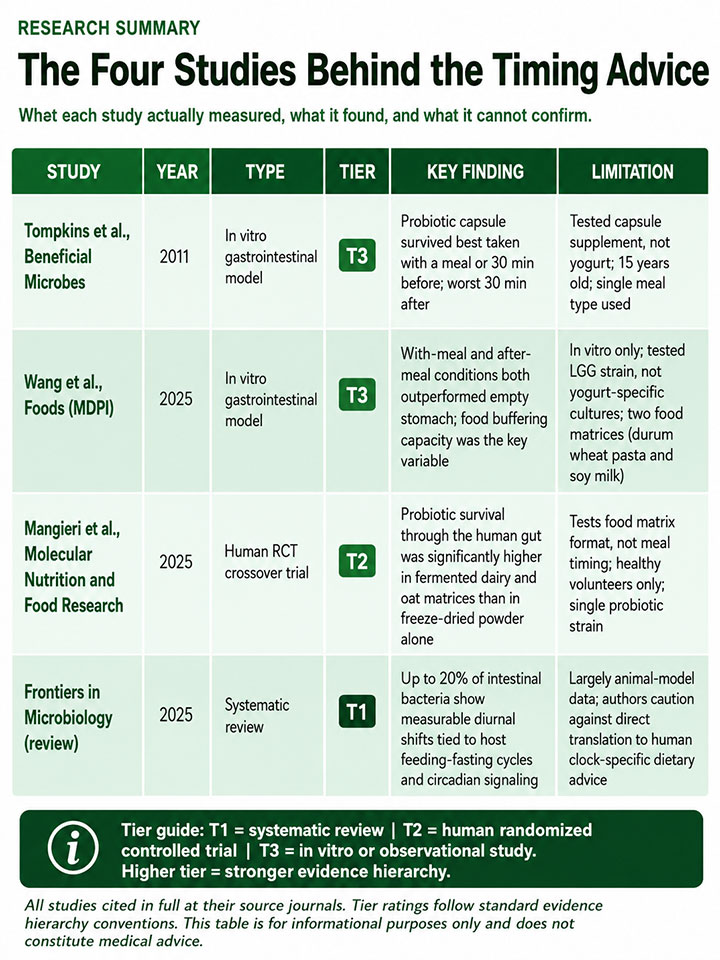
Researchers at the Rosell Institute in Montreal wanted to know whether the timing of probiotic intake relative to meals had any measurable effect on bacterial survival. Working with a multi-strain probiotic supplement (Lactobacillus helveticus, Lactobacillus rhamnosus, Bifidobacterium longum, and Saccharomyces cerevisiae boulardii in capsule form), they used an in vitro model of the upper gastrointestinal tract and tested four conditions: 30 minutes before a meal, at the start of a meal, 30 minutes after, and alongside water alone.
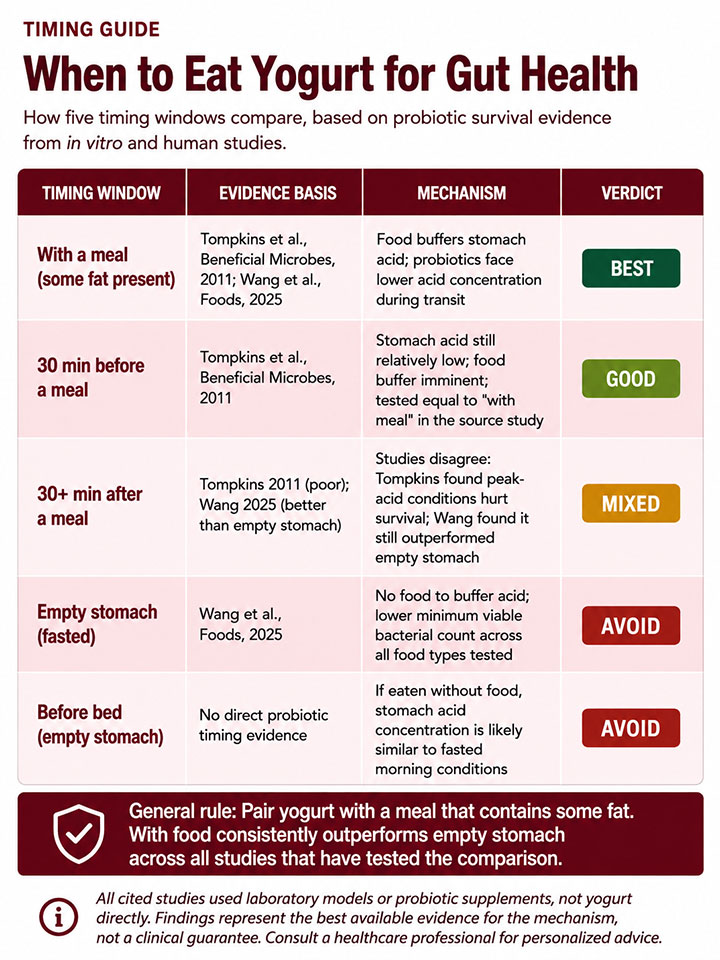
Published in the journal Beneficial Microbes in 2011, the study found that survival was highest when the probiotics were taken with a meal or 30 minutes before eating. The meal in question was oatmeal prepared with 1% fat milk, and the researchers noted that the fat content appeared to help buffer the stomach environment. Survival was lowest 30 minutes after the meal, when acid production was at its peak.
That is the entire basis of the “30 minutes before” rule. The study did not test yogurt. It tested a supplement capsule, in a lab model, using one specific meal type.
Several figures now circulating around that study appear nowhere in the original paper. Claims that probiotics survive “300% better” before meals, or that post-meal timing “destroys up to 85% of beneficial bacteria,” are not in the research. Those figures can be treated with appropriate skepticism.

Is It Better to Eat Yogurt on an Empty or Full Stomach?
With food is the better choice. An empty stomach has a higher concentration of acid and no food to buffer it. When probiotic bacteria face that environment without protection, more of them are degraded before they can reach the intestines, where they are needed.
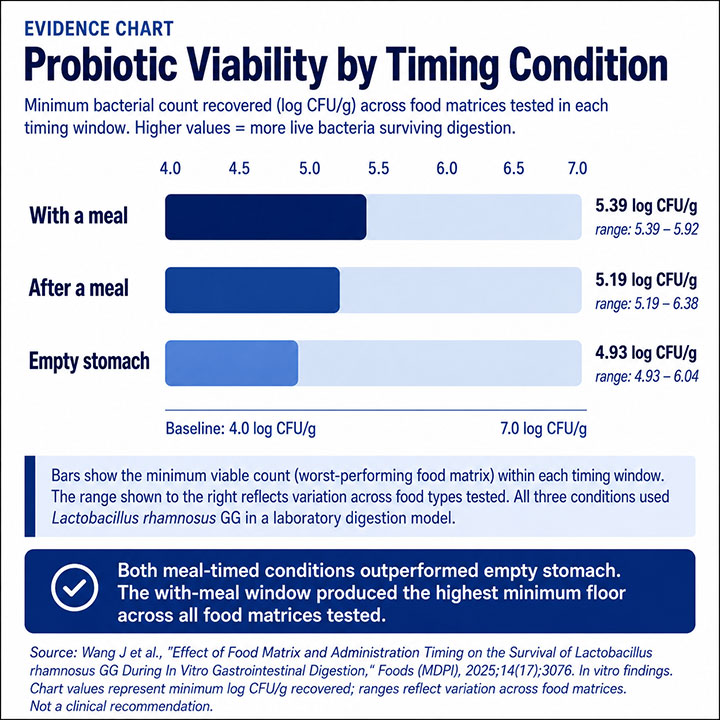
Researchers at Monash University tested this question directly in 2025. In a study published in the journal Foods, Junyan Wang and colleagues measured the viability of Lactobacillus rhamnosus GG during simulated digestion under three conditions: consumed with a meal, consumed after a meal, and consumed on an empty stomach. Both the with-meal and after-meal conditions produced higher viable bacterial counts than the empty-stomach scenario.
The buffering capacity of the food, they concluded, mattered more than the precise timing window.
The underlying mechanism is well established: food reduces the acid concentration probiotic bacteria face during transit. What is less settled is how much that principle applies to yogurt specifically, given that its dairy matrix already provides some natural buffering before the bacteria reach the stomach at all.
What to Eat Your Yogurt With
The food-buffering principle is specific enough to act on. The Tompkins 2011 study used oatmeal prepared with 1% fat milk as its meal condition.
The fat content, the researchers noted, appeared to help reduce the acid environment probiotics traveled through. You don’t need to replicate that exact meal, but the fat variable is the one worth carrying forward.
A breakfast that includes eggs, nuts, avocado, nut butter in oatmeal, or full-fat dairy alongside your yogurt creates the kind of buffered environment the research points toward. For lunch, anything cooked in olive oil, a dressing with oil, or a meal with a cheese component qualifies.
The bar is not high: even a modest amount of fat is enough to shift the stomach environment during transit in the right direction.
The failure mode to avoid is the minimalist breakfast: plain yogurt, a glass of water, and nothing else. That combination sits closer to the empty-stomach condition than to the buffered-meal condition the research supports. Adding fat and substance takes very little effort and aligns precisely with what both in vitro studies found.
Does the Time of Day Make a Difference?
You will encounter confident claims that morning is the optimal window because digestive efficiency peaks in the first half of the day. There is a biological basis for taking this seriously: a 2025 review in Frontiers in Microbiology confirmed that up to 20% of intestinal bacteria show measurable diurnal shifts tied to feeding-fasting cycles and circadian signaling.
The authors are also explicit that most of this evidence comes from animal models and cannot be cleanly translated into clock-specific human dietary advice. The morning argument survives the evidence check, at a general level. The specific-hour version does not.
Morning works well as a timing choice not because the science pinpoints it as optimal, but because breakfast is an established meal for most people and attaching yogurt to an existing habit is the most reliable path to eating it consistently. Midday alongside lunch is equally sound. What the evidence does not support is holding out for an empty stomach at either end of the day.
For people who train in the morning or at lunch, the timing question has a practical overlap worth noting. Greek-style yogurt carries enough protein (roughly 15 to 20 grams per 170-gram serving) to contribute to post-workout recovery, and the probiotic timing principle fits the post-workout meal naturally: pair the yogurt with a carbohydrate source, and you take care of both goals at once.
No probiotic timing study has tested yogurt specifically around exercise windows, so this is inferred from the general food-pairing evidence rather than exercise-specific data.
The Factor the Research Actually Agrees On
The most consistent finding across the timing literature has less to do with the clock and more to do with what the probiotics are traveling inside.
A 2025 randomized controlled crossover trial, published in Molecular Nutrition & Food Research by Nicola Mangieri and colleagues at the University of Milan, measured probiotic survival through the human gastrointestinal tract directly, using fecal samples from healthy volunteers.
Participants consumed the same strain (Lacticaseibacillus rhamnosus CRL1505) in three forms: freeze-dried powder, incorporated into a fermented oat drink, and incorporated into a fermented milk drink. Survival was significantly higher in the dairy and oat formulations than in the powder alone.
Yogurt, because it is a fermented dairy product, carries probiotics inside a matrix that appears to offer them some protection during transit. That’s not a trivial thing to know. The Mangieri trial is also the only study of this kind to measure probiotic survival in actual people rather than in a simulated gut, which gives its finding a different weight.
That distinction shifts the question: the timing of when you eat your yogurt may matter less than whether the carton in your fridge contains live cultures at all.
What to Look For on the Label
None of the timing considerations above apply to yogurt that doesn’t contain live bacteria. Heat treatment after fermentation, used in many shelf-stable and flavored products, destroys the cultures. Most of what occupies the middle of a typical supermarket dairy aisle does not survive this test, which means the timing question becomes secondary to the question of what you are actually eating.
Check the label for “live and active cultures” before anything else. Plain, unsweetened yogurt (Greek-style or regular) tends to be the most reliable vehicle: fermentation is more complete, sugar content is lower, and added sugars can support the growth of less beneficial gut bacteria. If sweetness is the goal, add it yourself with fresh fruit.
One serving of 150 to 200 grams daily is what the studies building the case for yogurt’s gut benefits have typically used as their dose.
Yogurt and Antibiotics: Does the Gap Matter?
If you are taking a course of antibiotics, the timing question becomes more specific than the standard food-pairing advice. Antibiotics do not distinguish between the bacteria they are targeting and the live cultures in a probiotic food. Taken at the same time, antibiotics can reduce the effectiveness of those live cultures before they reach the intestines.
Standard clinical guidance from major gastroenterological bodies, including the American Gastroenterological Association, suggests spacing probiotic foods and antibiotic doses at least two hours apart.
That guidance reflects a general principle rather than a yogurt-specific trial: spacing the two doses gives probiotic bacteria a better chance of passing through the upper digestive tract before antibiotic concentrations in the gut peak.
Eating yogurt through a course of antibiotics is generally considered worthwhile, not counterproductive. The goal is separation, not avoidance.
Consistency Beats Timing Precision
The gut microbiome responds to regular inputs, not to precisely timed ones. A yogurt eaten at a slightly imperfect time every day builds more benefit than one eaten at a theoretically ideal time three days a week. The clinical evidence on yogurt’s microbiome-modifying effects is built on consistent daily intake, not precise scheduling.
Pick a meal that happens reliably in your day and pair it with yogurt. If that is breakfast, eat it with the meal rather than before it. If it is lunch, the same principle holds.
The research does not distinguish meaningfully between morning and midday when food is present in either case.
What the evidence does distinguish is eating it with food versus eating it alone on an empty stomach. That difference has a mechanistic basis, consistent support across multiple study designs, and a practical version simple enough to act on without restructuring your day around a cup of yogurt.
When Should You Eat Your Yogurt?
Answer two quick questions to get a timing recommendation grounded in the evidence.
A Note on Precision
Timing advice with a single confident answer has the shape of a rule that can be followed and shared. That is why it travels well online. What the research actually offers is messier: a general principle (food buffering beats an empty stomach), a mechanistic finding that probably applies but was measured with a capsule, and a human-trial result confirming that the matrix the bacteria travel in matters more than the precise minute.
Messier, and more accurate for it. Eat plain yogurt with live cultures alongside a meal that has some fat in it, most days, at whatever time that meal reliably happens. The rest is optimization the evidence doesn’t quite support yet.
A useful test for any dietary advice: if the original study’s actual caveats were printed alongside every recommendation that drew from it, very few readers would treat the guidance as settled. In vitro, capsule-based, single-meal type: those qualifiers do not make the Tompkins finding useless. They make the practical guidance it supports narrower and more honest than the single-answer version that has been circulating for fifteen years.