Every yogurt commercial tells the same story. Live cultures move in, set up house in your gut, and stay there working on your behalf.
Researchers have spent more than a decade tracking what actually happens to those bacteria after they’re swallowed, using DNA sequencing precise enough to follow individual strains day by day. What they found flips the seeding idea on its head. It also explains why a daily yogurt habit matters more than most people assume, though not through the mechanism on the label.
Why Yogurt Bacteria Don’t Behave the Way You Think
Scientists wanted to answer something specific. If you eat live bacteria, do they actually move into your gut and stay there?
In 2011, a team led by Nathan McNulty at Washington University School of Medicine in St. Louis ran one of the most direct tests of that question yet. They tracked seven pairs of identical twins, 14 people in total, through 4 weeks of baseline monitoring, 7 weeks of daily fermented milk containing five distinct bacterial strains, and 4 more weeks after everyone stopped. Deep genetic sequencing allowed researchers to see exactly which strains showed up, when, and in what amounts.
A study three years later reached a similar conclusion in a different population. Patrick Veiga’s team, publishing in Scientific Reports in 2014, followed 28 women with irritable bowel syndrome through 4 weeks of daily fermented-dairy intake and watched the same pattern emerge. Gut bacteria diversity shifted while the cultures were coming in, then drifted back once they stopped.
In both studies, the yogurt strains arrived right on schedule. They just didn’t stay. Within days of stopping, the introduced bacteria were undetectable, and gut communities looked close to their starting point.
That result undercuts the seeding story most yogurt marketing still relies on.
So What Are They Actually Doing In There?
The bacteria that don’t stay aren’t idle while they pass through.
Picture a cleaning crew that shows up each morning, does the work, and leaves at night. Nobody lives in the building. It would still be a mess without them.
As these transient bacteria move through the gut, they interact with the microbes already living there. They help ferment leftover food particles, and they produce short-chain fatty acids and other compounds that feed the gut lining and appear to reduce inflammation. Some signal the immune system directly, in ways researchers are still mapping.
Kimchi and other fermented vegetables work through some of the same transient pathways, though the specific strains and resulting compounds differ from dairy fermentation. Exactly how much of the immune signaling depends on live bacteria versus their metabolic byproducts is still being sorted out.

How Fast Your Gut Actually Responds to What You Eat
A gut microbiome can shift within a single day of a major diet change.
Lawrence David, then a researcher at Harvard’s Center for Systems Biology, documented exactly that in 2014, when his team put volunteers on five straight days of an all-animal or all-plant diet. Using genetic sequencing, they watched the microbiome move within 24 hours of the switch and drift back just as fast once the diet was reversed.
The shift surprised David’s own team as much as anyone. Gut bacteria, it turns out, are reactive on a timescale closer to a thermostat than a garden.
The implication for yogurt is direct. If your gut responds to input this quickly, skipping it for even a few days probably isn’t neutral.
The Ten-Week Study That Changed How Scientists Talk About Fermented Food
For years, dietary fiber was assumed to be the more reliable lever for gut microbiome diversity. That assumption didn’t survive a 2021 trial out of Stanford.
Hannah Wastyk and colleagues randomized 36 healthy adults into two groups for 10 weeks. One group increased fiber intake. The other increased fermented foods, including yogurt, kefir, kimchi, and kombucha, working up to roughly six servings a day by the trial’s later weeks.
The fiber group showed no significant change in microbiome diversity, despite an increase in the enzymes their gut bacteria used to break down carbohydrates. The fermented-food group told a different story. Their gut diversity rose, and a broad blood panel showed 19 different inflammatory proteins had dropped, including interleukin-6, a marker tied to chronic disease risk.
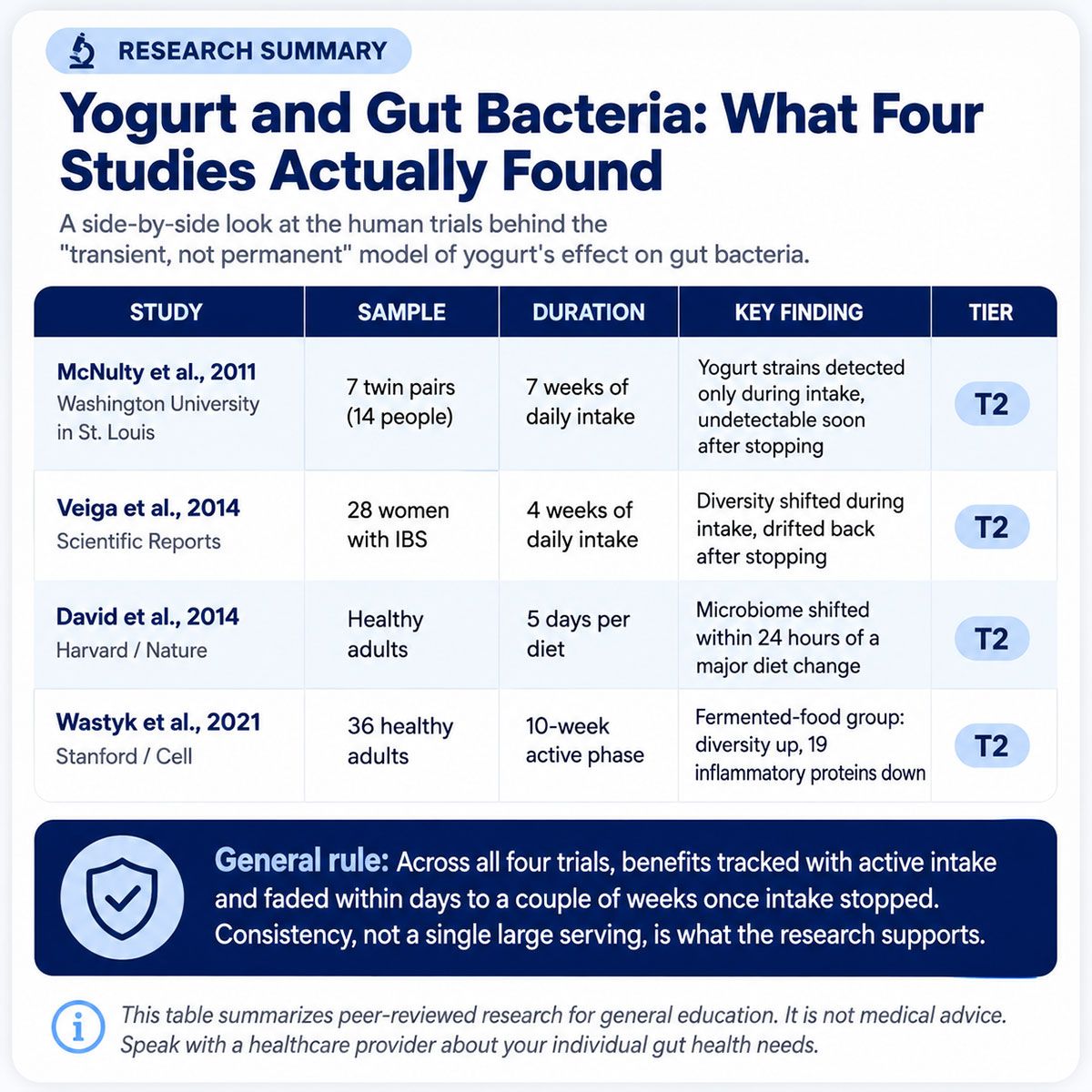
Yogurt was one part of a broader fermented-food pattern in that trial, not the only variable being tested, so the result belongs to the category rather than to yogurt specifically. Still, yogurt was the easiest and most consistent way most participants reached their daily servings, which is its own kind of evidence.

How Long Before You’d Actually Notice a Difference?
Nobody has run a trial that pins down the exact day yogurt’s benefits kick in or fade. The studies above get close enough to sketch an answer.
Short-chain fatty acid production and other bacterial byproducts appear to track intake closely, based on David’s 24-hour shift data and the fade-out timelines in the McNulty and Veiga studies.
That suggests measurable changes within days of starting, not weeks. Subjective digestive comfort, the kind you’d actually notice, likely takes longer to register, since it depends on more than one mechanism at once.
The honest answer on how long benefits last after you stop is less than a week, based on how quickly the transplanted strains disappeared in both colonization studies. That’s sooner than most people assume.
Gut Bacteria Countdown
See roughly how much of your yogurt's transient bacteria activity is likely still active
Not All Yogurt Earns a Place in This System
That timeline assumes the bacteria in your yogurt were alive to begin with. None of it matters if they were dead before you ate them.
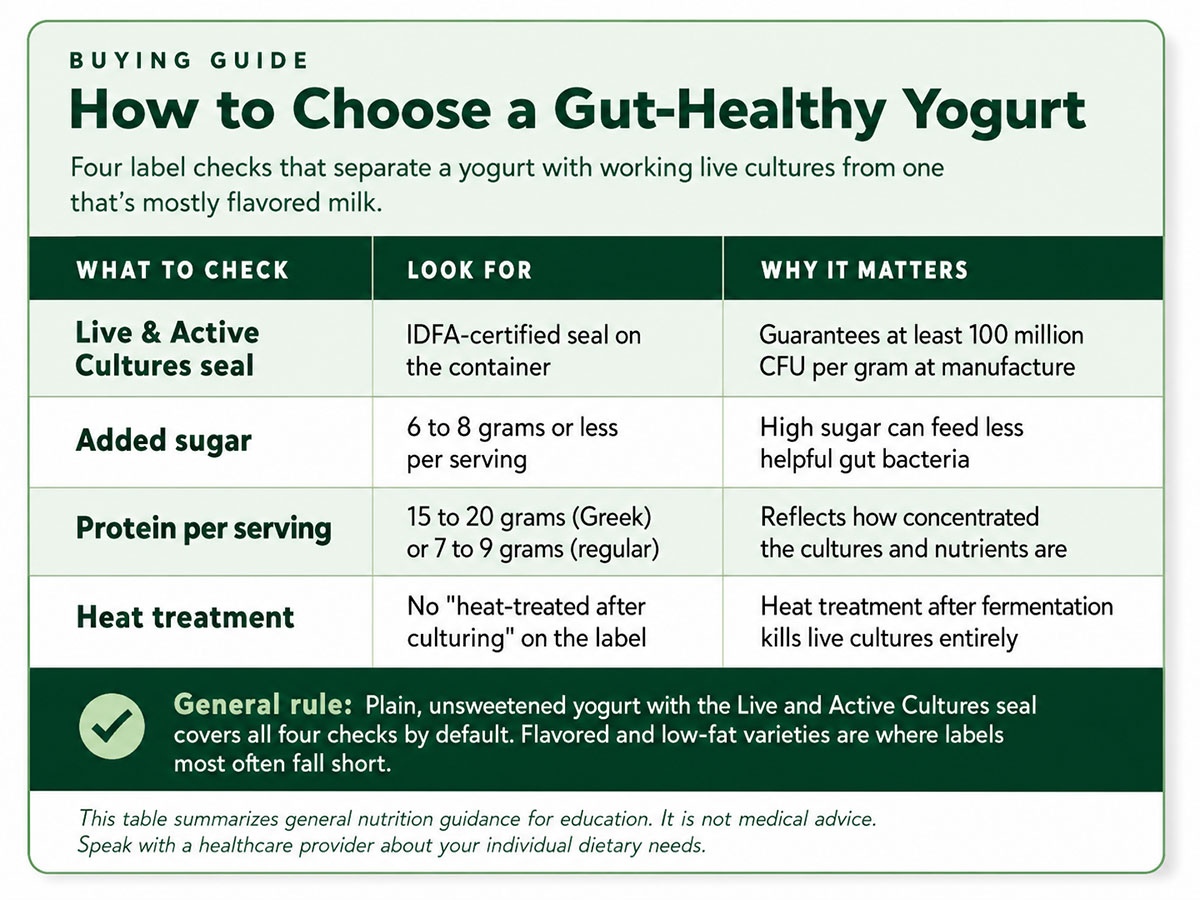
Stomach acid is harsh, and some commercial yogurt has been heat-treated after fermentation, which kills the live cultures entirely. Look for the Live and Active Cultures seal from the International Dairy Foods Association. It guarantees at least 100 million colony-forming units per gram at the time of manufacture.
Greek yogurt and regular yogurt start from the same cultures. Straining removes whey and concentrates what’s left. That means more protein per serving, typically 15 to 20 grams in a 6-ounce cup versus roughly half that in regular yogurt, plus a thicker matrix that some research suggests may help live cultures survive the trip through stomach acid. Regular yogurt isn’t inferior for gut health, only less concentrated, which matters more for protein goals than for bacterial survival.
Sugar works against the whole system. High-sugar yogurt can feed less helpful bacteria already living in the gut, which may offset some of what the live cultures are doing. Aim for 6 to 8 grams of added sugar or less per serving, and check the label rather than trusting a “probiotic” claim on the front of the container.
FAQs
Can yogurt lower cholesterol?
A little, maybe, depending on the strain. Certain Lactobacillus strains have shown modest reductions in LDL cholesterol in small clinical trials, but the effect is too inconsistent across strains to call yogurt a cholesterol treatment.
What are the signs of an unhealthy gut?
Bloating, irregular stool patterns, frequent digestive discomfort, and unexplained fatigue all show up in the research literature tied to microbiome imbalance. None of these signs confirm anything on their own, and at-home gut health testing remains too unreliable to fill in the gap.
Stop thinking of yogurt as something you plant. Think of it as something you rent.
The bacteria show up, do a day’s worth of work, and leave. The moment you stop paying, in the form of your next serving, the crew stops coming. That’s not a design flaw in yogurt so much as how a transient system works, and it means the seed-once-reap-forever version of gut health was never on the table.
A container of plain yogurt in the fridge looks different once you know that. It’s a subscription your gut is quietly counting on, not a one-time deposit.