Most condiments justify their existence by adding something. Bilbaina sauce does something stranger: it takes five ingredients already in most kitchens and turns them into something that tastes like it took longer than ten minutes and more effort than it did. The Basque cooks who developed it weren’t trying to complicate anything. They were doing the opposite.
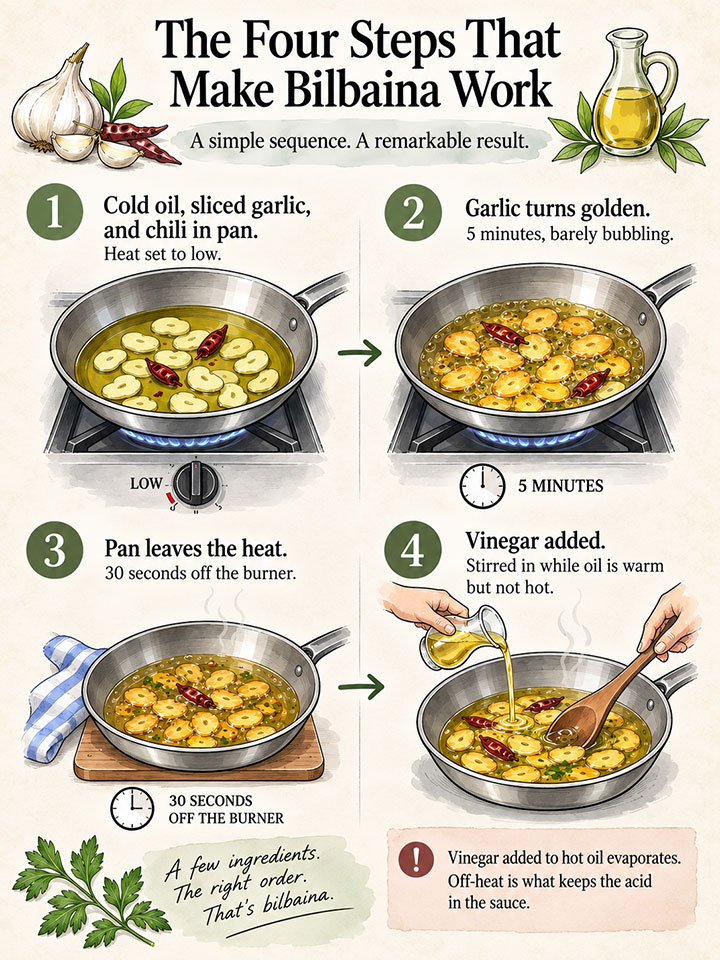
The sauce came out of Bilbao’s fishing culture, a port city that needed a way to make abundant, simply prepared fish worth eating every day. What emerged was a preparation built on sequence, not ingredients: garlic cooked slowly in olive oil until golden, heat off, a splash of vinegar added into the warm oil. That sequence is load-bearing. Change the order and the sauce falls apart.
Two centuries later, bilbaina is still made the same way. That kind of staying power doesn’t happen by accident.
Where bilbaina sauce comes from
Bilbao sits on the northern coast of Spain at the mouth of the Nervión River, with the Bay of Biscay a short distance west. Through the 19th century, as the city industrialized and its fishing operations expanded, the need for everyday, repeatable preparations grew alongside the fish supply.
Bilbaina sauce developed in that context: a way to dress freshly caught hake, cod, and sea bass that required little technique and could be scaled to a kitchen cooking for a lot of people.
The sauce spread across the Basque Country in those regional variations that are half-recognizable everywhere. Coastal towns near San Sebastián sometimes add a small amount of fish stock. Inland cooks have historically used more chili. The core preparation (garlic, oil, vinegar) held steady across all of them, because it works, and because there isn’t much to change.
Bilbaina is a close relative of the Basque refrito de ajos, the garlic fry that anchors dozens of northern Spanish dishes. The vinegar is what separates it. Without vinegar, the preparation has a different name and a different character. With it, you have bilbaina.
The ingredients that actually matter
Five ingredients. The quality of each one affects the result more than most sauce recipes allow.
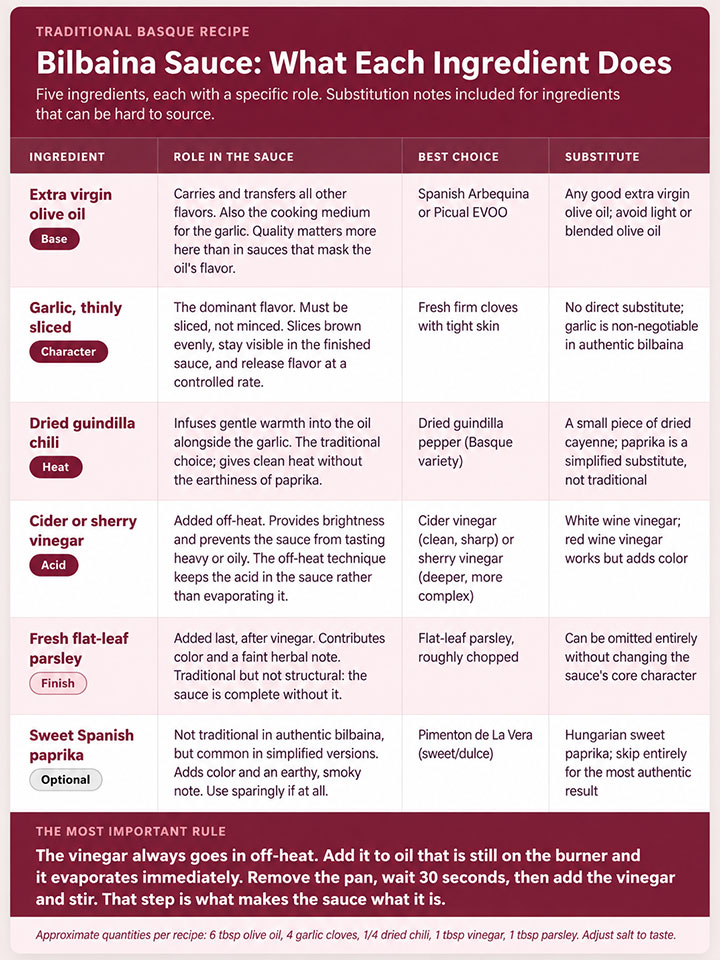
Extra virgin olive oil
The oil is the base and the carrier. It absorbs the garlic’s flavor during the fry, then picks up the vinegar’s acidity when the heat goes off. Spanish varieties give the most authentic result: Arbequina for a milder, fruitier profile, Picual for something more assertive. Any good extra virgin olive oil works.
A 2014 meta-analysis in Lipids in Health and Disease, covering 32 cohort studies and more than 840,000 participants, found that olive oil consumption was associated with reduced risk of cardiovascular events and all-cause mortality. The operative word in bilbaina is “extra virgin”: the oil is unheated until you warm it for the sauce, so its polyphenol content survives intact.
Garlic
Sliced, not minced or crushed. This is not incidental. The slice creates a larger surface area that browns more evenly and releases flavor into the oil at a controlled rate. Minced garlic fries faster, burns at the edges before the center is done, and produces a sharper, harsher flavor. The sliced garlic in authentic bilbaina should be visible in the finished sauce. It’s part of the texture.
Garlic’s active compound, allicin, forms when the clove is cut and the enzyme alliinase contacts alliin. A 2024 comprehensive review in Frontiers in Immunology documents allicin’s cardiovascular and immune-supporting activity, including its effects on blood pressure regulation and inflammatory markers.
Some of that activity decreases with extended high heat, which is one reason bilbaina’s low-and-slow approach matters: the garlic fries gently rather than searing.
Dried chili
This is where most simplified recipes (including the previous version of this article) diverge from the authentic preparation. Traditional bilbaina uses dried guindilla chili or cayenne, not paprika. The guindilla is a long, thin Basque pepper with moderate heat and a clean, slightly acidic flavor.
When sliced and added to the oil with the garlic, it infuses the fat with a gentle warmth that’s distinct from paprika’s earthier, smokier character.
Paprika is an optional addition in some versions (and a useful ingredient in its own right), but it’s not the traditional base. If guindilla isn’t available, a small piece of dried cayenne is the closer substitute. Paprika can be added in small quantities for color and a secondary flavor note, but the sauce works without it.
The guindilla version and the paprika version taste distinctly different. Worth knowing before you commit to either.
Vinegar
The vinegar goes in off-heat. This is the technical heart of the recipe. If you add vinegar to hot oil, it evaporates immediately, and you lose most of the acidity. Added into warm oil after the pan leaves the burner, it emulsifies slightly, and the acid stays in the sauce, softening as it blends.
Cider vinegar and sherry vinegar are both traditional. Cider vinegar gives a cleaner, sharper result, and sherry vinegar adds depth. White wine vinegar works as a substitute.
Fresh parsley
Stirred in after the vinegar, parsley adds color and a faint herbal note. It’s traditional and worth including, but the sauce holds together without it.
The authentic bilbaina sauce recipe
Prep time: 5 minutes. Cook time: 7 minutes. This makes enough for two to four servings over fish.
Ingredients:
- 6 tablespoons extra virgin olive oil
- 4 garlic cloves, thinly sliced
- 1/4 of a dried guindilla chili (or a pinch of dried cayenne flakes)
- 1 tablespoon cider vinegar or sherry vinegar
- 1 tablespoon fresh flat-leaf parsley, roughly chopped
- Sea salt to taste
- Optional: small pinch of sweet Spanish paprika
Method:
- Pour the oil into a cold pan. Add the sliced garlic and chili together. Place over low heat.
- Let the garlic and chili warm in the oil slowly. The oil should barely bubble. This takes patience, approximately 5 minutes. Watch the garlic. It should turn a uniform golden color, not brown at the edges. Burned garlic means starting over.
- The moment the garlic is golden, remove the pan from the heat.
- Let the pan sit off-heat for 30 seconds.
- Add the vinegar and stir. The sauce will sizzle slightly. Add parsley and salt. If using paprika, add it now and stir to combine.
- Allow to cool briefly, then pour over fish or serve at the table.
One technique note worth repeating: the pan must leave the heat before the vinegar goes in. Not reduced heat. Off the burner. That sequence is what makes the sauce work.
The sauce can be made up to three days ahead and refrigerated in a sealed container. The olive oil will solidify when cold. Bring it to room temperature before serving, then stir to recombine.
What bilbaina is actually for
In Basque cooking, bilbaina goes on white fish. That’s the orthodoxy. The sauce’s brightness cuts through the richness of pan-fried or grilled cod, hake, and sea bass in a way that heavier sauces don’t. Cold, it’s competent. Warm, the vinegar opens up in the oil and the garlic loses its edge, and the sauce becomes what it was meant to be.
The sauce has escaped its traditional boundaries. Spooned over roasted potatoes, it functions like a Spanish version of gremolata. Tossed with boiled chickpeas, it becomes a quick side dish. Drizzled over grilled asparagus, it adds enough character that nothing else is needed.
The one thing bilbaina doesn’t do well is stand up to heavily spiced or sweet preparations: the vinegar gets lost, and the garlic competes rather than complements.
Bilbaina vs. pil pil: what’s actually different
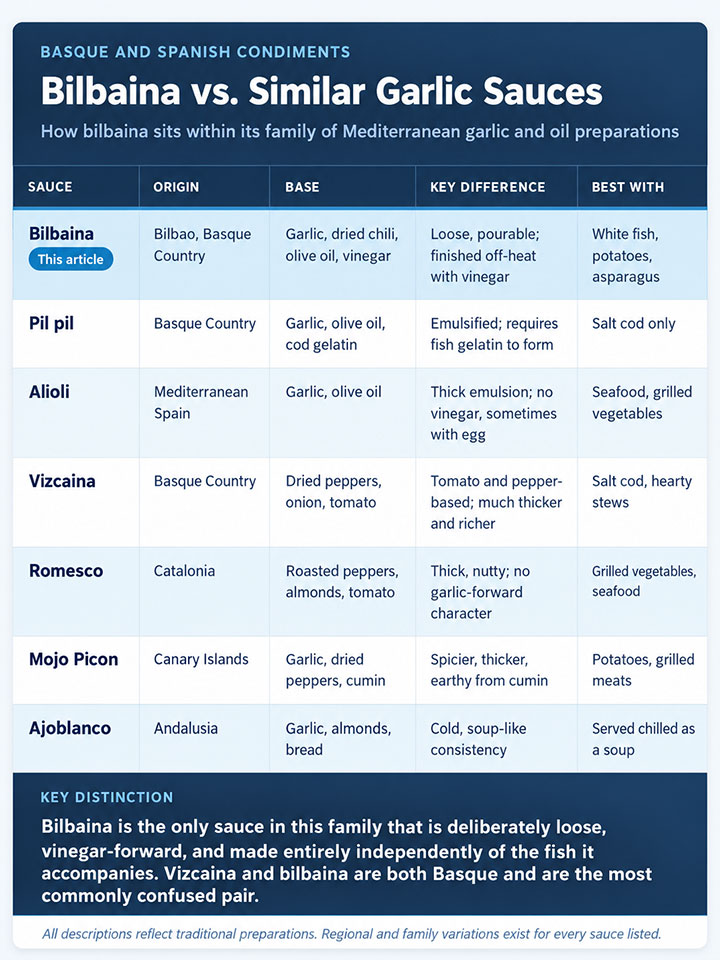
Both are Basque sauces. Both are built on garlic and olive oil. The confusion between them is understandable, but they’re made differently, and the results are completely different textures.
Pil pil requires cod specifically: the gelatin that leaches from the fish into the warm oil is what creates the sauce. The cooking technique involves constant, gentle swirling of the pan to coax the gelatin into an emulsion.
The result is thick, creamy, and inseparable from the fish that made it. Bilbaina is a standalone sauce made before the fish is plated, finished with vinegar, and loose enough to pour. You can make bilbaina without having any fish in the kitchen. You cannot make pil pil that way.
Bilbaina compared to other Spanish garlic sauces
Bilbaina sits in a family of Spanish condiments built on garlic and olive oil, but it occupies a specific position within it. Alioli is an emulsified garlic and oil sauce, thicker and richer, made without vinegar or chili. Romesco is nut and pepper-based, with a much heavier texture.
Mojo picón, from the Canary Islands, includes cumin and is typically spicier and thicker than bilbaina. Ajoblanco is essentially a cold soup built on garlic and almonds.
Vizcaína sauce (salsa vizcaína) is the one most commonly confused with bilbaina. Both are Basque. But vizcaína is tomato and dried pepper-based, considerably thicker, and has a different flavor profile entirely. If a recipe specifies one, the other is not a workable substitute.
The nutritional picture
Bilbaina is primarily olive oil, and olive oil is primarily fat: specifically oleic acid, the monounsaturated fatty acid responsible for most of its health associations. Two tablespoons of the finished sauce carry approximately 14 grams of fat, a small amount of vitamin E, and trace quantities of allicin from the garlic.
The numbers will vary by how generously the oil is measured, but the picture is consistent: this is a finishing sauce, not a cooking fat, and the amounts used per serving tend to be modest.
The calorie count for a two-tablespoon serving falls in the 120 to 150 range. The sauce is naturally vegan, gluten-free, and dairy-free.
Note: nutritional values are approximate and will vary by batch size and ingredient ratios.
Storing bilbaina sauce
Transfer the finished sauce to a clean glass jar with a lid. Refrigerate for up to one week. The flavors deepen over the first 24 hours as the vinegar and oil continue to meld. Before serving from cold, allow the jar to come to room temperature. The olive oil will have solidified in the refrigerator and needs time to loosen. Stir before using.
Bilbaina sauce is not suitable for freezing. The garlic and vinegar do not survive the freeze-thaw cycle at full quality. Fresh batches take under ten minutes, which removes most of the argument for freezing anyway.
Common problems and how to fix them
The sauce fails in predictable ways. Burned garlic produces bitterness that cannot be corrected. If the garlic browns unevenly or shows dark edges, start the oil and garlic again. Low heat and patience are the only protection against this.
If the vinegar flavor is too sharp, it usually means the vinegar was added to oil that was still very hot rather than just warm. The acid hits hot fat and sharpens rather than blending. Nothing corrects this batch, but adjusting the technique for the next one will prevent it.
If the sauce tastes flat, more vinegar or a pinch of salt is usually the fix. If the garlic flavor is harsh rather than mellow, the garlic was either undercooked or added to oil that was already hot before the garlic went in. Starting with cold oil and building the heat slowly prevents both problems.
Bilbaina Sauce Troubleshooter
Select the problem you are having. The cause and fix will appear below.
A sauce that earns its simplicity
Bilbaina sauce has stayed essentially unchanged for two centuries, not because Basque cooks lack imagination, but because the preparation was right from the start. The sequence (garlic and chili warmed slowly in oil, heat off, vinegar in) produces something the individual ingredients don’t suggest. That kind of efficiency is hard to improve on.
Most attempts to do so (more steps, more ingredients, better technique) end up with something different, not something better. Make it once, and you’ll understand why it stayed.
Frequently asked questions
What is bilbaina sauce made of?
The traditional preparation uses sliced garlic, dried guindilla chili or cayenne, extra virgin olive oil, vinegar (cider or sherry), and fresh parsley. Some versions include a pinch of sweet Spanish paprika. The simplicity of the ingredient list is the point: each one has a specific role in the flavor.
What fish goes best with bilbaina sauce?
Cod, hake, and sea bass are the traditional pairings. White-fleshed fish with a clean, mild flavor work best because they don’t compete with the vinegar and garlic. Oily fish like sardines or mackerel can work, but the sauce is more assertive against them.
Is bilbaina sauce spicy?
Mildly. The guindilla chili adds warmth rather than heat. It’s perceptible but not sharp. Using a small amount of cayenne instead produces a slightly hotter result. Omitting the chili entirely is an option if heat is a concern, though the sauce loses some of its character.
Can I make bilbaina sauce ahead of time?
Yes. Refrigerated in a sealed jar, it keeps for up to three days. The flavor improves after the first day. Bring it to room temperature before serving, as the olive oil solidifies when cold.
What is the difference between bilbaina and pil pil sauce?
Both are Basque, both use garlic and olive oil, but they’re different preparations. Pil pil depends on gelatin released by cooking cod in oil and requires an emulsification technique that takes time and attention. Bilbaina is a standalone sauce made independently of the fish, finished with vinegar, and pourable rather than creamy. They aren’t interchangeable.