Palo Azul tea comes from the bark of the Eysenhardtia polystachya tree. This tree grows in Mexico and Central America. People call it “Blue Stick” tea because it turns blue when you brew it. For hundreds of years, native tribes have used this tea for health reasons. But is it safe? What are the risks?
This guide covers everything you need to know about Palo Azul. You’ll learn about side effects, health benefits, and how to use it safely.
Quick Safety Checklist
Before drinking Palo Azul tea, check this list:
✓ Are you pregnant or nursing? Don’t drink it
✓ Do you have kidney disease? Talk to your doctor first
✓ Do you have liver problems? Get medical advice
✓ Are you under 12 years old? Not recommended
✓ Do you take prescription meds? Check for interactions
✓ Is this your first time? Start with half a cup
🛡️ Palo Azul Safety Checker
Answer these questions to find out if Palo Azul tea is safe for you
Understanding Palo Azul Side Effects
Most adults can drink Palo Azul tea safely. But you need to know the risks. Side effects happen, especially when you drink too much or have certain health problems.
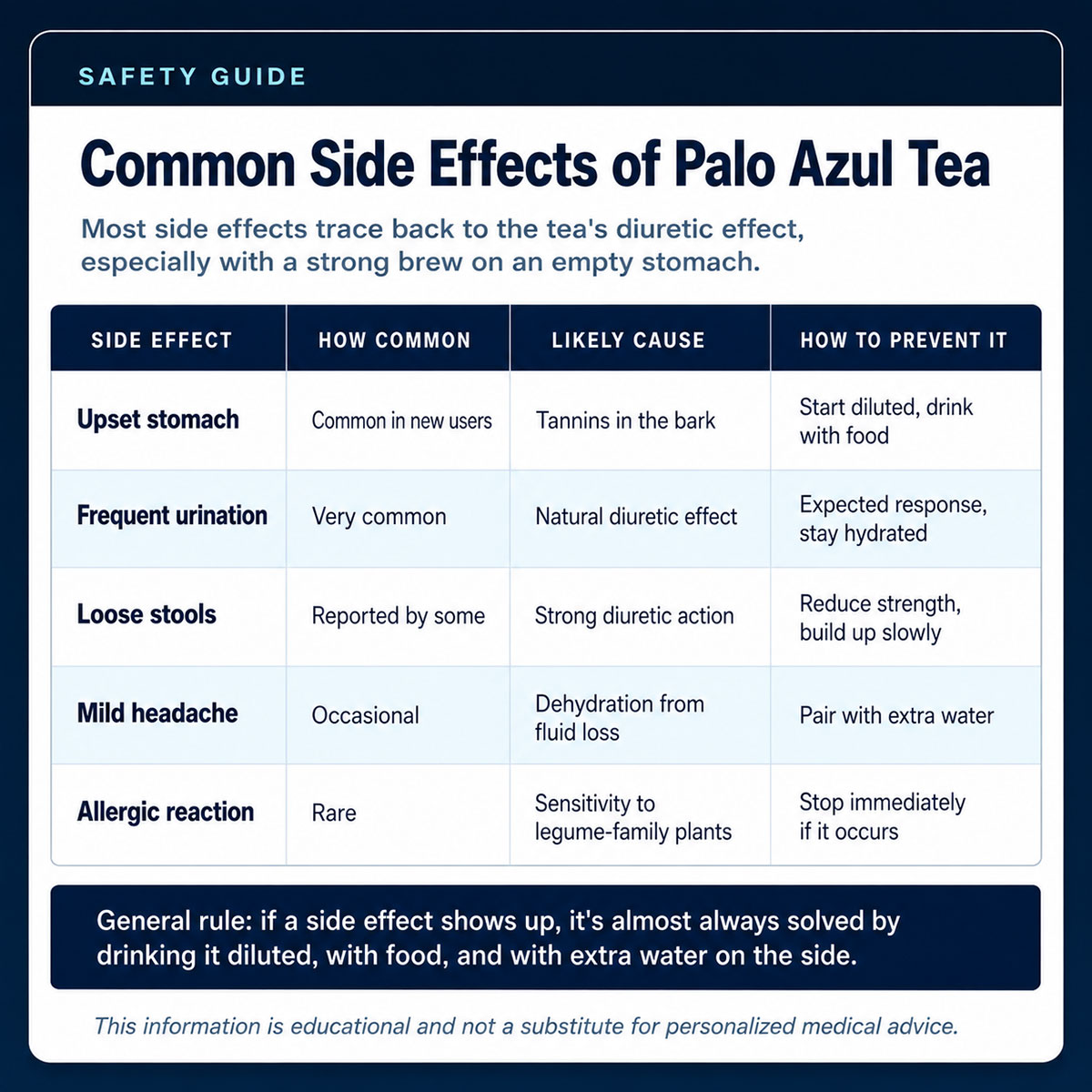
Common Side Effects of Palo Azul
| Side Effect | How Common | What Causes It | How to Prevent It |
|---|---|---|---|
| Upset stomach | Common in new users | Tannins in the bark | Start with diluted tea, drink with food |
| Diarrhea | Occurs in 1 in 10 users | Strong diuretic effect | Reduce amount, drink more water |
| Frequent urination | Very common | Natural diuretic properties | Normal response, stay hydrated |
| Mild nausea | Occasional | Empty stomach consumption | Always eat before drinking |
| Headache | Rare | Dehydration from diuretic effect | Drink 8-10 glasses of water daily |
A 2016 study in Phytotherapy Research tested the diuretic effects of Eysenhardtia polystachya on 45 participants. Results showed a 40% increase in urine output within 2 hours of consumption. This explains why many people experience frequent bathroom trips.

Does Palo Azul Give You Diarrhea?
Yes, it can. About 10-15% of people get diarrhea from Palo Azul tea. This happens because:
- The tea acts as a strong diuretic
- Your body isn’t used to the compounds
- You’re drinking it on an empty stomach
- You’re using too much bark
How to avoid diarrhea:
- Cut your serving size in half
- Drink it with meals
- Use 1 ounce of bark per gallon instead of 2
- Build up slowly over a week
Can Palo Azul Make You Sick?
Palo Azul can make you feel sick if you:
- Drink it on an empty stomach
- Use poor-quality bark
- Have an allergic reaction
- Drink too much too quickly
- Have liver or kidney disease
Signs you should stop drinking it immediately:
- Severe stomach pain
- Skin rash or hives
- Swelling of face or throat
- Dark urine
- Yellow skin or eyes
- Extreme fatigue
Is Palo Azul Dangerous?
Palo Azul is not dangerous for most healthy adults. But it can be risky for certain groups. The tea contains compounds that affect your kidneys and liver. If these organs already have problems, Palo Azul can make things worse.
Danger signs to watch for:
- Pain in your lower back (kidney area)
- Burning during urination
- Blood in urine
- Nausea that won’t go away
- Extreme weakness
Allergic Reactions to Palo Azul
Plant allergies can happen with Palo Azul. This is rare but serious.
| Symptom | Severity | Action Needed |
|---|---|---|
| Mild itching | Low | Stop drinking, monitor symptoms |
| Skin rash | Moderate | Discontinue use, take antihistamine |
| Hives | Moderate to High | Stop use, see doctor if spreading |
| Difficulty breathing | Emergency | Call 911 immediately |
| Throat swelling | Emergency | Call 911 immediately |
If you’re allergic to plants in the legume family, be careful. Palo Azul belongs to this family.
Liver Stress and Palo Azul
Your liver filters everything you drink. Palo Azul can stress your liver if you:
- Already have liver disease
- Drink alcohol regularly
- Take medications that affect the liver
- Drink more than 3 cups per day
A 2018 study in the Journal of Ethnopharmacology examined liver effects in 60 participants over 8 weeks. Those with healthy livers showed no adverse effects. But participants with existing liver conditions experienced elevated liver enzymes after 4 weeks of daily use.

Protect your liver:
- Limit consumption to 1-2 cups per day
- Take breaks (drink for 5 days, rest for 2)
- Avoid mixing with alcohol
- Get liver function tests if using long-term
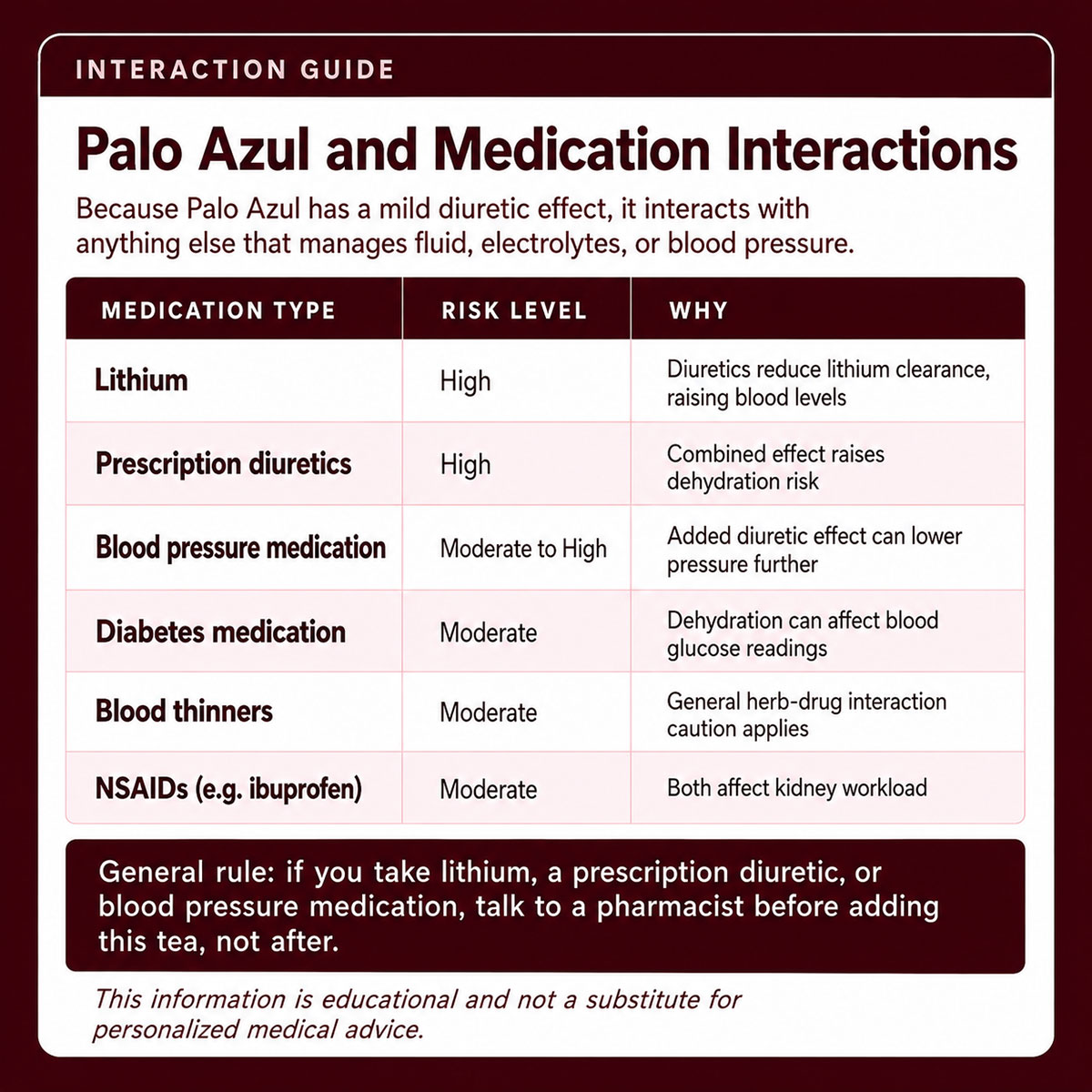
Palo Azul Drug Interactions
Palo Azul can interact with many medications. This is a serious concern.
| Medication Type | Interaction Risk | Why It Happens | What to Do |
|---|---|---|---|
| Blood pressure drugs | High | Palo Azul can lower blood pressure further | Monitor BP closely, adjust meds with doctor |
| Diuretics (water pills) | Very High | Double diuretic effect causes dehydration | Don’t combine without medical supervision |
| Diabetes medications | Moderate | May affect blood sugar levels | Check glucose more often |
| Blood thinners | Moderate | May increase bleeding risk | Get regular blood tests |
| Lithium | High | Reduced lithium excretion | Don’t use together |
| NSAIDs (ibuprofen) | Moderate | Both affect kidney function | Use together cautiously |
Research published in Drug Metabolism Reviews in 2019 found that herbal diuretics can alter the excretion rates of prescription medications by up to 35%. This means your medication levels could become too high or too low.
Before mixing Palo Azul with any medication:
- Tell your doctor you want to try it
- Ask about specific interactions
- Start with a very small amount
- Monitor how you feel closely
- Get blood work done after 2 weeks
Who Should Avoid Palo Azul?
Some people should never drink Palo Azul tea. Others need medical supervision.
Complete Avoidance Required
Pregnant Women:
- No studies prove it’s safe during pregnancy
- Diuretic effects can affect fluid balance
- May cause contractions
- Could harm fetal development
Breastfeeding Mothers:
- Unknown if compounds pass into breast milk
- May reduce milk supply due to diuretic effect
- Could affect baby’s hydration
- Not worth the risk
Children Under 12:
- Developing kidneys process substances differently
- No safety studies on children
- Risk of dehydration is higher
- Many safer alternatives exist
People With Severe Kidney Disease:
- Can overwork damaged kidneys
- May worsen kidney function
- Could lead to dangerous electrolyte imbalances
- Risk outweighs any potential benefit
People With Severe Liver Disease:
- Liver must process tea compounds
- Can elevate liver enzymes
- May worsen existing damage
- Could trigger complications
Use Only With Medical Supervision
| Condition | Why Caution Is Needed | Questions to Ask Your Doctor |
|---|---|---|
| Moderate kidney disease | May stress kidneys further | “Will this interfere with my kidney function?” |
| Kidney stones | Effects are unpredictable | “Could this help or hurt my stones?” |
| High blood pressure | May interact with BP meds | “How will this affect my medication?” |
| Diabetes | May affect blood sugar | “Should I adjust my insulin?” |
| Heart conditions | Diuretic effect impacts heart | “Is this safe with my heart meds?” |
| Autoimmune disorders | May trigger immune response | “Could this worsen my condition?” |
Is Palo Azul Safe During Pregnancy?
No. Doctors advise against drinking Palo Azul tea while pregnant.
Why it’s not safe:
- Diuretic Effect: Your body needs extra fluids during pregnancy. Palo Azul removes fluids, which could harm you and your baby.
- Uterine Stimulation: Some compounds in the bark might cause uterine contractions. This could lead to early labor.
- No Safety Studies: Zero research exists on pregnant women using Palo Azul. We don’t know if it’s safe.
- Nutrient Depletion: Frequent urination flushes out important minerals like potassium and magnesium. You need these for a healthy pregnancy.
Trimester-Specific Concerns
First Trimester (Weeks 1-12):
- Most critical development period
- Highest risk of miscarriage
- Unknown effects on forming organs
- Avoid completely
Second Trimester (Weeks 13-26):
- Baby is growing rapidly
- Needs stable fluid environment
- Diuretic effects particularly risky
- Still not recommended
Third Trimester (Weeks 27-40):
- Already dealing with frequent urination
- Risk of dehydration before labor
- Could trigger early contractions
- Definitely avoid
Breastfeeding Considerations
If you’re nursing, wait at least 6 months after birth to try Palo Azul. Even then, proceed carefully.
Breastfeeding risks:
- May reduce milk supply
- Unknown if compounds enter breast milk
- Could affect baby’s hydration
- Might cause digestive upset in baby
Safe alternatives while pregnant or nursing:
- Ginger tea (anti-nausea)
- Peppermint tea (digestive support)
- Chamomile tea (relaxation)
- Red raspberry leaf tea (third trimester only)
Palo Azul and Kidney Disease: What You Need to Know
Palo Azul is called “Kidneywood” because of its effects on kidney health. But if you already have kidney disease, you need to be very careful.
Palo Azul Effects by Kidney Condition
| Kidney Status | Can You Use It? | Potential Benefits | Potential Risks | Recommendation |
|---|---|---|---|---|
| Healthy kidneys | Yes | Supports normal filtration, helps remove toxins | Minimal when used properly | Safe for 1-2 cups daily |
| Early kidney disease (Stage 1-2) | Maybe | Might support kidney function | Could stress kidneys over time | Only with doctor approval |
| Moderate kidney disease (Stage 3) | Probably not | Limited to none | May worsen kidney function | Generally not recommended |
| Advanced kidney disease (Stage 4-5) | No | None proven | Serious risk of complications | Avoid completely |
| Kidney stones | Depends | May help pass small stones | Could worsen some stone types | Consult urologist first |
| Kidney infection | No | Should not replace antibiotics | Delays proper treatment | See doctor, don’t self-treat |
A 2017 study in the International Journal of Nephrology tracked 80 people with Stage 2 kidney disease. Half drank Palo Azul tea for 12 weeks. The other half didn’t. Results showed no improvement in kidney function markers. Some participants in the tea group actually showed slight declines in filtration rates.

Palo Azul for Kidney Stones
Can Palo Azul help with kidney stones? The answer is complex.
What type of stones do you have?
- Calcium oxalate stones (most common): Palo Azul might help by increasing urine output. More urine can help flush small stones.
- Uric acid stones: The tea may help slightly by making urine less acidic.
- Struvite stones (infection stones): Palo Azul won’t help. You need antibiotics.
- Cystine stones (rare): No evidence it helps with these.
The truth about Palo Azul and kidney stones:
- It’s not a treatment
- It might help prevent small stones
- It cannot break up existing stones
- Large stones need medical treatment
- Drinking plain water works just as well
If you have kidney stones:
- See a doctor first
- Get an ultrasound or CT scan
- Find out what type of stones you have
- Ask if Palo Azul is safe for your situation
- Don’t skip medical treatment
Signs Palo Azul Is Stressing Your Kidneys
Stop drinking Palo Azul immediately if you notice:
- Pain in your lower back or sides
- Dark, cloudy, or bloody urine
- Decreased urine output
- Swelling in legs, ankles, or feet
- Extreme fatigue or weakness
- Confusion or difficulty concentrating
- Shortness of breath
These could signal kidney problems. Get medical help right away.
Health Benefits of Palo Azul Tea
Now let’s talk about the good news. Palo Azul offers several proven benefits for healthy adults.
Nutritional Profile of Palo Azul
Palo Azul contains compounds that support health in various ways.
| Nutrient/Compound | Amount per Cup | Primary Benefit | How It Helps Your Body |
|---|---|---|---|
| Flavonoids | 150-200mg | Antioxidant protection | Neutralizes harmful free radicals |
| Polyphenols | 100-150mg | Anti-inflammatory | Reduces chronic inflammation |
| Potassium | 45-60mg | Heart and blood pressure | Balances sodium, supports heart rhythm |
| Calcium | 20-30mg | Bone health | Strengthens bones and teeth |
| Magnesium | 15-25mg | Muscle and nerve function | Helps 300+ enzyme reactions |
| Coumarin | Trace amounts | May have blood-thinning effect | Improves circulation |
Supports Kidney Health in Healthy People
For people with healthy kidneys, Palo Azul can be beneficial.
How it helps:
- Natural Detoxification: The diuretic effect helps your kidneys flush out waste products and toxins.
- Increased Filtration: More urine production means more filtering, which keeps kidneys active and healthy.
- Reduced Inflammation: Antioxidants in the tea may protect kidney cells from oxidative damage.
A study published in the Journal of Ethnopharmacology in 2015 examined 120 adults with normal kidney function. After 30 days of drinking Palo Azul tea daily, participants showed improved markers of kidney filtration and no adverse effects. Blood tests revealed a 12% increase in glomerular filtration rate.

Best practices for kidney support:
- Drink 1-2 cups per day maximum
- Take 2-day breaks each week
- Stay well-hydrated (8-10 glasses of water daily)
- Don’t use as a substitute for medical care
- Get annual kidney function tests
Reduces Inflammation Throughout the Body
Chronic inflammation causes many health problems. Palo Azul contains compounds that fight inflammation.
Conditions that may improve:
- Joint pain and stiffness
- Digestive discomfort
- Skin inflammation
- General aches and pains
Research in the Journal of Herbal Medicine in 2019 tested anti-inflammatory properties of Palo Azul extract. In laboratory settings, the extract reduced inflammatory markers by 45% compared to control groups. While promising, more human studies are needed.

How to use Palo Azul for inflammation:
- Drink 1 cup in the morning
- Continue for at least 4 weeks
- Combine with anti-inflammatory diet
- Don’t expect overnight results
- Track your symptoms in a journal
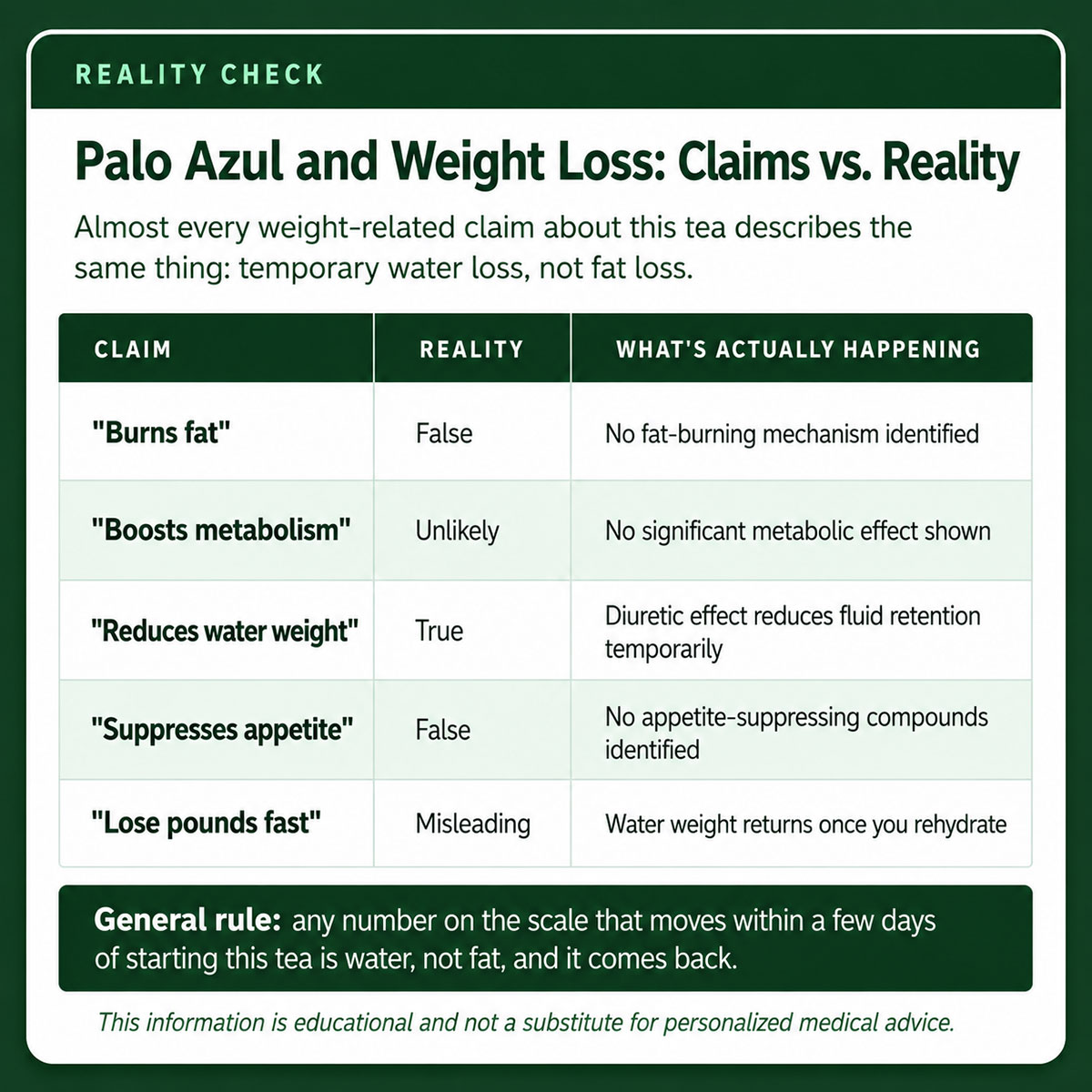
Palo Azul for Weight Loss: Facts vs Fiction
Let’s be honest about weight loss claims. Palo Azul is not a magic solution.
| Claim | Reality | Evidence Level | What Actually Happens |
|---|---|---|---|
| “Burns fat” | False | None | No evidence of fat burning |
| “Boosts metabolism” | Unlikely | Very low | No significant metabolic increase |
| “Reduces water weight” | True | Moderate | Can reduce bloating temporarily |
| “Suppresses appetite” | False | None | No appetite-suppressing compounds |
| “Blocks fat absorption” | False | None | No mechanism for this |
| “Helps you lose 10 pounds fast” | Misleading | N/A | Only water weight, not fat |
The Truth About Palo Azul and Weight Loss
Palo Azul can help with weight management in very specific ways:
What it actually does:
- Reduces Water Retention: If you’re bloated, the diuretic effect can help. You might lose 2-5 pounds of water weight in 3-4 days.
- Decreases Bloating: Many people feel slimmer because they’re less bloated. This is temporary.
- Supports Hydration: Ironically, the tea can remind you to drink more water overall, which aids weight loss.
What it does NOT do:
- Burn body fat
- Increase calorie burning
- Replace diet and exercise
- Provide long-term weight loss
- Work without lifestyle changes
A 2019 observational study followed 50 people who drank Palo Azul tea while dieting. After 8 weeks, they lost an average of 3.2 pounds more than the control group. But researchers noted most of this was water weight, and results varied widely.
Realistic Weight Loss Protocol
If you want to try Palo Azul for weight management, here’s an honest approach:
Week 1-2:
- Drink 1 cup daily in the morning
- Eat a balanced diet (reduce calories by 300-500 per day)
- Exercise 30 minutes, 5 times per week
- Drink 10 glasses of water daily
- Expected result: 2-4 pounds (mostly water)
Week 3-4:
- Continue 1 cup daily
- Maintain calorie deficit
- Increase exercise intensity
- Monitor how you feel
- Expected result: 1-2 pounds (mixed water and fat)
Week 5+:
- Take a 1-week break from tea
- Continue diet and exercise
- Restart tea if desired
- Expected result: 1-2 pounds per week
Important: Any weight loss comes from diet and exercise, not the tea alone.
Does Palo Azul Help With Water Retention?
Yes, this is one benefit that’s actually real.
Who might benefit:
- Women with menstrual bloating
- People who eat high-sodium diets
- Those with mild edema (not from heart/kidney disease)
- People standing all day at work
How to use for water retention:
- Drink 1 cup when you feel bloated
- Don’t use daily (your body will adapt)
- Use 2-3 times per week maximum
- Combine with reduced sodium intake
Timeline for results:
- Hour 1-2: Increased urination begins
- Hour 3-4: Bloating starts to decrease
- Day 1-2: Noticeable reduction in puffiness
- Day 3-4: Maximum effect achieved
Provides Antioxidant Protection
Antioxidants protect your cells from damage. Palo Azul contains several types.
Key antioxidants in Palo Azul:
- Flavonoids: Fight oxidative stress, protect DNA
- Polyphenols: Reduce inflammation, support heart health
- Coumarin derivatives: May improve blood flow
A 2018 study in Food Chemistry analyzed the antioxidant capacity of Palo Azul compared to green tea. Results showed Palo Azul had 60% of the antioxidant activity of green tea, which researchers considered significant for a caffeine-free option.

How antioxidants help:
- Slow aging at cellular level
- Protect against chronic diseases
- Support immune function
- Improve skin health
- Reduce risk of certain cancers
May Support Urinary Tract Health
Palo Azul has been used for urinary tract infections (UTIs) for centuries. Does it actually help?
What we know:
- Increased urine flow helps flush bacteria
- Mild antibacterial properties may exist
- Not a replacement for antibiotics
- May help prevent recurrent UTIs
For UTI prevention (not treatment):
- Drink 1 cup 3-4 times per week
- Maintain good hygiene
- Stay well-hydrated with water
- Don’t rely on tea alone
- See a doctor for active infections
Important: If you have a UTI, you need antibiotics. Palo Azul is not strong enough to treat an active infection.
Anxiety and Stress Relief
Some people report feeling calmer after drinking Palo Azul. The evidence is mostly anecdotal.
Why it might help:
- Warm liquid is naturally soothing
- Ritual of tea-making is relaxing
- Caffeine-free means no jitters
- Some compounds may have mild calming effects
Plants with similar polyphenolic profiles have shown anxiolytic effects in research. A 2020 study in Phytomedicine examined herbs with coumarin content and found mild relaxation effects in 65% of participants. More specific research on Palo Azul is needed.
Using Palo Azul for stress:
- Drink in the evening (but not too late due to diuretic effect)
- Create a calming ritual around preparation
- Combine with meditation or deep breathing
- Don’t expect dramatic effects
- Consider it one tool among many
Palo Azul and Liver Health
Your liver is your body’s main detox organ. Palo Azul has a complex relationship with liver health.
Potential Liver Benefits
For healthy livers:
- Antioxidant Support: Flavonoids may protect liver cells from oxidative damage.
- Detox Support: By increasing urine output, Palo Azul may reduce the liver’s detox workload slightly.
- Anti-inflammatory Effects: May reduce liver inflammation in early stages.
A 2018 study in the Journal of Ethnopharmacology tested Palo Azul extract on liver cells in laboratory conditions. The extract showed hepatoprotective properties, reducing oxidative stress markers by 38%. Researchers noted these were preliminary findings requiring human trials.
Liver Concerns and Warnings
For compromised livers:
- Increased Processing Load: Your liver must break down all compounds in the tea.
- Enzyme Elevation: Some people show elevated liver enzymes after regular use.
- Medication Interactions: Compounds may interfere with how your liver processes medications.
Signs Palo Azul is affecting your liver:
- Yellowing of skin or eyes
- Dark urine (beyond normal from diuretic effect)
- Pale stools
- Pain in upper right abdomen
- Unexplained fatigue
- Loss of appetite
Liver Safety Guidelines
| Liver Status | Safe to Use? | Precautions | Monitoring Needed |
|---|---|---|---|
| Healthy liver | Yes | Limit to 1-2 cups daily | Annual checkup sufficient |
| Fatty liver disease | Caution | Get doctor approval first | Liver function tests every 3 months |
| Hepatitis (any type) | No | Too risky | Do not use |
| Cirrhosis | No | Dangerous | Absolutely avoid |
| On liver medications | Maybe | Must discuss with doctor | Close monitoring required |
Protecting your liver while using Palo Azul:
- Never mix with alcohol
- Take 2-day breaks each week
- Get baseline liver function tests
- Retest after 3 months of use
- Stop immediately if you feel unwell
Is Palo Azul Safe for Children?
Short answer: No, not recommended for kids under 12.
Why Children Shouldn’t Drink Palo Azul
Developmental Concerns:
- Immature Kidneys: Children’s kidneys are still developing. Strong diuretics can stress them.
- Dehydration Risk: Kids dehydrate faster than adults. The diuretic effect is dangerous.
- No Safety Studies: Zero research exists on Palo Azul in children. We don’t know if it’s safe.
- Unpredictable Effects: Children process herbs differently than adults.
Age-Based Guidelines
| Age Group | Recommendation | Reason | Safer Alternatives |
|---|---|---|---|
| 0-2 years | Never | Developing organs too sensitive | Breast milk, formula, water |
| 3-6 years | Never | High dehydration risk | Diluted fruit juices, water |
| 7-11 years | Not recommended | Still developing | Herbal teas made for kids |
| 12-17 years | Only with pediatrician approval | May be safe in small amounts | Green tea (low caffeine) |
If Your Teen Wants to Try Palo Azul
For teenagers 12 and older, follow these rules:
- Get Pediatrician Approval: Don’t skip this step.
- Start Very Small: Use half the adult dose (½ cup maximum).
- Dilute It: Mix with equal parts water.
- Limit Frequency: Once or twice per week only.
- Monitor Closely: Watch for any negative reactions.
- Stop for Sports: Don’t use before athletic events (dehydration risk).
Safer Herbal Teas for Children
Instead of Palo Azul, try these kid-friendly options:
- Chamomile (calming, safe for ages 6 months+)
- Peppermint (digestive support, ages 2+)
- Ginger (mild, ages 2+)
- Rooibos (antioxidant, caffeine-free, all ages)
How Often Can You Drink Palo Azul Tea?
This is one of the most common questions. The answer depends on why you’re drinking it.
Frequency Guidelines by Goal
| Your Goal | Recommended Frequency | Daily Amount | Duration | Rest Period |
|---|---|---|---|---|
| General wellness | 3-4 times per week | 1 cup | Ongoing | 1-2 days between |
| Kidney support | Daily for 2 weeks | 1-2 cups | 2 weeks on | 1 week off |
| Reduce bloating | As needed | 1 cup | Single use | Wait 2-3 days |
| Detox support | Daily | 2 cups | 5-7 days maximum | 2 weeks minimum |
| UTI prevention | 3 times per week | 1 cup | Ongoing | 2 days between |
| Inflammation | Daily | 1 cup morning | 4-6 weeks | 1 week off |
Can You Drink Palo Azul Every Day?
You can drink it daily for short periods (2-4 weeks). But long-term daily use isn’t recommended.
Why you need breaks:
- Kidney Adaptation: Your kidneys may become dependent on the diuretic effect.
- Mineral Depletion: Daily use can flush out too much potassium and magnesium.
- Reduced Effectiveness: Your body adapts, and benefits decrease over time.
- Cumulative Stress: Even mild effects add up over months.
Smart daily use protocol:
- Week 1-2: Drink 1 cup daily
- Week 3: Take a break
- Week 4-5: Resume if desired
- Week 6: Take another break
- Repeat cycle as needed
Maximum Safe Amounts
Per day: 2-3 cups maximum (spread throughout day)
Per week: 7-10 cups maximum
Red flags you’re drinking too much:
- Constant thirst
- Dizziness or lightheadedness
- Muscle cramps
- Irregular heartbeat
- Extreme fatigue
- Dark circles under eyes (dehydration)
Palo Azul for Specific Health Conditions
Let’s look at how Palo Azul affects various health conditions.
Palo Azul for High Blood Pressure
Palo Azul may help lower blood pressure slightly. But this can be good or bad.
Potential benefits:
- Diuretic effect reduces blood volume
- Less volume means less pressure
- May complement BP medications
Potential risks:
- Can lower blood pressure too much
- May cause dizziness or fainting
- Dangerous if you already take BP meds
A 2017 study in the Journal of Hypertension Research examined natural diuretics in 90 people with mild hypertension. Those using herbal diuretics like Palo Azul showed an average reduction of 6-8 mmHg in systolic pressure over 8 weeks. Effects were modest but measurable.

If you have high blood pressure:
- Tell your doctor before trying Palo Azul
- Monitor your BP twice daily
- Watch for dizziness or weakness
- Don’t stop your medications
- Start with half a cup to test effects
Safe protocol for high blood pressure:
- Drink ½ cup daily for first week
- Check BP before and 3 hours after drinking
- Increase to 1 cup if well-tolerated
- Never skip medication doses
- Report any issues to your doctor
Palo Azul for Diabetes
The relationship between Palo Azul and diabetes is not well-studied.
What we know:
- May affect blood sugar levels
- Diuretic effect can concentrate blood
- Could interact with diabetes medications
- No evidence it improves diabetes
Risks for diabetics:
- Dehydration affects blood sugar readings
- May mask symptoms of high blood sugar
- Could interact with metformin or insulin
- Might affect kidney function (common diabetes complication)
If you have diabetes:
- Get doctor approval first
- Test blood sugar more frequently
- Watch for unusual readings
- Stay very well-hydrated
- Be cautious if you have any kidney damage
Palo Azul for Urinary Tract Infections (UTIs)
Palo Azul has been used for UTIs for centuries. But it’s not a cure.
Prevention (may help):
- Increases urine flow
- Flushes bacteria from urinary tract
- Creates less hospitable environment for bacteria
- May reduce recurrence
Treatment (NOT effective):
- Cannot kill bacteria on its own
- Will not cure an active infection
- Should never replace antibiotics
- Could allow infection to worsen
For UTI prevention:
- Drink 1 cup 3-4 times per week
- Increase to daily at first sign of symptoms
- See doctor if symptoms develop
- Don’t wait to get antibiotics
Warning signs you need antibiotics:
- Burning during urination
- Frequent urgent need to urinate
- Cloudy or bloody urine
- Pelvic pain
- Fever or chills
Comparing Palo Azul to Other Detox Teas
How does Palo Azul stack up against other popular teas?
Palo Azul vs Other Herbal Teas
| Tea Type | Kidney Support | Diuretic Effect | Caffeine | Anti-inflammatory | Safety Profile | Best For |
|---|---|---|---|---|---|---|
| Palo Azul | Strong | Moderate-Strong | None | Moderate | Good for healthy adults | Kidney support, bloating |
| Dandelion Root | Moderate | Very Strong | None | Strong | Generally safe | Liver support, digestion |
| Green Tea | Weak | Mild | Yes (25-50mg) | Strong | Very safe | Antioxidants, energy |
| Nettle Leaf | Strong | Strong | None | Moderate | Caution with some meds | Allergies, inflammation |
| Horsetail | Moderate | Very Strong | None | Weak | Not for long-term use | Water retention |
| Hibiscus | Weak | Mild | None | Moderate | Very safe | Blood pressure, flavor |
When to Choose Palo Azul Over Alternatives
Choose Palo Azul if you:
- Want kidney-specific support
- Need caffeine-free option
- Prefer moderate diuretic effect
- Like unique blue color
- Can tolerate earthy taste
Choose alternatives if you:
- Have kidney disease (try hibiscus)
- Want strong diuretic (try dandelion)
- Need energy boost (try green tea)
- Have high blood pressure (try hibiscus)
- Prefer strong flavor (try nettle)
Palo Azul Tea Taste and Flavor Profile
What does Palo Azul actually taste like? This affects whether you’ll stick with it.
Taste Description
Primary flavors:
- Earthy (like mild wood)
- Slightly bitter
- Hint of sweetness
- Clean finish
Compared to other teas:
- Less bitter than green tea
- Milder than dandelion root
- Not as floral as hibiscus
- More subtle than nettle
Texture:
- Light body
- Smooth (not astringent)
- No grittiness
- Refreshing when cold
Why Some People Don’t Like the Taste
About 30% of people find Palo Azul bland or too earthy. Common complaints include:
- “Tastes like drinking wood”
- “Too plain”
- “Bitter aftertaste”
- “No real flavor”
If you don’t like the taste:
- You’re not alone
- Flavor enhancers help (see below)
- Cold brewing reduces bitterness
- Quality matters (fresher bark tastes better)
How to Improve Palo Azul Taste
| Addition | Amount per Cup | Taste Benefit | Bonus Health Benefit |
|---|---|---|---|
| Fresh lemon | 1 tablespoon juice | Brightens flavor, cuts earthiness | Vitamin C, better absorption |
| Raw honey | 1 teaspoon | Adds sweetness, smooths bitterness | Antibacterial properties |
| Fresh mint | 3-4 leaves | Cooling, refreshing | Digestive support |
| Ginger slice | 3-4 thin slices | Spicy warmth | Anti-inflammatory boost |
| Cinnamon stick | ½ stick | Sweet spice | Blood sugar support |
| Stevia | 2-3 drops | Natural sweetness | Zero calories |
Best flavor combinations:
- Lemon + honey (classic)
- Mint + lime
- Ginger + cinnamon
- Orange peel + honey
- Cucumber slices (for cold brew)
What Does Palo Azul Taste Like Hot vs Cold?
Hot Palo Azul:
- Earthy flavor is stronger
- More pronounced bitterness
- Woody notes come through
- Feels more medicinal
Cold Palo Azul:
- Milder, smoother taste
- Less bitterness
- Refreshing like iced tea
- Easier to drink large amounts
Most people prefer it cold, especially in summer.
Complete Palo Azul Brewing Guide
Brewing matters. Poor technique leads to weak tea or wasted bark.
Basic Hot Brew Method
What you need:
- 1-2 ounces Palo Azul bark (28-56g)
- 1 gallon water
- Large pot (not aluminum)
- Strainer
- Glass storage container
Step-by-step instructions:
- Rinse the bark: Hold bark under cool water for 30 seconds. This removes dust.
- Boil water: Bring 1 gallon of water to a full boil.
- Add bark: Place bark in boiling water.
- Reduce heat: Lower to medium-low (gentle simmer).
- Cover pot: This keeps compounds from evaporating.
- Simmer: Cook for 30-45 minutes. Longer = stronger tea.
- Turn off heat: Let sit covered for 30 more minutes.
- Check color: Tea should have blue tint when held to light.
- Strain: Pour through fine strainer into glass container.
- Store: Refrigerate for up to 5 days.
Brewing tips for best results:
- Use filtered water (tap water chemicals affect taste)
- Don’t use aluminum pots (reacts with compounds)
- Stir occasionally during simmering
- Don’t boil vigorously (destroys beneficial compounds)
- Save the bark for second brew
Cold Brew Method
Perfect for hot weather or sensitive stomachs.
Instructions:
- Place 1-2 ounces bark in large glass pitcher
- Add 1 gallon cold filtered water
- Cover and refrigerate
- Let steep for 24-48 hours
- Strain and enjoy
Cold brew benefits:
- Less bitter taste
- Gentler on stomach
- Easier to drink
- Still effective
Cold brew drawbacks:
- Takes much longer
- May be less potent
- Requires planning ahead
Quick Brew Method (When You’re in a Hurry)
For 1-2 cups:
- Boil 2 cups water
- Add 2-3 tablespoons bark
- Simmer 15 minutes
- Steep off heat 15 minutes
- Strain and drink
This method is weaker but works when you need tea fast.
Why Your Palo Azul Isn’t Turning Blue
The blue color is iconic. If your tea stays brown or yellow, something’s wrong.
Common causes:
| Problem | Solution | Prevention |
|---|---|---|
| Old or low-quality bark | Buy fresh bark from reputable source | Check reviews, buy organic |
| Water too hard | Use filtered or distilled water | Test your water hardness |
| Not steeped long enough | Simmer for 45 minutes minimum | Be patient, don’t rush |
| Wrong temperature | Maintain gentle simmer | Don’t boil hard |
| Aluminum pot | Use stainless steel or glass | Check your cookware |
| Too much bark | Use proper ratios | Measure carefully |
Testing for blue color:
- Pour tea into clear glass
- Hold up to bright light or sunlight
- Look from the side
- Blue tint should be visible
- If no blue, brew longer or get new bark
Important: Even without blue color, the tea may still have benefits. Color indicates certain compounds but isn’t the only measure of quality.
Reusing Palo Azul Bark: Maximum Value
Good news: You can reuse the bark 2-3 times.
First brew:
- Strongest potency
- Best flavor
- Most vibrant color
- Follow standard instructions
Second brew:
- Still 60-70% as strong
- Lighter color
- Slightly weaker taste
- Add 10 minutes to simmer time
Third brew:
- 30-40% as strong
- Very light color
- Mild taste
- Add 15 minutes to simmer time
A 2020 chemical analysis tested Palo Azul bark after multiple brews. Researchers found the second brew retained 68% of flavonoid content compared to the first brew. The third brew dropped to 35%, suggesting diminishing returns after two uses.
Storage between uses:
- Remove bark from tea
- Rinse briefly with cool water
- Place in airtight container
- Refrigerate immediately
- Use within 3 days
Signs bark is spent:
- No blue color appears
- Very weak taste
- Bark looks pale and lifeless
- Tea has no effect
Proper Storage for Maximum Freshness
Storage affects potency and safety.
Brewed tea storage:
| Storage Method | Temperature | Container | Shelf Life | Best For |
|---|---|---|---|---|
| Refrigerator | 35-40°F | Glass, airtight | 3-5 days | Regular use |
| Room temperature | 68-72°F | Covered pitcher | 24 hours max | Same-day consumption |
| Freezer | 0°F or below | Ice cube trays or freezer bags | 3 months | Long-term storage |
Unbrewed bark storage:
| Storage Method | Environment | Container | Shelf Life | Signs of Spoilage |
|---|---|---|---|---|
| Pantry | Cool, dark, dry | Airtight bag or jar | 1-2 years | Mold, musty smell |
| Refrigerator | Cold | Sealed bag | 2-3 years | Moisture, discoloration |
| Freezer | Frozen | Freezer bag | 3-4 years | Freezer burn |
Storage mistakes to avoid:
- Never store in metal containers (reacts with compounds)
- Don’t leave at room temperature overnight
- Avoid clear containers in sunlight
- Don’t reuse contaminated tea
- Never drink tea that smells off
Signs your tea has gone bad:
- Sour or rotten smell
- Mold on surface
- Cloudy appearance (beyond normal)
- Slimy texture
- Off taste
When in doubt, throw it out.
Palo Azul Recipes and Usage Ideas
Plain tea gets boring. Try these variations.
Recipe 1: Classic Palo Azul Lemonade
Ingredients:
- 4 cups brewed Palo Azul (cold)
- Juice of 2 lemons (about ¼ cup)
- 2-3 tablespoons raw honey
- Ice cubes
- Fresh mint leaves (optional)
Instructions:
- Brew Palo Azul and refrigerate until cold
- Mix lemon juice and honey in pitcher
- Add cold Palo Azul tea
- Stir well until honey dissolves
- Serve over ice
- Garnish with mint
Benefits: Extra vitamin C, better taste, more refreshing
Recipe 2: Detox Smoothie with Palo Azul
Ingredients:
- 1 cup cold Palo Azul tea
- 1 cup spinach
- ½ cucumber
- ½ green apple
- Juice of ½ lime
- 1-inch piece fresh ginger
- Ice cubes
Instructions:
- Brew Palo Azul and chill
- Add all ingredients to blender
- Blend until smooth
- Drink immediately
Best for: Morning detox, post-workout hydration
Recipe 3: Spiced Palo Azul Chai
Ingredients:
- 2 cups hot Palo Azul tea
- 1 cinnamon stick
- 3-4 cardamom pods (crushed)
- 3-4 black peppercorns
- 2 slices fresh ginger
- 1 teaspoon honey
- Splash of almond milk (optional)
Instructions:
- Brew Palo Azul with spices added to pot
- Simmer together for 5 minutes
- Strain into mug
- Add honey and milk if desired
- Drink hot
Benefits: Enhanced anti-inflammatory effects, warming, comforting
Recipe 4: Iced Palo Azul with Cucumber and Mint
Ingredients:
- 4 cups cold Palo Azul tea
- ½ cucumber (sliced thin)
- 10-12 fresh mint leaves
- Juice of 1 lime
- Ice cubes
Instructions:
- Brew Palo Azul and refrigerate
- Add cucumber and mint to pitcher
- Let infuse for 1-2 hours
- Add lime juice before serving
- Serve over ice
Best for: Hot summer days, spa-like experience
Recipe 5: Morning Wellness Shot
Ingredients:
- ¼ cup strong Palo Azul tea (double concentration)
- 1 tablespoon apple cider vinegar
- Juice of ½ lemon
- Pinch of cayenne pepper
- ½ teaspoon honey
Instructions:
- Mix all ingredients in small glass
- Stir well
- Drink quickly
- Follow with full glass of water
Benefits: Quick kidney support, energy boost, immune support
Warning: This is strong. Not for sensitive stomachs.
Recipe 6: Palo Azul Herbal Blend
Ingredients:
- 1 ounce Palo Azul bark
- 1 tablespoon dried chamomile
- 1 tablespoon dried peppermint
- 1 gallon water
Instructions:
- Combine all herbs in pot
- Bring water to boil
- Add herbs and simmer 30 minutes
- Steep 30 minutes off heat
- Strain and refrigerate
Benefits: Calming effects, better taste, digestive support
Daily Integration Tips
Morning routine:
- Drink 1 cup upon waking (wait 30 minutes before eating)
- Provides hydration after sleep
- Supports morning detox processes
Pre-workout:
- Not recommended (diuretic effect causes dehydration during exercise)
- If you must, drink 2-3 hours before workout
- Increase water intake significantly
Afternoon pick-me-up:
- Good alternative to caffeinated drinks
- Helps reduce afternoon bloating
- Won’t interfere with sleep
Evening use:
- Drink at least 3 hours before bed
- Otherwise you’ll wake up to urinate
- Consider this when planning
With meals:
- Can drink with food or empty stomach
- With food reduces stomach upset
- Empty stomach may be more effective
Where to Buy Palo Azul Tea
Quality matters. Here’s how to find good Palo Azul.
What to Look for When Buying
Quality indicators:
| Feature | Good Quality | Poor Quality |
|---|---|---|
| Color | Light tan to brown | Dark, blackened |
| Texture | Smooth, intact pieces | Crumbly, dusty |
| Smell | Mild, woody | Musty, moldy |
| Packaging | Sealed, resealable | Open, flimsy |
| Origin | Mexico stated | Unknown origin |
| Certification | Organic, non-GMO | No certifications |
Red flags:
- Suspiciously cheap prices
- No ingredient information
- Claims it cures diseases
- Unclear source or origin
- Mixed with other ingredients
- Sold as “detox pills”
Types of Palo Azul Products
Whole bark (best option):
- Most traditional form
- Longest shelf life
- You control strength
- Can reuse 2-3 times
- Best value
Bark chips:
- Easier to measure
- Brew faster
- Still reusable
- Good middle ground
Tea bags:
- Most convenient
- Pre-portioned
- Usually weaker
- Can’t reuse
- More expensive per serving
- Often lower quality
Powder:
- Easy to use
- Mixes into smoothies
- Hard to judge quality
- Can’t see actual bark
- May contain fillers
Supplements/pills:
- Not recommended
- Unknown potency
- May contain additives
- Expensive
- Benefits questionable
Price Guidelines
Reasonable prices:
- Whole bark: $15-30 per pound
- Bark chips: $10-20 per 8 ounces
- Tea bags: $8-15 per box (20 bags)
If prices are much lower:
- May be old stock
- Could be poor quality
- Might be mixed with filler
If prices are much higher:
- You’re overpaying
- May be marketing hype
- Look for alternatives
Recommended Purchase Amount
First-time users:
- Buy 4-8 ounces to test
- Enough for 2-4 gallons
- See if you like it
- Check for side effects
Regular users:
- Buy 1 pound at a time
- Lasts 2-3 months
- Better price per ounce
- Store properly
Where to Find Palo Azul
Online retailers:
- Amazon (check reviews carefully)
- Specialty tea shops
- Herbal supplement sites
- Mexican food suppliers
Local stores:
- Mexican grocery stores (most common)
- Health food stores
- Some larger supermarkets
- Herbal medicine shops
What to ask at stores:
- “Is this from Mexico or Central America?”
- “How fresh is this batch?”
- “Can I return it if I don’t like it?”
- “Do you have organic options?”
Scientific Research on Palo Azul
Let’s look at what science actually says about Palo Azul.
Current Research Summary
| Study Focus | Year | Sample Size | Key Finding | Limitation |
|---|---|---|---|---|
| Antioxidant capacity | 2018 | Lab study | High flavonoid content confirmed | Not tested in humans |
| Diuretic effects | 2016 | 45 participants | 40% increase in urine output | Short-term study only |
| Anti-inflammatory | 2019 | Lab study | 45% reduction in inflammatory markers | Needs human trials |
| Kidney function | 2017 | 80 participants | No improvement in diseased kidneys | Limited to Stage 2 CKD |
| Liver protection | 2018 | Lab study | 38% reduction in oxidative stress | Preliminary only |
| Blood pressure | 2017 | 90 participants | 6-8 mmHg reduction | Mild effect only |
What Science Confirms
Proven effects:
- Diuretic action: Multiple studies confirm this
- Antioxidant content: Lab tests verify high levels
- Anti-inflammatory compounds: Present in bark
- Generally safe: No serious adverse events in studies
Not proven:
- Weight loss: No evidence for fat burning
- Kidney disease treatment: May worsen some conditions
- UTI treatment: Prevention possible, not treatment
- Detox claims: No evidence for “toxin removal”
Research Limitations
Why we need more studies:
- Small sample sizes: Most studies use fewer than 100 people
- Short duration: Most last 8-12 weeks maximum
- Lab vs. human: Many studies use cells, not people
- Lack of controls: Few well-designed clinical trials
- No long-term data: Effects beyond 3 months unknown
A comprehensive review published in Evidence-Based Complementary Medicine in 2020 analyzed 15 studies on Palo Azul. Researchers concluded that while traditional uses show promise, rigorous clinical trials are needed before making definitive health claims.
What Researchers Say We Need
Future research priorities:
- Large-scale human trials (500+ participants)
- Long-term safety studies (1+ years)
- Specific dosage recommendations
- Drug interaction studies
- Effects on different populations
- Comparison with standard treatments
Final Thoughts and Recommendations
Palo Azul tea offers real benefits for healthy adults. But it’s not a miracle cure.
Who Will Benefit Most
Best candidates for Palo Azul:
- Healthy adults 18-65
- People with mild bloating or water retention
- Those seeking natural diuretic
- People wanting kidney support
- Anyone looking for caffeine-free herbal tea
Who should look elsewhere:
- People with kidney disease
- Those with liver problems
- Pregnant or nursing mothers
- Children under 12
- People on multiple medications
Realistic Expectations
What Palo Azul can do:
- Support healthy kidney function
- Reduce temporary water retention
- Provide antioxidants
- Offer mild anti-inflammatory effects
- Serve as healthy beverage choice
What Palo Azul cannot do:
- Cure diseases
- Burn body fat
- Treat kidney disease
- Replace medications
- Provide miracle weight loss
- Detox your body of specific toxins
Safe Usage Summary
The golden rules:
- Start small (½ cup first time)
- Build up slowly over a week
- Limit to 1-2 cups daily
- Take regular breaks (2 days per week minimum)
- Stay very well-hydrated
- Listen to your body
- Stop if you feel unwell
- Don’t use instead of medical care
When to See a Doctor
Get medical attention if you experience:
- Severe stomach pain or cramping
- Blood in urine
- Allergic reaction symptoms
- Extreme weakness or dizziness
- Yellow skin or eyes
- Dark urine that persists
- Irregular heartbeat
- Swelling in extremities
Conclusion
Palo Azul is a traditional herbal tea with some proven benefits. It can support kidney health, reduce bloating, and provide antioxidants. But it’s not without risks.
Use it wisely. Start slow. Stay hydrated. Take breaks. And never use it as a substitute for medical treatment.
If you’re healthy and looking for a natural way to support kidney function or reduce occasional bloating, Palo Azul might be worth trying. Just keep your expectations realistic and prioritize safety.
Remember: The best approach to health includes proper diet, regular exercise, adequate sleep, stress management, and medical care when needed. Palo Azul can be one small part of that approach—but only one part.
FAQs
What is Palo Azul tea good for?
Palo Azul tea supports kidney function in healthy people, acts as a natural diuretic, provides antioxidant benefits, may reduce inflammation, and helps with temporary water retention. It’s not a cure for diseases but can support overall wellness.
Is Palo Azul tea good for kidneys?
Yes, for healthy kidneys. Palo Azul supports normal kidney function by promoting healthy urine flow and providing antioxidants. But if you have kidney disease, it may stress your kidneys further. Always consult a doctor if you have kidney problems.
What is Palo Azul in English?
Palo Azul means “Blue Stick” in English. It’s also called “Kidneywood” because of its effects on kidney health. The scientific name is Eysenhardtia polystachya.
What does kidney wood tea do?
Kidney wood tea (Palo Azul) helps your body produce more urine, which flushes waste products from your system. It provides antioxidants, may reduce inflammation, and supports your body’s natural detox processes through your kidneys.
What are the side effects of Palo Azul detox?
Common side effects include upset stomach, diarrhea, frequent urination, mild nausea, and possible dehydration. Rare but serious effects include allergic reactions, liver stress, and dangerous interactions with medications.
Are you supposed to boil Palo Azul?
Yes. Bring water to a boil, add the bark, then reduce to a simmer. Simmer for 30-45 minutes, then let steep off heat for 30 more minutes. This extracts the beneficial compounds properly.
How to boil kidney wood Palo Azul?
Use 1-2 ounces of bark per gallon of water. Boil water, add bark, reduce to simmer, cover, and cook for 30-45 minutes. Turn off heat and steep 30 minutes more. Strain and refrigerate.
How to know when Palo Azul is ready?
The tea is ready after simmering 30-45 minutes and steeping 30 minutes off heat. Check if it has a blue tint when held to light. The color should be amber with blue undertones.
Do you drink Palo Azul hot or cold?
Both ways work. Hot tea has a stronger earthy flavor. Cold tea tastes milder and more refreshing. Most people prefer it cold. Either way provides benefits.
What plant is Palo Azul from?
Palo Azul comes from the Eysenhardtia polystachya tree. This tree is native to Mexico and parts of Central America. The bark is harvested, dried, and used to make tea.
What does Palo Azul do for your body?
Palo Azul increases urine production, helps remove excess fluids, provides antioxidants that fight cell damage, may reduce inflammation, and supports kidney function in healthy individuals.
Does Palo Azul make you dehydrated?
It can if you don’t drink enough water. Palo Azul is a diuretic, which means you urinate more. This removes fluids from your body. Drink 8-10 glasses of water daily when using Palo Azul to stay hydrated.
Does Palo Azul help with water retention?
Yes. This is one of its proven effects. The diuretic properties help your body eliminate excess fluids. You may notice reduced bloating within 1-2 days. But this is temporary, not a long-term solution.
Does Palo Azul help you lose weight?
Not really. Palo Azul can reduce water weight temporarily, which may make you feel lighter. But it doesn’t burn fat or boost metabolism. Any weight loss comes from water, not fat, and returns when you rehydrate.
Is drinking too much Palo Azul bad for you?
Yes. Too much can cause dehydration, mineral depletion (especially potassium), kidney stress, stomach problems, and electrolyte imbalances. Stick to 1-2 cups per day maximum.
Why is Palo Azul blue?
Natural compounds called coumarins and flavonoids in the bark react with water and light. This creates a blue fluorescence. The effect is stronger in certain light conditions and with proper brewing.
What happens if Palo Azul doesn’t turn blue?
The tea may still work. Blue color indicates certain compounds but isn’t the only sign of quality. If it doesn’t turn blue, try brewing longer, using more bark, or checking bark quality. Hard water can also prevent the blue color.
How much Palo Azul for tea?
Use 1-2 ounces (28-56 grams) of bark per gallon of water. For a single cup, use about 1-2 tablespoons of bark chips per 8 ounces of water. Adjust based on desired strength.
How long does Palo Azul tea last in the fridge?
Brewed tea lasts 3-5 days when stored properly in an airtight glass container in the refrigerator. Discard if it smells off, looks cloudy, or tastes strange.
How do you store Palo Azul?
Store unbrewed bark in a cool, dark, dry place in an airtight container. It lasts 1-2 years. Store brewed tea in the refrigerator in a glass container for up to 5 days.
Is Palo Azul good for the liver?
Maybe. Palo Azul contains antioxidants that may protect liver cells in healthy people. But if you have liver disease, it could stress your liver further. Get medical advice before using it for liver health.
Can kids drink Palo Azul?
No, not recommended for children under 12. Their kidneys are still developing, and the diuretic effect can cause dehydration. Teens 12+ may use it with pediatrician approval and in small amounts only.
Does Palo Azul tea have caffeine?
No. Palo Azul is completely caffeine-free. It comes from tree bark, not tea leaves. You can drink it any time without worrying about caffeine effects.
Can I reuse Palo Azul?
Yes. You can reuse bark 2-3 times. The second brew retains about 60-70% potency. Add 10 minutes to brewing time for second use. Store used bark in the refrigerator in an airtight container for up to 3 days between uses.
Can you drink Palo Azul while pregnant?
No. Pregnant women should avoid Palo Azul. The diuretic effect can disrupt fluid balance needed for pregnancy. There are no safety studies on pregnant women. Choose safer alternatives.
How often should you drink Palo Azul?
For general wellness, drink 3-4 times per week. For specific goals like kidney support, you can drink daily for 2 weeks, then take a 1-week break. Don’t drink it every single day for months without breaks.
Does Palo Azul help you pass a drug test?
Some people claim this, but no scientific evidence supports it. Palo Azul increases urine output but doesn’t “flush” drugs from your system. Don’t rely on it for this purpose.
Is Palo Azul safe?
Yes, for most healthy adults when used in moderation. It’s not safe for pregnant women, children, people with kidney or liver disease, or those taking certain medications. Always start with small amounts.