Not every brain fog fix works on the same timeline. These nine habits are organized by how quickly they work, so you know exactly where to start.
The standard advice for brain fog sounds reasonable until you actually need it. Sleep better. Eat cleaner. Reduce stress. Each of those suggestions requires weeks of consistent behavior before anything changes. Meanwhile, you have a meeting in an hour and your thinking feels like it’s happening underwater.
This guide takes a different approach. Instead of lifestyle overhauls, it looks at micro-habits: small, specific actions that work with how your brain’s biology actually operates, not against it. Some produce noticeable changes within minutes. Others need a few days. The difference matters, so the habits here are organized by how fast they work.
One of the habits on this list will probably surprise you. The caffeine one. The evidence for it is weaker than everything else here, and the guide says so directly. A brain fog resource that tells you the truth about its own limits is worth more than one that presents every recommendation with equal confidence.
What’s Actually Happening When You Feel Foggy?
Brain fog describes a cluster of cognitive symptoms: slow processing speed, poor concentration, difficulty retrieving words, and a general sense that thinking requires more effort than it should. These symptoms share a common upstream cause: your brain is not operating in the conditions it needs to function well.
The conditions that matter most are blood flow to the prefrontal cortex (the region that handles focus and decision-making), blood glucose stability, circadian rhythm alignment, hydration, and adenosine clearance. When any of these is off, cognitive performance drops. The biology behind this is consistent. The practical question is which input is most off for you right now.
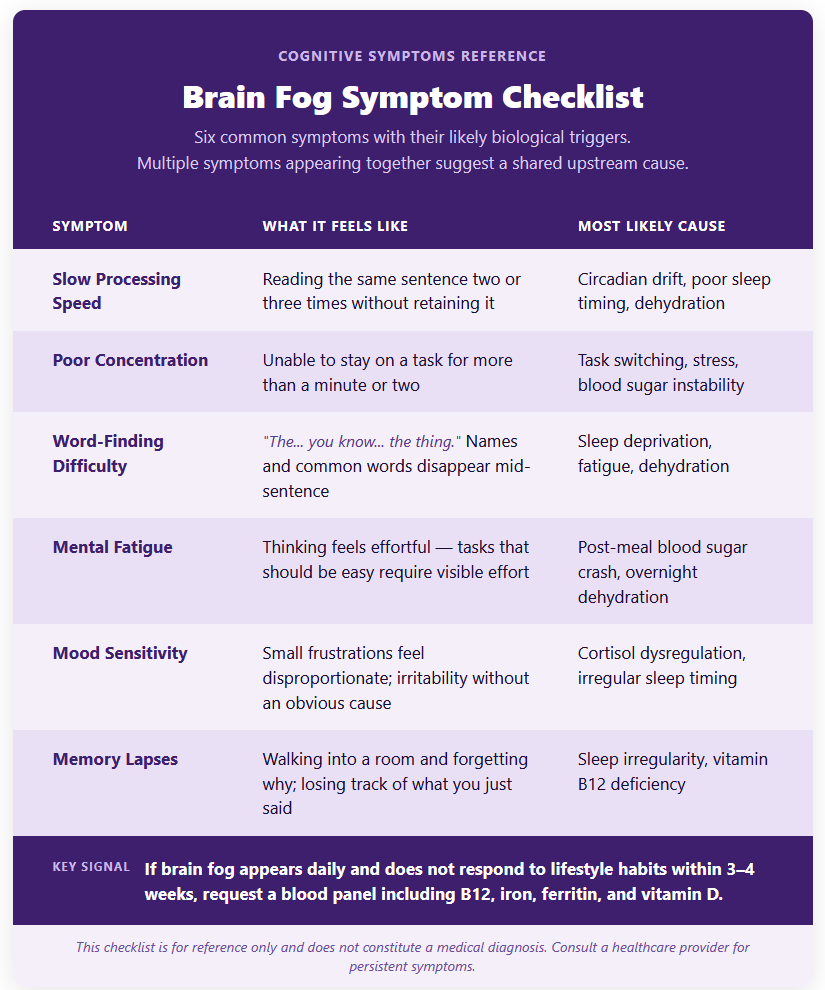
The habits in this guide address each of those inputs. They are not therapies for brain fog caused by a medical condition. If you have hypothyroidism, post-viral syndrome, autoimmune disorders, or severe nutritional deficiencies, these habits may help at the margins, but they will not fix the underlying cause. That section is covered at the end of this guide.

The Instant Resets: Results Within 5–30 Minutes
Habit 1: The 5-Minute Vagus Nerve Reset
Try this right now, even if you’re skeptical. Set a timer for five minutes. Breathe in for four seconds, out for six. You can do this at a desk without anyone noticing.
The reason it works has nothing to do with relaxation as a general concept. Your nervous system runs on two competing modes, and when stress tips you into the sympathetic one, blood flow actively redirects away from your prefrontal cortex (the region that handles clear thinking) and toward your muscles. The fog you feel under stress is partly biological. Slow breathing corrects that diversion.
The longer exhale is what does it. A 2018 systematic review in Frontiers in Human Neuroscience found that breathing at four to six cycles per minute activates the vagus nerve (the main brake pedal on the stress response). Within a single session, heart rate variability increases, prefrontal blood flow improves, and alpha-wave activity rises. These are measurable physiological shifts from a five-minute exercise that requires no equipment.
The effect is fast enough to feel during the session. Not because you’ve added something to your brain chemistry, but because you’ve removed something that was suppressing it.
Habit 2: The 10-Minute Post-Meal Walk
Post-meal brain fog has a specific cause. When you eat a meal high in refined carbohydrates, blood glucose spikes sharply, and your body releases inflammatory signaling molecules that interfere with the blood-brain barrier. The afternoon crash most people blame on their lunch is largely a blood sugar event, and like most of the fog on this list, it responds to correction rather than stimulation.
Walking corrects the shortfall directly. Contracting leg muscles pull glucose out of the bloodstream. The inflammatory cascade that follows a high-carb meal is interrupted before it peaks. A 2013 trial in Diabetes Care found that three 15-minute post-meal walks outperformed a single 45-minute workout on 24-hour glucose control. The result has held up across different populations in a 2023 systematic review of eight randomized trials, published in Sports Medicine.
After you eat, walk for 10 minutes. Pace doesn’t matter much. A casual walk around the block qualifies. Do it after lunch and the 2:00 PM crash becomes noticeably smaller within a few days of building the habit.
Habit 3: The Context-Switching Audit
Every time you switch between tasks, your brain pays a transition cost. Monsell’s influential 2003 review in Trends in Cognitive Sciences demonstrated that task switching reliably slows response times and increases error rates, with each transition requiring active mental reconfiguration.
The deeper problem is metabolic: your prefrontal cortex is one of the most energy-hungry regions in the brain, and constant task switching draws on it continuously rather than letting it recover between bursts.
The honest version of this finding is less exciting than it sounds. You probably already know that multitasking doesn’t work. What the research adds is a slightly different claim: the act of switching itself consumes the metabolic resources that should be going into the work. Both tasks end up underfunded because the transitions between them draw from the same budget.
The practical fix is also less dramatic than most productivity advice. Pick one type of work. Close every browser tab that doesn’t belong to it. Turn off notifications. Work on that one thing for 90 minutes, then stop. The goal is spending metabolic budget on the work, not on the transitions between work.
Of all the habits here, this one requires no specific timing, no equipment, and nothing external. It also produces the most resistance in people who rely on the feeling of constant responsiveness. That resistance is worth noticing.
What Your First Hour After Waking Is Actually For: Results Within 1–3 Hours
Habit 4: The 60-Minute Light Rule
Your brain has a master clock located in a region called the suprachiasmatic nucleus. This clock controls when cortisol rises, when melatonin falls, and when your prefrontal cortex shifts into its highest-performance state.
It runs slightly longer than 24 hours on its own, which means it needs a daily input to stay synchronized. That input is light: specifically, the wavelength and intensity pattern that tells the clock it’s morning.
What happens when morning light hits your retinas has been carefully documented. The circadian pacemaker advances its timing. Cortisol peaks earlier, and alertness onset advances. The full phase-response map was established in a 2003 Journal of Physiology study that exposed participants to precisely calibrated light pulses across different circadian phases.
A 2018 literature overview on white light and alerting effects found that daytime light exposure consistently improved subjective alertness and vigilance in research participants.
The practical implication is simple, if mildly inconvenient. Get outside within 60 minutes of waking. Ten minutes of direct outdoor light at any point during that window is enough to send the circadian signal. If you live somewhere overcast for months at a stretch, a 10,000-lux light therapy lamp achieves the same effect indoors. The active ingredient is wavelength and intensity: light at the right frequency and brightness, not vitamin D synthesis.
Habit 5: The 500mL Hydration Standard
Sleep is a dehydrating process. You lose water through breathing throughout the night, and most people wake up between 1 and 2 percent below their optimal hydration level. That number sounds small, but for a brain that is roughly 75 percent water, it isn’t.
Two University of Connecticut studies examined what mild dehydration actually does to cognitive function. In men, a 1.59 percent loss in body weight from dehydration impaired working memory and increased anxiety and tension, according to a 2011 study by Ganio and colleagues in the British Journal of Nutrition.
A 2012 study by Armstrong and colleagues, using an identical protocol with women, found similar effects at 1.36 percent dehydration. In both cases, the dehydration was induced under controlled conditions, but the morning hydration deficit that most people carry is well within this range.
Drink water before anything else in the morning, including coffee. Keep a 500mL bottle by the bed and drink it before getting up. Adding a small pinch of salt or an electrolyte packet speeds absorption. The cognitive benefit is noticeable within 30 to 60 minutes: tasks that felt effortful start to feel easier at their actual level of difficulty.
Habit 6: The Protein-First Breakfast
Your brain makes its primary focus neurotransmitters, dopamine and norepinephrine, from amino acids (specifically tyrosine and phenylalanine, which come from dietary protein). A cereal or toast breakfast delivers almost none of these. It spikes blood glucose and sets up the cognitive dip most people hit before 10:00 AM.
Leidy’s 2013 trial, often cited in appetite research, found something worth noting for brain fog purposes: when teenage girls ate 35 grams of protein at breakfast instead of a carb-equivalent meal, food reward brain activation dropped throughout the morning.
The original study measured hunger, not cognition. But the blood glucose mechanism is the same one that prevents the mental dip, and it is not specific to the study population.
Twenty grams of protein is the practical threshold. Three eggs, Greek yogurt with nuts, or a whey shake all qualify. The source matters less than the timing.
The Caffeine Habit Worth Questioning: Results by Mid-Morning
Habit 7: The 90-Minute Caffeine Buffer
When you wake up, cortisol rises naturally. This is called the cortisol awakening response, and it peaks roughly 30 to 45 minutes after you open your eyes. Some researchers argue that drinking coffee during this peak adds stimulation on top of an already rising alertness signal, and that this overlap may reduce the effect of both over time.
The proposed mechanism is that adenosine, the molecule that makes you feel tired, takes 60 to 90 minutes after waking to clear naturally. Waiting until it has partially cleared before introducing caffeine may let caffeine’s adenosine-blocking effects land more cleanly and reduce the tolerance that develops with habitual early morning use.
A 2008 review by Roehrs and Roth in Sleep Medicine Reviews found that under conditions of habitual adequate sleep, caffeine mainly restores performance degraded by sleepiness rather than enhancing performance above a well-rested baseline.
The timing-specific version of this argument, however, is not as well supported by direct human trials as the other habits in this guide. The cortisol-and-caffeine interaction is plausible and is widely discussed, but few studies have tested whether delaying caffeine by 90 minutes actually produces better outcomes than drinking it immediately.
Try the delay if you’re curious. If it makes your morning genuinely harder, abandon it. The stress of forcing yourself to wait for coffee may well cost more than any theoretical benefit would provide. The other eight habits here are on firmer ground. This one is worth experimenting with, not following as a rule.
The Two Habits That Change Your Baseline: Results Within 3–7 Days
Habit 8: The Sleep-Wake Anchor
Most sleep advice focuses on duration. The eight-hour target, the seven-hour minimum, the debate about nine. Duration matters, but research increasingly points to a different variable as the stronger predictor of cognitive function: consistency of sleep timing.
A systematic review by Bei and colleagues in Sleep Medicine Reviews in 2016 examined the correlates of day-to-day sleep variability across dozens of studies. Irregular sleep patterns consistently disrupted circadian alignment across multiple body systems, including brain function, independent of how many hours were being slept.
A person who sleeps seven hours at unpredictable times each night has worse cognitive outcomes than one who sleeps the same seven hours at consistent times.
The explanation is biological. You have multiple internal clocks running in parallel: one in the brain, others in the liver, pancreas, and muscles. When your sleep schedule varies by more than about 90 minutes night to night, these clocks fall out of synchrony. The prefrontal cortex, already the most sensitive brain region to sleep disruption, takes the largest performance hit.
Pick a wake time. Hold it within a 60-minute window every day. Including Saturday. Sleeping until 10:00 AM when you normally rise at 7:00 is functionally a return flight from London. Your brain adjusts, but the adjustment itself has a cost. Within three to seven days of consistent timing, most people notice that mornings feel less effortful without any change to their total sleep hours.
Habit 9: The Digital Sunset Wind-Down
Most people know that screens before bed delay sleep. What’s less discussed is why the phone isn’t even the main problem. The content is. Answering a work email at 10:30 PM doesn’t just expose your eyes to blue light.
It reactivates the parts of your brain that should be starting their shutdown sequence: the planning regions, the stress-response system, the working memory still holding whatever you haven’t solved yet. Both mechanisms, the light and the cognitive stimulation, run against you at the same time.
Consistent pre-sleep routines work through a different mechanism entirely. A 2015 review in Sleep Medicine Reviews found that repeating the same low-stimulation behaviors in the same sequence each night trains the brain to associate those behaviors with sleep. Classical conditioning, in other words: the routine itself starts triggering drowsiness before the actual sleep window opens.
This effect takes time. The first night you try it, nothing obvious happens. By the end of the first week, most people report falling asleep faster. The cognitive payoff arrives the next morning. Clearer thinking follows from better sleep quality and more consistent sleep timing. Total hours are only part of the picture.
Choose a 20-minute routine and protect it. No screens. Reading, light stretching, a warm shower, or journaling all work. The specific activity matters less than the consistency. Do it at the same time every night.
How to Actually Implement These Habits
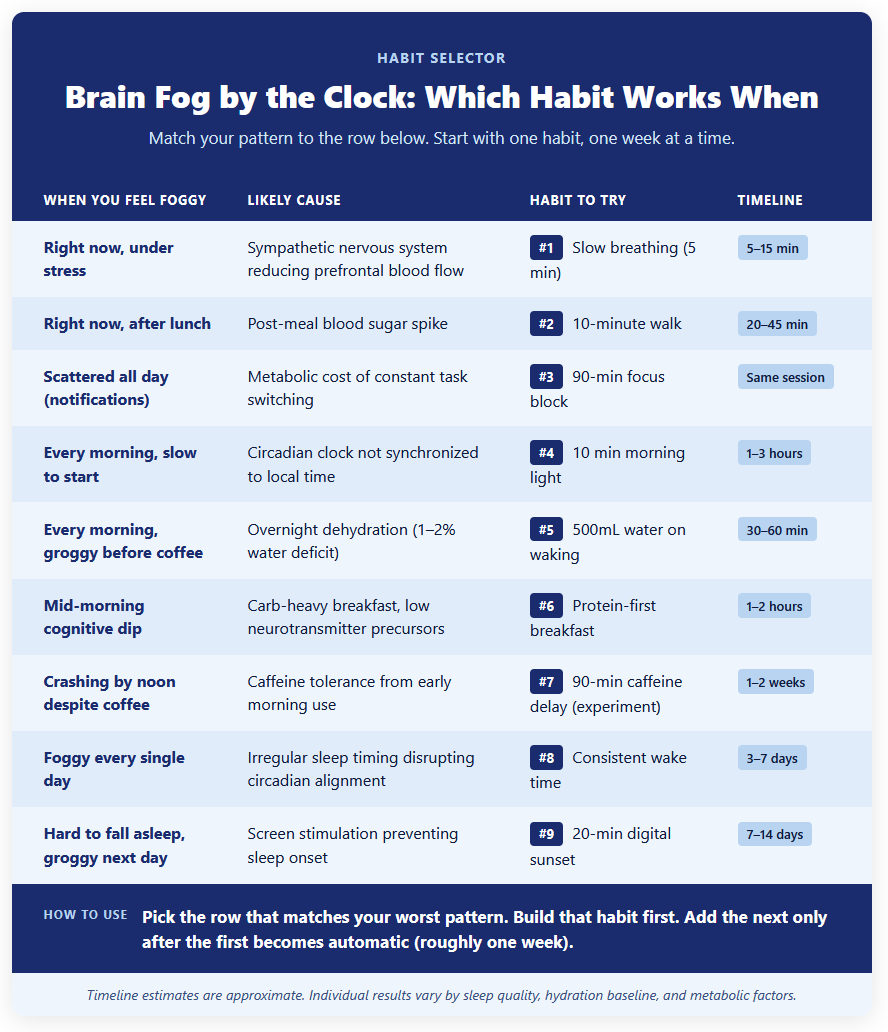
Add one habit per week. The goal is for each habit to become automatic before adding another. When you are doing something without having to think about it, that’s the cue to introduce the next one.
Start with your biggest problem:
- Foggy right now, mid-afternoon: Habit 1 (slow breathing, five minutes) or Habit 2 (walk after your next meal)
- Foggy every morning before 10:00 AM: Habits 4, 5, and 6 together, since they compound quickly
- Scattered all day from notifications and task-switching: Habit 3, extended to 90-minute work blocks
- Foggy all the time regardless of what you do: Start with Habits 8 and 9, since consistent sleep timing is the most likely root cause
When These Habits Aren’t Enough
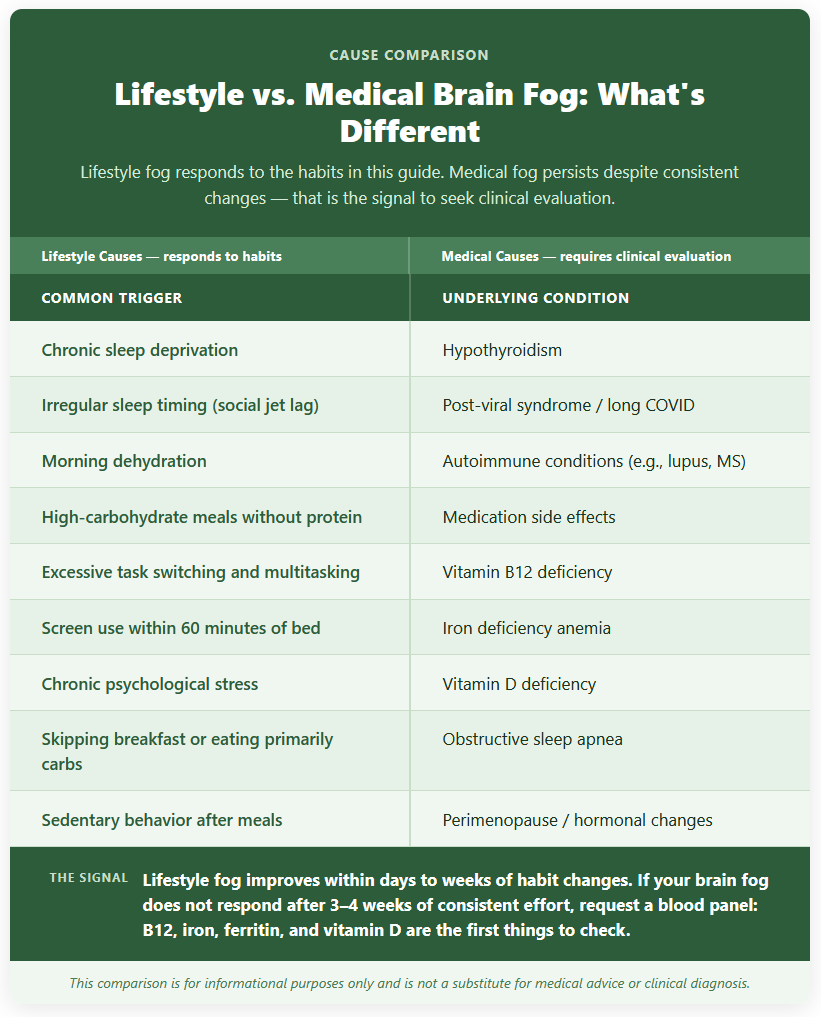
These habits work for lifestyle-driven brain fog: the kind caused by poor sleep, dehydration, blood sugar instability, circadian misalignment, or accumulated cognitive overload. They will not fix brain fog that has a different source.
If you have been consistently following these habits for three to four weeks and your brain fog has not improved, or if it is worsening, see a healthcare provider. Persistent brain fog is a symptom associated with several treatable conditions, including thyroid disorders, sleep apnea, and nutritional deficiencies that blood tests can identify.
Do Supplements Help With Brain Fog?
Supplements are the most searched aspect of brain fog management. The honest answer is that they help when the fog is caused by a deficiency, and they do almost nothing when it isn’t.
Vitamin B12 deficiency directly impairs myelin production, the fatty sheathing around nerve fibers that speeds cognitive signaling. People with low B12 levels consistently show cognitive symptoms that clear after supplementation.
The same applies to iron deficiency (which reduces oxygen delivery to the brain) and vitamin D deficiency (which is associated with fatigue and mood disruption). In these cases, supplementation corrects a documented deficiency and belongs in the category of medical treatment, not lifestyle choice.
For people who are not deficient, the evidence for most marketed “brain fog supplements,” including lion’s mane mushroom, ginkgo biloba, and most nootropic blends, ranges from inconclusive to absent in well-designed human trials.
Omega-3 fatty acids have stronger evidence for overall brain health over time, but they don’t produce the kind of same-day clarity improvement that the habits in this guide can.
Before supplementing, get a blood panel that includes B12, iron, ferritin, and vitamin D. If those come back low, address them. If they come back normal, the supplements marketed for brain fog are unlikely to move the needle.

Is Brain Fog Permanent?
For lifestyle-driven brain fog, no. The biology is reversible because the conditions causing it are reversible. Dehydration clears. Blood glucose stabilizes. Circadian rhythms re-synchronize. Sleep timing can be regularized. None of this requires pharmaceutical intervention or months of perfect behavior. Most people notice real change within a week of addressing the right input.
For brain fog caused by an underlying medical condition, the answer depends on the condition. Post-viral brain fog following COVID-19 or other illnesses can persist for months, and its mechanisms are still being studied. Thyroid-related fog typically resolves with appropriate treatment. Age-related cognitive changes are distinct from brain fog as described here and shouldn’t be conflated with it.
The most important thing to understand about brain fog is that it is feedback, not a sentence. The sensation of fuzzy, effortful thinking is your brain signaling that something is off in its operating conditions. The habits in this guide are ways of reading that signal accurately and responding to it specifically.
Where to Start
If you came to this guide needing clarity today, start with Habit 1. Five minutes, four seconds in, six seconds out. It won’t fix everything. But it will give your prefrontal cortex access to the blood flow it needs right now, and “right now” is the only timeline that actually applies when fog is sitting on you at 2:00 PM.
The person who needs a whole-life reset and the person who needs clarity in 20 minutes are not always the same person. This guide was written for both, but it was designed to be useful to the second one first.