Most people assume olive oil automatically helps with cholesterol. But after reviewing dozens of clinical trials, researchers found one overlooked factor changed everything.
Most people who already cook with olive oil assume it is doing something for their cholesterol. The bottle is on the counter. Salads get a drizzle, vegetables get a pour. The headlines have been calling it heart-healthy for years. Then the blood panel comes back, and the LDL is still elevated.
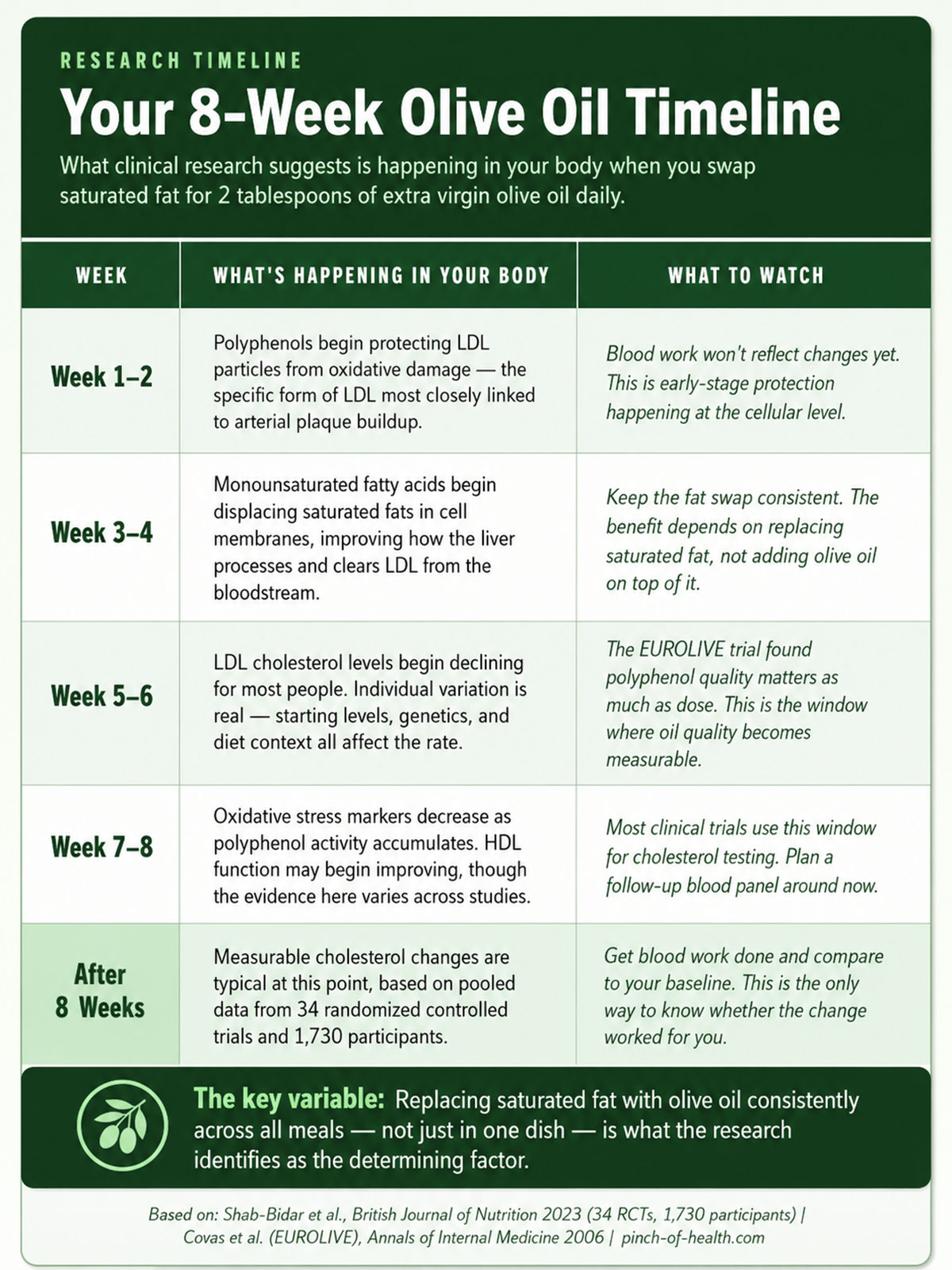
The reason is specific, and the research is consistent about it. Two tablespoons a day. Eight weeks. Those are the numbers that keep appearing across two decades of trials.
What Your Cholesterol Numbers Actually Mean
Cholesterol tests measure several different things at once. LDL, the low-density lipoprotein, is the form that accumulates in artery walls over time. Keeping LDL below 100 mg/dL is the standard target for most adults. People at elevated cardiovascular risk often aim closer to 70 mg/dL.
HDL works in the opposite direction. It removes excess cholesterol from artery walls and carries it to the liver for disposal. Men need at least 40 mg/dL. Women need at least 50 mg/dL. Higher is better in both cases. Total cholesterol, which combines all forms, should stay below 200 mg/dL.
Think of it as a bank account. LDL is money going out, accumulating as a liability against the artery wall. HDL is money coming back in, reducing that liability. Olive oil acts on both sides of that equation through different mechanisms and on different timelines.
If your LDL is only mildly elevated and you have no additional risk factors, dietary changes often produce real movement. Talk to your physician first if your numbers are significantly elevated, or if you have diabetes, hypertension, or a family history of early-onset heart disease. For many people, diet and medication work in parallel rather than as alternatives.
What the Research Actually Shows
The evidence here is more consistent than it is for most dietary interventions. When researchers at Tehran University of Medical Sciences pooled results from 34 randomized controlled trials involving 1,730 participants in a 2023 analysis for the British Journal of Nutrition, they found consistent, dose-dependent reductions in LDL cholesterol from olive oil. No single trial is decisive on its own. The pattern held across different populations, study designs, and durations.
Behind all of this is a question a 2006 European trial called EUROLIVE was designed to answer: does the polyphenol content in olive oil actually change anything, or does the benefit come purely from the fat type? The answer required two parts.
The first is the fat: olive oil is 70 to 80 percent monounsaturated fat, primarily oleic acid, which does not raise LDL the way saturated fats do, and when it replaces butter or animal fat, the liver clears LDL from the bloodstream more efficiently.
The second is slower and more specific. Extra virgin olive oil contains polyphenols, plant compounds that protect LDL particles from oxidative damage. Oxidized LDL is the form most closely linked to arterial plaque buildup. Polyphenols interrupt that process before it takes hold.
The EUROLIVE study, published in the Annals of Internal Medicine in 2006, is where polyphenol content stopped being theoretical and became measurable. Dr. María-Isabel Covas and her team at the Municipal Institute for Medical Research in Barcelona enrolled 200 healthy male volunteers across six research centers in five European countries.
Each participant received 25 mL of olive oil daily for three weeks, cycling through three oils with low, medium, and high polyphenol concentrations. The high-polyphenol oil reduced oxidized LDL significantly more than the low-polyphenol version. Same dose, same duration. Oil quality was the deciding variable.
The 8-week mark that most of these studies use as their measurement window also turns up in a small University of North Carolina pilot published in BMC Nutrition in 2018. Approximately 30 adults split across three dietary groups showed that a Mediterranean diet with olive oil as the primary fat reduced total cholesterol and LDL versus a habitual American diet, along with reduced oxidative stress markers.
With groups that small, the signal is directional rather than definitive. What makes it worth noting is not the sample size but the comparison point: a US population, the exact timeline the rest of the literature uses, and a habitual American diet as the baseline.
None of the studies above measured what happens when olive oil is added to a diet that still contains significant saturated fat. They measured what happens when it replaces saturated fat. That distinction is where most of the confusion in olive oil and cholesterol research lives, and it is worth addressing plainly before moving on.
The Replacement Rule: Why Most People Are Not Getting the Benefit
The most common reason olive oil fails to move someone’s cholesterol is also the most straightforward one. Adding olive oil to a diet that already contains significant saturated fat does not produce the same benefit that replacing that fat does. The mechanism depends on displacement, not addition.
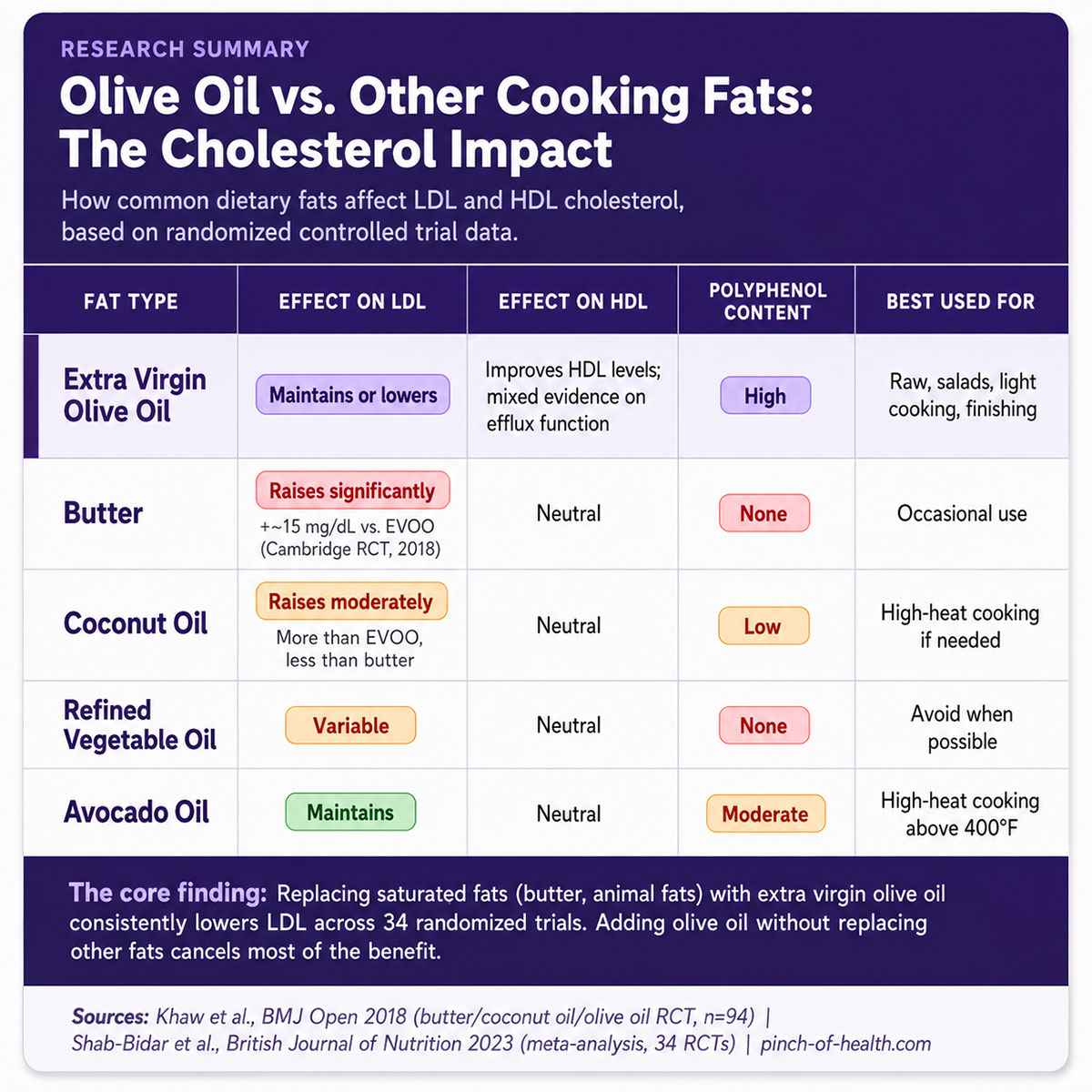
A trial at the Medical Research Council Epidemiology Unit at the University of Cambridge, published in BMJ Open in 2018, tested this directly. Ninety-four healthy adults aged 50 to 75 were randomly assigned to consume 50 grams daily of extra virgin olive oil, unsalted butter, or extra virgin coconut oil for four weeks.
Butter raised LDL by approximately 0.38 mmol/L (roughly 15 mg/dL) compared to olive oil. Olive oil produced no meaningful LDL increase at all. Butter is like adding fuel to a fire. Olive oil turns the heat down.
The reason addition fails is not only about calories. When saturated fat stays in the diet, the liver continues processing LDL at a rate that the oleic acid in olive oil cannot offset on its own. The swap changes what the liver is working with. Addition does not.
The dose-response analysis from the 2023 British Journal of Nutrition review confirmed the pattern. Replacing 10 grams of saturated fat per day with olive oil reduced total cholesterol by an average of 0.13 mmol/L and LDL by 0.16 mmol/L. Small numbers. Consistent across 34 trials, and without drug side effects or prescriptions.
The practical test is direct. If you are using olive oil on your salad while butter goes on everything else, the dressing is not doing the work you think it is. The swap has to apply across the meal, not just in one component of it.
Choosing the Right Oil
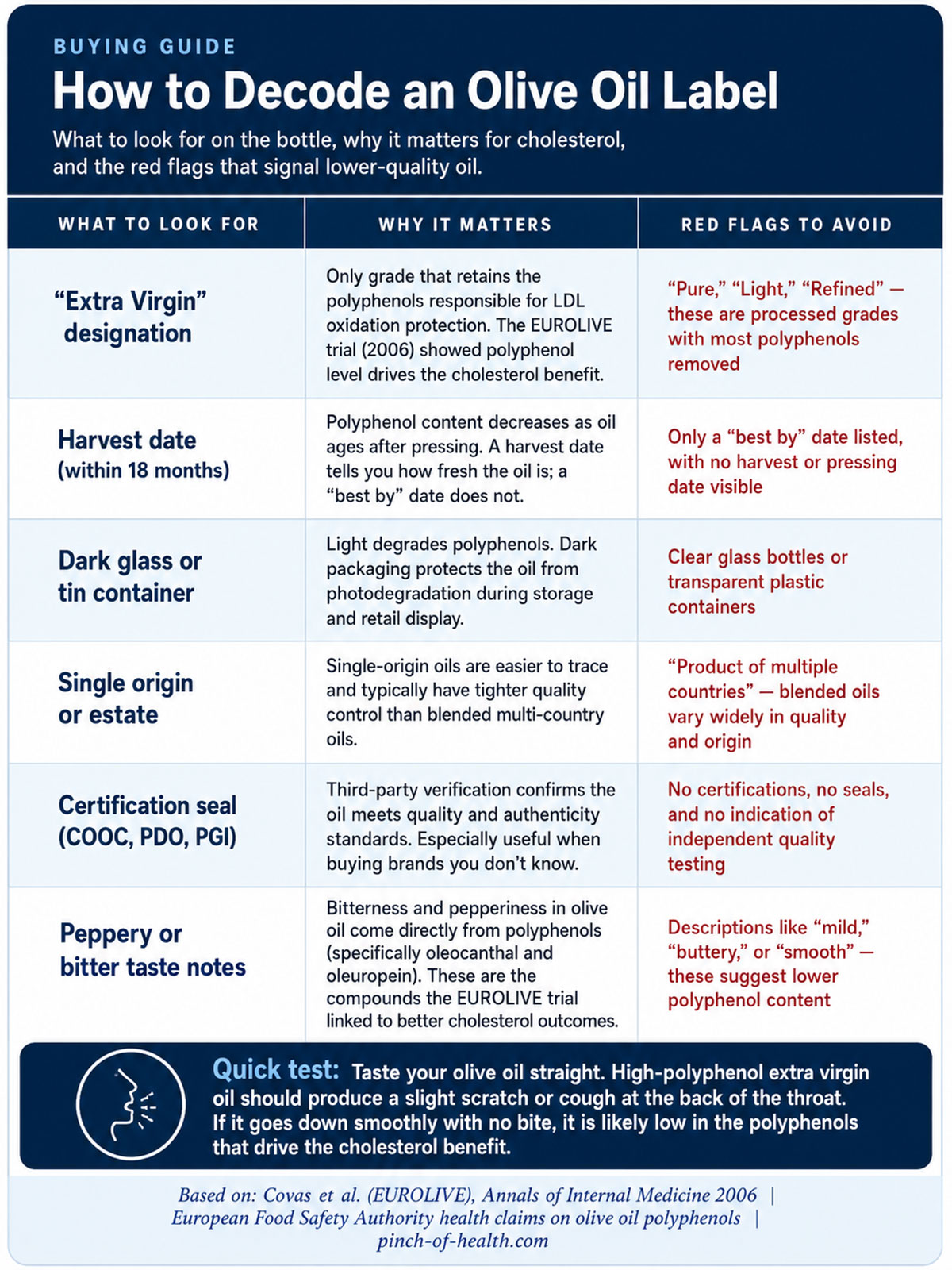
Not all olive oil delivers the polyphenol benefit the research describes. Extra virgin olive oil retains the plant compounds from the olive fruit. Refined olive oil, sold as “pure,” “light,” or simply “olive oil,” has been processed in ways that remove most of those compounds. For the cholesterol benefit, the label needs to say extra virgin.
Even within extra virgin olive oil, polyphenol content varies considerably. The EUROLIVE trial showed this directly: same dose, same duration, meaningfully different outcomes based on polyphenol concentration. That variation shows up in flavor. High-polyphenol oil is peppery and slightly bitter at the back of the throat. A smooth, neutral oil almost certainly has fewer polyphenols. If tasting the oil straight produces a faint scratch or cough, the polyphenol content is real.
If that bitterness is unfamiliar at first, a certified milder extra virgin oil is a reasonable starting point. The monounsaturated fat benefit holds regardless of polyphenol level. Most palates adjust within a few weeks and start actively seeking the peppery ones.
Harvest dates matter more than most buyers realize. Polyphenol content decreases as oil ages after pressing. Look for a harvest date rather than only a best-by date, and aim to buy oil pressed within the past 18 months. Dark glass or tin containers protect the oil from light degradation. Clear plastic bottles do not.
Certifications from recognized bodies, such as the California Olive Oil Council, Protected Designation of Origin, or equivalent European quality marks, provide independent verification that the oil is what the label claims. Price alone is not a reliable guide to quality or polyphenol content.
🫒 Olive Oil Quality Checker
Answer 6 questions to get your quality score
How Much, When, and How to Use It
Two tablespoons per day is the dose where cholesterol-related findings cluster in the research. That is 30 milliliters. Split between two meals or used all at once, the cholesterol effect appears similar across studies. The timing within the day does not appear to matter, as long as the oil is consumed with food. Fat-soluble vitamins (A, D, E, and K) absorb better when dietary fat is present, making mealtime the practical default.
Cooking temperature is where most of the polyphenol loss happens. Extra virgin olive oil has a smoke point of approximately 375°F (190°C), which handles most everyday cooking: sautéing, roasting at moderate temperatures, baking, and pan-cooking on a medium flame.
For high-heat applications above 400°F (205°C), avocado oil handles those temperatures without its beneficial compounds degrading. Save the EVOO for moderate heat, raw applications, and finishing dishes after they leave the heat.
Store your oil away from heat and light. Not next to the stove, not on a sunny countertop. A cool cabinet works well. The refrigerator also works: the oil will solidify and turn cloudy, but it returns to liquid at room temperature without any change to quality. Once opened, use the bottle within three to four months. Old oil loses its polyphenols without becoming harmful. It simply stops doing the thing you are buying it for.
Two tablespoons add 240 calories to your daily intake. If those two tablespoons replace butter or another fat you would have used anyway, the total caloric load stays roughly the same, and the cholesterol benefit follows. If they go on top of an otherwise unchanged diet, the calories will compound over time. Measuring your portions at the start, until the amount becomes intuitive, prevents this from becoming a problem.
For most people, this ends up being a salad dressing, a finishing drizzle over roasted vegetables, and a pour into a pan where butter used to go. Three places, two tablespoons, one habit.
Beyond Cholesterol: HDL Function, Inflammation, and More
LDL and oxidized LDL are not the only measures worth tracking. The research on olive oil and HDL function is more complicated than the LDL data, and more interesting for it.
A team led by Dr. Abdelouahed Khalil at the University of Sherbrooke in Canada followed 26 healthy volunteers through 12 weeks of consuming 25 mL of extra virgin olive oil daily. The 2013 study in the British Journal of Nutrition measured the capacity of HDL to remove cholesterol from cells, a function called cholesterol efflux.
HDL efflux capacity improved by roughly 10 percent in one cell model and by up to 25 percent in other cell types. That is a more meaningful outcome than a higher HDL number on a blood panel: it is HDL performing its actual function more effectively.
A more recent trial tells a different story. The OLIVAUS study, published in the British Journal of Nutrition in 2022, followed 50 healthy adults through three weeks of high-polyphenol or low-polyphenol extra virgin olive oil.
Both groups saw their HDL cholesterol levels rise. Neither group showed a significant improvement in HDL cholesterol efflux capacity. Researchers are still working out what explains the discrepancy: duration, polyphenol dose, participant characteristics, or some combination. The HDL efflux finding is not yet settled science.
The anti-inflammatory case is, if anything, more straightforward than the cholesterol one. A 2019 network meta-analysis in Frontiers in Nutrition examined 30 human intervention studies and found that inflammatory markers fell consistently with olive oil consumption, and fell more significantly in people who already had metabolic syndrome or another chronic condition.
That dose-response matters: the people most in need of the effect got the most of it. Chronic inflammation is a recognized pathway to arterial damage, which is part of why this data tends to hold up longer in cardiovascular research than any single cholesterol number.
Two other benefit areas appear in the research, though with considerably less certainty than the cardiovascular data. Insulin sensitivity improvements show up in smaller trials, typically in people with prediabetes or metabolic syndrome, which is a narrower finding than most headlines about olive oil and diabetes tend to suggest.
The cognitive picture is thinner still: the polyphenols that protect LDL from oxidation may exert similar protective effects in neural tissue, but the human trial evidence has not caught up with that theory yet. This is one to watch, not one to act on.
FAQs
How long does it take for olive oil to lower cholesterol?
That depends on where you are starting and how thoroughly you are making the fat swap. Most clinical trials that detect a clear LDL signal use an 8-week window, but the underlying variables are real: starting cholesterol level, genetics, and consistency all affect the rate. Some people see movement at 4 to 6 weeks. Others take 10 to 12. Set an 8-week mark on your calendar and get blood work done before deciding whether the approach is working or needs adjustment.
Can I cook with olive oil, or only use it raw?
Extra virgin olive oil handles moderate-heat cooking well, up to about 375°F (190°C). That covers most everyday sautéing, roasting at moderate oven temperatures, and pan-cooking on a medium flame. For high-heat cooking above 400°F (205°C), avocado oil is a better choice. Polyphenols begin degrading at high heat, which is why finishing dishes with olive oil after the cooking phase, rather than during high-heat searing or frying, preserves more of the beneficial compounds.
Will olive oil help if I’m already on statins?
Yes. Statins reduce the liver’s production of cholesterol. Olive oil works through different pathways: protecting existing LDL from oxidative damage and supporting HDL function. The two approaches are additive rather than competing. Talk to your physician before making changes to your medication or diet if your cardiovascular risk is elevated.
Is expensive olive oil worth it for cholesterol?
Price is not a reliable predictor of polyphenol content or quality. A certified extra virgin oil with a recent harvest date, stored in a dark glass or tin container, tells you more than the price tag does. Taste the oil straight. High-polyphenol extra virgin oil produces a peppery, slightly bitter sensation at the back of the throat. A smooth, neutral taste suggests lower polyphenol content, regardless of what the bottle costs.
Can I use olive oil if I’m trying to lose weight?
Yes, but the calories count. Two tablespoons add 240 calories to your daily intake. If those two tablespoons replace butter or another fat you would otherwise have used, your total caloric intake stays roughly the same and the cholesterol benefit follows. If you are adding olive oil on top of an unchanged diet, the extra calories will accumulate. The better question might be: what is the olive oil replacing?
Should I take olive oil supplements instead?
No. The intervention studies that showed cholesterol effects used real olive oil, not capsules. The full combination of monounsaturated fat, polyphenols, and other minor compounds in whole olive oil appears necessary for the effect. Supplements typically concentrate on one fraction rather than replicating the whole-food matrix. They can also go rancid inside capsules at rates that are difficult to assess from the outside. The research is on the food, not the pill.
How do I know if my olive oil has gone bad?
Smell it. Rancid olive oil smells like crayons, wax, or stale cooking grease. Fresh oil smells green, grassy, or faintly fruity. Taste a small amount: good oil has a fresh flavor with a peppery finish, while rancid oil tastes flat, greasy, or metallic. If your bottle is more than 18 months past its harvest date, or has been open for more than three to four months, replace it regardless of how it looks.
Is olive oil good for cholesterol and triglycerides?
The EUROLIVE trial found a modest average reduction in triglycerides of 0.05 mmol/L across all three polyphenol concentrations tested. The triglyceride effect is smaller and less consistent than the LDL effect, but it runs in the same direction. If elevated triglycerides are your primary concern, dietary changes targeting refined carbohydrates and alcohol typically produce a larger response than olive oil alone.
When is the best time to take olive oil for cholesterol, and can I take it straight?
With meals is better than on its own, and no particular time of day outperforms another. Dietary fat during a meal improves absorption of fat-soluble vitamins from your food, which makes mealtime the practical default.
Taking it straight before a meal is not harmful, and some people do it as a morning habit, but the intervention studies that showed cholesterol effects used olive oil as part of meals, not as a stand-alone dose. Beyond that, the hour of day does not appear in the research as a meaningful variable. Consistency matters more than when or how.
Two tablespoons of extra virgin olive oil, replacing saturated fat, consistently for eight weeks. That is what the studies keep finding. The mechanism is established: the monounsaturated fat prevents LDL from rising, and the polyphenols protect the LDL that remains from oxidizing into the form that damages artery walls.
Whether those two tablespoons move your specific numbers depends on your baseline cholesterol, how thoroughly you make the swap, and a degree of individual variation the evidence openly acknowledges. Get a lipid panel before you start and another one at eight weeks. Compare the two.