Most first batches of rosemary-infused olive oil taste fine on day one. By day three, something has shifted: a faint bitterness that wasn’t there before, a flavor that’s competent but not quite right.
The rosemary didn’t spoil. The oil didn’t either. The problem started during the first ten minutes, at a temperature most recipes describe as perfectly safe.
The choice between heat and no heat, fresh rosemary and dried, a week and two weeks, shapes more than flavor. Each affects shelf life, food safety risk, and whether the finished oil is practical for hair and skin use. They aren’t interchangeable decisions, and most recipes don’t explain why.
Fresh vs. Dried Rosemary: The First Decision You’ll Make
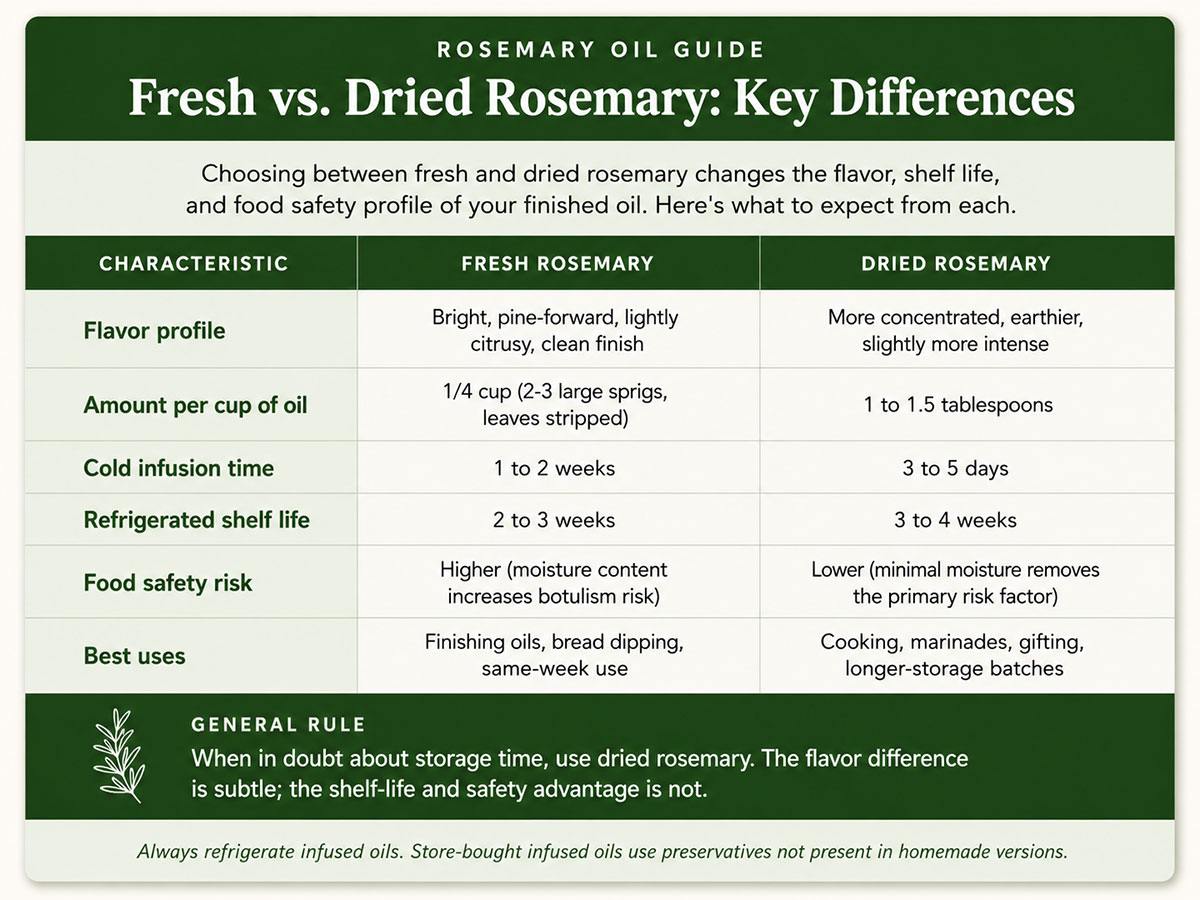
Fresh rosemary makes a brighter, more aromatic oil. Dried rosemary makes a safer one. That trade-off is worth understanding before you start.
The moisture in fresh rosemary is the issue. Olive oil is low in oxygen, and when fresh herbs carry moisture into it, the conditions can support bacterial growth over time. Dried rosemary has had that moisture removed, which is why infused oils made with dried herbs keep for 3 to 4 weeks instead of 2 to 3.
The flavor difference is real but subtler than most people expect. Fresh rosemary produces a pine-forward, lightly citrusy oil with a clean finish, the kind of thing that makes sense in a vinaigrette or on warm bread. Dried produces something earthier, more concentrated, less immediately fragrant, but more durable. Most recipes default to fresh because that’s what’s in the garden or on the counter. The case for dried almost never gets made, which is why the shelf-life trade-off catches people off guard.
How to Make Rosemary-Infused Olive Oil
Before You Start
The standard ratio is 1/4 cup of fresh rosemary leaves (stripped from 2 to 3 large sprigs) to 1 cup of extra-virgin olive oil. For dried rosemary, use 1 to 1.5 tablespoons per cup. Adjust in either direction based on how assertive you want the flavor.
The most critical step comes before any heat or waiting: fresh rosemary must be completely dry before it goes into the oil. Rinse the sprigs, pat them dry, and leave them on a clean towel for at least 30 minutes before using.
Any remaining surface moisture isn’t just a flavor concern.
Method 1: Stovetop Infusion (10 Minutes of Active Time)
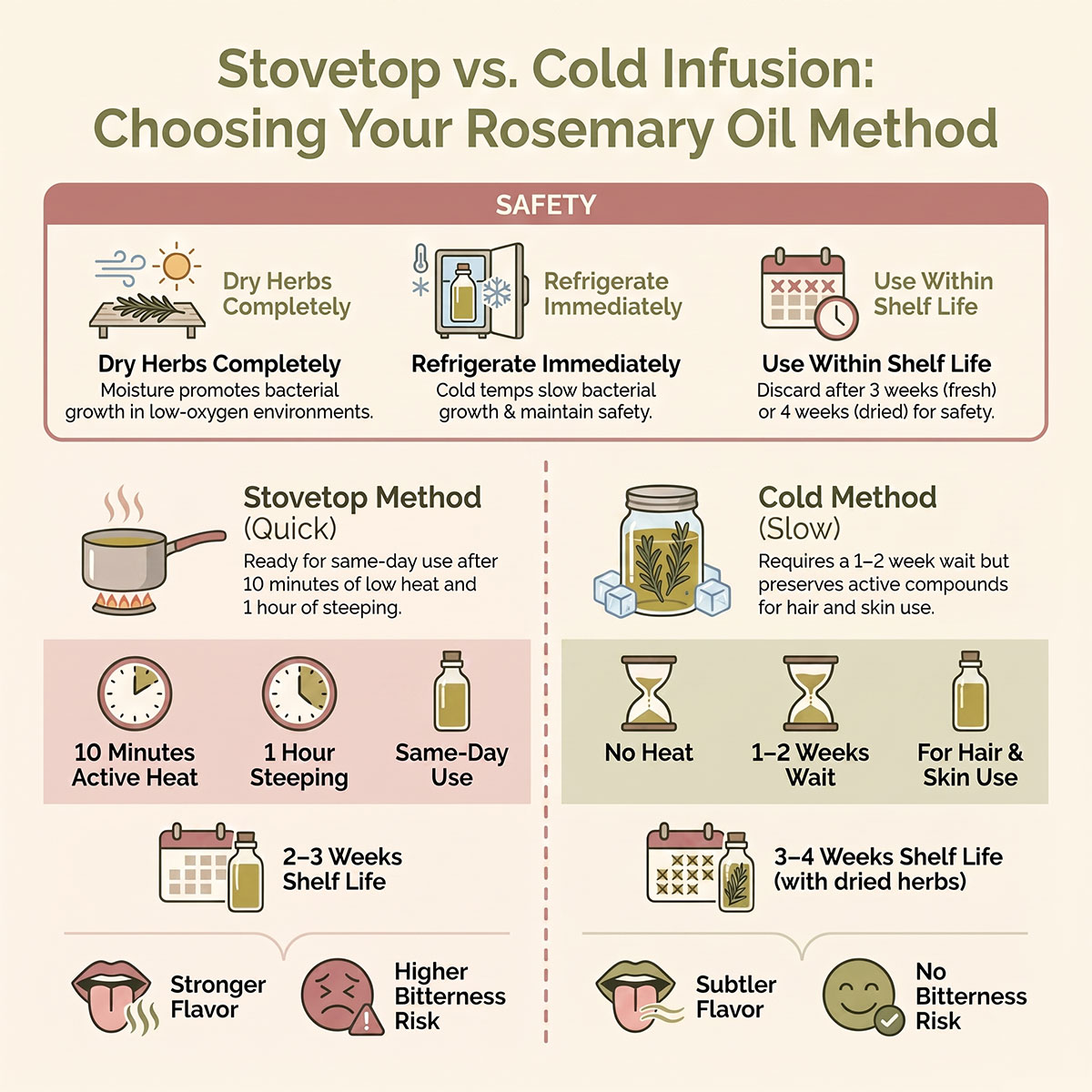
This method produces oil that’s ready to use the same day. The risk is overheating.
- Combine the rosemary leaves and olive oil in a small saucepan.
- Set the heat to the lowest setting your stove offers.
- Warm for 5 to 10 minutes. The oil should feel warm on the back of your hand, not hot. You want fragrant steam rising slowly with no visible movement in the liquid. The moment you see any bubbling or simmering, the heat is too high.
- Remove from heat and leave the rosemary in the oil for at least one hour. Two hours produces a noticeably fuller flavor.
- Strain through a fine-mesh strainer or cheesecloth into a clean, dry glass bottle. Discard the spent rosemary.
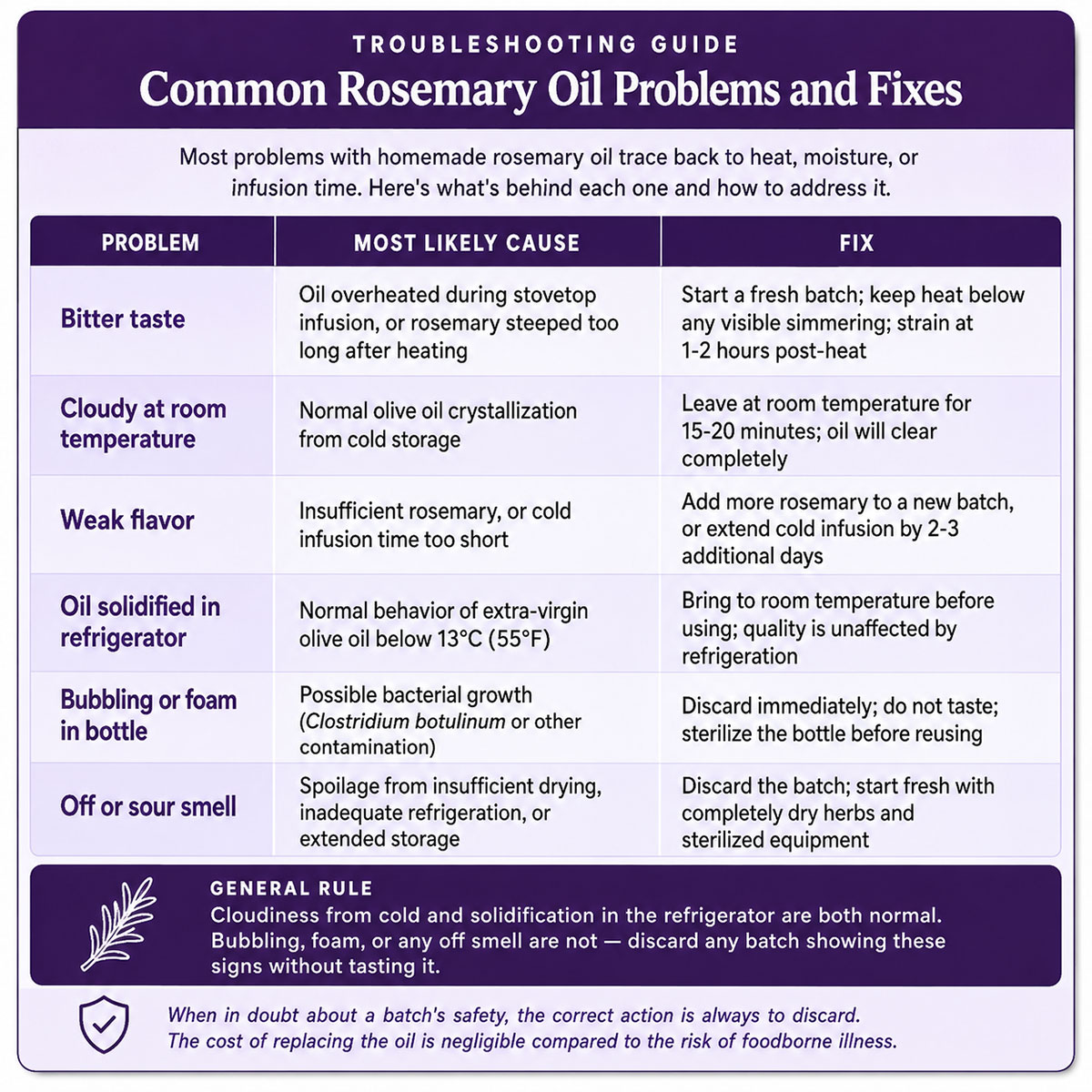
This is where the bitterness problem originates. Rosemary contains terpene compounds that break down under sustained heat, producing off-flavors that worsen over the following days. Keep the oil warm rather than hot, and the problem won’t occur. Rapid bubbling means the terpene degradation is already underway.
Method 2: Cold Infusion (1 to 2 Weeks)
This method uses no heat and produces a cleaner, more balanced flavor. It’s slower by design, and the wait is worth it if you’re not in a hurry.
- Place completely dry rosemary sprigs into a clean, sterilized glass bottle or jar.
- Pour room-temperature olive oil over the rosemary, ensuring all sprigs are fully submerged.
- Seal tightly and store in a cool, dark place.
- Shake gently every two to three days.
- After 1 to 2 weeks, strain the oil into a fresh, clean bottle, seal, and refrigerate immediately.
A longer infusion time, closer to two weeks, produces a more assertive flavor. One week gives a milder result. The cold method is preferable when making oil for hair and skin use, as the lower temperatures preserve more of the rosemary’s active compounds.
Using Dried Rosemary for a Longer Shelf Life
Dried rosemary infuses faster using the cold method: 3 to 5 days is usually sufficient. The finished oil keeps for 3 to 4 weeks in the refrigerator rather than the 2 to 3 weeks typical of fresh-rosemary batches.
Adjust the ratio down to 1 to 1.5 tablespoons of dried rosemary per cup of oil, as dried herbs are more concentrated than fresh. For anyone making the oil for gifting or batch cooking, dried rosemary is the practical choice on both safety and shelf-life grounds.
Which Infusion Method Is Right for You?
Answer three quick questions and get a personalized recommendation.
Food Safety and Storage
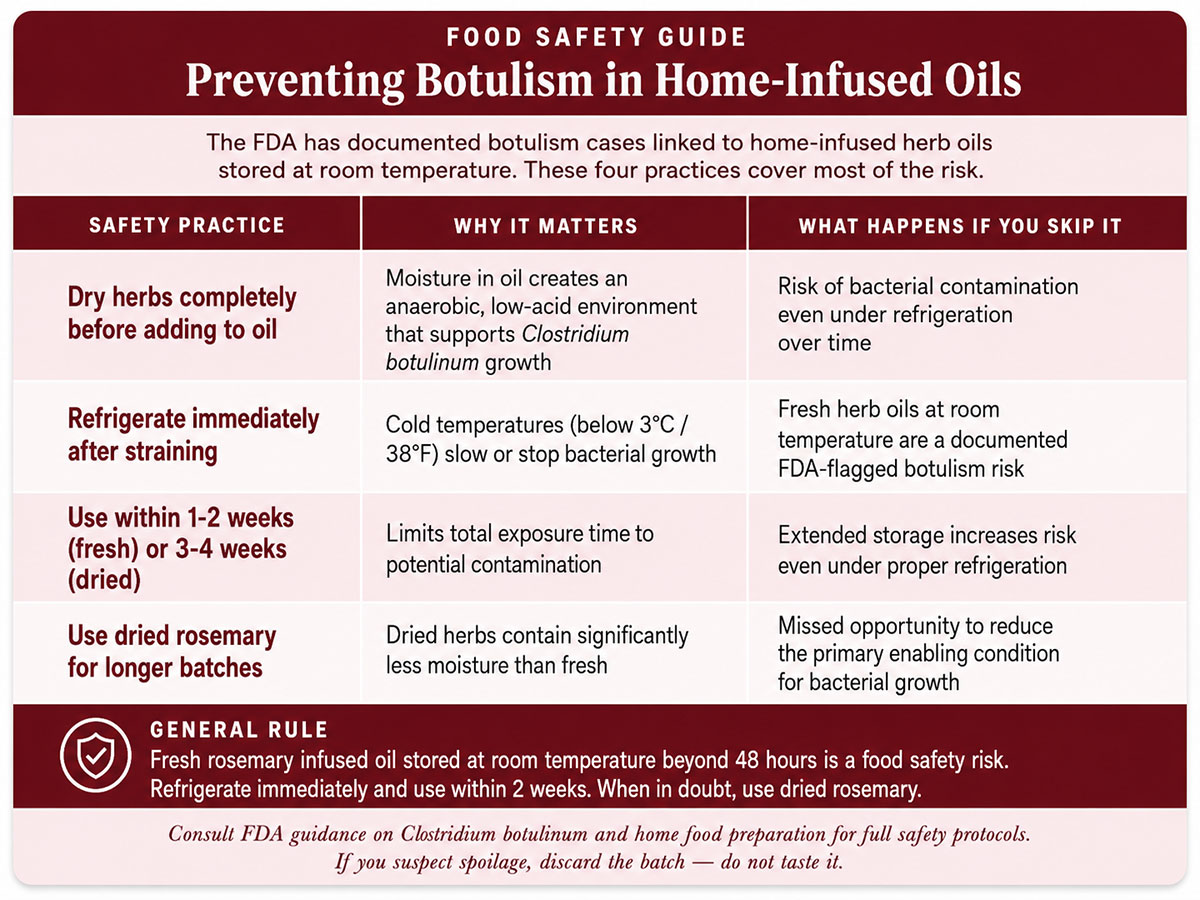
Most rosemary oil recipes online omit this section entirely. The FDA has documented botulism cases linked to home-infused herb oils, and the mechanism is clear: Clostridium botulinum bacteria thrive in low-oxygen, low-acid environments. Olive oil provides exactly that.
Fresh herbs introduce moisture. In an anaerobic oil environment, that moisture supports bacterial growth. This is why drying the rosemary completely matters beyond flavor, and why dried rosemary is genuinely safer (not just more convenient) for any batch stored longer than one week. The FDA’s guidance on Clostridium botulinum specifically identifies fresh-herb-in-oil preparations as a documented risk when stored at room temperature.
Adding one tablespoon of lemon juice or white wine vinegar to the finished oil creates a slightly more acidic environment that further reduces risk. It alters the flavor mildly, so taste before deciding.
Rosemary-infused olive oil will turn cloudy in the refrigerator. This is normal crystallization behavior in cold temperatures, not spoilage. It clears within 15 to 20 minutes at room temperature. The actual signs of spoilage are distinct: an off or sour smell, visible bubbling or foam, or any mold. If any of these appear, discard the batch entirely.
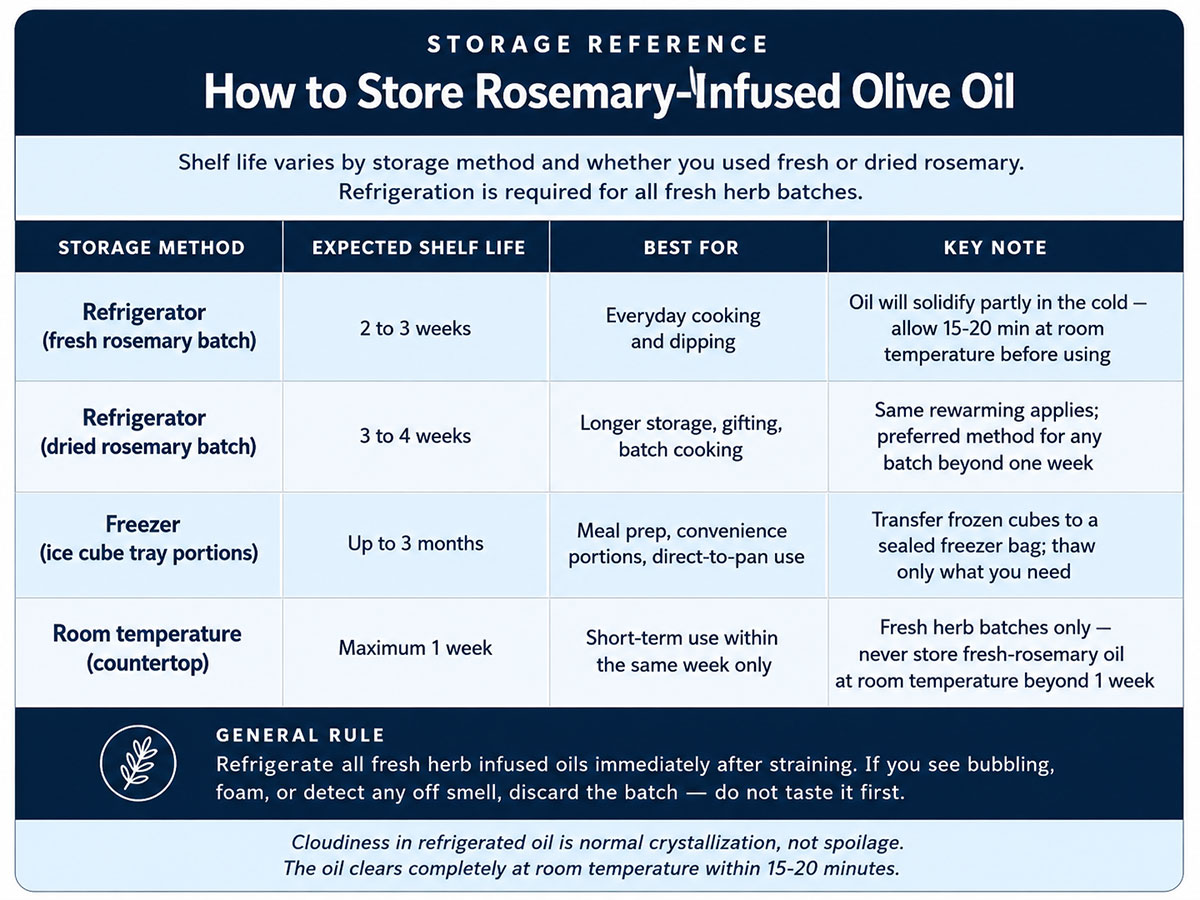
One underused option: freeze portions in an ice cube tray, then transfer the frozen cubes to a freezer bag. This extends shelf life to three months and produces convenient single-use portions for direct-to-pan cooking.
What Rosemary and Olive Oil Actually Do for Your Health
Olive oil’s health record in clinical research is unusually consistent. A cohort analysis from the PREDIMED trial, published in BMC Medicine in 2014, followed 7,216 adults at high cardiovascular risk and found that higher extra-virgin olive oil intake was linked to a 48% lower risk of cardiovascular mortality. The effect was strongest for those consuming EVOO specifically, compared to other olive oil varieties.
Rosemary’s bioactive compounds are less studied in humans but increasingly well-characterized. A 2020 systematic review in the Iranian Journal of Basic Medical Sciences documented anti-inflammatory and antioxidant activity from three primary rosemary constituents: rosmarinic acid, carnosic acid, and ursolic acid. Whether those compounds survive the infusion process at therapeutically relevant concentrations is less certain. What is clearer is that both ingredients bring documented anti-inflammatory compounds to the same cooking fat.
Using rosemary-infused olive oil as a daily cooking base is a low-effort way to get both. The case rests on the evidence for each ingredient separately, with the understanding that infusion doesn’t guarantee clinical-level concentrations of either.
The cognitive effects of rosemary are real but frequently overstated in popular writing. In a double-blind randomized controlled trial published in Complementary Therapies in Clinical Practice in 2018, 68 university students who took 500 mg of oral rosemary twice daily for one month showed significant improvements in prospective and retrospective memory scores compared to placebo. Most of the older evidence on cognition involves inhaling rosemary aroma rather than ingesting it, which is a meaningful distinction the 2018 trial helps clarify.
That distinction matters more than most rosemary health claims acknowledge.
How to Make Rosemary-Infused Olive Oil for Hair Growth
Some of those same compounds have drawn clinical attention in a different area of research. The research on rosemary oil and hair loss is more specific than most herbal treatment studies and more promising.
Researchers randomized 100 people with androgenetic alopecia (pattern hair loss) into two groups for six months. One group applied rosemary essential oil diluted to 3.7 mg/mL daily. The other used 2% minoxidil. At six months, both groups showed comparable improvements in hair count.
The rosemary group reported significantly less scalp itching than the minoxidil group. The study appeared in SKINmed in 2015 and remains the most-cited head-to-head comparison in this area.
One distinction worth making before reaching for your infused oil: this research used rosemary essential oil, not a home-infused cooking oil. Essential oils are far more concentrated in active compounds than a home infusion, and the clinical protocol involves topical application of a specific measured concentration.
Using rosemary-infused olive oil as a scalp treatment is a reasonable approach, with olive oil’s own conditioning properties contributing independently. It won’t replicate the clinical protocol directly.
Hair Treatment Instructions
For hair use, the cold-infused version is preferable to the stovetop version. Lower processing temperatures preserve more of the compounds most relevant to scalp health.
- Gently warm 2 to 3 tablespoons of the oil to approximately body temperature.
- Section the hair and apply directly to the scalp in small amounts.
- Massage in circular motions for 3 to 5 minutes.
- Cover with a shower cap and leave on for 30 to 45 minutes.
- Wash out thoroughly with shampoo. Repeat if needed.
- Apply weekly for consistent results.
Skin Use
Rosemary-infused olive oil can be used as a lightweight moisturizer, applied in small amounts to damp skin after showering. The antioxidant compounds in both ingredients are well-documented, though direct clinical evidence for infused oil specifically on skin outcomes is limited.
For scars, olive oil’s hydrating properties may support skin elasticity over time, which has some indirect relevance to scar appearance. The evidence for this specific use is mostly anecdotal. Apply 3 to 4 drops to clean skin and massage gently before bed.
Expert Tips and Kitchen Uses
Two things that rarely appear in rosemary oil recipes:
A wooden skewer is a more reliable temperature gauge than trying to eyeball the oil during the stovetop method. Insert it into the warming oil. Slow, lazy bubbles forming at its tip indicate the right temperature range. Rapid bubbling means the heat is too high and flavor degradation is already in progress. No thermometer required.
Don’t strain immediately after the heat step. The common instinct is to strain once the oil cools to room temperature. Leaving the rosemary in the cooled oil for an additional hour (or overnight, covered) produces a noticeably more complex result with no additional risk.
Label each bottle with the date made and the method. Stovetop and cold batches have different shelf lives, and after two weeks, you won’t remember which was which. A dark glass bottle matters more than most people realize: light degrades both the rosemary’s aromatics and olive oil’s phenolic content at a rate that makes a noticeable difference by the third week. And if the oil solidifies in the refrigerator (it will), that’s normal crystallization, not spoilage.
For cooking, rosemary-infused olive oil performs best when it isn’t cooked at high heat for long. It works well drizzled over roasted potatoes or white beans just before serving, brushed onto bread for grilling, or mixed into a simple vinaigrette. A quick vinaigrette: 3 tablespoons of the infused oil, 1 tablespoon of balsamic vinegar, 1 teaspoon of Dijon mustard, and salt and pepper to taste.
For a more layered version, try the cold-infusion method with rosemary and a strip of fully dried lemon peel together. The result is lighter and more citrus-forward, well-suited to fish and grain salads.
Conclusion
The stovetop method takes ten minutes. The cold method takes two weeks. The time difference is the whole decision.
The cold-infused version produces a cleaner, more balanced flavor that holds across the full shelf life. The stovetop version is useful when you need the oil today. Which one is worth starting with depends entirely on whether your next occasion to use it is tonight or next week.
Frequently Asked Questions
Can I use dried rosemary instead of fresh rosemary?
Yes, and for longer storage batches, dried is often the better choice. Dried rosemary has significantly lower moisture content, which reduces the food safety risk and extends shelf life to 3 to 4 weeks instead of 2 to 3. Use about 1 to 1.5 tablespoons of dried rosemary per cup of oil, roughly half the volume you’d use for fresh, as dried herbs are more concentrated.
How long does it take for rosemary to infuse in olive oil?
The stovetop method takes 5 to 10 minutes on low heat, then at least one hour of steeping off the heat (two hours for a fuller flavor). The cold infusion method takes 1 to 2 weeks for fresh rosemary, or 3 to 5 days for dried rosemary. Stovetop oil is usable the same day. Cold-infused oil has a subtler, more consistent flavor across its shelf life.
What happens if I leave rosemary in the oil too long?
Two problems develop. First, the flavor becomes progressively more bitter, particularly with the stovetop method, where heat amplifies the effect. Second, fresh rosemary left in oil at room temperature for more than 48 hours creates a food safety risk. Always strain the oil after the infusion period and refrigerate immediately.
What oil works best for rosemary infusion?
Extra-virgin olive oil works best for most uses. The flavor combination is well-established, and EVOO contributes its own documented health properties. For a more neutral base where you want the rosemary to come through cleanly, avocado oil and grapeseed oil both work well and have higher smoke points for high-heat cooking.
Why is my rosemary-infused olive oil cloudy?
If the cloudiness developed from refrigeration, this is completely normal. Olive oil crystallizes at cold temperatures and clears within 15 to 20 minutes at room temperature. Cloudiness that develops at room temperature and comes with an off smell or any bubbling indicates spoilage. Discard that batch without tasting it.
Can you infuse olive oil with rosemary for hair growth?
You can use homemade rosemary-infused olive oil as a scalp treatment, and the combination of rosemary’s bioactive compounds with olive oil as a conditioning carrier makes it a reasonable approach.
The clinical evidence for rosemary and hair growth comes from trials using concentrated rosemary essential oil rather than a home infusion, so the evidence doesn’t translate directly. Used weekly as a scalp massage oil, it’s a worthwhile practice, with olive oil contributing its own conditioning properties. The cold-infused version is better suited to this use than the stovetop version.
How do I avoid botulism when making infused oil at home?
Three practices cover most of the risk. First, completely dry all fresh herbs before adding them to oil. Moisture is the primary enabler of bacterial growth in an anaerobic environment. Second, refrigerate the finished oil immediately and use it within 2 weeks. Third, for any batch you’re making to store longer than a week, use dried rosemary instead of fresh.
The FDA specifically identifies fresh-herb-in-oil preparations stored at room temperature as a documented botulism risk. Cold temperatures slow or stop bacterial growth. Room temperature does not provide that protection.