Your muscles may not be the problem. Research shows strength can fade much faster than muscle, revealing a hidden weakness most workouts never address.
You grab the grocery bags. Your legs feel heavier than they should. You stand up from a chair and have to push off the armrest. You reach the third step on the staircase, and your thighs burn.
Most people attribute this to getting old. Others blame genetics. Neither explanation holds up under the research.
There is a specific biological process driving this shift, and it is far more fixable than most people believe. Your muscles may not have shrunk as much as you think. What is breaking down is the communication pathway between your brain and your muscle fibers.
Once you understand that distinction, the path forward becomes clear, and so does why most fitness advice for people over 50 misses the point entirely.
The Heavy Feeling Isn’t Just Age
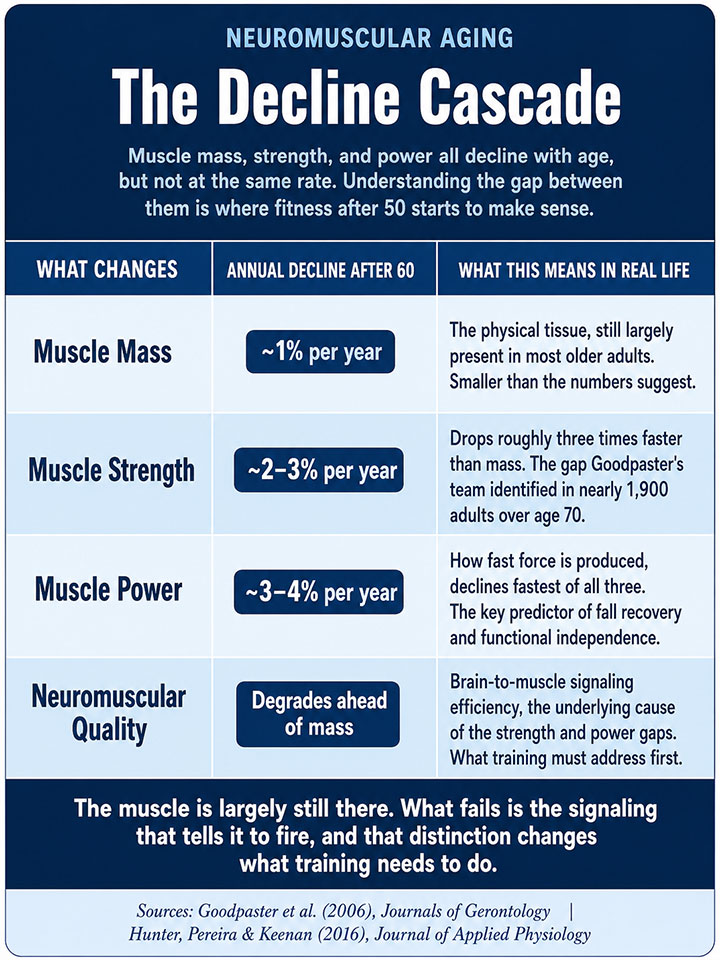
Here is the part most fitness guides skip: your muscles may not be as small as you think. A landmark study by Bret Goodpaster and colleagues at the University of Pittsburgh tracked 1,880 adults between the ages of 70 and 79 over three years. What they found challenged a central assumption in the field.
Strength declined at roughly three times the rate of muscle mass. The muscle was largely still there in most participants, but it wasn’t firing the way it should. The signaling had degraded ahead of the tissue.
Your brain sends signals down the spine and into the nerves that connect to your muscles. Those signals tell the muscle fibers to contract. When that system works properly, you stand up quickly, catch yourself when you stumble, and carry bags without thinking about it. When it begins to fail, your muscles respond slowly, even if they have not shrunk much at all.
The mechanism is called neuromuscular quality. In the Goodpaster study, published in the Journals of Gerontology in 2006, this mismatch between strength loss and mass loss was the central finding, and it is where fitness after 50 either holds or starts to slip.
What’s Actually Happening in Aging Muscles
A motor unit is a single nerve cell and all the muscle fibers it controls. Think of it as an electrical circuit: when your brain sends a signal, the circuit switches on and all the muscle fibers in that unit contract together.
Researchers Sandra Hunter, Hugo Pereira, and Kevin Keenan spent years mapping what happens to these circuits as we age. Their 2016 review in the Journal of Applied Physiology examined how motor unit morphology changes across the adult lifespan.
Motor neurons in the spinal cord die off gradually, and the muscle fibers they were connected to go quiet. Neighboring nerves can sometimes recapture those orphaned fibers through collateral sprouting, but this compensatory process becomes less efficient with advancing age, and some fibers never reconnect.
The result is fewer, slower circuits firing when you try to move. Your body struggles to recruit enough motor units at the right speed. That is the heavy-legs sensation, the reason a flight of stairs feels harder than it did a decade ago.
The loss here is one of neuromuscular quality, not tissue quantity, and that distinction changes what training needs to accomplish. The work here is retraining a communication system, not simply adding mass.
Power Fades Before Strength Does
Most fitness programs for people over 50 focus on strength: how much you can lift or push. Strength matters. But it misses something more urgent.
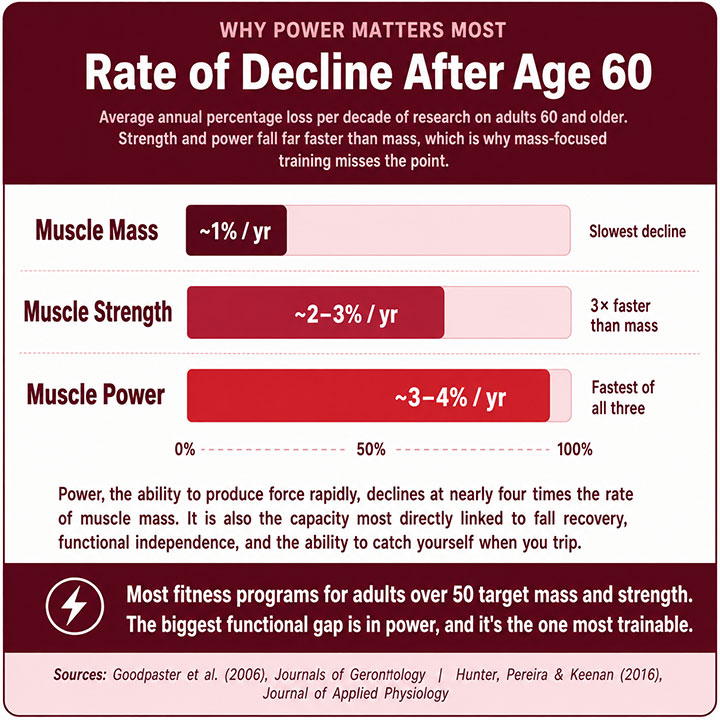
Power is how fast you can produce force. The limiting factor is not raw leg strength but how quickly your nervous system can recruit motor units to fire together (a neurological skill as much as a physical one). Power fades faster than raw strength as motor units are lost, which is what makes it the more clinically meaningful measurement in this age group.
The experience is subtle and often misread. Older adults rarely describe themselves as weak. They describe the hesitation before a movement, the extra second before they get up, the slight delay between deciding to move and actually moving. That gap is the nervous system running at reduced speed.
When you trip on a pavement crack, your body has a fraction of a second to respond. Your leg has to generate force fast enough to catch your weight before you fall. A strong muscle that responds slowly does not save you. A powerful muscle that fires quickly does.
Mirjam Pijnappels and colleagues at Vrije Universiteit Amsterdam spent years investigating exactly this scenario. In their 2005 study in Gait and Posture, twelve young adults aged 20–34 and eleven older adults aged 65–72 walked over a platform and were surprised by a sudden obstacle.
None of the twelve young adults fell. Seven of the eleven older adults did. In each case where an older adult fell, the critical failure occurred in the push-off phase immediately after the trip: the support leg simply could not generate force quickly enough to stabilize the body’s forward momentum.
Power declines faster than strength, and strength declines faster than mass. This cascade is what most fitness programs for older adults miss entirely.
The Sit-to-Stand Litmus Test
There is a simple way to gauge where your functional strength stands right now. Sit in a standard chair with your arms crossed over your chest. Stand up without pushing off with your hands. Sit back down. Repeat as many times as you can in 30 seconds.
This test is harder than it looks. A 2006 meta-analysis by researcher Richard Bohannon at the University of Connecticut pooled normative performance data from 13 studies on the five-repetition version of this test.
For adults aged 60–69, completing five sit-to-stands in under 11.4 seconds represents average performance for that age group. The threshold rises to 12.6 seconds for ages 70–79. These age-banded reference points have since been used widely in clinical settings to flag individuals showing early signs of functional decline.
Older adults who struggle with this test are showing something more specific than general unfitness: the neuromuscular disconnect described above. Their circuits are going quiet. Slower sit-to-stand times are consistently linked in the broader clinical literature to falls, loss of independent function, and reduced mobility across multiple cohort studies of older adults.
Sit-to-Stand Power Test
See how your score compares to age-group averages, and where to start in the 12-week plan.
- Sit fully back in a standard chair, arms crossed over your chest.
- Set a 30-second timer.
- Stand up fully and sit back down as many times as you can without using your hands.
- Count only complete repetitions (fully standing counts as one).
The practical upside is that the same movement that measures you can also train you. That dual function is what makes it worth returning to regularly.
Your Genes Aren’t Fixed
Resistance exercise does more than build muscle. Simon Melov at the Buck Institute for Age Research and colleagues at McMaster University spent six months measuring what else it does.
Fourteen older adults had their muscle tissue biopsied before and after the program, with a younger comparison group for reference. Before training, older participants showed altered expression across 596 genes associated with mitochondrial function (the energy-producing structures inside muscle cells).
Researchers called this an aging transcriptional signature: a cellular pattern linked to slower energy production, reduced repair, and declining muscle output. At baseline, older participants were 59% weaker than their younger counterparts.
After six months, the gene expression profile had shifted substantially back toward younger levels. The strength gap narrowed from 59% weaker to 38% weaker. Still behind, but moving in a direction that the field had not assumed was possible.
A pattern that took decades to form had partially reversed inside a calendar year. Published in PLOS ONE in 2007, this finding still does not get the attention it probably deserves. The way you move acts as an editor. It can rewrite the pattern.
Four Movements That Change Everything
Understanding the science is one thing. Applying it is another. Most traditional workout plans for people getting fit after 50 offer exercises like bicep curls or seated leg presses. These are not useless, but they train muscles in isolation, and real life does not work that way.
Researchers at Utrecht University Medical Center made this point clearly. In their 2005 randomized trial published in the Journal of the American Geriatrics Society, Paul de Vreede and colleagues assigned 98 women aged 70 and older to either functional task training (sit-to-stand transitions, stair climbing, functional reaching) or standard resistance exercise, with a third control group.
After 12 weeks, the task training group outperformed the resistance group on all functional movement tests. The muscles had adapted beyond strength alone: they had learned to coordinate in patterns that matched daily life.
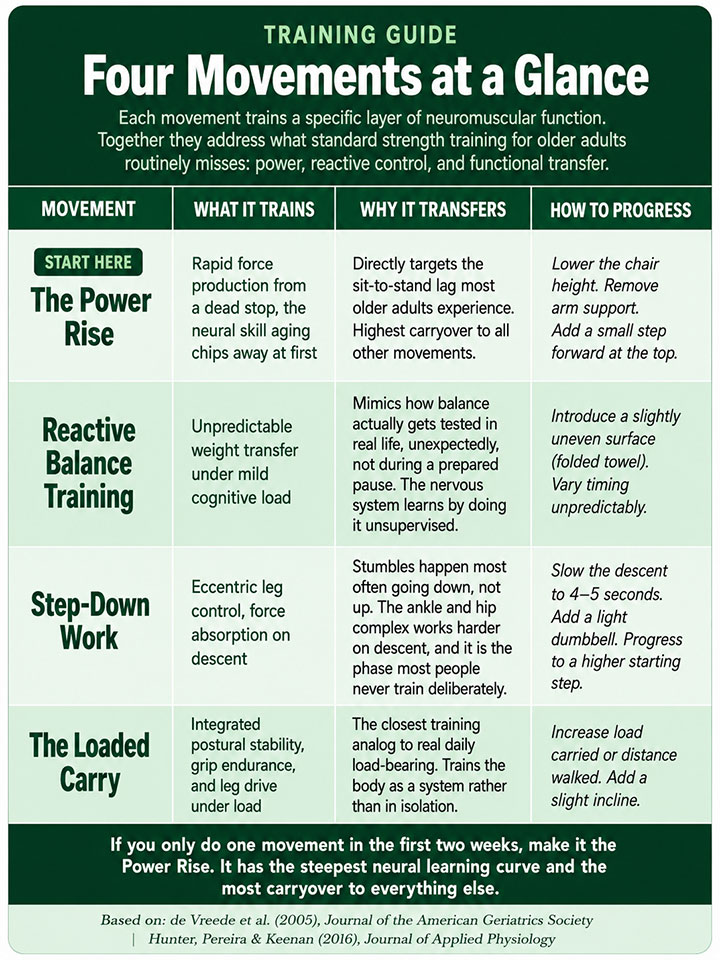
Four movement types stand out from this body of research.
The Power Rise
Most people stand up passively: they shift their weight and push off whatever surface is nearby. The Power Rise turns that everyday action into the most targeted neural training available outside a clinical setting. It asks your nervous system to produce rapid force from a dead stop, which is precisely the capacity that aging chips away at first.
- Sit fully back in a standard chair with your feet flat on the floor, hip-width apart.
- Cross your arms over your chest and keep them there throughout.
- Lean forward slightly from the hips, not the lower back.
- Drive upward as fast as you can in one smooth motion, without rocking twice to build momentum.
- Pause fully at the top, then lower yourself back to seated with control over 3–4 seconds.
If you are choosing one movement to start with in the first two weeks of any training program, make it this one. It has the steepest neural learning curve and the most carryover to everything else.
Reactive Balance Training
Balance practice is worth doing when it mirrors how balance actually gets challenged: unexpectedly, with attention elsewhere, often on an uneven surface. The nervous system learns the reactive pattern best when it is slightly surprised, not when it has time to prepare.
- Stand near a wall or chair for emergency support only.
- Shift your weight fully onto one foot and hold for 5–10 seconds, letting the standing leg do the work.
- Step down and transfer weight to the other foot without a planned pause.
- Vary the timing unpredictably: sometimes hold longer, sometimes switch immediately.
- Progress to a slightly uneven surface, like a folded towel, once single-leg holds feel stable for 20+ seconds.
Step-Down Work
Most people focus on going up stairs. The downward phase (the eccentric portion where muscles absorb force) is where control breaks down first and where strength actually matters most in preventing stumbles. One point that often surprises people: the ankle and hip complex work harder on descent than on ascent, which is why step-downs deserve their own training attention.
- Stand on a low step or stable surface, one foot hanging off the edge.
- Slowly lower the hanging foot toward the floor, aiming for 3–4 seconds on the way down.
- Touch the floor lightly and return to start under control, pushing through the standing heel.
- Keep the standing knee tracking over your foot, not collapsing inward.
- Progress by holding a light dumbbell at your side as you lower.
The Loaded Carry
Pick up something moderately heavy (a filled bag, a backpack, a pair of light dumbbells) and walk 40–60 meters. Set it down and repeat. This trains postural stability, grip, and leg drive simultaneously, and it is the closest analog in any training environment to the demands of actual daily load-bearing.
Why Light Weights Alone Fall Short
The standard advice for people over 50 is to keep things light and use high repetitions. The caution is not entirely wrong, but on its own, it leaves most of the benefit on the table.
A Cochrane review by Chiung-ju Liu and Nancy Latham, published in 2009 and covering 121 randomized controlled trials involving 6,700 participants, found that progressive resistance training produced a large effect on muscle strength and meaningful improvements in functional tasks including chair-stand speed and walking pace.
The standardized mean difference for strength gains was 0.84 (a large effect by clinical standards). The operative word throughout the review is “progressive.” Increasing load and difficulty over time is what distinguishes effective training from comfortable movement.
“Progressive” does not mean lifting heavier every session. It can mean faster movement on the rising phase, more demanding balance conditions, or a small resistance increase every two to three weeks. What it cannot mean is the same stimulus, done the same way, week after week. The nervous system only recruits new motor units when it needs to.
The optimal training volume and intensity for adults over 60 are still active areas of research. Studies vary in their populations, measurement methods, and follow-up durations, and the field has not fully resolved questions about how much stimulus is enough versus counterproductive for different starting fitness levels. The directional evidence is strong. The precise dose is still being worked out.
Research from the InCHIANTI cohort study, a long-running population study of older adults in the Chianti region of Italy, found that individuals with low physical performance were substantially more likely to develop disability in daily activities within the following year compared to those with adequate function.
There appears to be a performance threshold below which decline accelerates. Staying above that threshold matters as much as feeling better, and it is what keeps the more serious decline at bay.
How Long Does It Take to Get Fit After 50?
Most people feel noticeably different within four to six weeks of consistent training. Strength scores begin moving between weeks five and eight, and measurable improvements in sit-to-stand speed, stair climbing, and reactive balance are typically visible by weeks nine through twelve. The 12-week plan below is built around that arc. Phase 1 is the slowest phase for visible results, but it is the one that determines whether everything else holds.
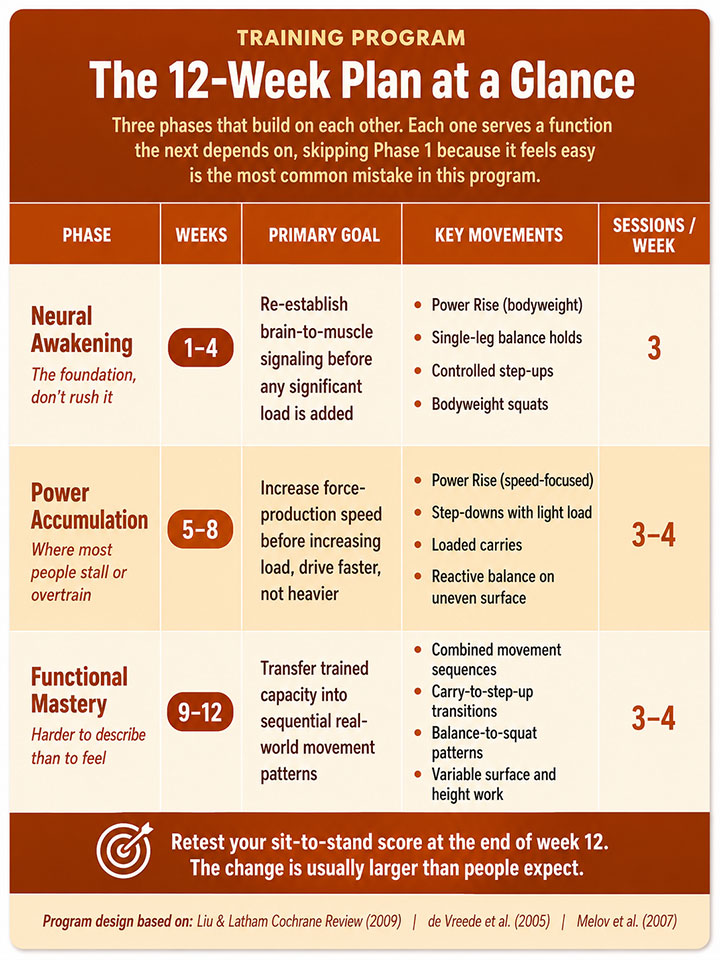
The 12-Week Plan
Reversing neuromuscular decline is not a matter of finding the right stretch or supplement. It is a structured process with three phases that build on each other, each one serving a function the next phase depends on.
Before starting: protein intake matters here in a way most training guides understate. Adults over 50 require more protein per kilogram of body weight than younger adults to achieve the same rate of muscle protein synthesis. A target of 1.6–2.0 grams per kilogram of body weight per day is a reasonable working range for this program.
Phase 1: Neural Awakening (Weeks 1–4)
The first step is re-establishing the brain-muscle connection. Many older adults have motor units that have not fired under any real load in years. The goal in this phase is not muscle growth but teaching the nervous system to recruit again.
Focus on functional movements with bodyweight or very light resistance, performed with intentional speed on the rising phase. Sit-to-stands, step-ups, gentle single-leg balance holds, and controlled squats. The movement pattern for each: 3–4 seconds down, a deliberate pause at the bottom, then as fast and controlled as possible on the way up. Three sessions per week, 30–40 minutes each.
Pay attention to body awareness here. Does one side feel weaker? Do your hips and knees track cleanly? These sessions build coordination as much as physical output, and the imbalances you find in week one are worth knowing before you add load in week five.
Between sessions, prioritize sleep and light movement: walking and gentle stretching. Your nervous system adapts during recovery, not during the session itself. This holds across all three phases.
Building From There: Phases 2 and 3
Phase 2 (weeks 5–8) is where most people stall or get injured, because the temptation once Phase 1 patterns feel easy is to add too much load too quickly. The better adjustment is to increase the speed of movement before increasing the weight. Drive faster on the Power Rise. Carry more briskly. Add a light dumbbell to your step-downs before adding a heavier one. Three to four sessions per week.
Phase 3 (weeks 9–12) is shorter to describe and harder to do. Ask your body to switch between patterns quickly: a loaded carry into a step-up, a balance hold transitioning into a controlled squat, rising from different chair heights and surfaces. Real life demands this kind of rapid sequential coordination. The body learns it best by doing it.
At the end of week 12, run your sit-to-stand test again. The change is usually larger than people expect.
Fitness After 50 Looks Different Than You’ve Been Told
The conversation around fitness after 50 has been dominated by the idea of managing decline: staying safe, staying moderate, accepting limits. That framing was incomplete, not entirely without foundation.
Physical capacity responds to training at any age, and the evidence now runs deeper than most people realize. The gene expression pattern that marks an aging muscle can shift back toward younger levels after six months of consistent work.
The same legs that feel heavy on a staircase today can respond six months later very differently from now, not because of a miracle, but because of a targeted, consistent process that works with the biology rather than against it.
Your genetics are your starting point. Your movement is what you build from there.
The heavy feeling is not a verdict. It is feedback. And feedback means there is something you can do about it.
Frequently Asked Questions
Is it possible to get fit after 50?
Yes. The neuromuscular research is clear on this point. Motor unit recruitment responds to training at any age. Gene expression patterns in aging muscle shift with resistance exercise. Functional capacity (sit-to-stand speed, stair-climbing ability, reactive balance) improves within 8–12 weeks of consistent progressive training. Getting fit after 50 requires more intentional programming than at 30, but the mechanisms still work.
How many times a week should a 50 year old workout?
Three sessions per week drives neural adaptation in Phase 1 while leaving adequate recovery time between sessions. Four sessions per week works well in Phase 2 and beyond, once basic movement patterns feel stable.
How long does it take to get fit at 50?
Most people notice improvements in daily energy and function within four to six weeks, though the timeline varies more than most guides admit: starting fitness level, sleep quality, and how genuinely progressive the training is all affect the rate. Measurable strength gains and functional improvements in sit-to-stand performance typically appear by weeks eight to twelve. Body composition changes, if that is a goal, generally require four to six months.
Which exercise is most anti-aging?
No single exercise earns the label cleanly. But across fall prevention, mobility, and independence research, the category that shows up most consistently is power-based training: movements that ask your muscles to fire fast rather than fire hard. The Power Rise and step-down work target this directly. Resistance training more broadly also shows cellular effects, as the Melov study demonstrates. The combination of power, reactive balance, and progressive load is where the evidence converges.
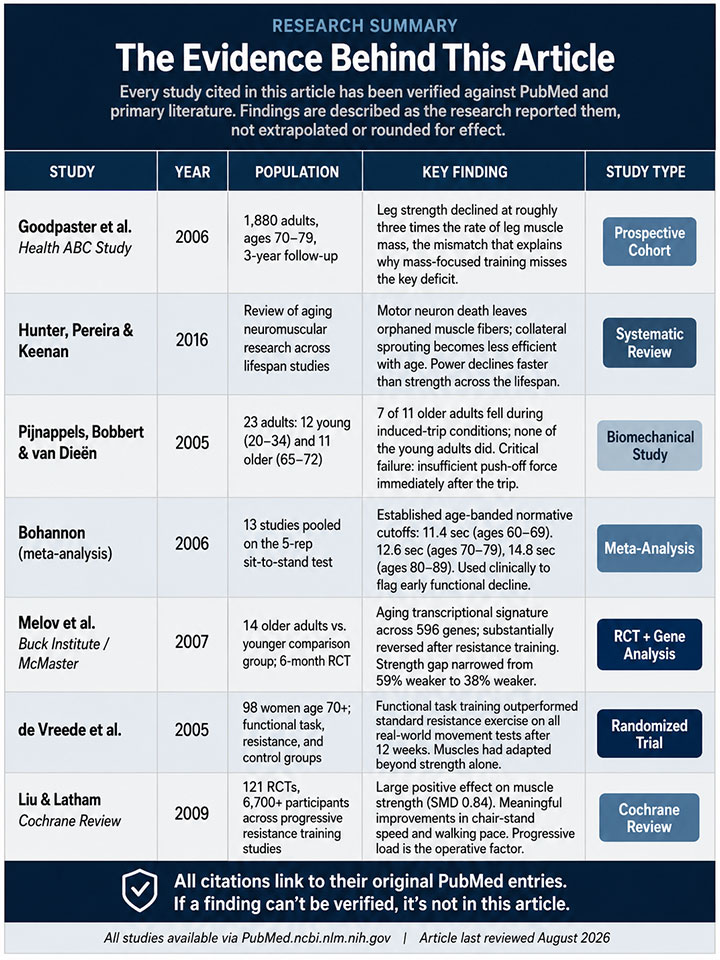
This article draws on peer-reviewed research published in the Journals of Gerontology, the Journal of Applied Physiology, Gait and Posture, the Journal of the American Geriatrics Society, PLOS ONE, and the Cochrane Database of Systematic Reviews. For guidance specific to your health history, consult a physical therapist or fitness professional with experience in aging-specific programming.