Beet juice doesn’t lower blood pressure equally for everyone. Research has uncovered a surprising factor that may determine who responds best.
The headline version of this story is simple: beet juice lowers blood pressure. Drink a cup a day, watch your numbers fall. But the headline misses the part that matters most.
What researchers actually found is more specific and more useful than any superfood claim. The effect is real. The timing is not what most people assume. And whether it works for you at all depends on a factor almost no article about beet juice bothers to mention.
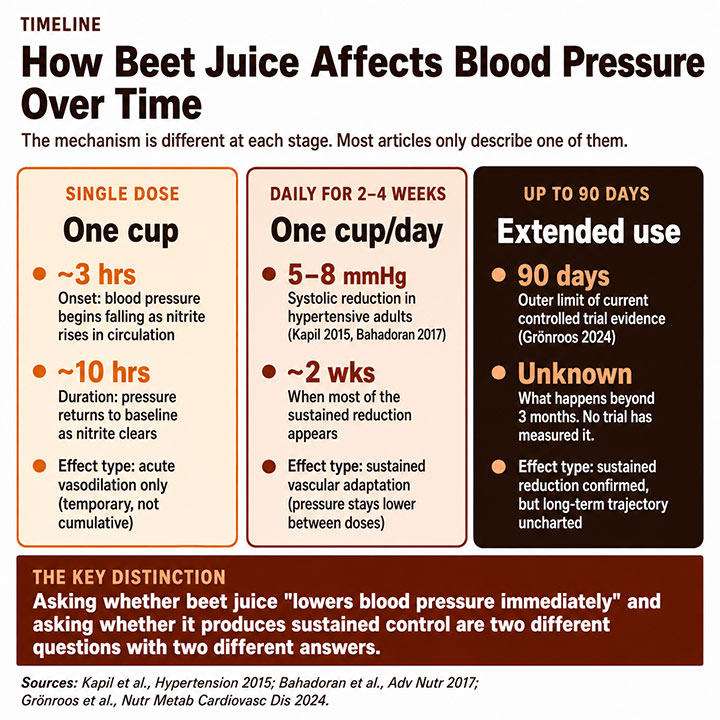
Start with what a single glass does. Blood pressure drops within three hours of drinking beet juice for high blood pressure and returns to baseline roughly ten hours later. That has been documented consistently.
The part that trips people up is the distinction between that response and what daily use does over four weeks, because they feel like a difference of degree, but they are actually a difference of mechanism. Something structurally different happens in the blood vessels themselves, and the pressure does not come back up between doses. Understanding that distinction is the only reason the research on beet juice is worth taking seriously.
One Glass vs. One Month: Two Different Mechanisms
The acute effect of beet juice on blood pressure is real but temporary. A concentrated shot raises plasma nitrite within 90 minutes. Blood vessels dilate. The top number falls by a few points. By the following morning, nitrite levels are back where they started, and so is the pressure.
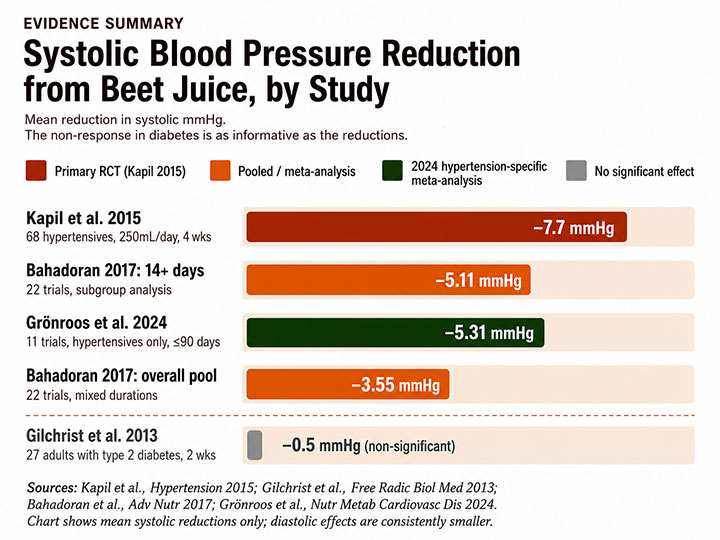
That’s not nothing. But it’s also not what the clinical trials showing large, sustained drops were studying. The landmark trial by Vikas Kapil and colleagues at Queen Mary University of London, published in Hypertension in 2015, assigned 68 people with hypertension to either 250 mL of nitrate-rich beet juice daily for four weeks, or an identical-looking nitrate-free placebo.
Clinical blood pressure fell by 7.7 mmHg systolic and 2.4 mmHg diastolic in the beet juice group. The placebo group: no change. The 24-hour ambulatory monitors showed the pressure stayed lower around the clock, not just in the clinic, not just in the first few hours after drinking.
That detail mattered. High nighttime blood pressure is a stronger predictor of cardiovascular events than daytime readings alone. The people in the Kapil trial had lower pressure at 2 AM than they did before they started, not a supplement effect, but the body operating differently. The mechanism had changed, not just the measurement.
Think of it the way the article’s original version described it: training a muscle. One session raises your heart rate for an hour. A month of sessions changes how your cardiovascular system operates at rest. Daily nitrate delivery appears to maintain the blood vessels in a more flexible state, not just dilate them acutely, but keep them primed to dilate more easily. That’s the mechanism researchers believe is responsible for the sustained effect.
One clarification the data warrants: the effect runs primarily through systolic pressure. The pooled analysis by Zahra Bahadoran and colleagues in Advances in Nutrition in 2017, which aggregated 22 trials and 1,248 participants, found an overall systolic reduction of 3.55 mmHg and a diastolic reduction of 1.32 mmHg. The top number responds more reliably than the bottom one.
How Long Does the Effect Last?
The Kapil 2015 trial ran for four weeks. That was enough to establish that the benefit doesn’t fade within the study window. What happens at twelve weeks? At six months?
A 2024 systematic review and meta-analysis by Rebecca Grönroos and colleagues at the University of Gothenburg addressed this directly.
Working only with trials enrolling people who met clinical thresholds for hypertension, Grönroos’ team pooled data from 11 trials with 349 patients and found a significant reduction in clinic systolic pressure of 5.31 mmHg, with a relevant finding on duration: the effect held in trials running up to 90 days.
That’s the current outer edge of what the controlled trial evidence covers. Beyond 90 days, there is no good data on whether the effect persists, adapts, or diminishes.
The Grönroos data also contains a finding worth stating plainly: the meta-analysis found no significant effect on 24-hour ambulatory blood pressure readings. The Kapil 2015 trial did show ambulatory effects.
That discrepancy probably reflects differences in study design, patient populations, and dose rather than a contradiction, but it means the claim that beet juice lowers blood pressure “around the clock” applies to some trials and not others, and anyone citing it should be specific about which evidence they mean.
Who Responds, And Who Doesn’t
The straightforward story breaks apart here. Not everyone who drinks it sees their numbers fall, and the research is getting clearer on why.
The most well-documented non-response is in people with type 2 diabetes. A 2013 study by Mark Gilchrist and colleagues at the University of Exeter assigned 27 patients with type 2 diabetes to 250 mL of beet juice daily for two weeks, using 24-hour ambulatory monitors as the primary measure. Systolic blood pressure was essentially unchanged, a mean difference of 0.5 mmHg compared to placebo, not statistically significant.
The researchers point to the endothelium, the thin cellular lining of blood vessels responsible for converting nitrate-derived nitric oxide into vasodilation. Years of elevated blood sugar can impair endothelial function. When the machinery is damaged, the raw material has little to work with.
It doesn’t mean beet juice has no value for people with diabetes, just that the blood pressure pathway specifically may not work the same way.
Age may be the more surprising responder variable. Research from the University of Exeter published in 2025 in Free Radical Biology and Medicine compared 39 adults under 30 with 36 adults in their 60s and 70s, all given concentrated beet juice twice daily for two weeks.
Only the older group showed measurable blood pressure reductions. The researchers traced the difference to the oral microbiome, specifically to shifts in the mouth bacteria responsible for the first step of nitrate conversion.
Older adults, who tend to start with less nitric oxide production due to age-related endothelial decline, may have more room to benefit from dietary nitrate precisely because the deficit is larger.
That finding is the opposite of what most people assume. Younger adults, whose blood pressure is typically lower and whose nitric oxide production is intact, may not see much from beet juice at all.
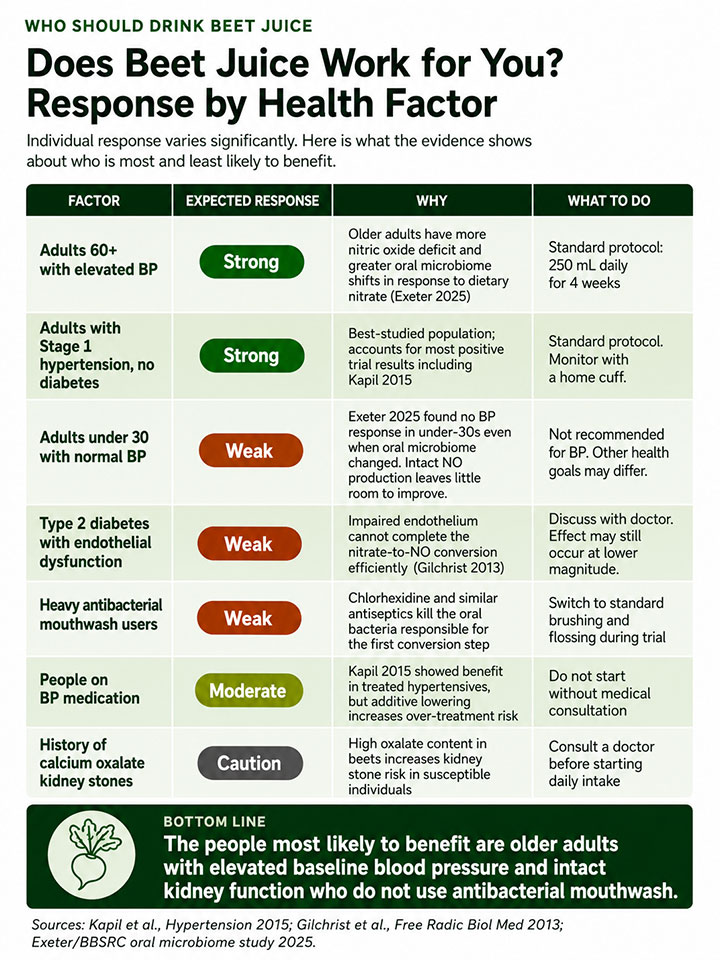
Other documented factors affecting response include antibacterial mouthwash (which kills the oral bacteria that start nitrate conversion), kidney function, and the baseline nitrate content of a person’s diet. Someone already eating significant amounts of leafy greens may have less room to improve.
How Much Beet Juice for High Blood Pressure, and When
The standard dose used across clinical trials is 250 mL per day, roughly one cup of juice containing about 400 mg of nitrate. Most trials used morning administration, though no head-to-head comparison of morning versus evening timing has been published. The practical case for morning drinking is that blood vessels are typically stiffer after waking, and the three-hour onset window means the effect peaks during the day.
A smaller dose of 70 mL, a concentrated “shot” product, has been used in some trials with mixed results. The Exeter oral microbiome study used this format twice daily, which suggests some benefit at lower single doses taken more frequently. But the four-week sustained-reduction evidence comes predominantly from the 250 mL daily protocol, and that remains the reference standard.
Form matters. The trials showing sustained BP reduction used juice, not whole beets, not beet powder, not supplement capsules. Juice delivers nitrate in a consistent, rapidly absorbed format. One medium beet contains variable amounts of nitrate depending on growing conditions; 250 mL of juice from a standardized product does not. If you eat beets regularly, the benefit is plausible in theory, but the head-to-head trial that would confirm it hasn’t been done.
For those choosing commercial products: look for juice labeled “nitrate-rich” or “high-nitrate,” often marketed for athletic performance. Avoid products that list nitrate removal as a processing step, and avoid adding sugar, which works against blood pressure over time.
On timing: the evidence supports morning as practical, not required. Consistency matters more than the hour. What the research does not tell you is whether the nighttime ambulatory reduction documented in the Kapil trial was specific to morning dosing or would have appeared regardless, because that comparison was never made. Morning is the reasonable default; whether it is the optimal one remains genuinely open.
What Happens If You’re Already on Medication
This requires an honest answer rather than a general reassurance. The Kapil 2015 trial enrolled two groups specifically: 34 drug-naive patients and 34 treated hypertensives already on medication. Both groups saw blood pressure reductions. That is the more encouraging part of this finding.
The concern is additive effect. A first-line antihypertensive medication lowers systolic pressure by 10 to 15 mmHg in a typical case. Adding seven or eight mmHg from beet juice raises the question of whether the combined effect overshoots the target.
Symptoms of over-treatment (dizziness when standing, fatigue, feeling faint) are a signal that the combined effect is too large, not that the beet juice isn’t working. Anyone on blood pressure medication should discuss this with their prescribing doctor before beginning a daily regimen.
The Bahadoran 2017 meta-analysis found that studies lasting 14 days or more produced larger effects than shorter ones (a mean systolic drop of 5.11 mmHg vs. 2.67 mmHg for studies under two weeks). That duration signal is part of why a two-week check-in with your doctor is a reasonable precaution, not just boilerplate advice.
Side Effects Worth Knowing
Most people tolerate beet juice without difficulty. Three effects are worth anticipating.
Beeturia (pink or red urine) affects roughly 10 to 14 percent of people. It happens because betacyanin, the pigment that makes beets red, passes through the digestive system without being fully broken down in some individuals. It is harmless and varies with stomach acid levels.
Kidney stones are a concern for anyone with a history of calcium oxalate stones. Beets contain oxalate, which binds with calcium in the kidney tubules to form crystals in susceptible people. Daily consumption at the 250 mL study dose increases oxalate load meaningfully. This is not a reason most people need to avoid beet juice, but it is a reason people with a documented history of calcium oxalate stones should check with a doctor first.
Low blood pressure from additive effects was covered under medication. The same concern applies at lower intensity in people who already have naturally low readings and are experimenting with beet juice for general cardiovascular health rather than to address a documented elevation. Monitoring symptoms in the first two weeks is the right approach, though what counts as “too low” is a question worth raising with a doctor before the experiment rather than after a dizzy spell.
Who Should Not Drink Beet Juice
A direct answer to a question many people ask: beet juice is not recommended as a blood pressure intervention, or warrants extra caution, in these cases:
- People with a history of calcium oxalate kidney stones (high oxalate content)
- People taking blood pressure medication, without first discussing it with their doctor (additive lowering effect)
- People taking nitrate medications for angina (nitroglycerin, isosorbide), because the combined vasodilatory effect can cause a dangerous pressure drop
- People with type 2 diabetes and significant endothelial dysfunction, because the blood pressure pathway may not work effectively, though individual responses vary
- People with naturally low blood pressure who are not hypertensive
This is not a complete contraindication list. It’s a flag-if-relevant list. Many people in these categories can still drink beet juice without harm. The point is to have the conversation before starting a daily regimen, not to avoid it entirely. Which raises a practical question: what does a well-structured trial actually look like?
Beet Juice Recipes for High Blood Pressure
The trials used plain juice, room temperature or chilled. That is also, for a meaningful number of people, the format they abandon by day five. Whether the mechanism works depends on drinking it every day for four weeks, and that depends on it being palatable. What follows is deliberately practical. Each blend preserves the full 8 oz nitrate dose. Nothing here removes what makes the juice effective.
How to Make Beet Juice for High Blood Pressure: Basic Morning Blend
- 8 oz beet juice (the full study dose)
- 4 oz orange juice (vitamin C may support nitrate absorption)
- Half an apple, chopped
- Ice
Blend and drink within 30 minutes. The citrus cuts the earthy aftertaste without touching the active compounds.
Green Power Mix
- 8 oz beet juice
- A large handful of spinach (adds additional dietary nitrate)
- Half a cucumber
- Half a lemon, juiced
- A half-inch piece of fresh ginger
Spinach and arugula are among the most nitrate-dense vegetables available, which means this blend delivers more than the beet juice alone. Worth considering if you want to go beyond the study dose rather than simply meet it.
Berry Beet Smoothie
- 8 oz beet juice
- Half a cup frozen mixed berries
- Half a banana
- Quarter cup plain yogurt
Blend until smooth. The berry and banana flavors mask the earthiness almost entirely. Add nothing sweet beyond the fruit, because the cumulative mechanism is slow to build and sugar works against blood pressure in the opposite direction.
Beet Juice Recipe for Blood Pressure Without the Taste: Tropical Blend
- 8 oz beet juice
- Half a cup pineapple chunks
- Quarter cup mango
- A splash of coconut water
- Fresh mint leaves
The tropical flavors cover the beet taste completely. If someone in your household is skeptical of beet juice, start here.
Beet Juice vs. Other Natural Approaches to High Blood Pressure
Beet juice sits within a broader range of dietary blood pressure interventions. The comparison table below presents ranges rather than single-point estimates, because the evidence for each approach varies considerably across studies, populations, and compliance levels. The beet juice figures are anchored to the verified trial data above; the other ranges draw on the research literature for each intervention and represent the full spread of what well-conducted trials have found.
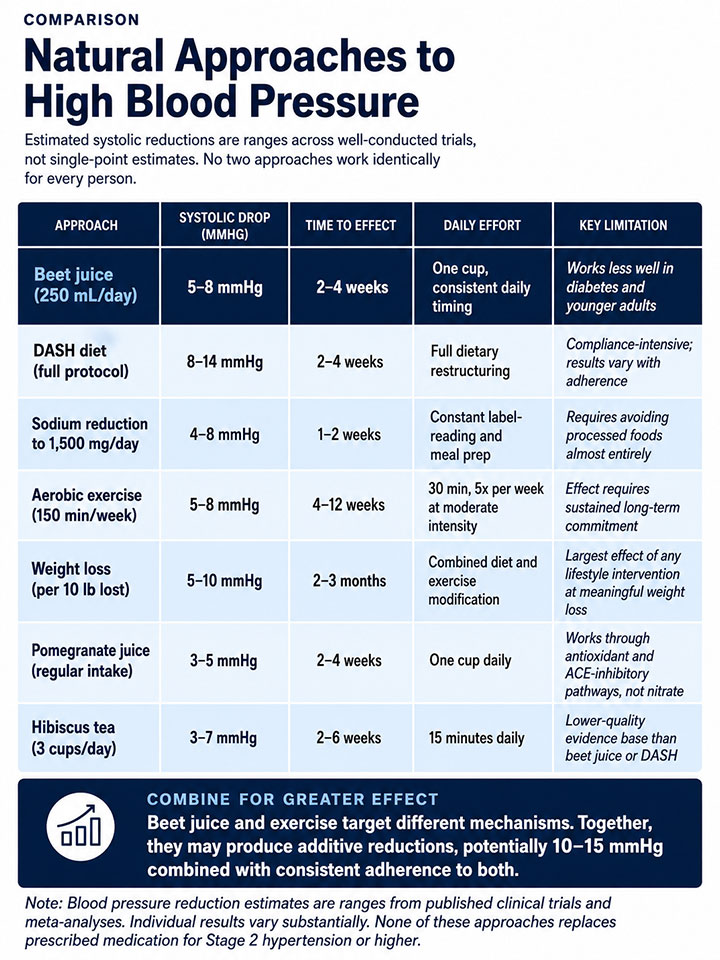
The most reliable combination in the literature is pairing a high-nitrate dietary pattern with regular aerobic exercise. Both work through different mechanisms and their effects are roughly additive. Adding beet juice to a DASH diet that already includes leafy greens may produce less marginal benefit than adding it to a lower-nitrate diet, since dietary nitrate intake overlaps.

Common Mistakes That Reduce Effectiveness
People who try beet juice for four weeks and see no change often made one of these errors.
Using antibacterial mouthwash is the one that surprises people most, not because they didn’t know mouthwash kills bacteria, but because they never connected oral bacteria to blood pressure at all.
The first step of nitrate conversion happens on the tongue and in the oral cavity, performed by bacteria that are part of the same pathway the Exeter oral microbiome study was tracking. Chlorhexidine-type antiseptic products wipe out those bacteria.
The juice arrives, the nitrate is there, and nothing converts it, which means the cumulative mechanism never engages, regardless of how consistently you drink. Switching to a standard brush-and-floss routine removes the interference.
Using the wrong product is also common. Some commercially available beet juices are processed in ways that reduce nitrate content, and not all products list nitrate concentration. Without adequate nitrate, the conversion pathway has nothing to work with, and the cumulative vascular adaptation the trials demonstrated cannot build.
Products marketed to athletes and labeled “high-nitrate” are generally more reliable than mass-market juice blends. Cold-pressed formats tend to retain more nitrate than heat-pasteurized ones.
Underdosing produces smaller effects. The sustained-reduction evidence comes from 250 mL daily, and half that amount has not been shown to produce the same result. Inconsistent use is the other version of this problem: the cumulative mechanism depends on daily nitrate delivery to maintain the vascular adaptation.
Missing several days in the third or fourth week appears to partially reverse what the preceding weeks built.
Taking high-dose antioxidant supplements at the same time may interfere with the nitrate pathway. The interaction isn’t fully characterized, but spacing supplements a few hours from the juice is prudent until clearer evidence exists.
What the Research Doesn’t Tell Us Yet
The Grönroos 2024 meta-analysis pushed the documented window to 90 days. What happens after that is genuinely unknown. No well-controlled trial has followed beet juice supplementation past three months. Whether the effect plateaus, continues, or requires periodic breaks to remain effective is a question nobody has answered with adequate data.
Optimal dosing by body weight has not been studied. Every trial used a fixed volume regardless of whether the participant weighed 60 kg or 120 kg. Whether a larger body requires more juice to achieve the same blood pressure response is a reasonable hypothesis with no direct evidence behind it.
The population question is still underexamined. The majority of trials enrolled middle-aged white European adults. The Exeter oral microbiome research suggests that age modifies the response significantly. Whether other factors (baseline dietary nitrate intake, gut microbiome composition, genetic variants in nitric oxide metabolism) create meaningful differences in response across populations has not been adequately tested.
Researchers still don’t agree on whether eating whole beets produces the same blood pressure effect as drinking the juice. The liquid form’s advantage is consistency of nitrate delivery. Whether the fiber matrix in whole beets slows nitrate absorption enough to blunt the effect, or whether it makes no functional difference over a four-week course, is genuinely unknown.
Understanding Your Blood Pressure Numbers
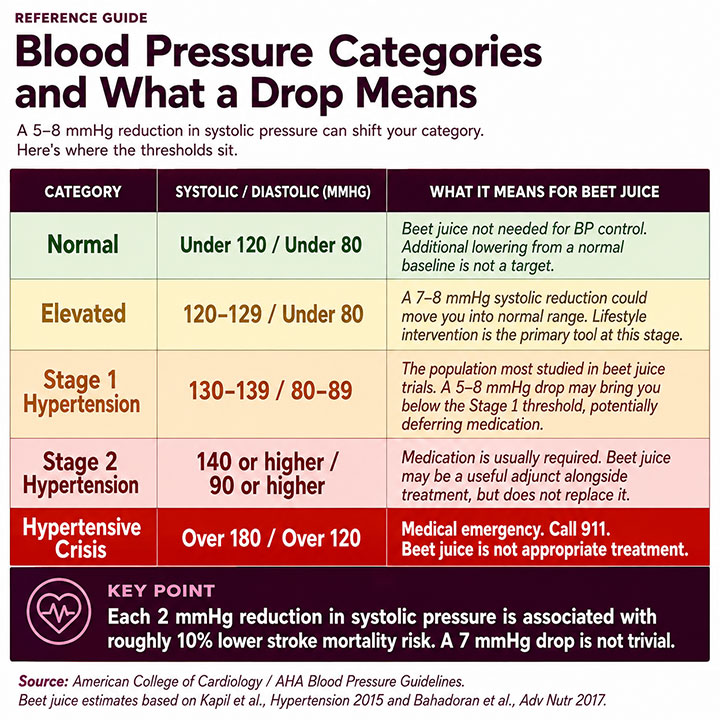
The clinical significance of a 5 to 8 mmHg drop depends entirely on where your baseline sits. Someone at 138/88 who drops to 131/85 remains in Stage 1 hypertension but at a lower point in the range. Someone at 128/79 who reaches 121/75 moves into normal territory and may be able to defer a medication conversation with their doctor, at least temporarily.
Starting a 30-Day Protocol
The research supports a four-week trial as a reasonable test. Here is how to structure it to match what the trials actually measured.
Before Day 1: Measure blood pressure three times, one minute apart, and record the average. This is your baseline. If you use blood pressure medication, discuss the plan with your prescribing doctor before starting.
Days 1 to 7: Start at 4 oz daily (half the full dose), taken in the morning with food. Note any side effects, particularly stomach upset or dizziness. Check blood pressure on days 3 and 7.
Days 8 to 28: Increase to the full 8 oz (250 mL) daily. Maintain the same timing each day. Track blood pressure weekly. Most of the sustained reduction, when it occurs, appears by the end of week two and stabilizes through week four.
After Day 28: Compare your average reading over days 26 to 30 against your baseline. A five-point or greater systolic drop indicates a meaningful response. Less than three points in a compliant trial (no mouthwash, correct product, consistent daily use) puts you in the non-responder category, and pursuing the mechanism question with your doctor makes sense.
Stop if you experience dizziness when standing, sustained fatigue, or unusually low readings.
Conclusion
The evidence for beet juice as a blood pressure intervention is real, specifically bounded, and genuinely useful for the right person. The effect size (five to eight mmHg systolic in compliant trials with hypertensive adults) is enough to matter clinically. It is not enough to substitute for medication in anyone with Stage 2 hypertension or poorly controlled pressure. It is enough to be worth a 30-day trial for someone at the lower end of Stage 1, or for someone whose medication is almost working but not quite.
What the research shows is also what it took researchers years to establish: the difference between drinking beet juice once and drinking it every day is not the difference between a small effect and a large one. It is the difference between a temporary vasodilatory response and a lasting change in how the blood vessels function under normal conditions. The first is interesting. The second is why this particular research thread has attracted serious clinical attention.
Whether you are one of the people for whom it works is something a month will answer. The mechanism is plausible, the evidence is real, and the cost of finding out is a cup of earthy juice every morning.
FAQs
Which beet juice is best for lowering blood pressure?
Products marketed for athletic performance and labeled as “high-nitrate” or “nitrate-rich” tend to be the most reliable, as nitrate content is their selling point and more likely to be verified. Cold-pressed formats retain more nitrate than heat-pasteurized products. Brands using nitrate-depleted juice (processed specifically to remove nitrate) are the ones to avoid. Organic certification has no documented effect on nitrate content.
What is the best juice to drink for high blood pressure?
Beet juice has the strongest single-compound evidence base for a direct blood pressure mechanism. Pomegranate juice has its own body of evidence working through different pathways, primarily antioxidant activity and ACE inhibition rather than nitrate conversion. The two are not competing alternatives; they target different aspects of cardiovascular health. See our pomegranate juice article for a direct comparison.
Can I drink beet juice while taking blood pressure medication?
Not without first discussing it with your doctor. The additive pressure-lowering effect can be significant enough to require a medication dose adjustment. This is especially relevant for nitrate medications, which share a mechanism with dietary nitrate and can produce dangerously low pressure in combination.
What to drink before bed for high blood pressure?
Beet juice is not well-studied as a bedtime intervention specifically. The nighttime blood pressure reduction documented in the Kapil 2015 trial came from morning administration, and no trial has tested evening beet juice on nocturnal pressure as a primary endpoint. For bedtime specifically, the stronger evidence points to limiting sodium and alcohol in the hours before sleep, keeping caffeine earlier in the day, and maintaining a consistent sleep schedule, all of which have documented effects on nighttime readings. If nocturnal hypertension is a specific concern, that conversation belongs with a cardiologist, not a juice regimen.
What if my urine turns pink?
That is beeturia, the pigment betacyanin passing through without full breakdown. Roughly 10 to 14 percent of people experience it. It is harmless and not a reason to stop. The prevalence varies with stomach acid levels and genetic factors.
Can I just eat beets instead?
Possibly, but it hasn’t been tested the same way. You would need to eat three medium beets daily to match the standard juice dose, and whether the fiber matrix affects nitrate absorption over a four-week period compared to juice hasn’t been studied head-to-head. For people who prefer whole food, it’s a reasonable approach; for research-matched dosing, juice is the reference standard.
Do beet supplements work as well?
Some do, some don’t. The issue is variability in nitrate content across products. Supplements that list actual nitrate content (300 to 400 mg per serving) are working from the same mechanism. Products that list “beet powder” without specifying nitrate concentration are harder to evaluate. The sustained blood pressure evidence comes from standardized juice, not from supplements.