The studies behind bananas and blood pressure tell a very different story than most headlines. The results are smaller, slower, and far more interesting than you’d expect.
“Eat a banana, help your blood pressure” is one of nutrition’s tidiest pieces of advice. It’s also, on its own, nearly meaningless. A single banana nudges systolic pressure by less than a point, an effect too small to register on a home monitor.
What actually moves the needle is slower, and it has almost nothing to do with the fruit itself. It has to do with a mineral your kidneys have been quietly rationing for years, and what happens when you finally give them more of it, every day, for a month straight.
The First 24 Hours: Your Body Starts a Balancing Act
Eat a banana, and your body absorbs roughly 420 milligrams of potassium within a few hours. That mineral begins acting on your blood vessels right away. It activates potassium channels in the smooth muscle lining your artery walls.
When those channels open, the muscle relaxes. Wider, looser arteries let blood move with less resistance, and that’s vasodilation, the first step toward lower blood pressure.
One banana supplies about 10% of the potassium an adult needs in a day. That’s real, but nowhere near a fix. Blood pressure might dip slightly within hours, and the effect fades by the next morning.
The banana that actually matters is the one you eat tomorrow, and the one after that.
What Actually Happens After a Month of Daily Bananas
Something shifts on day three or four. Your kidneys start registering the steady potassium coming in, and they respond by flushing more sodium out through urine. Sodium holds onto water, so when there’s too much of it circulating, blood volume climbs, and your heart pumps against more resistance. Potassium signals your kidneys to release that extra sodium.
You might notice you’re using the bathroom more that first week. That’s the mechanism working, not a problem.
One banana on a Monday doesn’t undo Sunday’s pizza. A banana every day for a week, though, starts to build momentum that your kidneys can work with.
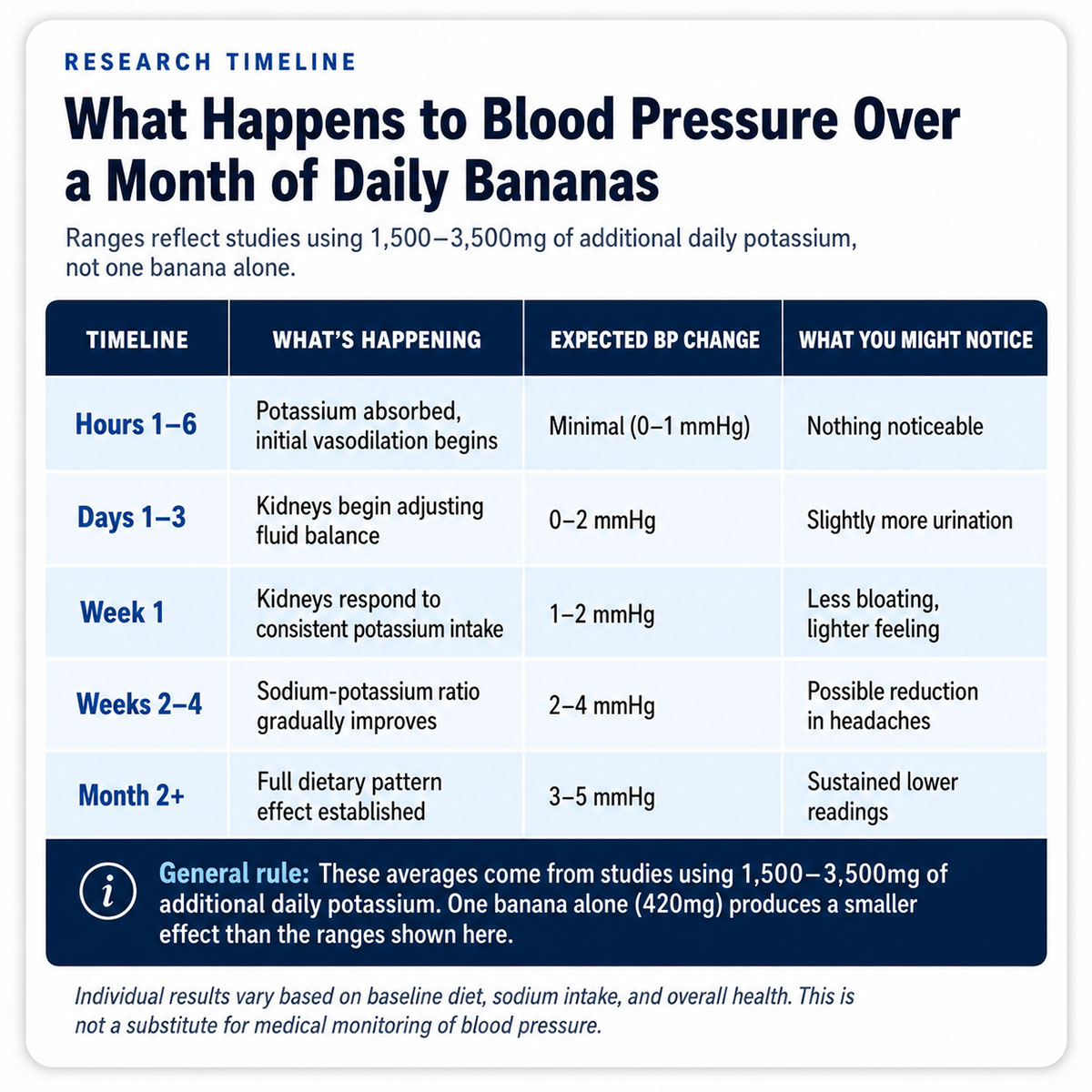
Most people won’t be retiring their blood pressure monitor after a single month of this. The research does point to something real, though, if smaller and slower than the headlines suggest.
The Studies Behind the Numbers
The baseline number comes from 1997: a meta-analysis of 33 clinical trials covering 2,609 adults found potassium dropped systolic pressure by about 3 points on average, diastolic by about 2. People who already had high blood pressure saw bigger drops, often 4 to 5 points on the systolic number, and the effect ran stronger still in anyone eating a lot of salt beforehand.
But the math has a catch. These trials used 1,500 to 3,500 extra milligrams of potassium daily, delivered mostly as supplements. One banana provides about 420. You’d need three to four bananas a day to approach even the low end of what these studies actually tested.
A follow-up analysis in the BMJ built on that finding with a far bigger sample: 22 controlled trials, covering 1,606 people, plus 11 long-term cohort studies covering another 127,038. Among people specifically diagnosed with hypertension, higher potassium intake lowered systolic pressure by about 3.5 points and diastolic by about 2. The stroke number is the one worth sitting with: people with higher potassium intake had a 24% lower risk of stroke.
But again, these weren’t banana studies. They were potassium studies, mostly using supplements rather than food.
The DASH trials came closer to testing something realistic. Researchers put 459 adults on an eating plan built around fruit, vegetables, whole grains, and low-fat dairy, bananas included, for eight weeks. Blood pressure fell by 5.5 over 3 points on average, and among people who started with high blood pressure, the drop was 11.4 over 5.5.
That’s the closest thing to a real-world test of what a banana-inclusive diet actually does, even though it measured a whole eating pattern rather than bananas in isolation.
The PURE study went even bigger: 102,216 adults across 18 countries, tracked using urine samples that estimated their actual sodium and potassium intake. Potassium was inversely linked to systolic pressure, and the relationship was steepest in people with hypertension, older adults, and anyone eating a lot of salt.
Researchers still don’t fully agree on why the effect is so much stronger in some groups than others.
One banana has about 422 milligrams of potassium. That’s a real, biologically active amount. But most of what’s known about potassium’s effects comes from broader research like the studies above, not from trials that tested “banana versus placebo” directly. Extrapolating from one to the other is reasonable. It isn’t the same as proof.
Lower blood pressure also means your heart works less hard with every beat, which matters more over years than days. Steadier blood flow benefits your brain as well. Some research suggests better blood pressure control in midlife is associated with sharper thinking and memory later on, though the evidence there is still developing.
None of this answers how many bananas are actually enough. That’s a different question, and the honest answer is smaller than most people expect.
How Many Bananas You Actually Need
Start with the official target, and it’s lower than a lot of nutrition content still claims. The World Health Organization recommends adults get at least 3,510 milligrams of potassium daily, a floor rather than a range.
In the US, the National Academies revised their own guidance in 2019, setting an adequate intake of 3,400 milligrams for men and 2,600 for women (NIH Office of Dietary Supplements). The older 4,700-milligram figure that still circulates in a lot of nutrition writing was the previous 2004 US guideline, and it has since been revised down.
One medium banana has about 420 milligrams. Do the math, and you’d need 8 to 11 bananas to hit the old 4,700-milligram figure from bananas alone, or 6 to 8 to reach the current, lower US target.
That’s not happening for most people, and it doesn’t need to. Too much sugar, too much fiber, and you’d be sick of bananas within a week.
Your Realistic Target
One to two bananas a day is sustainable for most people. That’s 400 to 800 milligrams of potassium. Pair that with a handful of other high-potassium foods and you can close the gap without banana overload.
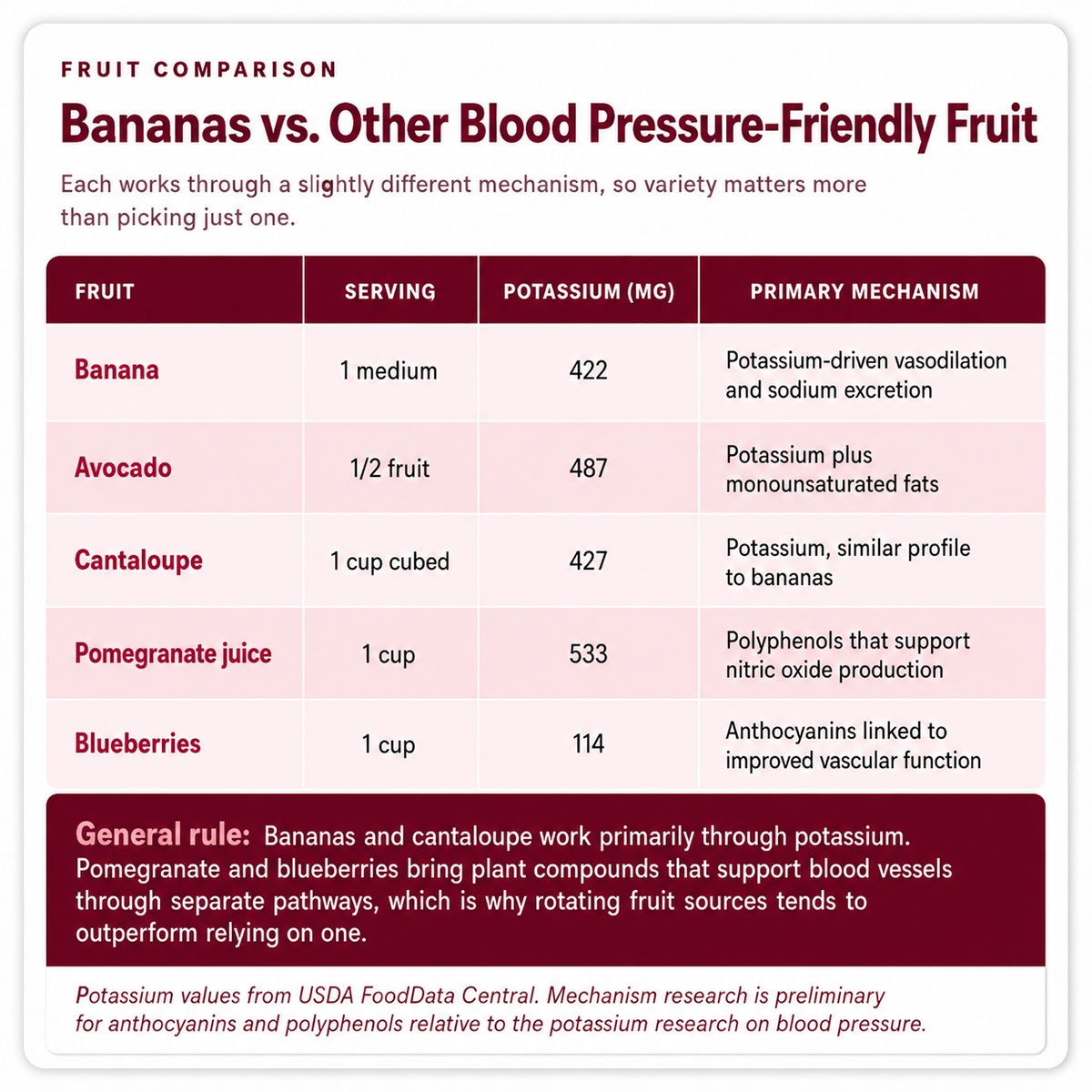
Beet greens, spinach, white beans, coconut water, and sweet potato all deliver comparable or higher potassium per serving, often with fewer calories. A morning smoothie with banana and spinach blended in gets you halfway to a daily goal before lunch.
Budget Tip: Frozen spinach delivers more potassium per dollar than fresh. One cup of cooked frozen spinach costs about 30 cents and provides roughly 839 milligrams.
That three-to-four-banana range from the research isn’t the realistic goal, though. One to two is, backed up by smarter choices the rest of the day.
Ripeness, Myths, and Your Gut Bacteria
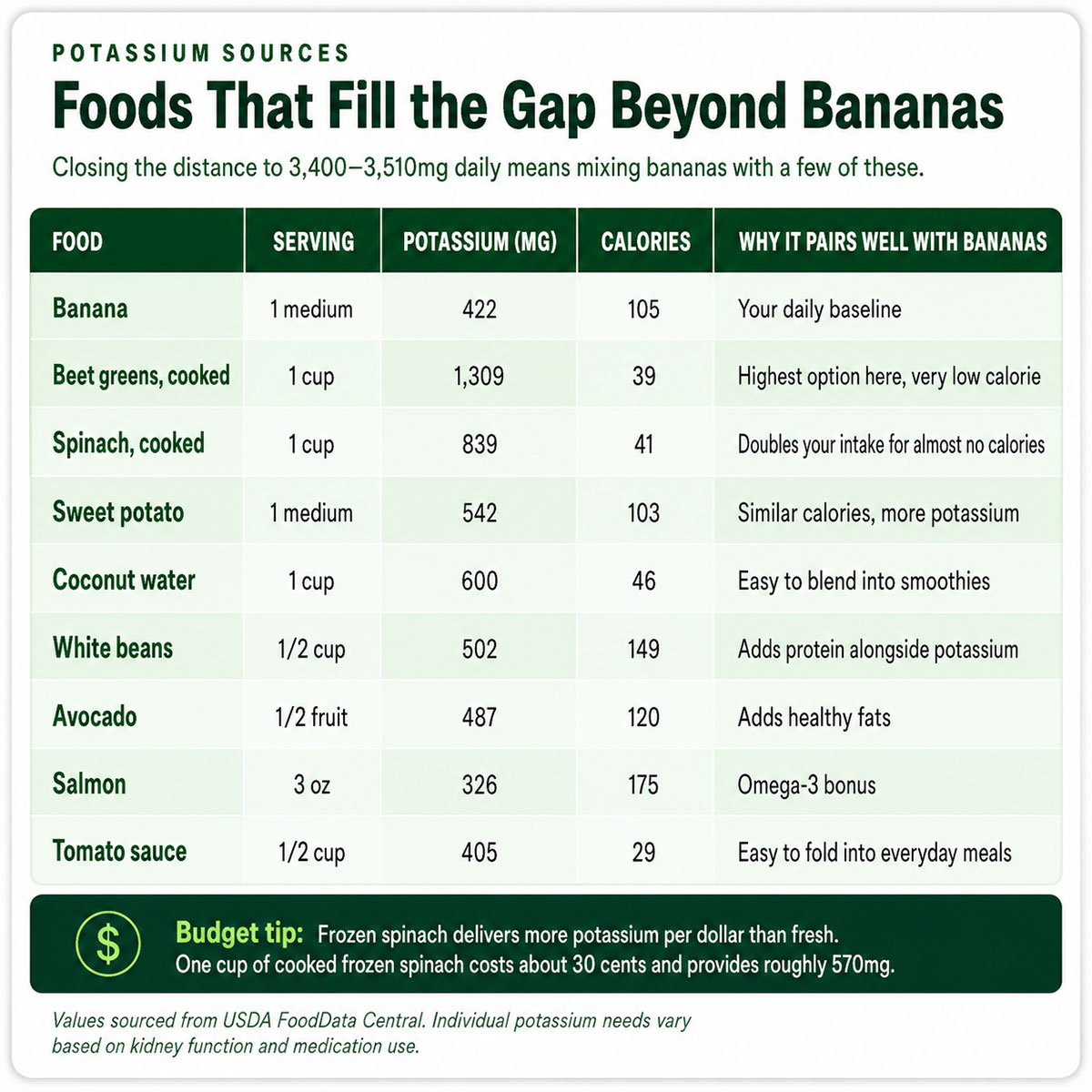
One banana won’t cure high blood pressure. Studies showing real benefits used 1,500 to 3,500 extra milligrams of potassium daily, the equivalent of three to eight bananas. Most people won’t eat that many, and they don’t need to. The goal is a complete diet with multiple potassium sources, not a single miracle fruit.
Ripeness changes more than people assume. Walk into any grocery store, and you’ll see bananas at every stage, from bright green to deeply spotted. Most shoppers grab yellow. Whether that’s the right call depends on what else is going on in your body.
Green Bananas and Resistant Starch
Green bananas contain resistant starch, a type of starch your small intestine can’t digest. It travels intact to your large intestine, where it feeds beneficial gut bacteria and improves blood sugar control and insulin sensitivity along the way.
That connects to blood pressure through metabolic syndrome, a cluster of problems that includes high blood pressure, elevated blood sugar, and excess abdominal fat. It tends to be closely associated with poor insulin sensitivity. Improve insulin sensitivity, and blood pressure often improves along with it.
The relationship between potassium and blood pressure also isn’t a straight line. A 2020 dose-response analysis in the Journal of the American Heart Association modeled outcomes across a wide range of intake levels.
Among people with hypertension, blood pressure kept improving as potassium excretion rose, bottoming out somewhere between 90 and 120 millimoles a day, or roughly 3.5 to 4.7 grams. Push meaningfully higher than that, and the benefit reverses.
Green bananas provide the same potassium as yellow ones, plus that bonus resistant starch. The tradeoff is taste. Green bananas are chalky and bland on their own.
Yellow bananas are sweeter because that resistant starch has already converted to simple sugars, which taste better but raise blood sugar faster. If you have diabetes or prediabetes, that faster sugar spike could work against your blood pressure goals. Brown-spotted bananas go further still, with nearly all their starch converted to sugar, which makes them better suited to baking than to blood sugar control.
The practical move is mixing ripeness levels by purpose. Green sliced into oatmeal or yogurt for blood sugar control. Yellow for a quick, convenient snack. Overripe blended into a smoothie with spinach and protein powder to balance the sugar.
What Your Gut Bacteria Have to Do With It
Most articles skip this part entirely. When resistant starch from green bananas reaches your large intestine, beneficial bacteria ferment it into short-chain fatty acids, including one called butyrate, which has anti-inflammatory effects that extend into your blood vessels.
Inflammation stiffens artery walls, and stiff arteries mean higher blood pressure. Reduce that inflammation by feeding the right bacteria, and the arteries stay more flexible. Blood moves more easily as a result.
This is why the fiber in bananas matters nearly as much as the potassium. You’re not getting a mineral supplement wrapped in fruit. You’re getting a complete package that supports your gut, your blood vessels, and your blood pressure together.
A green banana holds about 8 to 10 grams of resistant starch. As it ripens, that starch converts first to regular starch, then to sugar, until a fully ripe banana has less than a gram left. If you want both the potassium and the gut benefit, reach for one that’s still slightly green at the tips.
Five Ways to Eat Bananas
Eating the same banana the same way every day gets old fast. These five recipes work bananas into a routine without turning into a chore.
Recipe 1: Blood Pressure Smoothie Bowl
Ingredients:
- 1 frozen banana
- 1 cup fresh spinach
- 1/2 cup coconut water
- 1/4 avocado
- 1 scoop vanilla protein powder
- 1 tablespoon ground flaxseed
Toppings:
- 2 tablespoons sliced almonds
- 1/4 cup fresh berries
- 1 tablespoon hemp seeds
Instructions:
- Blend the frozen banana, spinach, coconut water, avocado, protein powder, and flaxseed until smooth.
- Pour into a bowl.
- Top with almonds, berries, and hemp seeds.
Nutrition per serving: Potassium: ~1,650mg | Sodium: under 100mg | Calories: 420 | Serves: 1
This single bowl delivers more than a third of a full day’s potassium target. The protein powder and healthy fats slow sugar absorption, so it won’t spike blood sugar the way a banana alone might.
Recipe 2: Green Banana Overnight Oats
Ingredients:
- 1/2 cup steel-cut oats
- 1 green banana, sliced thin
- 1 cup unsweetened almond milk
- 1 tablespoon chia seeds
- 1/2 teaspoon cinnamon
- 1 tablespoon almond butter
- Handful of walnuts
Instructions:
- Mix the oats, almond milk, and chia seeds in a jar.
- Layer banana slices on top.
- Sprinkle with cinnamon.
- Refrigerate overnight.
- In the morning, stir in almond butter and top with walnuts.
Nutrition per serving: Potassium: ~980mg | Sodium: under 150mg | Calories: 445 | Serves: 1
The green banana’s resistant starch keeps you full all morning while the chia seeds add fiber and omega-3s. A breakfast that stabilizes blood sugar and delivers solid potassium in one bowl.
Recipe 3: Heart-Healthy Banana Muffins
Ingredients (makes 12 muffins):
- 3 very ripe bananas, mashed
- 1/3 cup coconut oil, melted
- 1/2 cup honey
- 2 eggs
- 1 teaspoon vanilla
- 1 3/4 cups whole wheat flour
- 1 teaspoon baking soda
- 1/2 teaspoon cinnamon
- 1/4 teaspoon salt (optional, or omit)
- 1/2 cup chopped walnuts
- 1/2 cup dark chocolate chips (70% cacao)
Instructions:
- Preheat the oven to 350°F.
- Mix the mashed bananas, oil, honey, eggs, and vanilla.
- In a separate bowl, combine the flour, baking soda, cinnamon, and salt.
- Fold the dry ingredients into the wet until just combined.
- Stir in walnuts and chocolate chips.
- Fill muffin cups two-thirds full.
- Bake 18 to 20 minutes, until a toothpick comes out clean.
Nutrition per muffin: Potassium: ~240mg | Sodium: ~95mg (or ~55mg without added salt) | Calories: 235
Skip the added salt to keep sodium under 60 milligrams a muffin. The dark chocolate contributes flavonoids that support heart health on top of the banana’s potassium.
Recipe 4: Post-Workout Potassium Recovery Drink
Ingredients:
- 1 banana
- 1 cup coconut water
- 1/2 cup plain Greek yogurt
- 1/4 cup tart cherry juice
- A tiny pinch of sea salt (about 1/8 teaspoon)
- 3 to 4 ice cubes
Instructions:
- Blend all ingredients until smooth.
- Drink within 30 minutes after exercise.
Nutrition per serving: Potassium: ~1,100mg | Sodium: ~180mg | Calories: 280 | Serves: 1
Exercise depletes electrolytes, and this drink replaces potassium alongside a small, deliberate amount of sodium to help your body absorb both efficiently. The Greek yogurt adds protein for recovery, and tart cherry juice brings some anti-inflammatory benefit of its own.
Recipe 5: Evening Relaxation Banana Snack
Ingredients:
- 1/2 banana, sliced
- 2 tablespoons almond butter
- 1 tablespoon ground flaxseed
- A sprinkle of cinnamon
Instructions:
- Arrange banana slices on a small plate.
- Spread almond butter on each slice.
- Sprinkle with flaxseed and cinnamon.
Nutrition per serving: Potassium: ~380mg | Sodium: under 5mg | Calories: 240 | Serves: 1
About an hour before bed, this snack supports the natural nighttime dip that most people’s blood pressure follows. Bananas contain magnesium, which helps blood vessels relax, and the healthy fats in almond butter prevent a sugar spike that could disrupt sleep.
Building a Complete Potassium Plan: Why the Ratio Matters More Than the Banana
Potassium never works alone, and most coverage of it treats that fact as an afterthought. Your body constantly balances potassium against sodium, and when one climbs, the other should fall.
Think of sodium and potassium as two kids on a seesaw. Load the sodium side with processed food, fast food, and restaurant meals, and adding a banana genuinely helps rebalance things. Keep piling on sodium indefinitely, though, and no reasonable amount of potassium can level that seesaw back out.
The ideal ratio runs about 2:1 to 3:1, roughly two to three times more potassium than sodium. Most people eat the opposite: something like 3,400 milligrams of sodium against maybe 2,500 milligrams of potassium on an average day. That ratio is backward, and it’s a big part of why potassium’s benefits are strongest in people whose diets run heavy on salt.
A 2014 review in Advances in Nutrition worked through the evidence on this specific ratio, sodium to potassium, rather than either mineral studied in isolation. Its conclusion: the ratio predicts blood pressure and cardiovascular risk more consistently than sodium or potassium measured alone. That’s part of why the DASH diet, which cuts sodium while raising potassium at the same time, tends to outperform interventions that only adjust one side of the equation.
A bag of chips carries over 200 milligrams of sodium. A banana carries about 1. Trading one for the other helps twice over: you add potassium and remove sodium in the same swap.
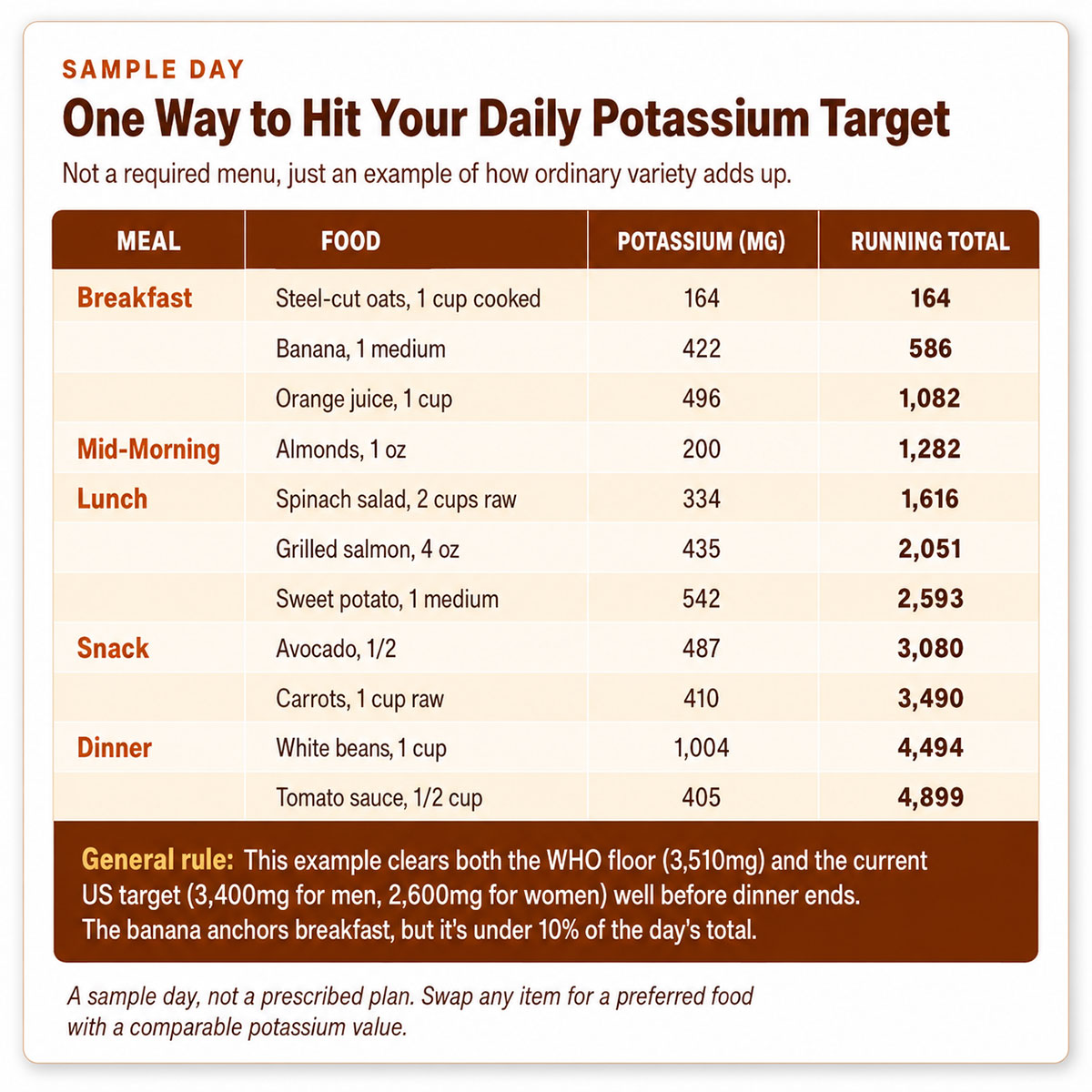
A full day of eating that reaches the current US target looks less like a strict meal plan and more like ordinary variety.
Notice the banana contributes less than 10% of the day’s total potassium. It’s still worth eating daily. It’s cheap, portable, and anchors a breakfast while other foods fill in the rest.
When Bananas Become a Problem
Before stocking up on bananas, know when they’re not safe.
If you have kidney disease, especially stage 3 or later, your kidneys can’t clear potassium efficiently. It builds up in your blood, a condition called hyperkalemia, which can trigger dangerous heart rhythms.
If a doctor has told you to limit potassium, bananas are off the table. Don’t guess here. Ask directly.
Certain blood pressure medications raise that risk further. ACE inhibitors and ARBs are “potassium-sparing,” meaning they help your kidneys hold onto potassium while flushing sodium. Combine one of these with a high-potassium diet, and levels can climb higher than intended.
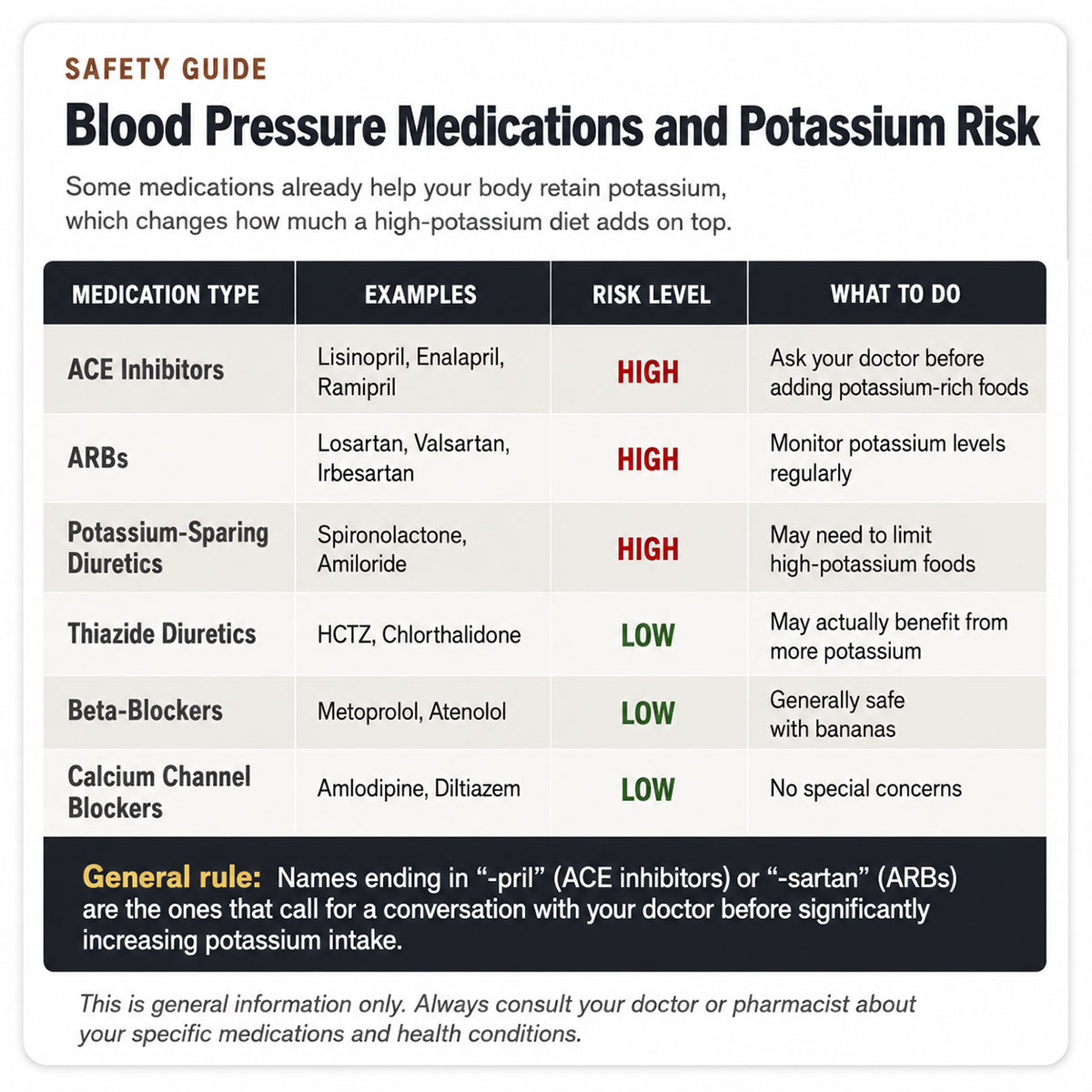
Doctor’s Note: If you’re taking an ACE inhibitor (names ending in “-pril”) or an ARB (names ending in “-sartan”), talk to your doctor before significantly increasing potassium intake. These medications can cause potassium to build up in the blood.
For most healthy adults, getting too much potassium from food alone is genuinely difficult. Your kidneys handle the excess. The risk climbs when potassium supplements get added on top of an already high-potassium diet. Stick to food sources unless a doctor prescribes something different.
Watch for muscle weakness, fatigue, tingling, an irregular heartbeat, or nausea after increasing banana intake. If any of those, stop and call your doctor.
A related question comes up often: why not skip the fruit and just take a potassium pill? Whole food comes with fiber, vitamin B6, vitamin C, manganese, and plant compounds that work alongside the mineral, and your body absorbs food-based potassium gradually over a couple of hours rather than all at once.
Over-the-counter supplements are capped at 99 milligrams per pill in the US, since higher single doses can irritate the stomach and esophagus. Matching one banana’s potassium would take four pills, and reaching a therapeutic dose used in the studies above would take 15 to 35. Prescription-strength potassium does exist for diagnosed deficiency, but that’s a decision made with blood tests and physician monitoring, not a swap to make on your own.
Tracking Whether It’s Actually Working
You can’t manage what you don’t measure. Buy a home blood pressure monitor with an upper-arm cuff rather than a wrist model. Upper-arm readings tend to be more accurate.
Check your pressure at the same time each day, ideally in the morning when readings tend to run highest. Sit quietly for five minutes first, rest your arm at heart level, and skip the conversation during the reading. Take two readings a minute apart and average them.
Do this daily for the first month, then drop to three times a week once you have a baseline.
Don’t expect week one to show much. Weeks two and three might bring a point or two of movement, some days higher than others.
By weeks four through eight, if potassium intake is up and sodium is down, a 3-to-5-point average drop is realistic. A simple week-over-week log, noting readings alongside diet, stress, and sleep, tends to reveal patterns faster than daily numbers alone.
Call your doctor if systolic pressure climbs above 180 or diastolic pressure above 120, if readings jump 10 or more points for several days running, if headaches, chest pain, or vision changes appear, if pressure drops below 90/60 alongside dizziness, or if eight weeks of consistent diet changes produce no improvement at all.
Conclusion
The honest version of this story isn’t as tidy as “eat a banana, lower your blood pressure.” It’s closer to: your kidneys have been running a sodium surplus for years, and one banana barely dents it. A month of bananas, alongside less salt, dents it considerably more.
That’s a less shareable finding than the one-line version. It’s also the one that actually holds up when you follow the studies back to their original numbers. The fruit was never really the point. The ratio was.
FAQs
How Many Bananas Should I Eat Daily to Lower Blood Pressure?
One to two bananas daily is realistic for most people, providing 400 to 800 milligrams of potassium. Meaningful blood pressure change typically requires 1,500 to 3,500 additional milligrams from all sources combined, so pairing bananas with leafy greens, beans, fish, and sweet potatoes matters more than the banana count alone.
Do Bananas Affect Blood Pressure Medication?
They can, depending on the medication. ACE inhibitors and ARBs, along with potassium-sparing diuretics, already help your body retain potassium. Add a high-potassium diet on top, and levels can climb into risky territory. Thiazide diuretics, beta-blockers, and calcium channel blockers don’t carry this risk and are generally fine with bananas. Check your specific prescription with a doctor or pharmacist rather than guessing from the drug class alone.
Why Are Bananas Sometimes Called Bad for Blood Pressure?
Almost always, it’s about who’s eating them, not the fruit itself. For someone with advanced kidney disease or on a potassium-sparing medication, a high-potassium diet, bananas included, can push blood potassium to dangerous levels. For everyone else, the research points in the other direction. The “bad for blood pressure” framing usually applies to a specific medical situation, not to bananas generally.
Who Should Avoid Bananas for Blood Pressure Reasons?
People with stage 3 or later kidney disease, anyone told by a doctor to limit potassium, and people on ACE inhibitors, ARBs, or potassium-sparing diuretics should talk to a doctor before increasing banana intake. Everyone else can generally eat bananas without concern, assuming no other diagnosed condition says otherwise.
Are Plantains Better Than Bananas for Blood Pressure?
Plantains carry slightly more potassium, about 490 milligrams per cooked cup versus 422 in a medium banana, but they’re usually prepared with salt and oil, which can cancel out the benefit. Prepared with minimal salt, plantains are a fine option. They’re not dramatically better than bananas.
How Long Before I See Results?
Most people notice small changes within two to four weeks if total potassium intake is up and sodium is down. The studies behind these numbers ran anywhere from four to sixteen weeks. Track weekly rather than daily, and look for a trend rather than a single good reading.
What If I Don’t Like Bananas?
Skip them. They’re convenient and cheap, not required. Spinach, sweet potatoes, avocados, beans, and fish all provide comparable or higher amounts of potassium.