Your genes aren’t the whole story. Long-term studies suggest everyday choices can still shape brain health, even when someone starts with elevated genetic risk.
Scientists tracking thousands of people for 20 to 30 years have found something hopeful. Up to 40% of dementia cases could be delayed or prevented through specific habits. These aren’t vague suggestions about “staying healthy.” They’re precise actions backed by studies that followed the same people from middle age into their later years.
The research is clear. While you can’t change your DNA, you can change how your brain ages. The 12 habits below come from studies that tracked real people for decades, not months. Each one has a measurable effect on your risk.
But before the habits, there’s something worth understanding about the risk factors you can’t change, because knowing those makes the ones you can change matter even more.
Personal Alzheimer's Risk Calculator
Answer 6 questions to assess your current modifiable risk factors and get personalized recommendations.
Risk Reduction at a Glance
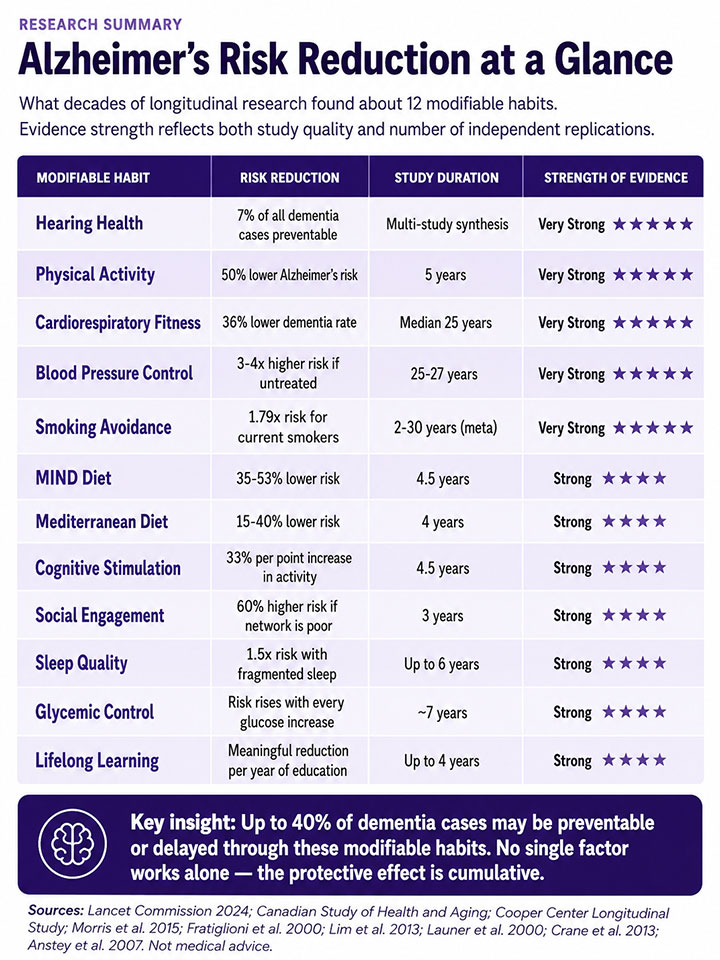
The table below shows what research has found about each modifiable habit. Strength of evidence ratings reflect both study quality and how many independent studies confirmed the findings.
The Risk Factors You Can’t Change
Age is the strongest single predictor of Alzheimer’s disease. After 65, risk doubles roughly every five years. After 85, it reaches nearly one in three. That isn’t a reason for fatalism, it’s a reason to start the habits below earlier rather than later.
Family history matters too. Having a parent or sibling with Alzheimer’s meaningfully raises your odds, though it doesn’t make the disease inevitable. Most cases involve multiple genes that slightly increase risk, not a single gene that guarantees it. Only 1–5% of cases are caused by specific mutations that directly cause the disease regardless of lifestyle.
The genetics question gets more complicated when you look at a gene called APOE4.
What Chris Hemsworth’s Genes Can Teach the Rest of Us
In 2022, while filming his National Geographic docuseries Limitless, Chris Hemsworth learned he carries two copies of the APOE4 gene variant, one inherited from each parent. That puts him among the 2–3% of the population at eight to ten times the average Alzheimer’s risk.
He went public with the information anyway, and his reason was instructive: he wanted people to pay attention to a question most treat as someone else’s problem.
APOE (apolipoprotein E) is a gene involved in how cholesterol moves through the bloodstream and the brain. About 20% of the population carries one copy of APOE4, which roughly doubles or triples Alzheimer’s risk.
Two copies push that risk dramatically higher. Carrying APOE4 doesn’t guarantee disease, and the absence of it doesn’t guarantee protection, but it’s the strongest known genetic risk factor currently identified.
What the Hemsworth story actually demonstrates is that genetics doesn’t decide everything. His response to the news was to change what he could: sleep, stress, physical training, diet. The habits in this article aren’t a consolation prize for people with a difficult genetic hand.
Research suggests they may matter more for people who have one. A 2025 Nature Medicine study found that higher physical activity was associated with slower cognitive decline specifically in people with elevated amyloid burden, the biological marker most closely linked to Alzheimer’s risk. The modifiable factors work. They may work harder when the underlying risk is higher.
A full look at APOE4, who should consider genetic testing, and what the current research says about modifying genetic risk is coming in a dedicated piece.
The Physical Foundation: Movement as Medicine
1. Prioritize Consistent Physical Activity
The Canadian researchers didn’t ask people to run. They asked what participants did most days. Walked. Gardened. Climbed stairs. Stayed active in daily life. Then they waited five years to see who developed cognitive problems.
The Canadian Study of Health and Aging tracked 4,615 older adults and found that those who stayed physically active cut their Alzheimer’s risk in half. Regular exercise also reduced the risk of any type of dementia by 37%. This wasn’t about marathons or gym memberships. It was about consistency over intensity.
The mechanism runs deeper than most people expect. Exercise does more than increase blood flow, it triggers the release of BDNF (brain-derived neurotrophic factor), a protein that directly supports neuron survival and growth.
It also reduces inflammation and promotes new cell formation in the hippocampus, the brain region Alzheimer’s affects first. You’re not just keeping the existing brain in better shape. You’re adding to it.
A 30-minute walk most days counts. The key is doing it regularly, not occasionally.
2. Build Cardiorespiratory Fitness
Getting your heart rate up does more than strengthen your heart. The Cooper Center Longitudinal Study followed 19,458 middle-aged adults for a median of 25 years, measuring fitness with treadmill tests when participants were around 50.
People in the highest fitness group had a 36% lower rate of incident all-cause dementia compared to the least fit group, and that protection lasted for more than two decades.
The DeFina et al. 2013 study in Annals of Internal Medicine is one of the longest-running fitness-and-dementia datasets on record. Its core finding: what you do in midlife still shows up in your brain 25 years later.
Cardiorespiratory fitness means your heart and lungs can deliver oxygen efficiently during exercise. You build it by doing things that make you breathe harder: brisk walking, swimming, cycling, dancing. If you can talk but not sing comfortably, you’re in the right zone.
You don’t need to become an athlete. You need to challenge your cardiovascular system regularly enough that it adapts.
The Cognitive Kitchen: Precision Nutrition
3. Adopt the Mediterranean Pattern
The Washington Heights-Inwood Columbia Aging Project followed 2,258 older adults for four years, tracking diet and Alzheimer’s incidence. Researchers divided participants into three groups based on how closely they followed Mediterranean eating patterns.
People with the highest adherence had 40% lower Alzheimer’s risk compared to those in the lowest group. Even moderate adherence showed a meaningful 15% reduction.
This diet emphasizes olive oil, fish, vegetables, fruits, whole grains, legumes, and nuts. It limits red meat, processed foods, and sweets. The protective mechanism runs through multiple pathways: reduced inflammation, better blood vessel health, and nutrients that directly protect brain cells from oxidative damage.
You don’t need to overhaul your kitchen overnight. Start by adding more vegetables to your meals, using olive oil instead of butter, and eating fish twice a week. The pattern is what matters, not perfection.
4. The MIND Diet Strategy
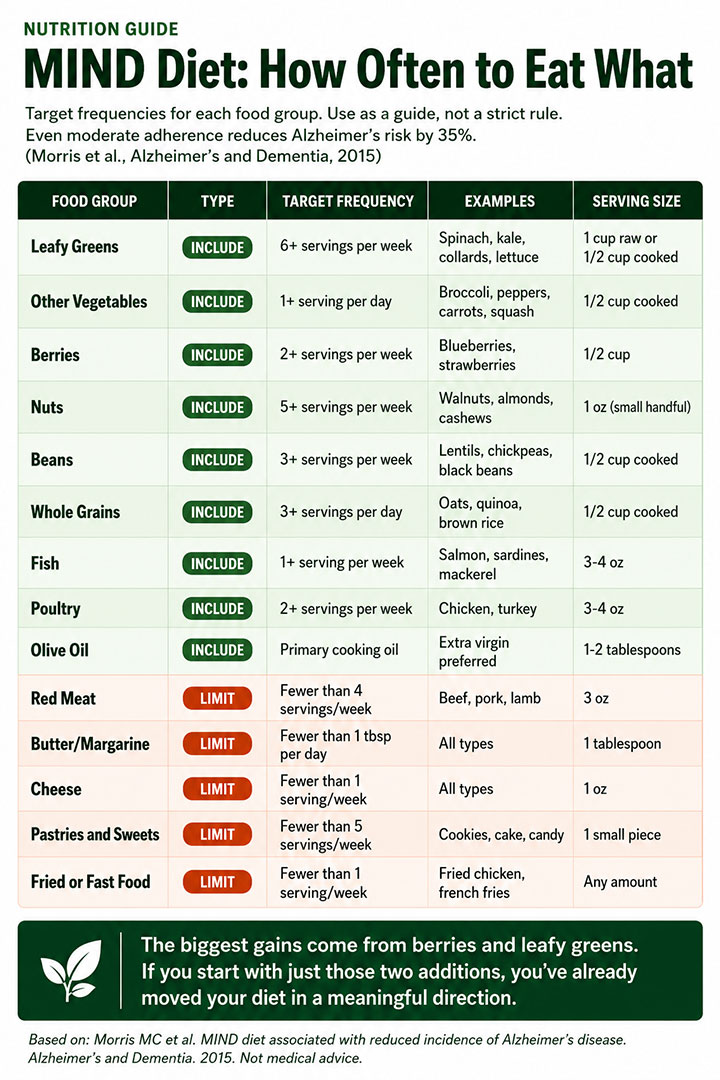
Scientists designed the MIND diet specifically for brain health, combining the best elements of Mediterranean eating with research on foods that protect cognition. The Memory and Aging Project tracked 923 older adults for 4.5 years.
Those who followed the MIND diet most closely had a 53% lower rate of developing Alzheimer’s. What makes the finding particularly useful: even moderate adherence, not perfect compliance, still showed a 35% risk reduction.
The MIND diet highlights ten brain-healthy food groups: green leafy vegetables, other vegetables, nuts, berries, beans, whole grains, fish, poultry, olive oil, and wine in moderation. It identifies five food categories to limit: red meat, butter and margarine, cheese, pastries and sweets, and fried or fast food.
Berries and leafy greens carry the strongest brain-health signal of any foods studied. Starting with just those two additions already moves your diet in a meaningful direction.
QUICK TAKEAWAY: Even partial MIND diet adherence provides real protection, 35% risk reduction without perfect compliance.
Weekly Brain-Health Meal Plan
This sample meal plan shows how to put the MIND diet into practice. Adjust portions and specific foods based on your preferences and needs.
MONDAY:
Breakfast: Oatmeal with blueberries, walnuts, and cinnamon
Brain benefit: Whole grains (slow-release energy), berries (antioxidants), walnuts (omega-3s)
Lunch: Large spinach salad with grilled salmon, chickpeas, olive oil dressing
Brain benefit: Leafy greens (vitamin K), fish (omega-3s), legumes (fiber)
Snack: Handful of mixed nuts
Dinner: Grilled chicken with roasted vegetables and quinoa
TUESDAY:
Breakfast: Brain-boost smoothie (recipe below)
Brain benefit: Leafy greens, berries, nuts, omega-3s
Lunch: Lentil soup with whole grain bread
Snack: Apple slices with almond butter
Dinner: Baked cod with steamed broccoli and brown rice
WEDNESDAY:
Breakfast: Whole grain toast with avocado and tomato
Lunch: Chickpea and vegetable stir-fry with quinoa
Snack: Berries with a few walnuts
Dinner: Roasted chicken with sweet potato and green beans
SHOPPING LIST FOR THE WEEK:
- Leafy greens: Spinach, kale, arugula (7+ servings)
- Berries: Blueberries, strawberries (5+ servings)
- Nuts: Walnuts, almonds, mixed nuts (daily portions)
- Fish: Salmon, cod, sardines (2–3 servings)
- Olive oil: Extra virgin (primary cooking oil)
- Whole grains: Oats, quinoa, brown rice, whole grain bread
- Beans: Chickpeas, black beans, lentils
- Vegetables: Broccoli, peppers, carrots, sweet potato, green beans, tomatoes
- Poultry: Chicken breast
Brain-Healthy Recipes
Recipe 1: Mediterranean Breakfast Bowl
Prep time: 5 minutes | Serves: 1
Ingredients:
- 1 cup cooked quinoa or farro
- 1/4 cup blueberries
- 1/4 cup chopped walnuts
- 1 tablespoon ground flaxseed
- Drizzle of honey
- Dash of cinnamon
Instructions:
- Warm quinoa in the microwave for 1 minute
- Top with berries and walnuts
- Sprinkle with flaxseed and cinnamon
- Drizzle with honey
Brain benefits: Whole grains provide slow-release energy. Blueberries contain anthocyanins that cross the blood-brain barrier and protect neurons. Walnuts offer omega-3 fatty acids that support brain cell membranes.
Recipe 2: Brain-Boost Smoothie
Prep time: 3 minutes | Serves: 1
Ingredients:
- 1 cup spinach
- 1/2 cup frozen blueberries
- 1/2 banana
- 1 tablespoon almond butter
- 1 tablespoon chia seeds
- 1 cup unsweetened almond milk
- Ice cubes
Instructions:
- Blend all ingredients until smooth
- Add more liquid if needed for desired consistency
Brain benefits: Spinach provides folate and vitamin K. Blueberries offer flavonoids that support memory. Chia seeds add omega-3s and fiber.
Recipe 3: Simple Salmon with Herb Crust
Prep time: 5 minutes | Cook time: 12 minutes | Serves: 2
Ingredients:
- 2 salmon fillets (4–6 oz each)
- 2 tablespoons olive oil
- 2 cloves garlic, minced
- 1/4 cup fresh parsley, chopped
- Juice of 1/2 lemon
- Salt and pepper to taste
Instructions:
- Preheat oven to 400°F
- Mix olive oil, garlic, and parsley
- Place salmon on a baking sheet
- Spread herb mixture on top
- Bake 12–15 minutes until fish flakes easily
- Squeeze lemon juice over top before serving
Serve with: Roasted vegetables and brown rice
Mental Reserve: Building a “Buffer” Brain
5. Seek Consistent Cognitive Stimulation
The Religious Orders Study had a counterintuitive design. Researchers didn’t measure how smart the participants were. They measured how often people read, wrote, played games, and did puzzles, ordinary activities, unremarkable on their own. Then they watched who developed Alzheimer’s over the next 4.5 years.
The atudy followed 801 older Catholic nuns, priests, and brothers. Each one-point increase in cognitive activity score reduced Alzheimer’s risk by 33%. The protection held regardless of education level or baseline cognitive function, meaning the activity itself was doing something, not merely a proxy for a higher-ability starting brain.
Cognitive reserve acts like a buffer. When brain cells begin to fail, a stronger neural network compensates longer. People with more reserve show symptoms later, even when their brains have accumulated the same amount of damage as those who declined faster.
The best activities are ones that push you. Reading a difficult book works better than scrolling social media. Learning a new language does more than repeating the same crossword puzzle every day. Novelty and effort are what drive the benefit, not the activity type itself.
What This Study Can and Cannot Tell Us:
- Shows association between mental activity and reduced risk
- Controlled for age, sex, education, and baseline health
- 4.5-year follow-up is substantial for this type of research
- Cannot prove causation, but the pattern holds across multiple independent studies
- Note: Participants were older Catholic religious community members, a specific population
6. Lifelong Learning and Education
Every year of learning builds protection against dementia, and that includes learning that happens well after graduation.
A 1994 JAMA cohort study by Stern and colleagues followed 593 older adults in North Manhattan for up to four years, tracking educational history and monitoring for dementia. Each additional year of education was associated with meaningfully reduced dementia risk. The protective effect lasted decades after people finished school.
Education doesn’t just fill your brain with facts. It rewires the structure of your thinking, more schooling builds more neural connections, which provide alternate pathways when some brain cells stop working. A 60-year-old learning to play guitar builds cognitive reserve just as effectively as a teenager studying calculus.
Look for opportunities to learn in whatever form fits your life. Community colleges, online courses, book clubs, craft classes, language apps. The format matters less than the challenge level. If it feels easy after a few weeks, it’s time to level up.
QUICK TAKEAWAY: Formal education builds early protection, but learning at any age keeps adding to your cognitive reserve.
The Social and Restorative Connection
7. Expand Your Social Network
Most people think of social withdrawal as a mood problem. Something that affects how you feel, not what happens inside your skull. The Kungsholmen Project found otherwise.
The Kungsholmen Project in Sweden tracked 1,203 older adults aged 75 and up for three years. Researchers assessed social networks by asking about relationships with children, friends, and confidants, and about participation in social activities. People with poor or limited social networks had a 60% higher risk of dementia compared to those with rich social connections.
Social interaction keeps your brain active in specific ways. Conversations require complex thinking, processing language, reading emotion, and holding multiple ideas in working memory simultaneously.
That mental workout strengthens neural networks over time. Social connection also protects against stress and depression, both of which accelerate cognitive decline through distinct biological pathways.
Quality matters more than quantity. A few close relationships protect more than many superficial ones. Maintaining friendships actively, volunteering in your community, video calls if in-person visits aren’t possible, all of it counts. The important thing is not treating social connection as optional.
8. Master Your Sleep Architecture
Sleep does more than rest your body. During deep sleep, your brain activates a clearing system that removes waste products that build up during waking hours, including proteins linked to Alzheimer’s. Fragmented sleep prevents your brain from completing that maintenance cycle.
The Rush Memory and Aging Project sleep study tracked 737 older adults for up to six years, using actigraphy devices worn on the wrist to measure actual sleep patterns, not self-reports. People with fragmented sleep had a 1.5 times higher Alzheimer’s risk, even after accounting for total sleep duration. Quality, not just quantity, was the variable that moved risk.
Fragmented sleep means waking repeatedly, even briefly, even without remembering it. This disrupts the slow-wave sleep stages where waste clearance is most active.
Create the conditions for solid sleep: a cool, dark, quiet room; consistent bedtimes and wake times; no screens for an hour before bed; caffeine limited to mornings. If you snore loudly or wake up gasping, talk to your doctor about sleep apnea, untreated apnea is one of the most common and underdiagnosed causes of sleep fragmentation in adults over 50.
The Clinical Guardians: Managing the “Silent” Risks
9. Midlife Blood Pressure Control
The Honolulu study is one of the more unsettling things in dementia research. Researchers measured the blood pressure of 3,703 Japanese-American men when they were between 45 and 49 years old.
Then they waited. For more than 25 years. When the data finally came in, the men who had untreated high diastolic blood pressure in midlife had a three to four times higher risk of dementia in old age. A thing that happened in 1965 was still showing up in their brains in the 1990s.
The Honolulu-Asia Aging Study is particularly valuable because the follow-up period is long enough to separate cause from effect. High blood pressure in your 40s and 50s doesn’t feel like anything, most people have no symptoms. That’s exactly what makes it dangerous.
High blood pressure damages small blood vessels in the brain over decades. This reduces oxygen delivery and causes cumulative injury to tissue that never gets a chance to repair itself. The critical window is midlife, but treating elevated blood pressure at any point reduces the downstream risk.
Know your numbers. If they’re elevated, work with your doctor: losing weight, reducing sodium, exercising, and limiting alcohol all move blood pressure meaningfully. Medication works when lifestyle changes aren’t enough.
QUICK TAKEAWAY: Midlife blood pressure predicts late-life brain health. Get yours checked regularly, especially in your 40s and 50s.
10. Glycemic Control and Diabetes Prevention
High blood sugar harms more than your pancreas. The connection between glucose levels and brain health turns out to be direct, continuous, and present even before diabetes develops.
The Adult Changes in Thought Study followed 2,067 older adults for nearly seven years, using over 35,000 clinical glucose and HbA1c measurements to track blood sugar patterns. People with diabetes had meaningfully higher dementia risk.
But the more striking finding was that even in people without diabetes, higher average glucose levels were associated with rising dementia risk, there was no safe floor where the risk leveled off.
Diabetes affects the brain through multiple pathways: vascular damage, inflammation, and disrupted insulin signaling in brain tissue. The connection is strong enough that some researchers refer to Alzheimer’s informally as “Type 3 Diabetes,” though that framing is contested and the full mechanism is still being mapped.
Preventing diabetes protects your brain. If you already have diabetes, controlling blood sugar reduces risk. Eat fewer refined carbohydrates, choose whole grains over white bread and white rice, fill half your plate with vegetables, and exercise regularly to improve insulin sensitivity.
Environmental and Sensory Protection
11. Smoking Avoidance and Cessation
Of all the habits in this article, the smoking finding is in some ways the most straightforward, and the most hopeful. A meta-analysis pooling 19 prospective studies and 26,374 participants over periods of up to 30 years found that current smokers had 1.79 times higher Alzheimer’s risk compared to people who never smoked.
Former smokers had a lower risk than current smokers. The brain can recover. That’s not a minor caveat. It’s the most actionable finding in the dataset.
Smoking reduces oxygen delivery to the brain, increases inflammation, accelerates harmful protein buildup in brain tissue, and damages blood vessels through the same mechanisms that cause cardiovascular disease. The dementia risk from smoking runs through several of these pathways simultaneously.
If you smoke, quitting is the single best thing you can do for your long-term brain health. Use whatever resources help: nicotine replacement, medication, counseling, support groups. Most people need several attempts before quitting sticks. Each attempt moves you closer.
12. Proactive Hearing Health
Hearing loss is the single largest modifiable risk factor for dementia, accounting for 7% of all cases worldwide. That figure comes from the 2024 Lancet Commission on Dementia Prevention, which analyzed population data across the full lifespan in its most comprehensive update to date. Seven percent may sound modest, but it’s more than any other single modifiable factor on this list.
Untreated hearing loss forces the brain to work harder to understand speech, draining cognitive resources that would otherwise support memory and thinking. Social isolation often follows hearing loss, which adds another independent risk pathway.
Hearing loss also changes brain structure over time. Areas that process sound shrink when they go unused, and that loss of brain volume contributes to cognitive decline.
Protect your hearing around loud noise. Get your hearing tested, especially after 50. Use hearing aids if you need them, modern aids are smaller, more effective, and more affordable than they were a decade ago. Don’t dismiss hearing loss as a minor inconvenience. The cognitive stakes are higher than most people realize.
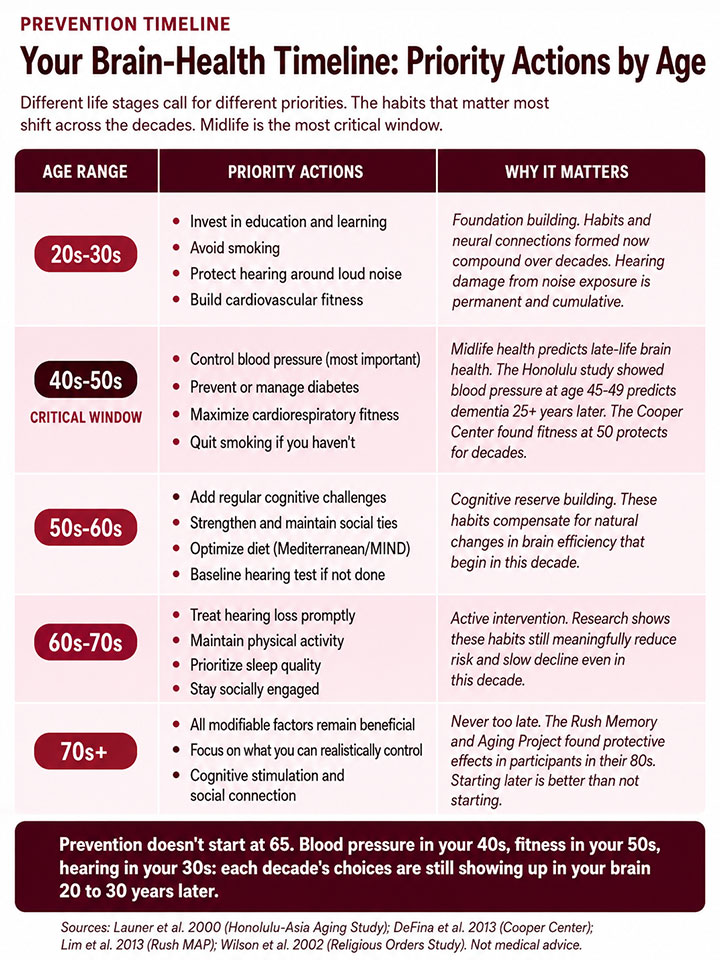
Your Brain-Health Timeline: Priority Actions by Age
Different life stages call for different priorities. Use this guide to focus your efforts where they matter most right now.
30-Day Brain-Health Starter Challenge
Change doesn’t happen overnight. This progressive challenge builds sustainable habits one week at a time.
WEEK 1: FOUNDATION
- Days 1–7: Add a 10-minute walk after one meal daily
- Daily: Eat one serving of leafy greens
- Once this week: Schedule a hearing test if you’re over 50
WEEK 2: BUILDING
- Days 8–14: Increase walk to 20 minutes
- Daily: Add berries to breakfast
- Once this week: Call or visit a friend you haven’t spoken to recently
WEEK 3: EXPANSION
- Days 15–21: Walk 30 minutes or try a new type of activity
- Daily: Replace one processed food with a whole food alternative
- Once this week: Try something mentally challenging you’ve never done before
WEEK 4: INTEGRATION
- Days 22–30: Maintain the walking habit
- Daily: Follow MIND diet principles for at least two meals
- Once this week: Schedule a blood pressure check or review your medical risk factors with your doctor
Common Myths About Alzheimer’s Risk
MYTH: Alzheimer’s is just a normal part of aging.
Normal aging involves some memory changes, but Alzheimer’s is a disease, not an inevitable outcome. Many people reach their 90s with sharp minds. The changes Alzheimer’s causes are distinct, progressive, and categorically different from typical age-related forgetfulness.
MYTH: If Alzheimer’s runs in my family, I’ll definitely get it.
Most Alzheimer’s cases aren’t purely genetic. Only 1–5% are caused by specific mutations that guarantee disease development. The vast majority involve multiple genes that slightly increase risk, combined with lifestyle factors. Having a parent or sibling with Alzheimer’s raises your odds, it doesn’t seal your fate. Lifestyle factors influence the majority of cases, including for people with family history.
MYTH: There’s nothing you can do to prevent Alzheimer’s.
Up to 40% of cases could be delayed or prevented through modifiable risk factors. The studies in this article tracked people for decades and found consistent protection from specific habits.
MYTH: Memory supplements can prevent Alzheimer’s.
No supplement has been proven to prevent Alzheimer’s in healthy adults. Large studies have repeatedly failed to show benefits from ginkgo biloba, vitamin E, omega-3 supplements (in people with adequate dietary intake), or other popular brain supplements. Focus on whole foods and the habits in this article.
MYTH: You need to do intense exercise to protect your brain.
Moderate activity like walking provides substantial protection. The Canadian Study found that regular physical activity of any intensity reduced Alzheimer’s risk by 50%. Consistency beats intensity. A daily 30-minute walk does more than occasional hard training.
MYTH: Doing crossword puzzles prevents Alzheimer’s.
The type of mental activity matters. Repeating the same puzzle type provides less benefit than learning genuinely new skills. Your brain grows when pushed beyond familiar territory, not when repeating things it has already mastered.
MYTH: Alzheimer’s only affects older people.
The brain changes that lead to Alzheimer’s begin decades before symptoms appear. That’s why midlife habits matter so much. Blood pressure control in your 40s and 50s affects dementia risk in your 70s and 80s. Prevention starts long before symptoms do.
When to See a Doctor
This article provides prevention strategies based on scientific research. It is not medical advice. Always consult a healthcare provider for personal health concerns.
Seek medical evaluation if you notice:
- Memory problems that disrupt daily life
- Difficulty completing familiar tasks
- Confusion with time or place
- Problems with words in speaking or writing
- Misplacing things and losing the ability to retrace steps
- Decreased or poor judgment
- Withdrawal from work or social activities
- Changes in mood or personality
Schedule routine checkups for:
- Blood pressure monitoring (at least annually, more often if elevated)
- Blood sugar and HbA1c testing (annually if at risk)
- Hearing evaluation (baseline at age 50, then every 2–3 years)
- Cognitive screening if you have concerns or family history
The Compound Effect: Building a Resilient Brain
Brain health isn’t built in a day. It’s the result of thousands of small decisions made over decades.
These 12 habits work together. Physical activity improves sleep quality. Better nutrition supports blood pressure control. Social connections motivate you to stay active. Each positive choice makes the next one easier, and each one reduces a risk factor that compounds when left unaddressed.
You don’t need to master all 12 at once. The Memory and Aging Project found that moderate adherence to the MIND diet still reduced Alzheimer’s risk by 35%, even though high adherence reduced it by 53%. Partial is better than none. Progress is better than perfection.
Start with the largest modifiable factor: get your hearing checked and treated if needed. Then add the most accessible habit: take a 30-minute walk most days. Build from there.
It’s never too late to start. The Rush Memory and Aging Project included participants in their 80s and still found protective effects from cognitive activities and sleep quality. And it’s never too early, the Cooper Center study showed that fitness levels at age 50 predicted dementia outcomes 25 years later. The decisions you make today are the ones your brain will carry into 2050.

Your Personalized Action Plan
THIS WEEK:
- Schedule a hearing test (if over 50 or if you notice any hearing difficulty)
- Take a 15-minute walk after dinner three times
- Add berries to breakfast twice
THIS MONTH:
- Check your blood pressure at a pharmacy or doctor’s office
- Try two new Mediterranean or MIND diet recipes
- Connect with a friend or family member you haven’t seen recently
- Learn one new skill or start one new hobby
THIS QUARTER:
- Build up to 30 minutes of daily activity most days
- Establish a consistent sleep schedule
- Start one mentally challenging hobby that pushes you beyond your comfort zone
- Get baseline blood work if you haven’t recently
THIS YEAR:
- Adopt at least 6 of the 12 brain-healthy habits as regular routines
- Get medical checkups for blood pressure, blood sugar, and hearing
- Build sustainable routines that protect your brain without requiring constant effort
Why Long-Term Studies Matter
Short-term studies can show associations that disappear over time. The studies cited in this article tracked people for 3 to 27 years. That’s long enough to see real outcomes, not just temporary changes in biomarkers.
The Honolulu-Asia Aging Study followed men for more than 25 years. When researchers find that midlife blood pressure predicts dementia a quarter-century later, that’s not merely a correlation, it describes a mechanism operating across the span of a person’s adult life. The Cooper Center’s fitness-dementia dataset spans nearly as long and shows the same durability of effect.
Longer follow-up periods also reduce the chance of reverse causation, the problem where early disease symptoms cause the behavior being studied, rather than the behavior preventing disease. A 20-year study makes that confusion far less likely than a 2-year study. It’s why the studies here were chosen specifically, and why study duration appears in the evidence table at the top of this article.
Conclusion
Your genes don’t determine your fate. The research is clear on this: daily choices shape your brain’s future more than most people realize, and that’s true even for people who start from a harder position genetically.
The habits in this article aren’t a guarantee. No prevention strategy works 100% of the time. But they stack the odds in your favor. The protective effects are strongest when you start in midlife, and they remain meaningful at any age. The studies that followed people into their 70s and 80s still found protection from adopting brain-healthy habits.
Start where you are. The compound effect of consistent, small choices across years is what the research actually measures, not heroic single interventions. Your brain’s future depends on what you decide to do most days, not what you do once.
Frequently Asked Questions
At what age should I start worrying about Alzheimer’s risk?
Start prevention in your 40s and 50s. Midlife habits have the strongest impact on late-life brain health. The Honolulu-Asia Aging Study showed that blood pressure levels in your late 40s predict dementia risk 25 years later. Fitness levels at age 50 predict outcomes at age 75. But prevention at any age still matters.
Can you reduce Alzheimer’s risk if it runs in your family?
Yes, meaningfully so. Even people with a family history benefit from the 12 habits. Lifestyle factors account for up to 40% of dementia cases, which means they matter even for those with a genetic predisposition. Genes load the starting conditions; lifestyle influences how those conditions play out.
What’s the single most important thing I can do to prevent Alzheimer’s?
No single habit prevents Alzheimer’s on its own. But hearing health affects 7% of all dementia cases, the largest share attributable to any one modifiable factor according to the 2024 Lancet Commission. Combine hearing protection and treatment with exercise, diet, and blood pressure control for the strongest combined effect.
Is it too late to reduce Alzheimer’s risk after age 70?
No. Studies consistently show that people in their 70s and 80s who adopt brain-healthy habits improve their cognitive trajectory. The Religious Orders Study included participants in their 70s and 80s and still found a 33% risk reduction from cognitive activities. Starting later is better than not starting.
How long does it take for lifestyle changes to affect brain health?
Some benefits appear within months. Exercise improves blood flow to the brain within weeks. Better blood sugar control shows effects over months. Maximum protection comes from decades of consistent habits, but early gains are real. Start now and stay consistent.
Do brain training games prevent Alzheimer’s?
Standard brain training apps show limited benefit for Alzheimer’s prevention. True cognitive stimulation comes from challenging, novel activities, learning a language, taking classes, mastering a new skill. The Religious Orders Study found that varied, effortful cognitive activities reduced risk by 33%. Effort and novelty matter more than the specific activity.
Can supplements prevent Alzheimer’s?
Current evidence doesn’t support supplements for prevention in healthy adults. Large, well-designed studies have failed to show benefits from popular brain supplements. Get nutrients from whole foods instead. The Mediterranean and MIND diets provide what your brain needs without the cost and uncertainty of supplementation.
Does caffeine or coffee affect Alzheimer’s risk?
Moderate coffee consumption (3–5 cups daily) is associated with lower dementia risk in some observational studies. Don’t start drinking coffee just for brain health. If you already drink it, moderate amounts appear safe and may offer some protection.
How does sleep apnea affect Alzheimer’s risk?
Sleep apnea causes repeated breathing interruptions during sleep, directly causing the kind of sleep fragmentation the Rush Memory and Aging Project linked to a 1.5 times higher Alzheimer’s risk. If you snore loudly, wake up gasping, or feel unrested despite adequate time in bed, talk to your doctor about sleep apnea testing. CPAP treatment can restore sleep quality substantially.
What about people with limited mobility or disabilities?
Many brain-protective habits don’t require physical fitness. Cognitive stimulation, social engagement, the MIND diet, hearing health, and blood pressure control all work regardless of mobility level. For physical activity, chair exercises, swimming, or water aerobics provide cardiovascular benefits. Work with your healthcare provider to find activities that fit your abilities.
Does Chris Hemsworth have Alzheimer’s?
No. Hemsworth carries two copies of the APOE4 gene variant, which significantly increases his statistical risk, but a genetic predisposition is not a diagnosis. As he has said publicly, carrying the gene is not the same as having the disease.
Many people with APOE4 never develop Alzheimer’s, and many people without it do. Lifestyle factors, including the habits in this article, appear to be particularly relevant for people with elevated genetic risk.
This article presents prevention strategies based on peer-reviewed research. It does not replace professional medical advice, diagnosis, or treatment. Always seek the advice of your physician or other qualified health provider with any questions about medical conditions or treatments.