Most people assume dementia begins when memory starts to fail. The latest research suggests the process often begins decades earlier, in places almost nobody thinks to look.
In 2023, researchers unveiled results from the largest clinical trial ever run on hearing aids and cognitive decline. Across nearly a thousand older adults, the intervention did almost nothing. Then a second look at the data found something almost nobody expected: inside one subgroup at elevated risk, hearing aids had slowed cognitive decline by 48 percent, one of the largest effects ever recorded for a prevention trial of any kind.
That split result captures something true about dementia prevention generally. The picture is rarely as clean as a single headline number.
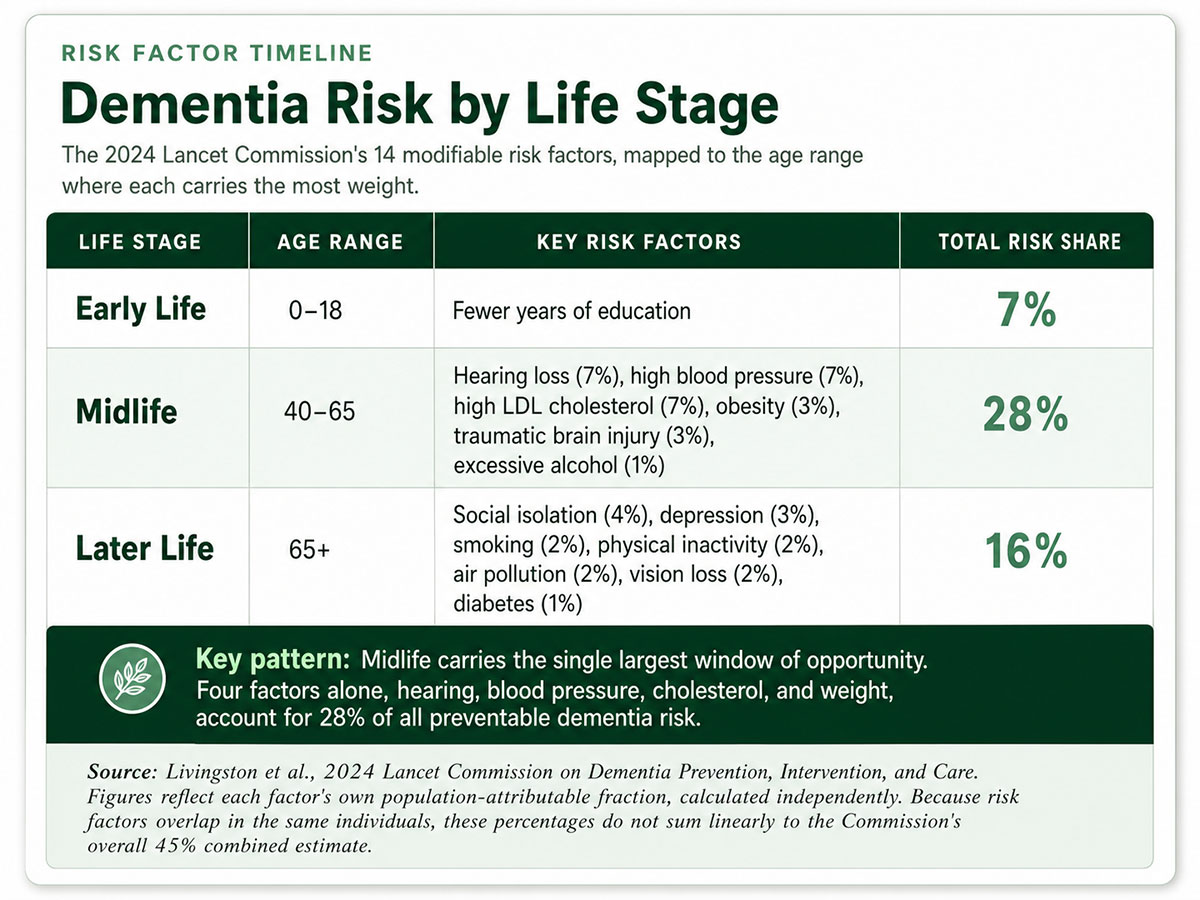
But the 2024 Lancet Commission on Dementia Prevention, Intervention, and Care, the standing body of dementia researchers that periodically reassesses the global evidence, concluded that up to 45 percent of dementia cases worldwide trace back to 14 risk factors that a person can actually change.
That is up from 40 percent in the Commission’s 2020 report, not because dementia became more preventable, but because the evidence got better.
Two of those 14 factors did not exist on anyone’s list five years ago. One of them barely feels related to the brain at all.
Dementia Is Not One Disease
Dementia and Alzheimer’s disease are used interchangeably in casual conversation, which causes more confusion than it resolves. Dementia is an umbrella term for any decline in mental function severe enough to interfere with daily life, whether that shows up as memory loss, language difficulty, or impaired judgment.
Alzheimer’s disease is the most common cause under that umbrella, accounting for 60 to 80 percent of cases. Vascular dementia, Lewy body dementia, and frontotemporal dementia make up most of the rest, each with a distinct underlying mechanism.
The prevention strategies below work across most of these types because they target shared vulnerabilities: blood vessel health, chronic inflammation, and the brain’s general capacity to withstand damage. A therapy aimed narrowly at amyloid plaques would not do that. Protecting blood flow to the brain does.
What Changed in 2024, and Why It Matters
The Lancet Commission’s 2024 update added two risk factors that were not on its radar in 2020. High LDL cholesterol, the kind that clogs arteries, now accounts for an estimated 7 percent of dementia risk on its own. Untreated vision loss adds another 2 percent. Together, that is nearly a tenth of all preventable dementia cases, hiding in two conditions most people manage for entirely different reasons.
The hearing aid finding belongs in this same “the evidence just got sharper” category. The 2023 ACHIEVE trial, run by researchers at Johns Hopkins and published in The Lancet, found no measurable benefit from hearing aids across its full study population of 977 adults.
But among a pre-specified subgroup of 238 participants who already carried other risk factors for cognitive decline, hearing intervention slowed decline by 48 percent over three years. The lead investigators have called the subgroup result promising rather than conclusive, and follow-up analyses are still underway to see whether it holds at longer time frames.
Three Windows, Three Priorities
Early life, roughly age 0 to 18, is dominated by one factor: education. Every additional year of schooling appears to lower dementia risk by building what researchers call cognitive reserve, a kind of buffer the brain draws on later.
Midlife, ages 40 to 65, is where the largest single opportunity sits. Hearing loss, high blood pressure, high LDL cholesterol, and obesity together account for 28 percent of all preventable dementia risk, and all four respond to action taken specifically in this window.
Later life shifts the priorities toward staying connected and staying active. Social isolation, depression, and vision loss all carry more weight after 65 than they do earlier on.
The Big Four: Your Midlife Priorities
Protect Your Hearing
Untreated hearing loss is the single largest modifiable risk factor identified in the Lancet Commission’s analysis, responsible for an estimated 7 percent of dementia risk on its own.
The mechanism runs in two directions at once. A straining brain diverts resources away from memory and reasoning just to decode speech, and hearing loss tends to push people out of conversations and social settings altogether. Reduced stimulation and rising isolation compound each other over the years.
The practical challenge is that hearing loss creeps in slowly enough that most people adapt without noticing. By the time someone complains that everyone else mumbles, the loss has usually been present for years.
Act on it:
- Get a baseline hearing test at age 50, then repeat every few years.
- If hearing aids are recommended, wear them consistently rather than only in difficult settings.
- Treat hearing loss as brain protection, not a cosmetic or convenience decision.
Control Your Blood Pressure
High blood pressure damages the small blood vessels that feed the brain, cutting off oxygen and nutrients gradually and silently. Symptoms rarely show up until decades later, by which point the damage is already done.
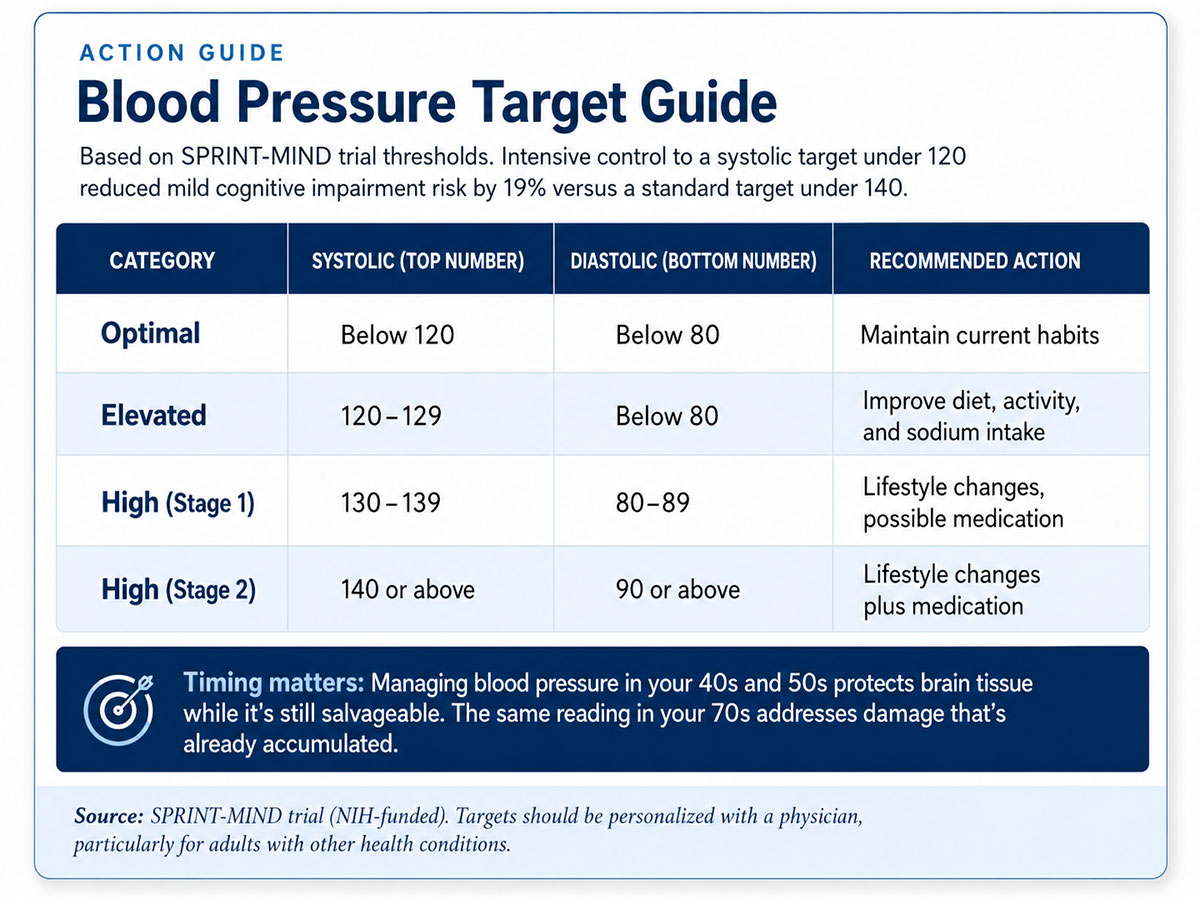
The clearest evidence for acting early comes from the SPRINT-MIND trial, a National Institutes of Health-funded study that randomized more than 9,000 adults to two different blood pressure targets. Intensive control, keeping systolic pressure under 120, reduced the risk of mild cognitive impairment by 19 percent compared to a standard target of under 140.
Timing turns out to matter as much as the number itself. Managing blood pressure in your 40s and 50s protects brain tissue while it is still salvageable. Waiting until your 70s to treat the same reading means confronting a problem that has already been accumulating for two decades.
Act on it:
- Check blood pressure at home monthly if you’re over 40.
- Cut sodium to under 2,300 mg daily.
- Ask your doctor whether medication makes sense if lifestyle changes alone aren’t enough.
Manage Your LDL Cholesterol
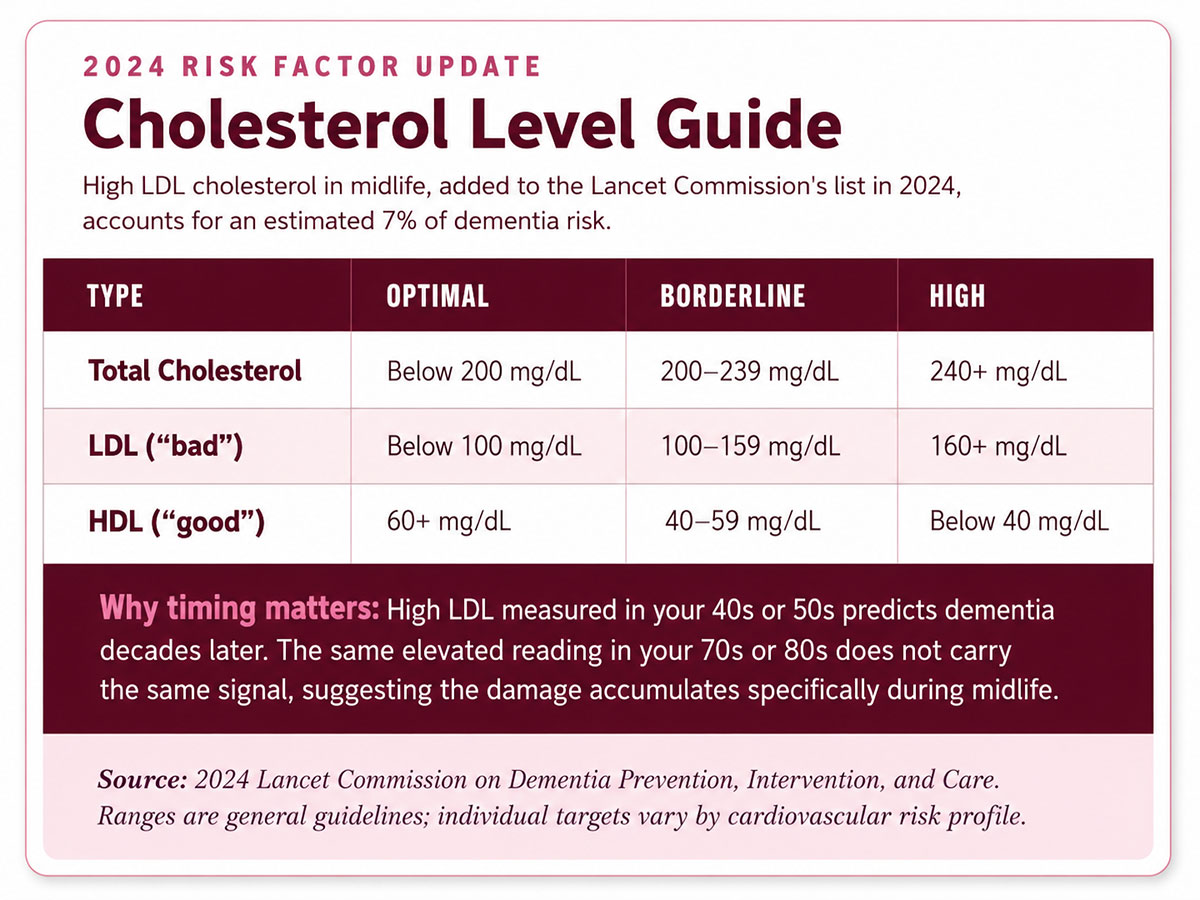
This is the newest entry on the Lancet Commission’s list, added in 2024 based on cohort data spanning more than a million participants. High LDL cholesterol in midlife predicts dementia decades later. Curiously, the same elevated cholesterol measured in someone’s 70s or 80s does not carry the same signal.
That timing detail is a clue about the mechanism. The damage from high LDL appears to accumulate during midlife itself, quietly, long before any cognitive symptom would be noticeable. Exactly how cholesterol crosses into brain tissue in the first place is not fully mapped. LDL’s role in artery walls is well established, but its relationship to the blood-brain barrier specifically remains more disputed.
Act on it:
- Get cholesterol checked every few years starting at 40.
- Keep LDL under 100 mg/dL where your doctor’s guidance supports that target.
- Add fiber (oats, beans, vegetables) and cut back on saturated fat from red meat, butter, and cheese.
Maintain a Healthy Weight, Especially in Midlife
Obesity between the ages of 40 and 65 raises dementia risk by an estimated 35 percent. Here is the part that trips up a lot of readers, and researchers had to clarify it as well. It looks, at first glance, like being underweight in your 70s is dangerous.
It is closer to the reverse. Dementia was often already present, quietly changing appetite and metabolism years before anyone noticed a memory problem.
The practical distinction: obesity in midlife is the factor worth actively addressing. After 65, weight stability matters more than weight loss, and aggressive dieting late in life can do more harm than good.
Act on it:
- Focus on preventing weight gain during your 40s and 50s rather than chasing loss later.
- Preserve muscle mass with resistance training and adequate protein.
- Don’t pursue aggressive weight loss after 65 without a doctor’s guidance.
Movement Reshapes the Brain Itself
Kirk Erickson, a cognitive neuroscientist then at the University of Pittsburgh, ran an experiment published in the Proceedings of the National Academy of Sciences in 2011 that still gets cited more than a decade later. Older adults who walked briskly three times a week for a year grew their hippocampus, the brain region most responsible for memory, by 2 percent. Left alone, that same region typically shrinks by 1 to 2 percent every year past age 55.
The walkers also performed better on memory testing, and their blood showed elevated levels of BDNF, a protein that supports the growth of new neural connections. Aerobic exercise appears to work through increased blood flow and reduced inflammation, both of which protect brain tissue from accumulated damage.
The finding wasn’t uncontested. A group of critics pointed out that the stretching-and-toning control group also improved on memory tests despite showing no hippocampal growth at all, which complicates any clean story about volume increases being what drives the performance gain.
Act on it:
- Aim for 150 minutes of moderate aerobic activity weekly, roughly 30 minutes five days a week.
- Brisk walking counts. You don’t need to train for a race.
- Consistency beats intensity. Regular moderate exercise outperforms occasional hard efforts.
Lifting Weights Sharpens Executive Function
Teresa Liu-Ambrose at the University of British Columbia led a 12-month trial that assigned 155 women in their late 60s and early 70s to once-weekly resistance training, twice-weekly resistance training, or a balance-and-toning control group. Both resistance groups improved on the Stroop test, a measure of selective attention and conflict resolution, while the control group did not.
Stretching and toning classes produced no comparable benefit. The effect seemed specific to actually lifting weight against resistance, not general movement. Twice weekly, hitting the major muscle groups with weights, bands, or bodyweight exercises, is enough to see the same benefit Liu-Ambrose’s trial found.
Anyone new to strength training is better off spending a session or two with a trainer first, since form matters more here than in most cardio work.
Sitting Undoes What Exercise Builds
Physical inactivity raises dementia risk even in people who exercise regularly elsewhere in the day. An hour at the gym does not cancel out eight hours in a chair.
Break sitting every 30 minutes. Stand for phone calls. Take the stairs. Small, frequent interruptions to prolonged sitting appear to matter independently of total weekly exercise volume.
A Single Head Injury Leaves a Mark
Even one moderate head injury raises dementia risk, and the effect is strongest for injuries involving loss of consciousness. Repeated milder impacts, the kind accumulated over years of contact sports or frequent falls, add up in ways a single incident does not.
Helmets during biking, skiing, and contact sports matter. So does removing fall hazards at home for anyone with balance concerns, and taking concussions seriously rather than playing through them.
The Senses and the Metabolism Quietly Shape Risk
Correct Vision Problems
Vision loss is the other new addition to the 2024 list, a factor that still surprises people who assume dementia prevention is only about blood vessels and blood sugar, and it works through a path that mirrors hearing loss almost exactly. Reduced visual input means reduced brain stimulation, and vision problems tend to push people toward social withdrawal in the same way hearing loss does.
The fix is often unglamorous. Cataract removal, an updated glasses prescription, and managed macular degeneration all count as brain protection first and convenience second.
Control Blood Sugar
Type 2 diabetes roughly doubles the risk of vascular dementia and raises Alzheimer’s risk substantially, a link strong enough that some researchers have started calling Alzheimer’s “type 3 diabetes” because of how directly insulin resistance appears to affect brain cells.
Preventing diabetes works better than managing it after the fact. Lifestyle changes can reverse prediabetes if caught early, through weight loss, regular exercise, and reduced refined carbohydrate intake.
Sleep Duration in Midlife Predicts Dementia Decades Later
Séverine Sabia and colleagues tracked nearly 8,000 participants in the Whitehall II cohort study for 25 years and published their findings in Nature Communications in 2021.
People who consistently slept six hours or less at ages 50 and 60 carried a 30 percent higher dementia risk than those who slept a normal seven hours, independent of other health and demographic factors.
During deep sleep, the brain’s glymphatic system clears out waste products, including amyloid and tau, the proteins that accumulate in Alzheimer’s disease. Skimp on sleep long enough and that clearance process falls behind.
Act on it:
- Protect 7 to 9 hours nightly, with a consistent schedule even on weekends.
- Cut caffeine after 2 p.m. and screens an hour before bed.
- Get morning sunlight exposure to help anchor your circadian rhythm.
Sleep Apnea Cuts Off Oxygen Repeatedly, Every Night
People with untreated sleep apnea show more amyloid buildup on brain imaging and tend to develop memory problems earlier than people without it. CPAP therapy restores normal oxygen levels during sleep.
Nobody has run the trial that would prove CPAP prevents dementia outright. The indirect evidence, drawn from imaging studies and long-term cohorts, points strongly in that direction anyway. Watch for loud snoring, gasping during sleep, and morning headaches, and get a sleep study if any of those show up regularly.
Food as a Long-Term Investment in Brain Tissue
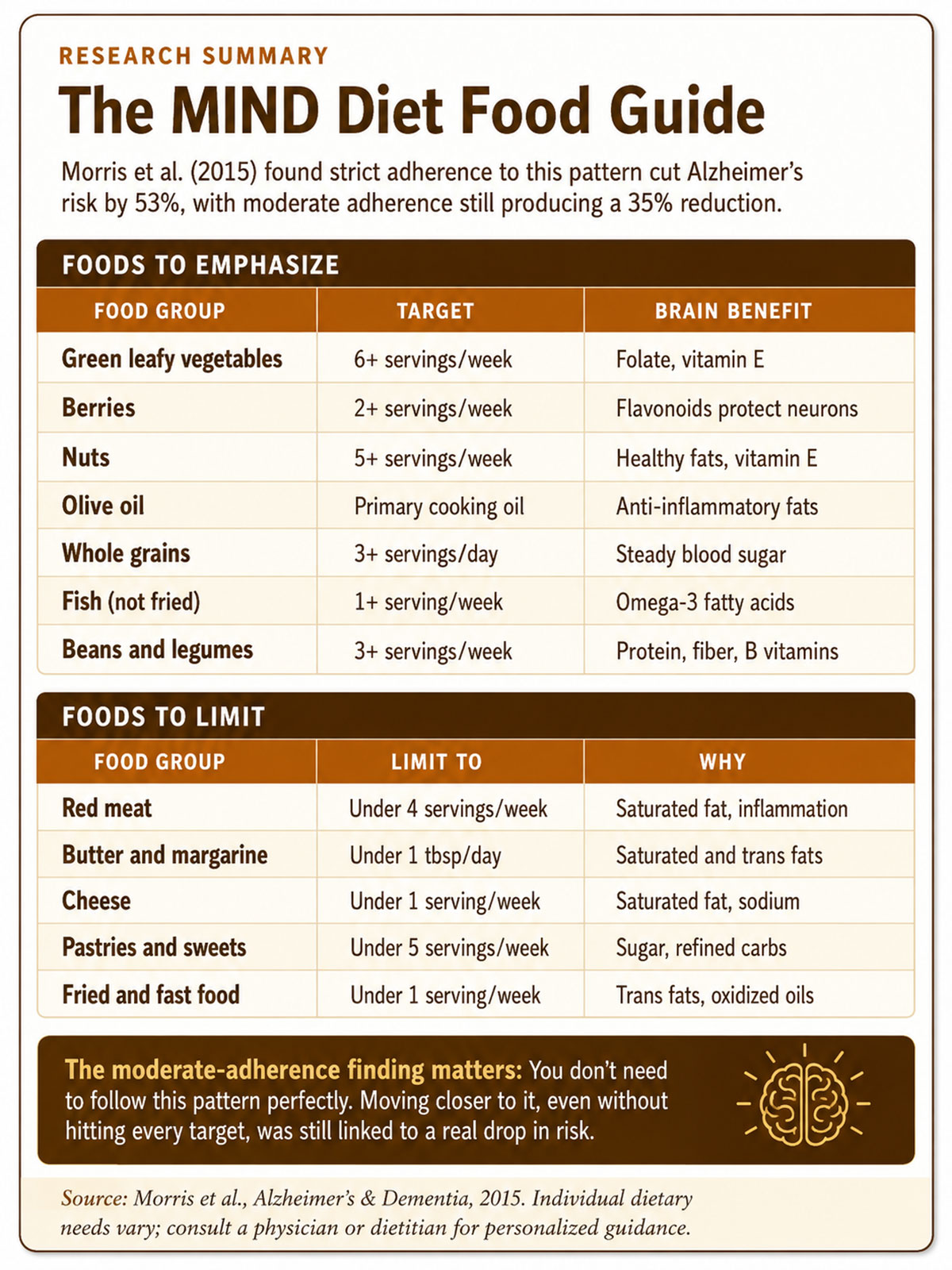
Martha Clare Morris, a nutritional epidemiologist at Rush University, developed the MIND diet by combining elements of the Mediterranean and DASH diets specifically for brain health.
Her 2015 study, published in Alzheimer’s & Dementia, followed 923 older adults and found that strict adherence to the MIND pattern cut Alzheimer’s risk by 53 percent. Even moderate adherence produced a 35 percent reduction.
What makes the diet distinct from Mediterranean or DASH alone is its emphasis on green leafy vegetables and berries specifically, foods whose flavonoids appear to have an outsized protective effect on neurons. Olive oil, the diet’s primary fat source, carries its own body of dementia-specific research well beyond its general reputation as a heart-healthy choice.

Berry-Walnut Overnight Oats
Serves: 1 | Prep time: 5 minutes
Combine half a cup of rolled oats with half a cup of unsweetened almond milk in a jar, then refrigerate overnight. In the morning, top with a quarter cup of blueberries, two tablespoons of chopped walnuts, a teaspoon of honey, and a pinch of cinnamon. The oats provide steady energy, the blueberries deliver neuron-protective flavonoids, and the walnuts add omega-3 fats and vitamin E.
Mediterranean Salmon Bowl
Serves: 2 | Prep time: 25 minutes
Season two salmon fillets with lemon juice, oregano, salt, and pepper, then bake at 400°F for 12 to 15 minutes. While the salmon cooks, combine two cups of spinach, a cup of cooked chickpeas, halved cherry tomatoes, diced cucumber, and thinly sliced red onion across two bowls.
Whisk olive oil and the remaining lemon juice for a dressing, top each bowl with salmon, and drizzle over the top. The omega-3 fatty acids in salmon support the same anti-inflammatory pathway the rest of this diet is built around.
Brain-Boosting Bean and Veggie Stir-Fry
Serves: 4 | Prep time: 20 minutes
Heat olive oil in a large pan and stir-fry sliced bell pepper, broccoli florets, snap peas, and julienned carrots for 5 to 7 minutes until crisp-tender. Add minced garlic and grated ginger for one more minute, then stir in a can of drained black beans and two tablespoons of low-sodium soy sauce. Serve over brown rice or quinoa with a sprinkle of sesame seeds.
Alcohol, Smoking, and the Air You Breathe
Here is where the science has moved recently. Researchers used to think moderate drinking might protect the brain. Newer evidence suggests there is no alcohol threshold that is genuinely safe for brain tissue.
Heavy drinking, more than 21 drinks weekly, roughly triples the risk of early-onset dementia, but even moderate intake has been linked to hippocampal shrinkage and white matter damage, neither of which shows up cleanly in a single risk percentage.
The Lancet Commission attributes 1 percent of total dementia risk to excessive alcohol specifically. That number almost certainly understates the picture. It only captures the heaviest end of consumption, not the more gradual effects at lower intake levels, effects researchers are still working out how to quantify.
Smoking works through a more familiar mechanism: damaged blood vessels, this time in the brain’s smallest capillaries. Current smokers carry 30 to 50 percent higher dementia risk than people who never smoked, but that risk drops steadily after quitting and approaches a never-smoker’s baseline within 10 to 15 years.
Air pollution is the risk factor with the least amount of personal control attached to it. Fine particulate matter, PM2.5, can cross from the lungs into the bloodstream and reach the brain directly. Checking air quality indexes before outdoor exercise and running a HEPA filter indoors are modest defenses against a largely structural problem.
Building Cognitive Reserve
Learning Something Genuinely New
Each additional year of education reduces dementia risk by roughly 7 percent, an effect that shows up decades after the schooling itself ends. But cognitive reserve keeps accumulating well past the classroom, provided the challenge stays genuinely unfamiliar.
That last qualifier matters more than most people assume. A crossword you’re already good at doesn’t build reserve the way a language you’ve never studied does. The brain needs friction, not repetition of a skill it has already mastered.
The ACTIVE trial illustrates why novelty and durability go together. Researchers assigned more than 2,800 older adults to memory, reasoning, or speed-of-processing training and tracked them for years afterward.
Trained participants maintained gains in their specific practiced domain for a full decade, and contrary to an older assumption that these gains stayed narrowly confined to test performance, participants also reported measurably less difficulty with everyday tasks like managing medications and finances. Speed-of-processing training, in particular, reduced participants’ odds of stopping driving and being involved in car crashes.
A 20-year follow-up published in early 2026 pushed the finding further. Adults who received speed-of-processing training, plus periodic booster sessions, were 25 percent less likely to receive a dementia diagnosis over the following two decades compared to an untrained control group.
That is one of the longest-running demonstrations that a purely cognitive intervention, with no drug and no exercise component, can move an actual dementia diagnosis rate rather than just a test score.
Act on it:
- Take up something you know nothing about: a language, an instrument, woodworking, painting.
- Prioritize novelty and difficulty over repetition of a skill you’ve already mastered.
Relationships Function Like a Cognitive Workout
Social isolation raises dementia risk by an estimated 50 percent, an effect comparable in size to smoking. Loneliness is not simply the absence of company. It’s possible to feel isolated in a crowded room and reasonably connected while living alone, depending on whether the relationships present feel substantive.
Conversation itself functions as a kind of cognitive workout. Listening, processing, responding, and reading social cues in real time exercise several brain systems simultaneously in a way that solitary activities generally don’t.
Act on it:
- Prioritize the quality of a few close relationships over a wide but shallow social circle.
- Join something with a recurring structure: a book club, a walking group, a volunteer commitment.
Depression Raises Dementia Risk on Its Own
Depression roughly doubles dementia risk, and the association is strongest when the depression occurs in midlife rather than later. Researchers are still working out how much of that link reflects depression directly damaging the brain through stress hormones and inflammation, versus depression serving as an early symptom of brain changes that later produce dementia. Either explanation points to the same conclusion: treatment matters, and untreated depression should not be dismissed as something to simply wait out.
Chronic Stress Is the Factor Nobody Agrees on Yet
Lena Johansson and colleagues in Gothenburg followed a group of women for 35 years, starting in the 1960s, and found, in a 2010 paper published in the journal Brain, that those reporting high psychological stress in midlife carried elevated dementia risk decades later. Chronic stress floods the brain with cortisol, which, over years, can shrink the hippocampus and disrupt memory formation.
The effect is real but smaller and messier than the hearing loss or blood pressure findings above it. Researchers still argue over how much of the association reflects stress itself versus the poor sleep, social withdrawal, and health neglect that tend to travel alongside chronic stress.
Small trials on mindfulness-based stress reduction in older adults have shown modest improvements in executive function, though the evidence base remains thinner than for exercise or diet. It may be the one factor on this list where naming the problem is considerably easier than solving it.
A Note for Women
Nearly two-thirds of Alzheimer’s patients are women, a gap that outlives the simple explanation that women live longer on average. Estrogen decline during menopause appears to interact with several of the risk factors above, particularly cardiovascular and metabolic ones, in ways researchers are still mapping.
The Big Four in this guide, hearing, blood pressure, cholesterol, and weight, carry the same weight for women as for men. The one addition worth flagging is that cardiovascular risk factors tend to accelerate around the menopause transition specifically, which makes the late-40s window a reasonable time to tighten monitoring rather than waiting for a standard midlife checkup schedule.
Brain Health Risk Calculator
Updated for the 2024 Lancet Commission's 14 risk factors, including LDL cholesterol and vision loss.
Your Prevention Checklist by Life Stage
Ages 0 to 20: Build the Foundation
- Complete as much education as circumstances allow.
- Wear head protection during sports.
- Build physical activity into daily routine early.
Ages 40 to 65: The Critical Window
- Get hearing tested and treated if needed.
- Keep blood pressure under 120/80 where medically appropriate.
- Manage LDL cholesterol and maintain a healthy weight.
- Stay active, eat a MIND-style diet, and address depression promptly rather than waiting it out.
Ages 65 and Older: Maintain and Adapt
- Get hearing aids and vision correction promptly if needed.
- Prioritize social connection more deliberately than in earlier decades.
- Keep moving to preserve balance and prevent falls.
Quick Start: Your First 30 Days
Week 1: Check blood pressure at a pharmacy, schedule hearing and vision tests, and track your current sleep and activity levels.
Week 2: Walk 20 minutes five days this week and stand up every hour while working.
Week 3: Add berries to breakfast three times and swap one red meat meal for fish.
Week 4: Reach out to a friend you haven’t spoken with in a while and start learning something genuinely unfamiliar.
Where This Leaves You
About 55 percent of dementia risk still comes from factors nobody can change yet: genetics, age, and causes researchers haven’t identified. That’s not the discouraging half of the story it sounds like. It means the other 45 percent isn’t a ceiling.
It’s a floor that keeps getting recalculated as the evidence improves, the way LDL cholesterol and vision loss quietly joined the list in 2024, and the way a single subgroup inside a “failed” hearing trial turned out to be the most important result in it. The habits worth building now are the ones that will still look sound the next time researchers take another pass at the numbers.
Frequently Asked Questions
What are the 7 habits to avoid dementia?
Different sources frame the list differently, but the factors carrying the most individual weight are treating hearing loss, controlling blood pressure, managing LDL cholesterol, maintaining a healthy weight in midlife, staying physically active, eating a MIND-style diet, and staying socially and cognitively engaged. Together, these represent the bulk of the modifiable risk identified by the Lancet Commission.
What causes most preventable dementia cases?
No single factor explains the majority of cases on its own. The Lancet Commission’s 45 percent preventable estimate is the sum of 14 separate factors, with the largest individual contributors, hearing loss, blood pressure, and LDL cholesterol, each accounting for around 7 percent apiece.
What are the warning signs of dementia?
Common early signs include memory lapses that disrupt daily life, difficulty planning or solving problems, confusion about time or place, and withdrawal from work or social activities. A single instance of forgetfulness is normal aging. A pattern that worsens and interferes with independence warrants a conversation with a doctor.
Is there one food to avoid for dementia prevention?
No single food drives risk on its own, but the MIND diet research points most consistently toward limiting fried food, since repeated frying produces oxidized fats and trans fats that work against the same blood vessel and inflammation pathways the rest of the diet protects.
Is there a vitamin linked to a large drop in dementia risk?
B vitamins, particularly B12 and folate, have shown risk reductions in some trials among people with elevated homocysteine levels, though the effect appears concentrated in that specific subgroup rather than the general population. Anyone considering supplementation should test homocysteine and vitamin levels with a doctor first rather than supplementing blindly.