You have read that text four times. Maybe five. The words haven’t changed. But the meaning you’re pulling from them keeps shifting, and now you’re building a case out of a one-word reply.
This is relationship overthinking: not general anxiety, not a personality flaw, but a specific pattern in which your mind treats a partner’s ambiguous signal as a problem to solve. The uncomfortable finding, the one that most advice skips over, is that the coping behavior that feels most natural in those moments makes things measurably worse.
The research on that pattern is worth understanding before you reach for any technique.
Why Asking “Are We Okay?” Can Make Things Worse
Most people caught in a relationship spiral do the same thing: they seek reassurance. They ask directly, or they check indirectly, and for a few minutes the anxiety subsides. Then it comes back, usually faster than before.
Researchers have been studying this loop for decades. A 2005 study led by Phillip Shaver at the University of California Davis examined excessive reassurance-seeking in romantic couples across two separate studies, including one with a 14-day daily diary component.
Reassurance-seeking was consistently linked to depression, but the link ran entirely through attachment anxiety rather than through the relationship quality itself. Partners noticed the seeking, but the couple’s reported closeness didn’t explain the mood outcome.
The longer-term picture is more striking. A longitudinal study by Jeremy Stewart and Kate Harkness published in the Journal of Social and Clinical Psychology tracked romantic couples over time and found that higher levels of reassurance-seeking were associated with a faster path to partner rejection.
Not always to the end of the relationship, but to something more immediate: the partner pulling back. The behavior designed to protect the connection was, on average, accelerating its erosion.
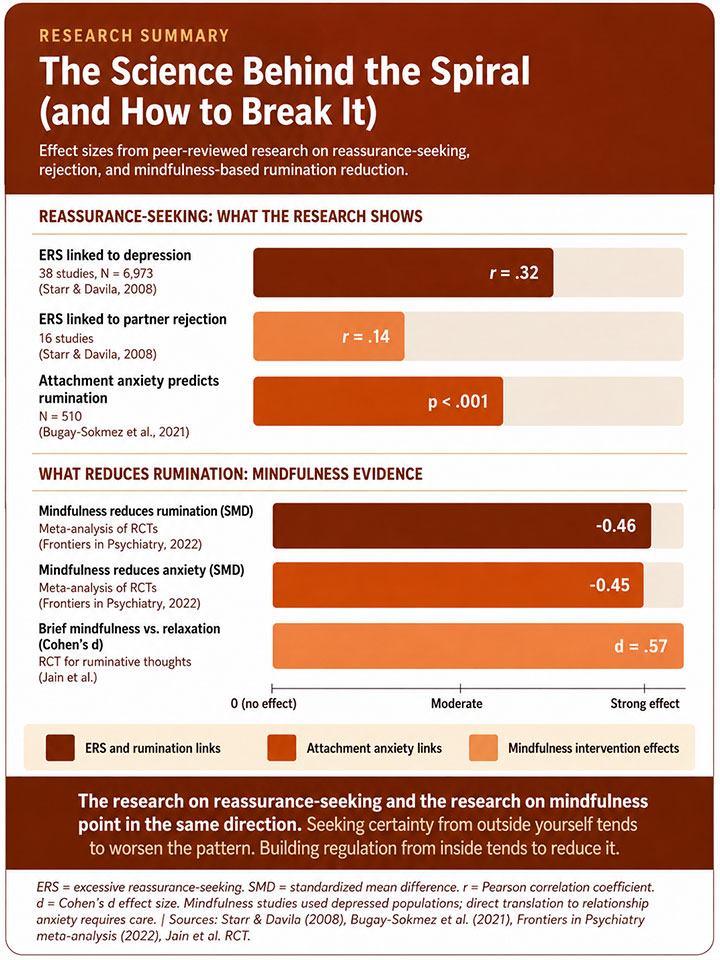
A meta-analysis of 38 studies, with nearly 7,000 participants total, by Lisa Starr and Joanne Davila put a number to the relationship between excessive reassurance-seeking and depression: an aggregate effect size of .32. The reassurance-and-rejection link, across 16 studies, came in at .14, with the relationship context showing stronger effects than non-romantic settings.
None of this means asking for support is harmful. A direct question, asked calmly, at the right moment, is healthy communication. The pattern that creates problems is compulsive checking: reassurance sought not to address a real concern, but to quiet a feeling that returns the moment the reassurance fades.
What’s Actually Driving the Spiral
The mechanism behind relationship overthinking is well-documented. Researchers call it attachment anxiety: a tendency to monitor the relationship for signs of rejection or withdrawal, particularly when signals from a partner are ambiguous.
A 2021 study by Alper Bugay-Sokmez and colleagues examined rumination patterns in 510 university students and found that attachment anxiety specifically (not attachment avoidance, which is the pull-away pattern) predicted both types of rumination: brooding and reflective thinking.
Self-esteem amplified the relationship. Self-compassion helped reduce it, particularly the brooding dimension.
The nervous system reading behind this is straightforward. Attachment anxiety treats relational ambiguity as a threat signal. The mind does what it does with threats: it runs scenarios, looks for resolution, checks for evidence. In a physical threat, that scan is adaptive. In a relationship, where the “threat” is a read receipt that never came, the scan has nowhere to land. So it keeps going.
How to Prevent Overthinking in a Relationship: 9 Proven Ways
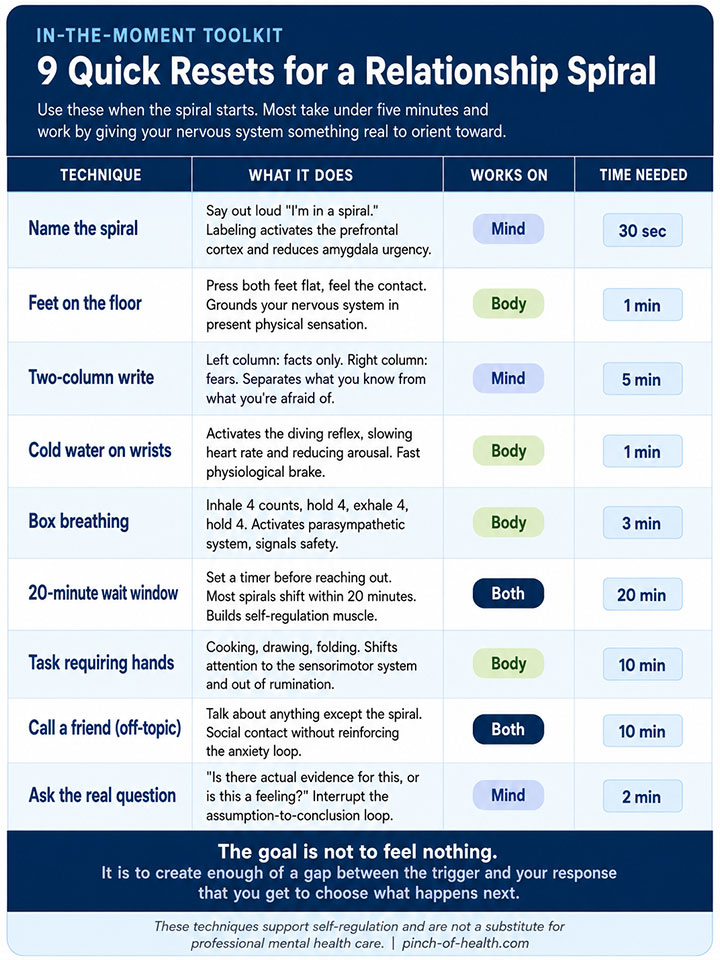
1. Name the Spiral Before It Names You
The first move is also the most underrated. When the loop starts, say it out loud or write it down: “I’m in a spiral right now. I’m not seeing the situation clearly.” This is not a trick or a mantra. It is a specific interruption of the process that keeps the loop running.
The brain treats an unnamed threat as an active one. Labeling the spiral as a spiral rather than as a legitimate read of reality reduces the nervous system’s urgency to solve it.
Therapists working in this space call this “naming to tame,” a term drawn from the work of UCLA neuroscientist Matthew Lieberman, whose research found that putting feelings into words reduces activation in the amygdala, the brain’s primary threat-response center.
The specific language matters less than the act of categorizing what’s happening. “I’m doing the thing again” works as well as anything clinical.
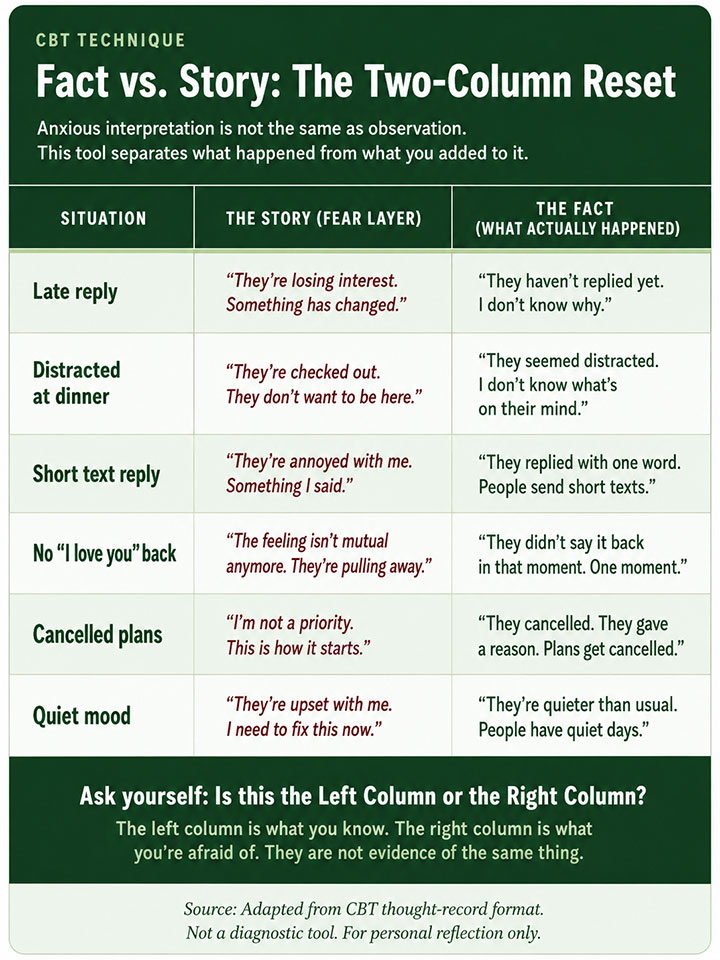
2. Separate the Fact from the Story
Most relationship spirals are built on a factual foundation but spin upward into interpretation. The practice of separating the two interrupts that spin at its source.
Write it in two columns if that helps. Left column: what actually happened, in the plainest terms possible. “She took two hours to reply.” “He seemed distracted at dinner.” Right column: the meaning you’ve added. “She’s losing interest.” “He’s not happy with me.”
The left column is what you know. What goes in the right column is what you’re afraid of, and those two things are not the same, even when the fear feels like proof.
This structure comes from cognitive behavioral therapy, specifically the thought-record format developed to interrupt automatic negative interpretation. Applied to relationships, the goal is not to convince yourself everything is fine.
The goal is to wait for actual evidence before drawing conclusions, because anxious interpretation tends to select for confirming data and screen out the rest.
3. Build a Physical Anchor, Not a Mental Argument
Trying to think your way out of a relationship spiral doesn’t work, because the spiral lives in the emotional and nervous-system layer, not the reasoning layer. Mental arguments with yourself (“I know this is irrational”) don’t touch the source.
Physical anchors do. Press both feet flat on the floor. Put a hand on your chest. Feel the temperature of the air through your nose. These are grounding techniques, and they work by giving the nervous system something specific to orient toward in the present moment rather than a feared future or an ambiguous past interaction.
Research on mindfulness-based interventions provides the evidence for why this category of approach is worth taking seriously. A meta-analysis of RCTs published in Frontiers in Psychiatry in 2022 found that mindfulness-based interventions reduced rumination levels (standardized mean difference: -0.46) and anxiety symptoms (SMD: -0.45).
These were studies in depressed populations, so the direct translation to relationship spirals requires some care. The mechanism itself, reducing the power of ruminative loops through present-moment attention, applies.
A separate randomized controlled trial comparing mindfulness meditation to relaxation training found that the mindfulness group showed significant reductions in ruminative thoughts and behaviors relative to the control group (Cohen’s d = .57), with that reduction partly explaining the drop in psychological distress.
4. Run a Self-Soothing Routine Before You Reach Out
The instinct to reach for your phone, text first, check in, or ask if you’re “okay” is not a communication skill. It is a self-regulation problem displaced onto a partner.
Self-soothing does not mean suppressing feelings. It means developing the ability to manage your own activation level before deciding whether an external conversation is actually needed. In practice, this looks like: give yourself 20 minutes before responding to the anxious impulse. Go for a walk. Do something that requires your hands. Call a friend about something unrelated.
The question to ask after that window is whether something real still needs to be addressed. If yes, have the conversation. If the feeling has shifted, it was the spiral talking, not a genuine need.

5. Invest in Your Life Outside the Relationship
When a relationship becomes someone’s primary source of emotional regulation, every signal from a partner starts to carry a load it was never designed to carry. Therapists who work with anxiously attached clients describe this as “enmeshment lite”: not full fusion, but enough overlap that one person’s ambient mood becomes the other’s data point.
The fix is having more inputs to care about, not caring less about the relationship. Friendships maintained independently, hobbies that absorb full attention, goals with their own timeline and satisfaction built in.
The reduction in overthinking that follows is not because the relationship matters less. It is because the relationship’s ambient signals are now competing with other inputs rather than dominating all of them.
6. Communicate When You’re Regulated, Not When You’re Activated
One of the most common patterns in relationship overthinking is the conversation that happens at the wrong moment. A spiral peaks, the urge to resolve it becomes unbearable, and the conversation starts before the person is in any position to have it properly.
Heavy conversations while activated tend to go poorly. The words that come out are shaped by the fear, not the actual situation. Partners read the dysregulation in tone and body language even when the words are technically calm, and the conversation ends up confirming the worst fears of the overthinking partner rather than addressing them.
The sequence is: feel the urge, don’t act on it immediately, wait for regulation, then decide whether the conversation is still needed. If it is, open with the feeling rather than the accusation. “I got anxious when you seemed distracted last night. Can we talk?” works in a way that “You were clearly checked out last night” does not.
7. Learn to Tolerate Uncertainty Instead of Resolving It
Relationship overthinking is almost always a response to uncertainty. The partner hasn’t replied. The dinner felt off. The tone in that message was ambiguous. The mind cannot locate a clear answer, so it generates possibilities, none of them neutral.
Partners are not transparent systems. They contain internal states the relationship can’t fully resolve, and most of the time, the ambiguity is not a signal. It is just two people navigating slightly different moments at the same time. Trying to close that gap through interpretation rather than conversation is exactly what keeps the spiral going.
Of all nine approaches in this list, tolerance of uncertainty is the hardest to build and the most resistant to quick techniques. It tends to develop slowly, through repeated experience of sitting with ambiguity and finding afterward that nothing catastrophic happened.
A practical starting point: when the urge to check, ask, or interpret rises, give it a two-hour window before acting. The goal is not to stop caring. It is to stop treating every ambiguous signal as a crisis requiring immediate resolution, and that shift takes longer than most people expect.
This is also where therapy tends to make the biggest difference. The tolerance gap usually traces back further than the current relationship, and cognitive behavioral approaches, specifically those targeting intolerance of uncertainty, have the most consistent evidence behind them for this kind of work.
8. Identify Your Specific Trigger Pattern
Most people have specific triggers: late replies, changes in affection frequency, a partner being distracted during what should be quality time, an offhand comment about the future. The spiral doesn’t distribute evenly across all situations. It concentrates around particular signals that the nervous system has learned to treat as dangerous.
Knowing your triggers creates a delay between the signal and the spiral. That delay is where every other technique in this list gets its window to work. A journal is the most direct mapping tool: after a spiral, note what started it, what your first physical response was, and what the first thought was. After several entries, the pattern becomes visible and loses some of its sense of inevitability.
Mapping triggers is a useful tool, not a resolution. Understanding why late replies set off your nervous system doesn’t stop them from doing it. The map is for awareness, not for cure.
Overthinking or Red Flag?
8 quick reflection questions to help you tell the difference between an anxious spiral and a concern worth acting on.
This is a reflection tool, not a clinical assessment. It does not diagnose relationship problems.
9. Know When Overthinking Is Pointing at Something Real
The nine strategies here are not techniques for convincing yourself everything is fine. Some overthinking is not a spiral. Sometimes the anxiety is tracking something true: a genuine change in a partner’s behavior, a real pattern that has been present for months, a situation that deserves a direct conversation rather than a grounding exercise.
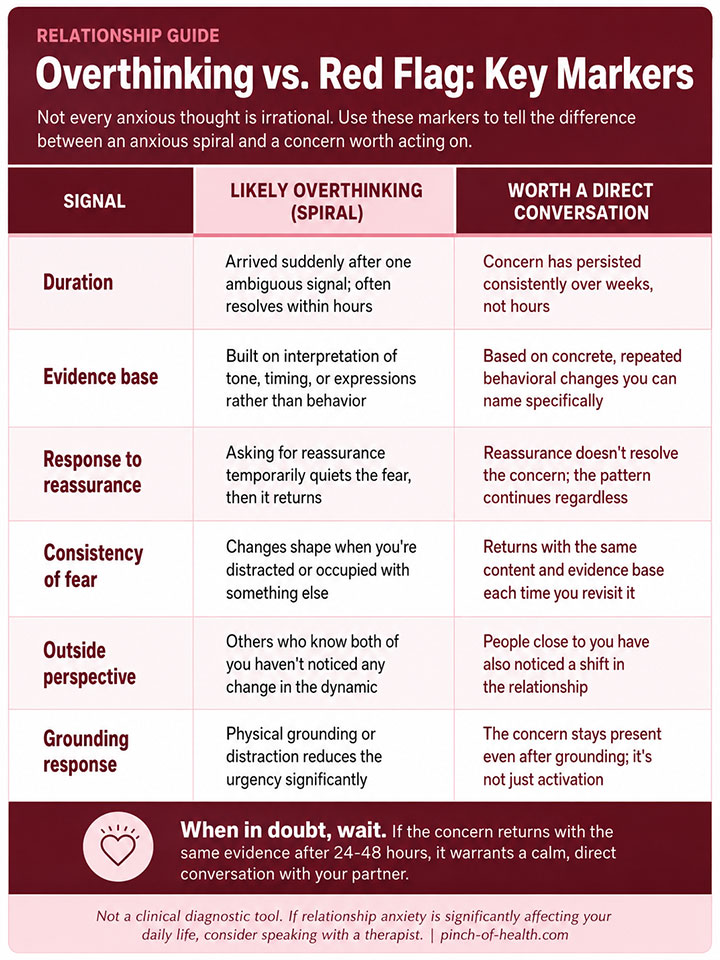
The distinction is not always obvious in the moment. A few markers that lean toward legitimate concern: the pattern has been consistent over weeks, not hours; other people in your life have also noticed a change in the dynamic; you have had the anxious thought, waited it out, and it has returned with the same content and the same evidence base.
A few markers that lean toward spiral: the feeling arrived suddenly after an ambiguous signal; it changes shape when you’re distracted; asking for reassurance temporarily resolves it; the “evidence” is interpretive rather than behavioral.
Neither category is absolute. Bringing a concern to a therapist, either individually or with a partner, is worth considering when the distinction remains unclear after the in-the-moment techniques have run their course.
What to Do When the Spiral Already Caused a Problem
The strategies above are built for prevention. But overthinking in relationships sometimes causes real damage before the pattern is even recognized: a fight that came from nowhere, a confrontation that confused a partner, a demand for reassurance that landed as pressure.
Repair is a separate skill. The first step is owning the spiral specifically, not just the conflict. “I got anxious about something ambiguous and came at you with that anxiety instead of coming with a question” is more useful than a generic apology.
It names the pattern, which reduces the partner’s confusion about what actually happened, and it signals that the person is doing the work of understanding their own response.
The second step is asking what the partner needs, not explaining what you need. The wrong move here (and it is a very common one) is to use the repair conversation as another bid for reassurance, ending it with “but we’re okay, right?”
That closes the loop for the anxious partner and reopens the problem for the other one. Repair works best when the overthinker demonstrates awareness of the impact before advocating for their own experience.
The Real Problem With Relationship Overthinking
Here is what none of the listicle approaches to this topic usually say: relationship overthinking is not primarily a thinking problem. It is a nervous system pattern, one that developed for reasons that probably made sense long before this relationship existed.
The brain learned to scan for rejection, to treat ambiguity as danger, to prefer the certainty of a worst-case scenario over the discomfort of not knowing.
That is the piece worth understanding. The techniques in this article can interrupt the pattern reliably. But the pattern itself, the learned tendency to treat a partner’s autonomy as a signal about your worth, tends to respond best to sustained work, often with a therapist trained in attachment-informed approaches.
What changes in the meantime is not the absence of spirals but the time between the trigger and the intervention. A spiral that used to run for two days gets caught at hour three. Then at hour one. Gradually, the window between “I’m doing it” and “I can stop now” shortens, and the relationship gets more of the presence you both showed up for.