If you’ve ever tried to force yourself to stop thinking and only made it worse, neuroscience explains why, and why a completely different approach works better.
Most advice for a racing mind comes down to one instruction: stop thinking about it. Clinical research on attention suggests that’s close to the opposite of what actually works.
Psychologists have a name for the loop a stressed brain falls into. They call it rumination, and it runs through a brain network that switches on the moment you stop focusing on anything else.
You replay a conversation that ended hours ago. You rehearse a disaster that hasn’t happened yet. Neither exercise solves anything, and neither stops because you’ve decided it should.
What breaks the pattern isn’t willpower. It’s a small set of attention techniques, tested in clinical trials against doing nothing and, in one notable case, against medication.
Why Your Brain Gets Stuck in Thought Loops
The network responsible for rumination is called the Default Mode Network. It activates during idle moments, and it’s the same system that lets you plan tomorrow or replay a memory on purpose.
Left unchecked, that same network turns against you. You replay conversations, forecast disasters that are pure speculation, and manufacture problems that don’t exist yet.
Researchers sometimes use “rumination” for what most people call overthinking. Same pattern, described from a different angle.
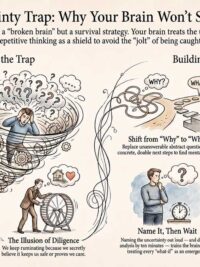
A large 2023 analysis pooled data from 61 clinical trials and more than 4,200 participants and found that mindfulness-based programs produced a medium-to-large reduction in rumination across both clinical and healthy groups.
That’s not a marginal effect. It’s roughly the same size that researchers see from established treatments for other repetitive thought patterns.
What Happens in Your Brain During Overthinking
The Default Mode Network includes the medial prefrontal cortex and the posterior cingulate cortex, regions that light up when you think about yourself, remember the past, or imagine the future.
Healthy activity here supports planning and self-reflection. Overactive, it fuels the “what if” and “why did I” loops that keep a mind from settling.
A separate system, the brain’s executive attention network, works against that pull. It’s what lets you notice a thought has wandered and redirect it somewhere else.
Judson Brewer’s imaging work on experienced meditators found something specific: less Default Mode Network activity at rest, alongside stronger connections between attention networks and the regions that regulate emotion. The brain gets measurably better at catching a spiral before it builds momentum.
A broader review across 111 randomized trials and roughly 9,500 meditation-naive adults found small-to-moderate improvements in executive attention, working memory, and inhibition. The changes weren’t dramatic. They were consistent enough, across a large enough sample, to matter.
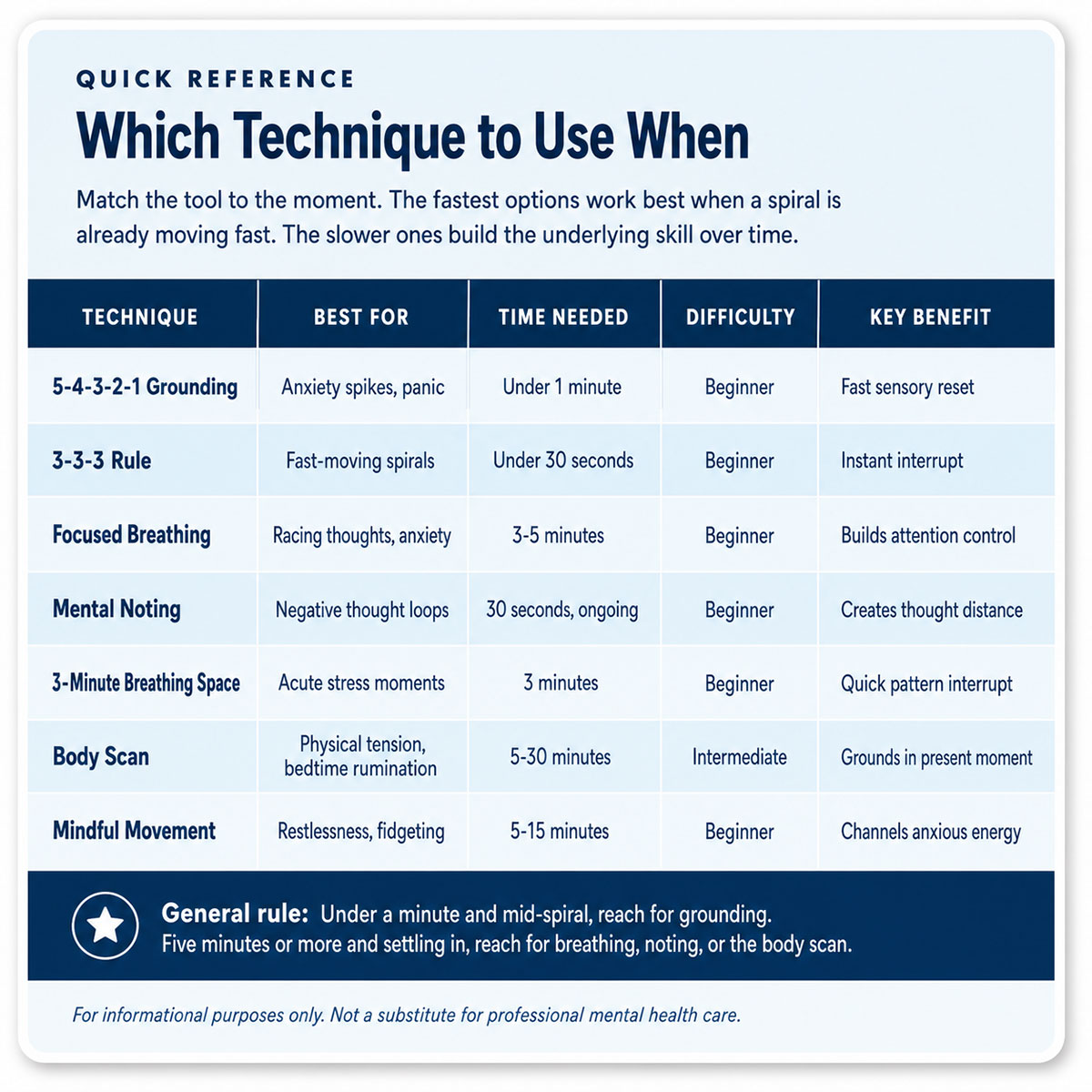
Quick Guide: Which Technique to Use When
Different moments call for different tools. This table matches technique to situation, so the choice doesn’t become one more thing to overthink.
Fast Techniques for the Moment
Some situations don’t leave room for a full practice. These two work in under a minute and need nothing but attention.
The 5-4-3-2-1 Grounding Technique
This is a sensory inventory, not a breathing exercise. It pulls attention out of a spiraling thought by forcing the brain to process what’s actually in front of it.
- Name 5 things you can see right now.
- Name 4 things you can physically feel, like your feet on the floor.
- Name 3 things you can hear.
- Name 2 things you can smell.
- Name 1 thing you can taste.
Counting through five distinct senses leaves no spare attention for rehearsing a worry. It’s commonly used for anxiety spikes, and it works equally well mid-spiral.
The 3-3-3 Rule
This one is simpler. Look around and name three things you can see, three things you can hear, then move three parts of your body, an ankle, a hand, a shoulder.
It takes less than 30 seconds. When a thought loop feels too fast to interrupt with a longer technique, speed is the whole strategy.
Technique 1: Focused Breathing, the Attention Anchor
Your breath goes wherever you go. Unlike an app or a journal, you can’t forget it at home.
How to Do It
Box breathing is a reliable starting pattern: breathe in for four counts, hold for four, breathe out for four, hold for four, and repeat.
Diaphragmatic breathing works too. Place one hand on your chest and one on your belly, and breathe so the belly rises more than the chest does.
The specific pattern matters less than the redirection. When attention wanders, and it will, bring it back to the breath without judging the wandering itself.
Try It Right Now: Box Breathing
- Sit comfortably with your hands resting in your lap.
- Exhale completely through your mouth.
- Close your mouth and inhale through your nose for 4 counts.
- Hold your breath for 4 counts.
- Exhale through your mouth for 4 counts.
- Hold empty for 4 counts, then repeat 4 times.
Notice where your mind went during the exercise and how many times you redirected it. That redirect is the actual practice.
Why It Works for Overthinking
A 2014 review of 47 trials and 3,515 participants found moderate evidence that structured meditation programs improved anxiety and depression at eight weeks, training the same skill that focused breathing teaches: redirecting attention toward something concrete instead of an abstract worry.
If a racing mind at 3 a.m. sounds familiar, the fix isn’t complicated. Five minutes of box breathing won’t silence the thoughts, but it slows them down enough to fall back asleep.
Technique 2: Mental Noting, Creating Distance From Thoughts
You are not your thoughts, even though most people live as if they are. Mental noting is the practice of proving that to yourself in real time.
How to Do It
When a thought appears, give it a soft, one-word label. There’s no need to analyze it or push it away. Name what kind of thought it is.
Worrying about tomorrow’s meeting becomes “worrying.” Replaying yesterday’s argument becomes “remembering.” Planning dinner becomes “planning.” Try it right now: close your eyes for thirty seconds, notice whatever thought shows up, and give it one word.
Did you notice the gap between you, the observer, and the thought being observed? That gap is the mechanism.
Why It Works for Overthinking
Researchers call this shift decentering. Labeling a thought creates enough psychological distance that “I’m anxious about this presentation” becomes “my mind is producing anxious thoughts about the presentation.”
That small shift changes more than it sounds like it should. It weakens the identity loop where being stressed becomes something you are, rather than something passing through.
Eleven trials examining mindfulness and acceptance-based interventions for depressive rumination found a significant, moderate reduction in ruminative thinking compared with usual care. Self-compassion tends to move in the same direction, since judging a thought less harshly makes it easier to release.
Sarah notices herself replaying her boss’s criticism from yesterday’s meeting. She labels it “replaying,” and the thought doesn’t disappear, but she can see it’s a memory rather than a live threat.
Waiting in line, sitting in traffic, or lying awake at night are all places to practice. The moment overthinking starts, the label goes on.
Technique 3: The Three-Minute Breathing Space, a Circuit Breaker
Marcus feels his thoughts spiraling into worst-case scenarios midway through a tense phone call. He excuses himself, finds a quiet corner, and runs through three minutes of structured attention before returning to the conversation with a clearer head.
That structure has a name: the three-minute breathing space. It was designed for exactly the situation Marcus was in, when there’s no time for a full meditation, but the spiral needs to stop now.
How to Do It
The practice runs in three roughly one-minute stages.
Observe: Notice thoughts, feelings, and body sensations without trying to change them.
Gather: Narrow your focus entirely to the breath, counting if that helps.
Expand: Widen awareness to the whole body, feet on the floor, back against the chair, the weight of your arms.
Try It Right Now: Three-Minute Breathing Space
- Set a timer for 3 minutes.
- Minute 1: Notice what you’re thinking and feeling, without changing it.
- Minute 2: Focus only on the breath, in and out.
- Minute 3: Feel the whole body breathing together.
Why It Works for Overthinking
This one works because each stage does a different job: acknowledging reality, focusing scattered attention, then grounding in physical presence. Mindfulness-Based Cognitive Therapy (MBCT) programs use this exact structure during moments when rumination threatens to take over, and three minutes is usually enough to reengage.
Technique 4: The Body Scan, Grounding Through Sensation
Overthinking lives entirely in the head. The body scan is the most direct way to pull attention back into the body instead.
How to Do It
Lie down or sit comfortably, and start at the toes. Notice warmth, coolness, tingling, or nothing at all, without trying to change any of it.
Move slowly upward through the feet, calves, knees, thighs, belly, chest, arms, shoulders, neck, and head, spending a few seconds with each part. Short on time, the same idea works in ninety seconds flat: three deep breaths, a quick pass from feet to jaw, three more breaths, done.
Mind-wandering is normal here. When it happens, return attention to whichever body part was being scanned.
Why It Works for Overthinking
The body scan is a core component of Mindfulness-Based Stress Reduction, which shows moderate evidence for improving anxiety and stress-related quality of life. Brain imaging shows the practice increases activity in sensory processing regions while decreasing Default Mode Network activity, so there’s less self-referential noise feeding the spiral.
It also teaches a distinction easy to miss: physical sensations and thoughts are connected but separate. A tight chest doesn’t require believing every anxious thought sitting behind it.
Elena can’t fall asleep because she keeps replaying an awkward conversation from earlier. She starts a 15-minute body scan, and by the time she reaches her shoulders, her thoughts have gone quiet enough to let her drift off before she finishes.
Technique 5: Mindful Movement, Breaking Loops Through Action
Stillness doesn’t work for everyone. Some people get more agitated sitting quietly with their thoughts than they do moving through them.
How to Do It
Walking meditation is the simplest version. Stand still, feel your weight on the ground, and take one very slow step, paying attention to the lift of the heel, the swing of the leg, the placement of the foot.
Walk at roughly a third of normal speed. If attention wanders, pause, reconnect with the physical sensation of standing, then continue. Mindful stretching works the same way, with attention on the pull in a muscle instead of footsteps.
Why It Works for Overthinking
The evidence base here is thinner than for seated practices like the body scan or MBCT. Most support comes from smaller trials rather than large meta-analyses, which doesn’t make it less useful for a restless mind, only less precisely measured.
What’s better understood is the mechanism: movement gives attention two things to track at once, the feeling of motion and the mechanics of it, sometimes called a double anchor. That’s particularly useful when anxious and energized show up together, since the movement discharges some of the physical energy while attention does the rest.
Five minutes of slow walking or stretching is enough to start. The goal isn’t distance or achievement. It’s training attention to land on action instead of rumination.
Choosing the Right Technique for Your Situation
Waking Up With Racing Thoughts
Start with focused breathing. Five minutes of box breathing sets a calmer tone before the day gets moving.
During Work Stress
The three-minute breathing space works at a desk without anyone noticing.
Stuck in a Loop About the Past
Mental noting works best here. Labeling the thought, “remembering,” “regretting,” creates enough distance to break it.
Before Bed When Sleep Won’t Come
The body scan redirects mental energy and releases the physical tension keeping you awake.
When Anxiety Makes You Restless
Mindful movement lets the body discharge energy while attention does its part.
During Acute Panic or Overwhelm
The 5-4-3-2-1 grounding technique or the three-minute breathing space both provide quick stabilization when a longer practice isn’t realistic.
The Research Evidence: What Studies Really Show
Four major analyses anchor most of what’s known about mindfulness and overthinking. None of them found a miracle. All of them found something real.
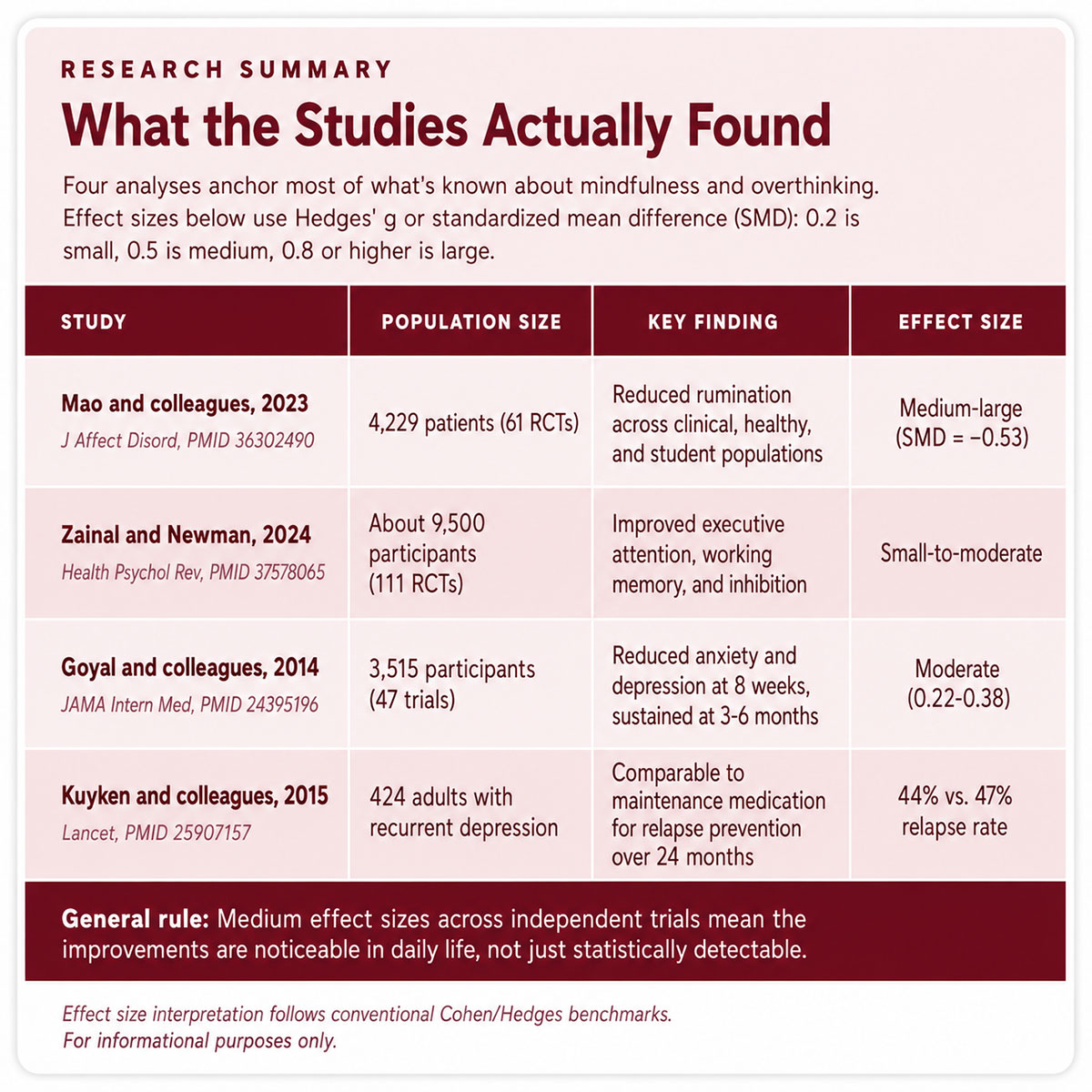
Effect sizes tell you how much a change matters, not only whether it’s statistically real. Researchers generally treat 0.2 as small, 0.5 as medium, and 0.8 or higher as large. By that scale, most of the findings above land in the medium range, meaning the improvements are noticeable rather than marginal.
One trial stands out for what it compared mindfulness against. Willem Kuyken and colleagues followed 424 adults with a history of recurrent depression for two years, comparing Mindfulness-Based Cognitive Therapy directly with ongoing antidepressant medication. 94 people relapsed in the mindfulness group, and 100 relapsed in the medication group, out of 212 in each arm, a gap researchers didn’t consider statistically meaningful.
A talk therapy program performed roughly as well as medication at preventing relapse into a condition medication exists specifically to prevent.
A separate, older meta-analysis pooling 209 studies and more than 12,000 participants found mindfulness-based therapy moderately to strongly effective across pre-post comparisons and against waitlist controls, with smaller but still real effects compared to other active treatments. It’s an older synthesis by now, and more recent, more targeted analyses have since refined the picture, but the scale of it still carries weight.
Building Your Practice: The 8-Week Timeline
Knowing the techniques is one thing. Learning how to practice mindfulness in daily life, consistently enough for it to matter, is another.
Most research measures change after four to twelve weeks of regular practice. The benefits aren’t instant, but they compound.
How to Start
Pick one technique instead of trying all five at once. Constant distraction at work suggests starting with focused breathing. Nighttime spiraling suggests the body scan. Physical restlessness suggests mindful walking.
Commit to a specific time and place. Five minutes daily beats thirty minutes once a week, since consistency is what trains the underlying attention networks.
After a week or two, layer in a second technique. Morning breathing plus mental noting throughout the day is a common pairing.
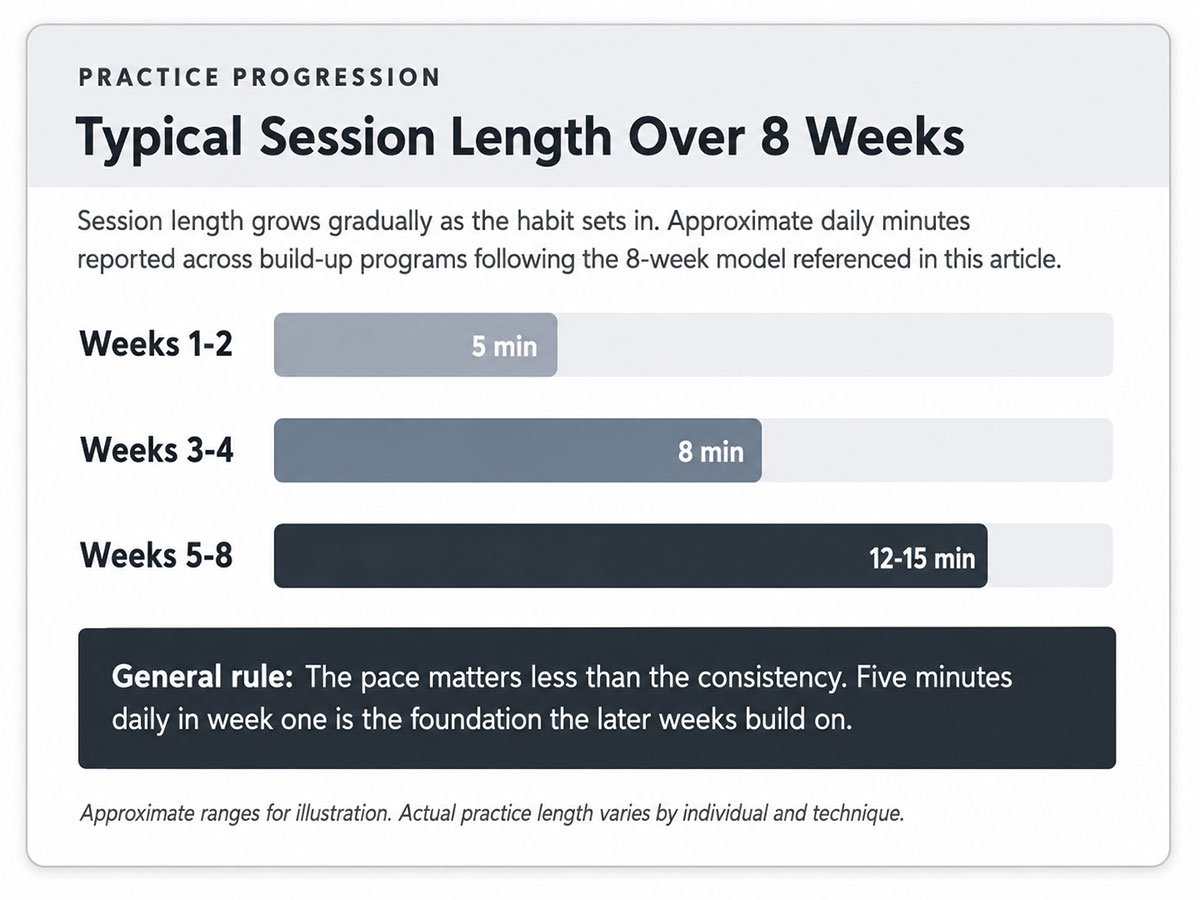
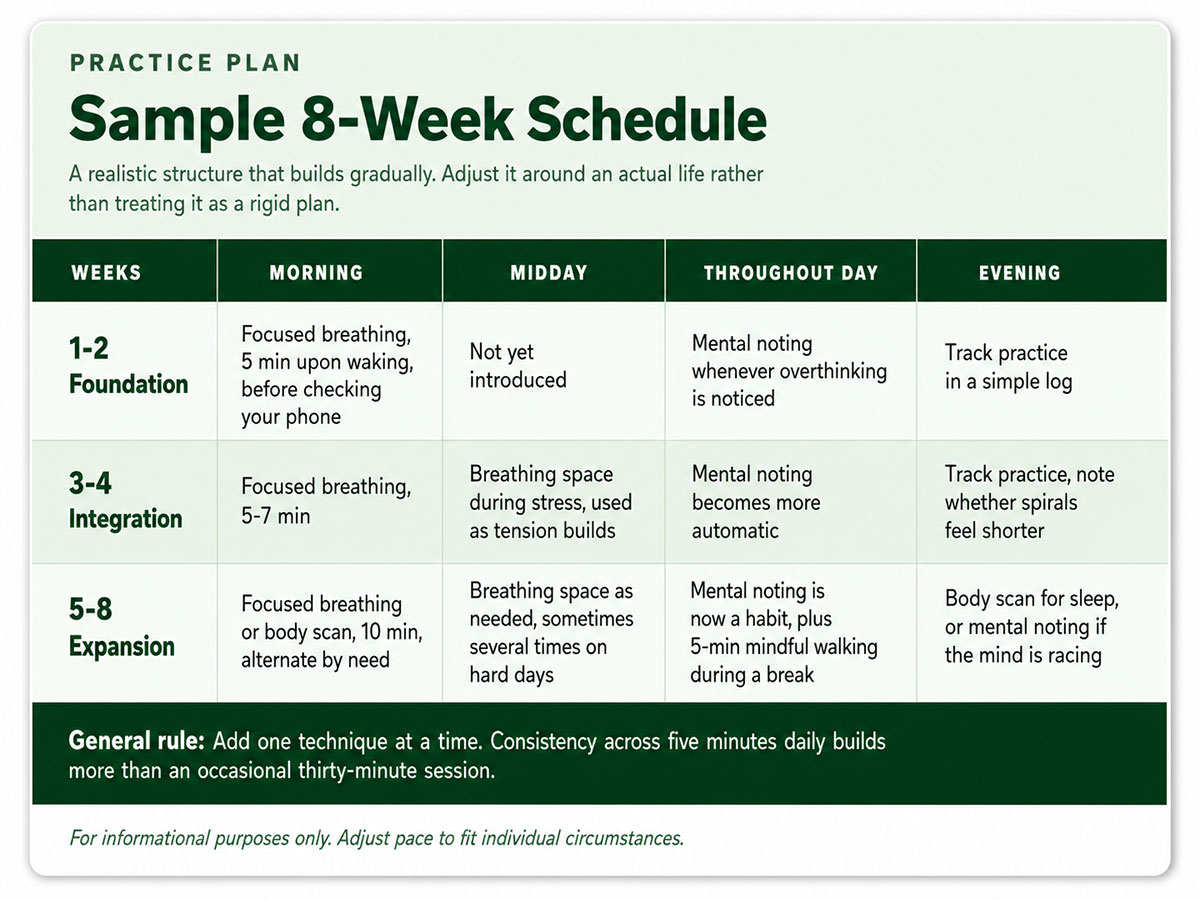
Session length typically grows from a few minutes in week one to ten or fifteen by week eight, though the exact pace matters less than showing up.
Sample Practice Schedule
The table below lays out a realistic eight-week structure, though it’s meant to flex around an actual life rather than function as a rigid plan.
Common Mistakes and How to Fix Them
Trying to Stop All Thoughts
The problem: Sitting down to meditate and getting frustrated when thoughts keep appearing.
The fix: The goal is observing thoughts, not eliminating them. Each redirect from thought back to breath counts as a successful repetition, not a failure.
Judging Yourself for Mind-Wandering
The problem: The mind wanders fifty times in a five-minute session, and that gets read as proof of failure.
The fix: Wandering happens to everyone, including experienced meditators. Fifty redirects are fifty successful moments of practice, not fifty failures.
Mismatched Expectations
Two versions of the same mistake show up constantly. One is meditating only on calm mornings and skipping the practice exactly when real stress hits, even though stress is when the training actually pays off. The other is expecting to feel completely different within a week, then quitting when no dramatic shift arrives. Reacting less to a stressful email, sleeping twenty minutes longer, a spiral ending sooner than usual, these subtle shifts are the real progress, whether or not they feel dramatic.
Switching Techniques Too Quickly
The problem: Trying focused breathing Monday, the body scan Tuesday, mindful walking Wednesday, then deciding none of it works.
The fix: Stick with one technique for at least a week before judging it. Master one before adding another.
Making Practice Too Complicated
An elaborate routine with candles, cushions, and a specific playlist collapses the moment life gets busy, while three minutes of focused breathing needs nothing but a body and a breath.
When Mindfulness Feels Harder
If You Feel More Anxious During Practice
This happens. Sitting still might surface anxiety that constant distraction had been keeping at bay.
Shorter sessions, just two minutes, help. Mindful movement or walking meditation can feel less activating than sitting with eyes closed. If anxiety persists or worsens, a mental health professional can help build a safer entry point, particularly for anyone with a trauma history.
If You Can’t Focus at All
Attention is a muscle, and it starts weak for most people. Counting breaths, “in-two-three-four, out-two-three-four,” gives the mind a structure to hold onto. Listening to the breath rather than only feeling it adds another anchor point.
If You Feel Nothing
Results aren’t always dramatic. Reacting less to a stressful moment, catching a spiral earlier than usual, redirecting attention faster, these count as progress even without an obvious wave of calm.
If Physical Discomfort Distracts You
A chair works fine, and so does lying down, though that risks falling asleep. Pain and discomfort are legitimate distractions, not signs of weak willpower. For the body scan specifically, lying down with pillows under the knees often helps.
If You Have Trauma or PTSD
Body scans and long stillness can surface traumatic memories or sensations for some people. A trauma-informed therapist can guide modified, trauma-sensitive versions of these practices safely.
Forcing through a practice that feels overwhelming isn’t building resilience. It’s retraumatizing.
When to Seek Additional Help
Mindfulness helps many people, but it isn’t a substitute for professional treatment. Seek help if overthinking interferes with work, relationships, or daily functioning, if thoughts of self-harm appear, or if these techniques haven’t moved the needle after eight consistent weeks.
Beyond Mindfulness: What Else Helps Overthinking
Cognitive Behavioral Therapy
CBT challenges the content of a thought. Mindfulness changes the relationship to it instead. Combined, they tend to outperform either approach alone.
Sleep Hygiene
Poor sleep worsens rumination directly, since the brain needs rest to regulate emotion and manage attention. A consistent bedtime routine supports whatever mindfulness work is already happening.
Physical Exercise
Moderate exercise reduces anxiety through different mechanisms than mindfulness does, burning off stress hormones and changing neurochemistry directly. Yoga combines both approaches at once.
Limiting Caffeine
High caffeine intake can worsen anxiety and make it harder to settle into any of these practices. Cutting back is worth testing before assuming a technique itself has failed.
Social Connection
Talking to someone trusted can interrupt rumination from the outside, since other people often see solutions or angles a stuck mind has missed entirely.
Professional Therapy
A good therapist teaches specific skills and helps identify what’s actually driving the overthinking. Many now teach mindfulness directly as part of treatment.

From Spiraling to Observing
The instruction to stop thinking about it was never going to work, and the research explains why: the brain doesn’t have an off switch for the Default Mode Network, only a set of trained alternatives to redirect it toward.
That reframes what these techniques actually are. Not willpower, not a personality fix, but attention training measured the same way clinical trials measure everything else, with real effect sizes and real limits.
The thought spirals don’t disappear permanently. What changes is how quickly you notice one starting, and how much choice you have left once you do.
FAQs
How Long Before I See Results?
Many people notice small changes within days, better sleep, less reactivity to minor stress, a spiral ending sooner. Moderate improvements typically show up by eight weeks of regular practice, though the exact timeline varies by person.
What Are the 7 Types of Overthinking?
Researchers and clinicians generally group repetitive negative thinking into a few recognizable patterns: rumination about the past, worry about the future, catastrophizing, all-or-nothing thinking, perfectionistic replaying, decision paralysis, and social overanalysis, replaying how you came across to others. Most people recognize themselves in two or three of these more than the rest, and the technique that helps most often depends on which pattern is doing the driving.
Do I Need to Meditate for 20 Minutes?
No. Trials on the three-minute breathing space measure results within the same session, so three minutes is genuinely enough to register a change. Consistency matters more than duration.
Can I Practice With My Eyes Open?
Yes, especially for mindful movement and the breathing space. Some people focus better with eyes closed, others feel more comfortable with them open. Either works.
What if I Have Trauma or PTSD?
Some practices, especially body-focused ones, can surface traumatic memories or sensations. A trauma-informed therapist can guide a modified, safer version of these techniques.
Is This the Same as Positive Thinking?
No. Mindfulness doesn’t replace negative thoughts with positive ones. It teaches observing whatever shows up, negative, positive, or neutral, without getting pulled into any of it.
What’s the Difference Between Mindfulness and Meditation?
Meditation is the formal practice, time set aside to train the skill. Mindfulness is what you use that training for the rest of the day. Sitting for ten minutes doing focused breathing is meditation. Noting “worrying” during a meeting is mindfulness.
What Are the 5 C’s of Mindfulness?
Teachers frame it slightly differently, but the core ideas usually cluster around curiosity, calm, clarity, compassion, and connection, five qualities the practice tends to build over time rather than five separate techniques to learn.
Can Kids Use These Techniques?
Yes. Focused breathing and mindful movement both work well for children, kept to one or two minutes and framed playfully, “breathe like you’re blowing up a balloon.”
Will This Cure My Anxiety?
It’s a skill that helps manage anxiety, not a cure for it. No single technique erases anxiety outright. What actually changes is how early you notice it building and how skillfully you respond once you do.
Can I Do This Wrong?
The only real failure is not doing it at all. A wandering mind that gets redirected a hundred times in one session is a hundred successful repetitions, not a hundred failures.