Most overthinkers have heard the same advice for years. Quiet your mind. Think less. Let it go. It almost never works, and the reason it fails says something important about what overthinking actually is.
The trouble was never the number of thoughts. Researchers who study chronic worry keep arriving at a different conclusion, one that has little to do with how much you think and everything to do with what you can sit with. They call it intolerance of uncertainty, and it may be the most overlooked idea in the whole conversation about overthinking.
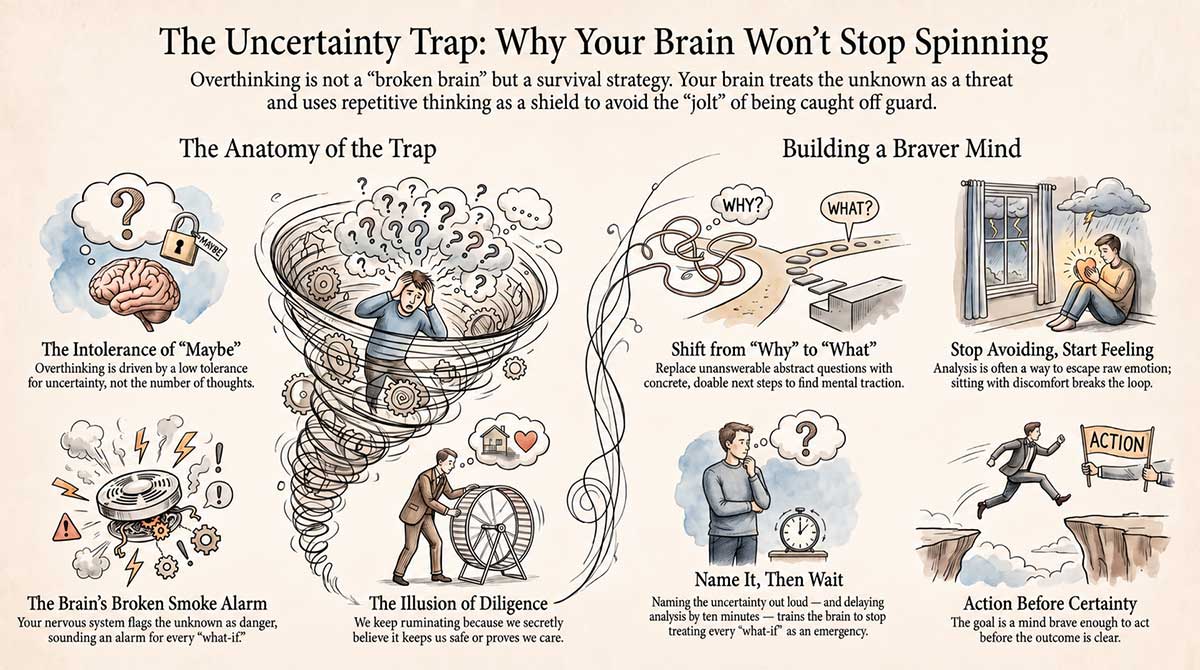
Overthinking is not a personality flaw or a broken brain. It is a strategy your mind uses to feel safer in a world full of unanswered questions. Understanding that changes what actually helps.
What Overthinking Really Is
Overthinking is the habit of dwelling on the same thought, worry, or decision long past the point where the thinking is useful. It usually takes one of two forms: replaying the past, or rehearsing a frightening future. Either way, the thoughts loop instead of leading anywhere.
The human brain treats uncertainty like a threat. Picture a smoke alarm that cannot tell burnt toast from a house fire. It sounds either way. When you do not know how something will turn out, your nervous system flags the unknown as danger, and your mind gets to work, not to solve the problem, but to feel more in control.
That instinct is where chronic worry lives.
The clinical psychologists Michel Dugas and Melisa Robichaud spent years studying adults with generalized anxiety disorder, and their work points to a telling pattern. What drove the worry cycle was not the content of any single fear.
It was the person’s reaction to not knowing. People who struggled most shared a low tolerance for the word maybe. Their cognitive model of intolerance of uncertainty put that reaction, rather than the worries themselves, at the center of the problem.
A later review by the Canadian researcher R. Nicholas Carleton looked across many different conditions and kept finding the same thread. His 2016 paper, Fear of the Unknown: One Fear to Rule Them All?, argued that discomfort with uncertainty runs underneath anxiety, depression, and repetitive worry alike. It was not specific to one diagnosis. It was common to many.
Strip away the specific worry, the deadline, the unanswered text, the test result, and what remains is the same every time. A mind that cannot rest with not knowing.
Is Overthinking a Disorder?
This is one of the most common questions people ask, often at 2 a.m., and the honest answer brings some relief. Overthinking is not a diagnosis. There is no clinical condition called overthinking in any psychiatric manual.
What overthinking is, instead, is a process. The psychologist Thomas Ehring and his colleague Edward Watkins describe it as repetitive negative thinking, a pattern that shows up across anxiety, depression, and the aftermath of trauma without being unique to any of them. The same mental habit wears different costumes depending on the person.
So a habit of overthinking does not mean something is broken in you. It can, however, feed conditions like anxiety and depression if it goes unchecked, which is exactly why understanding the mechanism matters more than labeling yourself.
Why You Secretly Believe Overthinking Helps
Ask yourself something uncomfortable. Does part of you believe that overthinking keeps you safe? If the answer is yes, that belief may be the reason the cycle never breaks.
The clinical psychologists Costas Papageorgiou and Adrian Wells studied people who ruminated heavily and found that many held what they called positive metacognitive beliefs, quiet convictions about the value of their own worrying.
Not beliefs like “I am smart.” Beliefs like “If I think this through enough, I will be ready,” or “Worrying means I care.” Their study of rumination and depression showed that people keep ruminating in part because some part of them is convinced it works.
That conviction builds a trap most advice walks right past. You cannot stop doing something while half of you believes it is protecting you. The worry feels like diligence. The rumination feels like preparation. Stopping feels reckless.
The catch is that overthinking delivers the feeling of productivity without the result. You end up where you started, only more tired.
What makes the trap so sticky is that most overthinkers hold two beliefs at once. They sense the rumination is harming them, and they still trust that it helps. That inner standoff is why trying harder to stop rarely lands. The part of you that sees the damage is arguing with the part that still finds it useful, and willpower alone cannot settle the argument.

Rumination or Problem-Solving: How to Tell the Difference
There is a thin line between working a problem out and going in circles, and most people cross it without noticing.
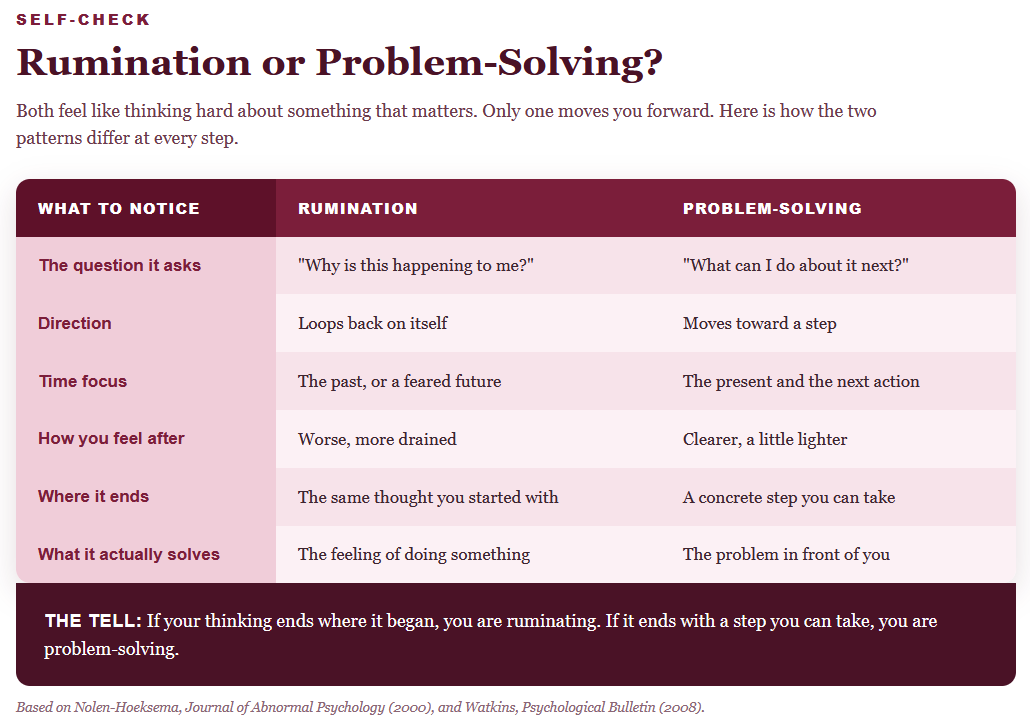
Productive thinking moves. It asks what can be done and ends with a step. Rumination spins. It asks why this is happening and ends on the thought it began with.
The late psychologist Susan Nolen-Hoeksema spent years tracking how people respond to low moods, and her findings were stark. In her research on rumination and depression, replaying events and feelings without moving toward action did not just accompany depression. It predicted it. People who ruminated more had longer depressive episodes and were more likely to develop new ones.
The event was not the problem. The way they processed it was.
So how do you know which side of the line you are on? A few signals give it away:
- You are replaying the same scenario and reaching no new conclusion.
- Your thinking circles around “why” rather than “what next.”
- You feel worse after thinking, not clearer.
- You are reviewing the past or projecting a frightening future instead of planning a real step.
Spotting the pattern is the first thing that has to happen before it can change.
Ruminating or Problem-Solving?
Six quick questions to tell which gear your mind is in right now
This check is a self-reflection prompt, not a diagnosis or medical advice. If overthinking is consistently disrupting your sleep, mood, or daily life, consider speaking with a licensed mental health professional.
What Worry Is Actually Avoiding
This part surprises people, because it runs backwards from how overthinking feels.
Overthinking can be a form of avoidance. That sounds wrong. Is the overthinker not engaging too much? In one sense, yes. But a 1998 review by the psychologist Thomas Borkovec and colleagues found that verbal worry, the running inner monologue, suppresses emotional processing. The mind is not trying to solve the feeling. It is trying to escape it.
By staying busy with words and analysis, you keep the raw emotion at arm’s length. The anxiety, the grief, the fear, never quite get touched. Borkovec’s work suggested that worry blocks the emotional imagery and physical response the brain normally needs to process a fear and let it settle. Stay in abstract thought, and you walk around the feeling instead of through it.
That finding took a while to sink in.
Not everyone reads the evidence the same way, and the disagreement is worth sitting with. The psychologists Michelle Newman and Sandra Llera spent years building a competing account, the contrast avoidance model.
Where Borkovec saw worry as a retreat from emotion, they see something close to the opposite. The worrier, on their reading, is not dampening feeling. They are keeping themselves deliberately on edge.
The logic runs against intuition. If you stay braced for the worst, a bad outcome cannot blindside you with a sudden emotional plunge, because you were already down there waiting for it. Worry, in this view, is insurance against the jolt of being caught off guard.
Newman and Llera found that chronic worriers will often choose to stay keyed up rather than relax first, because relaxing makes the eventual bad news land harder by contrast.
Researchers have not settled which model explains more, and that open question is itself part of the honest picture. What the two accounts share is the part that matters for an overthinker. One says you are hiding from the feeling. The other says you are bracing against it. Neither says the thinking is solving anything.
Why “Why” Keeps You Stuck
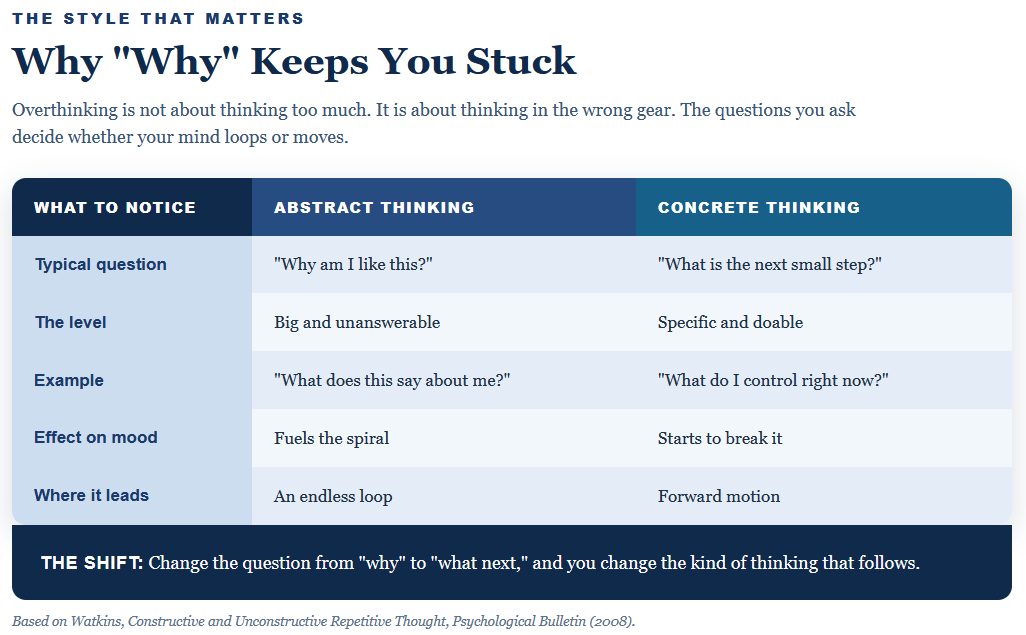
Not all thinking is the same. The style matters as much as the subject, and one style does almost all the damage.
Edward Watkins has done some of the most useful work here. His 2008 review for Psychological Bulletin, Constructive and Unconstructive Repetitive Thought, drew a clean line between two modes.
Abstract thinking asks big, unanswerable questions. Why is this happening? Why am I like this? What does it say about me? Those questions have no ground-level answer, so they loop. Concrete thinking asks specific, doable ones. What is the next small step? What do I actually control right now? Those have traction.
People who shifted from abstract to concrete thinking, Watkins found, had better mood outcomes. The abstract style fuels the spiral. The concrete style starts to break it.
This explains a paradox most overthinkers live inside. Much of the spinning is an attempt to solve a feeling. Something feels wrong, so the brain, the problem-solver it is, tries to fix it by thinking. And thinking. And thinking more.
Feelings do not answer to logic the way problems do. You cannot reason your way out of anxiety or analyze your way to calm, and trying usually turns the volume up. The shift that helps is not from thinking to silence. It is from “How do I fix this feeling?” to “What real step can I take while this feeling is here?” You move with the discomfort rather than waiting for it to leave first.
Learning to Sit With Not Knowing
If discomfort with not knowing is the engine of overthinking, then learning to sit with not knowing is the way out. This is not about becoming indifferent to how things turn out. It is about acting and living before the outcome is clear, the way a muscle gets stronger with use.
Dugas and Robichaud’s clinical work found that targeting intolerance of uncertainty directly, rather than just managing symptoms, led to real reductions in worry.
The psychologists Colette Hirsch and Andrew Mathews added another piece. Their cognitive model of pathological worry showed that when attention is biased toward spotting threat everywhere, that bias feeds the cycle, and shifting it loosens the loop.
A few practices, drawn from cognitive behavioral and acceptance-based therapies, build that tolerance over time:
- Name the uncertainty out loud. Say it plainly: “I do not know how this will go.” Naming the unknown is different from fighting it.
- Take one small action anyway. Waiting for certainty before you move is part of the trap, so pick a single imperfect step and take it.
- Delay the analysis. When a worry arrives, set a ten-minute window before you engage with it, and practice not reacting to every what-if on the spot.
The hardest practice has no tidy instructions, which may be why it works. When a feeling rises, instead of switching into analysis, let it move through you. Notice what it actually is, whether that is a tight chest or a racing mind, and name it.
Then stay with it for a moment, and resist the urge to fix it. This is the step most overthinkers skip, because sitting with a feeling is the very thing the analysis was built to avoid.
The stakes for getting this right are not small. The researchers Jelena Spasojević and Lauren Alloy followed college students over two and a half years and found that those who leaned on rumination as a coping style were far more likely to slide into depressive episodes. The way they processed stress, not the stress itself, shaped the outcome.

The Way Out Is a Braver Mind, Not a Quieter One
The mind spins because it is trying to protect you from pain and from not knowing. That instinct is not the enemy. The strategy is. When the brain believes more thinking means more safety, it keeps thinking, and when it believes avoiding a feeling keeps you protected, it stays in the loop.
So the goal was never a silent mind. It is a braver one, able to say “I do not know” without treating those three words as an emergency. That takes practice, and the research is detailed enough that it can be learned.
Frequently Asked Questions
What are the signs and symptoms of overthinking?
The usual markers are replaying the same scenario with no new conclusion, focusing on “why” instead of “what next,” trouble switching the mind off at night, indecision that stalls into analysis paralysis, and feeling worse after thinking rather than clearer. Physical signs can follow too, including tension, restlessness, and fatigue.
What is the biggest problem for overthinkers?
It is that the thinking feels like progress while delivering none. Overthinking produces the sensation of solving a problem without reaching a solution, so the mind keeps going, convinced one more lap will help. The real cost is the action never taken, and the feeling never faced.
What is the 3-3-3 rule for overthinking?
The 3-3-3 rule is a grounding technique: name three things you can see, three sounds you can hear, then move three parts of your body. It is a popular way to interrupt a spiral by pulling attention back to the present. It is a coping heuristic rather than a clinically tested protocol, useful in the moment but not a substitute for addressing the pattern underneath.
What triggers overthinking?
Uncertainty is the most common trigger, especially an unresolved situation the mind reads as threatening. A bias toward noticing threat, a belief that worrying is useful, and the urge to avoid an uncomfortable feeling all set the loop in motion before any single thought does.