The exercise that delivers the biggest BDNF spike isn’t necessarily the one that produces the greatest long-term brain changes. Here’s what the research uncovered.
The MRI scans were clear. Walking at a brisk pace three times a week had physically regrown the brain’s primary memory region in adults who had watched it shrink for years. Nobody ran. Nobody lifted. They walked.
That finding, from a randomized controlled trial published in the Proceedings of the National Academy of Sciences, sent researchers toward an obvious next question. If moderate walking does this, what does high-intensity interval training do? More intensity means more of everything in fitness. The assumption was reasonable. The data turned out to be more complicated.
What Is Neuroplasticity, and Why Should You Care?
Your brain is not fixed. It remodels constantly, forming new connections, strengthening pathways that get regular use, and pruning those that have gone quiet. This capacity to reorganize itself is neuroplasticity, and it is not abstract. It shows up in brain scans as measurable structural change.
At the center of this process is a protein called brain-derived neurotrophic factor, or BDNF. It supports the growth of new brain cells, strengthens existing neural connections, and helps the brain recover from the effects of stress and aging. Where BDNF production rises, structural growth tends to follow.
Exercise triggers BDNF release. What the research has spent the past decade working out is exactly how much exercise, at what intensity, and whether more of either consistently produces more benefit.

Why a Simple Walk Can Change Your Brain’s Structure
The hippocampus, the region most closely tied to learning and memory, normally shrinks with age. In cognitively healthy adults, it loses tissue at a rate that compounds into real functional decline over time. It is also one of the first structures affected in early Alzheimer’s disease.
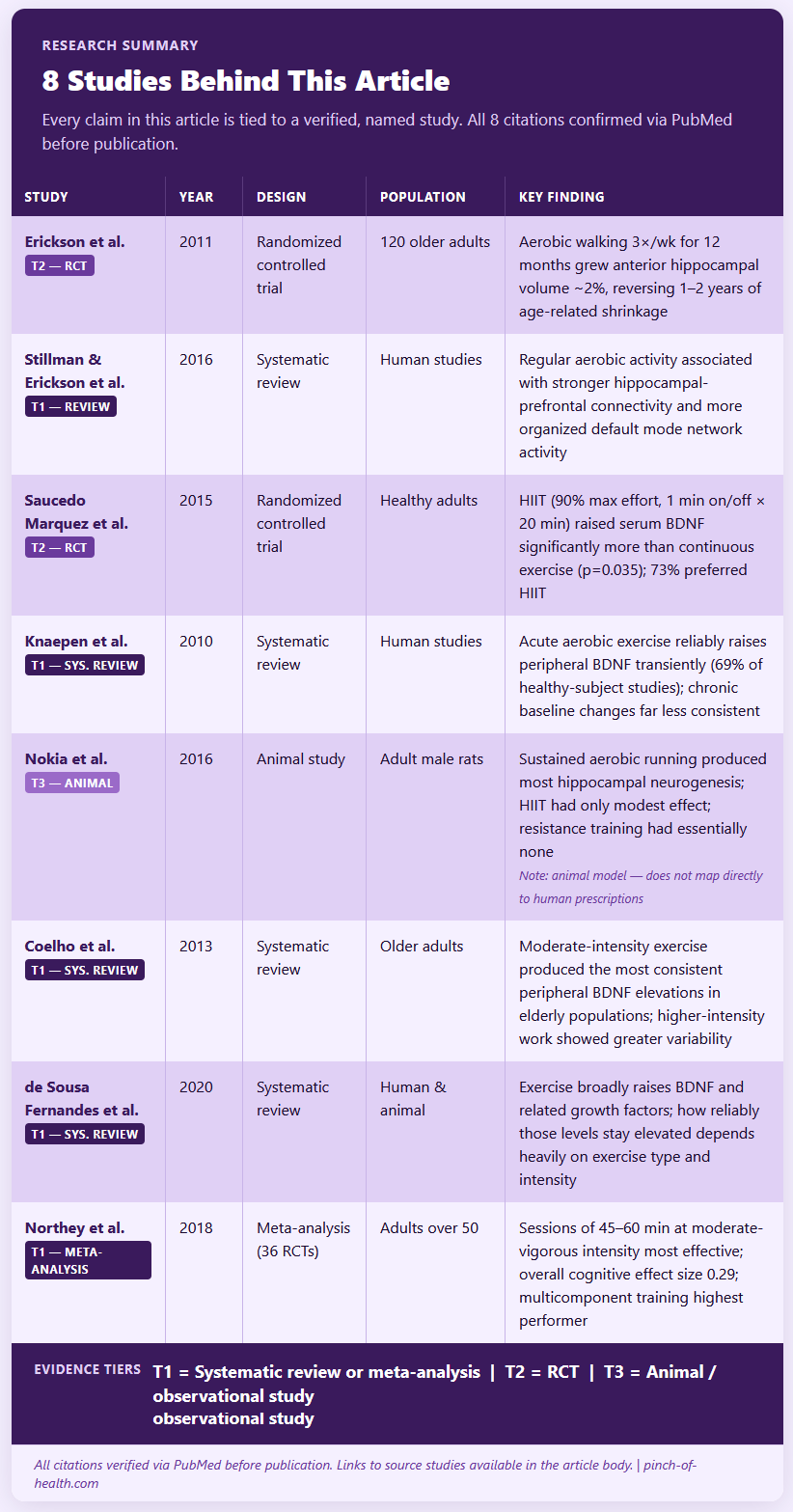
Kirk Erickson, a neuroscientist at the University of Pittsburgh, wanted to know whether exercise could reverse this. His 2011 randomized controlled trial, published in the Proceedings of the National Academy of Sciences, assigned 120 older adults to either an aerobic walking program or a stretching control group. The walkers exercised at moderate intensity, three times per week, for 40 minutes per session, for a full year.
The MRI results were unambiguous. Anterior hippocampal volume in the walking group had grown by roughly 2 percent, effectively reversing one to two years of expected age-related shrinkage. Memory scores improved alongside the structural changes. The stretching group showed continued tissue loss.
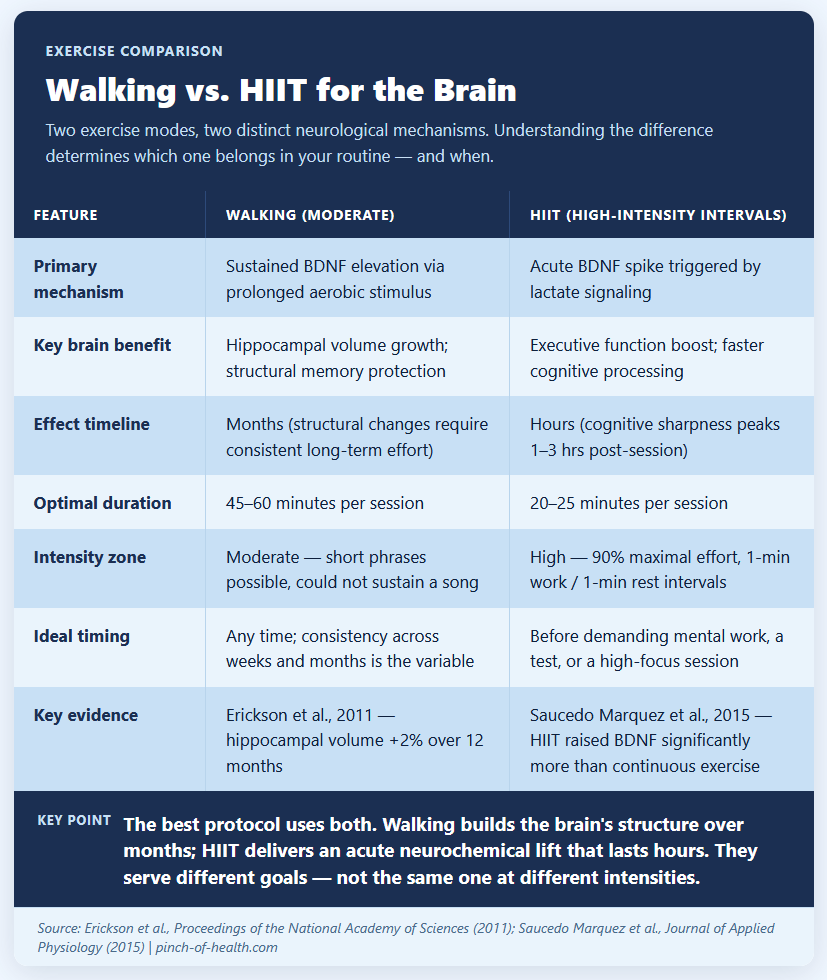
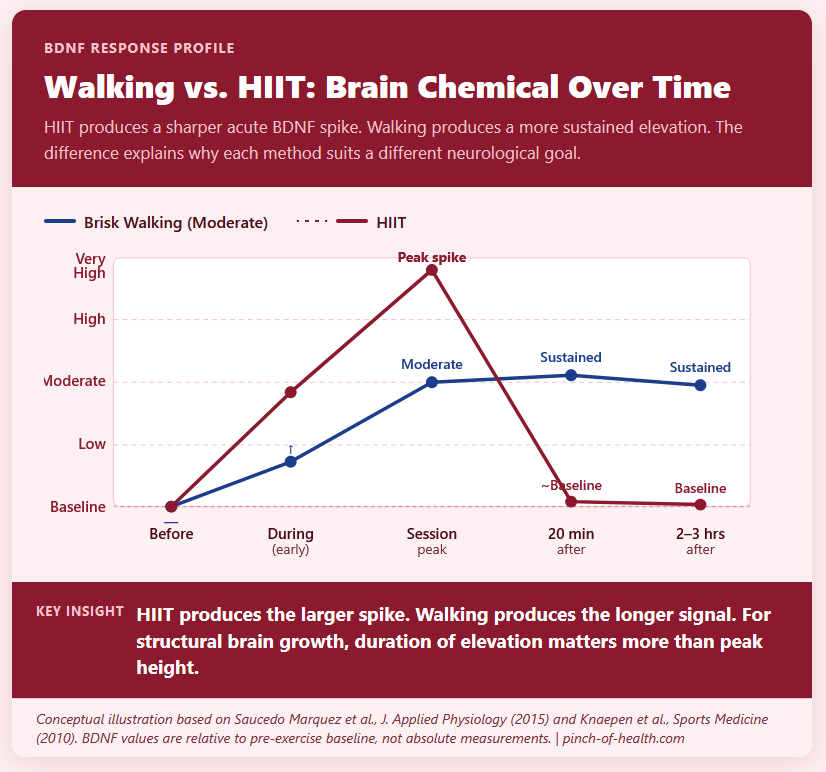
The mechanism runs through a sustained chemical environment rather than any single acute event. Moderate aerobic movement increases blood flow to the brain and keeps BDNF elevated over an extended period. The body is not under extreme metabolic stress, so growth signals stay active longer. This biochemical stability, rather than any single spike, appears to be what the MRI data captures.
A 40-minute walk at the right intensity tends to leave a cognitive clarity in the hours afterward that shorter or slower sessions rarely produce. The MRI data offers a structural explanation for something consistent walkers have already noticed.
A 2016 review in Frontiers in Human Neuroscience by Chelsea Stillman and Kirk Erickson at the University of Pittsburgh examined what happens to brain connectivity in regularly active people.
One pattern the review identified: stronger connections between the hippocampus and the prefrontal cortex, and more organized activity in the default mode network, the system active during memory consolidation, self-reflection, and planning.
Regular walkers are not just adding hippocampal volume. The connectivity data points to a more integrated brain.
The HIIT Effect: A Fast, Powerful Surge of BDNF
High-intensity interval training works through a different pathway on a different timeline.
Researchers at KU Leuven wanted to know whether the interval structure of HIIT produced a distinct neurochemical response compared to continuous high-intensity work at the same duration.
Cinthia Saucedo Marquez and colleagues, writing in the Journal of Applied Physiology in 2015, set up a comparison between two 20-minute protocols: continuous cycling at 70 percent of maximal work rate, versus interval cycling at 90 percent of maximal effort in one-minute bursts alternating with one-minute rests.
Both protocols raised BDNF. The interval training raised it significantly more, and 73 percent of participants said they preferred the interval protocol when given the choice.
Behind this effect is lactate. At high intensity, muscles produce lactate rapidly as a byproduct of anaerobic energy metabolism. Lactate travels to the brain and acts as a signaling molecule, triggering a sharp BDNF surge. The harder the effort, the more lactate enters circulation, and the more pronounced the neurochemical response.
Research on executive function consistently shows that short, intense exercise improves focus, decision-making, and mental flexibility in the hours that follow. A HIIT session before demanding mental work creates a biochemical environment that supports faster cognitive processing.
Most people notice the effect as a specific quality of alertness in the two to three hours afterward, cleaner than caffeine and harder to explain before you know about the lactate pathway.
The acute BDNF surge from HIIT dissipates quickly. Levels peak toward the end of the session and return to pre-exercise baseline within about 20 minutes of recovery. That is a description of what the mechanism actually is, not a flaw in the method, which raises the question of why the research took longer to answer.

The Plot Twist: Harder Isn’t Always Better for Your Brain
A systematic review by Kristel Knaepen and colleagues at Vrije Universiteit Brussel, published in Sports Medicine in 2010, examined the available human evidence on aerobic exercise and peripheral BDNF.
The pattern that emerged: acute aerobic exercise reliably raises BDNF in the short term. What proved much harder to establish was whether chronic training consistently elevated BDNF at resting baseline, and whether higher intensity reliably translated into larger lasting changes. The evidence on both questions was variable.
An animal study at the University of Jyväskylä brought the question into sharper focus. Miriam Nokia and colleagues tracked the production of new neurons in the hippocampus of adult male rats across three training conditions: sustained aerobic running, high-intensity interval training, and resistance training.
Published in the Journal of Physiology in 2016, the results were direct. Aerobic running produced the largest gains in hippocampal neurogenesis. HIIT had only a modest effect. Resistance training had essentially none.
Animal models have real limits, and those findings do not translate cleanly into human training prescriptions. But the direction aligned with what the human evidence was already suggesting.
The explanation comes back to the body’s stress response. At extreme training loads, cortisol rises sharply. In controlled amounts with adequate recovery, that stress is productive. When training intensity chronically outpaces the body’s ability to recover, cortisol can remain elevated long enough to interfere with neuroplastic signaling. The same physiological stress that builds cardiovascular fitness can, at the wrong dose, suppress the brain’s growth signals.
In its way, this is the brain’s version of overtraining. Chronic stress, insufficient recovery, and prolonged exhaustive exercise have all been associated with reduced neuroplastic signaling. The brain responds most reliably to consistent stimulation at manageable intensity.
Two systematic reviews of human populations pushed in the same direction, though with a qualifier the earlier studies had not clearly articulated. Flávia Gomes de Melo Coelho and colleagues, writing in Archives of Gerontology and Geriatrics in 2013, found that moderate-intensity exercise produced the most consistent BDNF elevations in older adults, while higher-intensity work produced more variable results.
Writing seven years later with a larger evidence base, Mariana de Sousa Fernandes and colleagues, in Neural Plasticity in 2020, confirmed the BDNF lift broadly, then added what the earlier work had not emphasized: how reliably those levels stay elevated depends heavily on the type and intensity of exercise used.
The precise threshold where more intensity starts to matter less, where the acute spike becomes noise rather than signal, remains unsettled. Nobody has mapped that curve cleanly for humans yet.
How Much Exercise Does Your Brain Need?
Two things came into focus from the larger studies: how long each session needs to be, and that exercise type matters as much as intensity.
A 2018 meta-analysis by Joseph Northey at the University of Canberra, published in the British Journal of Sports Medicine, drew on 36 randomized controlled trials involving adults over 50.
Across aerobic training, resistance training, multicomponent programs, and tai chi, one dosing pattern consistently produced results: sessions of 45 to 60 minutes at moderate to vigorous intensity. Sessions shorter than 45 minutes showed weaker effects.
Very high intensity did not outperform moderate intensity for cognitive outcomes, and the overall effect size across cognitive domains was 0.29.
Multicomponent training, combining aerobic work, resistance training, and coordination-based movement, performed particularly well for executive function and memory. When the brain has to manage balance, timing, spatial awareness, and movement sequencing simultaneously, the cognitive demand appears to amplify the neuroplastic response beyond what single-mode exercise produces.
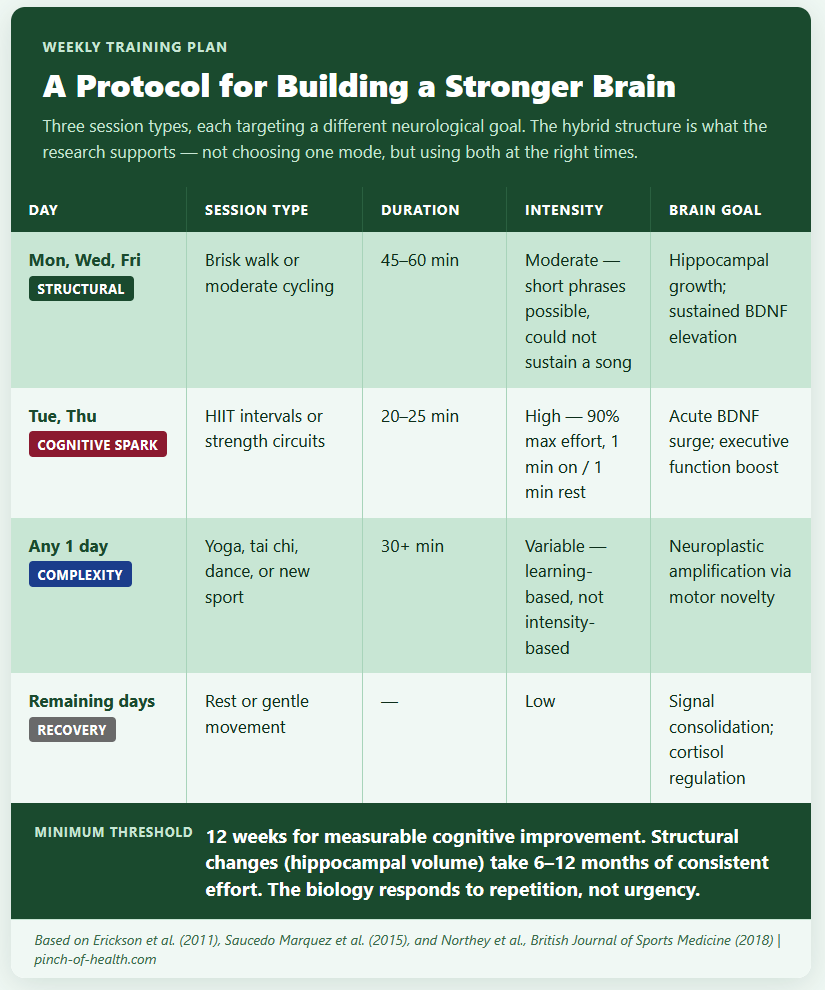
Twelve weeks appears to be the minimum for measurable improvements in cognitive function. Structural changes, like the hippocampal growth Erickson documented, take considerably longer. Consistency over months, not weeks, is what the biology requires.
A Weekly Protocol for Building a Stronger Brain
Most training advice treats walking and HIIT as competing options. The research treats them as tools for different neurological goals. The protocol below is built on that distinction rather than on a preference for one over the other.
The Structural Build Days: Monday, Wednesday, Friday
These are the structural days. The evidence here tracks duration, not a hard ceiling on intensity. A 45 to 60-minute brisk walk or cycling session at moderate effort creates the sustained BDNF environment the Erickson study measured. “Brisk” has a specific meaning: you can speak in short phrases but could not sustain a song.
If you are holding a full, easy conversation, you are moving too slowly to trigger the response the study produced. If you cannot manage short phrases, you have pushed past the moderate zone into something that serves a different purpose on a different day.
The Cognitive Spark Days: Tuesday and Thursday
On these days, the goal is an acute BDNF surge and an executive function lift before demanding mental work. A 20 to 25-minute interval session is enough. The Saucedo Marquez protocol was simple: one minute at high effort, one minute at rest, repeated for eight to ten rounds.
Here the variable shifts from duration to intensity. Twenty minutes at genuine high effort produces the lactate-driven BDNF surge that longer, moderate sessions do not. Resistance training fits here as well. Strength work activates neurochemical pathways that aerobic exercise does not, and the Northey meta-analysis found it particularly effective for working memory and executive function.
One Complexity Session: Any Day
Adding one session per week of something that demands coordination (yoga, tai chi, a dance class, or a sport you have not fully mastered) amplifies the neuroplastic response. The brain responds to movement patterns it has to consciously learn in ways it no longer responds to movement it has long since automated. A sport you are still learning provides more neurological work in 30 minutes than one you have played for decades.
What Zone Is Your Workout In?
Two quick questions to find out whether your exercise sessions are building brain structure, delivering an acute cognitive boost — or landing somewhere in between.
Walking vs. HIIT: Which One Actually Wins?
The question assumes a competition that does not exist in the data.
If the goal is building hippocampal volume and protecting long-term memory, consistent moderate aerobic exercise is the primary tool. The structural gains in the Erickson study came from walking, not sprinting.
If the goal is immediate cognitive sharpness and better executive function before demanding mental work, interval training delivers it faster. The lactate-driven BDNF surge is real and measurable.
If the goal is long-term cognitive health across decades, neither works as well alone as they do together. The Northey meta-analysis found that multicomponent training, pairing aerobic work with resistance exercise and coordination, produced the strongest results across multiple cognitive domains.
Adherence is the variable the evidence keeps returning to. It matters more than protocol design. The Erickson study ran for 12 months. A program abandoned after three weeks produces no measurable structural change.
Walking for 40 minutes, three times a week, turns out to be enough. That was not the obvious answer when this research began.
The biology responds to repetition, not urgency.