Not all meditation practices changed the brain in the same way. Researchers found that different approaches appeared to produce different neurological outcomes.
For most of human history, scientists believed the adult brain was fixed. You were born with a certain number of neurons, and that was that. Damage was permanent. Decline was inevitable. The brain you had at 30 was largely the brain you’d have at 80.
That view turned out to be wrong.
The science of neuroplasticity (the brain’s ability to physically change its structure) has rewritten what we thought was possible. And one of the most studied tools for triggering that change isn’t a drug, a surgery, or a high-tech device. It’s meditation.
The real questions aren’t whether meditation affects the brain anymore. Researchers have answered that. The questions are how it works, how fast it works, and what kind of practice produces which results, because those answers are not the same for every study or every intervention.
Some findings come from structured 8-week programs. Others come from 3-day intensive retreats. And some, genuinely surprising ones, come from studies that lasted 7 days or from brief daily sessions nearly anyone can fit into a morning. The full range matters here because the evidence points to different answers depending on the approach.
Growing Your Brain’s Processing Power: The Gray Matter Story
Gray matter increased. That is the finding that launched a thousand wellness articles about meditation, and for good reason. Gray matter contains most of the neurons that process information, regulate emotion, and store memories. More density in the right regions correlates with better performance on the tasks those regions handle.
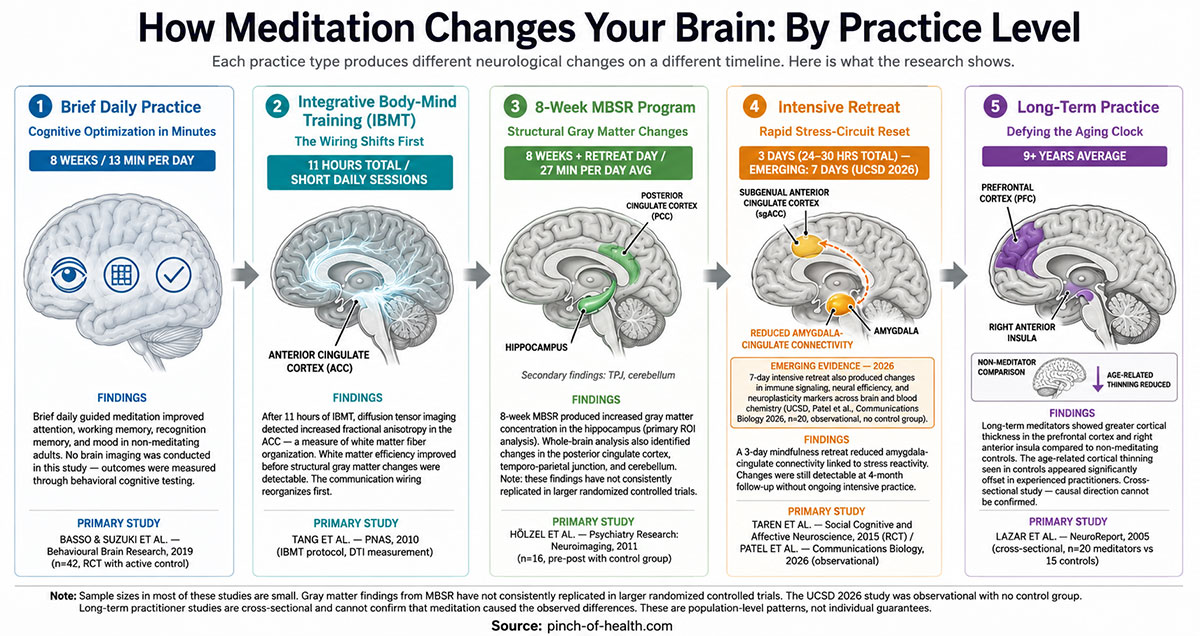
The study that produced this finding most clearly was led by Britta Hölzel at Massachusetts General Hospital. In a 2011 paper in Psychiatry Research: Neuroimaging, Hölzel and colleagues enrolled 16 healthy adults in an 8-week Mindfulness-Based Stress Reduction (MBSR) program: weekly group sessions, a full-day retreat, and home practice averaging 27 minutes per day.
Before-and-after MRI scans detected a measurable increase in gray matter concentration in one region of interest: the left hippocampus. The whole-brain exploratory analysis also picked up changes in the posterior cingulate cortex, the temporo-parietal junction, and the cerebellum.
A 2014 meta-analysis by Kieran Fox and colleagues at the University of British Columbia broadened the picture. Reviewing 21 neuroimaging studies and roughly 300 practitioners, the Fox meta-analysis identified eight brain regions that were consistently altered across meditation styles, including the frontopolar cortex, the sensory cortices, the insula, the hippocampus, and the anterior and mid-cingulate cortex.
The global effect size was medium (Cohen’s d of 0.46), which Fox himself described as meaningful but modest. He also flagged publication bias and methodological limitations as real concerns.
One caveat runs through that finding: it has proven difficult to replicate in larger controlled trials. A preprint by Tammi Kral and colleagues involving 218 participants found no significant gray matter changes following MBSR when compared against an active control group.
That doesn’t invalidate the Hölzel and Fox findings, but it does mean the structural gray matter story is more contested than most coverage suggests. Researchers continue to investigate, which is exactly what you’d expect from a field that’s still developing the tools to study it.
The Hippocampus: Your Brain’s Memory Hub
The hippocampus sits at the center of learning and memory. It converts short-term experience into long-term storage, connects past events to present ones, and plays a central role in emotional regulation. Chronically elevated cortisol (the hallmark of ongoing stress) can damage hippocampal neurons over time.
If you’ve ever noticed that prolonged stress makes it harder to retain information or find the right word, the hippocampus is part of that explanation. The Hölzel study’s finding of increased gray matter concentration in the left hippocampus after 8 weeks of MBSR suggests the relationship runs the other way too: sustained mindfulness practice may support the structural health of the region stress most reliably erodes. The evidence is correlational at this scale, but the pattern has appeared across enough independent research teams to take seriously.
The Posterior Cingulate Cortex and Temporo-Parietal Junction
The posterior cingulate cortex (PCC) handles something harder to name precisely. It’s where the brain runs what researchers call self-referential processing: the low-grade background loop of old regrets, vague projections, and quiet self-assessment that keeps running even when nothing is happening.
When it’s overactive, you’re not really thinking about anything specific. You’re just spinning. Meditation appears to quiet that loop, and over time may make the region more metabolically efficient.
The temporo-parietal junction (TPJ) does something more social. It’s the structure that allows you to understand that other people have mental states different from your own. It’s the region that becomes active when you sense that a friend is upset, even though they say they’re fine. The gray matter increase seen in the TPJ after MBSR training may be part of why long-term meditators report feeling more connected to others and less reactive in conflict.
Downsizing the Fear Center: What Happens to the Amygdala
The amygdala is the brain’s alarm system. It detects threats (real or perceived) and triggers the fight-or-flight cascade. In a world with actual predators, that’s essential. In modern daily life, where threats are often emails, traffic, and social pressure, a hair-trigger amygdala creates real problems. The result is a brain that treats an urgent message the same way it would treat a physical threat, then can’t understand why the tension lingers three hours after you’ve handled it.
Chronic stress keeps the amygdala in near-constant activation and appears to make it physically larger and more reactive over time. Meditation appears to reverse this pattern, though the speed of that reversal depends heavily on the intensity of the practice.
A 2015 study by Adrienne Taren and colleagues at the University of Pittsburgh and Carnegie Mellon University examined adults under significant psychological stress in a randomized controlled trial. Participants completed an intensive 3-day mindfulness meditation retreat: a format involving roughly 8 to 10 hours of guided practice per day.
Researchers then measured resting-state functional connectivity between the amygdala and the prefrontal cortex. After the retreat, the Taren study found reduced connectivity between the amygdala and the subgenual anterior cingulate cortex, a pattern associated with lower stress reactivity and better emotional regulation.
What makes this finding stand out is the follow-up data. Those connectivity changes were still detectable at a 4-month check-in, well after any ongoing intensive practice. A compressed retreat experience appears capable of producing durable shifts in stress-circuit function, at least in people already living under sustained pressure.
How the Prefrontal Cortex Learns to Take the Wheel
The prefrontal cortex (PFC) handles planning, decision-making, and impulse control. It’s also the region that can override the amygdala’s threat signals when a perceived danger turns out to be harmless. Researchers call this top-down regulation.
Regular meditation appears to strengthen that connection over time. The practical version of top-down regulation is probably familiar: you notice the spike of irritation, or the flood of worry before a difficult conversation, and something in you doesn’t follow it all the way down.
The PFC gets faster at recognizing a threat has passed and sending the all-clear. For people in high-pressure environments (demanding work, caregiving roles, unstable circumstances), that’s not a minor adjustment. It’s a functional shift in how the nervous system manages daily load.
The Wiring Shifts First: What White Matter Has to Do With It
Most coverage of meditation and brain health focuses on gray matter. But gray matter doesn’t operate in isolation. It relies on white matter (the network of insulated fibers that carry signals between brain regions) to communicate efficiently.
If gray matter is the hardware, white matter is the wiring. The part that surprised researchers was this: the wiring appears to shift before the gray matter changes, which the field is better known for.
Yi-Yuan Tang and colleagues at Dalian University of Technology demonstrated this using diffusion tensor imaging (DTI), a technique that measures the integrity and organization of white matter fibers.
After 11 hours of Integrative Body-Mind Training (IBMT), a structured meditation protocol rooted in Chinese medicine, Tang’s 2010 paper in the Proceedings of the National Academy of Sciences detected increased fractional anisotropy in the anterior cingulate cortex (ACC), a brain region tied to attention and self-regulation. Fractional anisotropy is the technical measure of how organized and intact white matter fibers are. Higher values indicate cleaner, more efficient signal transmission.
Eleven hours is a short exposure by most neuroscience standards. What the data showed was that the brain’s communication infrastructure began adapting to the signal of consistent attentional practice faster than structural gray matter measurements could capture. The communication cable got cleaner. Then, in later studies, the gray matter started shifting too.
What Attentional Control Actually Feels Like
The ACC, where those white matter changes appeared, plays a central role in what researchers call attentional control: the ability to focus, filter out distractions, and stay on task when something competing for attention arises. When white matter in the ACC becomes more organized, the subjective experience tends to be clearer thinking under pressure and less effortful sustained focus.
One downstream effect worth naming: a 2007 study by Heleen Slagter and colleagues at the University of Wisconsin-Madison found that meditators who completed a 3-month insight meditation retreat showed a significantly reduced attentional blink compared to non-meditating controls.
The Slagter study found the meditators were registering a second target stimulus more accurately, suggesting the brain was distributing its attentional resources more evenly across time. The attentional blink is that gap (roughly 200 to 500 milliseconds) during which the brain struggles to register a second piece of information if it arrives too close on the heels of a first.
Think of it as the lag between frames. Meditators appear to have a smaller lag. White matter efficiency in the ACC may be part of why. The wiring gets better at clearing after each input, leaving less backlog.
The Age-Defying Brain: Holding Back the Clock
Meditation changes the brain. So does age, and not in a favorable direction. Starting in the 30s, the prefrontal cortex loses cortical thickness in a predictable, measurable way. By midlife, structural decline has already begun at the cellular level, even when it’s not yet apparent in daily function. Thicker cortex in key regions correlates with sharper attention, better working memory, and faster processing speed.
Sara Lazar and colleagues at Harvard Medical School compared 20 experienced Insight meditation practitioners to 15 non-meditating controls. Using structural MRI to measure cortical thickness, the Lazar 2005 study in NeuroReport found greater cortical thickness in the meditators, concentrated in two regions in particular: the prefrontal cortex and the right anterior insula.
The age-related finding was the more striking result. Cortical thickness declines with age in a predictable pattern. In the meditation group, that thinning appeared significantly offset, with older meditators showing thickness measurements closer to those of considerably younger people.
This was a cross-sectional study: meditators and controls were compared at a single point in time, not tracked longitudinally. That means other factors can’t be ruled out: the kind of person drawn to sustained practice, general health habits, and cognitive baseline differences.
Still, the pattern was consistent enough that Lazar’s team concluded the data were at a minimum compatible with a protective effect of long-term practice against age-related structural decline.
The Insula: Staying Connected to Your Own Body
The right anterior insula (one of the regions showing greater cortical thickness in Lazar’s meditators) handles interoception: the brain’s monitoring of internal body states like heart rate, breathing, hunger, and tension. As people age, interoceptive awareness tends to dull.
That dulling has a practical cost. People who are less tuned into internal states often notice stress, fatigue, or physical discomfort later, after the body has already been sending signals for some time.
Long-term meditators appear to retain insular thickness at higher levels, keeping the signal from body to brain cleaner. The internal calm that experienced meditators often report may be partly structural: they’re simply receiving the body’s information more accurately.
What Brief Daily Practice Can Do
The studies discussed so far require either a structured 8-week program, an intensive retreat, or years of committed practice. That’s worth stating clearly. But there is a separate and encouraging body of evidence focused on much shorter, more accessible daily practice.
Julia Basso, Wendy Suzuki, and colleagues at NYU’s Center for Neural Science randomized 42 healthy adults between the ages of 18 and 45 (none of whom had previously meditated) into two groups. One group listened to a 13-minute guided meditation daily for 8 weeks. The other listened to a 13-minute podcast from the science program Radiolab. Both groups were asked to do this every single day.
At the 4-week mark, the groups looked identical on cognitive measures. By week 8, the picture had shifted. In the Basso and Suzuki 2019 study in Behavioural Brain Research, the meditation group showed meaningful improvements in attention (measured via the Stroop task), working memory, and recognition memory compared to the podcast group.
They also reported lower mood disturbance, anxiety, and fatigue. The control design here matters: both groups were listening to something for 13 minutes daily, which rules out the simple effect of taking a quiet break.
Why Regularity Appears to Outweigh Duration
The brain adapts to repeated, regular input. That principle runs through every tier of this evidence base. White matter changes emerged from 11 hours of IBMT spread across consistent short sessions. The cognitive gains documented in the Basso study required 8 weeks of 13 minutes per day. Gray matter changes required an 8-week MBSR program with regular home practice. The variable that keeps appearing is consistency, not total accumulated hours.
Think of it the way most people think about physical fitness. A short run every day builds more reliable cardiovascular conditioning than a single long effort once a week. The regular signal keeps the adaptation process active. The same logic applies to attentional training through meditation: the brain responds to daily practice over long periods more readily than to occasional intense bursts.
Can 7 Days of Intensive Meditation Rewire Your Brain?
A 2026 study out of UC San Diego asked a version of this question more directly than almost any prior research. Twenty healthy adults participated in a 7-day residential retreat combining meditation with other mind-body practices, led by neuroscience educator Joe Dispenza. Researchers then measured brain activity, blood chemistry, and markers of neuroplasticity before and after.
What they found, published in Communications Biology, was surprising in its breadth. Participants showed improved neural efficiency, changes in immune signaling, elevated levels of endogenous compounds associated with pain relief, and measurable markers of neuron growth and stronger brain network connectivity. The brain activity patterns observed after the retreat resembled those previously associated with psychedelic experiences, but without any pharmacological intervention.
“We’re seeing the same mystical experiences and neural connectivity patterns that typically require psilocybin, now achieved through meditation practice alone,” said Hemal H. Patel, a professor of anesthesiology at UC San Diego and senior author on the study.
The limitations here are significant and need to be declared. The study involved twenty participants, no control group, an observational design, and a self-selected population already motivated enough to attend a week-long residential retreat.
These findings are a starting point for investigation rather than a definitive conclusion. What the study does add is breadth: the changes weren’t confined to the brain. Blood chemistry shifted too, suggesting that intensive short-term meditation practice operates on biology at a systems level, and not only neurologically.
Putting It Together: Three Approaches, Three Timelines
The most common question in the meditation-neuroplasticity literature is also the most practically useful one: how long does this take? The honest answer is that it depends entirely on what kind of change you’re looking for and what kind of practice you’re doing.
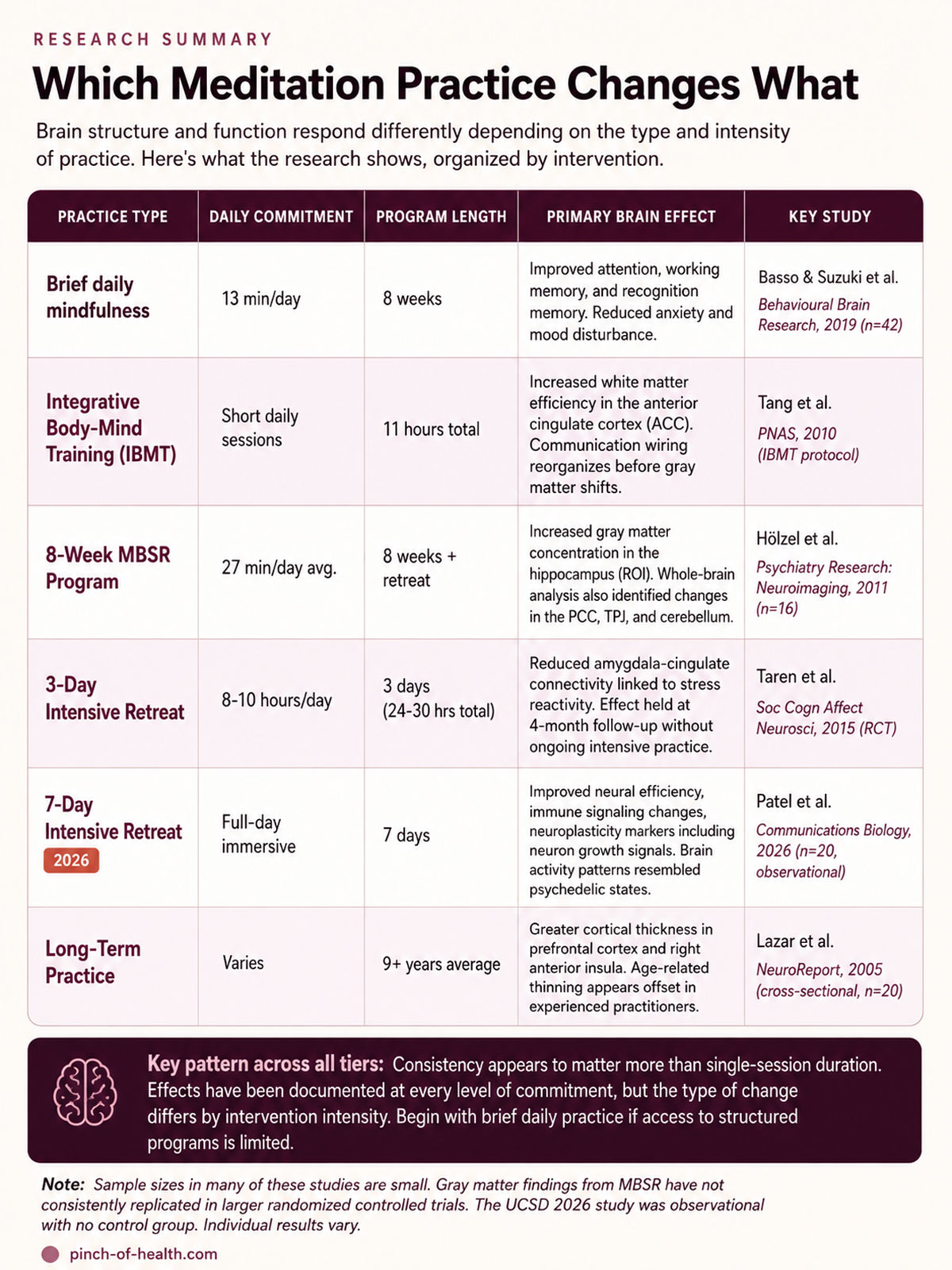
The research points to three distinct tiers. Each has a different evidence base and produces change on a different timeline.
Brief Daily Practice (13 to 20 minutes per day)
The Basso and Suzuki study sits here. Meaningful cognitive improvements in attention, working memory, and recognition memory appeared after 8 weeks of 13 minutes per day. The barrier to entry is lower than any other tier in this evidence base, and the cognitive returns are reliable for people who can maintain the daily practice.
Structured Programs (8-Week MBSR and Similar Formats)
The Hölzel study and the Fox meta-analysis represent this tier. These programs combine group instruction, sometimes a retreat experience, and sustained daily practice over 8 weeks. The gray matter changes documented at this level (in the hippocampus, posterior cingulate cortex, and temporo-parietal junction) represent potential structural shifts tied to memory, emotional regulation, and self-awareness. The evidence is stronger here than for brief practice alone, though questions about replicability at scale remain active in the field.
Intensive and Long-Term Practice
This tier contains the two most counterintuitive findings in the article, and they deserve more space than the others.
Three days of intensive practice (24 to 30 hours of total meditation) appear to produce lasting shifts in amygdala-cingulate connectivity that held at a 4-month follow-up in the Taren study. That’s worth sitting with. The practice itself lasted 72 hours.
The neurological change lasted months, without ongoing intensive practice to maintain it. For people operating under sustained high stress, that durability is a different category of finding than a general wellness benefit associated with a daily habit.
The 2026 UCSD study extends the intensive timeline in a different direction. Seven days of immersive retreat practice produced changes in brain function and in blood chemistry: immune signaling, endogenous pain-relief compounds, and biological markers of neuroplasticity.
The study had only 20 participants and no control group, and its findings await replication. What it adds, even at this preliminary stage, is a suggestion that intensive short-term meditation operates on biology at a systems level in ways that brief daily practice has not yet been shown to reach.
The third strand in this tier is the longest game. Lazar’s 2005 data on long-term practitioners show cortical thickness in the prefrontal cortex and insula at levels that outpace typical age-related decline, a structural finding measured in years of consistent practice, not weeks of intervention.
One caveat applies across all three tiers: most studies in this area involve small samples, and the findings continue to be tested across broader and more varied populations. Individual responses vary.
What the aggregate shows is a pattern consistent enough across independent research teams that the core claim holds: meditation produces measurable structural and functional changes in the brain, at multiple levels of practice and through multiple mechanisms. These are population-level trends, not individual guarantees.
Meditation Practice Planner
Answer two questions. Get a practice recommendation matched to the research.
What the research supports
Your evidence timeline
One practical tip
Conclusion
The idea that sitting quietly and paying attention to your breath could physically reorganize your brain used to require a certain willingness to suspend disbelief. It doesn’t anymore.
Different kinds of change require different kinds of practice. The wiring shifts first. Then the gray matter. Then, with sustained long-term practice, the structural clock slows. And a 7-day retreat, apparently, can move biology in ways researchers are only beginning to map.
None of that tells you exactly what will happen in your brain. But it does tell you something more useful: the biology responds. The level of practice you can sustain will shape which changes you’re likely to see.