The rule is almost universal. You’ve probably heard it from a parent, a grandparent, or a well-meaning stranger at a pool. Don’t bathe right after eating. Wait at least an hour.
Some version of this warning exists in East Asia, Latin America, the Mediterranean, and ancient Rome. Nearly two thousand years of cross-cultural agreement, and almost none of it backed by a single clinical trial.
That gap between how widely people believe this and how thin the evidence is happens to be the most interesting thing about it. The physiology is real, but modest. The history is genuinely strange. And the heart-attack myth has a traceable origin that explains exactly why it scared people for so long.
What follows isn’t a simple verdict of “it’s fine, relax.” The mechanisms are real enough to pay attention to, and a few groups of people should actually be more careful than most articles suggest. But for healthy adults eating typical meals, the rule as usually stated is much bigger than the risk it describes.
The Real Physiology, and Where It Gets Complicated
When you eat, your digestive system draws blood to the gut to begin breaking down food and absorbing nutrients. The Mayo Clinic Proceedings published a thorough review of cutaneous blood flow showing exactly what happens next when heat is applied to the skin: vasodilation directs blood toward the skin’s surface, and simultaneously, splanchnic and renal blood flow decrease to compensate. Under significant passive heat stress, splanchnic blood flow can fall by roughly 0.6 liters per minute.
That sounds alarming stated as a number. Whether it translates to meaningful digestive disruption for someone standing in a five-minute warm shower is a different question, and the honest answer is that nobody has measured this directly.
Most of the research involves prolonged immersion in hot water at temperatures higher than a typical shower: the kind of extended heat exposure you’d get from a sauna or a deep soak in a hot tub, not a morning rinse.
The relevant study is a 2019 trial published in Physiological Reports by Christof Leicht’s team at Loughborough University. Ten participants spent an hour submerged to the neck in 39°C water, then underwent a glucose tolerance test.
Their postprandial glucose response was measurably higher after the hot immersion than in the control condition. The stress hormones adrenaline and growth hormone had spiked during the immersion, which appears to be what drove the glucose effect.
It is the clearest evidence yet that heat and eating interfere, and also a good illustration of how far a controlled lab condition can sit from taking a shower after breakfast.
The extrapolation from “prolonged full-body immersion at 39°C” to a seven-minute warm shower is the part most articles skip. The mechanism is real. The magnitude in everyday conditions is almost certainly much smaller and, for most people, undetectable.
Why Did People Believe It Would Kill You?
This is where the history gets genuinely interesting, and where the heart-attack myth earns more than a one-sentence dismissal.
In 1881, the Swiss Medical Journal published a case report later archived in PubMed Central, about a fourteen-year-old boy who ate a heavy meal, went swimming immediately afterward, and drowned when food entered his airway during a cramp.
The report attributed the death to the combination of a full stomach and vigorous physical activity. By the time this type of case circulated in the popular hygiene literature of the late 1800s, “don’t bathe after eating” had become a standard rule, conflating the drowning risk of swimming with the rather more benign activity of standing in a shower.
The Roman satirists Persius and Juvenal wrote about gluttons who bathed in very hot water immediately after large meals accompanied by significant amounts of wine. Classical scholars reading those passages now identify the described deaths as what we’d call heart attacks.
Galen, writing in the second century, explicitly warned against bathing right after eating, citing his concern about obstruction of the kidneys and liver, the organs he believed regulated the body’s vital heat.
What he was observing, with the explanatory vocabulary available to him, was almost certainly the synergistic cardiovascular strain of digesting a very heavy meal, metabolizing alcohol, and sustaining extended heat exposure simultaneously.
In someone already carrying arterial disease, that combination can genuinely be dangerous. The risk was real. The translation of it into “a warm shower after dinner will harm a healthy adult” was not.
No peer-reviewed study links a routine post-meal shower to cardiac events in healthy individuals. A 2018 Japanese cohort study published in Scientific Reports following 873 middle-aged and elderly participants found that bathing in hot water five or more times per week was actually associated with better cardiovascular markers.
Bath-related cardiac deaths do occur in Japan, where the research was conducted, but the editorial commentary accompanying the study linked those deaths to thermal shock in elderly individuals, specifically the combination of a very hot bath and a cold bathroom in winter months, not to meal timing.
Will Showering After Eating Make You Fat?
No. And the reasoning for why people believe this is worth examining, because it reveals something about how plausible-sounding mechanisms can build into unfounded rules.
The theory goes: digestion requires energy, showering redirects blood flow, therefore fat storage increases. Each link in that chain has a kernel of physiology behind it. But the actual relationship between meal timing, thermogenesis, and fat storage doesn’t work this way.
Weight is determined by total caloric intake versus total caloric expenditure over time. The five minutes of mild blood flow redistribution during a post-meal shower has no plausible pathway to fat accumulation.
Showering itself burns a trivial number of calories. Hot showers produce a slight thermic effect. Neither of these variables shifts the energy balance of a meal in any measurable direction. The concern is based on a misreading of the mechanism, not on any outcome data.
Who Actually Should Wait Before Showering
The genuine cautions here are narrower than the general rule suggests, but for the right people they’re worth taking seriously.
The clearest case is GERD (gastroesophageal reflux disease). The combination of a full stomach, heat-induced relaxation of the lower esophageal sphincter, and the bent-forward posture most people adopt in a shower creates real conditions for reflux.
This is a consistent clinical complaint even where the controlled research is sparse, which it mostly is. Waiting 30 minutes and keeping the water temperature moderate handles most of the risk.
The Leicht 2019 glucose finding matters most for people managing diabetes. The stress hormones that spiked during hot water immersion in that study, adrenaline and growth hormone, are the same hormones that drive glucose elevation in people whose insulin response is already impaired.
The risk, it turns out, isn’t about digestion directly. It’s about the hormonal response to heat. The practical adjustment is the same as for GERD: a warm shower rather than a hot one, or a modest wait before either.
Low blood pressure adds a third variable. After a large meal, blood is already pooled in the digestive system. A hot shower on top of that can push blood pressure lower still, which is why some people feel lightheaded stepping out of a post-dinner shower. Avoiding abrupt position changes and keeping the water temperature moderate goes a long way.
Older adults carry all of these risks in a more concentrated form. The cardiovascular response to heat stress is slower to compensate with age, glucose regulation is more variable, and blood pressure shifts are less predictable. The Japanese bath-death data points squarely at this group, not at healthy adults in their thirties.
How Long Should You Actually Wait?
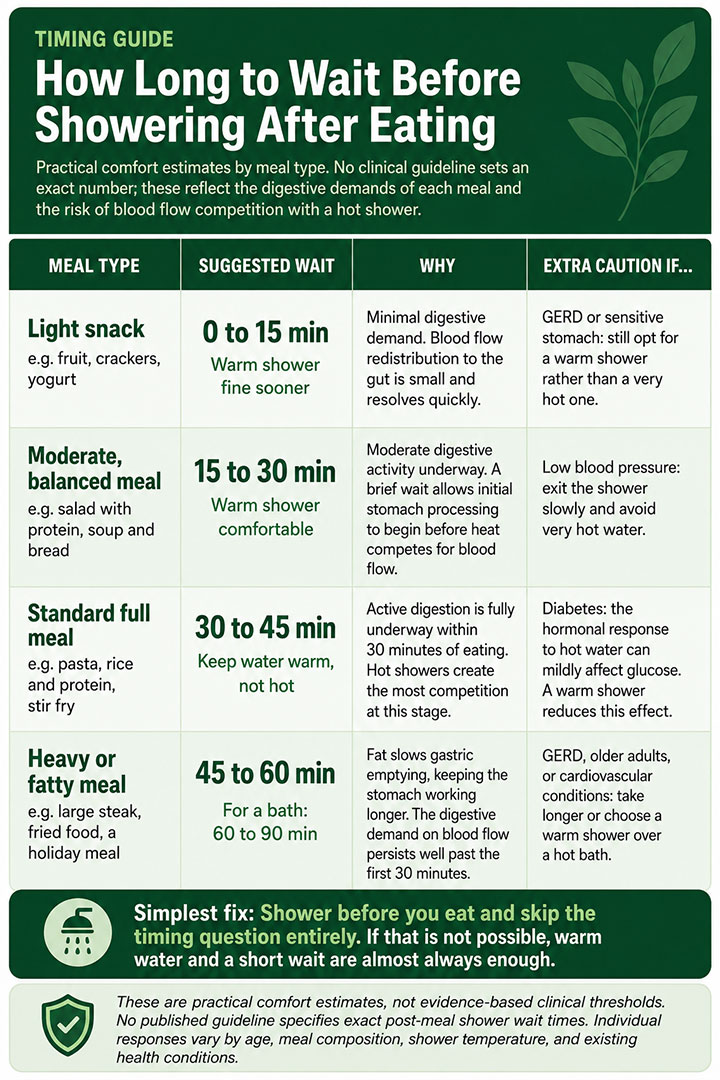
There is no clinical guideline that specifies a wait time for showering after eating. The numbers circulating online are practical estimates, not evidence-based thresholds. The estimates are reasonable:
The most useful reframe: if you have the option, shower before you eat. It removes the question entirely, and it’s something every competitor blog has noted but hasn’t made the centerpiece of its timing advice the way it should be. One simple logistical change avoids all the reasoning above.
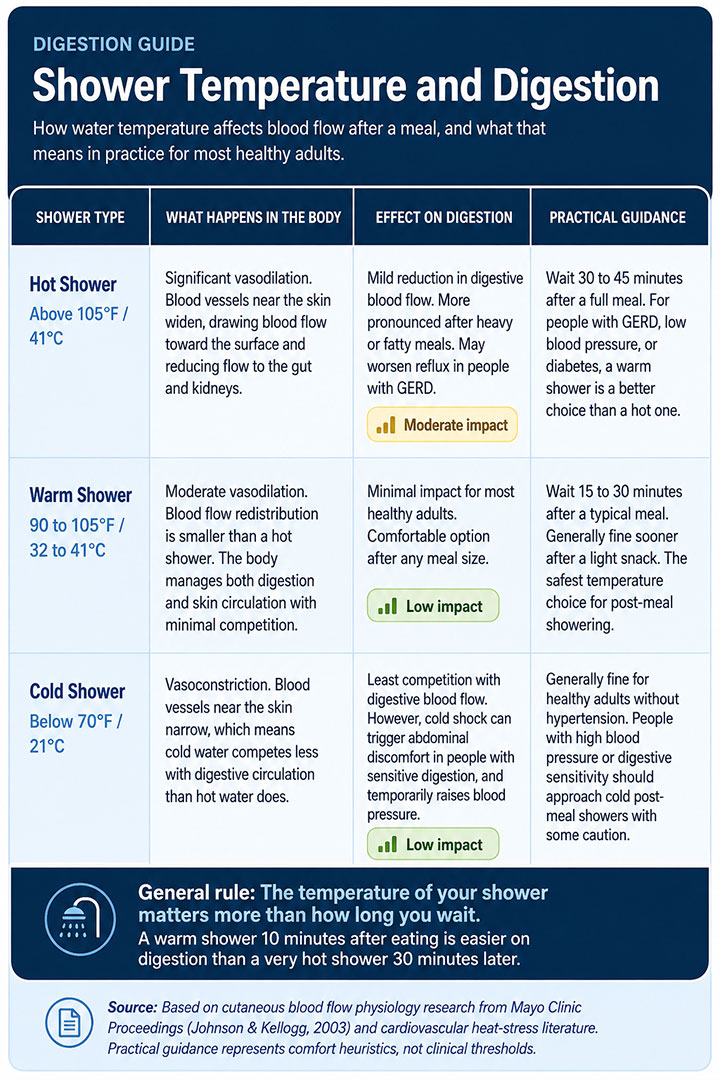
If that’s not possible, the temperatures in the table below matter more than the exact number of minutes you wait.
Shower Timing Estimator
Answer two questions to get a practical wait-time recommendation based on your meal and shower type.
Cold Showers After Eating
Cold showers work differently from hot ones at the vascular level. Where heat causes vasodilation and pulls blood toward the skin, cold causes vasoconstriction and reduces skin blood flow. In theory, this means a cold shower shortly after eating is less likely to compete with digestive blood demand.
In practice, the evidence for cold showers specifically in a post-meal context is thin. Vasoconstriction also increases blood pressure, which matters for people with hypertension. And a sudden cold shock after a meal can trigger abdominal discomfort in people with sensitive digestion, regardless of what the blood flow math suggests. If you shower cold every morning after breakfast and notice nothing, that’s your data. The mechanism doesn’t override a decade of unremarkable experience.
What the Cultures Got Right
The belief that you shouldn’t bathe right after eating appears in Chinese medicine’s concern about disrupting the body’s thermal balance, in Latin American traditions around empacho, in the Mediterranean warnings that evolved from swimming rules to bathing rules, and in the ancient Roman medical texts that were describing real risks to a specific population (heavy meals, alcohol, extended very hot baths) in terms their culture understood.
None of these traditions had access to randomized controlled trials. Most of them were observing real patterns: people who felt unwell after bathing too soon after eating, occasional dramatic cases that confirmed the rule. The biology behind their observations is legible. The extrapolation to “this is dangerous for everyone always” is where the evidence runs out.
The practical wisdom embedded in “wait a bit” turns out to be sound, just not for the reasons anyone was citing. The cultures that developed it weren’t wrong about the biology. They were wrong about the stakes, which makes for a strange kind of vindication: two thousand years of correct advice, rooted in mostly mistaken explanations.

The Rule Behind the Rule
For almost two thousand years, across cultures that couldn’t have compared notes, people arrived at roughly the same warning: don’t bathe right after eating. They were right that something was happening.
The blood flow competition is real, the cardiovascular strain of heat plus digestion is documented, the discomfort for people with sensitive systems is consistent. They were wrong about the scale of the danger for healthy people taking ordinary showers.
The rule survived so long not because the evidence sustained it, but because the mechanism behind it was plausible and the occasional dramatic case confirmed it. That’s a pattern worth recognizing beyond this specific question.
Folk wisdom about the body tends to identify a real signal and then overstates it far past what the signal can support. The shower rule is a good example of what that looks like once the research catches up.
FAQs
Is showering after eating bad for digestion?
For most healthy adults, a short warm shower after a typical meal causes no meaningful disruption to digestion. A hot shower creates mild competition for blood flow between the skin and the gut, but the practical effect is small. People with sensitive digestion, GERD, or low blood pressure may notice more discomfort and benefit from waiting 20 to 30 minutes.
Does showering after eating affect digestion differently for baths versus showers?
Yes, and the distinction matters more than most coverage acknowledges. The clinical research on blood flow and heat stress involves prolonged full-body immersion, the kind you’d get from a soaking tub or a sauna, not a brief standing shower.
The mechanisms apply to both, but the magnitude is considerably larger with extended immersion. Waiting longer before a hot bath than before a shower is a reasonable precaution, particularly after a heavy meal.
Can I shower after 30 minutes of eating?
For a moderate meal and a warm (not hot) shower, 30 minutes is a comfortable interval for most people. After a very heavy or high-fat meal, or before a hot bath, 45 to 60 minutes is a better buffer. There is no clinical rule that defines an exact threshold. The right amount of time depends on meal size, shower temperature, and individual factors like age and existing digestive conditions.
Can showering after eating cause a heart attack?
Not for healthy individuals taking routine showers. The historical root of this fear traces to ancient Roman texts describing deaths in people who combined very heavy meals, significant alcohol, and extended hot baths, a combination of cardiovascular stressors quite different from a post-dinner shower.
More recent data from Japan shows that bath-related cardiac events cluster in elderly individuals in cold rooms with very hot water, a thermal-shock pattern unrelated to meal timing. No study links a standard shower after eating to increased cardiac risk in healthy adults.
Why do some people feel dizzy after showering after a meal?
Blood pressure can drop transiently after a large meal as blood pools in the digestive system. A hot shower adds to this by causing further vasodilation. The combination can cause dizziness or lightheadedness when stepping out of the shower.
Waiting 20 to 30 minutes, using warm rather than hot water, and standing up slowly on exiting reduces this risk significantly.
Is it okay to take a cold shower after eating?
Cold showers cause vasoconstriction rather than vasodilation, so they compete less with digestive blood flow than hot showers do. For most healthy people, a cold shower shortly after eating is unlikely to cause digestive discomfort.
People with high blood pressure should be aware that cold water temporarily increases it. People with sensitive digestion sometimes find the shock of cold water causes abdominal discomfort regardless of meal timing.
Is it okay to take a bath when your stomach is full?
A full bath creates more significant temperature and blood pressure effects than a shower, particularly a hot one. After a heavy meal, waiting at least 45 to 60 minutes before a hot bath is a sensible precaution, especially for older adults or people with cardiovascular or digestive conditions. A lukewarm bath is a lesser concern than a very hot one.