The moment you finish studying may be more important than you realize. Researchers have discovered what happens next, and one common habit could interfere.
You just finished a long study session. You closed the laptop, set down the book, or hit pause on that dense podcast. What happens next?
If you’re like most people, you reach for your phone.
It feels harmless. You’ve earned a break. But that reflex might be quietly destroying everything you just learned.
Learning doesn’t stop when the input stops. Your brain keeps working on new information for a window of time after the session ends. Scientists call this process memory consolidation. And the habits most people default to right after studying are the exact habits that shut it down.
What Is Memory Consolidation?
Memory consolidation is the biological process your brain uses to stabilize and store a new memory. A fragile, recently encoded trace becomes a durable long-term representation. Think of it like wet concrete. Right after you pour it, it’s vulnerable. Press something into it, and you leave a mark. Leave it alone, and it sets hard.
New memories work the same way. Right after learning, they exist in a fragile, temporary state. Your brain needs a quiet stretch of time to transfer them from short-term holding into long-term storage. Interrupt that window, and the information doesn’t stick.
This is a well-documented biological process, not a loose approximation.

The Two Phases (and One Surprise)
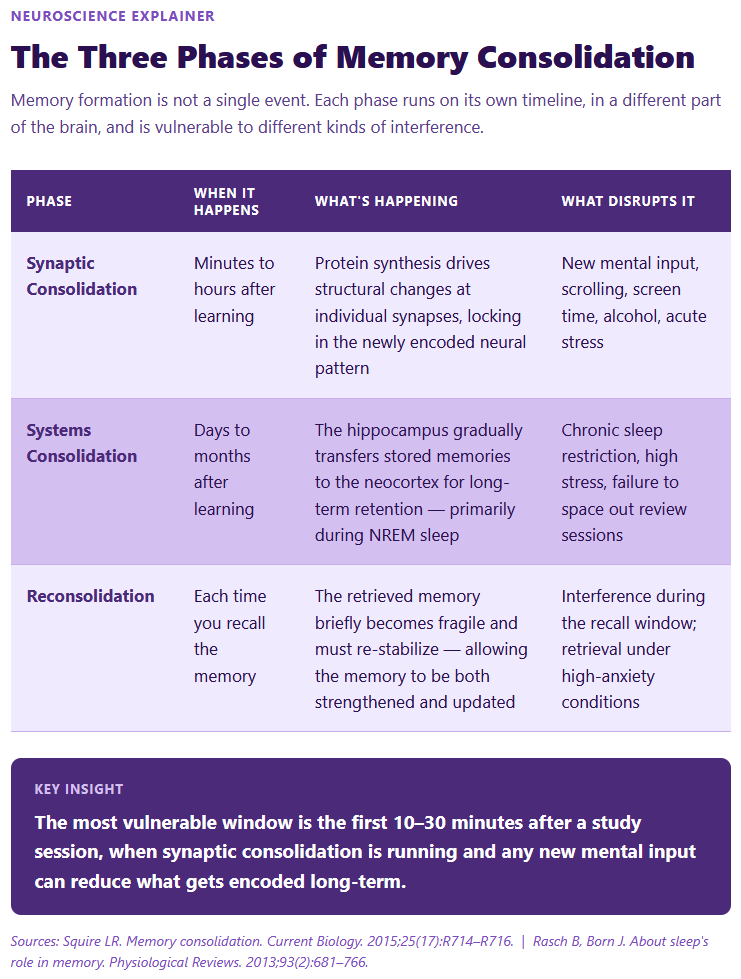
Memory consolidation doesn’t happen all at once. Researchers distinguish two main phases, and a third that most people never hear about.
The first is synaptic consolidation, which unfolds within hours after learning, at the level of individual synaptic connections. Protein synthesis drives lasting structural changes in the neurons that encoded the new information. You can’t feel it happening, but fill that window with mental noise and you’ll find less to retrieve the next day.
Systems consolidation is the longer transfer. Over days, weeks, and sometimes months, the hippocampus gradually transfers memory storage to the neocortex. Sleep plays a central role here. So do the gaps between study sessions.
The third phase is called reconsolidation, and it’s where things get counterintuitive. When you recall a stored memory, it briefly becomes fragile again and needs to re-stabilize before it’s fully restored. Testing yourself measures what you know, but each retrieval also actively reshapes and strengthens what you retain.
Why Your Smartphone Is Working Against You
There’s a specific threat that most articles on this topic miss: micro-interference.
Micro-interference is what happens when you flood your brain with new, irrelevant information right after a learning session. Scrolling a social media feed. Watching a video. Jumping into a group chat.
Each of these overwhelms your visual and cognitive systems with fresh input, and the same neural circuits that were just working to encode your new memories get hijacked by this new stream of content.
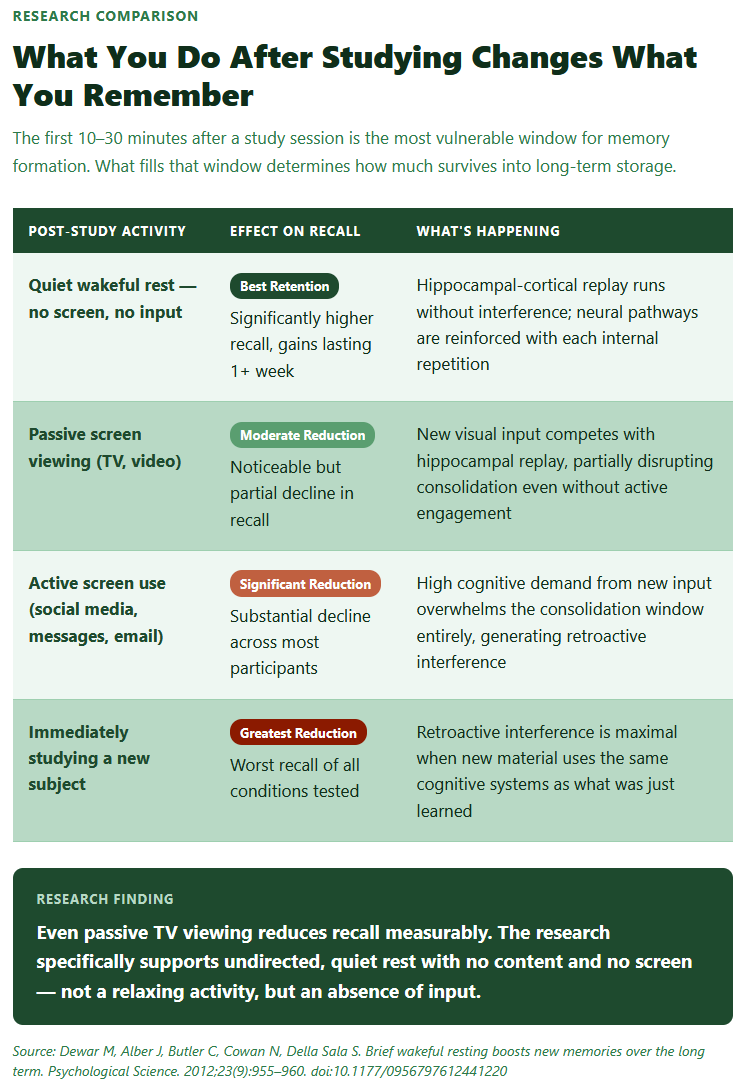
Michaela Dewar and colleagues at the University of Edinburgh ran the key test. Their 2012 study in Psychological Science had participants engage in new mental activity immediately after learning, and found significantly weaker recall later. The new input acted as retroactive interference, scrambling the stabilization process before it had a chance to finish.
The cognitive load of scrolling a newsfeed is enough to do this. You don’t need to study a second subject to cause damage. Even reading headlines can disrupt the hippocampal-cortical dialogue your brain needs to lock in what you just learned.
What’s Actually Happening in Your Brain
Two brain regions are doing most of the work during memory consolidation, and they need time to communicate after learning ends.
The hippocampus captures incoming information and holds it in a fragile state. The neocortex is the long-term archive, where stable memories are eventually stored. For a new memory to last, these two regions need to talk, and that conversation doesn’t happen during the lesson. It happens after.
Arielle Tambini and colleagues at New York University wanted to know whether that post-learning dialogue was measurable. Their 2010 fMRI study in Neuron found that the strength of hippocampal-cortical connectivity during rest right after learning was a direct predictor of how much participants remembered later. The more active this brain dialogue during rest, the stronger the memory.
The picture involves more than these two regions. The amygdala tags emotionally significant experiences for deeper encoding, and the medial prefrontal cortex plays a growing role as memories mature and start connecting with existing knowledge. But the hippocampus-to-neocortex handoff is where the post-study window matters most.
The Case for Doing Nothing After You Study
So what should you do right after a session ends? The research points to a surprisingly simple answer. Nothing.
Not a workout, not a podcast, not catching up on messages. Just quiet, undirected rest with no phone and no screen. Researchers call this wakeful rest, and it turns out to be one of the most effective memory tools that almost nobody uses.
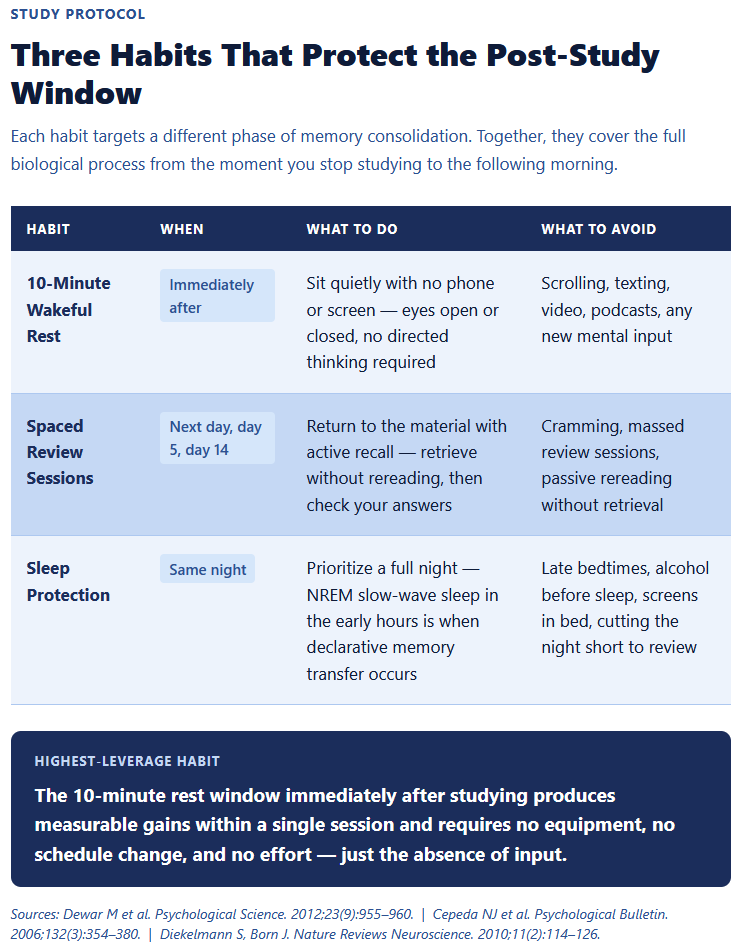
Dewar and her colleagues returned to this question in two 2014 studies, and the findings were more striking than expected. One, published in PLoS ONE, found that participants who spent 10 minutes in quiet rest immediately after learning retained significantly more than those who moved straight into another activity. Ten minutes. That’s the buffer.
A companion study in Neuropsychology by Jessica Alber, Sergio Della Sala, and Dewar extended the finding to amnesic patients and showed the memory gains held for at least a week.
What’s happening during those 10 minutes? The neural patterns that fired while you were learning don’t go quiet when the session ends. They keep firing, and with each repetition the pathways get reinforced.
In a 2019 review in Trends in Cognitive Sciences, Erin Wamsley of Furman University synthesized the evidence showing that wakeful rest triggers this same replay process previously associated only with deep sleep. The brain uses this quiet time to run a second pass on everything you just studied. You don’t have to do anything to make it happen.
Sleep Is Not Optional for Serious Learners
Short rest gets consolidation started. Sleep is what finishes it. That second process moves memories from temporary hippocampal storage into the neocortical networks where long-term knowledge is actually stored, and it requires a full night to run properly.
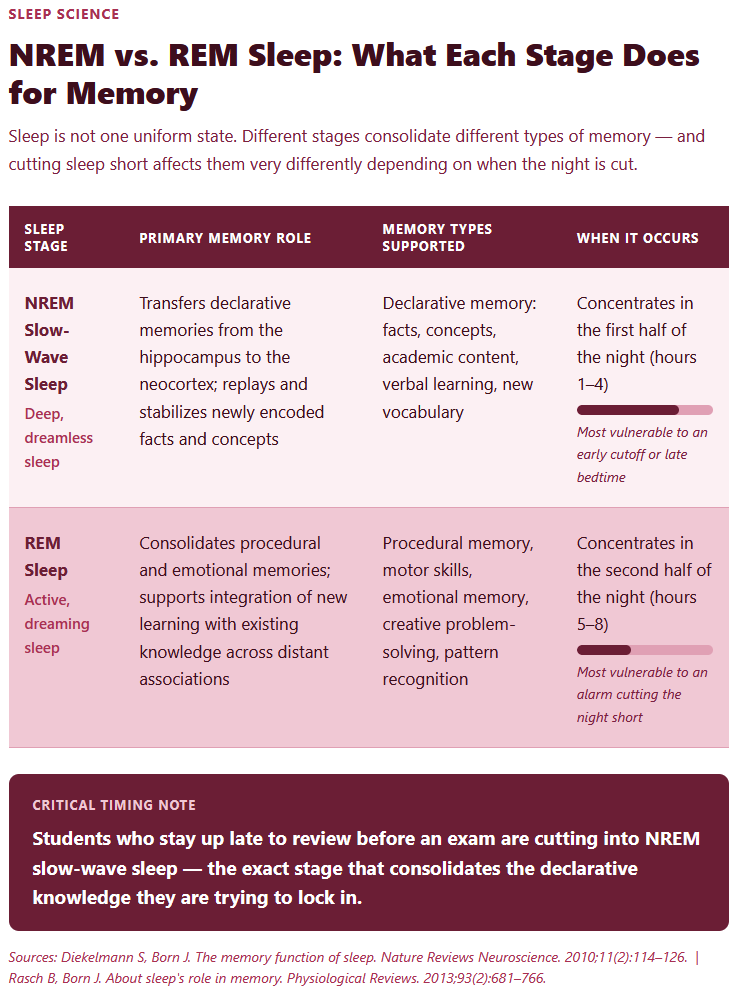
Susanne Diekelmann and Jan Born at the University of Tübingen laid out how this works in a major 2010 review in Nature Reviews Neuroscience: sleep is not a passive state. During Non-Rapid Eye Movement (NREM) slow-wave sleep, the brain replays recently acquired information and gradually transfers it from the hippocampus to the neocortex for permanent storage.
What Björn Rasch and Born’s 2013 review in Physiological Reviews added was specificity about timing. The reactivation that consolidates declarative memories (facts, concepts, the material most learners are actually studying) happens primarily during NREM slow-wave sleep, which concentrates in the early part of the night. Cut sleep short, and you lose disproportionately more of this window than the total hours lost would suggest.
The relationship between REM sleep and memory is real but different. REM appears more involved in procedural and emotional memory processing than in explicit learning. Students who sacrifice sleep for late-night reviewing are making a bad trade on both sides: they’re sacrificing rest and the primary consolidation window at once.
The Brain Keeps Connecting Dots After You Close the Book
After a learning session, the brain doesn’t only archive the new material in isolation. It begins building connections between new information and existing knowledge. This process, called memory integration, is one of the quieter benefits of the post-study window.
Dagmar Zeithamova and her colleagues at the University of Texas tracked what happened in participants’ brains after they learned sets of related information. Their 2012 fMRI study in Neuron found that the brain continued reorganizing and linking new material to existing knowledge long after the session ended.
The result was deeper, more flexible understanding. Participants could make accurate inferences about relationships between pieces of information they’d never seen paired together.
This is why sleep and rest after learning improve both recall and comprehension. A student who crammed and then slept poorly tends to struggle most with application questions, not recall questions. The facts made it in somewhere. The connections between them didn’t.

Why Cramming Always Fails
If the post-learning window is so important, cramming the night before an exam is among the worst possible study strategies. The research has been clear on this for decades.
A 2006 meta-analysis by Nicholas Cepeda and colleagues, published in Psychological Bulletin and drawing on 839 assessments across 317 experiments, found that spreading study sessions over days or weeks was consistently superior to massing everything into one block. The gaps between sessions aren’t wasted time. That’s when consolidation happens.
The explanation comes from Robert and Elizabeth Bjork at UCLA. Their work on desirable difficulties draws a distinction between storage strength (how deeply a memory is embedded in long-term networks) and retrieval strength (how easily you can access it right now).
Cramming temporarily raises retrieval strength, which is why material feels so accessible the night before an exam. It does very little for storage strength, which is why it’s mostly gone a week later.
Leaving gaps between sessions forces the brain to retrieve and rebuild the memory each time. The retrieval feels harder, and it is. That difficulty is the mechanism. Each effortful retrieval triggers reconsolidation, which is what actually deepens the memory and makes it more durable.
Protecting the Post-Study Window
The research on memory consolidation points to three habits that protect the window where the real work happens. None of them are complicated. All three work by giving the brain what it needs, rather than filling that window with interference.
Post-Study Consolidation Timer
10 minutes of quiet rest & your spaced review schedule
Your brain runs a critical memory replay in the first 10 minutes after you stop studying. Filling that window with any new input — phone, TV, music — disrupts the process before it can run.
Start the timer when you finish. Sit quietly. No screen. When it ends, you'll get a spaced review schedule timed to the research on distributed practice.
The Bigger Picture
Memory consolidation is an active biological process that unfolds over hours and nights after learning ends. The habits you build into that window either protect it or destroy it.
The good news is that the fixes are simple. A short rest. Spaced sessions. A good night’s sleep. None of this requires expensive tools or complex systems. It requires only knowing that the work your brain does after the session is just as important as the work you do during it.
Put the phone down. Let the concrete set.