You’ve spent three hours rereading the same chapter twice. You feel ready. Then the test arrives, and the answers just aren’t there.
That’s not a focus problem. It isn’t a memory problem. It’s a method problem, and it’s far more common than most students realize.
Most students rely on habits that feel productive but quietly waste their time. Re-reading is the single biggest offender, and the research on why is unusually consistent.
Why Re-Reading Feels Like It’s Working (And Isn’t)
The Fluency Trap
Re-reading creates a false sense of knowing. Each pass through the material makes the words feel more familiar, and your brain mistakes that familiarity for learning. Psychologists call this the fluency illusion.
Recognizing a concept when you see it written down is not the same as recalling it during a test, in a meeting, or on the job. Your brain stores information differently depending on how you engaged with it the first time.
Re-reading asks your brain to do something passive. It registers the text again. Recalling something from memory forces the brain to work, and that work is where learning actually happens.
The Evidence Gap
Henry Roediger and Jeffrey Karpicke wanted to know whether testing helps learning only because it gives students an extra chance to see the material again. In 2006, they ran an experiment designed to rule that out.
College students read prose passages, then either took a recall test on the material or restudied it the same number of times. The researchers measured retention five minutes, two days, and one week later.
At the five-minute mark, the students who restudied did better. That’s the trap. On the delayed tests, the pattern reversed sharply: the students who had been tested outperformed the ones who kept restudying, and the gap widened the longer the delay stretched.
The illusion is real. It doesn’t survive contact with time.
The Efficiency Angle
A 20-minute retrieval session can beat a 60-minute re-reading session for long-term retention, because retrieval forces active mental work that re-reading never asks for.
The Gold Standard: What Retrieval Practice Actually Is
Retrieval practice means shifting your focus from putting information in to pulling it back out. Instead of reading your notes again, you close them and try to recall what you just read. Instead of rereading a chapter, you take a practice quiz before you feel ready.
This approach goes by several names in the research: the testing effect, active recall, and retrieval-based learning. The term changes. The underlying principle doesn’t: making your brain work to remember something teaches it more than showing it the answer again.
Why the Struggle Is the Point
Cognitive scientists have a name for it: desirable difficulty. When you strain to recall something you half-remember, your brain treats the effort itself as a signal that the information matters and should be stored more durably.
This feels backward. When a study session feels difficult and messy, most students assume they’re doing something wrong, but that discomfort is the entire mechanism at work.
Long-Term Retention vs. Short-Term Comfort
A 2011 study published in Science took direct aim at one of the most trusted study methods in education: concept mapping. Jeffrey Karpicke and Janell Blunt had college students either build detailed concept maps while reviewing a text, or close the material and freely recall as much as they could.
A week later, the students who had practiced recall outperformed the concept-mappers by a wide margin, even on tests that asked them to build a concept map from memory. The students had also predicted the opposite outcome going in. They expected concept mapping to win.
That mismatch between what students expect to work and what actually works shows up again and again in this research.
5 Ways to Use Retrieval Practice (That Take Less Time Than Re-Reading)
These aren’t abstract concepts. Each one is a specific method you can use in your next study session.
1. The Blank Page Brain Dump
Close your book, close your notes, and write down everything you remember from what you just studied. Set a timer for five minutes. Don’t stop writing until it goes off.
What you remember is what you’ve actually learned. What you can’t remember is what needs more work. This single exercise reveals real gaps faster than any amount of highlighting.
After the five minutes, open your notes and check your answers. That feedback loop matters because the brain encodes information more strongly around moments of surprise or correction.
2. Flashcards Done Right
Flashcards work, but most people use them wrong. The common mistake is glancing at the front, feeling like you almost remember the answer, and flipping the card over to confirm. Researchers call this the illusion of competence: the material feels familiar, so it feels known, even though familiarity and recall are two different things.
The fix: look at the prompt, then say or write your full answer before flipping. If you get it wrong, put the card back in the deck immediately, and don’t retire it to the “done” pile until you’ve gotten it right across several separate sessions.
A 2017 meta-analysis by Olusola Adesope and colleagues reviewed effect sizes from 118 studies on practice testing and found consistent, medium-to-large benefits across student populations and age groups, including the kind of self-testing that flashcards support when used this way.
3. The Pre-Test Strategy
This one runs counter to instinct: test yourself before you’ve studied the material in depth. Attempting to retrieve information you don’t yet know primes your brain to pay closer attention when the right answer shows up.
Students who take a pre-test on new material, even when they score poorly, tend to retain more after studying than students who skip the pre-test entirely. The failure itself signals to the brain that this information is worth encoding. That benefit fades if too much time passes between the failed attempt and seeing the correct answer, so study the material soon after.
Before your next session, write five questions you expect the material to answer. Try answering them cold. Then study. Apps like Anki or Quizlet make this easy to build into a routine.
4. Concept Mapping from Memory
Draw a concept map, a diagram connecting key ideas, without looking at your notes. This is different from copying a map you’ve already seen.
Start with the central concept and branch outward with everything you can connect to it. Leave blanks where you’re unsure, then compare your map to your notes afterward and identify the gaps.
This method forces relational thinking instead of rote recall, since you’re reconstructing how ideas connect rather than remembering isolated facts.
5. The Teach-Back Method
The moment usually arrives about ninety seconds in. You’re explaining a concept out loud, confident, until you hit a point where the explanation stops making sense, even though you understood it five minutes ago when reading your notes.
That’s the Feynman Technique at work, named after physicist Richard Feynman, who argued that if you can’t explain something simply, you don’t understand it as well as you think. Pick a concept you just studied. Explain it out loud as if you’re teaching someone who knows nothing about it. An imaginary student works fine if nobody’s around.
Specific questions expose more than broad ones. “Why does photosynthesis require light?” forces sharper thinking than “Tell me about photosynthesis.” The more precise your explanation is, the more clearly the gaps in your understanding show up.
This works because explaining something requires you to sequence, simplify, and connect ideas in ways passive re-reading never demands.
The Efficiency Audit: What Retrieval Practice Costs You in Time
One common concern: doesn’t all this active effort take longer than just re-reading?
Not when you account for the full picture. Most research keeps total study time equal between groups to make fair comparisons, but what the data does show is that retrieval practice produces stronger initial retention, which means fewer review sessions are needed later.
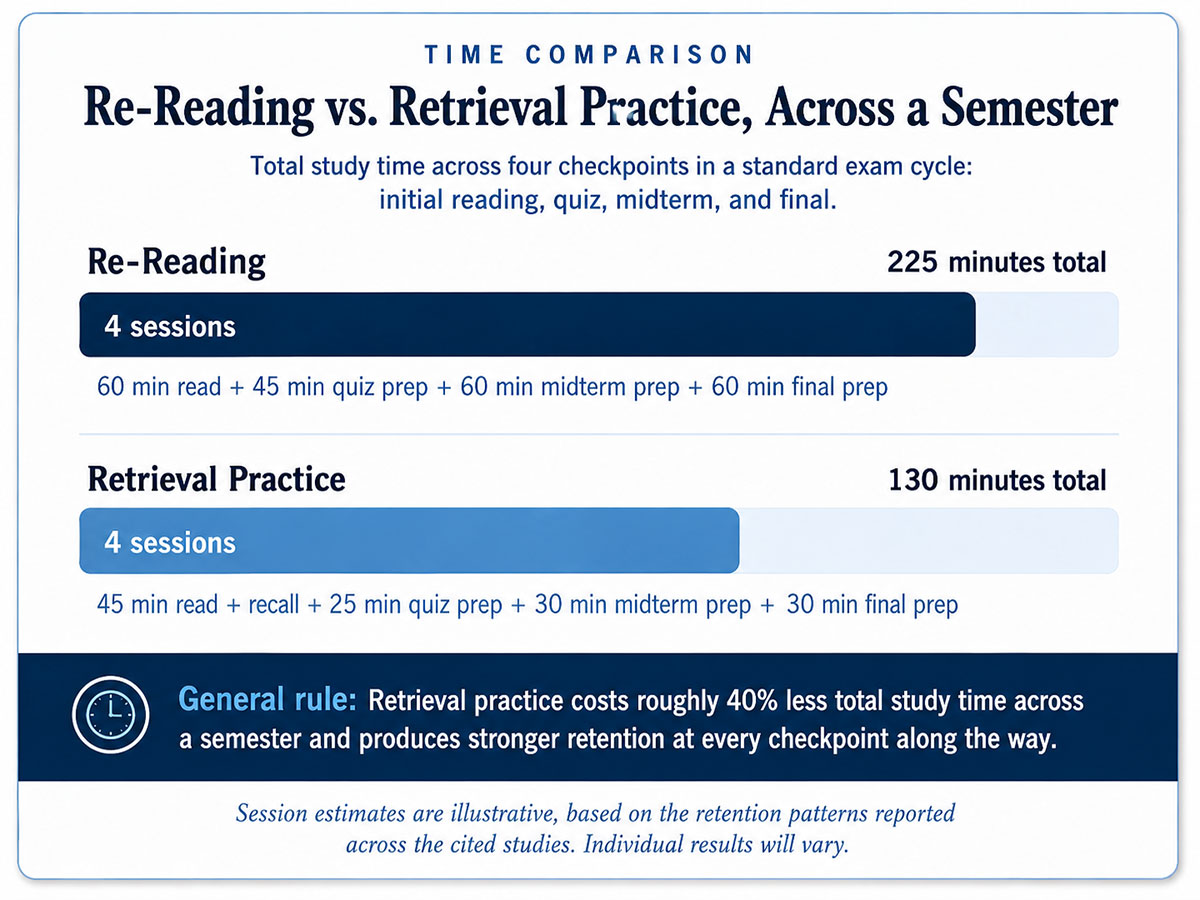
Across a standard exam cycle, a student relying on re-reading typically logs more total study time and still loses more of the material by the final. A student using retrieval practice spends less total time and retains more of it, because the initial encoding was deeper the first time around.
That gap only grows the longer the semester runs.
The “One and Done” Effect
When you retain information deeply after the first study cycle, you spend far less time relearning it later. Students using retrieval practice typically need 30 to 50% fewer review sessions to maintain the same level of retention as students relying on re-reading.
Re-reading requires constant repetition because the initial encoding stayed shallow. Retrieval practice builds a sturdier memory trace, which means shorter, less frequent sessions can maintain it over time.
Real-World Results
Henry Roediger, Pooja Agarwal, and their colleagues didn’t want to test this in a lab. They ran it in a real sixth-grade social studies classroom over a full semester, with low-stakes quizzes woven into normal lessons, no extra study time added anywhere.
By the end of the semester, students scored a full letter grade higher on quizzed material than on material that received the same amount of classroom instruction and review but no quizzing, 79% versus 67%. That’s not a lab environment. That’s a real classroom, real students, real exams, sustained across months.
Why It Works: What’s Happening in Your Brain
Retrieving a memory does more than access it: it modifies it. Pulling information out of storage and back into conscious awareness strengthens the neural pathway tied to that memory, making it more accessible and more durable the next time you need it.
Picture memory like a trail through a dense forest. The first walk-through is faint and hard to follow. Every time you find your own way back, rather than being led along a marked path, the trail strengthens the neural pathway a little more. Re-reading is being carried along someone else’s route. Retrieval practice means finding your own way through, every time.

Beyond Memorization: The Transfer Effect
Retrieval practice helps you apply what you studied to something new, not simply remember it, which is a harder and more valuable skill.
Mark McDaniel and colleagues tested this directly in middle-school science classrooms in 2013. Students who’d been quizzed on material outperformed their unquizzed peers on more than repeated questions. They also did better on questions that required applying the same concept to an unfamiliar problem.
That distinction matters for anyone studying law, medicine, or engineering, where exam questions and real-world problems rarely look exactly like the material in front of you.
The Science Says It Scales
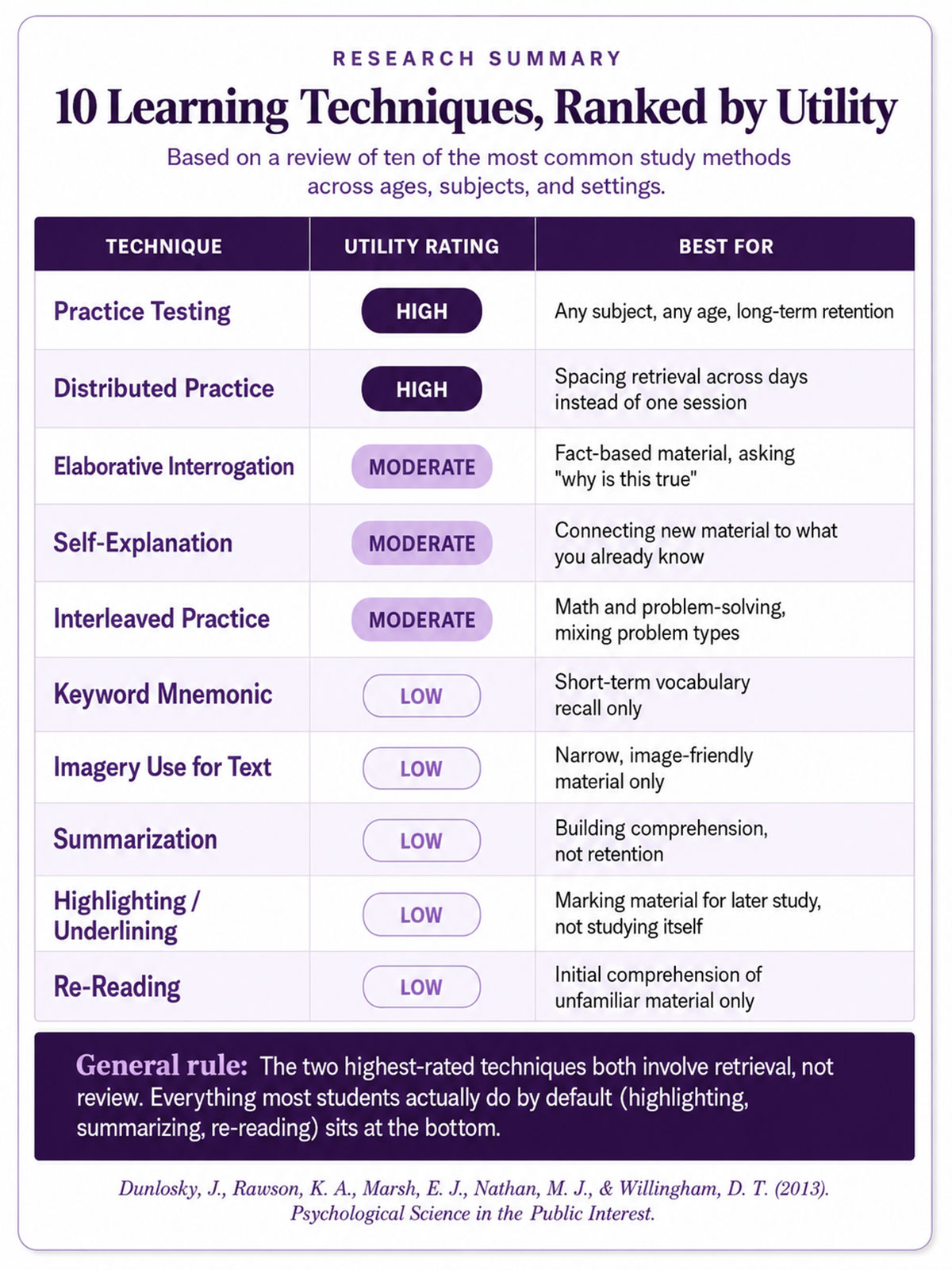
John Dunlosky and four colleagues set out in 2013 to answer a bigger question: of all the study techniques students actually use, which ones deserve the reputation they have? They reviewed the evidence behind ten of the most common learning techniques and sorted each one by how well its benefits held up across ages, subjects, and settings.
Only two techniques earned a high-utility rating: practice testing and distributed practice, meaning retrieval practice spaced out across multiple sessions rather than crammed into one sitting.
Elaborative interrogation, self-explanation, and interleaved practice landed in the middle and stayed there for a reason that’s less flattering to tidy rankings than it sounds: researchers still aren’t sure how to space interleaved practice optimally, so its real ceiling is still unmeasured. Highlighting, summarizing, and re-reading, the three techniques students reach for most, ranked at the bottom.
Distributed practice is the other half of that high-utility pair, and it folds easily into the five methods above. Instead of doing a single brain dump or flashcard session the night before an exam, spread the same retrieval attempts across several days.
Two 15-minute recall sessions three days apart beat one 30-minute session the night before, because your brain has to work slightly harder to retrieve information it’s started to forget. That extra effort is the same desirable difficulty driving retrieval practice itself.
A more recent review confirms how consistent this pattern is outside the lab. In 2021, Pooja Agarwal returned to this question with a systematic review of retrieval practice research conducted specifically in real schools and classrooms. Screening nearly 2,000 studies down to the 50 that met strict criteria, her team found that most showed medium or large benefits from retrieval practice, across grade levels, subjects, and testing formats.
This isn’t a handful of clever lab studies. It’s fifteen years of evidence, across multiple countries, that keep replicating in the messiest, most realistic setting there is: an actual classroom.
Breaking the Habit: A 7-Day Transition Plan
Changing a study habit takes intention, not willpower. Here’s a simple plan to shift from passive to active learning over one week.
Days 1-2: Identify Your Current Habits
Track your study sessions for two days. Write down exactly what you do: reading, highlighting, rereading, watching videos, reviewing notes. Be honest. Most students discover they spend 70 to 80% of their study time in passive mode.
This isn’t about guilt so much as clarity, since you can’t change a habit you haven’t actually seen.
Days 3-5: Add One Retrieval Block Per Session
Don’t overhaul everything at once. Add a single retrieval session to each existing study block. After reading a section, close the material and do a five-minute brain dump, or swap one rereading session for a self-quiz on notes you’ve already reviewed.
The goal is exposure to a new habit, not perfection. Your brain needs practice with retrieval the same way it needs practice with anything else.
Days 6-7: Measure the Difference
On day 6, review your material and take a self-quiz without looking at notes. Score yourself, then compare that to how much you’d typically recall after passive study alone.
On day 7, reflect on what felt harder than expected and where the gaps showed up. That reflection step matters because it turns the week into learning about your own learning, not only learning the material.
A Realistic Heads-Up
The first week or two of retrieval practice often feels less productive than re-reading, even though the underlying research is clear that it pays off. If early attempts feel awkward, that’s not a sign you’re doing it wrong. This is a new skill for your brain, and new skills take practice before they feel natural. Most students find the method starts to click within two or three weeks.
Everyone’s brain settles into this differently, too. Some people find the brain dump most useful. Others click with flashcards or teach-back. Try all five methods and stick with whichever ones you’ll actually use consistently.
Retrieval Practice Study Planner
Turn the research into a schedule you can actually follow
Each session rotates through one of the five retrieval methods from the article above, spaced further apart as your exam gets closer.
Less than two days doesn't leave room for spacing. Use tonight for one focused brain dump session instead of a full re-read, then a short flashcard recall pass right before the exam.
Why the gaps get shorter as the exam nears: Spacing sessions further apart early on forces harder recall, which is the desirable difficulty driving retrieval practice. Sessions tighten up near the exam date so the last pass stays fresh.
What If Re-Reading Actually Works for You?
Some readers will push back here. “I’ve always learned by re-reading, and my grades are fine.” That’s worth taking seriously rather than dismissing.
Most people who feel this way are experiencing the fluency illusion described earlier. The material feels more familiar after each pass, so it feels more learned. Test yourself honestly, without notes, a week after studying, and retention is usually lower than expected. Feeling like you know something and actually knowing it are not the same thing.
That said, re-reading isn’t worthless. It’s genuinely useful for initial comprehension of dense or unfamiliar material. If a concept is new enough that you don’t yet grasp the basic idea, re-reading helps build that foundation first. The research suggests a clear sequence: read once for comprehension, then switch to retrieval practice for retention. Don’t skip the reading phase. Just don’t stop there.
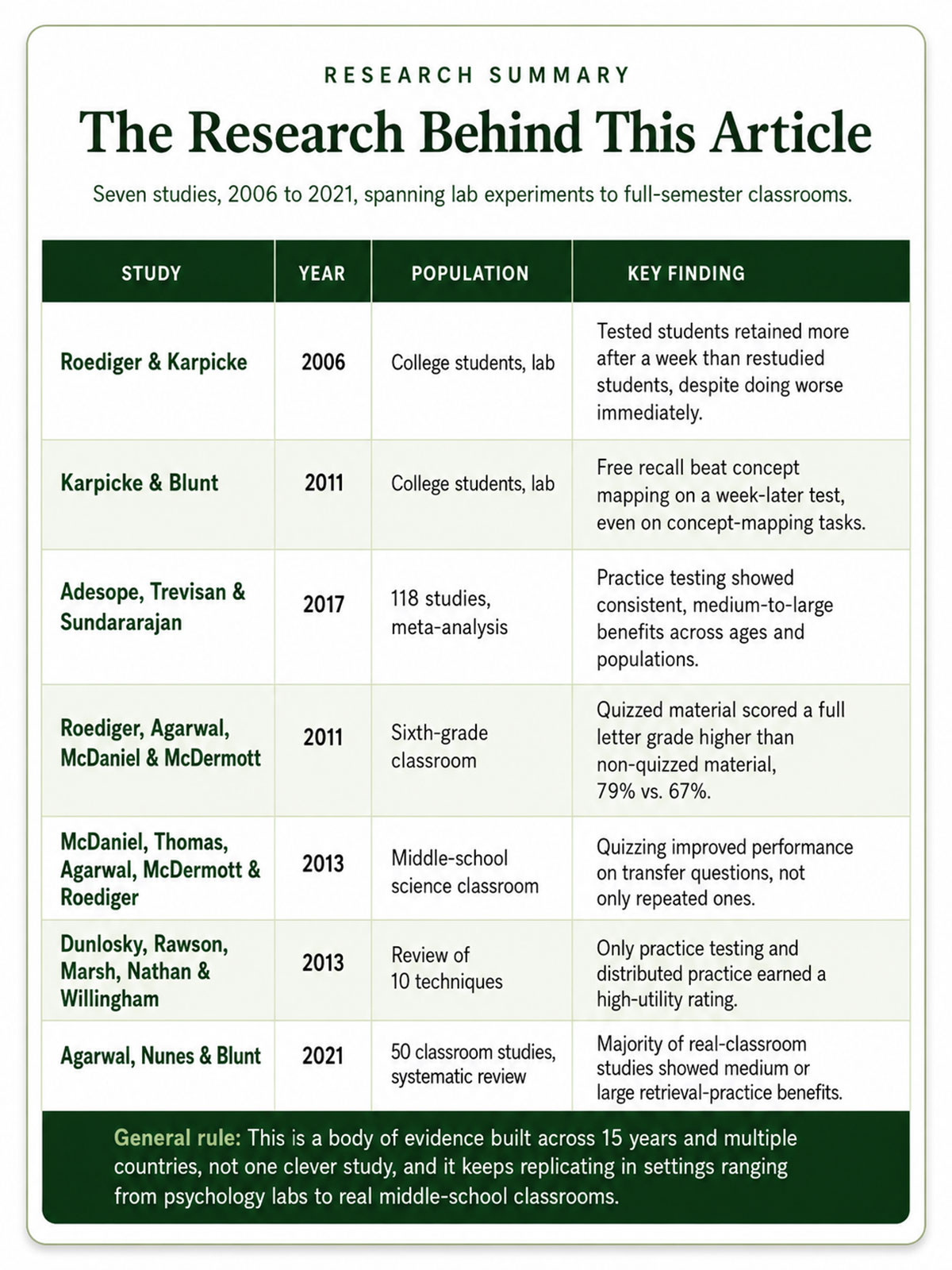
The Research at a Glance
Seven studies, spanning 2006 to 2021, sit behind the claims in this article. Here’s the full picture in one place, including the population each study tested and what it actually found.
Work Smarter, Not Harder
Re-reading feels safe. It’s familiar and low-effort, which is exactly why it’s so popular, and exactly why it underperforms.
Retrieval practice asks for more: effort, tolerance for being wrong before you’re right, willingness to sit with not-quite-knowing. That difficulty is the method, not a side effect of it.
The research behind this spans decades, thousands of students, and every level of education from middle school through graduate study. Few findings in cognitive psychology have replicated this consistently: making your brain retrieve information strengthens it more than simply showing it the same information again.
You don’t need more study hours. You need different ones. Start with a single brain dump tonight and see what you actually remember.
FAQs
What Are 5 Learning Strategies Backed by Research?
The five methods covered above, all built on retrieval rather than review: the blank page brain dump, flashcards used with full-answer recall before flipping, pre-testing before you’ve studied the material, concept mapping from memory, and the teach-back method. Each one forces retrieval instead of rereading, which is the mechanism that makes the difference.
What Are Examples of Effective Learning Techniques?
Practice testing and distributed practice are the two techniques with the strongest research backing, according to Dunlosky’s 2013 review of ten common methods. The table above shows how the full list breaks down, including popular techniques, like highlighting and summarizing, that perform worse than most students assume.