Everyone has a moment of self-doubt. For some people, that doubt fades by bedtime. For others, it’s still running at 3:00 AM, louder than ever.
What separates these two groups isn’t willpower. It isn’t confidence, either. The real gap lies in something most people have never heard of, and something that almost no mainstream advice addresses.
Popular self-help tells you to “think positive.” Research says that backfires. When you force a positive thought on top of genuine doubt, your brain notices the conflict. It flags it as unresolved. The loop starts again.
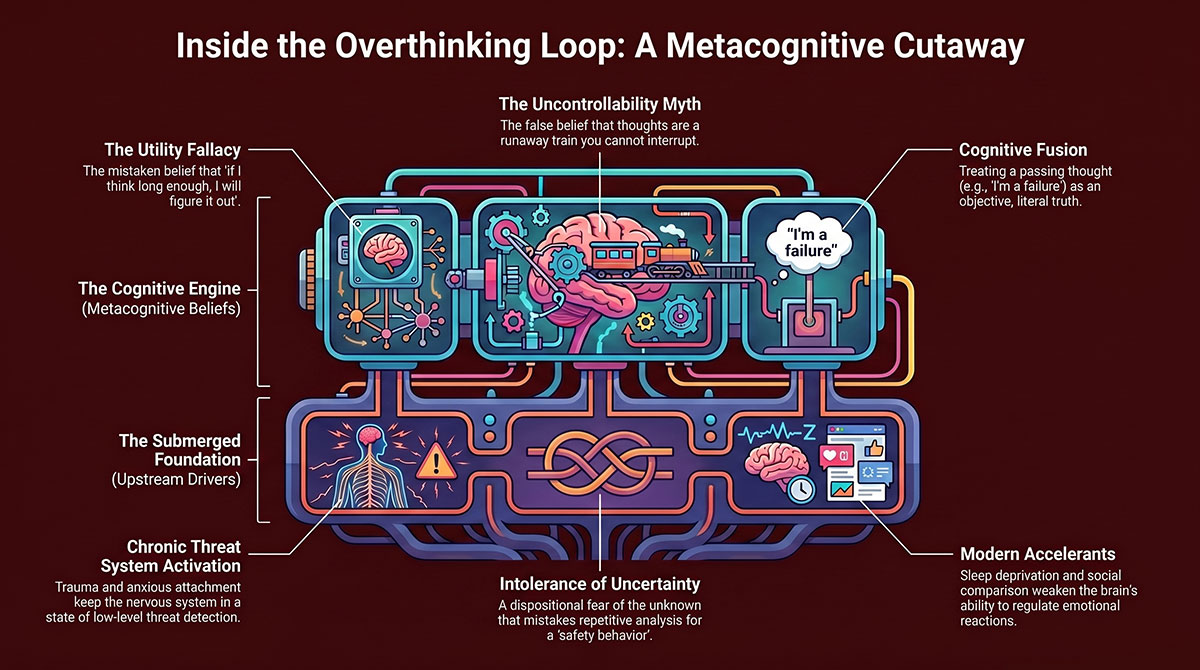
The real driver isn’t the doubt itself. It’s what you believe the doubt means, and what you believe overthinking will do about it. Psychologists call these Metacognitive Beliefs, and they’re the one factor almost no one is talking about.
The One Thing Mainstream Advice Misses: Metacognitive Beliefs
Psychologist Adrian Wells spent decades studying why some people can’t stop ruminating. His work at the University of Manchester led to a framework called Metacognitive Therapy, built around a concept called the Cognitive Attentional Syndrome (CAS).
The CAS describes a specific mental pattern: repeated negative thinking, unhelpful coping strategies, and a set of underlying beliefs about your own thoughts. Wells and colleagues, writing in a 2020 editorial in Frontiers in Psychology, identified these underlying beliefs as the real engine of the loop.
Here’s what that means in plain terms: you don’t just have doubts. You have beliefs about your doubts. Two of these beliefs are especially damaging.
The first is that overthinking is useful. “If I think about this long enough, I’ll figure it out.” The second is that overthinking is uncontrollable. “I can’t help it. My brain just does this.”
Both beliefs are wrong. Both beliefs keep the loop going.
When your brain believes that rumination is solving the problem, it won’t stop. It’s doing its job, as far as it’s concerned. And when it believes the process is uncontrollable, you stop trying to interrupt it. You become a passenger.
This is why telling yourself to “just stop overthinking” never works. You haven’t changed the belief driving the behavior.
Why Your Brain Gets Stuck: The Seven Upstream Drivers
The metacognitive framework tells us how the loop runs. But to understand why so many people are caught in it, we need to look further back. There are seven key factors that set the stage for chronic self-doubt and overthinking, and most of them start long before adulthood.
1. Anxious Attachment and the Hypervigilant Brain
Some brains are wired to scan for danger in relationships. This wiring often comes from early experiences of inconsistent caregiving, where love or approval felt unpredictable.
Attachment theory, developed by John Bowlby and expanded by decades of subsequent research, describes anxious attachment as a style where the nervous system stays on alert. It monitors relationships for signs of rejection, disapproval, or abandonment, even when none exist.
In adult life, this shows up as overthinking after social interactions. Did I say the wrong thing? Does she seem cold today? Why hasn’t he replied? The doubt isn’t irrational from the brain’s perspective. It’s a “safety behavior” designed to prevent the pain of rejection. The problem is that safety behaviors require constant mental energy. The scanning never stops.
2. Unresolved Trauma and a Permanently Activated Threat System
The nervous system is built for survival. When something dangerous happens and the threat passes, the system is supposed to return to a calm state. In people with unresolved trauma, it doesn’t fully reset.
Polyvagal Theory, developed by neuroscientist Stephen Porges, describes how chronic trauma keeps the autonomic nervous system in a state of low-level threat detection. The body stays ready for danger even in safe environments.
What does this have to do with overthinking? Everything. When the nervous system is already running hot, ambiguity reads as a threat. A vague text message. A manager’s closed door. Silence after a question. These become signals of danger, and the brain responds by trying to “solve” the threat through analysis. The more uncertain the situation, the harder the brain thinks. It mistakes overthinking for protection.
3. The Need for Control and the Paralysis of “Not Knowing”
Some people have a very low tolerance for uncertainty. Research found that intolerance of uncertainty (IU) is a broad risk factor across anxiety disorders. Carleton described it as a dispositional fear of the unknown: a deep discomfort with any situation that lacks a clear answer.
Self-doubt is, at its core, a form of uncertainty. “Am I good enough?” has no clean, final answer. For someone with high IU, that open-endedness is unbearable. The brain responds by searching for certainty through repeated analysis.
Rumination doesn’t generate solutions. Instead, it focuses the mind on the symptoms of distress rather than their resolution. People who ruminate in response to negative mood are more likely to develop depressive episodes over time. The brain searches for certainty and finds more doubt instead.
The control-seeker enters a loop: uncertainty triggers analysis, analysis deepens distress, distress produces more uncertainty.
4. Perfectionism and the Fear of Being “Found Out”
In 1978, psychologists Pauline Rose Clance and Suzanne Imes published a paper in Psychotherapy: Theory, Research and Practice that named an experience many high-achievers recognized immediately. They called it the Impostor Phenomenon.
Their research described people who, despite clear evidence of their competence, believed they were intellectual frauds waiting to be exposed. Success didn’t reduce this fear. It increased it, because more success meant more to lose.
Clance later detailed the Impostor Cycle: a new task arrives, anxiety spikes, the person either over-prepares obsessively or procrastinates to the last minute, succeeds anyway, and then attributes the success to luck rather than ability. The cycle repeats with the next challenge.
Overthinking is the engine of over-preparation. It masquerades as diligence. In reality, it’s fear-driven hypervigilance, burning cognitive resources on scenarios that never arrive.
5. People-Pleasing and the Collapse of Inner Certainty
People-pleasers carry an invisible burden: they must constantly track the emotional states of everyone around them. Is she upset with me? Did I disappoint him? Will they think less of me if I say no?
This constant social monitoring is exhausting for the brain. Think of it like an app running in the background of your phone: you’re not actively using it, but it’s draining the battery all the same. Cognitive Load Theory, originally developed by educational psychologist John Sweller, explains why: working memory has a limited capacity. When it’s consumed by tracking other people’s potential reactions, there’s very little left for clear, confident decision-making.
The result is chronic second-guessing. People-pleasers often find it nearly impossible to trust their own judgment, not because they lack intelligence, but because the cognitive system is overloaded. Every decision runs through an extra filter: “But what will they think?” That filter slows everything down and amplifies self-doubt.
6. Fusing With the Doubt: When Thoughts Feel Like Truth
Psychologist Steven Hayes developed Acceptance and Commitment Therapy (ACT) in the late 1980s and 1990s, building on decades of behavioral and cognitive science. One of ACT’s central concepts is cognitive fusion: the tendency to get so entangled with a thought that you treat it as literal reality.
For chronic overthinkers, cognitive fusion means that “I’m not good enough” doesn’t feel like a passing thought. It feels like a fact. The doubt is no longer something you’re having. It’s something you are.
Hayes also identified what he called the “literalization of thought,” a process where mental events are treated as direct descriptions of reality. This is why you can’t simply decide to stop overthinking. You’re not dealing with a thought you can dismiss. You’re dealing with what feels, at a gut level, like truth.
Low distress tolerance makes this worse. When uncomfortable emotions feel truly unbearable, and not just unpleasant, the brain will do anything to reduce them. Overthinking becomes a coping tool, a way to stay busy so the raw feeling of doubt never has to be fully felt.
7. The Physical and Digital Accelerants
Two modern factors pour fuel on an already burning fire: sleep deprivation and social media use.
The prefrontal cortex is the brain’s regulator. It helps dampen the amygdala’s fear response and brings rational perspective to emotional reactions. Chronic sleep deprivation physically weakens this regulation. A tired prefrontal cortex can’t hold the amygdala in check, so doubt triggers stronger fear reactions, and the loop spins faster.
Then there’s social media. A landmark study by Ethan Kross and colleagues, published in PLOS One in 2013, tracked 82 young adults over two weeks using experience-sampling. Participants were texted five times daily to report their mood. The researchers found that Facebook use predicted declines in both moment-to-moment wellbeing and overall life satisfaction, with heavier use directly linked to worse scores at the next check-in.
The mechanism is social comparison. Seeing carefully curated “perfect” lives online creates a gap between what you see and what you feel about yourself. Your brain tries to resolve that gap. It can’t. So it ruminates, looking for an answer to a question that has no answer on social media: “Why isn’t my life like that?”
Sleep deprivation plus passive scrolling is a particularly damaging combination for anyone already prone to self-doubt. One lowers the brain’s defenses. The other supplies an endless stream of comparison material.
Breaking the Loop: Three Evidence-Based Steps
Understanding the roots of the cycle is powerful, but the goal is to interrupt it. Here are three approaches backed by solid research.
Step 1: Defuse From the Thought
The first step is to stop treating the doubt as a fact. ACT calls this defusion: creating distance between yourself and your thoughts so you can observe them without being driven by them.
In practice, this looks simple but feels different from anything you’ve tried before. Instead of thinking “I’m not good enough,” you say internally: “I’m having the thought that I’m not good enough.” That small shift does something concrete. It moves the thought from the foreground to the background. You’re no longer inside it. You’re watching it.
Hayes’ research shows that defusion reduces the behavioral impact of difficult thoughts without requiring you to change or suppress them. You don’t have to believe a better thought. You just have to stop treating the doubtful one as gospel.
Step 2: Use Self-Compassion as a Circuit Breaker
Kristin Neff’s work, formalized in a 2003 paper in Self and Identity and built on by decades of follow-up research, defines self-compassion as three interlocking components: self-kindness instead of harsh self-judgment, a sense of common humanity instead of isolation, and mindfulness instead of over-identification with painful feelings.
What’s clinically relevant here isn’t just the emotional feel of self-compassion. It’s the neurological effect. Research drawing on social mentality theory shows that self-criticism activates the threat system, the same biological circuitry that handles real external danger. When you berate yourself for doubting, you’re adding a threat response on top of an already dysregulated nervous system.
Self-compassion, by contrast, activates what researchers describe as the self-soothing system, linked to feelings of safety and secure connection. It acts as a neurological brake on the threat loop. You’re not bypassing the doubt. You’re stopping the critical second layer that turns doubt into a full spiral.
This matters because most overthinkers double down on self-criticism when they notice themselves ruminating. “Why can’t I just stop this? What’s wrong with me?” Every harsh question adds another loop.
Step 3: Take One Small Action to Rebuild the Feedback Loop
Albert Bandura’s 1997 book Self-Efficacy: The Exercise of Control laid out decades of research on how people develop belief in their own abilities. His central finding: self-efficacy grows from what he called “enactive mastery,” which means actually doing things and succeeding at them, even at a small scale.
When self-doubt is high, the brain gets locked in what Bandura described as negative future thinking: an anticipatory over-analysis of all the ways things could go wrong. This isn’t useful planning. It’s a form of paralysis dressed up as preparation.
The antidote is not to feel more confident before acting. It’s to act, and let the evidence accumulate. Confidence is not the absence of doubt. It’s the collection of small, undeniable proofs that you are capable.
One completed action, even a minor one, creates a data point that contradicts the doubt narrative. Over time, those data points outweigh the stories the doubtful brain tells. The loop doesn’t get broken by a single insight. It gets worn down by consistent, small evidence that you can handle things.
What This All Means
Overthinking isn’t a character flaw. It’s a miscalibrated protection system, built from early wiring, nervous system responses, and deeply held beliefs about what it means to think and feel the way you do.
The reason mainstream advice fails is that it treats the surface behavior without touching the underlying structure. Journaling and positive affirmations can be useful tools, but they don’t address metacognitive beliefs, attachment patterns, or the threat system.
What works is going upstream. Changing what you believe about your thoughts, not just the content of those thoughts. Learning to defuse from doubt instead of fighting it. Treating yourself with the same basic kindness you’d offer a friend who was struggling. And taking one small step forward, even when the brain insists it needs more certainty first.
The loop can be interrupted. Not through force, but through understanding what it actually is.