You read the chapter twice. You highlighted. You even took notes. And then, in the middle of a conversation, someone asked you to explain what you’d learned, and you froze. The words that came out were vague, circular, and not quite right.
And you knew it. That sensation is not a sign of poor memory. It is a sign that recognition had been mistaken for understanding, which is one of the most common failures in how people learn.
The Feynman Technique is designed to surface exactly that gap, and to close it. It does this through a process that sounds almost too simple to work: explain what you’re learning in plain language, notice where the explanation breaks down, and go back to the source until it holds together. The research behind why it works is more interesting than most articles on this technique let on.
It is also more honest than the quote that usually introduces it. For years, writers and teachers have opened Feynman explainers with some version of “If you can’t explain it simply, you don’t understand it well enough,” attributed to Albert Einstein. Quotation researchers have traced it carefully.
Einstein never said it. Neither, in any verified source, did Feynman. The quote is almost certainly fabricated, attached to famous names through what researchers call Churchillian Drift, the tendency of compelling sentiments to migrate toward the most credible available name. The irony of launching a technique about intellectual honesty with a misattributed quote seems worth naming.
What the Science Behind It Actually Says
Here is the claim most articles about the Feynman Technique make without saying it directly: the technique was scientifically validated. It was not, at least not as a named, bundled, four-step protocol. No peer-reviewed study has tested the Feynman Technique as a unit against a control group and found it superior.
What has been extensively tested are the cognitive mechanisms the technique relies on. And those mechanisms are well-supported.
The central one is self-explanation, the act of generating your own account of how something works, in your own words, rather than receiving someone else’s account and recognising it as correct.
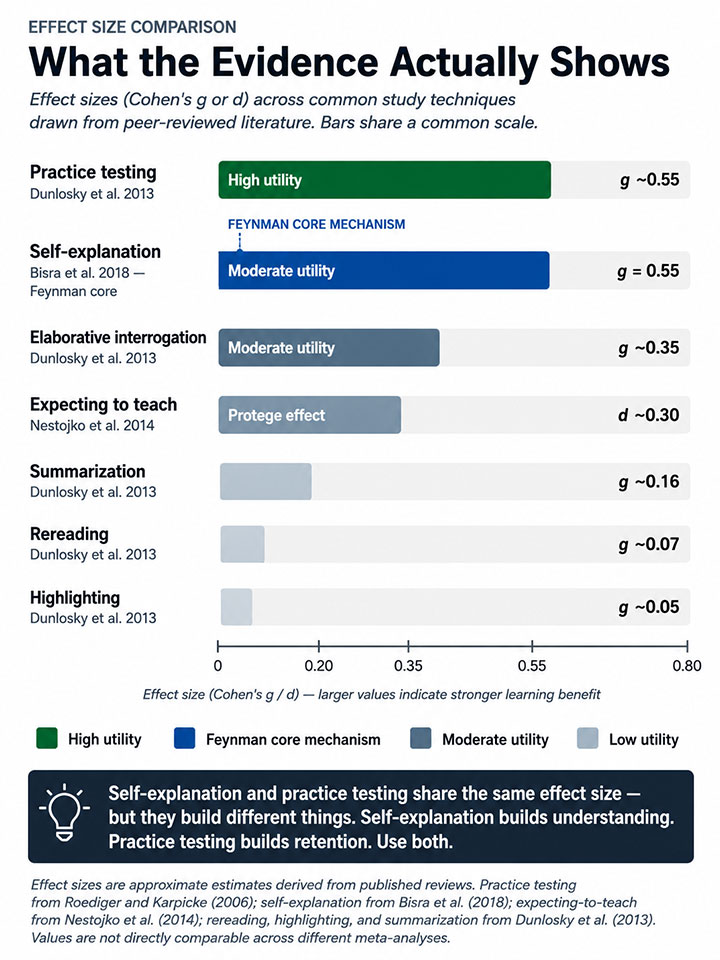
A 2018 meta-analysis led by Kiran Bisra at Simon Fraser University reviewed 64 research reports covering nearly 6,000 participants and found that self-explanation prompts improved learning outcomes with a weighted mean effect size of g = 0.55. In practical terms, that is a moderate-to-large benefit: roughly the difference between a student who plateaus and one who makes meaningful, measurable progress.
The Bisra meta-analysis, published in Educational Psychology Review, also found the effect generalised across school subjects and across both conceptual and procedural knowledge.
A second mechanism is what researchers call the protégé effect, the cognitive shift that occurs when you frame your learning as preparation for teaching someone else. In two experiments published in Memory and Cognition in 2014,
John Nestojko and colleagues at Washington University in St. Louis found that participants who expected to teach material afterward recalled it more completely, organised it more effectively, and retained key points better than participants who studied the same material expecting only a test. No actual teaching happened, yet the expectation alone changed how they encoded the information.
One caveat matters here, and most articles skip it. Later work by Logan Fiorella and Richard Mayer found that simply expecting to teach, without actually generating an explanation, did not reliably produce durable learning gains on delayed tests.
The act of producing the explanation, ideally from memory without notes open, is what drives the effect. The strongest learning gains appeared not immediately after the session, but one week later. That finding has a direct implication for how you use this technique, which the step-by-step section below addresses.
A third mechanism is the generation effect, a long-established finding in cognitive science showing that producing information from memory strengthens encoding more than re-reading the same information passively.
Michelene Chi at Arizona State University spent decades documenting exactly what that production looks like in practice: learners who constructed their own explanations of physics problems not only outperformed passive re-readers but made qualitatively different errors, ones that revealed genuine conceptual confusion rather than simple forgetting.
The Feynman Technique exploits this by adding a specific constraint: explain it simply. Translating jargon into plain language forces a deeper manipulation of the underlying idea than restating it in technical terms would. The simpler the language you demand of yourself, the more cognitive work the translation requires.
Does the Feynman Technique Work?
With those mechanisms in view, the honest answer is probably yes, but the reason it works is not the four-step framing. The framing is a delivery system for three strategies that each carry independent evidence: self-explanation (g = 0.55 across 64 studies), retrieval practice, and gap detection through attempted output.
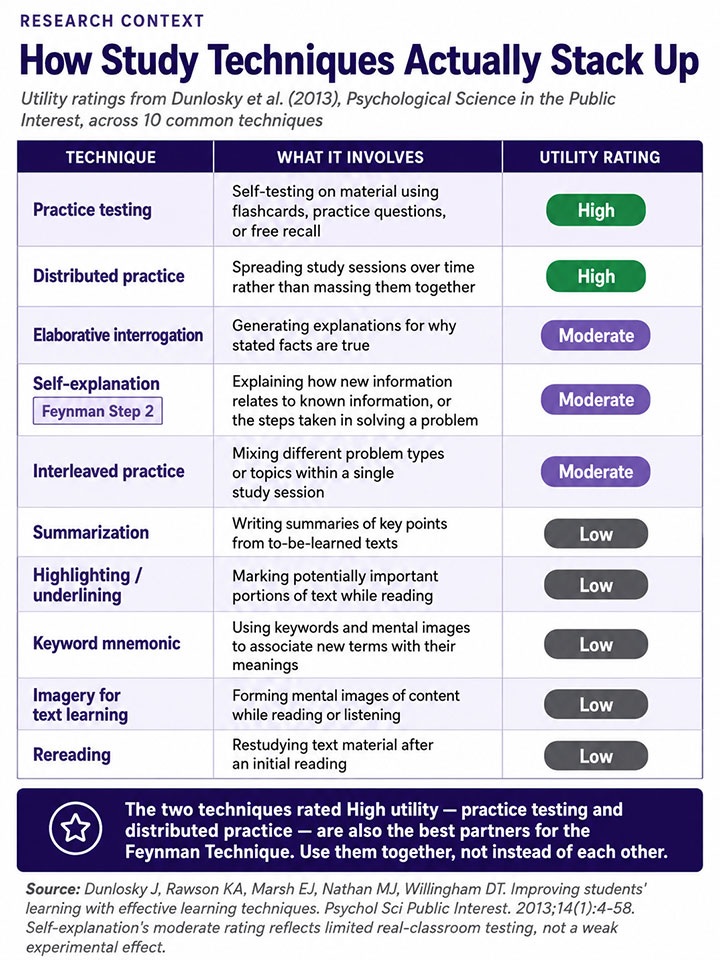
John Dunlosky at Kent State University led a landmark review of ten common study techniques in Psychological Science in the Public Interest in 2013. The review rated each technique on a utility scale. Rereading and highlighting both received low utility ratings.
Self-explanation received a moderate utility rating, not high, as it is often characterised. Dunlosky’s team was precise about why: the effect was real and consistent across studies, but it had not yet been adequately tested in naturalistic classroom settings at scale, which is a different thing from the effect not being real.
Practice testing and distributed (spaced) practice were the only two techniques rated as high utility, which is one reason combining the Feynman Technique with spaced review sessions is more effective than using it once and moving on.
The technique works because self-explanation works and retrieval practice works. The four-step structure is a scaffold for making those things happen, not a magic property of the method itself.
How to Use the Feynman Technique
The steps are simple. The execution is where most people stumble, specifically at Step 3, which almost every guide treats as obvious when it is anything but.
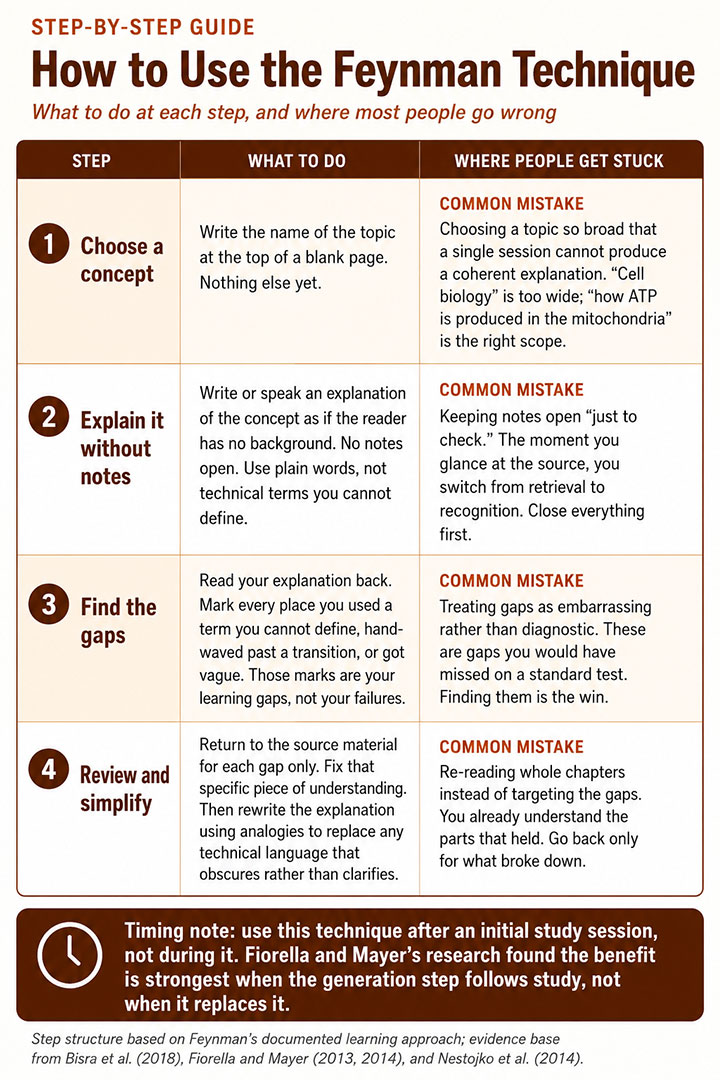
One practical note on timing: use this technique after an initial study session, not during. Fiorella and Mayer’s research found the benefit is strongest when the generation step follows study, not when it replaces it. A five-minute Feynman explanation at the end of a reading session is more effective than stopping to explain every paragraph as you go.
A Worked Example: Compound Interest
The most useful thing about a worked example is not the final clean explanation but where the first attempt breaks down.
First attempt (with jargon intact): “Compound interest is when interest is calculated on both the principal and the accumulated interest from previous periods, resulting in exponential growth of the principal over time.”
Two problems surface immediately. “Accumulated interest from previous periods” is a circular definition: it uses the word being explained. And “exponential growth” will lose any reader who has not already studied the topic. Those are the gaps.
Revised explanation (after going back to the source): “Imagine you put $1,000 in a savings account. After one year, the bank pays you $50 in interest, so now you have $1,050. In year two, the bank pays interest on the whole $1,050, not just on your original $1,000.
You earn a little more than $50 this time. And next year, the interest is calculated on that slightly larger amount again. Each year, the base the interest is calculated on gets bigger, which means each year you earn slightly more than the year before. Over decades, that small annual difference becomes a very large one.”
The second version has no financial jargon. A twelve-year-old would follow it, and if you can reach that standard, you understand the concept well enough to use it, not just well enough to recognise it on a multiple-choice test. Those are different things, and the gap between them is exactly what the first attempt reveals.
When the Feynman Technique Works Best (and When It Doesn’t)
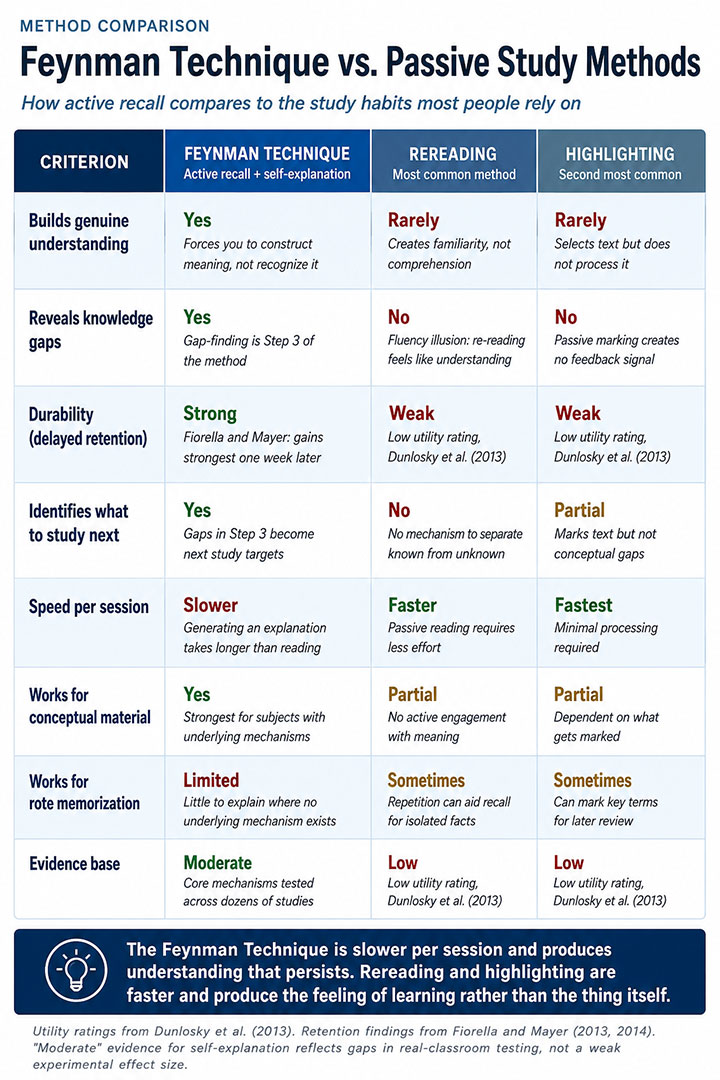
The technique is strongest with conceptual material, subjects where the question is “why does this work?” or “how does this connect to that?” Science, economics, mathematics at the conceptual level, philosophy, and complex workplace frameworks are all well-suited to it.
It is weaker for pure memorisation tasks: vocabulary in a foreign language, historical dates, specific names and places. For those, spaced repetition with flashcards is more time-efficient. The Feynman Technique asks you to understand the underlying mechanism. Where no such mechanism exists, where the only thing to learn is the arbitrary label, there is nothing to explain simply.
The other limitation is time, and it hits harder than most guides admit. Generating a full explanation from memory, identifying the gaps, and rewriting the explanation takes considerably longer than rereading a chapter.
Research on self-explanation consistently finds that the method is slower than passive review during the learning session. If you have tried the technique, stalled halfway through the explanation, felt the impulse to just open the book again “to check one thing,” and then quietly read the rest of the chapter instead, that is not a discipline failure.
That is the method working correctly and feeling uncomfortable. The discomfort is the signal that you found a gap. The question is whether you go back to close it or let the book close it for you.

How to Use It With Other Techniques
Most people who use the Feynman Technique use it once, file the explanation, and move on. That is enough to understand the material today. It is rarely enough to remember it in three weeks. What the technique cannot do on its own is force the spaced repetitions that make a memory durable, and that gap is where most “I understood it perfectly at the time” failures come from.
Spaced repetition picks up where the technique leaves off. Use the Feynman explanation you wrote as the material for retrieval practice sessions at increasing intervals (one day, three days, one week, two weeks). You are no longer re-reading. You are testing yourself against your own understanding, which is a more demanding and more effective use of the same material.
Practice testing, rated the highest-utility study technique in Dunlosky’s 2013 review, pairs naturally with the gap-identification step. After running the Feynman process once, the gaps you flagged become the basis for your practice questions.
Rather than generating test questions from the textbook, you are generating them from your own failure points, which is a more precise targeting of what actually needs more work.
What Feynman Actually Said About Learning
Richard Feynman did leave behind a coherent learning philosophy, though it is messier and more interesting than a single quotation makes it sound. He wrote extensively about the difference between knowing the name of something and understanding it, his famous example being the distinction between knowing a bird is called a brown-throated thrush and knowing what the bird actually does, how it migrates, how it finds food, what its songs mean. The name, he argued, teaches you nothing about the bird.
He also kept a list of twelve open problems, questions in physics he returned to throughout his career, testing every new technique or finding against them to see if it moved any of them forward. The list was not a to-do list but a standing interrogation: does this new thing I just learned change anything I already thought I knew?
That habit is considerably more demanding than the four-step technique, and considerably more honest about what deep learning requires. The four steps tell you how to understand one concept. The twelve problems ask you to hold a dozen open questions simultaneously and treat every new piece of knowledge as a potential answer, or a challenge, to at least one of them.
The technique named after him is a useful approximation. Feynman’s actual approach to learning was more radical: he questioned every received explanation, including his own, until it either held up under examination or he found a better one.
That habit (treating your own understanding as a hypothesis rather than a conclusion) is the part of the Feynman Technique that survives in the paperback version, if you are paying attention to the right step.