Your cholesterol report gives you a number, but it may leave out an important detail. Penn State researchers looked deeper and found something unexpected.
Most people already know avocados are “heart-healthy.” Fewer know which part of their cholesterol profile actually changes, how long it takes, or why the most significant finding from the most carefully designed trial on the subject is almost never reported. The number your doctor reads off the lab report is not the whole story.
What changes with daily avocado consumption is not just how much LDL you have. The more meaningful shift is in the type of LDL you are carrying, and that distinction has a direct bearing on cardiovascular risk in ways that a standard lipid panel will not show you.
The Study That Reframed the Question
In January 2015, a team at Penn State published results that represented years of research. Penny Kris-Etherton, a Distinguished Professor of Nutrition at Penn State and one of the field’s more careful researchers, led a randomized crossover trial with 45 overweight or obese adults who all had moderately elevated LDL cholesterol.
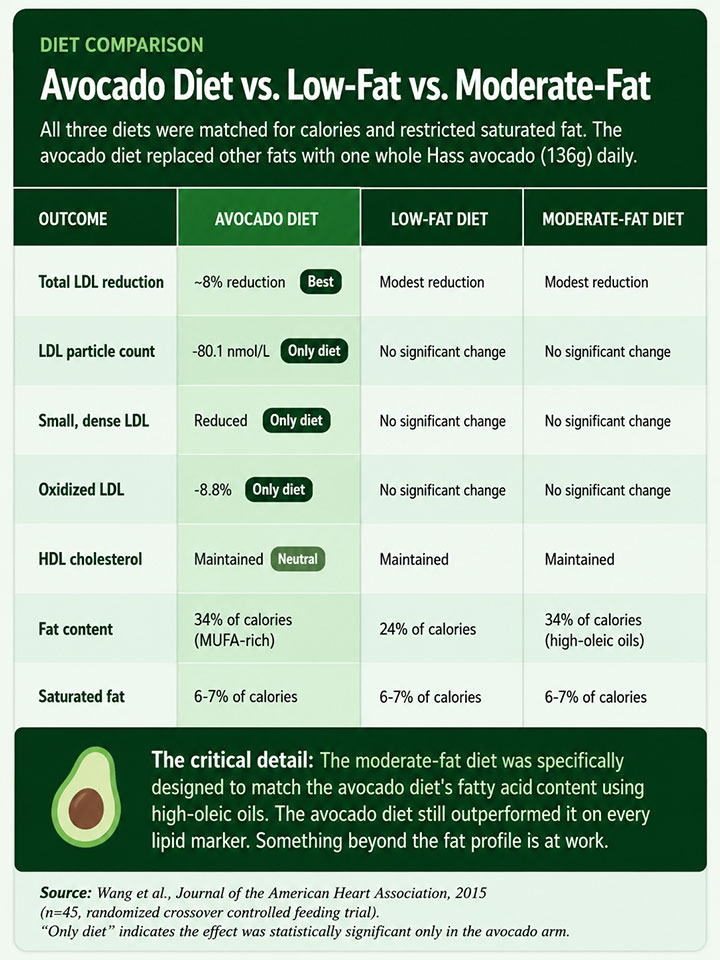
Each participant followed three different diets for five weeks at a time: a low-fat diet, a moderate-fat diet, and a moderate-fat diet that included one whole Hass avocado per day.
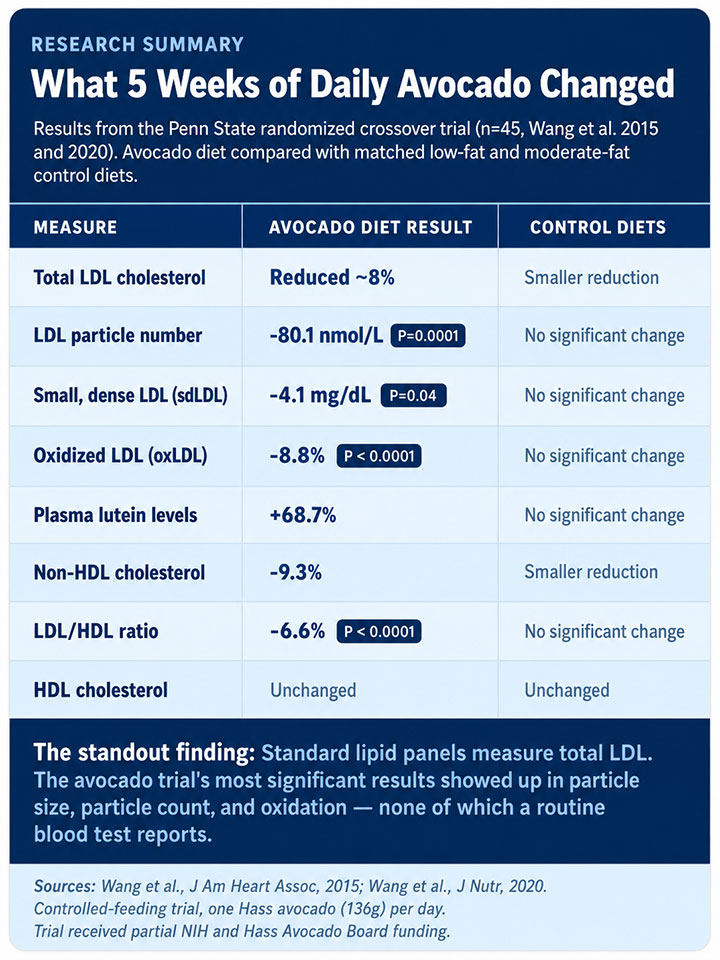
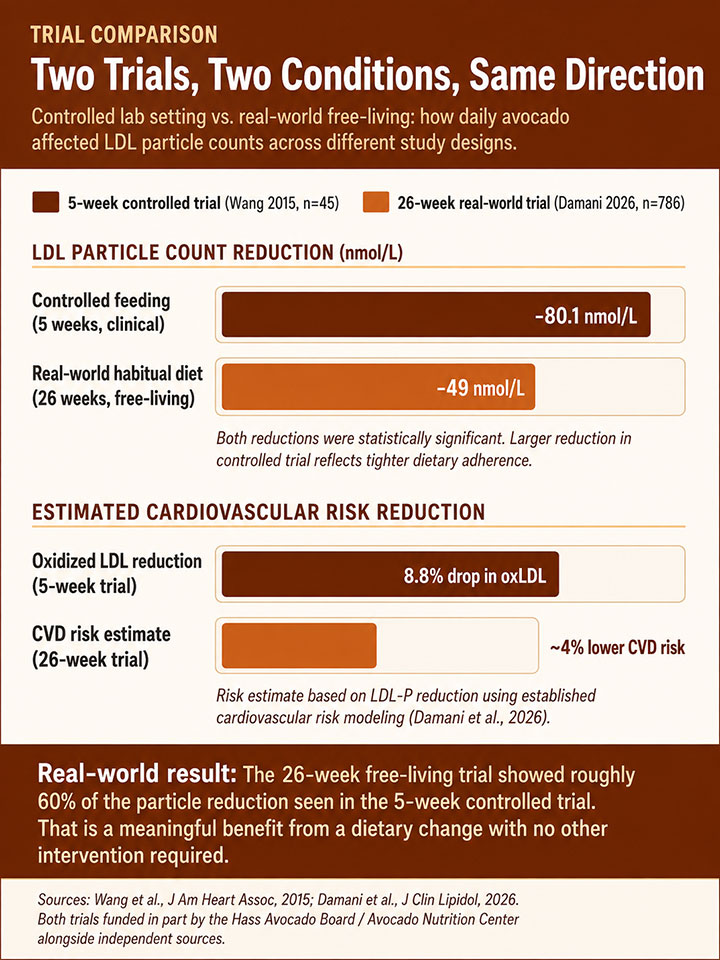
The diets were matched for calories. The only meaningful variable in the avocado arm was the avocado itself. The Wang et al. study in the Journal of the American Heart Association found that after five weeks on the avocado diet, participants’ total LDL cholesterol dropped by about 8% compared with the other diets. Their total LDL particle number fell by 80.1 nmol/L.
Those are not the numbers most articles quote. The number most articles miss is what happened to the particles themselves.
Why Particle Size Matters More Than LDL Total
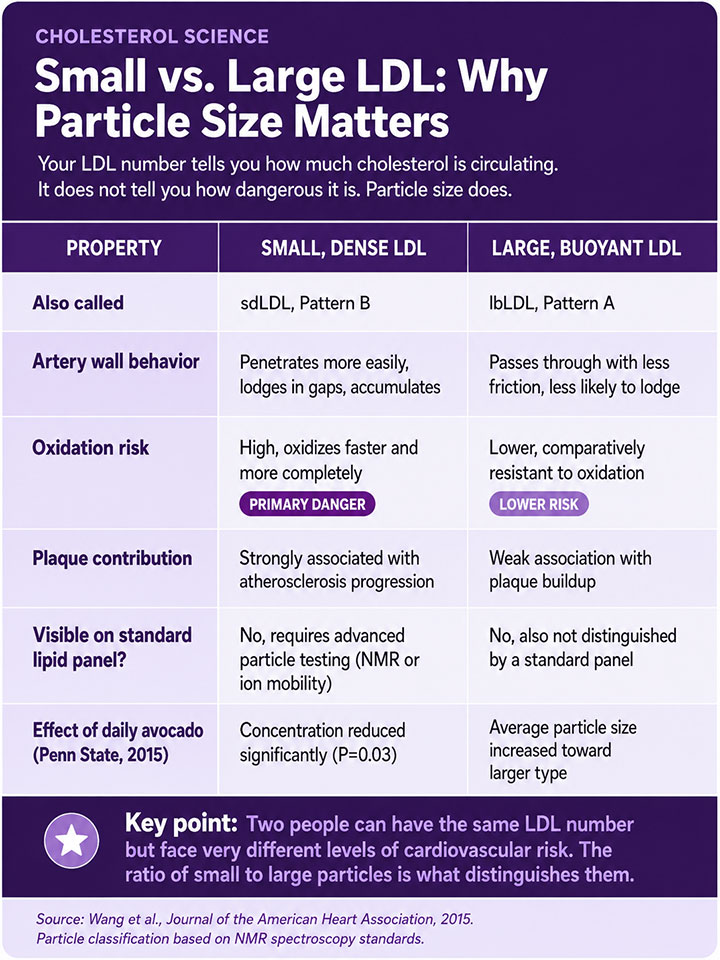
LDL cholesterol is not one uniform thing. It travels in particles of different sizes, and the size of those particles determines much of their danger.
Think of two kinds of objects moving through a pipe. Small, dense steel ball bearings scrape the walls, lodge in gaps, and cause cumulative damage. Larger foam balls roll through with far less friction.
LDL particles behave similarly in arterial walls. The small, dense variety squeeze through more easily, oxidize faster, and are more likely to trigger the inflammatory response that forms plaque. Larger particles are comparatively benign.
“All LDL is bad, but small, dense LDL is particularly bad,” Kris-Etherton has remarked in commentary on the trial findings. The 2015 Penn State study found that the avocado diet specifically reduced the concentration of small, dense LDL particles (P=0.03) and maintained a larger average LDL particle size compared with the low-fat control diet. The low-fat diet and the matched moderate-fat diet did not produce that shift.
A meta-analysis of 10 randomized controlled trials by Peou, Milliard-Hasting, and Shah, published in the Journal of Clinical Lipidology in 2016, added context: across 229 participants, avocado-substituted diets reduced total cholesterol by 18.80 mg/dL, LDL by 16.50 mg/dL, and triglycerides by 27.20 mg/dL, without reducing HDL.
The studies in that analysis used avocado extracts rather than whole fruit, which explains why the magnitude differs from Penn State’s whole-avocado numbers. The direction is consistent across both.
The Oxidized LDL Factor
Particle size is one layer of the story. What happens to those particles afterward is another.
Cholesterol does not become dangerous the moment it enters the bloodstream. The chain reaction starts when LDL oxidizes, a process roughly analogous to metal rusting from the inside. Oxidized LDL (oxLDL) is what triggers immune cells, promotes inflammation in the arterial wall, and initiates plaque formation. Lowering the LDL number without reducing oxidation addresses only part of the problem.
Kris-Etherton’s group published a second analysis from the same 45-participant trial in the Journal of Nutrition in 2020, this time focusing on oxidative stress markers. After five weeks on the avocado diet, oxidized LDL dropped by 8.8%, a highly statistically significant result (P less than 0.0001). Neither the low-fat nor the moderate-fat control diet produced a meaningful change in oxLDL.
What makes the oxidation finding more interesting is where it connects. The reduction in oxLDL was significantly correlated with the reduction in small, dense LDL particle count (r=0.32, P=0.0002), meaning the two effects are not independent.
The avocado diet appears to reduce the supply of particles most susceptible to oxidation, which reduces the fuel available for the inflammatory process that makes LDL genuinely dangerous. Fewer small particles, less oxidation. Less oxidation, less plaque risk.
The Lutein Finding That Almost Nobody Covers
The monounsaturated fats in avocado get most of the credit for the cholesterol effects, and they deserve some of it. But the 2020 Penn State paper pointed to a second compound that has received almost no attention in mainstream coverage: lutein.
Lutein is an antioxidant most people associate with eye health. After five weeks on the avocado diet, plasma lutein levels in participants increased by 68.7%. That is a substantial rise for a dietary change, not a supplement protocol.
And in the context of the cholesterol findings, it may explain part of what the monounsaturated fats alone cannot account for. Lutein does not simply accumulate in the blood. It appears to integrate into LDL particles themselves, where it can directly reduce oxidative vulnerability.
Lutein appears to act as a protective layer around LDL particles in the bloodstream, reducing their susceptibility to oxidation. The researchers suggested it is part of why the combination of fats, fiber, and bioactive compounds in a whole avocado outperforms what you get from an avocado extract or supplement.
A pill can deliver the fat. It cannot deliver the lutein increase, the fiber, and the fat profile together in the proportions that a whole avocado does.
That combination may be genuinely hard to replicate elsewhere, which is a reasonable argument against assuming an avocado oil capsule does the same job.
What the Larger, Real-World Trial Found
The Penn State controlled-feeding trial is well designed, but it has an obvious limitation: participants ate exactly what researchers gave them, in a clinical setting, for five weeks. That is not how most people eat.
A far larger study addressed that gap. The Habitual Diet and Avocado Trial, a multicenter trial run by Kristina Petersen and colleagues at Penn State, Tufts, UCLA, and Loma Linda University, enrolled 786 adults with abdominal obesity and tracked them for 26 weeks under free-living conditions.
One group ate one avocado per day added to their habitual diet. The control group limited avocado intake to fewer than two per month.
Published in the Current Developments in Nutrition in 2026, the results were more modest: LDL particle count (LDL-P) decreased by 49 nmol/L in the avocado group, corresponding to an estimated 4% reduction in cardiovascular disease risk.
No significant changes were observed for apolipoprotein B, apolipoprotein A-1, HDL particles, or triglyceride-rich particles. Participants did not lose weight, indicating the cardiovascular improvement was not driven by calorie reduction.
A 4% risk reduction is a meaningful number, but it is different from the dramatic shifts seen in the controlled five-week study. Petersen’s team acknowledged this directly. The controlled study showed what is possible under optimal dietary conditions.
The free-living trial shows what happens when people are simply given avocados and asked to keep eating normally. The honest answer is that the benefit is real and it is real-world achievable, but the magnitude is more modest than the clinical setting produces.
The Substitution Rule: Why Addition Alone Does Not Work
One detail from the Penn State trial is consistently overlooked. Participants in the avocado arm did not simply add an avocado to whatever they were already eating. They replaced other dietary fats with avocado. That substitution was the intervention.
This matters for caloric reasons and mechanistic ones. A single medium Hass avocado contains roughly 220 calories. If you add one to a diet already calibrated for saturated fat intake, you are adding calories and not making the dietary exchange that drives the cholesterol shift.
The Peou meta-analysis was explicit: substituting avocados for sources of saturated fat, rather than adding avocado to a free diet, is the correct approach for lipid improvement.
The swaps are more practical than people assume. Mashed avocado instead of butter on toast. Half an avocado instead of cheese on a burger or salad. Avocado in place of mayonnaise in sandwiches or tuna. None of these require a wholesale diet revision. They require a decision, repeated.
Avocado Substitution Calculator
See what swapping to avocado actually replaces in your diet, and how the numbers compare.
Is a Daily Avocado Worth It for Your Cholesterol?
If your doctor has flagged your LDL and recommended dietary changes, daily avocado is a reasonable part of the response, provided it replaces rather than adds to your existing fat intake. The evidence, taken together, is more specific than most coverage suggests.
Daily avocado does not just lower the LDL number. It changes what kind of LDL is circulating and how oxidation-prone those particles are, which is closer to the question that actually matters for cardiovascular risk.
The larger real-world trial suggests the particle-lowering effect persists under normal eating conditions, though at roughly half the magnitude. For someone managing borderline cholesterol through diet, a 4% CVD risk reduction from a food swap is worth taking seriously.
One question worth raising with your doctor: whether your standard lipid panel includes LDL particle testing, not just total LDL. Most routine panels do not. Most of the meaningful effects from the avocado research show up at the particle level, not in the number your panel reports by default. Knowing your LDL particle count gives you a much clearer picture of what is actually changing.
A Note on Funding and What It Means for the Evidence
Both the Penn State controlled-feeding trial and the Peou meta-analysis received partial funding from the Hass Avocado Board, alongside independent sources including NIH support for the Penn State work. This is standard in nutrition research, where commodity boards are among the few consistent funders of food-specific intervention trials, but it is worth naming directly.
The more recent 786-participant trial, published in 2026, was run by the same Penn State research group under Kris-Etherton and Petersen, again with Avocado Nutrition Center support. The methodological quality across all these studies is solid: randomized, controlled, with clear pre-specified outcomes and peer review at major journals. The results from the industry-funded and independently funded analyses point in the same direction.
Readers weighing the evidence should know about the funding. They should also know that the direction of that evidence is consistent across study designs and research groups, not dependent on any one trial.