Researchers have run multiple trials where they gave people chia seeds daily for 8 to 26 weeks and tracked their cholesterol levels. The results are more complex than some marketing claims would have you believe. Some studies showed clear benefits. Others found no change at all. The difference often came down to who was eating the seeds, how they prepared them, and what else they ate.
Let’s break down what actually happened in these studies.
Why 12 Weeks Matters for Cholesterol Studies
Your body doesn’t change overnight. When you alter your diet, it takes time for those changes to show up in bloodwork.
Most lipid studies use an 8 to 12-week timeline. This gives your body enough time to respond to dietary changes. Anything shorter might miss real effects. Anything much longer becomes hard to track because people’s diets and habits shift.
So when you see claims about chia seeds “instantly” improving heart health, be cautious. The clinical trials that matter all ran for at least two months. Some went as long as six months to capture lasting changes.
The superfood hype makes it sound simple: eat chia, lower your cholesterol. The actual research paints a different picture. Results varied based on the person’s starting health, the form of chia they used, and whether they ate chia alone or with other foods.
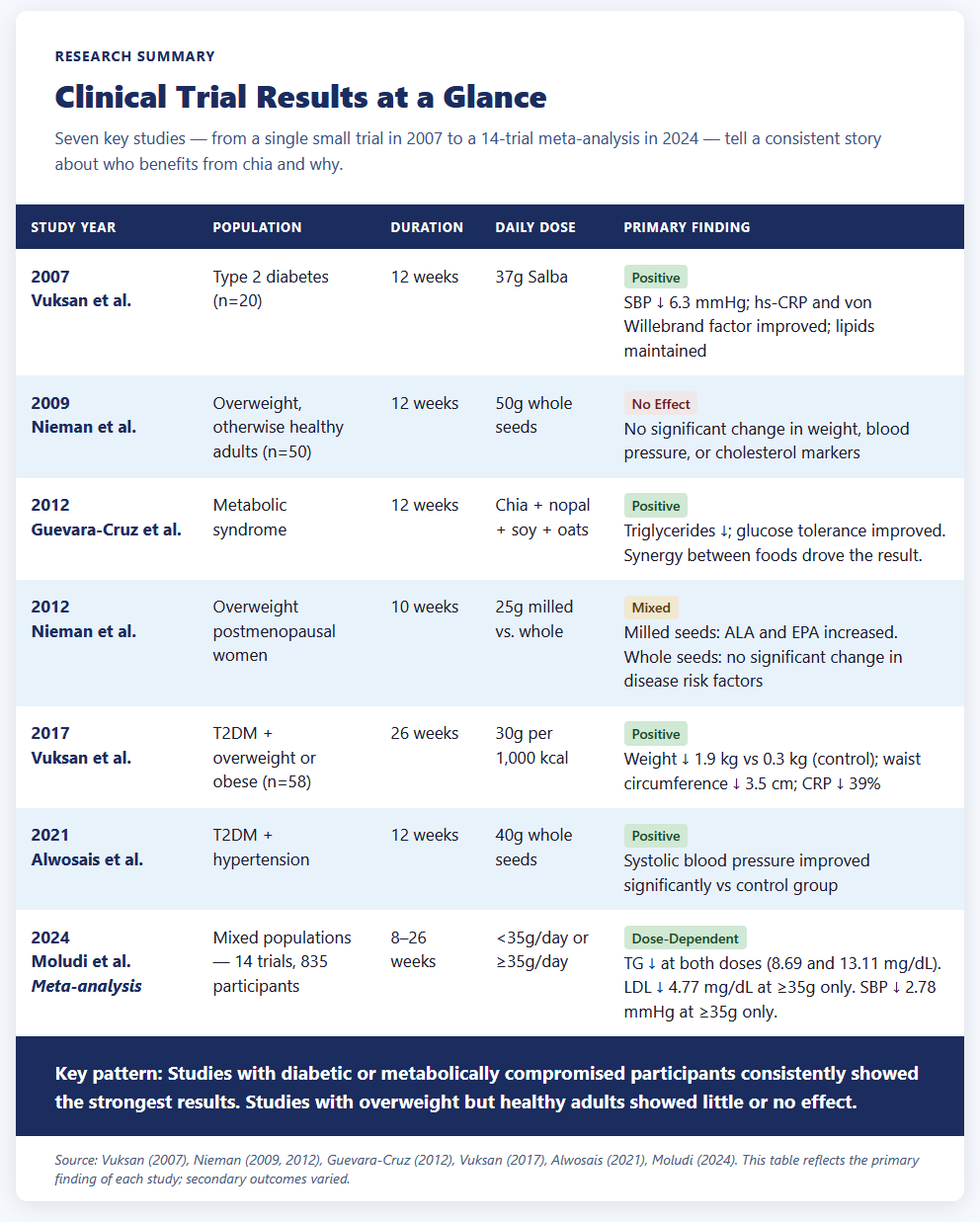
Clinical Trial Results at a Glance
Here’s what the research shows when you look at all the major studies together:
| Study Year | Population | Duration | Daily Dose | Key Cholesterol Finding |
|---|---|---|---|---|
| 2007 | Type 2 Diabetes | 12 weeks | ~30g Salba | Improved several lipid markers |
| 2009 | Overweight adults | 12 weeks | 50g whole | No significant change |
| 2012 | Post-menopausal women | 10 weeks | 25g | Limited broad improvements |
| 2012 | Metabolic syndrome | 12 weeks | Pattern with multiple foods | Reduced triglycerides |
| 2017 | T2DM + calorie restriction | 26 weeks | 30g/1000 kcal | Favorable lipid changes |
| 2021 | Type 2 Diabetes | 12 weeks | 40g | Some lipid shifts, BP improved |
| 2024 | Mixed populations (meta-analysis) | 8-12 weeks | 35g+ | LDL reduced 4.77 mg/dL |
Notice the pattern? Studies with diabetic participants showed better results. Studies with healthy overweight people showed minimal changes. The dose matters too—35 grams or more performed better than smaller amounts.
The Diabetes Connection: Where Chia Showed Real Promise
In 2007, researchers gave adults with type 2 diabetes a chia supplement called Salba for 12 weeks. These weren’t just overweight people trying to get healthier. They had an active metabolic condition that affected how their bodies processed fats and sugars.
The results were notable. Blood pressure dropped. Several heart risk markers improved. The study suggested chia might work better for people with existing metabolic problems than for those who are just slightly overweight but otherwise healthy.

A 2021 trial confirmed this pattern. Adults with type 2 diabetes ate 40 grams of chia seeds daily for 12 weeks. Their systolic blood pressure improved. Some lipid markers shifted, though not all changes reached statistical meaning across every measure. The researchers noted that consistent daily intake seemed to matter more than the exact timing of consumption.
Here’s the pattern: chia seems to help more when your metabolism is already struggling. If you have diabetes or pre-diabetes, the seeds appear to offer genuine support. If you’re healthy but just want to optimize your numbers, the benefit is less clear.
Think of it like this: chia seeds work like a tool that’s most useful when something is broken. They help fix problems. They’re less effective at making an already-good system slightly better.
When Chia Seeds Didn’t Change Anything
Not every study found benefits. In 2009, researchers gave overweight adults 50 grams of chia seeds daily for 12 weeks. That’s a lot of chia—about three tablespoons. They used whole seeds, compared them against a placebo, and tracked weight, blood pressure, and cholesterol.
The result? Nothing changed. No weight loss. No meaningful shift in LDL or total cholesterol.
Why didn’t it work? The participants were overweight but didn’t have diabetes or other metabolic issues. Their bodies were functioning normally, just carrying extra weight. The chia didn’t create change because there wasn’t a clear problem to fix.

This is the transparency gap most articles skip. They show you the wins and ignore the losses. But the losses matter. They tell you when chia might not be worth the effort.
If you’re healthy and active, eating chia seeds probably won’t move your cholesterol numbers much. It’s not that chia is bad—it’s just that your body doesn’t need what it offers.
Managing expectations is critical. Chia is a supplement, not a cure. It can support changes when combined with other healthy choices, but it won’t fix poor diet or lack of exercise on its own.
The 2024 Meta-Analysis: What Happens When You Pool All the Data
In 2024, researchers analyzed 14 clinical trials that included 835 people total. They looked for patterns across all these studies to get a clearer picture of what chia actually does.
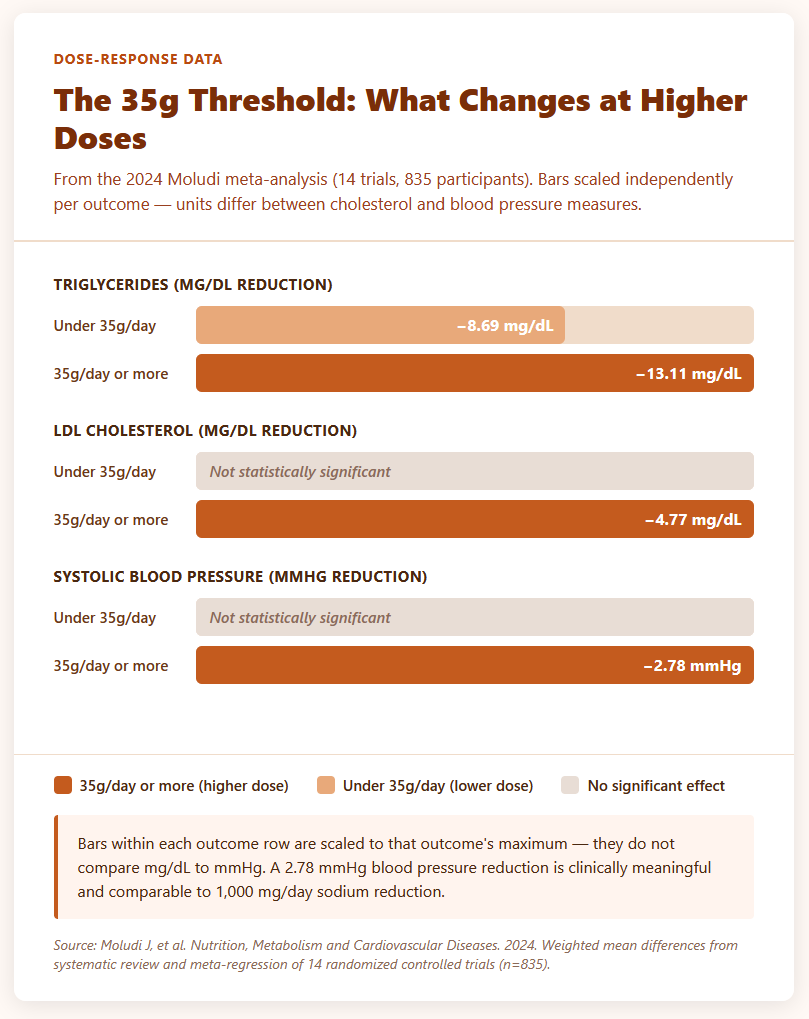
The findings were specific. Triglycerides decreased in both higher-dose and lower-dose groups. People taking more than 35 grams daily saw triglycerides drop by an average of 13.11 mg/dL. Those taking less saw drops of 8.69 mg/dL.
LDL cholesterol—the “bad” kind—only showed significant drops in the higher-dose group. People eating 35 grams or more daily saw LDL decrease by 4.77 mg/dL. That’s modest but measurable.
Systolic blood pressure also improved, dropping by 2.78 mmHg in people taking higher doses. That might not sound like much, but it’s comparable to the benefit you’d get from cutting salt intake or walking 30 minutes daily.
The analysis confirmed something important: dose matters. If you’re going to try chia for cholesterol, you need to hit at least 35 grams daily. Two tablespoons (about 28 grams) probably won’t cut it. You need closer to three tablespoons.

The Form Factor: Why Whole Seeds Often Fail
Here’s something most articles miss: how you prepare chia seeds matters as much as eating them.
In a 2012 study, postmenopausal women ate either whole or milled (ground) chia seeds for 10 weeks. The researchers measured various metabolic markers to see which form worked better. The milled seeds released more ALA—alpha-linolenic acid—an omega-3 fatty acid that supports heart health.
Whole seeds often pass through your digestive system intact. You’ve probably noticed this if you’ve eaten them. They come out looking the same as when they went in. When that happens, your body can’t access the nutrients inside.
The outer shell is tough. It protects the seed in nature, but it blocks absorption in your gut. Grinding the seeds breaks that barrier. It lets your body absorb the ALA and fiber that might help with cholesterol.
To get the most benefit, you need to mill your seeds. You can buy pre-ground chia or grind it yourself at home with a coffee grinder or blender. Store ground chia in the fridge to keep the fats from going rancid.
This small step can make the difference between chia working and chia doing nothing. It’s not complicated, but it’s often overlooked.
The ALA Conversion Problem Most People Don’t Know About
Here’s a critical detail that explains why chia’s effects are modest: your body can’t efficiently convert the omega-3s in chia into the forms it needs.
Chia contains ALA, which your body has to convert into EPA and DHA—the active omega-3 forms that protect your heart. But the conversion rate is terrible. Only 5 to 10% of ALA converts to EPA. Just 2 to 5% converts to DHA.
This means if you eat 5 grams of ALA from chia, your body might only convert 250 to 500 milligrams into EPA. That’s a fraction of what you’d get from eating fatty fish directly.
There’s a trick that helps. Research shows that soaking chia seeds in water for 24 hours improves how well your body can extract the omega-3 fatty acids compared to eating dry seeds. The soaking process starts breaking down the seed structure, making the fats more available.
Try this: put your chia seeds in a jar with water (about 3 parts water to 1 part chia) and leave it in the fridge overnight—or better yet, for a full day. The seeds will form a gel. This is what you want. Use this gel in smoothies or mix it into yogurt.
This explains why fish oil supplements often work better than chia for raising omega-3 levels. Fish oil gives you EPA and DHA directly. Chia makes your body do the conversion—and your body isn’t very good at it.
The Power of Food Combinations
In 2012, researchers tried something different. Instead of testing chia alone, they combined it with other foods: nopal (cactus), soy, and oats. Adults with metabolic syndrome ate this combination for 12 weeks as part of a specific dietary pattern.
Triglycerides dropped. Glucose tolerance improved. The combination worked better than any single food would have on its own. The researchers noted that the pattern of foods together created a synergy that amplified the individual benefits.

This finding challenges how we think about nutrition. We often focus on individual “superfoods.” But your body doesn’t work that way. Foods interact. Nutrients work together. A diet rich in fiber, healthy fats, and plant protein does more than any single ingredient.
If you want chia to help your cholesterol, don’t eat it in isolation. Add it to meals that already include other heart-healthy foods. Mix it into oatmeal. Blend it with soy milk. Pair it with vegetables high in soluble fiber.
The “chia-plus” approach outperforms the “chia-only” method every time. It’s not about finding one magic food. It’s about building a pattern of eating that supports your goals.
How Chia Compares to Other Cholesterol-Lowering Foods
Before you stock up on chia, it helps to see how it stacks up against other options:
| Food | Fiber (per serving) | Omega-3 (ALA) | Ease of Use | Monthly Cost |
|---|---|---|---|---|
| Chia (2 tbsp) | 8g | 5g | High (must grind) | $15-25 |
| Oats (1/2 cup) | 4g | 0g | Very High | $5-10 |
| Flaxseed (2 tbsp) | 6g | 6.4g | Medium (must grind) | $10-15 |
| Walnuts (1 oz) | 2g | 2.6g | Very High | $20-30 |
| Psyllium (1 tbsp) | 7g | 0g | High | $10-15 |
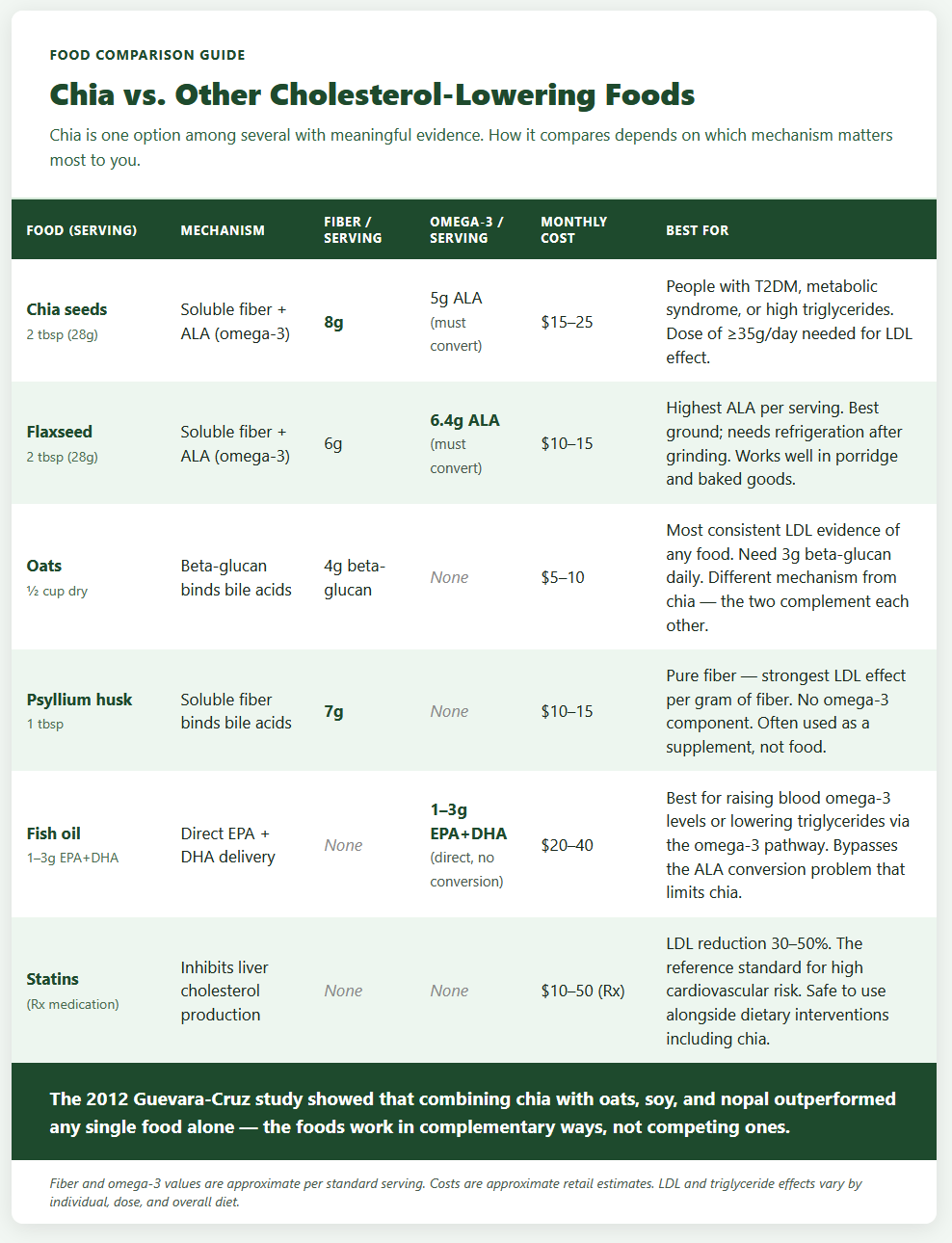
Chia isn’t the only option, but it offers a good balance of fiber and omega-3s in a small serving. Flaxseed actually contains more ALA per serving. Oats are cheaper and easier to use. Walnuts taste better but cost more.
The best approach? Use several of these foods. Rotate them through your week. Monday might be chia in your smoothie. Wednesday could be oatmeal with walnuts. Friday might be ground flaxseed on your salad.
Compare cholesterol-lowering foods to find the best option for your needs
You don't have to choose just one. The 2012 research showed that combining multiple heart-healthy foods works better than eating any single option alone. Try rotating chia, flaxseed, and oats throughout your week for maximum benefit.
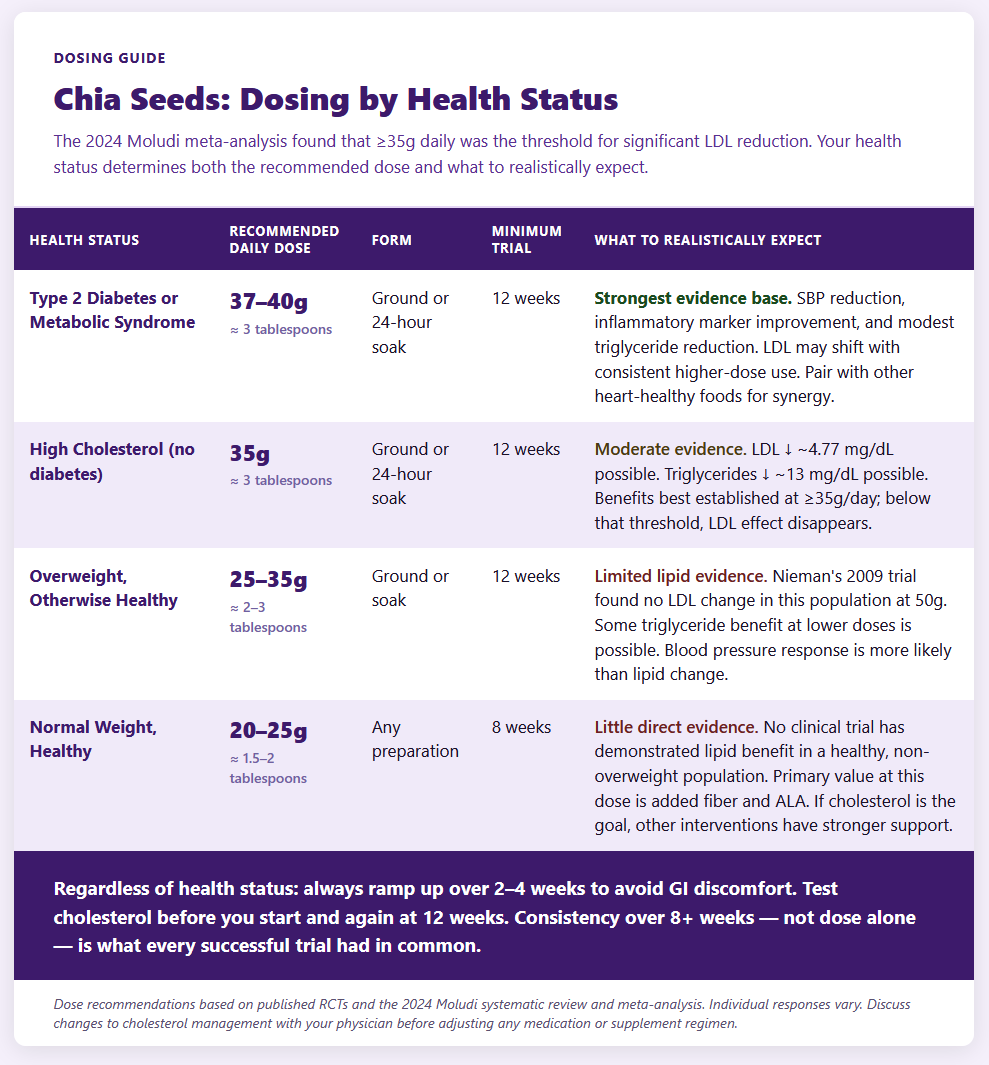
How Much Should You Actually Eat?
Clinical trials used doses between 25 and 50 grams daily. That’s roughly two to three tablespoons.
Most successful studies landed around 30 to 40 grams per day. That amount provided enough fiber and ALA to potentially affect cholesterol levels without adding too many calories. The 2024 meta-analysis confirmed that doses above 35 grams showed the strongest effects.
Here’s the catch: 50 grams of chia seeds contains about 240 calories. If you’re trying to lose weight, that’s a big chunk of your daily budget. You can’t just add chia on top of your current diet and expect results. You need to swap it in for something else.
Try these strategies:
Use chia as an egg replacement in baking. One tablespoon of ground chia mixed with three tablespoons of water equals one egg. This cuts cholesterol from your diet while adding fiber.
Mix chia into yogurt or oatmeal instead of adding granola. You get similar texture with more nutrition and less sugar.
Blend chia into smoothies. It thickens the drink and keeps you full longer without changing the taste much.
Start with smaller amounts—one tablespoon daily—and build up over a week or two. Your digestive system needs time to adjust to the extra fiber. Jump straight to 40 grams, and you’ll likely feel bloated and uncomfortable.
Consistency matters more than quantity. Eating two tablespoons every day beats eating four tablespoons sporadically.
Get your personalized chia seed dosage based on clinical research
Don't just add chia on top of your current diet. Replace other foods to avoid weight gain:
- Grind seeds fresh before use (coffee grinder works well)
- Or soak whole seeds for 24 hours to improve absorption
- Split dose across meals (morning and evening)
- Drink 8-10 glasses of water daily
- Commit to 12 weeks minimum for cholesterol effects
Your 12-Week Chia Protocol
If you want to replicate what worked in clinical trials, follow this timeline:
Weeks 1-2: Start with 1 tablespoon ground chia daily Focus on building the habit. Add it to one meal each day. Let your digestive system adjust to the extra fiber. Drink plenty of water—at least 8 glasses daily. The fiber in chia needs water to work properly.
Weeks 3-4: Increase to 2 tablespoons Split the dose if it’s easier. One tablespoon at breakfast, another at lunch or dinner. You should feel comfortable with this amount by now. If you’re experiencing bloating, stay at this level for another week before increasing.
Weeks 5-12: Maintain 2-3 tablespoons (30-40g) This is your therapeutic dose. Don’t skip days. Track your intake in a food diary or app. Consistency is what makes this work. If you miss a day, don’t double up the next day—just continue as normal.
Week 12: Get cholesterol tested Schedule bloodwork at the same lab you used at the start. Compare your numbers. Look at total cholesterol, LDL, HDL, and triglycerides. Small changes (5-10% drops) are realistic. Big changes are rare unless you’ve also improved your overall diet.
Recipes That Match the Research
The studies that showed the best results combined chia with other heart-healthy foods. Here are recipes that replicate those patterns:
Heart-Healthy Chia Breakfast Bowl
This recipe combines chia with soy and oats—the same pattern that reduced triglycerides in the 2012 metabolic syndrome study.
Ingredients:
- 3 tablespoons chia seeds (grind fresh in coffee grinder)
- 1 cup unsweetened soy milk
- 1/2 cup rolled oats
- 1/4 cup walnuts, chopped
- 1 teaspoon cinnamon
- 1/2 sliced banana (optional)
Instructions: Mix ground chia with soy milk the night before. Store in fridge. In the morning, add oats and let sit for 5 minutes. Top with walnuts, cinnamon, and banana.
Why it works: You’re getting fiber from three sources (chia, oats, walnuts), plant protein from soy, and omega-3s from both chia and walnuts. This hits multiple pathways that affect cholesterol.
Cholesterol-Lowering Green Smoothie
This smoothie packs in multiple sources of soluble fiber and plant sterols.
Ingredients:
- 2 tablespoons chia seeds (soaked overnight in 1/4 cup water)
- 1 cup soy milk or almond milk
- 1 cup fresh spinach
- 1/2 green apple, cored
- 1 tablespoon ground flaxseed
- 1/2 teaspoon fresh ginger
- 4-5 ice cubes
Instructions: Add pre-soaked chia gel to blender. Add remaining ingredients and blend until smooth. Drink within 30 minutes for best texture.
Why it works: The soaking step improves omega-3 availability. Spinach and apple add extra fiber. Flaxseed boosts the ALA content even more. Ginger helps with absorption and adds anti-inflammatory benefits.
Simple Chia Egg Substitute
Use this in baking to reduce dietary cholesterol while adding fiber.
Recipe:
- 1 tablespoon ground chia seeds
- 3 tablespoons water
Mix and let sit for 5 minutes until it forms a gel. Use in place of one egg in baked goods like muffins, pancakes, or cookies.
Why it works: Regular eggs add about 185mg of cholesterol per egg. This swap eliminates that while adding 3 grams of fiber and 1.7 grams of ALA.
Five Mistakes That Reduce Chia’s Effectiveness
After reviewing all the research, here are the most common errors people make:
1. Eating whole seeds without grinding The 2012 study on postmenopausal women showed that whole seeds don’t release their nutrients effectively. Your digestive system can’t break through that tough outer shell. Always grind your chia or buy it pre-ground. If you see whole seeds in your stool, you’re not absorbing the nutrients.
2. Not drinking enough water Chia absorbs up to 12 times its weight in water. If you eat it dry without enough fluids, it can cause digestive discomfort or even blockages. Aim for at least 8 to 10 glasses of water daily when eating chia regularly.
3. Adding chia on top of current calories The 2017 study that showed good results used chia as part of a calorie-restricted diet. They didn’t just add it—they replaced other foods with it. If you’re eating 2,000 calories daily and you add 240 calories of chia without cutting anything else, you’ll gain weight. That will hurt your cholesterol, not help it.
4. Inconsistent use Every successful study required daily intake for at least 8 weeks. Eating chia three times this week and then forgetting about it for two weeks won’t work. Set phone reminders if you need to. Make it part of your morning routine.
5. Expecting fast results The 2024 meta-analysis looked at studies lasting 8 to 12 weeks minimum. Your cholesterol won’t drop after three days or even three weeks. Give it time. Test at 12 weeks, not before.
A 2017 Study: Chia in a Calorie-Controlled Diet
In 2017, researchers tested chia in a different context. They gave overweight and obese adults with type 2 diabetes a calorie-restricted diet for six months. One group got 30 grams of chia per 1,000 calories they consumed. The control group got oat bran instead.
Both groups lost weight—that’s what happens in a calorie-restricted diet. But the chia group showed better improvements in several heart risk markers. Weight came off more easily. Visceral fat—the dangerous kind around your organs—decreased more. The researchers noted that chia seemed to help preserve lean muscle mass while the weight dropped, which is harder to achieve with calorie restriction alone.

This study highlights an important point: chia works best as part of a structured eating plan, not as an add-on to an unchanged diet.
If you want chia to help with cholesterol, you need to make room for it. Reduce calories elsewhere. Build meals around whole foods. Stay consistent for at least 12 weeks.
Random handfuls of chia sprinkled on whatever you already eat won’t cut it. You need a plan.
Beyond Cholesterol: Other Heart Benefits
Cholesterol isn’t the only marker that matters for heart health. Blood pressure and inflammation play big roles too.
In the 2007 Salba study, adults with diabetes saw their systolic blood pressure drop after 12 weeks. This effect appeared in multiple trials. Even when cholesterol didn’t budge, blood pressure often improved.
Why? Chia is high in potassium and magnesium—minerals that help regulate blood pressure. Two tablespoons of chia contain about 95 mg of magnesium and 115 mg of potassium. The fiber content also supports healthy blood vessel function by improving the flexibility of artery walls.
The 2024 meta-analysis confirmed this pattern. People taking higher doses of chia saw systolic blood pressure drop by an average of 2.78 mmHg. That’s about the same benefit you’d get from reducing sodium intake by 1,000 mg daily or walking briskly for 30 minutes most days.
A 3 mmHg drop doesn’t sound big, but population studies show that even small reductions in blood pressure translate to fewer heart attacks and strokes when applied across millions of people.
Inflammation is another piece. C-reactive protein (CRP) is a marker that shows how much inflammation is in your body. High CRP levels link to heart disease risk. In longer studies—those lasting 26 weeks—some participants showed lower CRP levels after eating chia regularly. The omega-3 fats and antioxidants in chia likely contribute to this effect.
These secondary benefits add up. Even if your LDL cholesterol doesn’t drop dramatically, better blood pressure and less inflammation still reduce your risk of heart problems.
Health isn’t about fixing one number. It’s about improving the whole system. Chia seeds contribute to that broader goal, especially when combined with other healthy habits.
White Chia vs Black Chia: Does It Matter?
You’ve probably seen both types at the store and wondered if one is better.
The nutritional content can vary by about 30% between different strains of chia. Cultivated white chia varieties—like Salba, which was used in several successful studies—tend to show more consistent omega-3 and protein levels.
Black chia is typically wild-harvested and shows more variation between batches. One bag might have 5.2 grams of ALA per serving while another has 4.5 grams.
White chia costs more but offers better consistency. If you’re using chia therapeutically for cholesterol, that consistency matters. You want to know you’re getting the same dose of active compounds each day.
That said, both types work. The studies that showed benefits used both white and black varieties. Just buy from reputable brands that test their products and list nutritional content clearly on the label.
What the 2021 Analysis Revealed
In 2021, researchers analyzed multiple trials together to look for patterns. They pulled data from studies lasting 8 to 12 weeks that tested various forms of chia—whole seeds, milled seeds, chia in bars.
Their conclusion? Mixed results. Some trials showed modest drops in triglycerides and LDL in specific groups. Others found nothing.
The evidence is heterogeneous. That’s science-speak for “all over the place.”
This doesn’t mean chia is useless. It means chia isn’t a silver bullet. It helps some people in some situations. It does less for others.
The analysis confirmed what individual studies suggested: chia offers the most benefit to people with existing metabolic issues, especially when prepared correctly and eaten consistently as part of a healthy diet.
One interesting finding: the analysis showed chia had significant effects in patients with type 2 diabetes and obesity when looking at combined populations. But when researchers separated the data by gender—looking at men and women individually—the effects became less clear. This suggests the benefits might depend on complex interactions between gender, metabolism, and baseline health that we don’t fully understand yet.
For the average person with normal cholesterol who just wants to optimize, the effect is small. For someone with high triglycerides or diabetes, the effect can be meaningful.
Gender and Age: Who Benefits Most?
The research shows interesting patterns when you look at who responds best to chia.
The 2012 study on postmenopausal women showed minimal benefits from chia alone. This group often has stubborn cholesterol levels due to hormonal changes. Chia by itself didn’t move the needle much for them.
But studies with mixed-gender groups of diabetic patients showed clearer benefits. Men and women combined saw improvements. When split apart, the effect weakened.
This suggests chia works better for some populations than others. If you’re a postmenopausal woman with high cholesterol but no diabetes, you might see limited benefits from chia alone. You’d likely need to combine it with other interventions—hormone therapy, more exercise, or medications.
If you’re dealing with diabetes or metabolic syndrome regardless of age or gender, chia appears more helpful.
Younger adults with good metabolic health but slightly high cholesterol fall somewhere in the middle. You might see small improvements, especially if you’re also improving your overall diet and activity level.
The Variability Problem: Why Results Differ So Much
If you read through all the studies, one thing becomes obvious: results vary wildly from person to person.
Some people see their triglycerides drop by 20%. Others see no change at all. Why?
Your starting point matters. People with high cholesterol or poor metabolic health tend to see bigger improvements. Those with already-healthy numbers see smaller shifts.
Your overall diet matters. Adding chia to a diet full of processed food won’t do much. Adding it to a diet already rich in vegetables, whole grains, and lean protein amplifies the effect.
Your genetics matter. Some people absorb and use omega-3 fats more efficiently than others. If your body struggles to convert ALA into the active forms of omega-3 (EPA and DHA), you might not see as much benefit. Genetic tests can reveal these differences, but most people don’t need that level of detail.
Your gut bacteria matter. The fiber in chia feeds certain bacteria in your intestines. If you have a healthy, diverse microbiome, you’ll get more from the fiber. If your gut health is poor, the seeds might just pass through without much effect. Taking probiotics or eating fermented foods alongside chia might help.
This explains why no single study tells the whole story. The research shows us trends and possibilities, not guarantees.
Who Should Skip Chia Seeds
Chia isn’t right for everyone. Here are situations where you should avoid it or talk to your doctor first:
If you take blood thinners (warfarin, Coumadin, Plavix) Chia has natural blood-thinning properties due to its omega-3 content. Combining it with medication could increase bleeding risk. Some studies excluded participants on blood thinners for this reason.
If you have diverticulitis or active digestive issues The small seeds can potentially get stuck in inflamed pouches in your intestines. While there’s debate about this, it’s better to be cautious during flare-ups.
If you’re allergic to sesame or mustard seeds There’s potential for cross-reactivity. Some people with these allergies also react to chia. Start with a tiny amount and watch for symptoms.
If your cholesterol is already optimal The 2009 study showed chia did nothing for healthy overweight adults. If your numbers are already good, chia probably won’t improve them further. You’d benefit more from focusing on other health goals.
If you have trouble swallowing Dry chia seeds can swell in your throat. Always mix them with liquid first. Never eat dry chia by the spoonful.
Is Chia Worth It Financially?
Let’s talk about the cost-benefit ratio.
Chia costs about $10 to $15 per pound. You need 30 to 40 grams (about 1.5 ounces) daily for therapeutic effects. That means one pound lasts roughly 10 days.
Your monthly cost: $15 to $25 for chia seeds alone.
Compare this to other cholesterol interventions:
Statin medications cost $10 to $50 monthly depending on your insurance. But they come with potential side effects—muscle pain, liver issues, and diabetes risk.
Fish oil supplements cost $20 to $40 monthly for high-quality brands. They provide EPA and DHA directly, which might work better than chia’s ALA.
Dietary changes (more vegetables, less processed food) cost about the same as eating processed food, sometimes less.
Chia falls in the middle. It’s more expensive than oats but cheaper than quality fish oil. The advantage is that it’s food, not a supplement or drug. You can stop anytime without withdrawal. It adds fiber along with omega-3s. And it works synergistically with other healthy foods.
Is it worth it? That depends on your situation. If you have diabetes and high triglycerides, spending $20 monthly on chia might save you thousands in future medical costs. If you’re healthy and just want slightly better numbers, your money might be better spent on a gym membership or cooking classes.
Troubleshooting: I’ve Been Eating Chia for 6 Weeks and Nothing Changed
This is common. Here’s how to figure out what’s wrong:
Check: Are you grinding it first? Whole seeds don’t work. Period. If you’re eating whole chia in pudding or smoothies, switch to ground chia. Buy a $15 coffee grinder dedicated to seeds. Grind fresh each week.
Check: Are you hitting 30g+ daily? Get out measuring spoons. One tablespoon of chia weighs about 12 grams. You need at least 2.5 tablespoons daily. Most people underestimate their portions.
Check: Are you pairing it with other healthy foods? Eating chia in a sugary yogurt with granola won’t work. The 2012 synergy study showed chia works best with soy, oats, and vegetables. Rethink your meals.
Check: Have you reduced processed food intake? If you’re still eating fast food three times weekly, drinking soda, and snacking on chips, chia can’t overcome that. The successful studies included overall diet improvements, not just chia added to junk food.
Check: Are you drinking enough water? Chia needs water to work. Aim for 8 to 10 glasses daily. If you’re dehydrated, the fiber can’t do its job properly.
Consider: You might be in the “healthy overweight” category If you don’t have diabetes or metabolic syndrome, you’re less likely to see dramatic changes. The 2009 study proved this. Chia helps people with metabolic problems more than people without them.
Give it the full 12 weeks before testing. If you’ve done everything right and still see no change, chia might not be the right tool for you. Try fish oil or increase your exercise instead.
How Long Does It Take for Chia Seeds to Lower Cholesterol?
This is one of the most common questions people ask. The research gives us a clear answer.
Minimum time: 8 weeks. This is the shortest duration used in successful clinical trials. Your body needs at least two months to show measurable lipid changes from dietary interventions.
Optimal testing time: 12 weeks. Most studies that showed significant results ran for 12 weeks. This is the sweet spot where enough time has passed to see changes without people dropping out or changing their habits too much.
Long-term effects: 26 weeks. The 2017 calorie-restriction study ran for six months and showed sustained improvements. If changes happen, they tend to stick around as long as you keep eating chia consistently.
Don’t test your cholesterol at 4 weeks or 6 weeks. You’re unlikely to see changes yet, and you’ll get discouraged for no reason. Wait the full 12 weeks. Mark it on your calendar. Make it a true experiment.
What’s Better for Cholesterol: Chia or Flax Seeds?
Both seeds offer similar benefits, but they’re not identical.
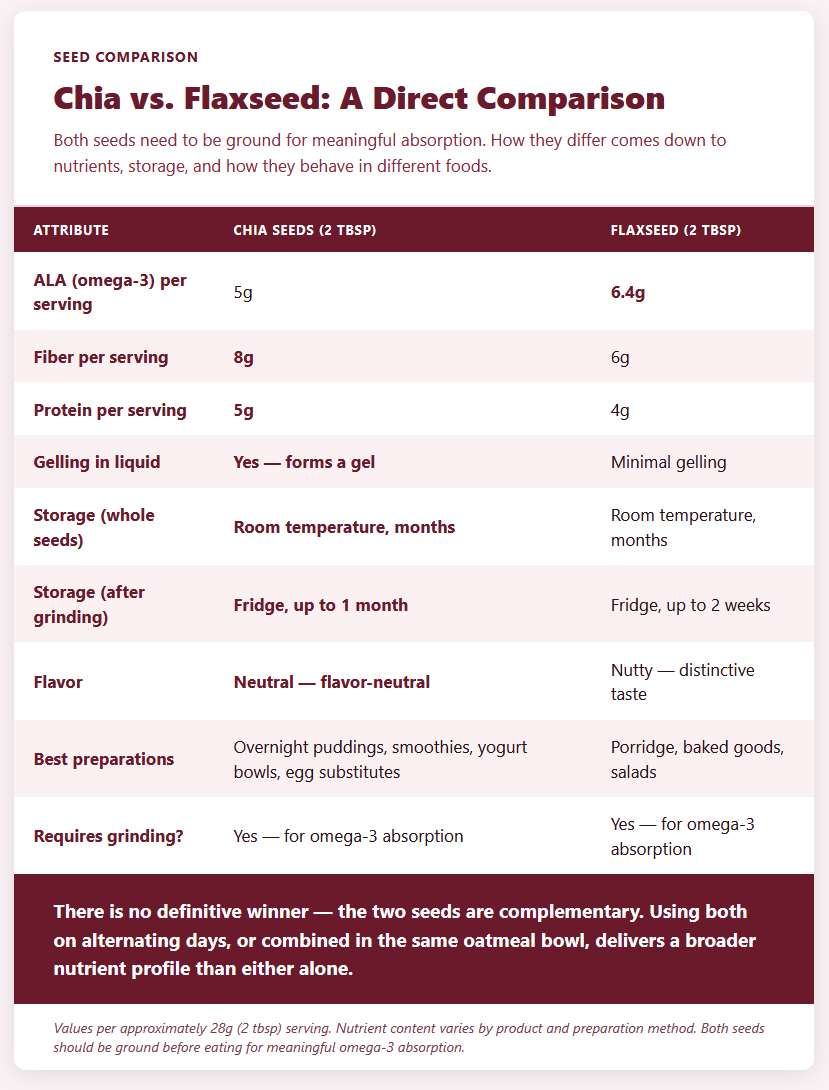
Flax contains more ALA per serving—6.4 grams versus chia’s 5 grams in two tablespoons. That’s a 28% difference. If omega-3 content is your main concern, flax wins.
But chia has more fiber—8 grams versus flax’s 6 grams. If fiber is your priority, chia edges ahead.
Chia is easier to use. It doesn’t go rancid as quickly as flax. You can store it at room temperature for months. Flax needs refrigeration after grinding.
Chia forms a gel when mixed with liquid. This makes it useful for puddings and as an egg substitute. Flax doesn’t gel the same way.
Both need to be ground for optimal absorption. Whole flax seeds pass through even more stubbornly than whole chia.
The best answer? Use both. Rotate them through your week. Monday and Wednesday get chia. Tuesday and Thursday get flax. This gives you variety and ensures you’re not missing out on unique compounds in either seed.
Can Chia Seeds Replace Statin Medication?
Short answer: No. Don’t stop taking prescribed medication without talking to your doctor.
Longer answer: Chia can be part of a plan to reduce or avoid medication, but it can’t match the power of statins.
Statins typically lower LDL cholesterol by 30 to 50%. That’s a reduction of 40 to 70 mg/dL for someone starting with LDL of 140 mg/dL.
The 2024 meta-analysis showed chia reduced LDL by an average of 4.77 mg/dL. That’s less than 10% of what statins do.
For some people with borderline-high cholesterol, dietary changes including chia might be enough to avoid medication. Your doctor might say, “Your LDL is 135. Let’s try three months of diet changes before starting a statin.”
In that case, chia becomes part of your toolkit alongside more vegetables, less saturated fat, regular exercise, and weight loss if needed.
But if your LDL is 180 or you’ve already had a heart attack, chia won’t be enough. You’ll need medication. You can still eat chia alongside your medication—it’s safe to combine them.
Think of chia as one tool in your toolbox. Statins are power tools. Chia is a hand tool. Both have their place. Sometimes you need both.
Best Time of Day to Eat Chia Seeds for Cholesterol
Does timing matter? The research doesn’t show a clear advantage to morning versus evening consumption. None of the successful clinical trials specified a particular time of day.
That said, there are practical reasons to choose certain times:
Morning benefits: Chia keeps you full through the morning. The fiber and protein prevent blood sugar spikes. If you tend to snack before lunch, morning chia helps.
You’re more likely to remember it. Morning routines are easier to maintain than evening habits.
Evening benefits: Some people find the fiber helps with overnight digestion. You wake up feeling lighter and more regular.
If you work out in the morning, evening chia won’t interfere with your workout. High fiber before exercise can cause discomfort.
Split dosing: Some people split their dose—one tablespoon at breakfast, another at dinner. This spreads the fiber throughout the day and might reduce digestive side effects.
The bottom line: eat chia when it fits your schedule and feels comfortable. Consistency matters more than timing.
Before You Start: A Practical Checklist
Don’t just buy chia and hope for the best. Set yourself up for success with these steps:
The Chia Timeline: What to Expect Week by Week
Understanding what happens at each stage helps you stay motivated:
Days 1-14: Digestive adjustment period Your gut is getting used to the extra fiber. You might feel bloated or gassy. This is normal. Drink more water. The discomfort should decrease by week two. If it doesn’t, you’ve increased your dose too quickly. Back down to one tablespoon daily for another week.
Weeks 3-4: Early fiber benefits begin You’re probably noticing more regular bowel movements. You might feel fuller after meals. Some people report more stable energy—fewer afternoon crashes. These are good signs that your body is responding to the fiber.
Week 6: Checking in By now, chia should feel like a normal part of your routine. You’re not thinking about it much. It just happens. If you’re still struggling with consistency, troubleshoot your routine. Maybe morning isn’t working. Try evening instead.
Week 8: Minimum time for lipid changes This is the earliest point where cholesterol could start shifting in your bloodwork. But don’t test yet. You’d be testing at the minimum threshold. Some people need more time. Be patient.
Week 12: Optimal testing window This is your moment. Schedule bloodwork. Compare your numbers to your baseline. Look for drops in LDL, triglycerides, or total cholesterol. Even a 5 to 10% reduction is meaningful. If your LDL was 140 and it’s now 130, that’s progress.
Week 26: Long-term sustainability marker If you’ve made it six months eating chia consistently, you’ve built a lasting habit. The 2017 study showed that benefits persist at this point as long as you keep going. If you stop now, your cholesterol will drift back to where it started within a few months.
The Final Verdict: Is It Worth the 12-Week Commitment?
Let’s summarize what the research actually tells us.
Chia seeds are high in fiber and ALA. These nutrients can support heart health. The seeds won’t fix a bad diet, but they can enhance a good one.
Results are strongest in people with type 2 diabetes or metabolic syndrome. If you fall into this category, chia is worth trying. Aim for 35 to 40 grams daily, ground up, for at least 12 weeks.
Results are weakest in healthy people who just want slightly better numbers. If your cholesterol is already normal, chia might not do much. You might see small improvements in blood pressure or inflammation, but don’t expect dramatic changes.
The form you use matters. Ground chia beats whole seeds almost every time. If you’re eating whole seeds in pudding and wondering why nothing’s changing, that’s probably why.
Combining chia with other healthy foods works better than eating it alone. Don’t just dump it in water and call it a day. Mix it into meals that already include fiber, healthy fats, and protein.
The dose matters. Aim for at least 35 grams (nearly 3 tablespoons) daily to match what worked in successful studies. Less than that might not be enough to move your numbers.
Expect modest results. We’re talking about 5 to 15 mg/dL drops in LDL and slightly larger drops in triglycerides for people who respond well. This isn’t statin-level reduction, but it’s meaningful—especially if you can achieve it without medication side effects.
The Three-Step Protocol for Home Use
If you want to replicate study conditions at home, here’s your simplified plan:
Step 1: Consistency Eat chia every single day for at least 12 weeks. Missing days will dilute any potential benefit. Set a reminder on your phone if needed. Put the chia container next to your coffee maker or on top of your yogurt in the fridge—somewhere you’ll see it every morning.
Step 2: Form Grind your seeds before eating them. If you buy whole seeds, use a coffee grinder or blender. Grind a week’s supply at a time. Store ground chia in an airtight container in the fridge. It will stay fresh for about a month, but smaller batches ensure maximum freshness.
Step 3: Duration Commit to three months minimum. Your body needs time to respond. Check your cholesterol at the start and at the 12-week mark. This gives you real data instead of guesswork. If you don’t see changes after 12 weeks of proper use (ground, 35g+ daily, paired with healthy foods), chia might not be the right tool for your body.
Track how you feel too. Changes in energy, digestion, and satiety often show up before blood markers shift. If you feel better after a month, that’s a good sign.
Conclusion
Chia seeds aren’t a miracle cure. They’re a tool—one that works best for specific people in specific situations.
The research shows modest benefits for those with diabetes or metabolic syndrome. It shows minimal benefits for otherwise healthy people. The seeds need to be ground, eaten consistently at therapeutic doses (35g+), and paired with other healthy foods to have any real effect.
If you’re looking for a quick fix, chia won’t deliver. If you’re building a long-term plan to improve your heart health, chia can be a useful piece of that plan.
The hype doesn’t match the data. But that doesn’t mean chia is worthless. It just means you need realistic expectations and a solid strategy.
Try it for 12 weeks if it fits your health goals. Track your results. Adjust as needed. That’s the scientific approach—and it’s the one most likely to actually work.
The studies are clear: chia can help some people lower their cholesterol modestly when used correctly. Whether you’re one of those people depends on your starting health, your overall diet, your genetics, and your willingness to stick with it for three months.
Now you have the real data. You can make an informed decision instead of relying on superfood hype. That’s worth more than any miracle seed.
FAQs
Can I take chia oil instead of seeds?
Studies used whole or ground seeds, not oil. Oil lacks fiber—a key component for cholesterol benefits. The fiber binds to bile acids in your gut, forcing your body to use cholesterol to make more bile. Oil can’t do that. Stick with seeds.
What about chia pudding recipes online?
Most chia pudding recipes work fine, but watch two things. First, make sure you’re getting ground chia or soaking whole seeds for at least 24 hours. Second, watch the sugar content. Many recipes add honey, maple syrup, or sweetened milk. Sugar can raise triglycerides, negating chia’s benefits. Use unsweetened plant milk and minimal natural sweeteners.
I’m vegan. Does chia work the same for me?
Possibly better. Vegans often have lower cholesterol absorption rates than meat-eaters, but they can still have high triglycerides from carbs. Chia’s fiber and ALA help with both issues. The synergy study used soy and nopal—both vegan foods—and showed good results.
Can kids eat chia for cholesterol?
Kids with familial hypercholesterolemia (genetic high cholesterol) might benefit from chia as part of their treatment plan. But talk to a pediatric cardiologist first. Kids need proper nutrition for growth. Don’t restrict calories or make major diet changes without medical guidance.
Does roasting or heating chia destroy the omega-3s?
High heat can damage omega-3 fats. If you’re baking with chia at temperatures above 350°F for extended periods, you’ll lose some ALA. For maximum benefit, add chia to foods after cooking or use it in no-bake recipes. The chia puddings and smoothies in this article preserve the fats better than baked goods.
My friend lost weight on chia. Why didn’t it help in the 2009 study?
Your friend probably changed other things too—ate less overall, exercised more, cut out junk food. The 2009 study specifically tested whether chia alone caused weight loss when people didn’t change anything else. It didn’t. But chia can help with weight loss when combined with other healthy behaviors by keeping you full and reducing snacking.
Can I eat chia if I have IBS?
It depends on your IBS type. If you have IBS-C (constipation-predominant), the fiber might help. Start with a tiny amount—half a teaspoon—and build slowly. If you have IBS-D (diarrhea-predominant), the fiber might make things worse. Talk to your gastroenterologist before trying it.
I heard chia can get stuck in your appendix. Is that true?
This is based on a single case report from 2014 where a man ate a tablespoon of dry chia seeds, then immediately drank water. The seeds expanded in his esophagus and caused problems. The lesson: never eat dry chia. Always mix it with liquid first and let it sit for at least 5 to 10 minutes. Used properly, chia doesn’t increase appendicitis risk.