It wasn’t an expensive supplement or complicated brain-training program. It was something remarkably ordinary that participants did consistently every day.
The number came out of a five-year study, and researchers almost didn’t believe it. Of the 723 older adults they tracked, the ones who drank green tea every single day were 68% less likely to develop cognitive decline or dementia than those who drank none at all. Not 10%. Not a rounding difference. Sixty-eight percent.
That finding held even after controlling for age, education, exercise, and diet. The same protection did not appear in coffee drinkers. Not in black tea drinkers. Something specific to green tea was driving the effect.
What’s in the cup, whether the dose matters, and what the most recent brain-scan data reveals about exactly what green tea appears to protect in the brain are all covered here. The story is more specific than most people assume, and one detail about the evidence is almost never mentioned anywhere.
The Study That Started the Conversation
In 2007, researchers from Kanazawa University began following 723 residents of Nakajima, Japan, who were aged 60 or older and showed no signs of cognitive problems at the time. For nearly five years, the team tracked who developed dementia or mild cognitive impairment, and cross-referenced those outcomes with what participants drank.
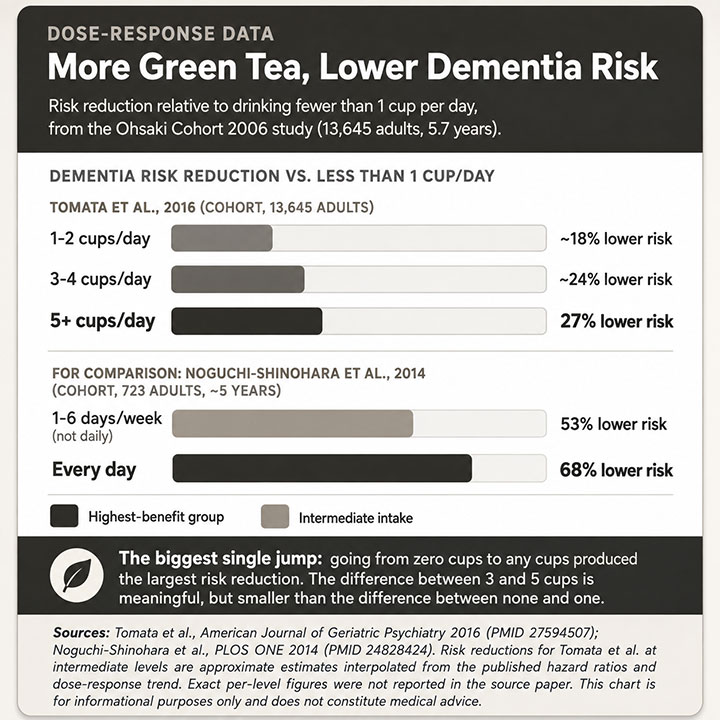
The results, published in the journal PLOS ONE in 2014, were unusually precise. The multiple-adjusted odds ratio for daily green tea drinkers was 0.32, meaning they were 68% less likely to develop cognitive decline during the follow-up period.
People who drank green tea one to six days per week also showed meaningful protection, with a 53% lower risk compared to non-drinkers. Coffee and black tea showed no comparable effect.
Moeko Noguchi-Shinohara, the neurologist who led the research at Kanazawa University’s Graduate School of Medical Sciences, would spend the next decade following this thread. That detail becomes relevant later.

Does Drinking More Green Tea Provide Greater Protection?
The next logical question was whether the dose made a difference. A large cohort study led by Yasutake Tomata at Tohoku University’s School of Public Health tracked 13,645 adults aged 65 and older across Japan for 5.7 years. Their data came from the Ohsaki Cohort 2006 Study, published in the American Journal of Geriatric Psychiatry in 2016.
People who drank five or more cups per day saw their dementia risk fall by 27% compared to those who drank fewer than one cup daily, a hazard ratio of 0.73. The dose-response pattern was consistent: more cups correlated with lower risk at each level measured.
The less-cited part of that finding is where the largest single gain appeared. The biggest risk reduction did not come from going from four cups to five. It came from going from none to any. The protective benefit at one or two cups daily was already substantial.
Subsequent cups added to it, but the person drinking one consistent cup per day was already in meaningfully different territory than the person drinking none.
Consistency appears to outweigh volume. Daily exposure at a modest amount does more than occasional high intake. Think of it as a daily baseline more than a dosing threshold to hit.
What a Brain Scan Actually Shows
Most cognitive research relies on questionnaires, memory tests, and long-term follow-up data. In January 2025, a different kind of evidence arrived: brain imaging data from nearly 9,000 people.
Shutaro Shibata and Moeko Noguchi-Shinohara, the same lead researchers from the 2014 Nakajima cohort, published findings from the Japan Prospective Studies Collaboration for Aging and Dementia in npj Science of Food, 2025.
Among the 8,766 community-dwelling adults aged 65 and older who underwent MRI scanning, a clear pattern emerged. Higher green tea consumption was associated with fewer cerebral white matter lesions.
White matter lesions are measurable markers of small blood vessel disease in the brain and are closely linked to both vascular dementia and Alzheimer’s disease. Those drinking three or more cups of green tea daily had, on average, 3% fewer lesions than those drinking one cup.
Those drinking seven to eight cups daily showed 6% fewer lesions. Coffee consumption showed no equivalent effect.
The mechanism is not yet established, but the researchers note that green tea contains less caffeine than coffee and that excess caffeine may adversely affect blood pressure, a pathway that could influence white matter health. Green tea’s polyphenol profile appears to do something coffee’s cannot replicate.
That result, arrived at through MRI machines rather than surveys, makes the earlier cohort findings considerably harder to dismiss.
What About Short-Term Memory?
The 68% figure is about what happens to the brain over five years. A trickier question is what happens in the next twelve weeks, specifically in people who already have memory problems.
In 2014, researchers from the University of Shizuoka recruited 12 elderly nursing home residents, all with existing cognitive dysfunction and a mean age of 88, and had each consume 2 grams of green tea powder daily for three months.
After that period, the group’s average MMSE (Mini-Mental State Examination) scores improved significantly from 15.3 to 17.0, with short-term memory showing the most notable gains.
That’s worth sitting with for a moment. People who already had memory problems showed measurable improvement in a standard clinical cognitive test after three months of a daily green tea habit.
The same research team then ran a proper follow-up: a randomized, placebo-controlled trial with 33 participants, published in Nutrition Journal in 2016. At 12 months, the green tea group did not show statistically significant MMSE improvement compared to the placebo group (P = 0.59). The larger, more rigorous study did not replicate the pilot’s effect on cognitive scores.
The honest read: the pilot’s short-term memory finding was real and statistically significant in that group. The longer, controlled study didn’t find the same MMSE effect. Neither result cancels the other. Together they suggest the relationship is more complicated than a single 12-week pilot can resolve.
What both point toward is that oxidative stress markers did not worsen in the green tea group during the longer trial. That marker stability may be doing some of the protective work even when cognitive scores don’t visibly shift.
Matcha vs. Steeped Tea: What the Research Shows
A randomized, double-blind, placebo-controlled trial by Noriko Ota and colleagues enrolled 61 adults between the ages of 60 and 84 and assigned half of them 3 grams of matcha powder daily for 12 weeks. The other half received a placebo. Using a battery of cognitive tests, the researchers assessed working memory, attention, and processing speed throughout.
The finding, reported in Nutrients in 2020, was gender-specific: working memory accuracy improved significantly in female participants in the matcha group. The improvement did not reach significance across the full sample or in male participants. Most broad-topic articles miss that the effect was not uniform.
Working memory is the mental capacity to hold and actively use information. It is the cognitive function that lets a person follow a conversation, retain a phone number, or stay organized under pressure, and it is among the first capacities to decline with age.
Why might matcha perform differently from steeped green tea? Concentration. When tea is steeped and discarded, the majority of the leaf’s compounds remain in the spent leaf. Matcha is a powder made from ground whole leaves, meaning everything in the leaf enters the cup. The concentration of both L-theanine and EGCG per gram is substantially higher in matcha than in most steeped teas.
The Two Compounds Behind the Effect
Green tea and coffee both contain caffeine. That’s the end of the similarity, neurologically speaking.
The reason the two beverages produce such different effects on attention and long-term brain health comes down to two molecules in green tea that coffee doesn’t carry.
L-theanine is an amino acid found almost exclusively in tea. A 2019 systematic review in Nutrients found that it crosses the blood-brain barrier and affects GABA, serotonin, and dopamine signaling, producing what researchers describe as “calm alertness,” a state of focused attention without the overstimulation that caffeine alone tends to create.
L-theanine also moderates the stimulant effect of the caffeine present in green tea, which is why green tea drinkers often report a cleaner, more sustained attention effect than coffee produces.
EGCG (epigallocatechin gallate) is the most abundant catechin in green tea, a polyphenol with potent antioxidant activity. It reduces oxidative stress in the brain, a recognized driver of age-related cognitive change.
In laboratory and animal studies, EGCG has also been shown to reduce beta-amyloid plaque formation, the same protein aggregation central to Alzheimer’s disease pathology, though this has not yet been confirmed directly in human brain tissue.
Neither compound alone accounts for the full pattern of the cohort evidence. The combination is what appears to matter. Neither caffeine supplementation alone nor a generic antioxidant supplement replicates the effect. The findings from the 8,766-person MRI study and the 13,645-person Ohsaki cohort point to something that requires the full chemistry of the leaf.
What to Buy
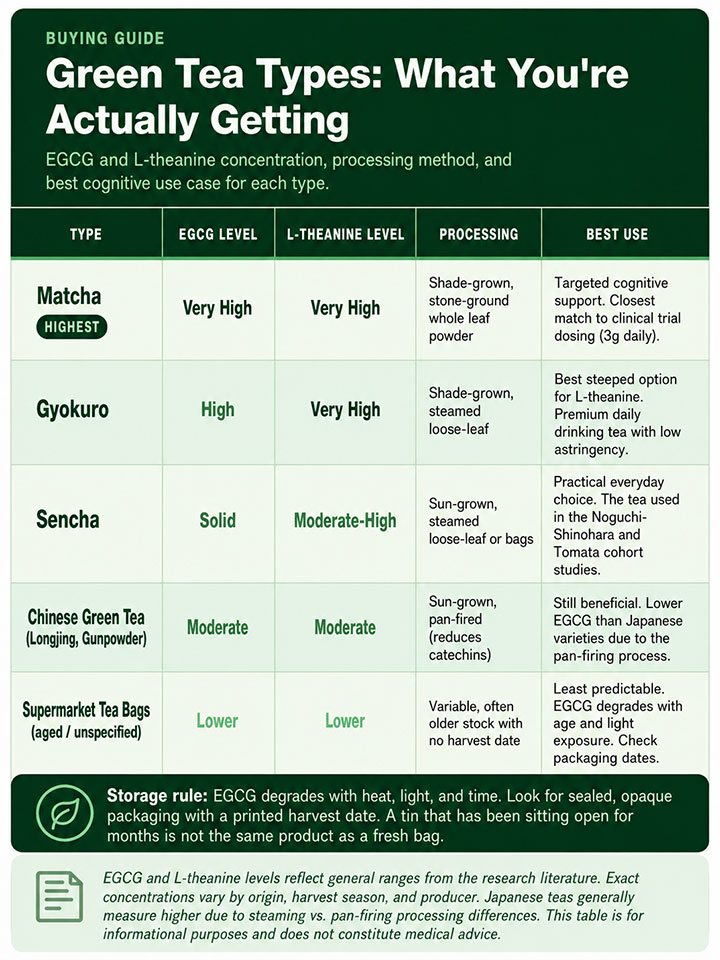
Not all green tea contains the same concentrations of EGCG and L-theanine. Processing method, shade cultivation, harvest timing, and storage all affect what is actually in the cup.
Japanese green teas consistently measure higher in both compounds than most Chinese varieties, largely because they are steamed rather than pan-fired, which preserves more catechins during processing.
Matcha is the most concentrated option. Made from shade-grown leaves stone-ground into a fine powder, it delivers the highest per-serving levels of L-theanine and EGCG available in any form of green tea. This is the preparation used in the Ota et al. trial at 3 grams daily. For targeted cognitive support, it is the clearest choice on evidence grounds.
Gyokuro is shade-grown loose-leaf tea, the same growing method as matcha, steeped rather than powdered. It is among the highest L-theanine sources available in steeped form, with a naturally sweet flavor and low astringency.
Sencha is the most widely consumed Japanese green tea. The Noguchi-Shinohara and Tomata cohorts were primarily conducted in populations drinking sencha. It offers solid EGCG levels at an accessible price point and is a practical daily choice.
Chinese green teas, including pan-fired varieties like dragonwell and gunpowder green, retain fewer catechins through processing. They still offer some benefit, but at lower concentrations than the Japanese types above.
Storage matters more than most buyers realize. EGCG degrades with heat, light, and time. Look for teas sold in sealed, opaque packaging with a stated harvest date. A beautiful tin that has been sitting open for eight months is not the same product as a freshly sealed bag from the current season.
4 Ways to Get More From Every Cup
The type of tea matters. So does how it is prepared.
1. Brew Below Boiling
Boiling water destroys catechins before they reach the cup. The optimal steeping temperature for green tea is 70 to 80 degrees Celsius, roughly 160 to 175 degrees Fahrenheit. Allowing water to cool for one to two minutes after boiling is enough. This single change meaningfully preserves the EGCG content of every serving.
2. Add Citrus
Mario Ferruzzi, then at Purdue University’s Department of Foods and Nutrition, found that ascorbic acid, the active compound in citrus juice, significantly increases catechin stability through digestion. In laboratory and animal research, citrus juice increased recovered catechin levels by approximately five times compared to plain tea.
Ascorbic acid alone increased recovery of the two most abundant catechins by six and thirteen times, respectively, under simulated digestive conditions. These are in vitro and rat data, not human pharmacokinetic measurements, so the figures should be read as directional rather than precise. A squeeze of fresh lemon in every cup reflects the best available evidence on bioavailability.
3. Time the Cup Correctly
The cognitive effects of L-theanine and caffeine in combination tend to peak 30 to 60 minutes after drinking. Morning or early afternoon, ideally before a demanding work session or a task requiring sustained attention, appears to be the most productive window.
Avoiding green tea within four to six hours of bedtime is worth observing, since caffeine’s half-life means an early afternoon cup can still affect sleep onset, and disrupted sleep is itself a recognized risk factor for accelerated cognitive decline.
4. Switch to Matcha for a Stronger Dose
The Ota et al. trial used 3 grams of matcha daily, roughly one to two teaspoons of quality powder in water or milk. For days that call for a more concentrated cognitive boost, substituting matcha for steeped tea delivers a meaningfully higher dose of the relevant compounds.
Regular sencha remains a sound daily baseline, but matcha several times per week provides the closest match to what the clinical evidence has actually tested.
Green Tea Brain Health Guide
Answer 4 quick questions to get a personalized recommendation on type, daily amount, and how to brew for maximum cognitive benefit.
Who Should Be Cautious
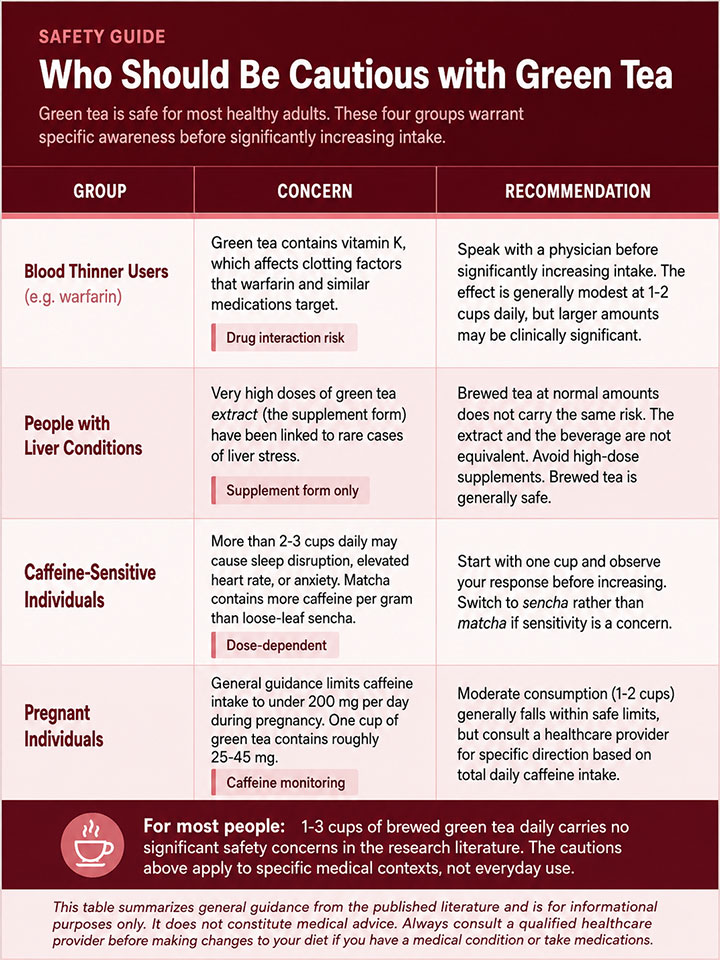
Green tea is safe for most healthy adults. A few groups warrant specific awareness before significantly increasing intake.
Those taking warfarin or other anticoagulant medications should speak with a physician before significantly increasing green tea intake. Green tea contains vitamin K, which affects clotting factors that warfarin targets. The effect is generally modest at one to two cups daily, but larger amounts may be clinically significant.
People with liver conditions should note a distinction: very high doses of green tea extract, the concentrated supplement form, have been associated with rare cases of liver stress in the literature. Brewed tea at normal intake levels does not carry the same risk profile. The supplement and the beverage are not equivalent.
Caffeine-sensitive individuals may find that more than two to three cups daily causes sleep disruption, elevated heart rate, or anxiety. Matcha contains more caffeine per gram than loose-leaf sencha. Starting with one cup and observing response before increasing is a reasonable approach.
Pregnant individuals are generally advised to keep caffeine intake below 200 milligrams per day. A standard cup of green tea contains roughly 25 to 45 milligrams of caffeine, putting moderate consumption within typical safety guidance, though a healthcare provider should be consulted for specific direction.
Summary of the Evidence
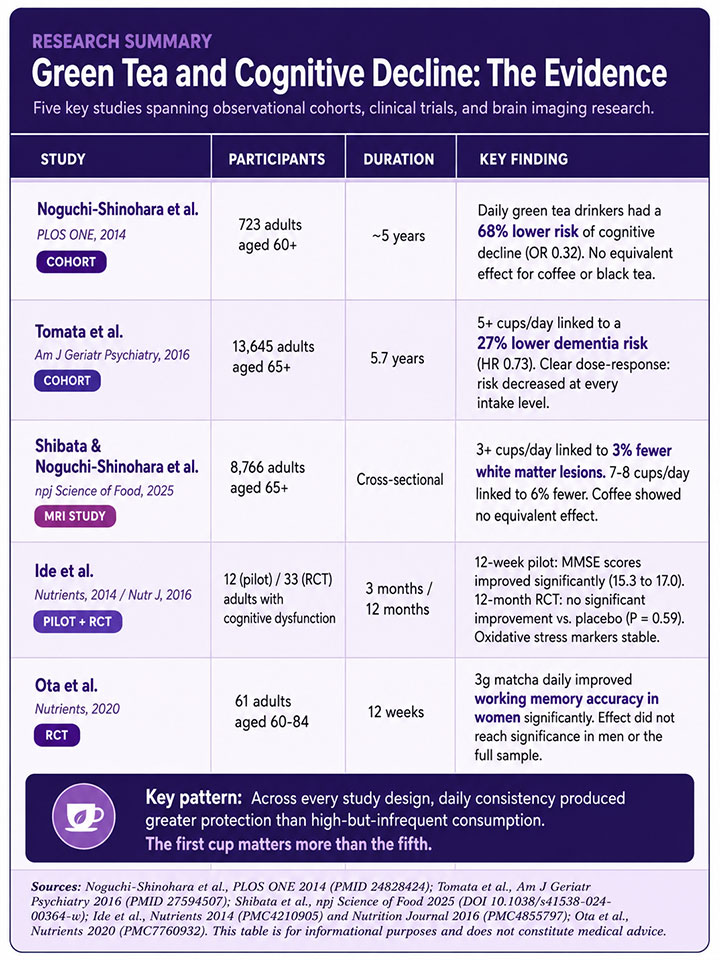
The Noguchi-Shinohara 2014 cohort: 68% lower cognitive decline risk among daily drinkers. The Tomata 2016 cohort: 27% lower dementia risk at five or more cups per day. The Shibata 2025 MRI data: measurably fewer white matter lesions in daily drinkers, confirmed by brain imaging. The Ota 2020 RCT: improved working memory accuracy in women over 12 weeks of daily matcha.
The short-term pilot evidence is more complicated. The 2014 pilot showing MMSE improvement in 12 people was not replicated in the 2016 placebo-controlled trial with 33 participants. That gap deserves honest acknowledgment.
Across several thousand participants and multiple study designs, the evidence consistently associates regular green tea consumption with a meaningfully lower risk of cognitive decline over time. The 2025 MRI study adds a structural plausibility argument that the previous observational data could not provide on its own: something physically different about the brains of people who drink green tea regularly.
The researcher who spent a decade turning the Nakajima findings into MRI data stated it plainly: drinking green tea, especially three or more glasses per day, may help prevent dementia. Not “may reduce risk factors” or “is associated with.” May prevent. For a beverage with no meaningful downside at moderate intake, that is a claim the evidence has now earned the right to make.
Frequently Asked Questions
How many cups of green tea per day help with memory?
The Noguchi-Shinohara cohort found significant protective effects at one to two cups per day. The Tomata cohort identified the strongest effect at five or more cups, with a clear dose-response pattern throughout. Daily consistency appears to matter more than reaching a specific cup count. One cup every day outperforms five cups three times a week.
Does green tea help with brain fog?
L-theanine modulates GABA, serotonin, and dopamine signaling and moderates the stimulant effect of caffeine, producing a state of focused attention that many people find cleaner than what coffee produces. Combined with caffeine, the effect peaks roughly 30 to 60 minutes after drinking.
The Ide 2014 pilot study also showed short-term memory improvements in adults with existing cognitive dysfunction after 12 weeks of daily green tea powder, though the follow-up controlled trial did not replicate the same MMSE gains over 12 months.
Is matcha better than regular green tea for memory and concentration?
For a concentrated dose of the relevant compounds, yes. Matcha is made from the entire leaf in powdered form, delivering substantially more L-theanine and EGCG per serving than steeped tea. The Ota et al. placebo-controlled trial used 3 grams daily and found working memory improvements in women specifically. Regular sencha still delivers meaningful long-term benefits. Matcha provides the highest per-serving concentration for targeted short-term cognitive use.
How long does green tea take to improve memory?
The L-theanine and caffeine combination affects attention and focus within 30 to 60 minutes of drinking. For structural brain protection, the MRI data from the 2025 Shibata study and the large cohort evidence both point toward benefits that accumulate over months and years of consistent daily intake. The short-term memory gains seen in the 2014 pilot appeared after 12 weeks, though they were not replicated in the longer controlled trial.
Can green tea prevent Alzheimer’s disease?
No clinical trial has established that green tea directly prevents Alzheimer’s disease in humans. EGCG has been shown in laboratory and animal research to reduce beta-amyloid plaque formation, the same protein aggregation most closely linked to Alzheimer’s pathology.
The large population studies show significantly reduced dementia risk among daily drinkers, and the 2025 MRI data show fewer brain lesions associated with cognitive decline. The evidence supports green tea as a consistent component of a brain-health habit, not as a proven clinical intervention for Alzheimer’s prevention.
Which type of green tea has the most benefit for brain health?
Matcha is highest in both L-theanine and EGCG per serving. Among steeped teas, gyokuro and high-quality sencha from Japan offer the best evidence-aligned concentrations. Freshness matters: EGCG degrades over time. Look for sealed packaging with a recent harvest date rather than optimizing on brand alone.
What happens if I drink green tea every day?
Based on the cohort evidence, daily drinkers have significantly lower rates of cognitive decline over five- to six-year follow-up periods. The 2025 MRI data show fewer white matter brain lesions as a structural correlate. Most healthy adults also notice a cleaner, more sustained attention effect from the L-theanine and caffeine combination compared to coffee.
At moderate intake (two to three cups), no significant adverse effects are reported in the literature for healthy adults without the specific medication or condition sensitivities described above.
Always consult a qualified healthcare provider before making significant changes to your diet, particularly if you have a medical condition or take medications.