The studies are surprisingly consistent, but they weren’t using the same pomegranate juice many people buy at the grocery store. Here’s why that matters.
There is a useful distinction that almost every pomegranate juice article skips over. The research does show that daily consumption can reduce systolic blood pressure by a clinically meaningful margin.
What the research also shows is that the effect works differently depending on where your numbers start, and that for a large share of the people most interested in this topic (those already on blood pressure medication), pomegranate juice can interact with their drugs in ways that require a conversation with a pharmacist before they open the first bottle.
The answer is yes, modestly. A 2024 pooled analysis of 22 randomized controlled trials, published in Phytotherapy Research, found that pomegranate consumption reduced systolic blood pressure by an average of nearly 8 mmHg and diastolic pressure by about 3 mmHg.
People whose baseline systolic reading exceeded 130 saw a larger reduction than those below that threshold. A separate 2026 meta-analysis extended this picture by confirming effects on endothelial markers, the proteins that indicate how well blood vessel walls are functioning, not just on the numbers themselves.
Eight millimeters of mercury is enough to matter. For someone sitting at 138 systolic (Stage 1 hypertension by American Heart Association classification), that drop can bring the reading into the normal range. For someone at 160, it is meaningful progress but not a treatment.
What the studies actually measured
The most frequently cited trial in this area, by Sedigheh Asgary and colleagues at Isfahan Cardiovascular Research Center and published in Phytotherapy Research in 2014, enrolled 21 hypertensive adults and assigned half of them 150 ml of fresh pomegranate juice daily for two weeks.
By the end of the two-week period, both systolic and diastolic blood pressure had dropped significantly in the juice group and not in the water controls. The study is small, and two weeks is a short window. What it established, though, is that the effect can arrive faster than most people expect.
The broader picture comes from the 2024 meta-analysis by Bahari and colleagues in Phytotherapy Research, which pooled findings across 22 controlled trials. The average systolic reduction of 7.87 mmHg is the most precise single estimate the literature currently offers.
The 2026 meta-analysis by Sanei and colleagues, drawing on trials published through January of that year, confirmed the blood pressure findings and extended them: pomegranate supplementation also reduced circulating levels of ICAM-1 and IL-6, two markers of vascular inflammation that typically precede elevated blood pressure rather than follow it.
That finding shifts the framing slightly. Pomegranate juice is not just a juice that happens to lower blood pressure in the short term. There is evidence it addresses one of the upstream processes that makes blood pressure difficult to control.
A third study, by Mira Rosenblat and colleagues at the Technion Faculty of Medicine in Haifa, published in Atherosclerosis in 2006, followed patients with type 2 diabetes for three months on 180 ml of pomegranate juice daily.
The primary finding was a substantial reduction in LDL cholesterol oxidative susceptibility and improved antioxidant status in the blood. This is a serum marker finding, not a blood pressure number, but it matters for a specific reason.
The mechanism by which pomegranate’s antioxidants affect blood vessel health runs directly through oxidative stress reduction, and the Rosenblat study is one of the better human demonstrations of that pathway functioning as the laboratory studies predict.

The drug interaction most people overlook
This is the section worth reading before anything else if you are currently on blood pressure medication, a statin, warfarin, or a diabetes drug.
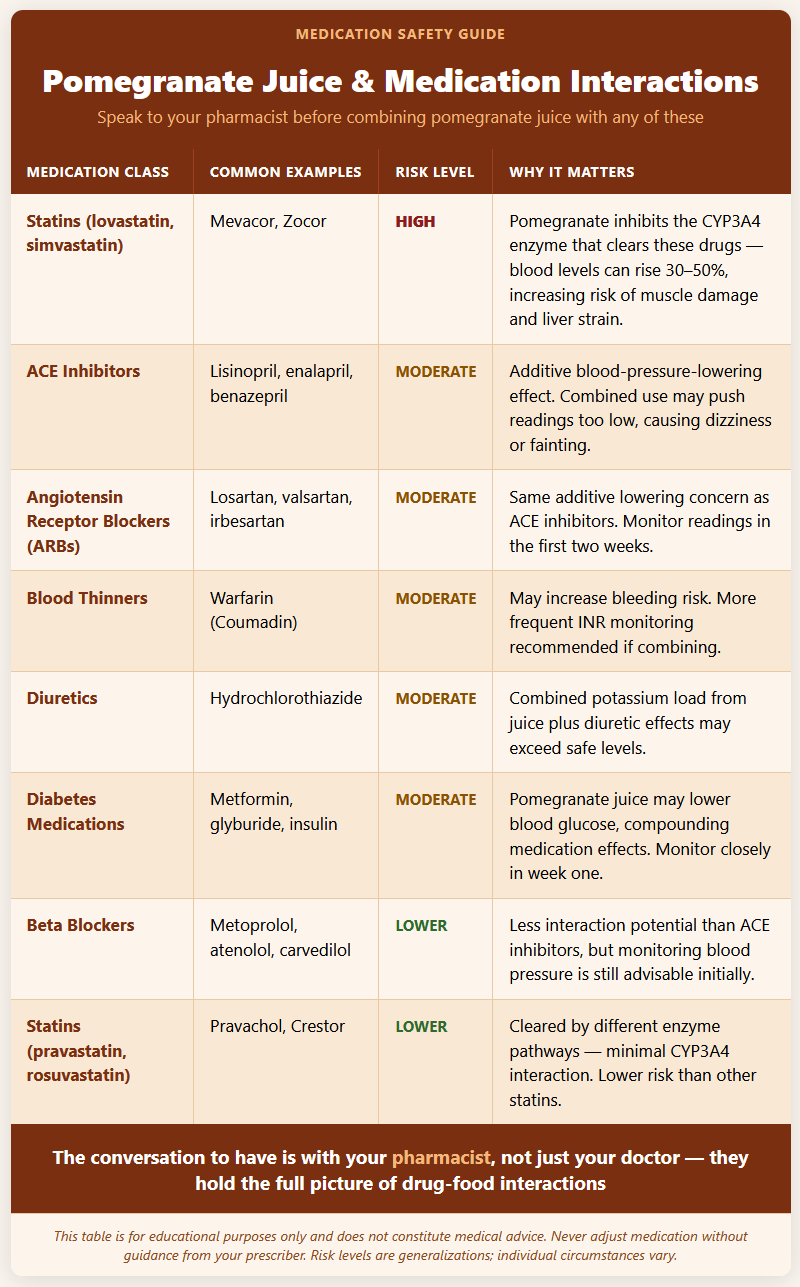
Pomegranate juice inhibits an enzyme called CYP3A4, which the liver uses to break down a range of common medications. When this enzyme is suppressed, drug concentrations in the blood increase, sometimes sharply.
For lovastatin and simvastatin in particular (the two statins most dependent on CYP3A4 clearance), blood levels can rise 30 to 50% above the intended dose. That is not a small margin. The risk is muscle damage and, at higher elevations, liver strain.
Pravastatin and rosuvastatin use different clearance pathways and carry much lower interaction risk, which is worth knowing if you are discussing this with a prescriber.
For people on ACE inhibitors or angiotensin receptor blockers, the interaction is additive rather than enzymatic. Both the medication and pomegranate juice lower blood pressure through partially overlapping mechanisms, and the combined effect can push readings lower than either alone would. Dizziness, lightheadedness, and fainting are the practical symptoms to watch for.
This is not a reason to avoid pomegranate juice if you are on these drugs, but it is a reason to space the juice several hours away from your dose initially and to monitor your readings more closely for the first two weeks.
Warfarin users need INR monitoring during any dietary change that affects their antioxidant intake, and pomegranate juice qualifies. The interaction evidence is less clear-cut than with statins, but the clinical standard is monitoring rather than avoidance.
The conversation to have is with your pharmacist, not just your doctor. Pharmacists carry the full picture of drug-drug and drug-food interactions and can assess your specific medication list in a way a general practitioner appointment rarely allows time for.
Pomegranate Juice Medication Interaction Checker
Find out whether pomegranate juice is safe to combine with your current medications
How much, what kind, and when
The trials that showed meaningful blood pressure reductions used between 150 ml and 300 ml daily (approximately 5 to 10 oz). The 2017 meta-analysis by Amirhossein Sahebkar and colleagues, published in Pharmacological Research, found a dose-response relationship in that range, with doses above 240 ml showing a borderline significant additional effect on diastolic pressure.
Going beyond 300 ml does not appear to produce further benefit and adds roughly 150 extra calories and 30 additional grams of natural sugar per day.
The juice must be 100% pure pomegranate, not from concentrate where possible, with no added sugar and no blending with apple or grape juice. This is not a marketing distinction. The polyphenol concentration in a diluted blend is proportionally lower, and the trials showing blood pressure effects used pure juice.
Read the ingredient list, not the front-label claim. The ingredient should read: pomegranate juice. If apple juice or grape juice appears anywhere in that list, the product will not replicate the trial results.
Cranberry-pomegranate blends sit in the same category. The pomegranate content in most commercial cranberry-pomegranate products is too low to deliver a therapeutic dose, and the added sugar makes them counterproductive for cardiovascular goals.
Timing appears to be less important than consistency. No trial has identified an optimal time of day. Drinking with a meal slows sugar absorption and reduces the glycemic response, which matters more for people managing blood sugar alongside blood pressure. Morning with breakfast is convenient for most people and makes the habit easier to maintain. Consistency matters more than timing.
What a realistic 4-week picture looks like
The Asgary 2014 trial showed measurable changes within two weeks. The Bahari 2024 meta-analysis found effects across trials with durations ranging from two weeks to three months. What this suggests is that the first two weeks are when the vascular response is most active, and that benefits continue and sometimes deepen over longer periods, though the Sahebkar 2017 analysis noted that the blood pressure effect appeared to plateau or attenuate beyond two months in some trial arms.
In the first week, polyphenols are circulating and nitric oxide production is beginning to increase. Your blood pressure monitor is unlikely to show you anything yet. Some people notice improved energy, which may reflect better blood flow to peripheral tissue. Most notice nothing.
By week two, some people see a drop of two to five points on the systolic reading. Not everyone. The research averages are pooled across participants with different baseline readings, different diets, and different levels of background inflammation. Your response will sit somewhere in that distribution, not at the midpoint of it.
Weeks three and four are where the trials tend to report their headline numbers. A five to eight mmHg reduction in systolic pressure at four weeks is the figure most consistent across well-designed trials.
If your reading has not moved at all by week four and you have been consistent with 8 oz of pure juice daily, the honest conclusion is that this particular intervention is not producing a large effect in your specific physiology. That matters more than any population average.

How it compares to other natural options
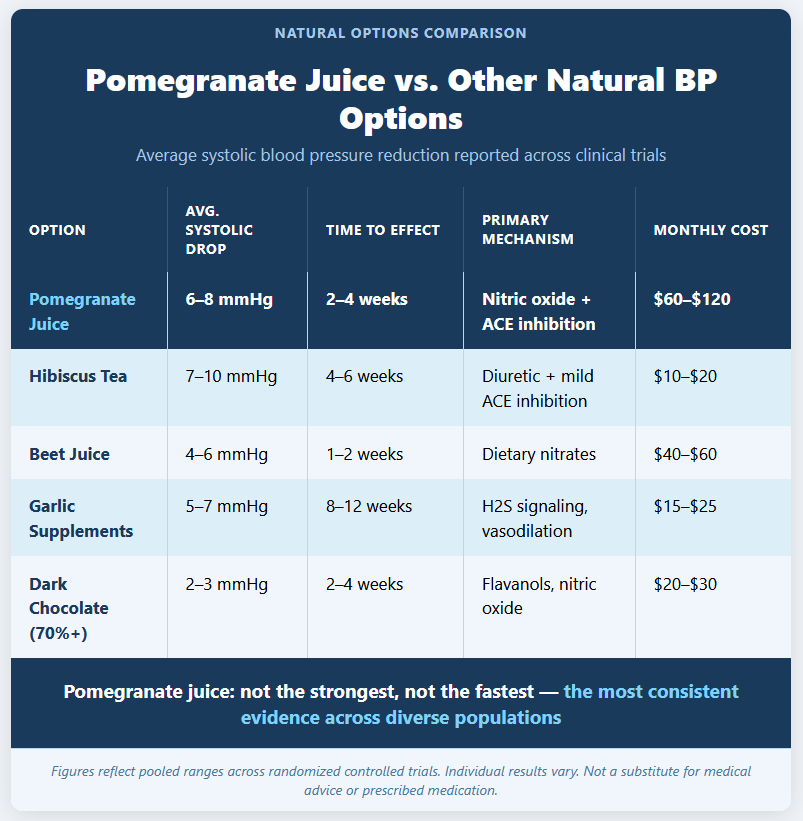
Hibiscus tea is the closest competitor. Meta-analyses put its systolic blood pressure reduction at seven to ten mmHg, modestly better than pomegranate juice on average, but it takes four to six weeks to reach full effect rather than two.
The mechanism is different: hibiscus works primarily as a mild diuretic and ACE inhibitor, while pomegranate’s primary pathway runs through antioxidant-driven nitric oxide signaling. They are not fully redundant, and some clinicians use both.
Beet juice works faster than either, often within one to two weeks, because its mechanism relies on dietary nitrates that convert to nitric oxide more directly. The average systolic reduction is somewhat lower (four to six mmHg), and the taste is a real barrier for many people. Garlic supplements can produce five to seven mmHg reductions but typically require eight to twelve weeks to show consistent effects.
Pomegranate juice is neither the most potent natural option on this list nor the fastest. What it has going for it is the most consistent trial record across diverse populations, evidence of effects on vascular inflammation markers beyond blood pressure alone, and a taste that most people find tolerable enough to maintain for months.
The practical guide: buying and using it right
POM Wonderful is the brand most clinical trials used, which makes it the most defensible choice if you want the study results to translate. It is 100% pure, not from concentrate, and contains no added sugar.
The cost runs roughly $0.45 to $0.55 per ounce, making an 8 oz daily dose about $4 a day. Lakewood Organic offers similar purity at a slightly lower price ($0.35 to $0.45 per ounce) and is certified organic. R.W. Knudsen is pure pomegranate from concentrate with no added sugar and is the most budget-accessible option at $0.25 to $0.35 per ounce; the from-concentrate processing does not meaningfully reduce polyphenol content in the research on this specific product.
Ocean Spray’s pomegranate product is a blend with apple juice and added sugar. It is not what the research used, and it will not replicate the results.
If you prefer to juice whole pomegranates, one large fruit yields four to six ounces. The polyphenol content is higher in fresh-squeezed juice, but the preparation time makes daily consistency harder, and consistency is what drives the results.
Drink through a straw to reduce acid contact with tooth enamel. Wait 30 minutes before brushing. Pomegranate juice is acidic enough that daily consumption without these habits will produce enamel erosion over months.
Nutritional profile and the sugar question
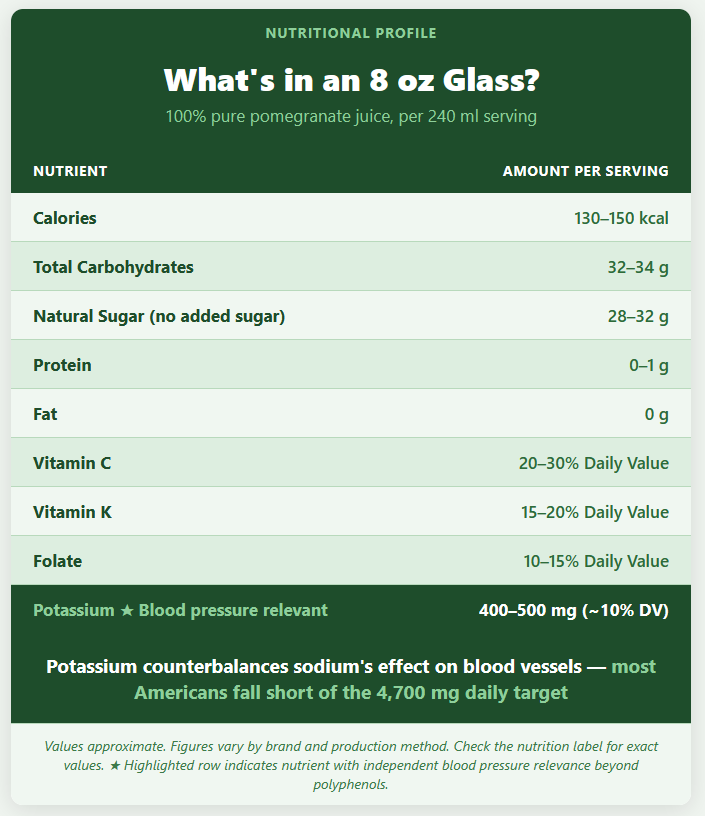
An 8 oz serving carries 130 to 150 calories, 28 to 32 grams of natural sugar, meaningful amounts of vitamin C and K, and roughly 400 to 500 mg of potassium. The potassium is relevant for blood pressure independent of the polyphenols: potassium counterbalances sodium’s constricting effect on blood vessels, and most Americans do not get enough of it.
The sugar content raises a real question for people managing blood glucose alongside blood pressure. The available evidence suggests that pomegranate juice does not produce the glycemic spike its sugar content might predict, because the polyphenols slow glucose absorption.
This does not mean the effect is neutral for everyone. People with type 2 diabetes or prediabetes should begin with a 4 oz portion, test blood glucose one to two hours later, and increase gradually only if the response is acceptable.
The Rosenblat 2006 study (which enrolled type 2 diabetic patients specifically) found that pomegranate juice did not worsen diabetes parameters in its participants, which is useful baseline evidence, but individual metabolic variation is real.
Combining it with other lifestyle changes
The DASH diet produces systolic reductions of eight to ten mmHg on its own, roughly comparable to pomegranate juice, but through sodium restriction, increased fruit and vegetable intake, and reduced saturated fat rather than a specific polyphenol mechanism.
Thirty minutes of moderate aerobic exercise most days adds another five to eight mmHg. These are not alternatives to pomegranate juice. They are the same category of intervention, acting through different pathways.
Combining three or four of these approaches does not simply add the numbers together, because the mechanisms overlap in places. But the cumulative effect in well-designed studies consistently exceeds what any single intervention produces alone.
A person making real progress on sodium intake, exercising regularly, managing sleep, and adding 8 oz of pure pomegranate juice daily can realistically see a combined reduction of 15 to 20 mmHg over two to three months. That is enough to move from Stage 1 hypertension to the normal range without medication for some people, and enough to reduce medication requirements for others under physician supervision.
The decision about whether to reduce medication is your doctor’s to make, not yours to act on independently. Pomegranate juice showing up in your blood pressure readings is not a signal to stop taking prescribed drugs. It is a data point to bring to the next appointment.
Ways to use it beyond a daily glass
The honest reason most pomegranate juice protocols fail is not skepticism about the evidence. It is that drinking 8 oz of straight juice every morning gets old by week three. These formats deliver the same polyphenol load through something that doesn’t.
Morning blood pressure smoothie. Blend 4 oz of pomegranate juice with 1 cup of fresh spinach, half a cup of frozen blueberries, half a banana, 1 tablespoon of ground flaxseed, and half a cup of plain Greek yogurt. This delivers the full pomegranate dose alongside potassium from the banana, anti-inflammatory omega-3s from the flaxseed, and enough protein to slow sugar absorption. Approximately 280 calories, 8g protein, 6g fiber.
Pomegranate chia pudding. Mix a quarter cup of chia seeds with 1 cup of unsweetened almond milk and 2 oz of pomegranate juice. Stir well, refrigerate for at least four hours. Chia seeds form a gel that further slows glucose absorption. A make-ahead option that works as breakfast or an afternoon snack. Approximately 220 calories, 8g protein, 14g fiber per serving.
Heart-healthy salad dressing. Combine 3 tablespoons of pomegranate juice with 2 tablespoons of extra-virgin olive oil, 1 tablespoon of apple cider vinegar, 1 teaspoon of Dijon mustard, and one minced garlic clove. Shake until emulsified. Stores in the refrigerator for five days. The olive oil aids polyphenol absorption. Polyphenols are fat-soluble.
Pomegranate protein popsicles. Blend 6 oz of pomegranate juice with 1 cup of plain Greek yogurt, a tablespoon of honey, and half a cup of fresh berries. Pour into popsicle molds and freeze for at least four hours. Approximately 60 calories and 4g protein per popsicle. A practical choice on hot days when a glass of cold juice feels repetitive.
Pomegranate green tea. Brew a cup of green tea and let it cool to warm before adding 2 oz of pomegranate juice and a squeeze of lemon. Avoid adding the juice to boiling-temperature tea, which can degrade heat-sensitive polyphenols. Green tea’s catechins are among the better-studied plant compounds for cardiovascular benefit. Combining the two in one drink is a straightforward way to increase total polyphenol intake.
Who should approach this carefully
The drug interaction section covers the highest-stakes group. Beyond that, a few other situations warrant attention.
People with low blood pressure (readings at or below 90/60) may find that 8 oz of pure pomegranate juice daily pushes their numbers lower than is comfortable. Dizziness on standing, lightheadedness, and fatigue are the symptoms to watch for. Starting with 4 oz and monitoring before increasing is reasonable for anyone whose baseline systolic is already below 110.
For people with diabetes, the glycemic response question was covered above. The more important practical point is that pomegranate juice appears to lower blood sugar slightly in some individuals, which is potentially useful but can interact with diabetes medication dosing. Monitor blood glucose in the first two weeks as you would with any significant dietary addition.
True pomegranate allergies are uncommon but real. Itching, hives, and swelling around the mouth are the initial signs. Discontinue immediately if these appear.
Is it worth the monthly cost?
At the POM Wonderful price point, 8 oz daily costs roughly $120 per month. R.W. Knudsen brings that to $60 to $75. Generic blood pressure medication in the same period runs $4 to $20 with insurance. The comparison is not the right frame. Pomegranate juice is not competing with medication: it is a lifestyle intervention being weighed against its own cost in isolation.
The more useful frame is: what is the cost of a confirmed five to eight mmHg systolic reduction, delivered through a daily food habit with no side effect profile comparable to what most blood pressure drugs carry? The drugs win on efficacy at Stage 2 hypertension and above. In the Stage 1 range, for someone not yet on medication, the cost-benefit calculation shifts meaningfully toward lifestyle interventions.
The potassium, the vitamin C, the antioxidant effects on LDL oxidation, and the vascular inflammation markers documented in the 2026 Sanei meta-analysis are real benefits that do not appear in the cost-of-medication comparison. They do not have a price. That is worth accounting for when the question is whether to spend $70 a month on juice.
Conclusion
Pomegranate juice is not a supplement that will rescue a failing cardiovascular system, and it is not a curiosity with modest evidence buried in academic journals. The trial record is real, it is consistent across populations, and the mechanisms are understood well enough to explain why the effect exists and in whom it tends to be largest.
What it requires is honesty about the math: eight millimeters of mercury, sustained over weeks of daily consumption, matters to some people and is insufficient for others. Anyone on medication needs a pharmacist’s input before starting.
Anyone who is not may have found the most palatable cardiovascular habit in the research literature. That is a narrower claim than most pomegranate juice articles make, and a more defensible one.
Frequently Asked Questions
How often should you drink pomegranate juice for high blood pressure?
Daily, consistently, for at least two to four weeks before assessing results. Intermittent use will not replicate what the trials measured. GoodRx notes in its blood pressure beverage review that the studies showing results all required at least two weeks of daily consumption; the frequency was daily in every trial that produced positive findings.
Who should not drink pomegranate juice?
Anyone on lovastatin, simvastatin, warfarin, or medications that depend on CYP3A4 clearance should speak to a pharmacist before starting. People with low blood pressure should start at a reduced dose. Individuals with a confirmed pomegranate allergy should avoid it entirely.
Which is better for blood pressure, beet juice or pomegranate juice?
Beet juice works faster and through a more direct nitrate pathway. Pomegranate juice has a broader supporting evidence base, better tolerability, and additional vascular effects beyond blood pressure numbers. For most people, the choice comes down to which they can sustain. A habit maintained for three months at a consistent dose will outperform a more potent intervention abandoned after two weeks.
Can I drink more than 10 oz for better results?
The Sahebkar 2017 meta-analysis found diminishing returns above 240 ml (8 oz). Going to 12 to 16 oz adds calories and sugar without producing additional blood pressure reductions in the data. Consistency at the standard dose matters more than volume.
Is pomegranate extract or pills as good as the juice?
The trials used juice, not supplements. Extracts and capsules vary in polyphenol concentration and standardization in ways that make them harder to dose reliably. If you cannot tolerate the juice, look for supplements that specify punicalagin content and discuss dosing with a pharmacist. The juice remains the better-evidenced option.
Is pomegranate juice good for high blood pressure and diabetes together?
The Rosenblat 2006 trial specifically enrolled type 2 diabetic patients and found no worsening of diabetes parameters over three months. More recent evidence on pomegranate’s effect on insulin resistance markers is mixed.
People managing both conditions should monitor blood glucose during the first two weeks and discuss the intervention with their care team, particularly if they are on insulin or sulfonylureas.
I’ve been drinking it for two weeks and haven’t seen a change. Should I stop?
Two weeks is early. The more likely explanation is not that the juice isn’t working but that home blood pressure monitoring is noisier than people expect, and a single reading can vary by five points depending on how long you sat quietly before measuring.
Check your average across a full week, not individual readings. Then give it four weeks total. If nothing has moved by then, the honest conclusion is that pomegranate juice is not producing a meaningful effect in your specific physiology, and you can stop without having wasted the effort.